

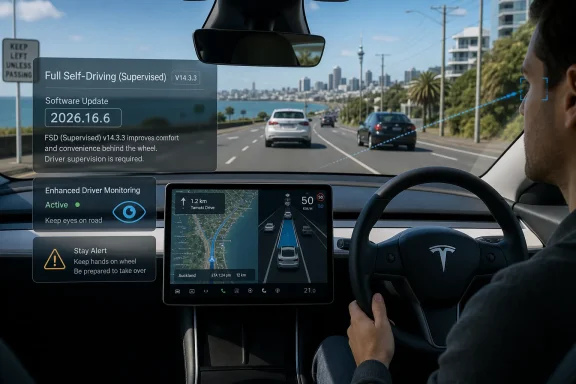
Tesla began rolling out Full Self-Driving (Supervised) V14.3.3 to eligible vehicles in Australia and New Zealand on June 19–20, 2026, with software build 2026.16.6 now appearing as the delivery package for Australian owners. The update matters less because it is another Tesla version number and more because it moves ANZ owners onto the same major FSD generation as North America. For a region that has spent years watching Tesla’s autonomy roadmap arrive late, trimmed, or hedged by regulation, this is a meaningful catch-up moment. It is also a test of whether Tesla’s neural-network-first driving stack can generalize cleanly beyond the roads where most of its mythology was built.
Tesla software updates often arrive with the anticlimax of a smartphone patch: a version number, a progress bar, and a few release-note phrases doing too much work. FSD V14.3.3 in Australia and New Zealand is not that kind of update. It is the first broad step that makes the region feel less like a delayed market and more like a live part of Tesla’s global supervised-driving experiment.
The reported rollout began with public confirmations from Tesla’s Australia/New Zealand and AI-facing accounts on June 19, followed by sightings of software update 2026.16.6 on June 20. That sequencing is worth noting because Tesla’s autonomy deployments are rarely a single event. They are usually a chain: eligibility, software availability, account entitlement, download, installation, and finally, a driver on an actual road deciding whether to trust the system for the next turn.
By June 19, at least one Australian owner had reportedly logged real-world FSD miles in the FSD Database, pushing the story from “Tesla says it is available” to “someone has activated it and driven with it.” That is a small but important distinction. In the Tesla ecosystem, availability has often meant a promise moving through an invisible queue; driven miles mean the queue has started to touch pavement.
The build also lands in a region with obvious differences from the American roads on which Tesla’s FSD narrative has been most heavily marketed. Australia and New Zealand drive on the left, use local signage conventions, have different lane markings, and include road environments that range from dense urban grids to rural routes with less forgiving edge cases. If Tesla’s argument is that its end-to-end AI stack scales globally, ANZ is not a footnote. It is a proving ground.
The release notes circulating with the build point to a stronger neural network, a vision encoder upgrade, broader reinforcement-learning improvements, enhanced visualizations, reduced driver attentiveness alerts, and improved driver monitoring. The practical translation is simple: Tesla is trying to make the system both more capable and less irritating. That second part matters more than enthusiasts sometimes admit.
A supervised driver-assistance system lives or dies not only by how well it handles an unprotected right turn or a complex roundabout, but by how well it manages the driver’s patience. Too many false nags and users disengage emotionally before they disengage mechanically. Too much confidence and users begin treating Supervised as a decorative legal word rather than the operating condition of the system.
The apparent inclusion of an intervention streak counter is especially revealing. Tesla has always sold FSD partly through anecdote: “It drove me all the way home,” “It handled the city,” “It only needed one correction.” By formalizing distance without intervention, Tesla gives users a gamified metric that turns autonomy into a scoreboard. That will thrill owners, feed social media, and generate useful feedback, but it also risks encouraging the wrong kind of contest if drivers chase streaks rather than soberly supervise.
The feature remains an advanced driver-assistance system that requires an attentive human ready to intervene. That is the legal and operational reality even when the car seems competent for long stretches. The more capable the system becomes, the more important that boundary becomes, because complacency is most dangerous when a tool works well enough to earn trust but not well enough to deserve independence.
This is where the improved driver monitoring in V14.3.3 becomes more than a comfort feature. Better eye-gaze tracking, improved performance with eyewear, and greater accuracy in varied lighting are all attempts to reduce the friction of supervision while preserving the obligation to supervise. Tesla wants drivers to feel less nagged, but regulators and safety advocates will want evidence that less nagging does not mean less attention.
Australia and New Zealand are also useful stress tests because local driving can be visually distinct without being alien. Roadworks, faded lane markings, tram-adjacent traffic in some cities, rural intersections, tight suburban streets, and aggressive urban merge behavior can all expose whether a system has learned driving broadly or merely learned a very large collection of North American habits. V14.3.3’s promise is that the model is more general. The roads will now grade that promise in public.
Tesla’s support language around FSD eligibility has generally kept HW3 in the picture, but the meaningful phrase is not “eligible.” It is “rollout timing.” A car can be theoretically supported and still sit behind a software gate for months. Australian and New Zealand HW3 owners are now in precisely the place that long-time Tesla watchers recognize: not excluded, not included, and not given a date that would help with planning.
That uncertainty matters because FSD is not a cheap cosmetic add-on. Some owners purchased vehicles with autonomy promises in mind, and Tesla’s long-running hardware story has trained customers to believe that software will eventually unlock value already paid for. When a major release favors the latest hardware, the logic may be defensible, but the customer-relations problem remains.
The HW4-first path also hints at Tesla’s broader autonomy strategy. The company is optimizing for the fleet that best supports its current neural architecture, not necessarily the fleet that reflects every customer’s original expectation. That may be the only realistic engineering decision. But it means the ANZ rollout will be watched not only for how V14.3.3 drives, but for how Tesla communicates the gap between “coming later” and “quietly becoming legacy.”
In Australia, the subscription is listed at AUD$149 per month for owners moving from Basic Autopilot, with a lower tier for Enhanced Autopilot owners. In New Zealand, reporting around the shift has put the monthly figure at NZD$159. The exact value proposition will vary by owner, commute, and appetite for experimentation, but the model itself changes the conversation. Instead of asking whether FSD will someday justify a five-figure purchase, users can ask whether it justifies this month’s bill.
That lowers the barrier to trial while raising the pressure on Tesla to deliver visible improvement. A sunk-cost owner may tolerate months of waiting because the money is already gone. A subscriber can cancel. In that sense, V14.3.3 is not only a software release; it is a retention instrument.
The subscription model may also accelerate feedback. Owners who are curious but cautious can try FSD without committing to the lifetime economics of a car they may sell in a few years. If the system performs well in Sydney, Melbourne, Auckland, Brisbane, Perth, Wellington, and regional roads, Tesla gets adoption and miles. If it behaves inconsistently, the churn button is much closer than it used to be.
Driving profiles are not merely personality settings. They shape how assertive a system feels in gaps, merges, lane changes, and traffic negotiation. In countries where driver expectations and road norms differ, a profile that plays well in one market can feel rude, risky, or simply out of step in another. Tesla may eventually bring the option to ANZ, but holding it back at launch is a quiet admission that localization is not finished when the car knows which side of the road to use.
The omission also gives Tesla a useful buffer. If early ANZ reports are mixed, the company can point to a conservative launch profile and continue tuning. If the system performs well, more assertive behavior can be introduced later as an upgrade rather than defended immediately as a default. That is better product management than Tesla is sometimes given credit for.
Still, the branding creates its own problem. A company that names a driving mode after cinematic road chaos should not be surprised when skeptics use the phrase as evidence of misplaced priorities. For enthusiasts, it is a wink. For regulators, insurers, and safety advocates, it can sound like the wrong joke attached to a serious machine.
The first Australian FSD miles being logged publicly matters because it creates a local reference point. Until now, ANZ owners were largely consuming North American FSD discourse and mentally translating it to local roads. Now the videos, comments, leaderboards, and complaints can come from intersections they recognize and traffic behavior they understand.
That local evidence will be uneven. Enthusiasts tend to share successes; skeptics tend to share failures; ordinary owners often do not share anything unless something surprising happens. But over time, patterns emerge. If V14.3.3 routinely struggles with certain roundabouts, lane markings, speed-zone transitions, school zones, or unusual road geometry, the community will find out quickly.
For IT pros and WindowsForum readers who think in systems rather than fandom, this is the useful lens: the rollout is a production deployment into a new environment. The launch announcement is the change ticket. The real story is the incident log, telemetry, rollback behavior, user feedback loop, and patch cadence that follow.
The reinforcement-learning language in the release notes is important because it points to Tesla’s current preferred story about improvement. The company is not merely hand-tuning rules for every awkward intersection. It is presenting FSD as a model that absorbs driving complexity through training and becomes broadly better across scenario classes. If that is true, each new region should become easier to unlock than the last.
But “broadly better” is a dangerous phrase in safety-critical software. A model can improve across aggregate benchmarks while still regressing in specific behaviors that matter deeply to users. A driver does not experience the fleet average when the car hesitates in the wrong place or commits too late. They experience one moment, in one lane, with one horn behind them.
That is why Tesla’s staged rollout remains essential. The company may talk in global neural-network terms, but the deployment reality is cautious, VIN-limited, and telemetry-driven. ANZ owners should expect waves, not a single universal switch. If Tesla sees problems, the rollout can slow. If confidence grows, the fleet can expand.
The phrase Supervised is doing substantial legal work. It reminds users, regulators, and insurers that the driver remains responsible. That may be sufficient for deployment as an advanced driver-assistance feature, but it will not settle the longer argument over how systems like this should be tested, described, audited, and restricted as they become more capable.
There is also the consumer-language issue. Tesla has spent years defending a brand architecture in which “Autopilot” and “Full Self-Driving” describe features that do not make the car autonomous. In a new market phase, every intervention video and every confused owner becomes part of that debate. If users understand the limits, Tesla benefits. If they do not, the naming becomes a liability all over again.
For enterprise fleet managers, insurers, and safety officers, the key question is not whether V14.3.3 is impressive. It probably will be, at least some of the time. The question is whether the operating model is governable: who may use it, under what conditions, with what training, with what incident reporting, and with what consequences after misuse.
But the ease of installation should not flatten the seriousness of the feature. Owners should review the release notes, re-check settings, and treat the first few drives as familiarization rather than demonstration. FSD updates can change behavior in subtle ways, and subtle changes matter when the system is steering, braking, choosing lanes, and negotiating traffic.
The intervention streak counter, if present, should be approached with particular caution. It is useful feedback, but it should not become a dare. A zero-intervention drive is not automatically a safe drive, and an intervention is not automatically a failure. Sometimes the best driver is the one who interrupts early, calmly, and without waiting to see whether the model will recover.
Owners should also expect staged availability. Tesla’s update system often rolls through cohorts, and seeing other local owners receive the build does not guarantee immediate availability for every eligible VIN. That is frustrating, but it is also part of how large software deployments avoid turning every edge case into a simultaneous support event.
Left-hand traffic alone is not the full challenge. The deeper issue is behavioral context: how drivers merge, how aggressively they claim gaps, how lane discipline works in practice, how temporary traffic control is marked, and how rural roads communicate risk with fewer visual cues. These are not abstract details. They are the difference between a system that feels locally competent and one that feels like a tourist with fast reflexes.
Tesla’s North American FSD videos often emphasize dense urban complexity, and that remains a legitimate benchmark. But ANZ roads will put pressure on different instincts. A car that handles a U.S. four-way stop elegantly still needs to understand the rhythm of Australian roundabouts, hook-adjacent urban layouts where applicable, and the visual mess of roadworks that may not match idealized training examples.
If the system adapts quickly, Tesla gets a powerful proof point. If it does not, the company will face a more uncomfortable conclusion: global autonomy is not only a bigger training set, but a harder localization problem than its most confident rhetoric suggests.
 Tesla’s Down Under Rollout Is a Product Milestone Disguised as a Software Update
Tesla software updates often arrive with the anticlimax of a smartphone patch: a version number, a progress bar, and a few release-note phrases doing too much work. FSD V14.3.3 in Australia and New Zealand is not that kind of update. It is the first broad step that makes the region feel less like a delayed market and more like a live part of Tesla’s global supervised-driving experiment.The reported rollout began with public confirmations from Tesla’s Australia/New Zealand and AI-facing accounts on June 19, followed by sightings of software update 2026.16.6 on June 20. That sequencing is worth noting because Tesla’s autonomy deployments are rarely a single event. They are usually a chain: eligibility, software availability, account entitlement, download, installation, and finally, a driver on an actual road deciding whether to trust the system for the next turn.
By June 19, at least one Australian owner had reportedly logged real-world FSD miles in the FSD Database, pushing the story from “Tesla says it is available” to “someone has activated it and driven with it.” That is a small but important distinction. In the Tesla ecosystem, availability has often meant a promise moving through an invisible queue; driven miles mean the queue has started to touch pavement.
The build also lands in a region with obvious differences from the American roads on which Tesla’s FSD narrative has been most heavily marketed. Australia and New Zealand drive on the left, use local signage conventions, have different lane markings, and include road environments that range from dense urban grids to rural routes with less forgiving edge cases. If Tesla’s argument is that its end-to-end AI stack scales globally, ANZ is not a footnote. It is a proving ground.
The Version Number Is Boring; the Neural Stack Is the Story
V14.3.3 is described as a jump from the V13-generation FSD stack that reached Australia and New Zealand in September 2025. That nine-month gap is not merely a delay between markets. It represents a period in which Tesla has continued refining the model, the vision encoder, the reinforcement-learning stages, and the driver-monitoring experience that sits between the software and the human being legally responsible for the car.The release notes circulating with the build point to a stronger neural network, a vision encoder upgrade, broader reinforcement-learning improvements, enhanced visualizations, reduced driver attentiveness alerts, and improved driver monitoring. The practical translation is simple: Tesla is trying to make the system both more capable and less irritating. That second part matters more than enthusiasts sometimes admit.
A supervised driver-assistance system lives or dies not only by how well it handles an unprotected right turn or a complex roundabout, but by how well it manages the driver’s patience. Too many false nags and users disengage emotionally before they disengage mechanically. Too much confidence and users begin treating Supervised as a decorative legal word rather than the operating condition of the system.
The apparent inclusion of an intervention streak counter is especially revealing. Tesla has always sold FSD partly through anecdote: “It drove me all the way home,” “It handled the city,” “It only needed one correction.” By formalizing distance without intervention, Tesla gives users a gamified metric that turns autonomy into a scoreboard. That will thrill owners, feed social media, and generate useful feedback, but it also risks encouraging the wrong kind of contest if drivers chase streaks rather than soberly supervise.
Supervised Autonomy Still Means the Human Is the Fallback System
Tesla’s naming has always done the company both favors and damage. “Full Self-Driving” is a phrase that suggests destination; “Supervised” is the parenthetical that drags it back into the present. In Australia and New Zealand, that distinction is not academic. This is not a robotaxi release, not a driverless approval, and not a transfer of responsibility from owner to vehicle.The feature remains an advanced driver-assistance system that requires an attentive human ready to intervene. That is the legal and operational reality even when the car seems competent for long stretches. The more capable the system becomes, the more important that boundary becomes, because complacency is most dangerous when a tool works well enough to earn trust but not well enough to deserve independence.
This is where the improved driver monitoring in V14.3.3 becomes more than a comfort feature. Better eye-gaze tracking, improved performance with eyewear, and greater accuracy in varied lighting are all attempts to reduce the friction of supervision while preserving the obligation to supervise. Tesla wants drivers to feel less nagged, but regulators and safety advocates will want evidence that less nagging does not mean less attention.
Australia and New Zealand are also useful stress tests because local driving can be visually distinct without being alien. Roadworks, faded lane markings, tram-adjacent traffic in some cities, rural intersections, tight suburban streets, and aggressive urban merge behavior can all expose whether a system has learned driving broadly or merely learned a very large collection of North American habits. V14.3.3’s promise is that the model is more general. The roads will now grade that promise in public.
Hardware 4 Gets the Future First, and Hardware 3 Owners Get the Familiar Wait
The initial rollout appears focused on Hardware 4 vehicles, particularly newer Model 3 Highland and Model Y Juniper configurations. That makes technical sense. HW4 gives Tesla more camera capability and compute headroom, and it is the natural landing zone for the company’s latest model work. It also creates a familiar social split inside the Tesla owner base: the people who bought the future, and the people waiting to be told whether their version of the future is still invited.Tesla’s support language around FSD eligibility has generally kept HW3 in the picture, but the meaningful phrase is not “eligible.” It is “rollout timing.” A car can be theoretically supported and still sit behind a software gate for months. Australian and New Zealand HW3 owners are now in precisely the place that long-time Tesla watchers recognize: not excluded, not included, and not given a date that would help with planning.
That uncertainty matters because FSD is not a cheap cosmetic add-on. Some owners purchased vehicles with autonomy promises in mind, and Tesla’s long-running hardware story has trained customers to believe that software will eventually unlock value already paid for. When a major release favors the latest hardware, the logic may be defensible, but the customer-relations problem remains.
The HW4-first path also hints at Tesla’s broader autonomy strategy. The company is optimizing for the fleet that best supports its current neural architecture, not necessarily the fleet that reflects every customer’s original expectation. That may be the only realistic engineering decision. But it means the ANZ rollout will be watched not only for how V14.3.3 drives, but for how Tesla communicates the gap between “coming later” and “quietly becoming legacy.”
Subscription-Only FSD Changes the Psychology of the Rollout
The timing of V14.3.3 is awkward in a very Tesla way. Australia and New Zealand moved to a subscription-only model for FSD for new buyers from April 1, 2026, after the outright purchase option ended on March 31. That means many owners encountering this major FSD upgrade are doing so in a market where Tesla has shifted the product from a long-term speculative purchase into a monthly service.In Australia, the subscription is listed at AUD$149 per month for owners moving from Basic Autopilot, with a lower tier for Enhanced Autopilot owners. In New Zealand, reporting around the shift has put the monthly figure at NZD$159. The exact value proposition will vary by owner, commute, and appetite for experimentation, but the model itself changes the conversation. Instead of asking whether FSD will someday justify a five-figure purchase, users can ask whether it justifies this month’s bill.
That lowers the barrier to trial while raising the pressure on Tesla to deliver visible improvement. A sunk-cost owner may tolerate months of waiting because the money is already gone. A subscriber can cancel. In that sense, V14.3.3 is not only a software release; it is a retention instrument.
The subscription model may also accelerate feedback. Owners who are curious but cautious can try FSD without committing to the lifetime economics of a car they may sell in a few years. If the system performs well in Sydney, Melbourne, Auckland, Brisbane, Perth, Wellington, and regional roads, Tesla gets adoption and miles. If it behaves inconsistently, the churn button is much closer than it used to be.
“Mad Max” Staying Away Says More Than the Joke Suggests
One notable omission in the initial ANZ release is the “Mad Max” driving profile. Tesla’s naming here is characteristically cheeky, but the absence is not just trivia. It signals that Tesla is willing, at least in this case, to tune the product surface for region, regulation, or launch caution rather than simply exporting the North American experience whole.Driving profiles are not merely personality settings. They shape how assertive a system feels in gaps, merges, lane changes, and traffic negotiation. In countries where driver expectations and road norms differ, a profile that plays well in one market can feel rude, risky, or simply out of step in another. Tesla may eventually bring the option to ANZ, but holding it back at launch is a quiet admission that localization is not finished when the car knows which side of the road to use.
The omission also gives Tesla a useful buffer. If early ANZ reports are mixed, the company can point to a conservative launch profile and continue tuning. If the system performs well, more assertive behavior can be introduced later as an upgrade rather than defended immediately as a default. That is better product management than Tesla is sometimes given credit for.
Still, the branding creates its own problem. A company that names a driving mode after cinematic road chaos should not be surprised when skeptics use the phrase as evidence of misplaced priorities. For enthusiasts, it is a wink. For regulators, insurers, and safety advocates, it can sound like the wrong joke attached to a serious machine.
The First Miles Will Be Anecdotes, but Anecdotes Move Markets
Early FSD rollouts are always noisy. One driver posts a flawless commute through complicated traffic; another posts a near miss, a confused lane choice, or a sudden intervention that looks indefensible in a 15-second clip. Neither tells the whole story, but both shape perception. Tesla knows this better than any automaker because it has turned owners into an informal media network.The first Australian FSD miles being logged publicly matters because it creates a local reference point. Until now, ANZ owners were largely consuming North American FSD discourse and mentally translating it to local roads. Now the videos, comments, leaderboards, and complaints can come from intersections they recognize and traffic behavior they understand.
That local evidence will be uneven. Enthusiasts tend to share successes; skeptics tend to share failures; ordinary owners often do not share anything unless something surprising happens. But over time, patterns emerge. If V14.3.3 routinely struggles with certain roundabouts, lane markings, speed-zone transitions, school zones, or unusual road geometry, the community will find out quickly.
For IT pros and WindowsForum readers who think in systems rather than fandom, this is the useful lens: the rollout is a production deployment into a new environment. The launch announcement is the change ticket. The real story is the incident log, telemetry, rollback behavior, user feedback loop, and patch cadence that follow.
Tesla’s AI Bet Is Now Running Through Ordinary Streets
Tesla’s FSD strategy has become increasingly distinct from the autonomy approaches favored by companies using heavily mapped geofenced domains or more sensor-diverse stacks. Tesla wants a vision-led system trained at vast scale, shipped through consumer cars, and improved through fleet learning. V14.3.3 in Australia and New Zealand is another attempt to prove that the approach is portable.The reinforcement-learning language in the release notes is important because it points to Tesla’s current preferred story about improvement. The company is not merely hand-tuning rules for every awkward intersection. It is presenting FSD as a model that absorbs driving complexity through training and becomes broadly better across scenario classes. If that is true, each new region should become easier to unlock than the last.
But “broadly better” is a dangerous phrase in safety-critical software. A model can improve across aggregate benchmarks while still regressing in specific behaviors that matter deeply to users. A driver does not experience the fleet average when the car hesitates in the wrong place or commits too late. They experience one moment, in one lane, with one horn behind them.
That is why Tesla’s staged rollout remains essential. The company may talk in global neural-network terms, but the deployment reality is cautious, VIN-limited, and telemetry-driven. ANZ owners should expect waves, not a single universal switch. If Tesla sees problems, the rollout can slow. If confidence grows, the fleet can expand.
The Regulatory Shadow Never Leaves the Cabin
Australia and New Zealand are not regulatory backwaters waiting for Silicon Valley to ship them the future. They have their own vehicle standards, road rules, consumer-protection frameworks, and public tolerance thresholds. Tesla’s FSD deployment operates inside that environment, even if the software update itself arrives over Wi-Fi with the casualness of a streaming-app refresh.The phrase Supervised is doing substantial legal work. It reminds users, regulators, and insurers that the driver remains responsible. That may be sufficient for deployment as an advanced driver-assistance feature, but it will not settle the longer argument over how systems like this should be tested, described, audited, and restricted as they become more capable.
There is also the consumer-language issue. Tesla has spent years defending a brand architecture in which “Autopilot” and “Full Self-Driving” describe features that do not make the car autonomous. In a new market phase, every intervention video and every confused owner becomes part of that debate. If users understand the limits, Tesla benefits. If they do not, the naming becomes a liability all over again.
For enterprise fleet managers, insurers, and safety officers, the key question is not whether V14.3.3 is impressive. It probably will be, at least some of the time. The question is whether the operating model is governable: who may use it, under what conditions, with what training, with what incident reporting, and with what consequences after misuse.
Owners Should Treat 2026.16.6 Like a Major Feature Deployment
For eligible owners, the practical path is straightforward: connect the car to Wi-Fi, check the Software screen, look for update 2026.16.6, install when the car can be unavailable, and then confirm FSD V14.3.3 under the Autopilot or Self-Driving settings. That simplicity is part of Tesla’s magic. A capability that would once have required a dealer visit arrives like any other OTA update.But the ease of installation should not flatten the seriousness of the feature. Owners should review the release notes, re-check settings, and treat the first few drives as familiarization rather than demonstration. FSD updates can change behavior in subtle ways, and subtle changes matter when the system is steering, braking, choosing lanes, and negotiating traffic.
The intervention streak counter, if present, should be approached with particular caution. It is useful feedback, but it should not become a dare. A zero-intervention drive is not automatically a safe drive, and an intervention is not automatically a failure. Sometimes the best driver is the one who interrupts early, calmly, and without waiting to see whether the model will recover.
Owners should also expect staged availability. Tesla’s update system often rolls through cohorts, and seeing other local owners receive the build does not guarantee immediate availability for every eligible VIN. That is frustrating, but it is also part of how large software deployments avoid turning every edge case into a simultaneous support event.
ANZ Roads Will Teach Tesla Things California Cannot
The most interesting part of this rollout may not be how much ANZ owners learn about FSD. It may be how much Tesla learns about its own claims. A system built to scale globally needs diverse roads, diverse signage, diverse driver behavior, and diverse failure modes. Australia and New Zealand provide all of that without being so alien that poor performance could be dismissed as an exotic special case.Left-hand traffic alone is not the full challenge. The deeper issue is behavioral context: how drivers merge, how aggressively they claim gaps, how lane discipline works in practice, how temporary traffic control is marked, and how rural roads communicate risk with fewer visual cues. These are not abstract details. They are the difference between a system that feels locally competent and one that feels like a tourist with fast reflexes.
Tesla’s North American FSD videos often emphasize dense urban complexity, and that remains a legitimate benchmark. But ANZ roads will put pressure on different instincts. A car that handles a U.S. four-way stop elegantly still needs to understand the rhythm of Australian roundabouts, hook-adjacent urban layouts where applicable, and the visual mess of roadworks that may not match idealized training examples.
If the system adapts quickly, Tesla gets a powerful proof point. If it does not, the company will face a more uncomfortable conclusion: global autonomy is not only a bigger training set, but a harder localization problem than its most confident rhetoric suggests.
The Real Scorecard Starts After the Download
The V14.3.3 launch gives Australian and New Zealand Tesla owners a long-awaited place in the front row of the FSD story, but the meaningful judgment will come from ordinary use rather than launch-day screenshots. The most concrete points are already clear:- Tesla began pushing FSD V14.3.3 to Australia and New Zealand around June 19–20, 2026, with 2026.16.6 identified as the key software build for Australian owners.
- The rollout appears to prioritize HW4-equipped vehicles, leaving HW3 owners without a confirmed local timing window for the same major FSD generation.
- The update brings ANZ owners forward from the V13-era stack that reached the region in September 2025 to Tesla’s newer V14 architecture.
- FSD in Australia and New Zealand is now framed commercially as a subscription product for new access, following the end of the outright purchase option on March 31, 2026.
- The system remains Full Self-Driving (Supervised), which means the driver must stay attentive and ready to take over at any moment.
- The missing “Mad Max” profile suggests Tesla is launching with at least some regional caution rather than copying every North American behavior setting into ANZ on day one.
References
- Primary source: BASENOR - Tesla Accessories
Published: Fri, 19 Jun 2026 07:59:20 GMT
Tesla FSD V14.3.3 Now Rolling Out in Australia and New Zealand
📌 UPDATE — June 20, 2026 Tesla has begun pushing software update 2026.16.6, which serves as the delivery vehicle for FSD 14.3.3 in Australia. Tracker account @NowRollingOut first spotted the new build on June 20, 2026, and quickly confirmed it carries FSD 14.3.3 for Australian owners. If you... www.basenor.com
- Related coverage: whichcar.com.au
Tesla shifts to subscription-only model for full self-driving in Australia
Buyers have until March 31, 2026 to secure Full Self-Driving (Supervised) outright. www.whichcar.com.au
- Related coverage: tesla.com
- Related coverage: teslarefers.com

Australia: Tesla FSD Purchase Option Ends March 31, 2026 — Switches to A$149/mo Subscription | TeslaRefers
Tesla is ending FSD one-time purchases in Australia on March 31, 2026. The A$10,100 outright purchase option will be replaced by a subscription at A$149/month. Learn what this means and your options.
teslarefers.com
- Related coverage: theautoexec.com
Tesla moves to subscription model for FSD - TheAutoExec
Tesla's shift to a subscription model for Full Self-Driving raises questions about ownership, flexibility, and the future of automotive technology in Australia and New Zealand.www.theautoexec.com - Related coverage: e34.od.ua
Tesla Australia to End Upfront Full Self-Driving Purchases
Tesla Australia is transitioning to a subscription-only model for its Full Self-Driving (Supervised) software, effective April 1, 2026. This mirrors a change already implemented in the US market and means customers will no longer be able to purchase the advanced driver-assistance system...e34.od.ua
- Related coverage: thedriven.io
Tesla FSD to be available only by subscription in Australia from April
Tesla to stop selling FSD Supervised software, only available as subscription from April in Australia.thedriven.io - Related coverage: tesorb.com
Tesla FSD Global Regulatory Tracker | Tesorb
Nine markets. 9.18 billion cumulative Full Self-Driving (FSD) miles. And on April 10, 2026, the Netherlands' RDW (Rijksdienst voor het Wegverkeer, thetesorb.com - Related coverage: zecar.com
Tesla pulls the plug on lifetime FSD purchases in Australia | Zecar | Reviews | News
Tesla will make Full Self Driving subscription-only in Australia from April 2026, ending lifetime purchases and shifting eligible owners to a monthly model. zecar.com
- Related coverage: seczine.com

