

Tesla’s six-seat Model Y L, sold in Australia from March 2026, is facing child-restraint compatibility warnings after Infasecure and Maxi Cosi told Drive that their tethered child seats should not be used on the SUV’s second-row captain’s chairs. The problem is not that the Model Y L lacks anchors; it is that the shape of the seat may stop the tether from staying where crash engineers need it to stay. For a vehicle marketed squarely at families, that distinction is devastating. Tesla has built a bigger Model Y, but the controversy shows that bigger is not the same as family-ready.
The Tesla Model Y L was supposed to be the obvious answer to a problem Tesla created for itself: the standard Model Y is hugely popular, but it is still a five-seat crossover in a market where families often want a third row. The L stretches that pitch into six seats across three rows, with second-row captain’s chairs that look premium, flexible, and easier to walk through.
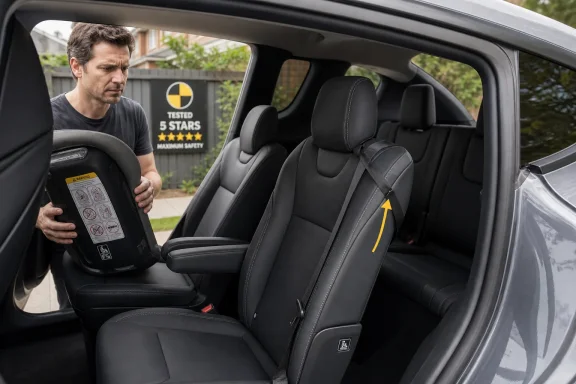
That design choice is now the centre of the controversy. According to Drive, child-seat manufacturers have warned that the second-row captain’s chairs are not compatible with some tethered restraints because the top tether may slip down the side of the seatback or headrest rather than remain routed securely over the top.
That is a small-looking geometry problem with large consequences. Child restraint safety is not just about the presence of ISOFIX points, LATCH-style lower anchors, or a labelled top-tether hook. It is about the path of load in a crash, and whether the child seat stays positioned as the restraint maker tested it.
The awkward part for Tesla is that the Model Y L appears, on paper, to have the equipment parents expect. All four rear seats reportedly have ISOFIX anchors and top-tether hooks. The dispute is about whether those anchors can be used correctly with real restraints on real seats, and that is exactly where showroom checklists often fail families.
That matters because Australia’s child-restraint environment is different from Europe’s and the United States’ in ways that vehicle makers can underestimate. A seat design that looks acceptable in a global cabin package can run into local compliance and usability problems if the tether path is not robust.
The Model Y L issue, as reported, is not that the second row has no top-tether anchor. It is that the captain’s chair design — fixed headrests, sloped seatbacks, and the shape of the upper seat — may allow the tether to move away from the route intended by the child-seat maker.
That is why the manufacturers’ language matters. Infasecure said its restraints are not compatible with the Model Y L’s captain’s chairs. Maxi Cosi said it could not recommend using its restraints there because the configuration is untested and may allow strap slippage in a collision. Britax, meanwhile, was reportedly still seeking written confirmation from Tesla about whether split tethers or V-tethers can route around the seats and still perform dynamically.
The nuance is important. This is not yet a blanket finding that every child seat is unsafe in every rear position of every Model Y L. It is a warning that some leading manufacturers do not want their restraints used in the second row, and that one of the remaining major brands is still trying to establish what can be installed with confidence.
But child-seat installation is one of the least glamorous tests of cabin design, and it is often where premium seating concepts collide with practical restraint engineering. A thick, sculpted seat with an integrated headrest may look cleaner than a conventional bench, but it can also give a top tether fewer predictable surfaces to follow.
A traditional rear bench has a simple advantage: the tether often runs over a broad seatback and down to an anchor point behind it. There is less opportunity for the strap to wander around a shoulder, slide down a side bolster, or be deflected by a fixed headrest shape.
The irony is that the regular five-seat Model Y is not reported to have the same problem precisely because its second-row bench allows the top tether to route more conventionally. The Model Y L’s selling point — those individual second-row chairs — is also what appears to complicate the most important use case for young families.
That should make automakers uncomfortable well beyond Tesla. The industry has spent years turning SUVs into lifestyle devices, layering second-row recline, individual armrests, power adjustments, and cinema-style access onto vehicles that are sold as practical tools. But a family vehicle is not validated by how good the second row looks in a configurator. It is validated by whether a tired parent can install a certified seat correctly and repeatedly without discovering a caveat buried in someone else’s manual.
That is a classic modern safety-rating paradox. A vehicle can earn an overall five-star rating and still have a practical safety weakness that matters enormously to a subset of buyers. The star rating compresses many crash, assist, pedestrian, and occupant-protection measurements into a consumer-friendly badge; the installation note is where the messy real-world caveat lives.
ANCAP’s child occupant protection score for the Model Y L was reported at 84 per cent, still above the five-star threshold but materially below the five-seat Model Y’s 95 per cent. That difference is not cosmetic. It signals that the six-seat layout introduced compromises the smaller version did not carry.
The most damning detail in Drive’s reporting is that ANCAP’s second-row success case appears to have been narrow. Rear-facing capsules could install, but the only seat ANCAP reportedly found to fit properly was a Britax Safe and Sound Unity rear-facing capsule. Convertible seats and boosters, according to the report, could not be correctly installed in the second row.
That is where a star rating can become a blunt instrument. A five-star badge may tell buyers the vehicle performed strongly overall. It does not tell them that the second row may be unsuitable for the exact child restraint they already own, or the restraint they will need six months from now when a child outgrows a capsule.
Putting children in the third row changes the entire operating pattern of a family car. It affects access, school drop-offs, pram loading, adult seating, and the ability to use the second row for grandparents or older passengers. It may also force younger children into the least convenient row while the most accessible seats sit unused for child restraints.
That is not a theoretical inconvenience. The Model Y L is a six-seat SUV, not a minivan, and third-row space in vehicles of this class is always a compromise. Even if the third row can accept a child restraint, it may not be where many parents expected or wanted to place one.
There is also the issue of growth. A family does not use one restraint configuration forever. Capsules give way to convertible seats, convertible seats give way to forward-facing harnessed restraints, and then to boosters. A second-row limitation that seems manageable for a newborn can become a bigger problem as children age.
Tesla’s position, as reported by Drive, was to refer customers to updated guidance from child-seat manufacturers. That is technically defensible, because restraint makers control their own compatibility advice. But it also reads like a handoff. When a vehicle is marketed as a family SUV, buyers reasonably expect the carmaker to have solved the ordinary family-use cases before delivery.
The regulatory question is likely to be specific: do the child-seat anchorages comply with the relevant Australian Design Rules, particularly the rules governing top-tether anchor points? If the anchors are present, correctly located, and compliant, Tesla may not be forced to recall the vehicle simply because the seat shape makes many restraints difficult or impossible to use correctly.
That is the gap between legal compliance and practical safety. A vehicle can satisfy a technical requirement while still being awkward or risky for a common real-world installation. For parents, the difference is academic; if the child seat manufacturer says “do not use it there,” that seating position is effectively unavailable.
The case also exposes a weakness in global platform design. Tesla is not alone in building vehicles for multiple markets and then adapting them to local rules. But Australia’s tether requirements are distinctive enough that local validation cannot be treated as a paperwork exercise.
For IT pros and WindowsForum readers who spend their days thinking about systems, there is a familiar pattern here. A spec can be green while the implementation fails the user workflow. The Model Y L may have the required hardware, but the reported tether-routing problem suggests the whole system — vehicle seat, child restraint, tether path, anchor location, and crash load — was not sufficiently validated as one integrated design.
A top-tether path is not a software toggle. If the strap slips because the headrest and seatback shape invite it to slip, no over-the-air update changes the contour of the chair. Guidance can be updated, compatible seats can be listed, and owners can be told to use the third row, but the underlying cabin design remains what it is.
That is why this story lands differently from the usual Tesla software controversy. Autopilot naming, Full Self-Driving disclaimers, touchscreen controls, and driver-assistance behaviour all fit the familiar Tesla debate about digital ambition outrunning regulatory caution. Child-seat compatibility is more basic. It is bolts, straps, foam, plastic, and crash energy.
Tesla has had seating-related problems before, including a recall involving Model 3 vehicles where a rear middle top-tether point was not exposed. This Model Y L matter is different in mechanism, but similar in lesson: family-safety details are unforgiving because they are not edge cases for the people affected.
The most generous reading is that the Model Y L’s second row was designed with global packaging priorities and that the Australian restraint ecosystem revealed a weakness late. The less generous reading is that Tesla sold a six-seat family SUV into a market with well-known top-tether expectations without making compatibility boringly obvious.
Scale changes the stakes. A child-restraint compatibility problem in a low-volume luxury SUV irritates a small group of buyers. A similar problem in a top-selling family EV affects mainstream households, resale expectations, fleet decisions, and the credibility of electric SUVs as practical family replacements.
Tesla’s defenders will fairly point out that many vehicles have child-seat caveats. Three-row SUVs often have awkward tether locations, tight third rows, inaccessible anchors, or owner’s-manual restrictions that buyers discover only after purchase. That is true, and it is also an indictment of the broader market.
But Tesla’s branding raises expectations. The company sells itself as an engineering-first disruptor, not a legacy automaker cutting corners in a crowded cabin. When a basic family-use problem emerges, the gap between the brand’s technological confidence and the parent’s installation frustration becomes especially visible.
There is also a trust issue. Tesla’s retail model gives buyers fewer traditional dealership touchpoints where a specialist might physically test a child seat before purchase. Online ordering is wonderfully efficient until the product’s suitability depends on a physical installation that cannot be understood from a spec sheet.
Child-seat fitment is one of the few areas where user error and design ambiguity are dangerously intertwined. If an installation is hard to do correctly, many people will do it incorrectly. That is not because parents are careless; it is because the vehicle has failed to make the safe path obvious.
This is where the Model Y L’s issue is so damaging. The second-row captain’s chairs are visually prominent and intuitively the place many parents would put young children. They are accessible, separated, and seemingly designed for comfort. If the safest guidance becomes “use the third row instead,” the vehicle’s human-factors logic has inverted itself.
There is a cybersecurity analogy hiding in plain sight. A secure system that depends on users following obscure steps under pressure is not robust. A safe child-restraint installation that depends on a specific tether route surviving real-world handling, different seat brands, and crash loading is only as strong as its worst practical ambiguity.
A serious family SUV should be tested against the seats families actually buy. Not one capsule, not a narrow selection, and not merely the existence of anchor points. A vehicle maker should know which restraint categories work in which positions, with what routing, and under what limits before customers are asked to pay.
That does not mean every car must fit every seat. It does mean the limitations should be clear, early, and impossible to miss. If a second-row seating position cannot be recommended for tethered child restraints from leading brands, that should not be a post-purchase discovery made through a media investigation.
The same applies to safety ratings. Five-star programs remain useful, but they need to communicate child-restraint caveats with more force when the affected vehicle is being marketed as a family mover. A reduced child-protection score and a technical note are not enough if the consumer takeaway remains “five stars, therefore fine.”
The Model Y L story should push regulators, testers, and manufacturers toward more explicit family-use disclosure. The real question is not whether a vehicle contains anchors. It is whether a parent can use them correctly with mainstream restraints across the lifespan of a child.
That may mean moving a child restraint to the third row, selecting a different restraint, booking a professional installation, or reconsidering the vehicle if the required seating layout cannot be made to work. None of those options is ideal after buying a new family SUV.
The difficulty is that child restraints are not interchangeable accessories. Parents often choose them based on age, height, weight, legal requirements, sibling combinations, and whether the seat fits another household vehicle. Changing the vehicle-seat compatibility equation can cascade into several expensive and inconvenient decisions.
It also complicates second-hand advice. A friend’s seat “fitting” in the Model Y L is not the same as a manufacturer confirming compatibility. A strap that appears tight in the driveway may not be routed in a way the restraint maker has tested or endorsed.
 Tesla’s Family SUV Has Run Into a Family-Use Problem
The Tesla Model Y L was supposed to be the obvious answer to a problem Tesla created for itself: the standard Model Y is hugely popular, but it is still a five-seat crossover in a market where families often want a third row. The L stretches that pitch into six seats across three rows, with second-row captain’s chairs that look premium, flexible, and easier to walk through.That design choice is now the centre of the controversy. According to Drive, child-seat manufacturers have warned that the second-row captain’s chairs are not compatible with some tethered restraints because the top tether may slip down the side of the seatback or headrest rather than remain routed securely over the top.
That is a small-looking geometry problem with large consequences. Child restraint safety is not just about the presence of ISOFIX points, LATCH-style lower anchors, or a labelled top-tether hook. It is about the path of load in a crash, and whether the child seat stays positioned as the restraint maker tested it.
The awkward part for Tesla is that the Model Y L appears, on paper, to have the equipment parents expect. All four rear seats reportedly have ISOFIX anchors and top-tether hooks. The dispute is about whether those anchors can be used correctly with real restraints on real seats, and that is exactly where showroom checklists often fail families.
The Top Tether Is the Detail That Refuses to Stay Small
To non-parents, the words “top tether” sound like a minor installation detail. To Australian and New Zealand families, it is central to how child restraints are used. A top tether helps control the forward rotation of a child restraint in a crash, and in Australia it is not an optional nicety for most harnessed child seats.That matters because Australia’s child-restraint environment is different from Europe’s and the United States’ in ways that vehicle makers can underestimate. A seat design that looks acceptable in a global cabin package can run into local compliance and usability problems if the tether path is not robust.
The Model Y L issue, as reported, is not that the second row has no top-tether anchor. It is that the captain’s chair design — fixed headrests, sloped seatbacks, and the shape of the upper seat — may allow the tether to move away from the route intended by the child-seat maker.
That is why the manufacturers’ language matters. Infasecure said its restraints are not compatible with the Model Y L’s captain’s chairs. Maxi Cosi said it could not recommend using its restraints there because the configuration is untested and may allow strap slippage in a collision. Britax, meanwhile, was reportedly still seeking written confirmation from Tesla about whether split tethers or V-tethers can route around the seats and still perform dynamically.
The nuance is important. This is not yet a blanket finding that every child seat is unsafe in every rear position of every Model Y L. It is a warning that some leading manufacturers do not want their restraints used in the second row, and that one of the remaining major brands is still trying to establish what can be installed with confidence.
Captain’s Chairs Solved One Problem and Created Another
Captain’s chairs are fashionable because they make big crossovers feel more expensive. They also improve access to the third row, reduce the visual bulk of a bench seat, and help sell the idea that a family SUV can be both practical and lounge-like.But child-seat installation is one of the least glamorous tests of cabin design, and it is often where premium seating concepts collide with practical restraint engineering. A thick, sculpted seat with an integrated headrest may look cleaner than a conventional bench, but it can also give a top tether fewer predictable surfaces to follow.
A traditional rear bench has a simple advantage: the tether often runs over a broad seatback and down to an anchor point behind it. There is less opportunity for the strap to wander around a shoulder, slide down a side bolster, or be deflected by a fixed headrest shape.
The irony is that the regular five-seat Model Y is not reported to have the same problem precisely because its second-row bench allows the top tether to route more conventionally. The Model Y L’s selling point — those individual second-row chairs — is also what appears to complicate the most important use case for young families.
That should make automakers uncomfortable well beyond Tesla. The industry has spent years turning SUVs into lifestyle devices, layering second-row recline, individual armrests, power adjustments, and cinema-style access onto vehicles that are sold as practical tools. But a family vehicle is not validated by how good the second row looks in a configurator. It is validated by whether a tired parent can install a certified seat correctly and repeatedly without discovering a caveat buried in someone else’s manual.
ANCAP Saw the Shadow Before the Brands Said It Out Loud
The child-seat brands’ warnings did not arrive in a vacuum. ANCAP awarded the Tesla Model Y L five stars in 2025, but the rating carried a warning about child restraint installation. The safety body noted difficulty installing child restraints in the second row because of top-tether routing limitations, and it also flagged installation challenges in the third row with ISOFIX anchorages.That is a classic modern safety-rating paradox. A vehicle can earn an overall five-star rating and still have a practical safety weakness that matters enormously to a subset of buyers. The star rating compresses many crash, assist, pedestrian, and occupant-protection measurements into a consumer-friendly badge; the installation note is where the messy real-world caveat lives.
ANCAP’s child occupant protection score for the Model Y L was reported at 84 per cent, still above the five-star threshold but materially below the five-seat Model Y’s 95 per cent. That difference is not cosmetic. It signals that the six-seat layout introduced compromises the smaller version did not carry.
The most damning detail in Drive’s reporting is that ANCAP’s second-row success case appears to have been narrow. Rear-facing capsules could install, but the only seat ANCAP reportedly found to fit properly was a Britax Safe and Sound Unity rear-facing capsule. Convertible seats and boosters, according to the report, could not be correctly installed in the second row.
That is where a star rating can become a blunt instrument. A five-star badge may tell buyers the vehicle performed strongly overall. It does not tell them that the second row may be unsuitable for the exact child restraint they already own, or the restraint they will need six months from now when a child outgrows a capsule.
The Third Row Is a Partial Escape Hatch, Not a Fix
The report contains one piece of reassurance: Infasecure, Maxi Cosi, and Britax all reportedly confirmed the Model Y L’s third row, which uses a more conventional bench-style arrangement, is suitable for their single- and split-tether child seats. That gives owners a path forward, but not a painless one.Putting children in the third row changes the entire operating pattern of a family car. It affects access, school drop-offs, pram loading, adult seating, and the ability to use the second row for grandparents or older passengers. It may also force younger children into the least convenient row while the most accessible seats sit unused for child restraints.
That is not a theoretical inconvenience. The Model Y L is a six-seat SUV, not a minivan, and third-row space in vehicles of this class is always a compromise. Even if the third row can accept a child restraint, it may not be where many parents expected or wanted to place one.
There is also the issue of growth. A family does not use one restraint configuration forever. Capsules give way to convertible seats, convertible seats give way to forward-facing harnessed restraints, and then to boosters. A second-row limitation that seems manageable for a newborn can become a bigger problem as children age.
Tesla’s position, as reported by Drive, was to refer customers to updated guidance from child-seat manufacturers. That is technically defensible, because restraint makers control their own compatibility advice. But it also reads like a handoff. When a vehicle is marketed as a family SUV, buyers reasonably expect the carmaker to have solved the ordinary family-use cases before delivery.
The Regulator’s Test Is Narrower Than the Parent’s Test
Australia’s Department of Infrastructure has reportedly said it is aware of the matter and is looking into it. That is the correct response, but it should not be mistaken for a guaranteed recall.The regulatory question is likely to be specific: do the child-seat anchorages comply with the relevant Australian Design Rules, particularly the rules governing top-tether anchor points? If the anchors are present, correctly located, and compliant, Tesla may not be forced to recall the vehicle simply because the seat shape makes many restraints difficult or impossible to use correctly.
That is the gap between legal compliance and practical safety. A vehicle can satisfy a technical requirement while still being awkward or risky for a common real-world installation. For parents, the difference is academic; if the child seat manufacturer says “do not use it there,” that seating position is effectively unavailable.
The case also exposes a weakness in global platform design. Tesla is not alone in building vehicles for multiple markets and then adapting them to local rules. But Australia’s tether requirements are distinctive enough that local validation cannot be treated as a paperwork exercise.
For IT pros and WindowsForum readers who spend their days thinking about systems, there is a familiar pattern here. A spec can be green while the implementation fails the user workflow. The Model Y L may have the required hardware, but the reported tether-routing problem suggests the whole system — vehicle seat, child restraint, tether path, anchor location, and crash load — was not sufficiently validated as one integrated design.
Tesla’s Speed Culture Meets the Slow Discipline of Restraint Engineering
Tesla’s great advantage has always been speed. It iterates quickly, ships software features aggressively, and treats many vehicle experiences as updateable. That mindset has made Tesla a dominant force in EVs, but it is poorly suited to anything that depends on physical geometry, certification, and crash loads.A top-tether path is not a software toggle. If the strap slips because the headrest and seatback shape invite it to slip, no over-the-air update changes the contour of the chair. Guidance can be updated, compatible seats can be listed, and owners can be told to use the third row, but the underlying cabin design remains what it is.
That is why this story lands differently from the usual Tesla software controversy. Autopilot naming, Full Self-Driving disclaimers, touchscreen controls, and driver-assistance behaviour all fit the familiar Tesla debate about digital ambition outrunning regulatory caution. Child-seat compatibility is more basic. It is bolts, straps, foam, plastic, and crash energy.
Tesla has had seating-related problems before, including a recall involving Model 3 vehicles where a rear middle top-tether point was not exposed. This Model Y L matter is different in mechanism, but similar in lesson: family-safety details are unforgiving because they are not edge cases for the people affected.
The most generous reading is that the Model Y L’s second row was designed with global packaging priorities and that the Australian restraint ecosystem revealed a weakness late. The less generous reading is that Tesla sold a six-seat family SUV into a market with well-known top-tether expectations without making compatibility boringly obvious.
The Sales Success Makes the Problem Harder to Shrug Off
This would be a niche story if the Model Y L were an obscure compliance special. It is not. The Model Y family is one of the most consequential vehicle lines in the world, and Drive reported that combined Australian sales of the five-seat Model Y and three-row Model Y L reached 5605 vehicles in May 2026, enough to make it the nation’s top-selling vehicle that month.Scale changes the stakes. A child-restraint compatibility problem in a low-volume luxury SUV irritates a small group of buyers. A similar problem in a top-selling family EV affects mainstream households, resale expectations, fleet decisions, and the credibility of electric SUVs as practical family replacements.
Tesla’s defenders will fairly point out that many vehicles have child-seat caveats. Three-row SUVs often have awkward tether locations, tight third rows, inaccessible anchors, or owner’s-manual restrictions that buyers discover only after purchase. That is true, and it is also an indictment of the broader market.
But Tesla’s branding raises expectations. The company sells itself as an engineering-first disruptor, not a legacy automaker cutting corners in a crowded cabin. When a basic family-use problem emerges, the gap between the brand’s technological confidence and the parent’s installation frustration becomes especially visible.
There is also a trust issue. Tesla’s retail model gives buyers fewer traditional dealership touchpoints where a specialist might physically test a child seat before purchase. Online ordering is wonderfully efficient until the product’s suitability depends on a physical installation that cannot be understood from a spec sheet.
The Manual Is Not a Substitute for a Usable Seat
Tesla and other automakers often rely on owner’s manuals to define correct child-seat installation. That is necessary, but insufficient. A parent does not experience a family car as a manual; they experience it at 7:45 a.m. with a wriggling toddler, a school bag, and a strap that seems to want to fall into the wrong place.Child-seat fitment is one of the few areas where user error and design ambiguity are dangerously intertwined. If an installation is hard to do correctly, many people will do it incorrectly. That is not because parents are careless; it is because the vehicle has failed to make the safe path obvious.
This is where the Model Y L’s issue is so damaging. The second-row captain’s chairs are visually prominent and intuitively the place many parents would put young children. They are accessible, separated, and seemingly designed for comfort. If the safest guidance becomes “use the third row instead,” the vehicle’s human-factors logic has inverted itself.
There is a cybersecurity analogy hiding in plain sight. A secure system that depends on users following obscure steps under pressure is not robust. A safe child-restraint installation that depends on a specific tether route surviving real-world handling, different seat brands, and crash loading is only as strong as its worst practical ambiguity.
The Industry Should Treat Fitment Notes as Product Defects
Automakers have become very good at talking about active safety. Lane-keeping systems, automatic emergency braking, driver monitoring, and crash-avoidance software dominate brochures because they are visible, scoreable, and easy to market. Child-seat fitment is less glamorous, but it is a core family-safety feature.A serious family SUV should be tested against the seats families actually buy. Not one capsule, not a narrow selection, and not merely the existence of anchor points. A vehicle maker should know which restraint categories work in which positions, with what routing, and under what limits before customers are asked to pay.
That does not mean every car must fit every seat. It does mean the limitations should be clear, early, and impossible to miss. If a second-row seating position cannot be recommended for tethered child restraints from leading brands, that should not be a post-purchase discovery made through a media investigation.
The same applies to safety ratings. Five-star programs remain useful, but they need to communicate child-restraint caveats with more force when the affected vehicle is being marketed as a family mover. A reduced child-protection score and a technical note are not enough if the consumer takeaway remains “five stars, therefore fine.”
The Model Y L story should push regulators, testers, and manufacturers toward more explicit family-use disclosure. The real question is not whether a vehicle contains anchors. It is whether a parent can use them correctly with mainstream restraints across the lifespan of a child.
The Model Y L’s Second Row Is Now the Seat to Check Twice
For current and prospective Model Y L owners, the practical advice is uncomfortable but simple: do not assume the second-row captain’s chairs are suitable for your child seat just because anchors are present. The restraint manufacturer’s compatibility guidance should be treated as decisive.That may mean moving a child restraint to the third row, selecting a different restraint, booking a professional installation, or reconsidering the vehicle if the required seating layout cannot be made to work. None of those options is ideal after buying a new family SUV.
The difficulty is that child restraints are not interchangeable accessories. Parents often choose them based on age, height, weight, legal requirements, sibling combinations, and whether the seat fits another household vehicle. Changing the vehicle-seat compatibility equation can cascade into several expensive and inconvenient decisions.
It also complicates second-hand advice. A friend’s seat “fitting” in the Model Y L is not the same as a manufacturer confirming compatibility. A strap that appears tight in the driveway may not be routed in a way the restraint maker has tested or endorsed.
The Concrete Lessons for Tesla Families
The Model Y L is still a five-star-rated vehicle, and the available reporting does not mean every rear seating position is unusable for every child. But the second-row warning is specific enough that families should treat it as a live safety issue rather than a forum rumour.- The second-row captain’s chairs are the problem area because the tether route may be compromised by the fixed headrest and seatback shape.
- Infasecure and Maxi Cosi have reportedly said their tethered restraints should not be used in those second-row seats.
- Britax was reportedly still seeking written confirmation from Tesla about whether certain tether styles can be routed safely around the second-row seats.
- The third row is reportedly suitable for the relevant restraints from the three brands, but using it may change how practical the car is for a family.
- ANCAP’s five-star rating should be read alongside its child-restraint installation warning and the lower child occupant protection score for the Model Y L.
- Owners should follow the child-seat manufacturer’s latest guidance and consider a professional fitting rather than relying on anchor presence alone.
References
- Primary source: drive.com.au
Published: Thu, 25 Jun 2026 20:04:26 GMT
'Cannot recommend': Child seat brands warn of Tesla safety issue
EXCLUSIVE: Parents have been warned that the unique seat design in the Tesla Model Y L electric SUV could pose a safety risk.www.drive.com.au
