

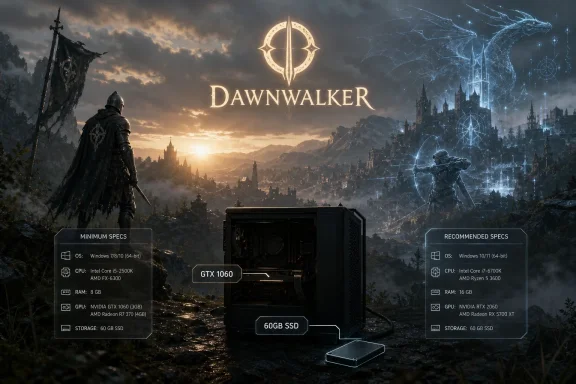
The Blood of Dawnwalker’s latest PC requirements, published by Rebel Wolves in June 2026 after an earlier April spec sheet, lower the game’s minimum Nvidia entry point from a GeForce GTX 1070 to a GTX 1060 for Windows 10 DirectX 12 systems ahead of its September 3, 2026 launch. That sounds like a small one-line correction in a marketing table. It is not. For a new open-world dark fantasy RPG carrying the expectations of ex-CD Projekt Red pedigree, that single GPU swap says something larger about the state of PC gaming in 2026: developers know the hardware floor still matters, even when the industry would rather talk about frame generation, upscaling, and $1,000 graphics cards.
The revised minimum requirement is the headline because it changes who gets to feel invited. In April, Rebel Wolves’ published PC requirements put the GeForce GTX 1070 alongside the GeForce RTX 3050, Radeon RX Vega 56, and Intel Arc A580 as minimum-class cards. The June update reportedly lowers that Nvidia Pascal-era baseline to the GeForce GTX 1060, a card that has become almost mythological in PC gaming because of how long it remained viable after its 2016 debut.
The rest of the minimum platform remains stern enough to prevent anyone from confusing this with a lightweight RPG. Rebel Wolves still lists Windows 10 with DirectX 12, 16GB of RAM, a 60GB SSD, and CPUs in the Intel Core i7-8700K or AMD Ryzen 7 3700X class. This is not a return to the era when a midrange quad-core and a hard drive could be expected to brute-force a big RPG into usability.
That distinction matters. The GPU change broadens access, but it does not turn The Blood of Dawnwalker into a low-spec showcase. It instead suggests the studio has found room to scale graphics work downward without rewriting its expectations for CPU throughput, streaming, memory, or storage behavior.
For WindowsForum readers, the SSD requirement may be as important as the GTX 1060 line. A system with a GTX 1060 but a spinning hard drive is increasingly the wrong mental model for modern PC minimum specs. The bottleneck has migrated from “can the GPU draw it?” to “can the entire platform feed the world fast enough without stutter?”
The Blood of Dawnwalker is not promising miracles here. A GTX 1060 should be read as a minimum-floor device, not a secret recommendation. The April requirements were framed around 1080p, low settings, and 30fps-class expectations for the minimum tier; the June revision does not magically make an older 6GB card a high-refresh open-world machine.
Still, the symbolic value is real. The GTX 1060 lacks the hardware features that now dominate GPU marketing: no DLSS, no dedicated ray tracing cores, no frame generation pipeline, and no modern tensor acceleration. If Rebel Wolves is willing to include it, the studio is implicitly saying the game’s base renderer can still run without leaning entirely on contemporary AI-assisted graphics plumbing.
That is a notable message in 2026. PC players have become increasingly skeptical of system requirements that appear to use upscaling as a crutch rather than an optional enhancement. A minimum spec that includes a GTX 1060 is a promise that the game must still have a traditional rasterized path capable of surviving on older silicon.
This is where open-world design asserts itself. The Blood of Dawnwalker is being pitched as a single-player, open-world dark fantasy action RPG set in 14th-century Europe, with a strong emphasis on narrative systems, day-night duality, and consequential questing. Those features are not just art-direction problems. They imply simulation, streaming, animation, AI, quest-state tracking, and asset management — all the things that turn “minimum requirements” into a platform-wide negotiation.
The Ryzen 7 3700X requirement is especially revealing because it is not some exotic workstation part. It is a widely owned Zen 2 CPU, but it still represents a class of machine newer and more capable than the average GTX 1060-era build. Many original GTX 1060 systems shipped with four-core Intel i5 chips, and those users should not assume the GPU revision alone makes them safe.
This is the practical warning buried under the good news. Rebel Wolves may have widened the GPU gate, but it has not lowered the whole bridge. A Windows 10 PC with 16GB of RAM, a proper SSD, and a six- or eight-core CPU is still the apparent baseline for an acceptable experience.
The CPU pairing is odd at first glance. Intel’s Core i5-13600 and AMD’s Ryzen 9 7900X are not symmetrical market-position equivalents, which makes the table feel less like a tidy buyer’s guide and more like a performance envelope assembled from internal test machines. That is common with game requirements, but it is also why PC players should treat these charts as directional rather than mathematically precise.
The GPU side is similarly interesting. The Radeon RX 6800 XT is a proven high-end RDNA 2 card with a healthy memory configuration. The RTX 5060 line, depending on exact model and VRAM, is a more contemporary but potentially more complicated recommendation because modern Nvidia cards often lean heavily on feature support and upscaling ecosystems.
This is where the minimum GTX 1060 and recommended RTX 5060 tell two different stories. Rebel Wolves appears to be saying that Dawnwalker can start on older hardware, but the game it wants most players to see is tuned for far newer GPUs, higher memory bandwidth, and modern driver stacks.
Early reporting around the April spec sheet emphasized that Rebel Wolves was at least making distinctions around native performance in some tiers. That is useful, because requirements that conceal upscaling assumptions often create launch-week anger. If a “recommended” card only reaches the advertised performance through aggressive reconstruction, the table may be technically true while still feeling misleading.
The GTX 1060 revision makes this even more important. The 1060 cannot participate in DLSS, and while it can use vendor-agnostic upscaling methods such as FSR in many games, the experience depends heavily on implementation. If Dawnwalker is playable on that class of hardware, the studio will need to offer meaningful low-end settings rather than a menu full of features that assume modern accelerators.
This is where PC optimization becomes less glamorous but more important. The best low-end support is not a magic checkbox. It is careful shader compilation, sane texture streaming, scalable shadows, adjustable foliage density, stable frame pacing, and a settings menu that explains itself.
That said, a Windows 10 listing should not be mistaken for a guarantee that every old Windows 10 machine is in scope. DirectX 12 support, driver maturity, SSD behavior, CPU scheduling, and security software overhead all vary wildly across the decade of hardware that can run Microsoft’s older operating system. The OS line is the easiest part of the chart to satisfy and the least predictive of actual performance.
For sysadmins and family tech-support departments, this is the likely support headache. Someone will read “Windows 10” and “GTX 1060” and assume a 2017 prebuilt is ready. Then the game will collide with a weak CPU, 8GB of RAM upgraded in mismatched sticks, a nearly full SATA SSD, or years of driver cruft.
The lesson is not that Rebel Wolves should abandon older Windows users. It is that the Windows ecosystem’s breadth makes every minimum spec a compromise between technical truth and consumer expectation.
This is one of the least appreciated shifts in PC gaming. For years, GPU upgrades defined whether a system felt current. Now, a machine can have a serviceable GPU and still feel obsolete if its storage path cannot keep pace with world streaming and shader caches.
The Blood of Dawnwalker’s 60GB footprint is not especially alarming, especially compared with the ballooning install sizes of some blockbuster shooters and live-service games. But the SSD requirement reinforces that the minimum PC is not simply “old hardware.” It is “old hardware modernized in the right places.”
For Windows users planning to stretch a GTX 1060 build into another year, the most cost-effective upgrade may not be the GPU. It may be ensuring the game sits on a decent SSD, the system has 16GB of stable dual-channel RAM, and the Windows install is not carrying years of background services into every play session.
For a debut studio, a system-requirements revision can be read two ways. Optimistically, it suggests ongoing optimization and a willingness to communicate changes before launch. Cynically, it can look like the spec sheet is still moving because performance targets are not yet locked. The truth may be more mundane: as builds stabilize, the team gets better data from a wider hardware matrix and adjusts the table accordingly.
Lowering the GPU floor before release is preferable to discovering after launch that the game performs better than advertised on older cards. It gives budget-conscious players a reason to keep watching and may reduce the sense that Dawnwalker is only for people with the newest hardware. But it also raises expectations that the GTX 1060 experience will be meaningfully tested, not merely bootable.
That is the difference between a minimum spec and a reputational promise. If the game launches and GTX 1060 users face shader stutter, unstable frametimes, or settings that turn the world into mush, the lowered requirement will be used against the studio. If it runs at a stable 30fps with sensible compromises, Rebel Wolves will have bought goodwill from exactly the kind of PC audience that keeps RPGs alive for years.
A June adjustment also fits the normal marketing cadence for a major fall release. April established the release date and broad technical expectations. June gives the studio room to absorb reaction, revise messaging, and keep the wishlist campaign alive. By late summer, players will expect previews, hands-on impressions, and ideally much more concrete footage running across PC configurations.
The lack of Russian language support listed in the source material is a separate commercial note, but not a technical one. For a dark fantasy RPG with a European setting and a global publisher, localization decisions can affect regional reception as much as performance requirements. Still, the requirements story is primarily about access, not translation.
The sharper issue is timing. September is a competitive window, and RPG players are not short on demands for their attention. A technically messy launch can sink months of careful world-building in a weekend; a technically credible launch can turn a new IP into the next long-tail PC obsession.
The modern player wants to know not just the GPU, but the target resolution, frame rate, graphics preset, upscaling mode, VRAM expectation, storage type, and whether ray tracing is involved. A single “recommended” line is no longer enough. It collapses too many variables into a format inherited from a simpler era.
Rebel Wolves’ decision to publish multiple tiers in April was the right instinct. The June revision is useful because it corrects the floor. But the more important test will be whether the studio continues clarifying what each tier actually means as launch approaches.
This is especially true for VRAM. The industry is in an awkward transition where some older high-end cards have enough raw horsepower but less memory than newer midrange parts, while some newer cards have feature advantages but constrained VRAM configurations. Games that do not explain their memory behavior invite confusion before players even click “install.”
But minimum-spec optimism has a cost. Players who barely qualify are often the least forgiving if the game feels misrepresented. They are not benchmarking for sport; they are trying to decide whether to spend money on a game now or wait for patches, discounts, and a future hardware upgrade.
The honest version of the message is this: a GTX 1060 may get you into The Blood of Dawnwalker, but it should not define your expectations for the experience. Low settings, 1080p-class output, and a 30fps target remain the sensible assumption unless Rebel Wolves says otherwise. Anyone expecting high settings or a locked 60fps on that card is setting themselves up for disappointment.
That is not a criticism of Rebel Wolves. It is the reality of trying to ship a visually ambitious open-world RPG across a PC ecosystem that spans a decade of GPU history.
For Windows users, the safest reading is conservative. If your system only barely matches the minimum, wait for independent benchmarks before assuming the game will feel good. If your machine sits closer to the recommended tier, the revised minimum is less relevant than how the game handles frame pacing, shader compilation, and VRAM pressure.
The studio’s bigger opportunity is trust. By adjusting the requirement before launch, Rebel Wolves has shown that its PC targets are not frozen marketing copy. If it follows that with transparent performance guidance, a useful settings menu, and a stable launch build, the GTX 1060 headline could become more than a feel-good footnote.
 Rebel Wolves Moves the Floor, Not the Ceiling
The revised minimum requirement is the headline because it changes who gets to feel invited. In April, Rebel Wolves’ published PC requirements put the GeForce GTX 1070 alongside the GeForce RTX 3050, Radeon RX Vega 56, and Intel Arc A580 as minimum-class cards. The June update reportedly lowers that Nvidia Pascal-era baseline to the GeForce GTX 1060, a card that has become almost mythological in PC gaming because of how long it remained viable after its 2016 debut.The rest of the minimum platform remains stern enough to prevent anyone from confusing this with a lightweight RPG. Rebel Wolves still lists Windows 10 with DirectX 12, 16GB of RAM, a 60GB SSD, and CPUs in the Intel Core i7-8700K or AMD Ryzen 7 3700X class. This is not a return to the era when a midrange quad-core and a hard drive could be expected to brute-force a big RPG into usability.
That distinction matters. The GPU change broadens access, but it does not turn The Blood of Dawnwalker into a low-spec showcase. It instead suggests the studio has found room to scale graphics work downward without rewriting its expectations for CPU throughput, streaming, memory, or storage behavior.
For WindowsForum readers, the SSD requirement may be as important as the GTX 1060 line. A system with a GTX 1060 but a spinning hard drive is increasingly the wrong mental model for modern PC minimum specs. The bottleneck has migrated from “can the GPU draw it?” to “can the entire platform feed the world fast enough without stutter?”
The GTX 1060 Is Still the Industry’s Guilty Conscience
There is a reason a GTX 1060 mention still lands differently from almost any other old GPU. It represents the huge middle of the PC audience: people who bought sensible hardware, skipped one or two overpriced upgrade cycles, and still expect games to meet them somewhere near the middle. Every time a modern AAA or near-AAA game drops support below the 1070 or 1660 tier, it quietly acknowledges that the PC market is not just enthusiasts comparing ray tracing charts.The Blood of Dawnwalker is not promising miracles here. A GTX 1060 should be read as a minimum-floor device, not a secret recommendation. The April requirements were framed around 1080p, low settings, and 30fps-class expectations for the minimum tier; the June revision does not magically make an older 6GB card a high-refresh open-world machine.
Still, the symbolic value is real. The GTX 1060 lacks the hardware features that now dominate GPU marketing: no DLSS, no dedicated ray tracing cores, no frame generation pipeline, and no modern tensor acceleration. If Rebel Wolves is willing to include it, the studio is implicitly saying the game’s base renderer can still run without leaning entirely on contemporary AI-assisted graphics plumbing.
That is a notable message in 2026. PC players have become increasingly skeptical of system requirements that appear to use upscaling as a crutch rather than an optional enhancement. A minimum spec that includes a GTX 1060 is a promise that the game must still have a traditional rasterized path capable of surviving on older silicon.
The CPU Requirement Tells a Less Comforting Story
The GPU downgrade grabs attention, but the minimum CPU listing is not gentle. An Intel Core i7-8700K or AMD Ryzen 7 3700X means Rebel Wolves is still drawing its baseline around relatively capable six- and eight-core desktop processors. That is a very different message from “your old gaming PC is probably fine.”This is where open-world design asserts itself. The Blood of Dawnwalker is being pitched as a single-player, open-world dark fantasy action RPG set in 14th-century Europe, with a strong emphasis on narrative systems, day-night duality, and consequential questing. Those features are not just art-direction problems. They imply simulation, streaming, animation, AI, quest-state tracking, and asset management — all the things that turn “minimum requirements” into a platform-wide negotiation.
The Ryzen 7 3700X requirement is especially revealing because it is not some exotic workstation part. It is a widely owned Zen 2 CPU, but it still represents a class of machine newer and more capable than the average GTX 1060-era build. Many original GTX 1060 systems shipped with four-core Intel i5 chips, and those users should not assume the GPU revision alone makes them safe.
This is the practical warning buried under the good news. Rebel Wolves may have widened the GPU gate, but it has not lowered the whole bridge. A Windows 10 PC with 16GB of RAM, a proper SSD, and a six- or eight-core CPU is still the apparent baseline for an acceptable experience.
Recommended Specs Reveal the Real Ambition
If the minimum tier is about inclusion, the recommended tier is where Rebel Wolves shows its appetite. The published recommended requirements include Windows 10 with DirectX 12, 16GB of RAM, a 60GB SSD, a Core i5-13600 or Ryzen 9 7900X-class CPU, and GPUs such as the GeForce RTX 5060 or Radeon RX 6800 XT. That is a much more modern and more expensive target than the GTX 1060 headline might suggest.The CPU pairing is odd at first glance. Intel’s Core i5-13600 and AMD’s Ryzen 9 7900X are not symmetrical market-position equivalents, which makes the table feel less like a tidy buyer’s guide and more like a performance envelope assembled from internal test machines. That is common with game requirements, but it is also why PC players should treat these charts as directional rather than mathematically precise.
The GPU side is similarly interesting. The Radeon RX 6800 XT is a proven high-end RDNA 2 card with a healthy memory configuration. The RTX 5060 line, depending on exact model and VRAM, is a more contemporary but potentially more complicated recommendation because modern Nvidia cards often lean heavily on feature support and upscaling ecosystems.
This is where the minimum GTX 1060 and recommended RTX 5060 tell two different stories. Rebel Wolves appears to be saying that Dawnwalker can start on older hardware, but the game it wants most players to see is tuned for far newer GPUs, higher memory bandwidth, and modern driver stacks.
Upscaling Is the Quiet Assumption Behind Every 2026 Spec Sheet
Modern system requirements have become harder to read because “1080p,” “high,” and “60fps” no longer mean what they used to mean. Native resolution, quality-mode upscaling, performance-mode upscaling, frame generation, and dynamic resolution can all sit behind a single marketing line. Players have learned to ask the follow-up question: native or reconstructed?Early reporting around the April spec sheet emphasized that Rebel Wolves was at least making distinctions around native performance in some tiers. That is useful, because requirements that conceal upscaling assumptions often create launch-week anger. If a “recommended” card only reaches the advertised performance through aggressive reconstruction, the table may be technically true while still feeling misleading.
The GTX 1060 revision makes this even more important. The 1060 cannot participate in DLSS, and while it can use vendor-agnostic upscaling methods such as FSR in many games, the experience depends heavily on implementation. If Dawnwalker is playable on that class of hardware, the studio will need to offer meaningful low-end settings rather than a menu full of features that assume modern accelerators.
This is where PC optimization becomes less glamorous but more important. The best low-end support is not a magic checkbox. It is careful shader compilation, sane texture streaming, scalable shadows, adjustable foliage density, stable frame pacing, and a settings menu that explains itself.
Windows 10 Remains the Baseline Because the Audience Is Still There
The requirement for Windows 10 with DirectX 12 is not surprising, but it is still worth pausing on. Despite Windows 11’s maturity and Microsoft’s steady pressure on the ecosystem, game publishers continue to list Windows 10 because the installed base remains too large to ignore. For a PC release that wants to maximize day-one sales, cutting off Windows 10 would be a self-inflicted wound.That said, a Windows 10 listing should not be mistaken for a guarantee that every old Windows 10 machine is in scope. DirectX 12 support, driver maturity, SSD behavior, CPU scheduling, and security software overhead all vary wildly across the decade of hardware that can run Microsoft’s older operating system. The OS line is the easiest part of the chart to satisfy and the least predictive of actual performance.
For sysadmins and family tech-support departments, this is the likely support headache. Someone will read “Windows 10” and “GTX 1060” and assume a 2017 prebuilt is ready. Then the game will collide with a weak CPU, 8GB of RAM upgraded in mismatched sticks, a nearly full SATA SSD, or years of driver cruft.
The lesson is not that Rebel Wolves should abandon older Windows users. It is that the Windows ecosystem’s breadth makes every minimum spec a compromise between technical truth and consumer expectation.
The SSD Requirement Is Now the Real Minimum Spec
The 60GB SSD requirement is modest by 2026 storage standards, but the SSD qualifier is no longer decorative. Modern open-world games are designed around fast random access and predictable asset streaming. Even when they do not require the most advanced NVMe drives, they increasingly assume the system is not waiting on a mechanical disk.This is one of the least appreciated shifts in PC gaming. For years, GPU upgrades defined whether a system felt current. Now, a machine can have a serviceable GPU and still feel obsolete if its storage path cannot keep pace with world streaming and shader caches.
The Blood of Dawnwalker’s 60GB footprint is not especially alarming, especially compared with the ballooning install sizes of some blockbuster shooters and live-service games. But the SSD requirement reinforces that the minimum PC is not simply “old hardware.” It is “old hardware modernized in the right places.”
For Windows users planning to stretch a GTX 1060 build into another year, the most cost-effective upgrade may not be the GPU. It may be ensuring the game sits on a decent SSD, the system has 16GB of stable dual-channel RAM, and the Windows install is not carrying years of background services into every play session.
A Smaller Studio Cannot Afford a Bad First Impression
Rebel Wolves is not just shipping another RPG. The studio’s identity is tied to experience from CD Projekt Red, including veterans associated with The Witcher 3 and Cyberpunk 2077. That pedigree brings attention, but it also brings a harsher standard. PC players remember both the triumphs and the technical turbulence of ambitious open-world RPGs.For a debut studio, a system-requirements revision can be read two ways. Optimistically, it suggests ongoing optimization and a willingness to communicate changes before launch. Cynically, it can look like the spec sheet is still moving because performance targets are not yet locked. The truth may be more mundane: as builds stabilize, the team gets better data from a wider hardware matrix and adjusts the table accordingly.
Lowering the GPU floor before release is preferable to discovering after launch that the game performs better than advertised on older cards. It gives budget-conscious players a reason to keep watching and may reduce the sense that Dawnwalker is only for people with the newest hardware. But it also raises expectations that the GTX 1060 experience will be meaningfully tested, not merely bootable.
That is the difference between a minimum spec and a reputational promise. If the game launches and GTX 1060 users face shader stutter, unstable frametimes, or settings that turn the world into mush, the lowered requirement will be used against the studio. If it runs at a stable 30fps with sensible compromises, Rebel Wolves will have bought goodwill from exactly the kind of PC audience that keeps RPGs alive for years.
The September Date Leaves Little Room for Ambiguity
The Blood of Dawnwalker is scheduled for September 3, 2026, on PC and current-generation consoles. That puts the system-requirements update in a meaningful window: close enough to launch that it likely reflects real optimization work, but far enough out that there is still time for drivers, patches, and final performance tuning.A June adjustment also fits the normal marketing cadence for a major fall release. April established the release date and broad technical expectations. June gives the studio room to absorb reaction, revise messaging, and keep the wishlist campaign alive. By late summer, players will expect previews, hands-on impressions, and ideally much more concrete footage running across PC configurations.
The lack of Russian language support listed in the source material is a separate commercial note, but not a technical one. For a dark fantasy RPG with a European setting and a global publisher, localization decisions can affect regional reception as much as performance requirements. Still, the requirements story is primarily about access, not translation.
The sharper issue is timing. September is a competitive window, and RPG players are not short on demands for their attention. A technically messy launch can sink months of careful world-building in a weekend; a technically credible launch can turn a new IP into the next long-tail PC obsession.
The PC Audience Has Stopped Trusting Spec Tables at Face Value
Part of the reaction to Dawnwalker’s requirements comes from accumulated fatigue. PC players have seen too many games launch with requirements that were either vague, misleading, or technically accurate only under narrow conditions. A table that once seemed like consumer information now reads like a negotiation.The modern player wants to know not just the GPU, but the target resolution, frame rate, graphics preset, upscaling mode, VRAM expectation, storage type, and whether ray tracing is involved. A single “recommended” line is no longer enough. It collapses too many variables into a format inherited from a simpler era.
Rebel Wolves’ decision to publish multiple tiers in April was the right instinct. The June revision is useful because it corrects the floor. But the more important test will be whether the studio continues clarifying what each tier actually means as launch approaches.
This is especially true for VRAM. The industry is in an awkward transition where some older high-end cards have enough raw horsepower but less memory than newer midrange parts, while some newer cards have feature advantages but constrained VRAM configurations. Games that do not explain their memory behavior invite confusion before players even click “install.”
Lower Specs Can Be Good Marketing, but Only If They Survive Contact With Players
There is an obvious marketing upside to saying a new RPG will run on a GTX 1060. It widens the funnel, reassures budget players, and generates a friendlier headline than “you need a monster GPU.” In a year when hardware prices and upgrade fatigue remain sore subjects, that matters.But minimum-spec optimism has a cost. Players who barely qualify are often the least forgiving if the game feels misrepresented. They are not benchmarking for sport; they are trying to decide whether to spend money on a game now or wait for patches, discounts, and a future hardware upgrade.
The honest version of the message is this: a GTX 1060 may get you into The Blood of Dawnwalker, but it should not define your expectations for the experience. Low settings, 1080p-class output, and a 30fps target remain the sensible assumption unless Rebel Wolves says otherwise. Anyone expecting high settings or a locked 60fps on that card is setting themselves up for disappointment.
That is not a criticism of Rebel Wolves. It is the reality of trying to ship a visually ambitious open-world RPG across a PC ecosystem that spans a decade of GPU history.
The Dawnwalker Spec Change Is Really a Test of PC Good Faith
The practical meaning of the revised requirements is narrower than the discourse around it, but still important. Rebel Wolves has lowered the Nvidia minimum from GTX 1070 to GTX 1060, while leaving the broader platform expectations in modern territory. That makes the game more approachable without making it truly low-end.For Windows users, the safest reading is conservative. If your system only barely matches the minimum, wait for independent benchmarks before assuming the game will feel good. If your machine sits closer to the recommended tier, the revised minimum is less relevant than how the game handles frame pacing, shader compilation, and VRAM pressure.
The studio’s bigger opportunity is trust. By adjusting the requirement before launch, Rebel Wolves has shown that its PC targets are not frozen marketing copy. If it follows that with transparent performance guidance, a useful settings menu, and a stable launch build, the GTX 1060 headline could become more than a feel-good footnote.
The Old Pascal Card Gets One More Invitation
The concrete read for WindowsForum readers is simple, even if the hardware reality is not.- The Blood of Dawnwalker is scheduled to launch on September 3, 2026, with PC, PlayStation 5, and Xbox Series X|S versions expected.
- Rebel Wolves’ June update reportedly lowers the minimum Nvidia GPU from a GeForce GTX 1070 to a GeForce GTX 1060.
- The minimum PC still calls for Windows 10 with DirectX 12, 16GB of RAM, a 60GB SSD, and relatively capable Intel Core i7-8700K or Ryzen 7 3700X-class processors.
- The recommended tier remains much more demanding, with modern CPUs and GPUs such as the GeForce RTX 5060 or Radeon RX 6800 XT.
- GTX 1060 owners should expect a minimum-tier experience, not a hidden path to high settings or 60fps.
- The most important launch-week evidence will come from independent benchmarks that test real frame pacing, VRAM use, shader behavior, and low-end settings quality.
References
- Primary source: ixbt.games
Published: 2026-06-23T17:20:21.274571
The Blood of Dawnwalker Developers Lowered System Requirements - The Game Will Run on GTX 1060
The creators of the vampire action-RPG are focusing on optimization.ixbt.games - Related coverage: store.steampowered.com
Pre-purchase The Blood of Dawnwalker on Steam
The Blood of Dawnwalker is an open-world dark fantasy action RPG set in 14th-century Europe. You play as Coen, human by day and vampire by night, fighting to save your family in a story shaped by your actions and the secrets you uncover.store.steampowered.com
- Related coverage: techspot.com
Witcher 3 director's Blood of Dawnwalker launches September 3 with steep system requirements | TechSpot
Konrad Tomaszkiewicz, a writer and quest designer on CD Projekt Red's first two Witcher games who went on to direct the award-winning Witcher 3, has spent the...www.techspot.com - Related coverage: thegameswiki.com
- Related coverage: pcgamer.com
The Blood of Dawnwalker system requirements revealed | PC Gamer
We got a closer look at the upcoming vampiric RPG today, including a release date and details on what you'll need to actually run it.www.pcgamer.com - Related coverage: gematsu.com
The Blood of Dawnwalker ‘Road to Launch’ event set for April 28 - Gematsu
Publisher Bandai Namco and developer Rebel Wolves will host The Blood of Dawnwalker “Road to Launch” event on April 28 at 9:00 a.m. PT / 12:00 p.m. ET…www.gematsu.com
- Related coverage: gamesradar.com
The Blood of Dawnwalker release date is set for September 2026 | GamesRadar+
The latest game from The Witcher 3 director and other CDPR vets is officially on the road to release this yearwww.gamesradar.com - Related coverage: game8.co
The Blood of Dawnwalker Sets Sept 3 Release Date; Details Duality System and Edition|Game8
2026.04.30 The Blood of Dawnwalker reveals its release date and shares new gameplay footage. Check out how the game’s day-and-night cycle duality system works and what fans can get from each edition of the game.game8.co - Related coverage: techradar.com
The Blood of Dawnwalker director says the game's time limit system won't 'punish' players — 'You’ll be able to complete a majority of the game before the time runs out' | TechRadar
Rebel Wolves CEO and The Blood of Dawnwalker director Konrad Tomaszkiewicz has said players don't need to worry about the game's time-limit mechanic and will have plenty of time to explore.www.techradar.com - Related coverage: gagadget.com
The Blood of Dawnwalker needs an RTX 5090 for 4K — here's the full spec breakdown
The Blood of Dawnwalker, the dark fantasy RPG from ex-CD Projekt Red studio Rebel Wolves, has published its full PC system requirements — and if you want nativegagadget.com
