

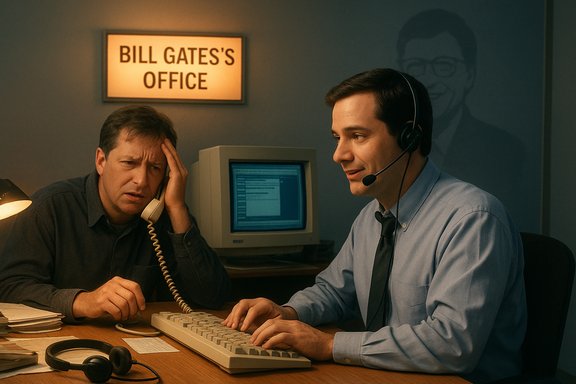
Microsoft support once used a remarkably simple social trick to calm furious customers: transfer them to a line labelled, to callers, as “Bill Gates’s office,” collect their complaint, and promise a follow-up that began with the words, “Bill Gates asked me to contact you.” The result was the Gates effect — the soothing illusion of escalation that left both caller and company satisfied without necessarily involving the CEO. Raymond Chen, longtime Microsoft engineer and author of the Old New Thing blog, has published a firsthand account of the procedure as told to him by a former product‑support colleague, and the anecdote has since been recirculated by wider tech press.
Microsoft’s customer‑facing scale in the 1990s and 2000s placed enormous pressure on product support to resolve critical business problems quickly. In that environment, the psychological value of perceived escalation could be as important as a concrete escalation path: when a frustrated customer believed the complaint had reached the company’s top, the incentives to be patient and cooperative rose sharply. Raymond Chen’s account describes this dynamic and outlines the practical mechanics that support teams used to create it. A separate anecdote from the same era illustrates how unusually direct contact could sometimes produce rapid results: a 1996 incident in which an irate administrator emailed [email protected] about an Excel interoperability bug and was reportedly contacted within hours by a Microsoft engineer and provided with a fix within 48 hours. That story — retold by readers, forums and press — shows that executive aliases and privileged routing were real levers during that period. Contemporary retellings of the event appear in mainstream outlets repeating the same chronology.
Historically, however, Microsoft and other firms did expose executive aliases in internal mail trails and litigation exhibits, proving the alias and related mail routing were real infrastructure artifacts. Public antitrust exhibits and internal email indexes include references to “billg” aliases, demonstrating that executive aliases were part of company communications in the 1990s. Those records corroborate the infrastructure side of these anecdotes even if they do not prove personal involvement.
Today, however, the same technique would be far less feasible and far riskier. Scale, automation, regulatory scrutiny and an expectation of auditable action have replaced the old levers. That does not mean human judgment and targeted executive engagement are obsolete; it means those interventions must be transparent, documented and designed so that the promise of escalation equals actual, measurable follow‑through.
Raymond Chen’s account preserves a useful story for IT professionals: sometimes the right customer outcome is achieved not by changing code, but by changing the narrative the customer receives — but those narratives must be used responsibly, with clear boundaries and verifiable commitments.
The Gates effect will remain a memorable lesson in customer psychology and operational ingenuity: a small, theatrical trick that delivered outsized returns in goodwill. It is worth remembering both for its craft and for the caution it imparts about substituting perceived attention for genuine accountability.
Source: theregister.com How Microsoft provided customers with the Gates effect
 Background
Microsoft’s customer‑facing scale in the 1990s and 2000s placed enormous pressure on product support to resolve critical business problems quickly. In that environment, the psychological value of perceived escalation could be as important as a concrete escalation path: when a frustrated customer believed the complaint had reached the company’s top, the incentives to be patient and cooperative rose sharply. Raymond Chen’s account describes this dynamic and outlines the practical mechanics that support teams used to create it. A separate anecdote from the same era illustrates how unusually direct contact could sometimes produce rapid results: a 1996 incident in which an irate administrator emailed [email protected] about an Excel interoperability bug and was reportedly contacted within hours by a Microsoft engineer and provided with a fix within 48 hours. That story — retold by readers, forums and press — shows that executive aliases and privileged routing were real levers during that period. Contemporary retellings of the event appear in mainstream outlets repeating the same chronology. Anatomy of the Gates effect
What support agents actually did
- The support technician attempted standard troubleshooting and issued apologies for unsatisfactory outcomes.
- If the customer continued to demand escalation to the CEO, the call was transferred to a special internal phone number routed to an operator trained to answer, “Bill Gates’s office.”
- The operator took a message, recorded the complaint and contact details, and marked the case for a follow‑up.
- The follow‑up was routed back into product support with instructions that the callback begin with the phrase, “Bill Gates asked me to contact you to follow up on an issue you had earlier.”
Why it worked
- The approach exploited authority cues: referencing a high‑status individual triggers compliance and reduces the perceived need for further escalation.
- It provided a clean, consistent script to support agents for cases where technical resolution stalled but customer emotions were the main obstacle.
- It preserved internal bandwidth: the CEO and senior executives were spared direct involvement while the appearance of attention satisfied the customer.
Verification and provenance
The core account comes from Raymond Chen’s Old New Thing blog entry, published by Microsoft’s developer blog, where Chen explicitly relates the anecdote and the exact phrasing used by operators. That primary account supplies the procedural detail and Chen’s own caveat that he had no direct evidence Bill Gates ever read the messages routed to that alias. Independent reporting captured the same anecdote and amplified the story to a broader technical readership; The Register’s coverage summarized Chen’s recollection and added context about contemporary support realities, while other outlets repeated the 1996 [email protected] Excel anecdote that underlines how reachable top executives could sometimes be (or at least appear to be) in that period. These corroborating accounts provide two independent attestations of the practice and its era. Note: whether Bill Gates personally reviewed any specific messages sent to the billg alias is not verifiable from public records. Chen himself treats that as an assumption. Anyone linking the “Gates effect” to direct CEO awareness should treat that as unproven.The playbook: social engineering for customer care
The Gates effect is essentially a formalized social engineering technique used internally for customer relations rather than for intrusion. It rests on a few deliberate choices:- Labeling the special line so operators could convincingly perform the role of an executive’s assistant.
- Scripting the operator and the callback so that callers consistently received the same reassurance and subsequent follow‑up.
- Routing the details back into product support but changing the opening line of the callback to imply direct executive involvement: “Bill Gates asked me to call.”
Ethical, legal and reputational considerations
The ethical edge
The Gates effect deliberately creates the impression of executive attention while often withholding actual CEO involvement. That raises two distinct ethical questions:- Is it acceptable for a company to pretend that an executive instructed follow‑up when they did not? From a purely customer‑relations perspective, the intent is remediation and de‑escalation, not deception for profit. That matters: the practice’s goal is to resolve an urgent customer problem, not to misrepresent product capability.
- Could the same technique be abused? If a firm used such scripted escalations to placate regulatory complainants or to avoid documentation trails, the practice would cross into problematic territory.
Legal and compliance angle
There is little evidence that employing a scripted “executive” callback violated consumer‑protection or corporate‑governance rules in the era described. However, modern regulatory environments place a higher premium on accurate disclosures, notarized escalation records, and audit trails. A scripted pass‑off that caused a materially false representation — for example, signaling that an executive had authorized a refund or a contractual change when they had not — could create legal exposure today.Historically, however, Microsoft and other firms did expose executive aliases in internal mail trails and litigation exhibits, proving the alias and related mail routing were real infrastructure artifacts. Public antitrust exhibits and internal email indexes include references to “billg” aliases, demonstrating that executive aliases were part of company communications in the 1990s. Those records corroborate the infrastructure side of these anecdotes even if they do not prove personal involvement.
Why the Gates effect belongs more to the past
Scale, automation and contact channels
Microsoft in the 1990s and early 2000s was large, but it was still possible for a tiny number of privileged internal routes to produce outsized customer outcomes. Today’s Microsoft is orders of magnitude larger, globally distributed, and instrumented with automated routing, cloud telephony, and AI‑driven front ends. Those changes make the old playbook hard to replicate:- The volume of incoming queries is far higher, so privileged aliases or internal phone numbers that once worked as human shortcuts would not scale without significant staffing.
- Automated routing and case‑management systems record and route issues in ways that favor programmatic SLAs over ad hoc human intervention.
- Executive time is commodified into fewer, higher‑value interventions, and the optics of personal executive outreach are managed with far more scrutiny.
The AI and Copilot era
The combination of scale and the rise of AI has also changed expectations and mechanics. Microsoft’s productization of Copilot and agentic features, and the resulting complexity, have forced a different support model where telemetry, automated diagnostics and role‑based escalation rules are used to route critical issues. WindowsForum community discussions and analysis published on internal partner program changes highlight the company’s shift to programmatic governance and telemetry as the main way to prioritize incidents — not the charismatic stick of “ask for the CEO.” Those community analyses argue the human touch is constrained by the need for reproducible, auditable operational responses in modern cloud and AI services.Costs, benefits and operational risks
What Microsoft gained
- Rapid emotional de‑escalation of otherwise fraught customer contacts.
- A consistent, low‑resource tactic to protect brand perception for high‑value customers.
- Faster conversion of angry callers into cooperative partners for troubleshooting.
What the company risked
- Potential erosion of trust if customers discovered the call had never reached the executive.
- The practice relied on disciplined internal controls; poor implementation could allow critical cases to be logged with insufficient follow‑through.
- Modern compliance regimes could construe misleading escalation claims as deceptive, particularly if they impacted contractual outcomes.
Lessons for IT leaders and customers
For IT and vendor management teams
- Document escalation paths clearly and ensure actual executive involvement when promises are made that affect contracts, SLAs, refunds or legal outcomes.
- Use authority cues ethically: if a message is phrased as being “from” an executive, confirm there is a documented chain of responsibility for any commitments made in that context.
- Design customer‑experience workflows that scale emotional reassurance without fabricating executive attention: proactive status updates, named senior contacts for enterprise customers, and guaranteed response windows do the same job transparently.
For customers
- Naming an executive or emailing a high‑profile alias can still accelerate attention in some vendors, but outcomes depend on customer value, contract stage, and the vendor’s incident‑management discipline.
- Escalation rhetoric is useful tactically, but insist on concrete deliverables — ticket numbers, deadlines, or written remediation plans — not just verbal assurances that “someone senior will call.”
- Keep records of communications and request written confirmation for any commitments made during callbacks.
The performative leadership paradox
The Gates effect exposes a broader truth about service design: perception of attention often matters as much as actual attention. Companies with limited senior‑executive time nonetheless want to transmit a signal of accountability when stakes are high. The trick used by Microsoft in the Chen anecdote was effective precisely because it preserved both honesty in intent (fix the problem) and operational efficiency (don’t over‑commit the executive). The ethical boundary is crossed only when the performance substitutes for substantive commitments that carry legal or contractual weight.Final analysis: charm, not a sustainable model
The Gates effect is an elegant behavioral hack from a different corporate era — one in which direct channels and privileged internal routing could be used to produce disproportionate returns in customer satisfaction. It worked because it relied on human psychology and modest internal coordination rather than on extraordinary technical fixes.Today, however, the same technique would be far less feasible and far riskier. Scale, automation, regulatory scrutiny and an expectation of auditable action have replaced the old levers. That does not mean human judgment and targeted executive engagement are obsolete; it means those interventions must be transparent, documented and designed so that the promise of escalation equals actual, measurable follow‑through.
Raymond Chen’s account preserves a useful story for IT professionals: sometimes the right customer outcome is achieved not by changing code, but by changing the narrative the customer receives — but those narratives must be used responsibly, with clear boundaries and verifiable commitments.
The Gates effect will remain a memorable lesson in customer psychology and operational ingenuity: a small, theatrical trick that delivered outsized returns in goodwill. It is worth remembering both for its craft and for the caution it imparts about substituting perceived attention for genuine accountability.
Source: theregister.com How Microsoft provided customers with the Gates effect
