

Telltale Games and PM Studios used Summer Game Fest 2026 to reintroduce The Wolf Among Us 2 with a 2027 release window, while also announcing The Wolf Among Us Remastered for Holiday 2026 on modern consoles and PC. The news matters less because a trailer exists than because this particular sequel had become a test case for whether revived studios can turn nostalgia into shipping software. For fans, Bigby Wolf is back; for the industry, the harder question is whether Telltale can make a second comeback feel more solid than the first.
There was a time when The Wolf Among Us 2 felt like a safe bet. The first game, released episodically in 2013 and 2014, arrived during Telltale’s high-water mark, when the studio had turned licensed narrative adventures into a recognizable house style. It was noir, comic-book pulp, and branching dialogue wrapped in a five-episode structure that suited the era’s appetite for downloadable storytelling.
Then the ground moved. Telltale’s original incarnation collapsed in 2018, taking projects, staff, and player confidence down with it. The studio name later returned under new ownership, and The Wolf Among Us 2 was announced again in 2019, but that revival came with a burden most game announcements do not carry: it had to convince people not only that the game was real, but that the institution promising it could survive long enough to finish it.
That is why the Summer Game Fest reveal landed differently from a normal trailer drop. It was not merely a marketing beat. It was an attempt to reset the emotional contract between Telltale and an audience that has learned, reasonably, to treat long-silent projects as vapor until proven otherwise.
The announcement did not erase that skepticism. A 2027 window is still a window, and windows move. But it did change the status of The Wolf Among Us 2 from a lingering obligation to an active product with a visible publishing plan, a companion remaster, and a renewed public timetable.
The original game’s power was never that it reinvented interactivity. It was that it understood tone. Fabletown’s magic worked because it was shabby, bureaucratic, and exhausted; fairy-tale figures were not presented as shiny mythology but as damaged immigrants trying to survive under neon, rent pressure, and old grudges.
The sequel’s trailer appears designed to reassure viewers that this texture has not been lost. Bigby is still framed as a reluctant instrument of order in a community that distrusts him. The colors still lean into hard shadows and urban glow. The premise still lives somewhere between detective fiction and dark fantasy, which is exactly where the first game found its identity.
That is not a small thing after a long development gap. Games that spend years in limbo often return looking overproduced, overexplained, or oddly detached from the thing people originally loved. The smartest part of this reveal was its restraint: it did not try to prove that The Wolf Among Us 2 had become something grander. It tried to prove that it had not become something else.
That age gap matters. The original Telltale model depended on habit and momentum. Players followed episodes, discussed choices, and carried memory from one release to the next. A sequel arriving in 2027 cannot assume that same communal memory still exists.
The remaster gives Telltale and PM Studios a way to rebuild the audience before asking it to care about a sequel. It puts Bigby, Snow, Fabletown, and the rules of the world back into circulation at the moment when they need to feel current again. It also provides a lower-risk proving ground for how this partnership presents The Wolf Among Us on modern hardware and storefronts.
Holiday 2026 is a useful slot for that reason. If the remaster lands well, it creates a runway into the sequel. If it stumbles, it will raise hard questions before the main event. Either way, it turns the franchise’s return into a two-step campaign rather than a single leap of faith.
That tension hangs over The Wolf Among Us 2. The project has been announced, delayed, reintroduced, and discussed for so long that it can no longer be judged only as a sequel. It has become a referendum on whether the revived Telltale can deliver the kind of carefully paced narrative game that made the name valuable in the first place.
The partnership with PM Studios is therefore not a footnote. It suggests a more deliberate production and publishing structure around a project that badly needed one. The public details remain limited, and nobody outside the companies should pretend to know how responsibility is divided behind the scenes, but the practical message is clear enough: Telltale is no longer asking audiences to believe on the strength of its name alone.
That is wise. In 2026, the Telltale name opens the door, but it does not close the sale. Players have seen too many resurrected brands, spiritual successors, and delayed revivals arrive in compromised form. The sequel will need to be judged by execution, not sentiment.
Troubled development cycles do not automatically doom games. Some projects survive resets and emerge stronger because the extra time allowed teams to rebuild around a clearer vision. Others keep slipping because the fundamental problems were never solved. The public cannot know which category The Wolf Among Us 2 belongs to yet.
What we can say is that the new reveal looks more coordinated than a token reminder that the game still exists. The sequel, the remaster, the PM Studios partnership, and the renewed franchise language all point to a campaign rather than a defensive statement. That is a better sign than a lone teaser dropped into the void.
Still, caution is healthy. “Coming in 2027” gives Telltale room, but it also creates a new clock. After years of silence, the studio has moved from absence to expectation, and expectation is where the pressure begins.
That balance is essential. The Wolf Among Us works when its fairy-tale references are not just winks. The characters need to feel like people living with myth as a burden, not mascots pulled into a detective plot. The first game understood that Bigby was compelling because he was both the Big Bad Wolf and a tired cop trying not to become the worst version of himself.
The sequel’s premise appears to preserve that contradiction. A criminal organization drawn from Oz lore gives the writers a new faction to explore without abandoning the original’s central idea: Fabletown is a place where old stories become modern problems. If handled well, the Oz Gang can widen the world without turning it into a parade of recognizable names.
That is the danger with any sequel built on beloved source material. The temptation is to go broader, louder, and more referential. The opportunity is to go deeper, using a new case to examine power, fear, and loyalty in a community that has always survived by lying to itself.
That does not mean The Wolf Among Us 2 needs to reinvent itself. In fact, chasing every modern trend would probably be a mistake. But the sequel does need to understand that players are more literate now about the illusion of choice, the limits of branching structures, and the difference between meaningful consequence and cosmetic variation.
The original Telltale games often thrived on emotional immediacy rather than mechanical depth. The countdown timer, the hard dialogue choice, the relationship shift, the end-of-episode comparison screen — these were tools for making players feel implicated. They did not always produce radically different storylines, but they often produced different feelings about the same story.
That model can still work, but it needs precision. If The Wolf Among Us 2 leans too heavily on old patterns, it may feel preserved rather than revived. If it abandons them entirely, it risks losing the identity people waited for. The challenge is not to modernize Telltale out of recognition, but to make its old grammar feel intentional again.
The PC release also raises practical questions that will become more important closer to launch. Remasters of narrative games are not judged only by higher-resolution art. They are judged by stability, ultrawide behavior, input handling, cloud saves, controller support, frame pacing, accessibility options, and whether older design choices feel awkward on modern displays.
For the sequel, PC expectations will be higher still. A cinematic adventure game does not need cutting-edge rendering to satisfy its audience, but it does need to feel polished. Nothing punctures noir atmosphere faster than stutter, broken subtitle timing, poor audio mixing, or inconsistent save behavior.
This is where the remaster may serve as a useful test. If The Wolf Among Us Remastered arrives with careful PC implementation, it will build confidence in the sequel’s technical stewardship. If it feels perfunctory, the 2027 window will look more fragile.
That kind of absence creates risk, because memory edits out flaws. The original game had technical rough edges, uneven pacing, and the usual Telltale constraints. A sequel arriving after more than a decade will be compared not only with the game that shipped, but with the version fans have carried in their heads.
At the same time, the gap gives Telltale room to turn the return into an event. Bigby’s reappearance is not just another sequel beat; it is a cultural callback to a particular moment in narrative gaming. The remaster can capitalize on that nostalgia while giving new players a cleaner entry point.
The smartest path is to acknowledge the past without becoming trapped by it. The Wolf Among Us 2 does not need to pretend the last decade did not happen. It needs to show that the qualities people remember — voice, mood, character, consequence — can survive in a different industry.
Publishing partnerships do not magically solve development problems. They can, however, provide schedule discipline, production support, marketing coordination, and platform management — all the unglamorous machinery that determines whether a game actually reaches players. For a narrative adventure, those factors matter as much as a sharp script.
The danger is that partnership language can become a substitute for clarity. Fans still need to see gameplay, understand the release model, and learn whether the sequel will arrive as a complete package or follow some version of Telltale’s episodic tradition. The announcement restored visibility, but it did not answer every operational question.
Even so, the paired reveal of remaster and sequel feels like a stronger posture than the franchise has had in years. Telltale is not simply saying “trust us.” It is laying out a sequence: revisit the original, rebuild the audience, then deliver the continuation.
The original game’s visual identity is already strong. Its comic-book framing, heavy shadows, and saturated nighttime palette do not require photorealism. In fact, over-cleaning the look could work against it. The remaster’s job should be to make the art read better on modern displays without sanding away the stylization that made it memorable.
The announced extras and behind-the-scenes material could help distinguish the package. For longtime fans, production context matters because The Wolf Among Us sits at the intersection of Telltale’s creative peak and the instability that followed. For newcomers, extra material is less important than a frictionless first playthrough, but it can still frame the game as a significant work rather than old content being resold.
The best remasters feel like acts of curation. They know what to preserve, what to repair, and what to leave alone. If Telltale and PM Studios understand that, the remaster can do more than warm up the audience; it can reestablish why this series deserved a second life.
After years of delay, the sequel faces an additional challenge: it must earn suspense inside the game after exhausting suspense outside of it. Fans have already spent years wondering whether the project would survive. Once it launches, the story cannot rely on mere relief that it exists.
That means the writing has to be sharp from the opening scene. Bigby’s return cannot be treated as applause bait for too long. Fabletown needs new pressures, not just familiar faces. The Oz Gang needs to feel like a force with motives and consequences, not simply a lore expansion.
The first game’s best moments came when mythic identity collided with mundane compromise. A good sequel will remember that the wolf is interesting because he is trying not to be a monster. A weaker sequel will settle for telling us he is cool.
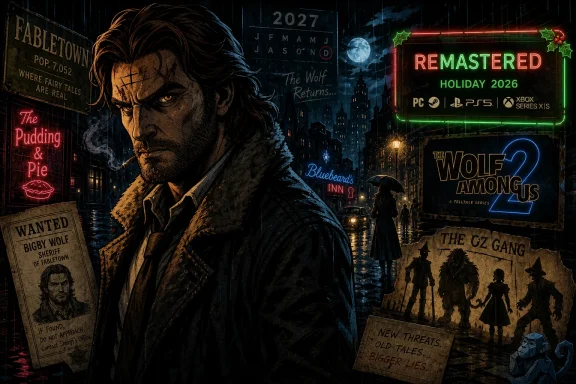 Bigby Wolf Returns to a Different Games Business
There was a time when The Wolf Among Us 2 felt like a safe bet. The first game, released episodically in 2013 and 2014, arrived during Telltale’s high-water mark, when the studio had turned licensed narrative adventures into a recognizable house style. It was noir, comic-book pulp, and branching dialogue wrapped in a five-episode structure that suited the era’s appetite for downloadable storytelling.Then the ground moved. Telltale’s original incarnation collapsed in 2018, taking projects, staff, and player confidence down with it. The studio name later returned under new ownership, and The Wolf Among Us 2 was announced again in 2019, but that revival came with a burden most game announcements do not carry: it had to convince people not only that the game was real, but that the institution promising it could survive long enough to finish it.
That is why the Summer Game Fest reveal landed differently from a normal trailer drop. It was not merely a marketing beat. It was an attempt to reset the emotional contract between Telltale and an audience that has learned, reasonably, to treat long-silent projects as vapor until proven otherwise.
The announcement did not erase that skepticism. A 2027 window is still a window, and windows move. But it did change the status of The Wolf Among Us 2 from a lingering obligation to an active product with a visible publishing plan, a companion remaster, and a renewed public timetable.
The Trailer Was Selling Continuity, Not Mechanics
The new footage was striking for what it chose not to emphasize. This was not a systems-heavy demonstration, a combat breakdown, or a deep dive into dialogue architecture. It was a mood piece, and for The Wolf Among Us, that may have been the correct first move.The original game’s power was never that it reinvented interactivity. It was that it understood tone. Fabletown’s magic worked because it was shabby, bureaucratic, and exhausted; fairy-tale figures were not presented as shiny mythology but as damaged immigrants trying to survive under neon, rent pressure, and old grudges.
The sequel’s trailer appears designed to reassure viewers that this texture has not been lost. Bigby is still framed as a reluctant instrument of order in a community that distrusts him. The colors still lean into hard shadows and urban glow. The premise still lives somewhere between detective fiction and dark fantasy, which is exactly where the first game found its identity.
That is not a small thing after a long development gap. Games that spend years in limbo often return looking overproduced, overexplained, or oddly detached from the thing people originally loved. The smartest part of this reveal was its restraint: it did not try to prove that The Wolf Among Us 2 had become something grander. It tried to prove that it had not become something else.
The Remaster Is Not Just Fan Service
Announcing The Wolf Among Us Remastered alongside the sequel might look like a straightforward nostalgia play, but it is more strategic than that. The first game is now more than a decade old. For a large portion of today’s console and PC audience, it is not a beloved classic they remember fondly; it is a name they have heard from people who were there.That age gap matters. The original Telltale model depended on habit and momentum. Players followed episodes, discussed choices, and carried memory from one release to the next. A sequel arriving in 2027 cannot assume that same communal memory still exists.
The remaster gives Telltale and PM Studios a way to rebuild the audience before asking it to care about a sequel. It puts Bigby, Snow, Fabletown, and the rules of the world back into circulation at the moment when they need to feel current again. It also provides a lower-risk proving ground for how this partnership presents The Wolf Among Us on modern hardware and storefronts.
Holiday 2026 is a useful slot for that reason. If the remaster lands well, it creates a runway into the sequel. If it stumbles, it will raise hard questions before the main event. Either way, it turns the franchise’s return into a two-step campaign rather than a single leap of faith.
Telltale’s Name Still Carries Both Affection and Baggage
The difficulty for modern Telltale is that its brand means two contradictory things at once. To many players, it still evokes some of the most memorable choice-driven games of the 2010s: The Walking Dead, The Wolf Among Us, Tales from the Borderlands, and others. To others, it evokes overextension, aging technology, uneven production, and the brutal collapse of a studio whose output often seemed larger than its business could support.That tension hangs over The Wolf Among Us 2. The project has been announced, delayed, reintroduced, and discussed for so long that it can no longer be judged only as a sequel. It has become a referendum on whether the revived Telltale can deliver the kind of carefully paced narrative game that made the name valuable in the first place.
The partnership with PM Studios is therefore not a footnote. It suggests a more deliberate production and publishing structure around a project that badly needed one. The public details remain limited, and nobody outside the companies should pretend to know how responsibility is divided behind the scenes, but the practical message is clear enough: Telltale is no longer asking audiences to believe on the strength of its name alone.
That is wise. In 2026, the Telltale name opens the door, but it does not close the sale. Players have seen too many resurrected brands, spiritual successors, and delayed revivals arrive in compromised form. The sequel will need to be judged by execution, not sentiment.
The 2027 Window Is Encouraging, but It Is Not a Promise Carved in Stone
A 2027 release target is meaningful because it places The Wolf Among Us 2 back on the calendar. It is not the same as a release date. That distinction matters, especially for a project with this much history.Troubled development cycles do not automatically doom games. Some projects survive resets and emerge stronger because the extra time allowed teams to rebuild around a clearer vision. Others keep slipping because the fundamental problems were never solved. The public cannot know which category The Wolf Among Us 2 belongs to yet.
What we can say is that the new reveal looks more coordinated than a token reminder that the game still exists. The sequel, the remaster, the PM Studios partnership, and the renewed franchise language all point to a campaign rather than a defensive statement. That is a better sign than a lone teaser dropped into the void.
Still, caution is healthy. “Coming in 2027” gives Telltale room, but it also creates a new clock. After years of silence, the studio has moved from absence to expectation, and expectation is where the pressure begins.
The Oz Gang Gives the Sequel a Cleaner Hook
The new story outline puts Bigby Wolf back in the role that suits him best: sheriff, investigator, enforcer, and uneasy participant in Fabletown’s damaged social order. The mention of a criminal underground and the growing influence of the Oz Gang is a smart narrative signal. It points to a case with recognizable fantasy DNA but enough noir machinery to keep the story grounded.That balance is essential. The Wolf Among Us works when its fairy-tale references are not just winks. The characters need to feel like people living with myth as a burden, not mascots pulled into a detective plot. The first game understood that Bigby was compelling because he was both the Big Bad Wolf and a tired cop trying not to become the worst version of himself.
The sequel’s premise appears to preserve that contradiction. A criminal organization drawn from Oz lore gives the writers a new faction to explore without abandoning the original’s central idea: Fabletown is a place where old stories become modern problems. If handled well, the Oz Gang can widen the world without turning it into a parade of recognizable names.
That is the danger with any sequel built on beloved source material. The temptation is to go broader, louder, and more referential. The opportunity is to go deeper, using a new case to examine power, fear, and loyalty in a community that has always survived by lying to itself.
Choice-Based Games Have Changed While Bigby Was Away
When the first Wolf Among Us arrived, Telltale’s formula was one of the most visible forms of narrative choice in mainstream games. By 2026, the landscape is different. Players have had years of cinematic prestige games, choice-heavy RPGs, visual novels, immersive sims, and indie narrative experiments that have pushed expectations in different directions.That does not mean The Wolf Among Us 2 needs to reinvent itself. In fact, chasing every modern trend would probably be a mistake. But the sequel does need to understand that players are more literate now about the illusion of choice, the limits of branching structures, and the difference between meaningful consequence and cosmetic variation.
The original Telltale games often thrived on emotional immediacy rather than mechanical depth. The countdown timer, the hard dialogue choice, the relationship shift, the end-of-episode comparison screen — these were tools for making players feel implicated. They did not always produce radically different storylines, but they often produced different feelings about the same story.
That model can still work, but it needs precision. If The Wolf Among Us 2 leans too heavily on old patterns, it may feel preserved rather than revived. If it abandons them entirely, it risks losing the identity people waited for. The challenge is not to modernize Telltale out of recognition, but to make its old grammar feel intentional again.
Windows and PC Players Are Part of the Core Audience, Not an Afterthought
For WindowsForum readers, the PC side of this announcement is not incidental. The Wolf Among Us 2 is targeting PC through major storefronts, and the remaster is also expected to arrive on PC alongside current console platforms. That matters because Telltale’s audience has always been unusually broad across platforms, with PC players forming a central part of the studio’s episodic history.The PC release also raises practical questions that will become more important closer to launch. Remasters of narrative games are not judged only by higher-resolution art. They are judged by stability, ultrawide behavior, input handling, cloud saves, controller support, frame pacing, accessibility options, and whether older design choices feel awkward on modern displays.
For the sequel, PC expectations will be higher still. A cinematic adventure game does not need cutting-edge rendering to satisfy its audience, but it does need to feel polished. Nothing punctures noir atmosphere faster than stutter, broken subtitle timing, poor audio mixing, or inconsistent save behavior.
This is where the remaster may serve as a useful test. If The Wolf Among Us Remastered arrives with careful PC implementation, it will build confidence in the sequel’s technical stewardship. If it feels perfunctory, the 2027 window will look more fragile.
The Franchise’s Long Absence May Help More Than It Hurts
There is a strange advantage in being gone this long: the audience has had time to miss the thing rather than merely expect more of it. The Wolf Among Us did not get annualized, overextended, or diluted into a dozen connected products. It became a cult object, preserved in memory as one of the sharpest expressions of Telltale’s strengths.That kind of absence creates risk, because memory edits out flaws. The original game had technical rough edges, uneven pacing, and the usual Telltale constraints. A sequel arriving after more than a decade will be compared not only with the game that shipped, but with the version fans have carried in their heads.
At the same time, the gap gives Telltale room to turn the return into an event. Bigby’s reappearance is not just another sequel beat; it is a cultural callback to a particular moment in narrative gaming. The remaster can capitalize on that nostalgia while giving new players a cleaner entry point.
The smartest path is to acknowledge the past without becoming trapped by it. The Wolf Among Us 2 does not need to pretend the last decade did not happen. It needs to show that the qualities people remember — voice, mood, character, consequence — can survive in a different industry.
PM Studios Gives the Comeback a More Concrete Shape
PM Studios’ involvement is one of the more consequential parts of the announcement because it suggests that The Wolf Among Us is being positioned as more than a one-off resurrection. The company is attached to both the sequel and the remaster, giving the franchise return a joined-up structure. That is particularly important for a brand whose recent history has been defined by uncertainty.Publishing partnerships do not magically solve development problems. They can, however, provide schedule discipline, production support, marketing coordination, and platform management — all the unglamorous machinery that determines whether a game actually reaches players. For a narrative adventure, those factors matter as much as a sharp script.
The danger is that partnership language can become a substitute for clarity. Fans still need to see gameplay, understand the release model, and learn whether the sequel will arrive as a complete package or follow some version of Telltale’s episodic tradition. The announcement restored visibility, but it did not answer every operational question.
Even so, the paired reveal of remaster and sequel feels like a stronger posture than the franchise has had in years. Telltale is not simply saying “trust us.” It is laying out a sequence: revisit the original, rebuild the audience, then deliver the continuation.
The Remaster Has to Justify Its Existence Beyond Resolution
The phrase “remaster” has become slippery. Sometimes it means a careful restoration with improved assets, modernized interfaces, and thoughtful preservation. Sometimes it means a higher-resolution wrapper around a game whose underlying issues remain intact. The Wolf Among Us Remastered will need to land closer to the former.The original game’s visual identity is already strong. Its comic-book framing, heavy shadows, and saturated nighttime palette do not require photorealism. In fact, over-cleaning the look could work against it. The remaster’s job should be to make the art read better on modern displays without sanding away the stylization that made it memorable.
The announced extras and behind-the-scenes material could help distinguish the package. For longtime fans, production context matters because The Wolf Among Us sits at the intersection of Telltale’s creative peak and the instability that followed. For newcomers, extra material is less important than a frictionless first playthrough, but it can still frame the game as a significant work rather than old content being resold.
The best remasters feel like acts of curation. They know what to preserve, what to repair, and what to leave alone. If Telltale and PM Studios understand that, the remaster can do more than warm up the audience; it can reestablish why this series deserved a second life.
The Real Test Is Whether Telltale Can Earn Suspense Again
The original Wolf Among Us succeeded because players cared about what Bigby would do next. That is a deceptively simple achievement. It required pacing, character writing, voice performance, art direction, and choice design to pull in the same direction.After years of delay, the sequel faces an additional challenge: it must earn suspense inside the game after exhausting suspense outside of it. Fans have already spent years wondering whether the project would survive. Once it launches, the story cannot rely on mere relief that it exists.
That means the writing has to be sharp from the opening scene. Bigby’s return cannot be treated as applause bait for too long. Fabletown needs new pressures, not just familiar faces. The Oz Gang needs to feel like a force with motives and consequences, not simply a lore expansion.
The first game’s best moments came when mythic identity collided with mundane compromise. A good sequel will remember that the wolf is interesting because he is trying not to be a monster. A weaker sequel will settle for telling us he is cool.
The Wait Finally Has a Shape
The practical news is simple, but the implications are larger.- The Wolf Among Us Remastered is planned for Holiday 2026, giving new and returning players a route back into Fabletown before the sequel.
- The Wolf Among Us 2 is targeting 2027, which restores the long-delayed sequel to an active release calendar without providing a fixed launch date.
- PM Studios is now part of the franchise’s public production and publishing picture, giving the comeback a more stable-looking framework than years of silence suggested.
- The sequel’s current story pitch centers on Bigby Wolf, a criminal underground in Fabletown, and the rising influence of the Oz Gang.
- The new trailer appears designed to reassure fans about tone and identity rather than explain mechanics or release structure.
- The biggest remaining questions concern gameplay detail, technical execution, the release model, and whether the remaster can rebuild trust before the sequel arrives.
References
- Primary source: NoobFeed
Published: 2026-06-07T00:22:07.008813
The Wolf Among Us 2 Finally Returns After Years of Silence | NoobFeed
For years, The Wolf Among Us 2 felt like one of those games that existed more as a promise than a reality. It became a familiar name whenever people discusse...www.noobfeed.com - Related coverage: gematsu.com
The Wolf Among Us 2: A Telltale Series launches in 2027 for PS5, Xbox Series, Switch 2, Xbox One, Switch, and PC - Gematsu
The Wolf Among Us 2: A Telltale Series will launch for PlayStation 5, Xbox Series, Switch 2, Xbox One, Switch, and PC via Steam and Epic Games Store in 2027…www.gematsu.com - Related coverage: gamespot.com
The Wolf Among Us 2 Finally Reappears Alongside Remastered Original - GameSpot
Bigby Wolf is back.www.gamespot.com - Related coverage: pm-studios.com
- Related coverage: videogameschronicle.com
The Wolf Among Us 2 and a remaster of the original announced at Summer Game Fest 2026 | VGC
The Wolf Among Us 2 is coming in 2027, and The Wolf Among Us Remastered is coming Holiday 2026.www.videogameschronicle.com - Related coverage: gameinformer.com
The Wolf Among Us 2 Gets 2027 Launch Window, And A Remaster Of The First Game Arrives This Holiday
Bigby returns, again.gameinformer.com

- Related coverage: rpgfan.com
The Wolf Among Us 2 Finally Coming in 2027 & The Wolf Among Us Remastered Revealed | RPGFan
Extensive RPG coverage since 1998www.rpgfan.com
- Related coverage: gamesbeat.com
The Wolf Among Us 2 gets 2027 release window alongside remastered original - GamesBeat
Telltale Games revealed a new trailer and release window for The Wolf Among Us 2, as well as a remaster of the original game.gamesbeat.com - Related coverage: pcgamer.com
7 years after it was announced, The Wolf Among Us 2 is finally set to arrive—in 2027 | PC Gamer
A remastered version of the original Wolf Among Us is also coming later this, so you'll have something to do while you wait.www.pcgamer.com - Related coverage: gamesradar.com
The Wolf Among Us 2 finally releases in 2027, with a remaster of the original due out this holiday season | GamesRadar+
The Big Bad Wolf is back in town.www.gamesradar.com - Related coverage: pcmrace.com
The Wolf Among Us Remastered llegará en 2026 y The Wolf Among Us 2 en 2027 - Screenshots y Trailer | PC Master Race Latinoamérica
Telltale Games y PM Studios anunciaron el regreso de The Wolf Among Us por partida doble con The Wolf Among Us Remastered, una versión renovada del clásicowww.pcmrace.com - Related coverage: telltale.com
- Related coverage: psu.com
The Wolf Among Us 2 Re-emerges At Summer Game Fest With 2027 Release Window - PlayStation Universe
The Wolf Among Us 2 has received a new trailer, check it out here.www.psu.com
