

Technology Management Concepts announced in May 2026 that it has acquired PowerApps911, folding a specialist Microsoft Power Platform consulting and training firm into TMC’s broader Microsoft business applications practice. The deal is not just another channel roll-up. It is a bet that the next phase of Microsoft services will be won less by firms that merely deploy software and more by firms that can teach customers how to build, govern, and automate with it. For WindowsForum readers, the acquisition matters because Power Platform has become one of the places where Microsoft’s AI ambitions collide most directly with everyday enterprise operations.
TMC’s acquisition of PowerApps911 lands at a moment when Microsoft’s business applications story is expanding faster than many IT departments can absorb. Power Apps, Power Automate, Power BI, Power Pages, Dataverse, Copilot Studio, Microsoft Fabric, Azure AI, and Microsoft 365 Copilot are not separate islands anymore. They are increasingly presented as a single operational fabric for building apps, automating work, exposing data, and adding AI agents to business processes.
That is precisely why the deal is more interesting than its size. TMC was already a Microsoft-focused consulting organization with Dynamics 365, Business Central, CRM, Power Platform, Azure, data, and AI work in its portfolio. PowerApps911 adds a recognizably practitioner-led Power Platform brand, one known for training, hands-on consulting, and a large creator community. According to TMC’s own announcement, the acquisition brings certified professionals, more than 15,000 trained students, and the appointment of PowerApps911 co-founder Shane Young as TMC’s first chief AI officer TMC announcement.
That last detail is the tell. TMC did not simply buy a low-code shop and tuck it into a delivery unit. It attached the acquisition to an AI leadership role, making explicit what many Microsoft partners are now saying in quieter language: Power Platform is becoming an AI implementation surface.
The consulting pitch is no longer “we can build a form over your SharePoint list.” It is “we can help your organization decide which processes should become apps, which should become automations, which should become analytics workflows, and which should become governed AI agents.” That is a much more complicated services motion, and it is one that rewards firms with both delivery muscle and teaching credibility.
The company’s public site describes Power Platform consulting and training across Power Apps, Power Automate, Power BI, Power Pages, Copilot Studio, Copilot, SharePoint, Dataverse, and Fabric, and advertises more than 200 Power Platform projects, more than 500 mentoring customers, and more than 15,000 students worldwide PowerApps911. MSDynamicsWorld reported that PowerApps911 was founded in 2018 and had grown into a global company with more than 20 certified professionals working across six continents, while also building a YouTube audience with more than 27 million views MSDynamicsWorld.
Those numbers matter because low-code adoption usually fails in the messy middle. A pilot app can be built quickly. A departmental automation can save hours. But scaling low-code across a company requires governance, naming standards, data policies, environment strategy, lifecycle management, licensing discipline, and enough internal skill that every change does not require a ticket to an outside consultant.
That makes training a strategic asset rather than a side business. A partner that can teach a customer’s finance analyst, operations manager, or IT admin how to reason about Power Platform is in a better position to shape the customer’s long-term architecture. It becomes part vendor, part coach, part governance adviser.
PowerApps911’s reputation also gives TMC something difficult to manufacture: trust among makers. Microsoft’s partner ecosystem is full of firms that sound nearly identical in procurement decks. A community-facing training brand with recognizable instructors and a library of practical content can cut through that sameness, especially for customers who learned Power Apps through YouTube before they ever opened a statement of work.
Microsoft’s own 2026 release wave 1 plan shows how far the platform has moved beyond simple departmental app building. The plan covers Power Apps, Power Pages, Power Automate, Copilot Studio, Dataverse, and Power Platform governance and administration, with features arriving from April 2026 through September 2026 Microsoft Learn. Microsoft says the wave includes hundreds of new features, including expanded AI features in Power Apps, AI agent authoring and self-healing capabilities in Power Automate, deeper Copilot Studio governance, multi-agent orchestration, and new governance controls around agent security and usage visibility Microsoft Learn.
That is not a hobbyist platform. It is an enterprise software layer with production consequences.
The Windows admin angle is obvious. Power Platform touches Microsoft 365 identities, SharePoint data, Teams workflows, Dataverse environments, Azure services, and now Copilot and agent tooling. It can become a useful accelerator or a shadow-IT multiplier depending on how it is deployed. The difference is rarely the technology alone; it is the operating model around it.
This is where TMC’s acquisition looks less like opportunistic expansion and more like defensive positioning. If customers are going to ask for AI-enabled workflows, Power BI dashboards, Power Automate processes, and Copilot Studio agents in the same breath, a Microsoft partner cannot credibly respond with isolated teams that barely speak to one another. It needs a practice that understands the platform as an ecosystem.
Microsoft’s current product direction is to embed Copilot-style assistance and agentic workflows across the stack. Copilot Studio is described by Microsoft as a SaaS agent platform for building AI agents and agentic workflows, with managed security, governance, and operational controls intended to let enterprises adopt agents at scale Microsoft Learn. Power Automate’s 2026 wave includes AI agent authoring, optimization, self-healing desktop flows, and Copilot Studio-powered actions in cloud flows Microsoft Learn.
That makes “AI consulting” less of a standalone boutique offering and more of a wrapper around process automation. The enterprise question is not merely whether a chatbot can answer an employee’s question. It is whether AI can trigger an approval, update a customer record, pull from a governed data source, hand off to a human, preserve an audit trail, and avoid leaking sensitive information along the way.
Power Platform is one of Microsoft’s preferred answers to that question. It is also where the old low-code risks become AI risks. A poorly governed flow can already break a process. A poorly governed agent can break a process while giving users the impression that it understands more than it does.
TMC’s move suggests a recognition that the partner market is shifting from implementation to orchestration. Customers need help connecting the dots between Dynamics data, Microsoft 365 collaboration, Power Platform automations, Fabric analytics, and Azure AI services. The partner that can draw that map has a better chance of owning the account.
The pattern is familiar across the Microsoft channel. As Microsoft pushes customers toward integrated cloud, data, application, and AI platforms, partners are trying to assemble enough specialized capability to remain relevant. A firm that only knows ERP risks being boxed out of AI-led transformation work. A firm that only knows automation risks being boxed out when the customer’s data estate becomes the real bottleneck. A firm that only knows training risks being treated as an enablement vendor instead of a transformation partner.
The PowerApps911 deal helps TMC fill a gap that many Microsoft partners are now racing to close: credible Power Platform depth with a public teaching footprint. It is one thing to say “we support Power Platform.” It is another to inherit a team whose brand has been built around explaining Power Platform to administrators, business users, and makers.
There is also a geographic and scaling argument. TMC says PowerApps911 adds global reach and technical capability, while MSDynamicsWorld reported the company had professionals across six continents. In partner economics, that matters because Power Platform projects are often fragmented. One customer may need a short training engagement, another a full app build, another an automation audit, and another a governance overhaul. The delivery model has to be flexible enough to support all of those without treating every project like a traditional ERP implementation.
Power Apps and Power Automate solutions often begin as tactical fixes. Someone needs a replacement for a spreadsheet. A department needs an approval workflow. A process owner needs a dashboard. The first version may be excellent, but the organizational burden starts later: ownership changes, connectors are deprecated, permissions drift, data volumes grow, and users start depending on the app as if it were a formally engineered system.
That is why the Power Platform services market is maturing. The most valuable work is not always building the first app. It may be assessing the environment sprawl that followed the first hundred apps. It may be establishing data loss prevention policies, deciding when Dataverse is appropriate, documenting flows, aligning licensing with real usage, or moving a mission-critical workflow out of a personal maker account.
Microsoft has been investing accordingly. Its 2026 wave emphasizes governance and administration, including admin controls for agent security, risk assessment in Copilot Studio, visibility into usage patterns, Copilot credit consumption, connector dependencies, and application lifecycle management improvements Microsoft Learn. The company knows that broader adoption depends on convincing IT that low-code can be managed rather than merely tolerated.
This is where a partner like the combined TMC-PowerApps911 can make a concrete difference. The strategic sales pitch will be about AI and transformation. The day-to-day work will often be less glamorous: cleaning up environments, standardizing practices, training makers, and teaching administrators where the control planes actually are.
That makes partner capability important, but it also raises the standard for customer maturity. Buying consulting hours cannot substitute for internal ownership. If a company allows hundreds of apps and flows to proliferate without knowing who owns them, what data they touch, or which business process they control, no acquisition in the partner channel will save it.
The better model is shared responsibility. Business users can identify pain points and build lightweight solutions. IT can provide guardrails, environments, policies, and review processes. Professional developers can step in when requirements exceed the safe boundary of low-code. Partners can accelerate all of that, but they should not become the only people who understand the system.
PowerApps911’s training heritage is useful precisely because the Power Platform problem is cultural as much as technical. An enterprise does not just need apps; it needs a maker community that knows when to build, when to ask for help, and when to stop. It needs admins who understand the difference between enabling innovation and letting unmanaged automation become business-critical plumbing.
The first wave of AI adoption has been license-led. Organizations buy Microsoft 365 Copilot, experiment with Copilot Studio, test a few agents, and look for productivity wins. The second wave is harder. It involves process redesign, data readiness, governance, custom connectors, workflow automation, security review, training, and measurement. That is where services firms make their money.
TMC’s acquisition puts it in a stronger position for that second wave. PowerApps911 gives it credibility with the makers who build and maintain Power Platform solutions. TMC’s broader Microsoft practice gives it access to ERP, CRM, Azure, data, and AI projects. Together, the pitch becomes end-to-end: modernize the business system, expose the data, automate the workflow, build the app, train the users, and govern the agents.
There is, however, a risk hidden inside that ambition. The more complete the partner pitch becomes, the easier it is to blur the line between strategic guidance and platform dependence. Microsoft’s ecosystem rewards partners that keep customers inside Microsoft’s stack, and Power Platform is sticky by design. Once a company’s approvals, dashboards, apps, agents, and operational data flows are built around Microsoft services, switching costs rise.
That does not make the strategy wrong. For many enterprises already standardized on Microsoft 365, Entra ID, Teams, SharePoint, Dynamics, and Azure, Power Platform may be the most practical path to automation. But customers should enter these projects with eyes open. The convenience of integration is real; so is the gravity of lock-in.
Microsoft has put powerful tools in front of business users and administrators. It has also made those tools more complex by adding AI agents, deeper data integration, lifecycle controls, and consumption-based governance concerns. That creates a services market for firms that can reduce confusion without slowing adoption to a crawl.
For WindowsForum’s audience, the practical reading is straightforward:
That is good news for customers who have outgrown ad hoc Power Apps experiments and need a more disciplined operating model. It is also a warning to organizations still treating Power Platform as a harmless side channel for departmental tinkering. The tools are becoming more capable, more AI-infused, and more deeply connected to enterprise data. The partner ecosystem is reorganizing around that fact. The next competitive edge will not come from merely turning on Microsoft’s newest feature; it will come from knowing which features deserve to become part of the business, and which ones need a firmer hand before they do.
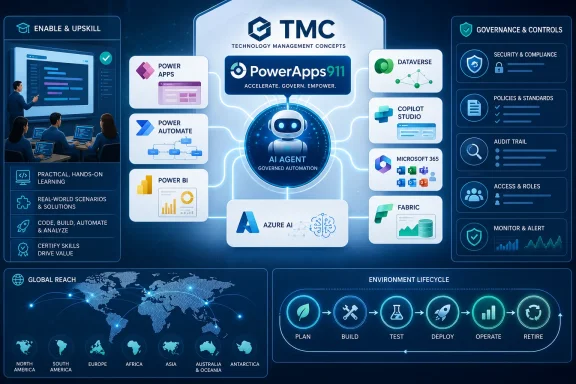 TMC Buys the Part of the Microsoft Stack Customers Still Struggle to Operate
TMC’s acquisition of PowerApps911 lands at a moment when Microsoft’s business applications story is expanding faster than many IT departments can absorb. Power Apps, Power Automate, Power BI, Power Pages, Dataverse, Copilot Studio, Microsoft Fabric, Azure AI, and Microsoft 365 Copilot are not separate islands anymore. They are increasingly presented as a single operational fabric for building apps, automating work, exposing data, and adding AI agents to business processes.That is precisely why the deal is more interesting than its size. TMC was already a Microsoft-focused consulting organization with Dynamics 365, Business Central, CRM, Power Platform, Azure, data, and AI work in its portfolio. PowerApps911 adds a recognizably practitioner-led Power Platform brand, one known for training, hands-on consulting, and a large creator community. According to TMC’s own announcement, the acquisition brings certified professionals, more than 15,000 trained students, and the appointment of PowerApps911 co-founder Shane Young as TMC’s first chief AI officer TMC announcement.
That last detail is the tell. TMC did not simply buy a low-code shop and tuck it into a delivery unit. It attached the acquisition to an AI leadership role, making explicit what many Microsoft partners are now saying in quieter language: Power Platform is becoming an AI implementation surface.
The consulting pitch is no longer “we can build a form over your SharePoint list.” It is “we can help your organization decide which processes should become apps, which should become automations, which should become analytics workflows, and which should become governed AI agents.” That is a much more complicated services motion, and it is one that rewards firms with both delivery muscle and teaching credibility.
PowerApps911 Brings a Training Engine, Not Just a Bench of Consultants
PowerApps911’s value to TMC is not only that it knows Power Apps. Lots of Microsoft partners can claim that. The stronger asset is that PowerApps911 has built a business around explaining the platform to the people who actually have to use it.The company’s public site describes Power Platform consulting and training across Power Apps, Power Automate, Power BI, Power Pages, Copilot Studio, Copilot, SharePoint, Dataverse, and Fabric, and advertises more than 200 Power Platform projects, more than 500 mentoring customers, and more than 15,000 students worldwide PowerApps911. MSDynamicsWorld reported that PowerApps911 was founded in 2018 and had grown into a global company with more than 20 certified professionals working across six continents, while also building a YouTube audience with more than 27 million views MSDynamicsWorld.
Those numbers matter because low-code adoption usually fails in the messy middle. A pilot app can be built quickly. A departmental automation can save hours. But scaling low-code across a company requires governance, naming standards, data policies, environment strategy, lifecycle management, licensing discipline, and enough internal skill that every change does not require a ticket to an outside consultant.
That makes training a strategic asset rather than a side business. A partner that can teach a customer’s finance analyst, operations manager, or IT admin how to reason about Power Platform is in a better position to shape the customer’s long-term architecture. It becomes part vendor, part coach, part governance adviser.
PowerApps911’s reputation also gives TMC something difficult to manufacture: trust among makers. Microsoft’s partner ecosystem is full of firms that sound nearly identical in procurement decks. A community-facing training brand with recognizable instructors and a library of practical content can cut through that sameness, especially for customers who learned Power Apps through YouTube before they ever opened a statement of work.
Microsoft Has Made Low-Code Too Important to Leave Ungoverned
For years, the Power Platform pitch leaned heavily on citizen development: business users could build the tools they needed without waiting for central IT. That was always half true and half dangerous. The same features that make low-code productive also make it easy to create sprawling, undocumented business logic outside normal application governance.Microsoft’s own 2026 release wave 1 plan shows how far the platform has moved beyond simple departmental app building. The plan covers Power Apps, Power Pages, Power Automate, Copilot Studio, Dataverse, and Power Platform governance and administration, with features arriving from April 2026 through September 2026 Microsoft Learn. Microsoft says the wave includes hundreds of new features, including expanded AI features in Power Apps, AI agent authoring and self-healing capabilities in Power Automate, deeper Copilot Studio governance, multi-agent orchestration, and new governance controls around agent security and usage visibility Microsoft Learn.
That is not a hobbyist platform. It is an enterprise software layer with production consequences.
The Windows admin angle is obvious. Power Platform touches Microsoft 365 identities, SharePoint data, Teams workflows, Dataverse environments, Azure services, and now Copilot and agent tooling. It can become a useful accelerator or a shadow-IT multiplier depending on how it is deployed. The difference is rarely the technology alone; it is the operating model around it.
This is where TMC’s acquisition looks less like opportunistic expansion and more like defensive positioning. If customers are going to ask for AI-enabled workflows, Power BI dashboards, Power Automate processes, and Copilot Studio agents in the same breath, a Microsoft partner cannot credibly respond with isolated teams that barely speak to one another. It needs a practice that understands the platform as an ecosystem.
The AI Label Is Becoming a Services Requirement
The appointment of Shane Young as TMC’s first chief AI officer is easy to dismiss as title inflation. It may also be one of the more commercially important parts of the announcement.Microsoft’s current product direction is to embed Copilot-style assistance and agentic workflows across the stack. Copilot Studio is described by Microsoft as a SaaS agent platform for building AI agents and agentic workflows, with managed security, governance, and operational controls intended to let enterprises adopt agents at scale Microsoft Learn. Power Automate’s 2026 wave includes AI agent authoring, optimization, self-healing desktop flows, and Copilot Studio-powered actions in cloud flows Microsoft Learn.
That makes “AI consulting” less of a standalone boutique offering and more of a wrapper around process automation. The enterprise question is not merely whether a chatbot can answer an employee’s question. It is whether AI can trigger an approval, update a customer record, pull from a governed data source, hand off to a human, preserve an audit trail, and avoid leaking sensitive information along the way.
Power Platform is one of Microsoft’s preferred answers to that question. It is also where the old low-code risks become AI risks. A poorly governed flow can already break a process. A poorly governed agent can break a process while giving users the impression that it understands more than it does.
TMC’s move suggests a recognition that the partner market is shifting from implementation to orchestration. Customers need help connecting the dots between Dynamics data, Microsoft 365 collaboration, Power Platform automations, Fabric analytics, and Azure AI services. The partner that can draw that map has a better chance of owning the account.
The Channel Is Consolidating Around Microsoft’s AI Gravity
TMC’s acquisition of PowerApps911 is not happening in isolation. In January 2026, TMC also acquired The TM Group, a Microsoft ERP and CRM partner, saying that deal would strengthen its ERP, CRM, Power Platform, cloud, data, automation, and AI capabilities Morningstar. By May, TMC’s own “about” page described TMC Global’s portfolio as including The TM Group and PowerApps911 TMC.The pattern is familiar across the Microsoft channel. As Microsoft pushes customers toward integrated cloud, data, application, and AI platforms, partners are trying to assemble enough specialized capability to remain relevant. A firm that only knows ERP risks being boxed out of AI-led transformation work. A firm that only knows automation risks being boxed out when the customer’s data estate becomes the real bottleneck. A firm that only knows training risks being treated as an enablement vendor instead of a transformation partner.
The PowerApps911 deal helps TMC fill a gap that many Microsoft partners are now racing to close: credible Power Platform depth with a public teaching footprint. It is one thing to say “we support Power Platform.” It is another to inherit a team whose brand has been built around explaining Power Platform to administrators, business users, and makers.
There is also a geographic and scaling argument. TMC says PowerApps911 adds global reach and technical capability, while MSDynamicsWorld reported the company had professionals across six continents. In partner economics, that matters because Power Platform projects are often fragmented. One customer may need a short training engagement, another a full app build, another an automation audit, and another a governance overhaul. The delivery model has to be flexible enough to support all of those without treating every project like a traditional ERP implementation.
Low-Code’s Next Problem Is Lifecycle, Not Legitimacy
The old debate over whether low-code is “real development” has become less useful. Enterprises are already using it. The better debate is whether the resulting applications and automations can survive contact with production reality.Power Apps and Power Automate solutions often begin as tactical fixes. Someone needs a replacement for a spreadsheet. A department needs an approval workflow. A process owner needs a dashboard. The first version may be excellent, but the organizational burden starts later: ownership changes, connectors are deprecated, permissions drift, data volumes grow, and users start depending on the app as if it were a formally engineered system.
That is why the Power Platform services market is maturing. The most valuable work is not always building the first app. It may be assessing the environment sprawl that followed the first hundred apps. It may be establishing data loss prevention policies, deciding when Dataverse is appropriate, documenting flows, aligning licensing with real usage, or moving a mission-critical workflow out of a personal maker account.
Microsoft has been investing accordingly. Its 2026 wave emphasizes governance and administration, including admin controls for agent security, risk assessment in Copilot Studio, visibility into usage patterns, Copilot credit consumption, connector dependencies, and application lifecycle management improvements Microsoft Learn. The company knows that broader adoption depends on convincing IT that low-code can be managed rather than merely tolerated.
This is where a partner like the combined TMC-PowerApps911 can make a concrete difference. The strategic sales pitch will be about AI and transformation. The day-to-day work will often be less glamorous: cleaning up environments, standardizing practices, training makers, and teaching administrators where the control planes actually are.
The Windows Shop Now Has to Think Like a Platform Team
For many Windows-centric IT teams, Power Platform sits in an awkward place. It is not traditional endpoint management. It is not classic server administration. It is not quite software development either. Yet it depends on identity, permissions, data access, Microsoft 365 configuration, and cloud governance—the very things IT is expected to protect.That makes partner capability important, but it also raises the standard for customer maturity. Buying consulting hours cannot substitute for internal ownership. If a company allows hundreds of apps and flows to proliferate without knowing who owns them, what data they touch, or which business process they control, no acquisition in the partner channel will save it.
The better model is shared responsibility. Business users can identify pain points and build lightweight solutions. IT can provide guardrails, environments, policies, and review processes. Professional developers can step in when requirements exceed the safe boundary of low-code. Partners can accelerate all of that, but they should not become the only people who understand the system.
PowerApps911’s training heritage is useful precisely because the Power Platform problem is cultural as much as technical. An enterprise does not just need apps; it needs a maker community that knows when to build, when to ask for help, and when to stop. It needs admins who understand the difference between enabling innovation and letting unmanaged automation become business-critical plumbing.
TMC’s Real Prize Is the Post-Copilot Services Budget
Every Microsoft partner is now trying to answer the same boardroom question: what happens after the Copilot licenses are sold?The first wave of AI adoption has been license-led. Organizations buy Microsoft 365 Copilot, experiment with Copilot Studio, test a few agents, and look for productivity wins. The second wave is harder. It involves process redesign, data readiness, governance, custom connectors, workflow automation, security review, training, and measurement. That is where services firms make their money.
TMC’s acquisition puts it in a stronger position for that second wave. PowerApps911 gives it credibility with the makers who build and maintain Power Platform solutions. TMC’s broader Microsoft practice gives it access to ERP, CRM, Azure, data, and AI projects. Together, the pitch becomes end-to-end: modernize the business system, expose the data, automate the workflow, build the app, train the users, and govern the agents.
There is, however, a risk hidden inside that ambition. The more complete the partner pitch becomes, the easier it is to blur the line between strategic guidance and platform dependence. Microsoft’s ecosystem rewards partners that keep customers inside Microsoft’s stack, and Power Platform is sticky by design. Once a company’s approvals, dashboards, apps, agents, and operational data flows are built around Microsoft services, switching costs rise.
That does not make the strategy wrong. For many enterprises already standardized on Microsoft 365, Entra ID, Teams, SharePoint, Dynamics, and Azure, Power Platform may be the most practical path to automation. But customers should enter these projects with eyes open. The convenience of integration is real; so is the gravity of lock-in.
The Deal Tells Microsoft Customers Where the Bottleneck Is Moving
The TMC-PowerApps911 combination is best read as a signal about where Microsoft implementation work is heading. The bottleneck is no longer access to low-code tools. The bottleneck is organizational capacity to use them safely, consistently, and intelligently.Microsoft has put powerful tools in front of business users and administrators. It has also made those tools more complex by adding AI agents, deeper data integration, lifecycle controls, and consumption-based governance concerns. That creates a services market for firms that can reduce confusion without slowing adoption to a crawl.
For WindowsForum’s audience, the practical reading is straightforward:
- Power Platform should now be treated as production infrastructure when it touches real business processes, customer data, approvals, or regulated information.
- Training is becoming as important as implementation because low-code platforms scale through people, not just through code.
- Copilot Studio and Power Automate are moving AI from demonstration projects into operational workflows, which raises the stakes for governance.
- Microsoft partners are consolidating because customers increasingly expect one firm to understand Dynamics, Microsoft 365, Azure, Fabric, Power Platform, and AI together.
- The best customer outcome will come from using partners to build internal capability, not from outsourcing all institutional knowledge about apps, flows, data, and agents.
A Small Acquisition With a Large Platform Message
The acquisition does not radically change Microsoft’s product roadmap, and it does not by itself determine who wins the Power Platform services market. But it captures a larger shift with unusual clarity. Microsoft’s low-code platform has become important enough that serious partners now need specialist talent, public educators, AI leadership, and governance expertise under the same roof.That is good news for customers who have outgrown ad hoc Power Apps experiments and need a more disciplined operating model. It is also a warning to organizations still treating Power Platform as a harmless side channel for departmental tinkering. The tools are becoming more capable, more AI-infused, and more deeply connected to enterprise data. The partner ecosystem is reorganizing around that fact. The next competitive edge will not come from merely turning on Microsoft’s newest feature; it will come from knowing which features deserve to become part of the business, and which ones need a firmer hand before they do.
References
- Primary source: Redmond Channel Partner - TMC Acquires PowerApps911 to Expand Microsoft Power Platform Services
Published: 2026-05-16T23:56:41.353027
TMC Acquires PowerApps911 to Expand Microsoft Power Platform Services -- Redmond Channel Partner
Deal strengthens TMC’s Microsoft-focused consulting and application development capabilities.rcpmag.com - Context: msdynamicsworld.com - msdynamicsworld.com
- Context: powerapps911.com - powerapps911.com
powerapps911 | Expert Microsoft Power Apps Consulting & Development
PowerApps911 provides expert services and training in Power Apps, Power Automate, and the entire Microsoft Power Platform. Partner with us to create custom solutions, streamline processes, and empower your team with hands-on learning. www.powerapps911.com
- Context: abouttmc.com - abouttmc.com
TMC Welcomes PowerApps911. Bringing the Microsoft Ecosystem’s Most Trusted Power Platform Team Into the TMC Global Family
TMC acquires PowerApps911, adding 15,000+ trained students, 27M+ YouTube views, and Shane Young as Chief AI Officer, expanding TMC's full-stack Microsoft practice.abouttmc.com - Context: randgroup.com - randgroup.com
Microsoft Power Platform 2026 release wave 1: What it means for your business | Rand Group
Discover what’s new in Microsoft Power Platform 2026 release wave 1, including AI, automation, governance, and app development updates. www.randgroup.com
