

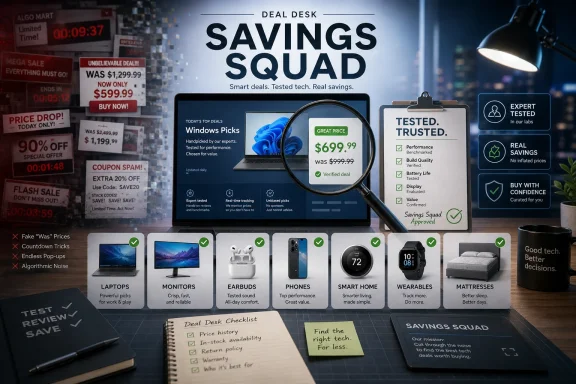
Windows Central highlighted the launch of Tom’s Guide Savings Squad on May 11, 2026, presenting the new Future-owned deals initiative as a curated shopping resource for readers tracking laptops, monitors, earbuds, phones, smart home devices, wearables, mattresses, and other consumer technology purchases. The pitch is simple: online deals have become too noisy, too fast-moving, and too easily gamed for ordinary buyers to trust at face value. But beneath the cheery branding is a more interesting media story about how tech publications are trying to reclaim authority in a shopping ecosystem increasingly dominated by algorithmic storefronts, sponsored placements, coupon spam, and fake urgency. For Windows users in particular, that matters because the PC upgrade cycle is no longer just about specs; it is about timing, trust, and knowing whether a “deal” is actually a deal.
For years, tech sites treated deals coverage as a seasonal add-on: Black Friday pages, Prime Day live blogs, holiday gift guides, and the occasional “lowest price ever” headline attached to a gadget someone on staff had actually used. The Savings Squad suggests something more permanent. It packages deal-hunting as a dedicated editorial function, not a scramble that appears only when retailers light up the discount machine.
That distinction matters. A one-off sale post can be useful, but it often leaves the reader doing the hard work: checking whether the discount is real, whether the product is obsolete, whether a better model is due next month, whether the retailer inflated the list price, and whether a cheaper alternative is hiding in plain sight. A standing deals team, if it does its job well, turns that chaos into a repeatable judgment process.
Tom’s Guide is leaning on its existing product-review machinery to make that promise credible. The Windows Central post describes a team drawing from broad testing experience across phones, laptops, TVs, wearables, smart home devices, fitness tech, and more. That breadth is the point. A useful deals operation is not just a price tracker; it is a memory bank.
The uncomfortable truth is that many bargain pages on the web are not built around memory. They are built around conversion. The most valuable contribution a deals team can make is often not finding a discount, but refusing to recommend one because the product, price history, support outlook, or timing is wrong.
That complexity creates opportunity for savvy buyers, but it also creates traps. A laptop discounted by $400 might be a genuine steal, or it might be last year’s chassis with a dim panel, soldered 8GB RAM, a tiny SSD, and a processor whose branding hides more than it reveals. A gaming monitor might advertise a dramatic markdown while shipping with compromises in HDR performance, port selection, stand ergonomics, or panel response that only show up after the box is open.
This is where Windows Central’s audience should pay attention. The best deal on a PC accessory is rarely the biggest percentage discount. It is the best match between price, performance, longevity, and the user’s actual setup.
A Surface buyer, a PC gamer, a sysadmin refreshing home-office gear, and a student trying to stretch a laptop budget are not shopping for the same thing. Yet retailer pages often flatten all of them into the same urgency loop: sale ends soon, cart now, think later. A better deals desk slows that loop down just enough to reintroduce judgment.
That is especially true in categories with volatile pricing. SSDs, monitors, gaming laptops, earbuds, and smart home accessories can swing wildly depending on supply, seasonal promotions, inventory clearance, and platform transitions. A sale badge may reflect an unusually good price, but it may also reflect the normal weekly rhythm of a product that is constantly on promotion somewhere.
The Savings Squad’s promise, as framed by Windows Central, is to separate actual bargains from decorative markdowns. That sounds modest until you consider how much of modern shopping is designed to prevent exactly that. Retailers do not merely sell products; they sell momentum.
For Windows users, momentum can be expensive. A laptop bought in haste may miss a generational CPU shift. A monitor bought for a headline refresh rate may underperform in color, brightness, or adaptive sync behavior. A dock, charger, webcam, or headset that looks cheap on the day can become a daily irritation for years.
The best version of affiliate commerce is simple: readers get help, publishers get paid if that help leads to a purchase, and the editorial team preserves enough independence to tell readers when not to buy. The worst version is also simple: every discount becomes “hot,” every product becomes “must-have,” and the site slowly turns into a decorative layer over the retailer’s own marketing funnel.
Windows Central emphasizes that Tom’s Guide’s operation is built around independent testing, multi-editor signoff, and a “no affiliate bias” approach. Those are the right words. The real test will be consistency over time.
A deals brand earns trust not when it recommends the obvious bargain, but when it passes on a tempting one. It earns trust when it says the $699 laptop is cheap for a reason, the “gaming” chair is mostly branding, the monitor was cheaper two weeks ago, or the SSD is fast but unnecessary for most buyers. In an affiliate environment, restraint is the most convincing editorial signal.
A deal is only good inside that context. A cheap Windows laptop with limited RAM may be a poor buy for anyone hoping to keep it through several years of browser bloat, Teams calls, and background AI features. A discounted mini PC may be excellent for home lab tinkering but wrong for someone who needs vendor support, quiet thermals, or easy expansion.
Gaming buyers face an even sharper version of the problem. GPU tiers, laptop wattage limits, display resolution, cooling design, and storage needs can make two machines with similar spec sheets feel dramatically different in practice. A discount cannot fix a bad thermal design or a mismatched panel.
This is where editorial deal curation can outperform raw price comparison. A price tracker can tell you that something is cheaper today. A competent deals editor can tell you whether today is the day to buy it.
In a fragmented tech market, scale can help. A single Windows-focused publication may have deep expertise in PCs, Xbox, Surface, and Microsoft services, while a broader consumer site like Tom’s Guide may have more review coverage across phones, TVs, wearables, home devices, mattresses, and appliances. A reader’s actual life does not fit neatly into one vertical. The same person buying a Windows laptop may also need a monitor, mesh router, earbuds, office chair, smart display, and backup drive.
The danger is that scale can also blur accountability. If a deal recommendation appears across a family of sites, readers need to know that it survived more than syndication. The value of the Savings Squad will depend on whether it behaves like an editorial team with standards or like a content pipe with branding.
For now, the smarter interpretation is that Future is formalizing something most major tech publishers already know: shopping advice is no longer a supplement to product journalism. It is one of the main ways readers experience it.
Good deals journalism counters that pressure with context. It remembers normal street prices. It distinguishes old stock from evergreen value. It knows when a product is discounted because it is excellent and temporarily cheaper, and when it is discounted because the market has moved on.
That work is not glamorous, and it is easy to underestimate. But anyone who has tried to buy a laptop during a major sales event knows the feeling: ten tabs open, five models that seem nearly identical, three retailer pages with different list prices, two YouTube reviews, and one creeping suspicion that the “limited-time” offer will somehow still be there tomorrow.
The useful deals editor does not merely point at the cheapest tab. The useful deals editor explains why one machine deserves the money and another deserves the recycling bin of forgotten wish lists.
A home user replacing a six-year-old laptop may be buying into Windows 11, modern standby quirks, USB-C charging, biometric login, AI acceleration claims, and a display ecosystem that has changed dramatically since their last purchase. An IT pro buying personal gear may be more sensitive to repairability, firmware support, driver maturity, and docking behavior than a casual shopper. A gamer may care less about the lowest price and more about whether the discount finally makes the right GPU tier attainable.
That is why deal quality matters. The wrong bargain is not just wasted money; it is years of small annoyances. A bad keyboard, inadequate RAM, mediocre Wi-Fi, poor webcam, loud fan curve, weak hinge, or underpowered charger becomes part of daily life.
A trusted deals operation can reduce that risk, though it cannot eliminate it. Readers still need to match recommendations to their own workloads. But if the Savings Squad does the screening properly, the starting point gets much better.
Those systems are fast, convenient, and often indifferent to nuance. They can surface a price, aggregate ratings, or summarize product claims, but they may struggle with the subtleties enthusiasts care about. They may not know that a laptop line changed panel suppliers mid-cycle, that a cheap dock behaves badly with certain sleep states, or that a monitor’s advertised HDR is more checkbox than experience.
Human editorial judgment still has an opening here, but only if it is visibly better. “We found a deal” is no longer enough. The better claim is: “We know this category, we know this product, we know its normal price, and we know why this discount matters.”
That is the standard readers should apply to the Savings Squad. Not whether it sounds fun. Not whether the mascot works. Whether it consistently saves people from bad purchases as often as it points them toward good ones.
That difference will matter most during the big sales periods, when the internet becomes a carnival of urgency. Prime Day, Black Friday, Cyber Monday, back-to-school sales, and end-of-quarter clearance events all create the same pattern: too many products, too little time, and a constant sense that hesitation equals loss. In that environment, trusted curation becomes more valuable, not less.
But trust is cumulative. The Savings Squad will need to show its work in ways readers can feel: clear explanations, honest caveats, price context, product history, and the occasional recommendation to wait. A deals desk that never says “skip this” eventually sounds like an ad desk.
For Windows Central readers, the opportunity is obvious. If Tom’s Guide can bring broad consumer-testing coverage together with disciplined price evaluation, it could become a useful filter for the hardware and accessory decisions that orbit every PC setup.
Source: Windows Central Introducing the Tom’s Guide Savings Squad — and why Windows Central readers should absolutely care
 The Deal Desk Is Becoming a Product in Its Own Right
For years, tech sites treated deals coverage as a seasonal add-on: Black Friday pages, Prime Day live blogs, holiday gift guides, and the occasional “lowest price ever” headline attached to a gadget someone on staff had actually used. The Savings Squad suggests something more permanent. It packages deal-hunting as a dedicated editorial function, not a scramble that appears only when retailers light up the discount machine.That distinction matters. A one-off sale post can be useful, but it often leaves the reader doing the hard work: checking whether the discount is real, whether the product is obsolete, whether a better model is due next month, whether the retailer inflated the list price, and whether a cheaper alternative is hiding in plain sight. A standing deals team, if it does its job well, turns that chaos into a repeatable judgment process.
Tom’s Guide is leaning on its existing product-review machinery to make that promise credible. The Windows Central post describes a team drawing from broad testing experience across phones, laptops, TVs, wearables, smart home devices, fitness tech, and more. That breadth is the point. A useful deals operation is not just a price tracker; it is a memory bank.
The uncomfortable truth is that many bargain pages on the web are not built around memory. They are built around conversion. The most valuable contribution a deals team can make is often not finding a discount, but refusing to recommend one because the product, price history, support outlook, or timing is wrong.
Windows Buyers Live in the Worst Part of the Pricing Maze
Apple customers have their own frustrations, but the Windows hardware market is uniquely difficult to shop. A MacBook buyer usually compares a handful of current configurations. A Windows laptop buyer may be staring at dozens of machines with similar names, overlapping CPUs, regional SKUs, retailer-exclusive bundles, display substitutions, memory compromises, and model numbers that read like inventory codes from a warehouse fire.That complexity creates opportunity for savvy buyers, but it also creates traps. A laptop discounted by $400 might be a genuine steal, or it might be last year’s chassis with a dim panel, soldered 8GB RAM, a tiny SSD, and a processor whose branding hides more than it reveals. A gaming monitor might advertise a dramatic markdown while shipping with compromises in HDR performance, port selection, stand ergonomics, or panel response that only show up after the box is open.
This is where Windows Central’s audience should pay attention. The best deal on a PC accessory is rarely the biggest percentage discount. It is the best match between price, performance, longevity, and the user’s actual setup.
A Surface buyer, a PC gamer, a sysadmin refreshing home-office gear, and a student trying to stretch a laptop budget are not shopping for the same thing. Yet retailer pages often flatten all of them into the same urgency loop: sale ends soon, cart now, think later. A better deals desk slows that loop down just enough to reintroduce judgment.
The Red Sticker Has Lost Its Moral Authority
The internet trained consumers to hunt discounts, and retailers learned the lesson better than anyone. “Was” prices, countdown timers, coupon overlays, member-only pricing, bundle credits, flash events, and marketplace seller promotions now form a permanent fog around consumer electronics. The result is that the visual language of savings has been devalued.That is especially true in categories with volatile pricing. SSDs, monitors, gaming laptops, earbuds, and smart home accessories can swing wildly depending on supply, seasonal promotions, inventory clearance, and platform transitions. A sale badge may reflect an unusually good price, but it may also reflect the normal weekly rhythm of a product that is constantly on promotion somewhere.
The Savings Squad’s promise, as framed by Windows Central, is to separate actual bargains from decorative markdowns. That sounds modest until you consider how much of modern shopping is designed to prevent exactly that. Retailers do not merely sell products; they sell momentum.
For Windows users, momentum can be expensive. A laptop bought in haste may miss a generational CPU shift. A monitor bought for a headline refresh rate may underperform in color, brightness, or adaptive sync behavior. A dock, charger, webcam, or headset that looks cheap on the day can become a daily irritation for years.
Affiliate Commerce Needs Editorial Discipline or It Becomes Wallpaper
There is no point pretending affiliate commerce is a side issue. Windows Central’s article includes the standard disclosure that purchases through site links may generate commission. That is normal across digital publishing, and it is not inherently disqualifying. But it does put pressure on the credibility of every recommendation.The best version of affiliate commerce is simple: readers get help, publishers get paid if that help leads to a purchase, and the editorial team preserves enough independence to tell readers when not to buy. The worst version is also simple: every discount becomes “hot,” every product becomes “must-have,” and the site slowly turns into a decorative layer over the retailer’s own marketing funnel.
Windows Central emphasizes that Tom’s Guide’s operation is built around independent testing, multi-editor signoff, and a “no affiliate bias” approach. Those are the right words. The real test will be consistency over time.
A deals brand earns trust not when it recommends the obvious bargain, but when it passes on a tempting one. It earns trust when it says the $699 laptop is cheap for a reason, the “gaming” chair is mostly branding, the monitor was cheaper two weeks ago, or the SSD is fast but unnecessary for most buyers. In an affiliate environment, restraint is the most convincing editorial signal.
The PC Upgrade Cycle Has Become a Timing Problem
The traditional PC buying question was once straightforward: Is this machine faster than my current one, and can I afford it? That still matters, but the modern Windows ecosystem adds timing layers that make the decision harder. Windows 11 requirements, AI PC branding, ARM versus x86 trade-offs, GPU availability, Thunderbolt and USB4 support, Wi-Fi generations, display standards, and memory requirements all complicate the meaning of “good enough.”A deal is only good inside that context. A cheap Windows laptop with limited RAM may be a poor buy for anyone hoping to keep it through several years of browser bloat, Teams calls, and background AI features. A discounted mini PC may be excellent for home lab tinkering but wrong for someone who needs vendor support, quiet thermals, or easy expansion.
Gaming buyers face an even sharper version of the problem. GPU tiers, laptop wattage limits, display resolution, cooling design, and storage needs can make two machines with similar spec sheets feel dramatically different in practice. A discount cannot fix a bad thermal design or a mismatched panel.
This is where editorial deal curation can outperform raw price comparison. A price tracker can tell you that something is cheaper today. A competent deals editor can tell you whether today is the day to buy it.
The Future Family Is Turning Scale Into Shopping Leverage
Windows Central’s enthusiasm is partly explained by corporate proximity. Tom’s Guide and Windows Central sit under the same Future umbrella, so a deals initiative at one site can be promoted as useful to readers at another. That sort of cross-site amplification is predictable, but it is not automatically cynical.In a fragmented tech market, scale can help. A single Windows-focused publication may have deep expertise in PCs, Xbox, Surface, and Microsoft services, while a broader consumer site like Tom’s Guide may have more review coverage across phones, TVs, wearables, home devices, mattresses, and appliances. A reader’s actual life does not fit neatly into one vertical. The same person buying a Windows laptop may also need a monitor, mesh router, earbuds, office chair, smart display, and backup drive.
The danger is that scale can also blur accountability. If a deal recommendation appears across a family of sites, readers need to know that it survived more than syndication. The value of the Savings Squad will depend on whether it behaves like an editorial team with standards or like a content pipe with branding.
For now, the smarter interpretation is that Future is formalizing something most major tech publishers already know: shopping advice is no longer a supplement to product journalism. It is one of the main ways readers experience it.
The Best Deals Coverage Is Really Anti-Noise Technology
The phrase “Savings Squad” sounds deliberately light, almost cartoonish. But the job it describes is serious because it sits between consumers and one of the most manipulative parts of the web. Retail shopping pages are optimized, tested, personalized, and timed to push decisions under pressure.Good deals journalism counters that pressure with context. It remembers normal street prices. It distinguishes old stock from evergreen value. It knows when a product is discounted because it is excellent and temporarily cheaper, and when it is discounted because the market has moved on.
That work is not glamorous, and it is easy to underestimate. But anyone who has tried to buy a laptop during a major sales event knows the feeling: ten tabs open, five models that seem nearly identical, three retailer pages with different list prices, two YouTube reviews, and one creeping suspicion that the “limited-time” offer will somehow still be there tomorrow.
The useful deals editor does not merely point at the cheapest tab. The useful deals editor explains why one machine deserves the money and another deserves the recycling bin of forgotten wish lists.
Windows Central Readers Should Care Because the Stakes Are Practical
For WindowsForum readers, this is less about Tom’s Guide branding than about the changing economics of PC ownership. Hardware has become more durable in some ways and more confusing in others. Many users can stretch a machine longer than before, but when they finally upgrade, the purchase has to carry more weight.A home user replacing a six-year-old laptop may be buying into Windows 11, modern standby quirks, USB-C charging, biometric login, AI acceleration claims, and a display ecosystem that has changed dramatically since their last purchase. An IT pro buying personal gear may be more sensitive to repairability, firmware support, driver maturity, and docking behavior than a casual shopper. A gamer may care less about the lowest price and more about whether the discount finally makes the right GPU tier attainable.
That is why deal quality matters. The wrong bargain is not just wasted money; it is years of small annoyances. A bad keyboard, inadequate RAM, mediocre Wi-Fi, poor webcam, loud fan curve, weak hinge, or underpowered charger becomes part of daily life.
A trusted deals operation can reduce that risk, though it cannot eliminate it. Readers still need to match recommendations to their own workloads. But if the Savings Squad does the screening properly, the starting point gets much better.
The Real Competition Is Not Other Tech Sites
It is tempting to view the Savings Squad as another move in the endless competition among tech publishers. That is only partly true. The real competition is Amazon search, retailer recommendation engines, sponsored placement boxes, social media deal accounts, browser coupon extensions, and AI-generated shopping summaries.Those systems are fast, convenient, and often indifferent to nuance. They can surface a price, aggregate ratings, or summarize product claims, but they may struggle with the subtleties enthusiasts care about. They may not know that a laptop line changed panel suppliers mid-cycle, that a cheap dock behaves badly with certain sleep states, or that a monitor’s advertised HDR is more checkbox than experience.
Human editorial judgment still has an opening here, but only if it is visibly better. “We found a deal” is no longer enough. The better claim is: “We know this category, we know this product, we know its normal price, and we know why this discount matters.”
That is the standard readers should apply to the Savings Squad. Not whether it sounds fun. Not whether the mascot works. Whether it consistently saves people from bad purchases as often as it points them toward good ones.
The Bargain Hunters Now Have to Prove They Are Editors
The most important word in Windows Central’s write-up is not “savings.” It is “testing.” Deals coverage without testing is just retail narration. Deals coverage informed by testing can become buying advice with a timestamp.That difference will matter most during the big sales periods, when the internet becomes a carnival of urgency. Prime Day, Black Friday, Cyber Monday, back-to-school sales, and end-of-quarter clearance events all create the same pattern: too many products, too little time, and a constant sense that hesitation equals loss. In that environment, trusted curation becomes more valuable, not less.
But trust is cumulative. The Savings Squad will need to show its work in ways readers can feel: clear explanations, honest caveats, price context, product history, and the occasional recommendation to wait. A deals desk that never says “skip this” eventually sounds like an ad desk.
For Windows Central readers, the opportunity is obvious. If Tom’s Guide can bring broad consumer-testing coverage together with disciplined price evaluation, it could become a useful filter for the hardware and accessory decisions that orbit every PC setup.
The Short List Before the Next Checkout Click
The launch is worth watching because it lands at the intersection of tech journalism, affiliate commerce, and increasingly confusing consumer hardware. Readers do not need another page of red sale tags; they need a reason to believe someone has already done the boring verification work.- The Tom’s Guide Savings Squad is a newly launched deals initiative promoted by Windows Central on May 11, 2026.
- Its value to Windows users depends on whether it can connect discounts to tested product quality, not just advertised price cuts.
- PC buyers have more to gain from curated deals than many shoppers because Windows hardware pricing is fragmented across brands, configurations, and retailers.
- The affiliate-commerce model makes editorial restraint essential, because the most trustworthy recommendation is sometimes to avoid a discounted product.
- The initiative will be judged during major sales events, when fake urgency, inflated list prices, and obsolete inventory are most likely to mislead buyers.
Source: Windows Central Introducing the Tom’s Guide Savings Squad — and why Windows Central readers should absolutely care
