

Wall Street’s most vocal tech bull has drawn a line under a provocative idea: the next chapter of the AI rally won’t only be won by the silicon giants, but by companies that can monetize AI through software, services, devices, autonomy and security — and his top-five roster for 2026 reflects that thesis. In a widely circulated Wedbush note and subsequent media roundups, Dan Ives named Microsoft, Apple, Tesla, Palantir, and CrowdStrike as the “best AI names for 2026,” deliberately emphasizing platform monetization, recurring revenue, and verticalized AI applications over a pure semiconductor bet.
The market debate of late 2024–2026 has a clear axis: on one side are the infrastructure and chip leaders — the companies that supply compute; on the other are the platforms and application vendors that turn compute into recurring cash flow. Dan Ives’ position is that 2026 will be an inflection year when enterprise deployments scale, seat-based and device-based monetization becomes visible on income statements, and AI spending shifts from speculative to measurable. That repositioning explains why his top-five list sidesteps an obvious hardware leader in some headlines while still recognizing it as central to the ecosystem. This matters for IT leaders and investors alike: the winners in the next phase are likely to be those who convert AI prototypes into defensible, subscription-like revenue streams — Copilot seats and Azure inference hours, device-embedded AI subscriptions, robotics-as-a-service, verticalized decision-intelligence, and AI-native cybersecurity. The following sections examine each name, verify the most consequential claims with independent reporting and company disclosures, and weigh practical risks versus potential upside.
In short: the list is a strategic lens more than a shopping list — a useful blueprint for where AI value may concentrate in 2026, but one that must be validated with company-level evidence rather than adopted uncritically from headlines.
Source: Barron's https://www.barrons.com/articles/dan-ives-ai-stocks-2025-palantir-crowdstrike-70ae5c17/
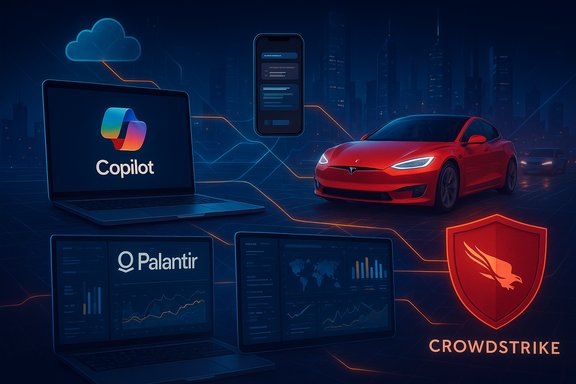 Background / Overview
The market debate of late 2024–2026 has a clear axis: on one side are the infrastructure and chip leaders — the companies that supply compute; on the other are the platforms and application vendors that turn compute into recurring cash flow. Dan Ives’ position is that 2026 will be an inflection year when enterprise deployments scale, seat-based and device-based monetization becomes visible on income statements, and AI spending shifts from speculative to measurable. That repositioning explains why his top-five list sidesteps an obvious hardware leader in some headlines while still recognizing it as central to the ecosystem. This matters for IT leaders and investors alike: the winners in the next phase are likely to be those who convert AI prototypes into defensible, subscription-like revenue streams — Copilot seats and Azure inference hours, device-embedded AI subscriptions, robotics-as-a-service, verticalized decision-intelligence, and AI-native cybersecurity. The following sections examine each name, verify the most consequential claims with independent reporting and company disclosures, and weigh practical risks versus potential upside.Microsoft: the enterprise AI flywheel
Thesis in one line
Microsoft captures AI monetization through the intersection of identity, productivity suites, cloud infrastructure (Azure) and deep OpenAI ties — enabling seat-based Copilot monetization and high-margin inference services in Azure.What Ives and Wedbush claim
Wedbush frames Microsoft as the single best pure-play capture of enterprise AI monetization: Copilot turns Office seats into recurring revenue while Azure captures inference spend and platform fees. The note highlights Microsoft’s already substantial AI revenue run rate as evidence that monetization is not just hypothetical.Verifiable anchors
- Microsoft’s product pages and partner announcements establish formalized Copilot pricing and business SKUs — Copilot Business and other Copilot offerings are now priced and promoted as discrete monetizable products. Microsoft’s own commercial pages and partner announcements confirm the company’s strategy of embedding Copilot into paid SKUs.
- Multiple independent financial reports and analyst write-ups reported that Microsoft stated an AI-related annualized revenue run rate near $13 billion, a concrete metric widely republished after the company’s FY2025 commentary. This figure is treated in sell-side research as the base for modeling future Azure and Copilot revenue upside.
Strengths
- Distribution and stickiness: Microsoft controls AD/Entra identity, Windows endpoints, and Microsoft 365 seats — an unusually strong flywheel for seat-based monetization.
- Monetization cadence: Copilot SKUs are paid, metered, and being bundled into mainstream offers (SMB and enterprise SKUs), turning a previously experimental feature into a line-item business.
- Balance-sheet backing: Microsoft’s scale and willingness to fund massive datacenter capex reduces a major execution risk common to smaller players.
Risks and caveats
- CapEx to margin timing: Heavy investment in AI-optimized infrastructure depresses near-term margins until utilization and higher-margin services scale.
- Field-check vs. audited metrics: Sell-side penetration assumptions (e.g., very high eventual Copilot penetration) derive from channel checks; company-reported seat counts and Azure inference metrics remain the highest-signal metrics to watch.
Apple: device-first monetization, but execution matters
Thesis in one line
Apple can monetize device-embedded AI across iPhone, iPad, and Mac at scale if it moves from cautious experimentation to paid AI services and SDK partnerships.What Ives and Wedbush claim
Ives views Apple as a sleeping giant for consumer AI monetization: with billions of active devices, Apple can extract recurring revenue through per-device AI services and retain high margin on services. Wedbush estimates material per‑share upside if Apple turns AI into a paid, integrated service across iOS.Verifiable anchors
- Apple’s public product and developer updates show incremental on-device AI features, and major press coverage documents Apple’s deliberate, privacy-heavy approach to AI integration. Independent reports also capture Wedbush’s estimate for a potential per-share contribution from AI monetization.
Strengths
- Huge installed base: Apple’s device ecosystem is arguably the most monetizable consumer base in tech, enabling premium pricing for privacy-first AI features.
- High ARPU potential: Historically, Apple converts product and services advantages into material services revenue, and AI could be the next services leg.
Risks and caveats
- Timing and productization risk: Apple’s deliberate approach risks being late to market or under-indexed in enterprise-centric AI deployments.
- Dependency on partnerships: Where Apple relies on third‑party models or cloud partners, any delay or integration complexity could impede monetization speed.
Tesla: “physical AI” and robotaxi optionality
Thesis in one line
Tesla’s upside is driven less by chips and more by autonomy-as-a-service: robotaxis, Cybercab deployments, Optimus robotics, and recurring autonomy software revenue.What Ives and Wedbush claim
Ives repeatedly argues Tesla’s long-run upside is dominated by autonomy and robotics: a successful robotaxi/robotics roll-out could generate an enormous service revenue stream, giving Tesla a multi‑trillion dollar upside in the bull case. Specific scenarios floated by Wedbush put Tesla’s potential valuation in the $2–$3 trillion range under favorable execution.Verifiable anchors
- Public company timelines, regulatory filings, and coverage of Tesla’s robotaxi announcements confirm the company’s objectives and the market’s expectation framing. Industry reporting highlights both Tesla’s progress and the regulatory/operational hurdles that accompany large-scale autonomous deployments.
Strengths
- Unique data trove: Tesla benefits from massive, proprietary driving data and a large fleet for iterative model improvements — a high barrier to entry if deployed at scale.
- Optionality: Even incremental software monetization (FSD subscriptions, fleet services) compounds valuation in optionality-driven models.
Risks and caveats
- Binary execution risk: Robotaxi scale requires regulatory approvals, safety validation, insurance frameworks and proven operational economics — any delay or incident could dramatically reset expectations.
- Competition and margin pressure: Waymo and other AV players pursue robotaxi economics that could compress pricing or speed market adoption ahead of Tesla.
Palantir: decision‑intelligence and a $1T thesis
Thesis in one line
Palantir’s AIP and vertical AI platforms position it as a decision-intelligence provider for government and enterprise, with sticky contracts and high margins if commercial expansion continues.What Ives and Wedbush claim
Ives has been the most optimistic Wall Street voice on Palantir, publicly stating the company has a path to a $1 trillion market cap over a two- to three-year horizon based on commercial AIP adoption and government demand. He calls Palantir a “gold standard” in applied enterprise AI, capable of outsized multiple expansion.Verifiable anchors
- Media coverage and sell-side notes document Ives’ public trillion-dollar projection and Palantir’s strong stock performance in 2024–2025. Independent reporting confirms Palantir’s expansion into commercial contracts and its AIP product rollouts creating real momentum.
Strengths
- Sticky contracts and government credentials: Palantir’s long-term government work provides durable revenue and credibility when selling to regulated commercial verticals.
- Product fit for regulated use cases: Palantir’s emphasis on explainability, operational integration, and ontology-driven architectures maps well to enterprise needs where governance matters.
Risks and caveats
- Valuation stretch: Moving to a $1T market cap requires aggressive revenue and margin growth; current multiples already bake in significant upside, increasing sensitivity to execution hiccups.
- Political and procurement risk: Heavy government reliance introduces procurement cycle and policy risks that can compress visibility.
CrowdStrike: AI‑native cybersecurity as recurring revenue
Thesis in one line
CrowdStrike stands to be a core beneficiary of enterprise AI adoption because AI increases attack surface complexity and raises the value of AI-native defensive platforms that provide continuous telemetry, detection and response.What Ives and Wedbush claim
Wedbush elevated CrowdStrike as a high-conviction AI security play and raised price targets materially, citing both strong product momentum and AI-driven demand. In a bull-case scenario cited in media, Wedbush suggests CrowdStrike shares could reach $700+ over the next 12–18 months, based on expanding bookings and AI module uptake.Verifiable anchors
- Independent coverage of Wedbush’s rating changes and target increases confirm the $600–$700 target range and highlight CrowdStrike’s role as a core AI security vendor. Analyst commentary focuses on product expansion (agent-based telemetry, cloud workload protection and LogScale) as near-term revenue drivers.
Strengths
- Platform nature: CrowdStrike’s subscription model and wide endpoint coverage create durable revenue and opportunities to upsell AI-native modules.
- AI as both tailwind and cost: As attacks become more automated and generative, enterprises are more likely to invest in real-time defenses — a structural tailwind for vendors that can demonstrate efficacy.
Risks and caveats
- Crowding and price pressure: Cybersecurity is highly competitive; decisive product differentiation and execution on enterprise sales are essential to justify stretched multiples.
- Proof points: A few high-profile wins or disclosed bookings tied to AI modules would materially reduce execution uncertainty.
Cross‑checks, verification and where the numbers come from
This feature verifies the most consequential claims in two ways: (1) company-level disclosures and product pages, and (2) independent reporting from multiple outlets corroborating sell-side commentary.- Microsoft’s commercial Copilot SKUs and pricing are documented on Microsoft product pages and Partner Center announcements — establishing a concrete monetization mechanism that analysts use in revenue modeling.
- Multiple outlets independently reported Microsoft’s AI annualized revenue run rate in the $13 billion range following FY2025 commentary; that figure appears in analyst summaries and earnings coverage and serves as a real, testable anchor for future modeling.
- Dan Ives’ public trillion-dollar characterization for Palantir and his $700 bull-case for CrowdStrike are documented across major financial news outlets and market commentary, allowing readers to distinguish between sell-side scenarios and company-audited guidance.
- Internal analysis briefings and community write-ups (prepared by analysts and industry journalists) echo the monetization-centric thesis and provide practical monitoring checklists — e.g., Copilot seat uptake, Azure inference‑hour growth, disclosed AIP deals at Palantir, and CrowdStrike bookings for AI modules.
Practical metrics and a monitoring checklist for 2026
For CIOs, procurement leads, and investors who want to translate the thesis into measurable indicators, focus on a short set of high-signal KPIs that will either validate or falsify the monetization narrative:- Microsoft
- Reported Copilot seat counts and Copilot ARPU disclosures.
- Azure AI inference hours growth and Azure gross margin trend.
- Apple
- Product announcements tying paid AI features to iOS/macOS; SDK/partnership disclosures and billing integration timelines.
- Tesla
- Robotaxi deployment cities, vehicle registration and regulatory approvals; service pricing and fleet utilization metrics.
- Palantir
- Large commercial AIP contract announcements, disclosed recurring revenue from commercial customers, and FedRAMP/sovereign cloud authorizations.
- CrowdStrike
- New bookings attributable to AI-native modules, expansion revenue per customer, churn trends, and platform adoption metrics.
Strengths of Ives’ top‑five framework — and where it overreaches
Notable strengths
- Practical focus on monetization: The list privileges companies that can turn AI into recurring revenue — a stronger, more testable investment criterion than simply owning the compute supply chain.
- Diversification across monetization vectors: The five names offer exposure to platform monetization (Microsoft), device monetization (Apple), autonomous services (Tesla), vertical AI platforms (Palantir), and security subscriptions (CrowdStrike) — reducing single-point dependency on one technology stack.
- Actionable monitoring guidance: The thesis naturally maps to precise, trackable company-level metrics that investors and IT teams can follow to validate progress.
Where the call overreaches
- Scenario-driven headlines: Multi‑trillion or trillion-dollar forecasts derive from aggressive sell‑side extrapolations and should be labeled as bull-case scenarios. These often rest on optimistic penetration, pricing and regulatory timing assumptions.
- Omission of infrastructure nuance: Excluding the obvious infrastructure winners from the top five in headline copy can create a false dichotomy — Nvidia and other chipmakers remain essential to the AI stack, and infrastructure constraints (or breakthroughs) could re-center returns on accelerators.
- Field-check uncertainty: Some of the more bullish seat-penetration and ARR extrapolations come from channel checks rather than audited company disclosures. Treat them as directional until company-level reporting confirms the trajectory.
How to act (for IT decision-makers and investors)
- For enterprise IT teams: negotiate AI-ready contracts now. Reserve inference capacity, clarify egress pricing, demand SLAs that cover model availability and throughput, and insist on contractual protections for data governance and incident response.
- For investors: use the five names as a framework, not a shopping list. Consider a blended approach:
- Core positions in platforms with proven monetization (e.g., Microsoft).
- Satellite positions in higher‑optionality names (Palantir, Tesla) sized to conviction and risk tolerance.
- Exposure to cybersecurity as a defensive allocation that benefits from structural AI tailwinds (e.g., CrowdStrike).
- For both cohorts: require observable milestones — not headlines — before increasing exposure. Seat counts, disclosed ARPU, large enterprise contracts, and clear service economics are the hardest, highest‑value signals.
Final assessment: sensible reframing — but not a repudiation of chips
Dan Ives’ top-five list for 2026 is valuable because it reframes the AI winners debate around monetization and recurring revenue capture. That shift is both practical and testable: Copilot seats, device subscriptions, robotaxi service economics, AIP commercial contracts, and AI-native security bookings are concrete outcomes that convert hype into cash flow. Multiple independent reports and company disclosures (including Microsoft’s Copilot SKUs and reported AI run-rate figures) support the core premise that monetization is beginning to show up in earnings narratives. However, bold price-targets and trillion-dollar forecasts remain sell-side scenarios. They are useful as stretch cases but should be treated as conditional on continued execution, favorable regulation, constrained supply dynamics, and clear customer economics. Investors and IT leaders who pivot to this monetization map will benefit from building explicit testable metrics into their decision cycles: demand, price realization, recurring revenue growth, and margin improvement.In short: the list is a strategic lens more than a shopping list — a useful blueprint for where AI value may concentrate in 2026, but one that must be validated with company-level evidence rather than adopted uncritically from headlines.
Source: Barron's https://www.barrons.com/articles/dan-ives-ai-stocks-2025-palantir-crowdstrike-70ae5c17/
