

TQA’s pivot to an Agentic AI identity is more than a marketing refresh — it’s a deliberately engineered response to a problem that has paralyzed the enterprise AI agenda: pilots that don’t produce measurable business value. The company’s new multi-platform strategy, announced on February 20, 2026, reframes the work from “bolt-on AI” to agent-enabled workforces that redesign processes and aim for production-grade financial impact.
The context for TQA’s move is stark. Recent academic and industry research shows that a vast majority of enterprise generative AI pilots fail to deliver measurable P&L improvements, creating what researchers have called a “GenAI Divide.” That disconnect between hype and outcomes has pushed customers to demand not just prototypes, but repeatable, governed, and measurable production deployments.
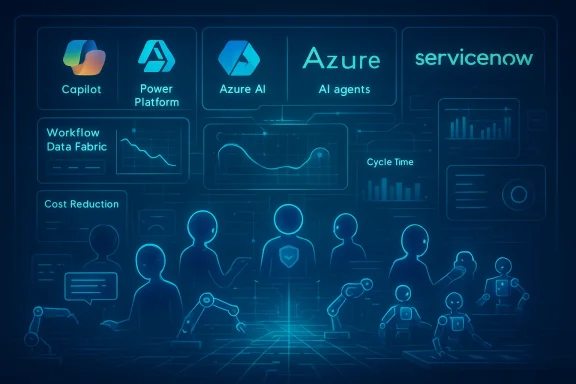
TQA — founded in 2020 and headquartered in Austin with offices in the UK, Romania, and the Philippines — has grown into a roughly 200-person specialist consultancy focused on automation, data, and enterprise search. The company says it will lean into three platform verticals as part of its rebrand: Microsoft (Copilot, Power Platform, Azure AI), ServiceNow (Workflow Data Fabric and AI agents), and UiPath (its longstanding RPA and agentic automation partner).
Key considerations for customers:
What TQA gains from UiPath:
Core elements of the TQA approach:
Several market dynamics follow:
That said, the path from pilot to production is littered with technical, organizational, and regulatory landmines. TQA’s proposition — to combine Microsoft copilots and cloud foundations, ServiceNow governance, and UiPath automation connectivity — is credible on paper and supported by partner program participation and funding signals. The ultimate test will be whether TQA can consistently produce independently verifiable production metrics across multiple customers and regulated environments.
For IT leaders, the practical takeaway is simple: demand production-grade evidence, insist on outcome-linked contracts, and treat agentic deployments as a full-stack engineering and change-management program — not a series of isolated model experiments. If TQA can deliver on that promise, their repositioning will be a timely and valuable contribution to the enterprise AI transformation agenda.
Source: TipRanks TQA Rebrands Around Agentic AI and Expands Microsoft and ServiceNow Partnerships to Tackle Enterprise AI Gridlock - TipRanks.com
 Background
The context for TQA’s move is stark. Recent academic and industry research shows that a vast majority of enterprise generative AI pilots fail to deliver measurable P&L improvements, creating what researchers have called a “GenAI Divide.” That disconnect between hype and outcomes has pushed customers to demand not just prototypes, but repeatable, governed, and measurable production deployments.TQA — founded in 2020 and headquartered in Austin with offices in the UK, Romania, and the Philippines — has grown into a roughly 200-person specialist consultancy focused on automation, data, and enterprise search. The company says it will lean into three platform verticals as part of its rebrand: Microsoft (Copilot, Power Platform, Azure AI), ServiceNow (Workflow Data Fabric and AI agents), and UiPath (its longstanding RPA and agentic automation partner).
What TQA Announced
TQA’s announcement contains three core commitments:- A formal rebrand toward Agentic AI, signaling a shift from task automation to building agent-enabled workforces that rethink processes for autonomous, outcome-driven execution.
- A deliberate, platform-agnostic implementation approach that aligns Microsoft Copilot, Power Platform, and Azure AI as secure, scalable foundations for enterprise agentic systems.
- Expanded consulting and implementation practices for ServiceNow’s Workflow Data Fabric (WDF) and AI agents to modernize legacy workflows, combined with continued deep engagement with UiPath as a premier partner in Europe and North America, highlighting long-standing accreditations including Diamond Partner status and participation in UiPath’s Agentic Fast Track programs.
Why the Timing Matters
The production gap is real
The MIT-linked “GenAI Divide” analysis — and widespread reporting on the study — makes the timing of TQA’s repositioning logical. Organizations have rushed to adopt generative AI but are increasingly frustrated by a lack of measurable outcomes when pilots do not translate into operational value. That gap creates demand for partners who can deliver pragmatic engineering and operationalization skills, not just model experiments.Platform vendors are making agentic stacks viable
Microsoft and ServiceNow have both accelerated investments in agentic features — from Copilot and Copilot Studio to ServiceNow’s AI orchestration and Workflow Data Fabric — creating a commercial landscape where multi-agent orchestration, identity-aware actioning, and enterprise governance are now first-class concerns for buyers. This vendor momentum lowers the technical lift for enterprises but raises the bar for integration, governance, and outcomes — precisely the domain TQA is targeting.Deep Dive: The Technology Partnerships
Microsoft: Copilot, Power Platform, Azure AI as the enterprise backbone
TQA positions Microsoft technologies as the secure, scalable foundation for agentic deployments. The practical reasons are clear: Copilot and Copilot Studio are designed to embed AI directly into the productivity surface where knowledge workers live, while Power Platform and Azure provide the tooling and compute needed to operationalize agents at scale.- Benefits Microsoft brings to TQA engagements:
- User-level integration through Office surfaces (Teams, Outlook, Word).
- Low-code/no-code accelerators to convert business logic into production-ready agents.
- Enterprise governance and identity controls baked into Azure and Microsoft 365 stacks, which are critical for auditability and compliance.
ServiceNow: Workflow Data Fabric, AI agents, and enterprise control
ServiceNow’s Workflow Data Fabric and AI Platform are explicitly geared toward connecting data, process, and experience across enterprise systems. TQA says it will act as a consulting and implementation partner to help customers map legacy workflows to ServiceNow’s agentic patterns.Key considerations for customers:
- ServiceNow’s control plane for agents facilitates cross-platform visibility, policy enforcement, and audit trails — essential when multiple agents and copilots act on the same data.
- Converting brittle legacy workflows into deterministic orchestrations is non-trivial; it requires both process re-engineering and a disciplined approach to data contracts.
UiPath: automation, orchestration, and continuity into agentic scenarios
UiPath remains central in TQA’s portfolio. The RPA vendor has formally launched an “agentic” orientation in its platform and partner program; TQA has participated in UiPath’s Agentic Fast Track and is listed among regional partners completing the program. UiPath’s strength is in process orchestration, legacy connectivity, and an ecosystem for unattended and attended automation — capabilities that map directly to the operational needs of agentic deployments.What TQA gains from UiPath:
- Proven connectors and robot orchestration for legacy applications.
- Experience operationalizing unattended agents at scale in regulated environments.
- Access to UiPath training and partner programs specific to agentic automation.
The TQA Technical Thesis: Agentic Architectures, Not Patches
From augmentation to redesign
TQA’s central critique of failed pilots is that enterprises try to bolt AI onto broken processes. The company argues that the correct approach is to redesign processes for autonomous agent execution — in other words, to model outcomes first and then map agents, data, and governance to those outcomes.Core elements of the TQA approach:
- Outcome-led design: define measurable KPIs (cost reduction, cycle-time, error-rate) up front.
- Agent composition: combine specialist agents (LLM copilots, RPA robots, workflow orchestrators) into orchestrated teams, each with bounded responsibilities.
- Deterministic fallbacks: ensure agents operate with transactional guarantees, audit trails, and human-in-the-loop checkpoints where required.
- Platform integration: use Microsoft/Azure and ServiceNow control planes for identity, compliance, and observability, with UiPath handling legacy connectivity and robot execution.
How agentic systems scale in production
Scaling agentic deployments hinges on three engineering practices:- Model context and memory: agents must carry and persist context across interactions and handoffs to avoid brittle one-off behavior.
- Policy-driven governance: centralized policy layers to control data usage, permissions, and auditability.
- Operational telemetry: measure agent performance in business terms (e.g., revenue retained, time saved) rather than purely technical metrics.
Evidence and Credibility
TQA’s repositioning is backed by concrete signals that lend credibility to its claims.- The announcement was distributed via a formal press release and positions the new identity and partnerships as part of a strategic pivot.
- The industry narrative that most GenAI pilots do not deliver measurable ROI is not just marketing noise; it is supported by high-profile research coverage and widespread industry reporting that frames the problem as operational, not technological.
- TQA’s partner credentials are corroborated by multiple sources: LinkedIn company profiles, industry listings, and UiPath’s own partner communications and earnings transcripts where TQA is mentioned as completing agentic partner programs. These markers indicate the company is embedded in the ecosystems it claims to operate in — an important signal for enterprise buyers.
- Financial backing and prior growth signals exist: TQA previously announced growth capital from investors, which supports its ability to invest in practices and personnel needed for this pivot. That funding history helps explain how the firm can scale platform practices across regions.
Critical Analysis — Strengths
- Practical positioning against a known market problem
- TQA is targeting a tangible pain point: converting pilots to production. This specificity increases the chance that prospects will hear the message as pragmatic rather than opportunistic.
- Platform-agnostic, but practitioner-led
- The “best-of-breed” posture — using Microsoft for cloud and copilots, ServiceNow for workflow governance, and UiPath for legacy automation — is realistic for enterprises that already live in heterogeneous stacks.
- Operational focus
- Emphasizing outcome metrics and engineering practices (context, telemetry, policy) aligns with what CIOs and CTOs ask for when budgets are scrutinized.
- Ecosystem credibility
- Participation in vendor programs (UiPath Agentic Fast Track) and visible partner status lend TQA legitimacy when competing for enterprise transformation mandates.
Critical Analysis — Risks and Open Questions
- Vendor dependency vs. lock-in risk
- The multi-platform narrative reduces single-vendor lock-in superficially, but deep integrations with Microsoft, ServiceNow, and UiPath can still create complex vendor dependencies. Enterprises should scrutinize escape paths, data portability, and interoperability assumptions.
- Integration complexity
- Agentic architectures increase complexity: agents need consistent context, identity, and policy enforcement across platforms. Integrating disparate authorization models, data schemas, and telemetry systems is hard and time-consuming.
- Governance and compliance hurdles
- Agents that act autonomously raise regulatory concerns — auditability, data residency, and explainability. TQA’s success depends on demonstrating robust, testable governance frameworks that meet auditors’ and regulators’ expectations.
- Human-in-the-loop balance and trust
- The shift from augmentation to redesign means people’s roles will change. Real-world adoption will hinge on user trust, change management, and clear mechanisms for human oversight and appeal. If TQA underestimates organizational change work, agent programs will stall.
- Claims verification
- While partner badges and fast-track participation are verifiable, vendor accreditations and the degree of enterprise success must be assessed through independent case studies and measurable outcomes. Prospective buyers should ask for production metrics (not just demos) and contractually defined SLAs tied to business outcomes.
Practical Guidance for Enterprise Buyers
If your organization is evaluating TQA — or any systems integrator promising to industrialize agentic AI — use the following checklist to separate real capability from sales rhetoric.- Outcome definition and contract alignment
- Require concrete KPIs and tie a portion of payment to production outcomes (e.g., X% reduction in cycle time, $Y of recovered revenue).
- Proof-of-production, not proof-of-concept
- Ask for references and case studies with production telemetry. Validate that the deployments ran beyond pilot scope for at least 6–12 months and include incident histories.
- Governance, auditability, and human oversight
- Insist on architecture diagrams that show where policies live, how data access is controlled, and how audit logs are preserved for compliance.
- Exit and portability clauses
- Ensure data and process artefacts are portable. Require exportable process definitions, data mappings, and model artifacts so your architecture isn’t locked into a single SI or vendor.
- Skills transfer and operational readiness
- Confirm training plans and runbooks. Production agentic systems require internal operational teams who can interpret telemetry, tune agents, and handle incident responses.
- Incremental deployment roadmap
- Favor vendors that propose a sequenced rollout: pilot, hardened pilot, initial production, and scaled production — each stage gated by measurable success criteria.
A Pragmatic Scorecard: How TQA’s Play Maps to Enterprise Needs
- Readiness to integrate with Microsoft Copilot and Azure: High (platform-first architecture; explicit practice).
- Experience with legacy connectivity and automation: High (UiPath partnerships and Diamond-level history).
- Governance and compliance maturity: Medium (ServiceNow practice announced; real production evidence will be the test).
- Evidence of production impact: Medium (company cites experience and partners; independent production case studies should be reviewed).
How This Shapes the Market
TQA’s repositioning illustrates a broader market maturation: the conversation is shifting from “what models can do” to “how models are embedded into deterministic workflows that move the needle on the balance sheet.” Where firms once sold the promise of productivity gains, the next wave of winners will sell operational guarantees, integration capability, and governance scaffolding.Several market dynamics follow:
- Vendors and systems integrators who can prove production outcomes will enjoy stronger procurement confidence and longer-term contracts.
- Companies that fail to invest in governance and operations will see pilot churn and wasted spend.
- Industries with strict compliance constraints (financial services, healthcare, government) will gravitate to partners who can demonstrate audit-ready agentic systems.
Conclusion
TQA’s rebrand toward Agentic AI and its explicit expansion of Microsoft and ServiceNow practices is a logical strategic response to a clear market failure: pilots that don’t reach production or financial impact. The company’s multi-platform, outcome-led message is well aligned with enterprise buyers’ growing insistence on measurable results, governance, and operational readiness.That said, the path from pilot to production is littered with technical, organizational, and regulatory landmines. TQA’s proposition — to combine Microsoft copilots and cloud foundations, ServiceNow governance, and UiPath automation connectivity — is credible on paper and supported by partner program participation and funding signals. The ultimate test will be whether TQA can consistently produce independently verifiable production metrics across multiple customers and regulated environments.
For IT leaders, the practical takeaway is simple: demand production-grade evidence, insist on outcome-linked contracts, and treat agentic deployments as a full-stack engineering and change-management program — not a series of isolated model experiments. If TQA can deliver on that promise, their repositioning will be a timely and valuable contribution to the enterprise AI transformation agenda.
Source: TipRanks TQA Rebrands Around Agentic AI and Expands Microsoft and ServiceNow Partnerships to Tackle Enterprise AI Gridlock - TipRanks.com
