

Tractor Supply’s decision to concentrate its generative AI strategy around a single partner — OpenAI — marks a high‑stakes move that swaps breadth for depth: productionized chat assistants, computer‑vision store tooling, and Snowflake‑backed agents are live or rolling out, and leadership says the shift is intended to deliver consistent governance, faster co‑development, and measurable frontline ROI — but it also amplifies vendor‑concentration, portability, and model‑evolution risks that could blunt competitive flexibility.
Tractor Supply experimented with multiple AI vendors after the generative AI surge but by early 2025 elected to “double down” on OpenAI for its primary agent and automation stack, keeping other providers only where they are embedded inside third‑party software (for example, replenishment modules). Executives framed the choice as a pragmatic tradeoff: governance simplicity and a single roadmap versus the flexibility of a multi‑model approach.
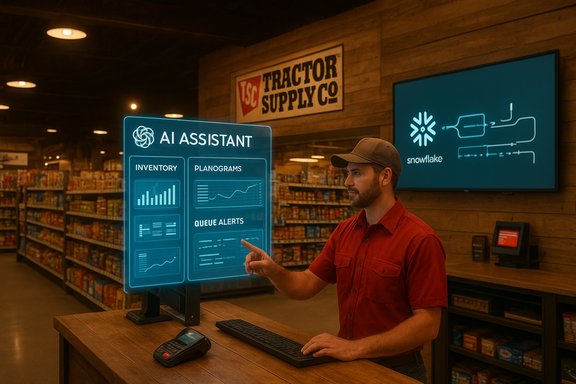
The company has already placed OpenAI‑powered tools into production: a customer‑facing conversational assistant on the website, an internal assistant for store associates to answer product questions and speed onboarding, and computer‑vision triggers in stores to surface queue‑length and planogram exceptions. Tractor Supply reports that roughly 1,200–1,500 enterprise OpenAI accounts have been provisioned as part of the rollout. Those are company figures and should be treated as directional pending independent verification.
However, the bet is not without material caveats. Vendor concentration increases switching costs and can create blind spots if specialized capabilities from other providers leap forward. Company‑reported adoption metrics are promising but require independent validation to confirm durable ROI. And the economics of inference, vector storage, and operational telemetry must be actively managed as adoption scales.
In short: Tractor Supply’s move is a sensible accelerator for retail AI adoption and has a credible path to payback if governance, portability, and cost‑control disciplines are enforced. But the strategy demands persistent vigilance: rigorous telemetry, contractual escape hatches, continuous red‑teaming, and a willingness to reintroduce multi‑model routing for tasks where other vendors demonstrably outperform. If those guardrails are in place, the company will likely capture significant operational value; if not, vendor lock‑in and capability drift could erode expected benefits.
What matters next is not the initial vendor choice but how Tractor Supply operationalizes governance and measured outcomes — those will determine whether the OpenAI partnership is a lasting advantage or an expensive lesson in vendor concentration.
Source: RetailWire Will Tractor Supply's All-In Gamble on OpenAI Pay Off?
 Background
Tractor Supply experimented with multiple AI vendors after the generative AI surge but by early 2025 elected to “double down” on OpenAI for its primary agent and automation stack, keeping other providers only where they are embedded inside third‑party software (for example, replenishment modules). Executives framed the choice as a pragmatic tradeoff: governance simplicity and a single roadmap versus the flexibility of a multi‑model approach.The company has already placed OpenAI‑powered tools into production: a customer‑facing conversational assistant on the website, an internal assistant for store associates to answer product questions and speed onboarding, and computer‑vision triggers in stores to surface queue‑length and planogram exceptions. Tractor Supply reports that roughly 1,200–1,500 enterprise OpenAI accounts have been provisioned as part of the rollout. Those are company figures and should be treated as directional pending independent verification.
Why Tractor Supply went all‑in: the company case
Tractor Supply’s leadership — led by EVP and chief technology officer Rob Mills — describes three practical drivers for a primary vendor strategy.- Governance and security: A single dominant model supplier simplifies policy enforcement, audit trails, and model‑version controls across stores, supply chain, and corporate systems. Centralized governance reduces the cognitive load on security teams when instrumenting red‑teaming, provenance logging, and human‑in‑the‑loop thresholds.
- Faster co‑development: Executives say OpenAI has been unusually collaborative about roadmaps and integrations, giving Tractor Supply early visibility into upcoming features and the ability to influence product priorities for retail use cases. That vendor attention can shorten the path from pilot to production.
- Operational simplicity for agents: By standardizing on one model provider for its “agents and automation” tier and connecting those agents to an enterprise Snowflake data lake, Tractor Supply aims to lower hallucination risk and produce responses anchored in internal, authoritative data. This retrieval‑augmented approach is the backbone of their automation playbook.
What’s live today — and what’s plausible next
Current deployments
- Website conversational assistant powered by OpenAI for customer support and exploratory commerce.
- In‑store computer vision alerts to detect long queues and certain customer/associate behaviors, nudging staff when intervention is needed.
- Internal team‑member assistant used as a consultative tool so associates can draft responses to product and policy queries, plus onboarding aids to reduce ramp time.
- Photo‑review automation for planogram resets that routes only exceptions to managers, replacing bulk manual checks.
Near‑term possibilities
- Deeper agentic commerce experiences where conversational flows check inventory, suggest complementary items, and help customers complete orders across store and web channels.
- Expanded vision use cases for compliance, merchandising checks, and safety monitoring that feed into district manager dashboards.
- Internal prompt engineering training programs to ensure employees write robust, context‑aware prompts and workflows that produce high‑quality outputs.
Strengths of the single‑vendor approach
- Simplified governance and auditability. A primary model provider reduces the surface area for compliance teams and allows consistent logging, model‑versioning, and red‑team cadence. This is especially useful where outputs affect operations, legal risk, or customer outcomes.
- Faster integration and vendor attention. Smaller, strategic customers that commit to a vendor often receive prioritized engineering support and roadmap visibility — an advantage Tractor Supply says it is already seeing. That can accelerate feature parity and bespoke optimizations for retail workflows.
- Operational wins tied to concrete problems. Tractor Supply anchored its use cases to high‑frequency, medium‑complexity tasks (queue detection, planogram validation, associate Q&A) that map well to current model capabilities and deliver measurable time savings. This avoids the classic “shiny‑object” trap.
- Engineering efficiency. Reducing the number of model families in production reduces integration complexity, decreases testing matrices, and shortens developer onboarding for internal builders and vendors consuming those services.
Major risks and caveats
Tractor Supply’s strategic clarity brings important risks that require active mitigation.Vendor concentration and lock‑in
Relying primarily on one provider concentrates operational dependency. Proprietary embeddings, fine‑tunes, or provider‑specific agent runtimes can be hard to port, creating real switching costs if pricing or capabilities degrade. Even with exceptions for embedded third‑party AI in vendor software, the core agentic layer becomes a single‑point dependency.Rapid model landscape and capability shifting
The “best” model for a specific subtask can change quickly; image models, reasoning models, or specialized code models may leap ahead from other vendors. A single‑provider posture trades run‑time flexibility for governance simplicity — an appropriate trade for operational stability, but one that risks missing step‑changes in specialized performance. Industry experts have warned that task‑to‑model routing is increasingly valuable.Unverifiable or company‑reported metrics
Company figures such as “1,200–1,500 OpenAI accounts” or reported counts of automated processes should be treated as indicative but not independently audited. Those numbers are useful operational signals but require third‑party verification to be treated as external KPIs.Hallucinations, escalation patterns, and human‑in‑the‑loop thresholds
Even well‑grounded retrieval‑augmented agents can produce incorrect or risky outputs. At scale, a small hallucination rate multiplied across thousands of interactions can materially affect customer experience or operations. Tractor Supply acknowledges this and is investing in prompt engineering and governance; continuous red‑teaming and rollback policies remain essential.Cost and inference economics
Generative AI inference and vector storage costs can escalate quickly at scale. A single‑provider deal may offer enterprise discounts, but operational cost visibility — including egress, vector store costs, and per‑inference telemetry — must be tight to prevent unanticipated TCO erosion. This is an industry‑wide challenge as models and compute tiers evolve.Competitive risk: first‑mover disadvantage for specialized capabilities
Competitors that elect a polyglot or best‑of‑breed approach may ship specialized capabilities (for example, superior multimodal reasoning, advanced image generation, or highly optimized vision pipelines) first. Tractor Supply could be slower to adopt these improvements if they’re tightly coupled to other vendors’ runtimes. That risk is real in a market where different models show rapid, narrow‑domain leadership.The broader context: OpenAI, compute markets, and why this matters
Tractor Supply’s vendor choice does not occur in a vacuum. The cloud and accelerator landscape — including multi‑cloud OpenAI sourcing news and large hyperscaler deals — changes the dynamics for any enterprise picking a primary model supplier.- OpenAI’s enterprise posture and compute sourcing strategy are actively shifting toward multi‑provider capacity commitments and potential compute offerings, which in turn affects enterprise bargaining power, SLAs, and feature availability. Analysts have documented large consumption arrangements and the industry’s focus on resource scarcity (GPUs), which implies both opportunity and execution risk for customers that align tightly with OpenAI.
- The hardware stack remains heavily concentrated around a few accelerator providers. Even with multi‑cloud sourcing, the underlying supply chain for advanced GPUs is a systemic constraint; that affects latency, pricing, and availability for enterprise inference workloads. Enterprises should expect changing price/perf dynamics as hyperscalers respond.
- The market is experimenting with different procurement models — from reseller/marketplace packaging to co‑built “Stargate” partnerships and the distant possibility of first‑party model+compute clouds. Each path changes contract terms and lock‑in profiles for enterprise customers. Organizations should model contractual escape clauses and portability in any major AI partnership.
Governance, procurement, and technical controls Tractor Supply (and any retailer) must keep tight
To make an all‑in vendor strategy safe and economically sensible, the following controls are essential.- Portability and escape clauses. Contracts should include clear data export, embedding snapshots, and migration toolkits to reduce lock‑in costs.
- Model‑version SLAs and rollback playbooks. Define automated rollback triggers and runbooks for model regressions or safety incidents.
- Provenance and response‑level citations. Agents should cite the internal documents, inventory records, or canonical sources that produced their answers, enabling audit trails and human review.
- Human‑in‑the‑loop thresholds. For higher‑impact outputs, require mandatory human signoff and define error budgets for automation.
- Cost telemetry and observability. Track inference cost per interaction, vector store growth, and egress to maintain TCO discipline.
- Continuous red‑teaming and regression testing. Automate adversarial tests and snapshot behaviors across model versions to detect regressions early.
Practical ROI considerations and how Tractor Supply can show value
Retails that succeed with generative AI anchor projects to clear operational metrics. For Tractor Supply, early ROI vectors include:- Reduced store manager inspection time via photo automation — measured as hours saved per week and reduced time‑to‑escalation.
- Shorter new‑hire ramp times through internal assistants — measured as decreased training cost and improved first‑month productivity.
- Fewer customer service escalations and faster resolution on web chat — measured in contact center cost per interaction and CSAT improvements.
Competitive implications for other retailers
Tractor Supply’s choice will be watched closely in retail circles. It sets a pragmatic playbook: pick a primary partner for agent stability but retain multi‑model adapters for specialized tasks. Other retailers face a similar tradeoff:- Some will favor single‑vendor depth to reduce integration costs and accelerate production rollouts.
- Others will favor polyglot flexibility to route discrete tasks to the best available model at any moment, tolerating more governance complexity for capability advantage.
Recommendations for retailers considering a similar move
- Codify a three‑tier AI stack: (a) embedded vendor modules for commodity services, (b) primary partner for agentic automation, (c) adapters to experiment with best‑of‑breed models. This mirrors Tractor Supply’s pragmatic compromise.
- Require contractual portability artifacts: embedding dumps, vector index snapshots, and model execution wrappers to ease future migration.
- Invest in prompt engineering and continuous training for frontline staff: better prompts reduce hallucinations and improve downstream efficiency.
- Instrument cost and safety telemetry from day one: per‑inference cost tracking, error budgets, and automatic rollback thresholds.
- Pilot with measurable KPIs tied to labor or revenue: replace manual tasks with automation that has clear time‑saved and error‑rate targets.
Final assessment — will Tractor Supply’s gamble pay off?
Tractor Supply’s concentrated partnership with OpenAI is a practical, well‑scoped strategy for an operationally complex retailer that needs consistent governance, measurable productivity gains, and fast vendor collaboration. Their early focus on productionized, medium‑complexity use cases (queue alerts, planogram review, associate assistants) is the right way to de‑risk AI adoption and capture near‑term labor savings.However, the bet is not without material caveats. Vendor concentration increases switching costs and can create blind spots if specialized capabilities from other providers leap forward. Company‑reported adoption metrics are promising but require independent validation to confirm durable ROI. And the economics of inference, vector storage, and operational telemetry must be actively managed as adoption scales.
In short: Tractor Supply’s move is a sensible accelerator for retail AI adoption and has a credible path to payback if governance, portability, and cost‑control disciplines are enforced. But the strategy demands persistent vigilance: rigorous telemetry, contractual escape hatches, continuous red‑teaming, and a willingness to reintroduce multi‑model routing for tasks where other vendors demonstrably outperform. If those guardrails are in place, the company will likely capture significant operational value; if not, vendor lock‑in and capability drift could erode expected benefits.
What matters next is not the initial vendor choice but how Tractor Supply operationalizes governance and measured outcomes — those will determine whether the OpenAI partnership is a lasting advantage or an expensive lesson in vendor concentration.
Source: RetailWire Will Tractor Supply's All-In Gamble on OpenAI Pay Off?
