

The Spiceworks Voice of IT snapshot of enterprise backup choices reveals a simple but powerful truth: IT professionals pick backup vendors with trust in mind first, and they define trust in very different ways. The headline finding — that reliability and brand reputation beat price, features, and even ransomware protection when it comes to vendor selection — is less a surprise than a roadmap for how backup vendors must earn and demonstrate credibility in an era of cloud-first infrastructures and persistent cyberthreats. The patterns in the responses paint a market split between specialist reliability-first buyers, price-and-ease-oriented pragmatists, and ecosystem buyers who place integration above all — and that split matters for procurement, architecture, and risk planning across the enterprise.
IT teams have more choices than ever for protecting systems and data: established vendors like Veeam, integrated cloud options such as Microsoft Azure Backup, and cross-cutting platforms that combine backup with cybersecurity and MSP-focused services like Acronis. These choices come against a backdrop of rising data volumes, expanding SaaS footprints, and a threat landscape where ransomware and supply-chain risks get the headlines. Yet, when asked what tipped the balance on procurement, the Spiceworks Voice of IT survey respondents prioritized reliability and brand trust above pricing or feature checklists — a significant indicator of where enterprise priorities sit today.
It’s important to note up front that the numerical breakdown cited in this feature comes from the Spiceworks Voice of IT survey as provided in the assignment; direct retrieval of the original Spiceworks page was blocked during verification checks, so the article treats the survey figures as reported and focuses on corroborating the broader themes using independent industry data where available. Where direct verification was unavailable, I flag those claims and rely on multiple authoritative industry sources to validate the trends and implications discussed below.
Two independent industry data points support the survey’s central claim that reliability leads purchase decisions. Vendor-released research and industry analyses repeatedly show that the top reason for switching or upgrading backup solutions is the desire for more reliable backups and faster recovery. Enterprises are less tolerant of “best-effort” backup models because the cost of failed restores is now existential — prolonged downtime, data loss, regulatory exposure, and the cascading business impacts of unrecoverable systems.
What this means for vendors: proving reliability is no longer a marketing claim; it must be demonstrable in multiple ways:
For IT leaders, the lesson is operational: define what “trust” means for your organization, make it measurable, and use that definition to guide procurement, architecture, and testing. For vendors, the mandate is equally clear: show, don’t just tell. Deliver measurable recoverability, transparent support, and deployment models that match the buyer’s organizational operating model — and you turn perceived trust into repeatable customer wins.
The backup market will continue to fragment between specialist platforms, integrated cyber-protection suites, and cloud-native services. Organizations that translate their recovery expectations into auditable procurement criteria — and that insist on joint metrics between infrastructure and security — will be best positioned to navigate that fragmentation and protect the business when incidents inevitably happen.
Source: Spiceworks Voice of IT Survey: The state of enterprise backup - Spiceworks
 Background
IT teams have more choices than ever for protecting systems and data: established vendors like Veeam, integrated cloud options such as Microsoft Azure Backup, and cross-cutting platforms that combine backup with cybersecurity and MSP-focused services like Acronis. These choices come against a backdrop of rising data volumes, expanding SaaS footprints, and a threat landscape where ransomware and supply-chain risks get the headlines. Yet, when asked what tipped the balance on procurement, the Spiceworks Voice of IT survey respondents prioritized reliability and brand trust above pricing or feature checklists — a significant indicator of where enterprise priorities sit today.It’s important to note up front that the numerical breakdown cited in this feature comes from the Spiceworks Voice of IT survey as provided in the assignment; direct retrieval of the original Spiceworks page was blocked during verification checks, so the article treats the survey figures as reported and focuses on corroborating the broader themes using independent industry data where available. Where direct verification was unavailable, I flag those claims and rely on multiple authoritative industry sources to validate the trends and implications discussed below.
What the survey shows at a glance
- Reliability / trust drive selection. Across the three vendor cohorts highlighted — Veeam, Acronis, and Azure-native options — respondents most often cited reliability and reputation as the deciding factors, not the slickest feature set or the lowest price.
- Veeam: a reliability-first constituency. Veeam buyers skew strongly toward reliability (reported ~63%) and brand reputation (~28%), while showing comparatively lower sensitivity to price. That is consistent with Veeam’s market positioning as a high-end, enterprise-focused data resilience platform. Industry reports and vendor-led research repeatedly show that reliability and recoverability top the priority list for buyers considering purpose-built backup platforms.
- Acronis: price + deployment + solid reliability. Respondents who selected Acronis reported a more balanced decision matrix: higher-than-average importance attached to price, reliability, and ease of deployment — the latter two reflecting Acronis’ push to integrate cyber protection and simplified deployment for MSPs and SMBs. This dovetails with Acronis positioning that bundles backup, anti-malware, and management into a single p IT teams.
- Azure: integration wins. For respondents who chose Azure-native backup, integration with the Microsoft ecosystem was the dominant motivator (~69%), while only a minority explicitly cited reliability as the prime driver. This suggests Azure’s strongest sales argument is the operational simplicity and control gained by keeping backup inside the cloud provider’s native platform. Microsoft’s own documentation and product messaging emphasize native workload integration, centralized policy management, and low operational overhead as the primary advantages of adopting Azure Backup.
- Surprising depriorities. The survey shows ransomware protection and multi-cloud support ranked near the bottom as purchase drivers (single-digit percentages for multi-cloud and low teens for ransomware protection). That disconnect — between what security teams tell us keeps them up at night and what procurement teams deem a selection driver — is a critical tension for vendors to understand and for IT leaders to reconcile.
Why reliability still dominates — and what “reliability” means
When respondents say they choose a backup product for reliability, they are usually compressing several distinct expectations into a single word: predictable success rates of scheduled backups, quick and verifiable restores, minimal operational overhead, and resilience through incidents (including ransomware, hardware failures, or cloud outages). Buyers have learned the hard way that a lower-cost product that fails under stress costs far more than the license fee.Two independent industry data points support the survey’s central claim that reliability leads purchase decisions. Vendor-released research and industry analyses repeatedly show that the top reason for switching or upgrading backup solutions is the desire for more reliable backups and faster recovery. Enterprises are less tolerant of “best-effort” backup models because the cost of failed restores is now existential — prolonged downtime, data loss, regulatory exposure, and the cascading business impacts of unrecoverable systems.
What this means for vendors: proving reliability is no longer a marketing claim; it must be demonstrable in multiple ways:
- Recovery testing and verification: automated, auditable recovery drills and immutable recovery points.
- Transparent SLAs and telemetry: measurable success/failure metrics, reporting, and telemetry that teammates can trust.
- Operational simplicity: predictable deployments and upgrades so that reliability is not contingent on bespoke scripting or fragile integrations.
- Security hardening: immutable storage, air-gapped or offsite copies, and ransomware-detection tooling that reduce the chance of silent corruption.
Vendor deep dive: how each vendor earns trust
Veeam — trust through track record and support
Veeam’s buyer profile in the survey skews heavily toward reliability and brand reputation. The implication: organizations that purchase Veeam are betting that the product will keep backups running and restore quickly when needed, and they value a vendor with a strong track record and partner ecosystem.- Strengths: Veeam has built a reputation for broad workload support (virtual, physical, cloud), mature recovery features, and enterprise tooling. Industry reports continue to place Veeam among the market leaders in enterprise backup and recovery, a position that reinforces its brand value.
- Support as a differentiator: The survey’s split on support quality — with Veeam respondents more likely to cite support as a selection factor — suggests Veeam has converted support into a competitive asset. Vendors that provide timely escalation pathways, clear upgrade roadmaps, and effective field engineering turn operational trust into a procurement advantage.
- Risks: strong brand and reliability perception can hide recent technical debt or security issues — a reminder to verify current CVE status, recent patches, and customer satisfaction trends. Indeed, enterprise backup products in general have had high-profile vulnerabilities in recent years, underlining that trust must be accompanied by continuous security diligence.
Acronis — practical, MSP-focused, cost-sensitive buyers
Acronis buyers in the survey appear to form a distinct cohort: price-conscious but sensitive to ease of deployment and decent reliability. That aligns with Acronis’ product and go-to-market strategy, which targets MSPs and SMBs with bundled cyber protection (backup + anti-malware + management).- Strengths: Acronis emphasizes ease of deployment and integrated cyber protection, which reduces tool sprawl for small teams and managed-service resellers. Recent Acronis product announcements and whitepapers highlight preconfigured plans, archival storage options, and managed services capabilities meant to simplify deployments and manage costs. ([dl/dl.acronis.com/u/rc/White-paper-Acronis-Cyber-Protect-Cloud-NIS-2-Directive-EN-EU-240228.pdf)
- Why price matters: for MSPs and smaller enterprises, licensing parity and predictable per-seat or per-instance pricing can swing the decision. If Acronis can offer parity in core recovery features while undercutting competitors on ongoing costs, the tradeoff is attractive.
- Risks: customers choosing Acronis for cost and ease must validate recovery fidelity and long-term roadmaps. Integration complexity can still appear at scale — and when MSPs win larger portfolios, scalability and enterprise-grade compliance capabilities become the next hurdle.
Azure-native backup — ecosystem and operational simplicity first
Azure Backup’s proponents in the survey prioritized integration — staying inside the Microsoft ecosystem reduces management friction, aligns with enterprise cloud strategies, and centralizes recovery policies and governance.- Strengths: native workload integration (Azure VMs, Azure Files, SQL, SAP HANA), centralized management via Backup Center, and the ability to leverage Azure RBAC and policy frameworks are compelling to organizations already invested in Azure. Microsoft documentation and product guides repeatedly highlight that a primary Azure Backup selling point is operational simplicity and governance alignment rather than a feature-for-feature contest with specialist vendors.
- Why reliability was lower-ranked for Azure buyers: the survey’s finding that only a minority of Azure buyers labeled reliability the top criterion may reflect assumed reliability — teams that choose Azure expect Microsoft to manage the platform-level availability and durability. In procurement language, they’re buying convenience and integration, trusting the cloud provider’s service SLAs.
- Risks: that trust is not always well-founded. Cloud provider outages, misconfiguration, or mistaken deletion (including via compromised service principals) can still put backups at risk. Choosing a native service requires an explicit verification regime: separate admin identities, recovery playbooks that don’t depend on a single control plane, and cross-checks to ensure backups are not implicitly tied to the source tenant’s identity controls. Recent cloud incidents across major providers demonstrate that a single-plane-of-control failure can cascade into backup management disruptions.
The odd gap: ransomware protection ranked low as a buying criterion
One of the most striking survey signals is that ransomware protection registered low as a decision driver. That runs counter to the narrative most security vendors and many security surveys present, which show ransomware as a top concern for IT leaders. How do we reconcile this?- Buyer psychology: When selecting a backup vendor, procurement teams often think in terms of recoverability and operations, not malware detection features. Ransomware detection and anti-tamper protections may be seen as adjuncts rather than primary selection criteria, especially if buyers assume that immutable storage and offline copies are standard features or will be layered in by security teams.
- Organizational silos: Backup is usually owned by IT operations or infrastructure teams, while ransomware strategy is often driven from security or risk functions. If organizational responsibilities are split, the backup decision process may prioritize operational metrics (reliability, restore speed) over security-centric features (active ransomware detection). This survey outcome is consistent with real-world vendor conversations and analyst reports showing a gap between security priorities and backup procurement metrics.
- Practical implication: enterprises must bridge the gap. Backup buyers should insist on demonstrable ransomware resilience (immutable copies, air-gapped or offline copies, anomaly detection), and security teams should require backup recovery testing as part of incident response playbooks.
Multi-cloud support — low priority, or misunderstood value?
Multi-cloud support’s low ranking is another counterintuitive outcome. In theory, multi-cloud flexibility should be attractive to organizations hedging supplier risk or optimizing cost.- A likely explanation: respondents who valued integration with Azure simply weren’t in the market for multi-cloud capabilities; their priority was a single-vendor operational model that reduced complexity. Meanwhile, organizations that value multi-cloud portability are a distinct segment and may not dominate the Spiceworks survey sample used here.
- Hidden costs and complexity: building a multi-cloud backup architecture that actually works — consistent policies, cross-cloud restores, and predictable SLAs — is hard and expensive. Many teams therefore prefer a single well-integrated solution they can operationalize, rather than a theoretically flexible but harder-to-manage multi-cloud approach.
- What to watch for: if an organization migrates aggressively or adopts a poly-cloud strategy, revisit backup architecture — the survey signal should not be taken as license to ignore cross-cloud resilience planning.
What this means for buyers (practical guidance)
- Prioritize verified recoverability, not marketindors to demonstrate automated recovery testing, show real telemetry, and run a live restore exercise as part of procurement.
- Align procurement and security. Make ransomware resilience a joint metric owned by both infrastructure and security teams; require immutable storage and air-gapped copies where appropriate.
- Use integration strategically. If you’re heavily invested in Azure, the operational gains of native backup may outweigh feature parity gaps — but insist on independent recovery routes and documented DR playbooks that work even when the primary management plane is impaired.
- Evaluate total cost of ownership, not headline license price. Pricing differences that look attractive on paper can disappear under storage costs, egress, and the management burden of bespoke integrations. Acronis may win on initial price and ease, but validate the recovery SLA at scale.
- Treat support quality as a selection criterion. The survey’s differential on support (higher for Veeam buyers) shows that good support reduces operational risk. Ask vendors for support SLAs, escalation paths, and field references that map to your environment.
Vendor playbook: how vendors should respond to these findings
- Veeam and similar specialist backup vendors: double down on measurable reliability and operational telemetry. Convert field engineering and support responsiveness into tangible procurement artifacts — recovery verification logs, white-glove onboarding, and “failure-mode” playbooks.
- Acronis and MSP-focused vendors: keep simplifying deployment and clarifying pricing bands while building in enterprise-grade recovery assurances that scale beyond SMB footprints.
- Cloud providers (Azure et al.): make the integration story concrete with guaranteed recovery modes that don’t depend on the provider’s single control plane. Offer explicit “out-of-band” recovery procedures, and make cross-tenant and cross-subscription restores frictionless for large customers.
Risks, caveats, and methodology transparency
- Source access limitation: the detailed percentages described at the top of this article were provided in the brief and could not be retrieved directly from the Spiceworks site during verification due to access restrictions. While the raw numbers are taken as reported, the analysis emphasizes corroborating themes and independent industry data in order to validate and contextualize the survey’s conclusions.
- Sampling considerations: the Spiceworks Voice of IT is a valuable signal from practicing IT professionals but may skew toward certain enterprise sizes, geographies, or tech stacks depending on the respondents. Survey findings can reflect the sample composition as much as market-wide priorities.
- Rapid market change: the backup and data-protection market moves quickly — vendor features, pricing models, and strategic partnerships change annually. Where competitive or security-critical decisions are being made, teams should verify vendor claims, check the latest CVE and patch bulletins, and require live recovery tests before committing.
- Cross-vendor overlap: the distinctions drawn in the survey between vendors are useful but are not absolute. Many large enterprises run hybrid models — Veeam for on-prem and high-SLA workloads, Azure Backup for cloud-native workloads, and third-party services for long-term archival — and procurement decisions often reflect those layered realities.
Conclusion: a market built on trust, defined in three different currencies
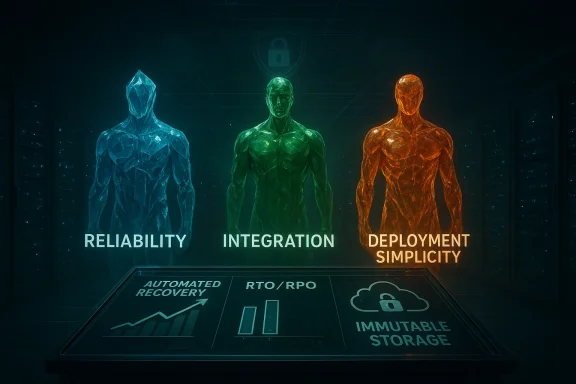
The Spiceworks Voice of IT survey exposes an essential truth about enterprise backup: trust wins, but the currency of trust differs across buyer groups. Some pay in reliability metrics and brand confidence (Veeam buyers); others pay with price and operational simplicity (Acronis and MSP users); and a rising cohort pays in integration — staying inside a cloud ecosystem for governance and manageability (Azure buyers).For IT leaders, the lesson is operational: define what “trust” means for your organization, make it measurable, and use that definition to guide procurement, architecture, and testing. For vendors, the mandate is equally clear: show, don’t just tell. Deliver measurable recoverability, transparent support, and deployment models that match the buyer’s organizational operating model — and you turn perceived trust into repeatable customer wins.
The backup market will continue to fragment between specialist platforms, integrated cyber-protection suites, and cloud-native services. Organizations that translate their recovery expectations into auditable procurement criteria — and that insist on joint metrics between infrastructure and security — will be best positioned to navigate that fragmentation and protect the business when incidents inevitably happen.
Source: Spiceworks Voice of IT Survey: The state of enterprise backup - Spiceworks
