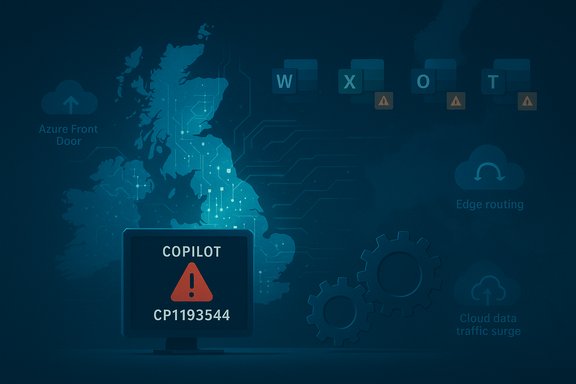
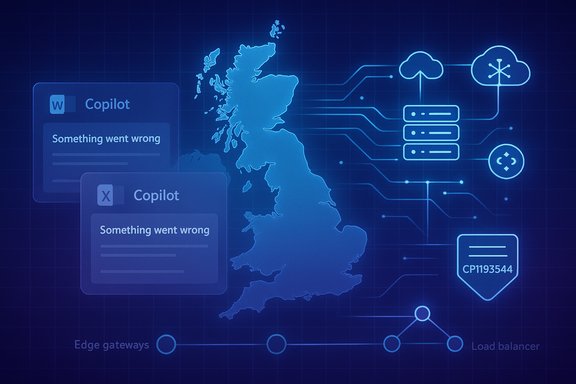
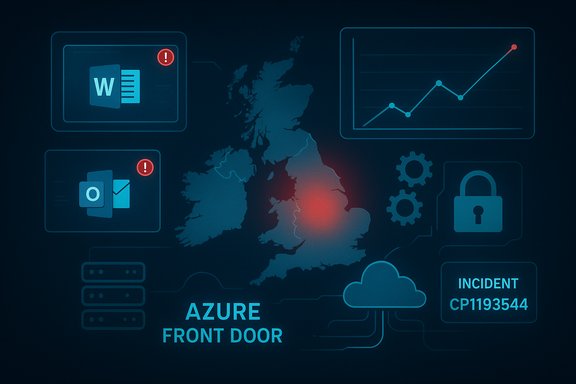
Copilot users in the United Kingdom and parts of Europe were briefly locked out of Microsoft’s AI assistant on December 9, 2025, after a surge in traffic overwhelmed autoscaling controls and produced region-specific service failures that were visible on public trackers and acknowledged by Microsoft’s status channels.
Microsoft Copilot is a deeply integrated AI assistant embedded across Windows and Microsoft 365 applications, offering features from draft generation to contextual in‑app automation. Because Copilot is both an independent app and a layer inside Word, Excel, Outlook, Teams and other products, a regional or platform fault can cascade into many day‑to‑day workflows. News.Az first reported the December 9 outage as a major disruption to Copilot in the United Kingdom, citing outage‑tracking reports that placed the disruption on Tuesday morning UK time. Independent monitoring and follow‑up coverage confirmed that Microsoft acknowledged a targeted incident impacting Copilot in the UK and parts of Europe on December 9, tracked internally under incident code CP1193544, and attributed the visible symptoms to difficulties in service autoscaling to meet demand as telemetry showed an unexpected traffic surge. This acknowledgment appeared in Microsoft’s published status updates and was reported by major outlets.
For administrators and organizations that rely on Copilot, the practical takeaways are straightforward: prepare fallback processes, monitor Microsoft’s Service Health notices (incident CP1193544 for the Dec 9 event), and treat AI intermediaries as capabilities that require the same operational rigor applied to any mission‑critical service. For Microsoft and other hyperscalers, the engineering challenge remains to make autoscaling more anticipatory, to harden shared control planes against ripple effects, and to be relentlessly transparent when these systems fail.
In the immediate term, users and admins should watch the Microsoft 365 Service Health dashboard for any lingering notices, follow the posted incident code for updates, and rely on manual workarounds if Copilot features are essential to ongoing work. The incident is a reminder that, even as AI becomes embedded in productivity, classic cloud engineering risks — capacity, control‑plane changes, and systemic coupling — remain the dominant determinants of service reliability.
Source: Latest news from Azerbaijan Microsoft Copilot down in major outage | News.az
 Background / Overview
Microsoft Copilot is a deeply integrated AI assistant embedded across Windows and Microsoft 365 applications, offering features from draft generation to contextual in‑app automation. Because Copilot is both an independent app and a layer inside Word, Excel, Outlook, Teams and other products, a regional or platform fault can cascade into many day‑to‑day workflows. News.Az first reported the December 9 outage as a major disruption to Copilot in the United Kingdom, citing outage‑tracking reports that placed the disruption on Tuesday morning UK time. Independent monitoring and follow‑up coverage confirmed that Microsoft acknowledged a targeted incident impacting Copilot in the UK and parts of Europe on December 9, tracked internally under incident code CP1193544, and attributed the visible symptoms to difficulties in service autoscaling to meet demand as telemetry showed an unexpected traffic surge. This acknowledgment appeared in Microsoft’s published status updates and was reported by major outlets. What happened — concise timeline
Dec 9, 2025 — UK/Europe Copilot disruption (regional autoscaling)
- Early morning (UK time) — users in the UK and parts of Europe began reporting failures or degraded responses from Copilot; public trackers showed a spike in reports. News.Az published an item noting the outage and citing DownDetector’s surge in reports.
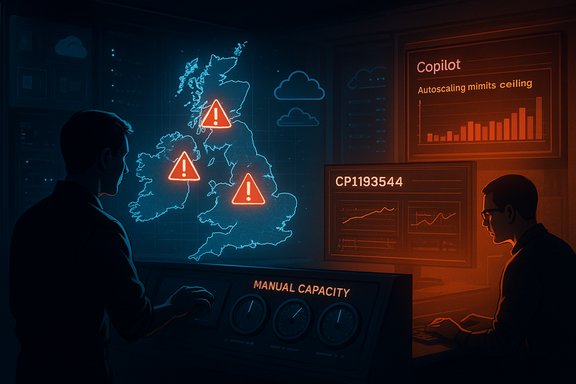
- Microsoft posted updates to its Microsoft 365 Status channel and the admin center, opening incident CP1193544 and telling administrators the issue appeared to be caused by an unexpected increase in traffic that impacted autoscaling and capacity provisioning for Copilot services. Engineers began manually scaling capacity while monitoring results.
- Within hours — Microsoft reported stabilization after manual scaling actions and continued monitoring; public trackers showed reports decline as capacity increases took effect. Independent articles and IT monitoring feeds documented the event and the company’s response.
Context: earlier high‑impact outages that involved Copilot
Copilot service interruptions are not new: large Microsoft platform incidents have previously disrupted Copilot when the underlying Azure edge, DNS or routing fabrics were affected. A high‑visibility event on October 29, 2025, for example, stemmed from an Azure Front Door configuration change and produced cascading failures across Microsoft 365 surfaces, including Copilot features for some tenants. That incident was tracked under Microsoft 365 incident MO1181369 and was extensively reconstructed by monitoring teams and reporters. The October 29 outage demonstrates how edge routing and identity token flows can amplify a single change into far‑reaching effects that touch Copilot’s integrations.Technical anatomy — why Copilot outages look big
Copilot sits on multiple layers
- At the application layer, Copilot provides in‑app features inside Word, Excel, Outlook, and Teams.
- At the service layer, Copilot depends on cloud APIs, model inference endpoints, token issuance (Microsoft Entra), and file‑handling pipelines (OneDrive/SharePoint).
- At the network/edge layer, global ingress services (Azure Front Door and other routing fabrics) and DNS participate in making Copilot reachable and secure.
Autoscaling and the surge problem (what Microsoft reported)
Microsoft’s December 9 incident was described as a capacity shortfall triggered by an unexpected traffic surge. In modern cloud systems, autoscaling is meant to absorb workload spikes by provisioning additional compute and networking resources automatically. But autoscaling depends on:- Correct telemetry (to detect demand quickly),
- Fast provisioning pipelines (to spin up model inference nodes and related services),
- Throttles and safeguards (to avoid runaway resource allocation),
- Sufficient spare capacity in the target region.
Edge coupling and historic precedents
The October 29, 2025 Azure Front Door incident is a useful precedent. That outage was traced to an inadvertent AFD configuration change which created DNS/routing anomalies and token issuance timeouts that inhibited sign‑in and in‑app features across Microsoft’s portfolio. Copilot, when fronted by the same edge stack and reliant on Entra for tokens, was among the affected services. That event highlights two recurring systemic risks:- Centralized edge fabrics and identity planes become amplification points for failures.
- Control‑plane changes (config or deployment missteps) can cascade far faster than any single service rollback can recover.
Impact — who felt the outage and what stopped working
Consumer and professional users
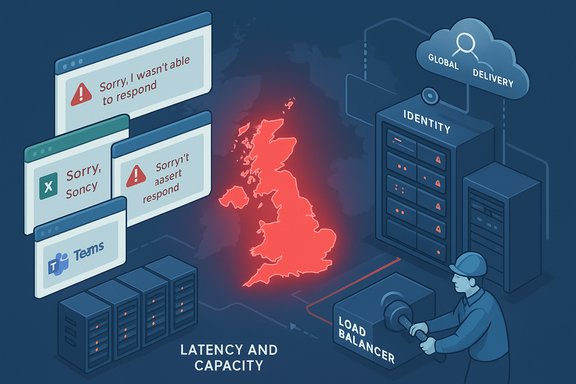
- Users relying on Copilot inside Word, Outlook and Teams reported delays, timeouts or complete inability to access Copilot prompts and responses in affected regions. News portals and community trackers recorded complaints primarily from the United Kingdom and Europe during the incident window.
Enterprise implications
- Organizations that use Copilot for day‑to‑day drafting, summarization, or automated workflows could see halted automation and increased manual work while the service was affected. This can have downstream consequences for deadlines, customer support, and dependent automation pipelines.
- Admins were advised to monitor Microsoft 365 Admin Center incident entries (CP1193544 in the December 9 event) for status and remediation guidance.
Third‑party and downstream effects
- Because Copilot integrates with file services and identity flows, brief outages can produce confusion where files appear accessible via OneDrive/SharePoint but Copilot can’t read or edit them through its UI, or where token issues block Copilot‑initiated actions. Past incidents show that downstream customer sites hosted behind the same edge fabric (Azure Front Door) experienced 502/504 gateway errors; while the December 9 incident appears more localized to Copilot autoscaling, the risk of cross‑service impact is real.
Microsoft’s response and public messaging
Microsoft’s operational pattern for service incidents is consistent: publish an incident to the Microsoft 365 Status feed and Service Health dashboard, assign an incident code, and provide rolling updates while engineers remediate. For December 9 the code CP1193544 appeared in Microsoft’s admin‑center notices and updates, and the company reported manual scaling actions to restore capacity. Independent outlets quoted Microsoft’s status messages and telemetry‑based assessments. For historical perspective, the October 29 outage prompted Microsoft to block further Azure Front Door configuration changes and roll back to a previously validated configuration while failing management portals away from affected AFD paths. Those containment choices — freeze, rollback, failover — are orthodox control‑plane responses and were followed during that event. The October incident teaches a clear lesson: containment choices that prioritize data integrity and long‑term stability may extend short‑term availability pain during recovery.Why this matters — risks, strengths, and the tradeoffs
Strengths: rapid detection and operational playbooks
- Microsoft’s ability to detect the spike via telemetry and assign an incident code quickly is a strength: rapid visibility limits uncertainty for customers and allows coordinated remediation.
- Manual scaling as an immediate temporary measure prevented longer outages for many users while engineers investigated root causes and adjusted autoscaling thresholds.
Risks: concentration and coupling
- Centralization of edge routing (Azure Front Door) and identity (Microsoft Entra) creates high‑blast‑radius failure modes. When a region’s autoscaling falters or an edge configuration is wrong, many services relying on those shared surfaces can show simultaneous symptoms.
- Reliance on Copilot as a primary interface for critical workflows increases operational exposure: when AI intermediaries fail, users may find files or services technically available but effectively unusable for automated work.
Operational tradeoffs
- Autoscaling accelerates innovation and efficiency, but it presumes predictable provisioning windows and sufficient headroom. When traffic patterns change dramatically — driven by a product announcement, viral usage pattern, or external event — autoscaling settings and capacity planning are tested.
- Microsoft’s conservative safety postures in edge/hosted infrastructure (e.g., powering down hardware for cooling safety or rolling back configurations to preserve durability) are defensible from a data‑integrity perspective, but they trade short‑term availability for long‑term reliability.
Recommendations for IT teams and Copilot users
For IT administrators
- Monitor the Microsoft 365 Admin Center and Service Health regularly for incident codes (e.g., CP1193544) and targeted guidance. Microsoft posts remediation actions and ETA estimates there.
- Prepare fallback workflows: ensure core tasks have non‑AI paths (manual templates, scripted generation outside Copilot) so critical operations are not blocked by a Copilot outage.
- Use programmatic admin tools where portals are affected: Microsoft has historically recommended PowerShell/CLI alternatives when Azure Portal blades are blank during edge incidents.
- Consider multi‑region redundancy and failover strategies for customer‑facing services that depend on AFD—use Azure Traffic Manager or similar tools to route around problematic entry points if needed. Past advisories from Microsoft detail these mitigations.
For power users and knowledge workers
- Keep local copies or drafts when performing time‑sensitive work that depends on Copilot-generated content.
- When Copilot is degraded, switch to the native app’s built‑in features and templates; maintain a checklist of manual steps for time‑critical processes that Copilot would normally streamline.
Verification and sourcing — what we can confirm and what remains provisional
- Confirmed: News organizations and Microsoft’s status channels confirmed a Copilot service impact on December 9, 2025, affecting the UK and parts of Europe. Microsoft opened incident CP1193544 and reported autoscaling difficulties; engineers manually scaled capacity while monitoring stabilization. These points are documented in Microsoft status updates and coverage by independent news outlets.
- Confirmed (historical): The October 29, 2025 Azure Front Door incident (MO1181369) disrupted wide swathes of Microsoft services, including Copilot in affected tenants; Microsoft attributed that event to an inadvertent AFD configuration change and executed a rollback. This sequence is documented in Microsoft’s incident logs and independent technical reconstructions.
- Provisional / unverifiable claims: Some short news items and social posts reported minute‑level details (exact minute of first user reports, precise root‑cause traces inside Microsoft’s internal telemetry) that are not fully disclosed publicly. Root‑cause analyses that attribute certain symptoms to specific microservice failures or internal code changes should be treated as provisional until Microsoft releases a post‑incident report (PIR) or its Service Health page publishes a conclusive post‑mortem. Where reporting relies on outage‑tracker spikes alone, use caution — those trackers show symptom velocity and geography but do not replace provider telemetry for definitive causal attribution.
Critical analysis — what Microsoft (and customers) should consider next
Strengthen autoscaling resilience for AI workloads
AI model hosting and inference have different scaling characteristics than typical web workloads: cold starts for large models and GPU provisioning can be non‑trivial, and autoscaling thresholds tuned for CPU‑based services may be inadequate. Providers and customers should:- Pre‑warm inference pools for predictable spikes (scheduled events, product launches).
- Use capacity reservations or burst capacity where latency‑sensitive AI interactions are business‑critical.
- Implement graceful degradation modes (e.g., fall back to smaller models or cached responses) rather than hard failures.
Reassess single‑point dependencies
Many organizations view Microsoft’s platform as the default, but the October 29 and December 9 incidents illustrate concentration risk:- For Internet‑facing properties and mission‑critical flows, multi‑provider strategy or architected failover patterns remain worth considering.
- At a minimum, decouple identity and ingress where possible, and design for token‑issuance fallback mechanisms.
Transparency and post‑incident communications
Large cloud providers owe customers timely, accurate post‑incident reports that include timelines, root‑cause analysis and mitigations. Public and corporate trust hinges on:- Clear incident IDs and consistent status updates (Microsoft’s practice helps here).
- Final PIRs that explain not only what failed, but what will change to prevent recurrence.
Final assessment
The December 9, 2025 Copilot disruption in the United Kingdom and Europe was a limited but instructive episode: it exposed how autoscaling limits and regional capacity constraints can translate into immediate, user‑visible outages for AI‑driven productivity tools. Microsoft’s rapid detection and manual scaling response reduced the outage window, but the event underscores structural tensions as AI becomes central to everyday workflows: performance expectations are high, but the underlying infrastructure — from edge routing to inference capacity — must be continuously adapted to meet unpredictable demand.For administrators and organizations that rely on Copilot, the practical takeaways are straightforward: prepare fallback processes, monitor Microsoft’s Service Health notices (incident CP1193544 for the Dec 9 event), and treat AI intermediaries as capabilities that require the same operational rigor applied to any mission‑critical service. For Microsoft and other hyperscalers, the engineering challenge remains to make autoscaling more anticipatory, to harden shared control planes against ripple effects, and to be relentlessly transparent when these systems fail.
In the immediate term, users and admins should watch the Microsoft 365 Service Health dashboard for any lingering notices, follow the posted incident code for updates, and rely on manual workarounds if Copilot features are essential to ongoing work. The incident is a reminder that, even as AI becomes embedded in productivity, classic cloud engineering risks — capacity, control‑plane changes, and systemic coupling — remain the dominant determinants of service reliability.
Source: Latest news from Azerbaijan Microsoft Copilot down in major outage | News.az