Shopify and Google’s joint push around a new open standard — the Universal Commerce Protocol (UCP) — and Shopify’s concurrent rollout of Agentic Storefronts and an expanded Shopify Catalog mark a decisive moment in the evolution of conversational commerce. The announcements position UCP as the interoperability layer that lets AI assistants discover canonical product records, assemble carts, negotiate offers, and complete delegated, tokenized checkouts inside chat and search surfaces (Gemini, AI Mode in Search, Copilot, and other assistants) while preserving merchants as the merchant of record. What was an ecosystem of brittle, point-to-point integrations is being reframed as a standards-driven plumbing stack for “agentic commerce.”
The last 18–24 months transformed assistants from research tools into action-capable agents that can ask clarifying questions, maintain multi-turn context, and — crucially — take actions on behalf of users. That change exposed three structural weaknesses in early in-chat commerce pilots:
This approach preserves PCI boundaries, while providing an auditable chain from prompt → decision → token issuance → settlement.
Key merchant benefits:
Possible commercial models:
This is a structural industry shift rather than a single product release: the winners will be merchants and platforms that execute the technical foundations faithfully, negotiate transparent commercial terms, and invest in fraud and governance mechanisms that preserve trust. Over the next 6–12 months, pilots and early rollouts will reveal whether UCP turns the promise of in-conversation shopping into durable, merchant-friendly channels — or whether unresolved governance, fraud and economic frictions will limit it to a promising but constrained experiment.
Source: Finextra Research Deep Dive: Breaking Down Shopify and Google’s Universal Commerce Protocol: By Sam Boboev
 Background / Overview
The last 18–24 months transformed assistants from research tools into action-capable agents that can ask clarifying questions, maintain multi-turn context, and — crucially — take actions on behalf of users. That change exposed three structural weaknesses in early in-chat commerce pilots:- inconsistent and stale product metadata that made agent recommendations prone to hallucination;
- bespoke connector and integration complexity between assistants, merchants and PSPs (payment service providers);
- security and disputeability gaps when assistants touched or facilitated payment flows without auditable provenance.
What the Universal Commerce Protocol (UCP) is — a practical definition
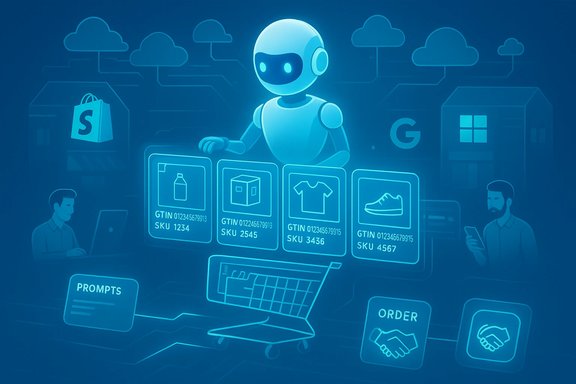
UCP is not a single API call or a closed platform; it’s a specification and modular set of primitives intended to make agent-driven commerce reliable, auditable, and merchant-friendly. At its core, UCP aims to standardize:- Canonical product representation — machine-readable product records (GTINs, SKUs, variant mappings, images, sizes/dimensions, live inventory windows, policy text for returns and warranties).
- Cart lifecycle semantics — a consistent set of cart messages (create, update, validate, submit) and merchant-specific constraints (required buyer inputs such as delivery slots, subscription cadence, or mandatory documentation).
- Delegated, tokenized payments — short‑lived, scope-limited payment tokens or delegated checkout sessions that let an agent initiate settlement while leaving PCI and settlement responsibilities with PSPs and merchants.
- Provenance and audit trails — tracing metadata that links conversational prompts and agent decision paths to order artifacts for dispute resolution and analytics.
- Extensibility — optional extensions for loyalty, promotions, subscriptions, post-purchase support, and embedded checkout UI.
Why a standard now?
Agentic shopping compresses the funnel from discovery to checkout into a single conversational surface. Without a common language between agents and merchant systems, each assistant would require custom integrations to enforce merchant rules, validate inventory, or ensure secure checkout. UCP seeks to break that N×N integration problem, enabling multiple assistants to interact with many merchants using the same canonical semantics.How UCP works in practice — the three technical primitives
The UCP architecture bundles three interlocking technical pillars that must each work well to deliver frictionless, reliable agentic commerce.1. Canonical, machine-readable catalogs
Agents cannot invent or guess availability, sizing, or return policies. UCP requires merchants to expose high-fidelity, machine-readable product records that include:- GTINs, SKUs and unique canonical IDs;
- variant mappings and deduplication;
- high-resolution images and metadata (dimensions, material, care instructions);
- live inventory windows and fulfillment constraints;
- explicit policy and warranty text.
2. Cart and checkout semantics
UCP formalizes cart lifecycle events so an agent-assembled cart is unambiguous to a merchant’s backend. The standard covers:- cart creation and item mappings to merchant SKUs;
- incremental updates (quantities, variants, shipping options);
- validation hooks for merchant rules (pre-order constraints, subscription cadence, restricted items);
- final submission and settlement handoff.
3. Delegated, tokenized payments and provenance
Security is central. UCP codifies a pattern where agents never see raw PANs (Primary Account Numbers). Instead, agents obtain short-lived payment or checkout tokens from PSPs or wallets; the merchant/PSP finalizes settlement and retains merchant-of-record responsibilities. The protocol also mandates logging and cryptographic provenance so conversational inputs and agent decision paths are auditable, which is essential for chargebacks, disputes, and regulatory compliance.This approach preserves PCI boundaries, while providing an auditable chain from prompt → decision → token issuance → settlement.
Shopify’s commercial moves: Agentic Storefronts, Agentic plan and the Catalog
Shopify paired the UCP announcement with product and policy changes designed to make merchants agent-ready:- Agentic Storefronts: a configure-once syndication model that converts a merchant’s product feed into a normalized, machine-readable Shopify Catalog record and lets merchants toggle which AI channels may offer direct selling.
- Agentic plan (catalog access for non-Shopify merchants): an offering that allows merchants who don’t host on Shopify to publish product records into Shopify Catalog so they can appear across AI channels.
- Centralized control in Shopify Admin: channel toggles, attribution reporting, and controls for which SKUs are available for agentic checkout; stewardship of the merchant/customer relationship (Shopify emphasizes merchants remain the merchant of record and orders continue to flow into Shopify Admin).
Platform integrations and the early ecosystem
UCP’s rollout is already paired with platform pilots and merchant integrations that illustrate how the protocol will operate across surfaces:- Google (Gemini and AI Mode in Search): UCP is slated to underpin native, in-conversation shopping in the Gemini app and Google AI Mode in Search. That includes in-moment Direct Offers and the ability for merchants to present in-chat checkout experiences.
- Microsoft (Copilot Checkout and Brand Agents): Microsoft has announced Copilot Checkout, an embedded, branded checkout widget inside Copilot conversations that allows customers to confirm shipping, select payment, and finalize orders without leaving the chat. Microsoft is positioning Copilot Checkout as compatible with open agentic standards and is onboarding partners such as Shopify, PayPal and Stripe.
- Payments and PSPs: Major PSPs and wallet providers (including PayPal, Stripe, and Google Pay/Wallet) are part of the initial ecosystem, providing the tokenization, checkout sessions, and fraud defenses that UCP expects.
Merchant impacts — benefits and operational demands
UCP and Agentic storefront technology create real, near-term opportunities for merchants, but they also raise operational requirements.Key merchant benefits:
- expanded reach into high-intent conversational moments and new discovery channels;
- shorter funnels from intent to conversion (reduced friction can increase conversion rates);
- centralized channel management and attribution reporting through Shopify Admin or equivalent control planes;
- preservation of merchant-of-record status, keeping customer data and post-purchase relationships.
- Catalog hygiene — merchants must ensure SKU accuracy, GTIN mapping, complete variant data, and up-to-date inventory windows;
- Payment readiness — PSP integrations must support delegated token semantics and consistent fraud controls across channels;
- Policy and UX alignment — shipping windows, return policies and subscription rules must be machine-readable and enforceable by agents;
- Commercial clarity — merchants must negotiate fees, discoverability terms, opt-in/opt-out mechanisms, and attribution agreements with platform partners.
Security, fraud and payment risk
UCP’s tokenized payment model addresses many security concerns but does not eliminate risk.- Token semantics matter: expiry, scope, merchant scoping, amount limits and token reuse constraints determine how safe delegated payments are. Weak token scoping or long lifetimes increase fraud exposure.
- Fraud shifts, not eradicates: delegated tokens reduce PAN exposure but increase reliance on PSPs’ fraud detection and on merchants’ fulfillment checks. Agents can still be abused for social engineering or manipulated prompts that result in unauthorized token issuance if authentication and mandate semantics are lax.
- Chargebacks and dispute resolution: the expectation that provenance metadata maps conversational chains to order artifacts is necessary for disputes. Implementations must be careful to preserve detailed traces and retention policies for any regulatory requirements.
- Third-party dependencies: merchant liability may increase if platforms or PSPs default on checks; contractual clarity is essential to allocate risk.
Privacy, intent data and ad targeting
Agentic commerce surfaces a new class of high-value intent signals. These signals — including multi-turn preferences, clarifying questions and purchase intent — are extremely valuable for advertising and personalization, which raises key issues:- Agent-aware privacy frameworks: platforms and partners are discussing new rules on how intent signals may be used for advertising conversions or personalization. Merchants and platforms will need to comply with privacy law requirements in every region where they operate.
- Data minimization vs. personalization: balancing the benefits of intent-based personalization with user privacy expectations and regulatory constraints will be a central governance challenge.
- Disclosure and consent: clear consumer disclosures about agent involvement, what data is shared with merchants, and how offers are applied will be necessary to maintain trust and meet legal obligations.
Commercial models and competition for the checkout moment
Who owns the checkout and the post-purchase truth wins more than a transaction: they get conversion data, repeat customer access, and monetizable signals.Possible commercial models:
- platform revenue share or referral fees for orders that originate in an assistant;
- auction-based placement or bidding for Direct Offers and in-conversation promotions;
- fixed fees for syndication or channel access; or
- subscription-based models for merchants to appear in agentic channels.
Implementation checklist — how merchants should prepare (practical steps)
- Audit and clean product catalogs: ensure GTINs, SKUs, variant mappings, dimensions, and high-quality images are complete and accurate.
- Confirm PSP compatibility: verify your payments provider supports delegated checkout tokens, scoped token semantics, and required fraud hooks.
- Define machine-readable policies: convert shipping windows, return terms, subscription cadence and legal disclaimers into structured fields agents can consume.
- Pilot with narrow catalogs: start with a curated SKU subset to validate discovery, cart semantics, and tokenized settlements before broad rollout.
- Instrument rigorously: set up A/B tests, conversion funnels, return and dispute tracking, and correlate agent-surface attribution in your analytics stack.
- Negotiate commercial terms: confirm fees, attribution rules, data sharing, and opt-out mechanics with channel partners before enrolling at scale.
- Train customer support and returns workflows: ensure post-purchase experiences reflect orders that originated in agentic channels and that staff can access provenance logs for dispute handling.
Risks, unknowns and things to watch
- Adoption vs. endorsement: partner lists and pilot participation do not guarantee universal production adoption. Merchants should treat platform endorsements as indicators of intent, not as automatic business outcomes.
- Regulatory treatment of agentic contracting: how consumer protection laws treat agent-mediated contracts, disclosures of the agent’s role, and liability allocations remain unresolved in many jurisdictions.
- Fraud and mandate governance: the devil is in the token details — weak mandate semantics can cause systemic fraud vectors if not carefully designed and enforced.
- Monetization and platform defaults: platforms that auto-enroll merchants or favor proprietary wallets could create uneven competitive outcomes.
- International rollout complexity: local payments networks, card network rules and regional privacy laws may delay global rollouts or require varied implementations of UCP semantics.
Critical analysis — strengths and potential pitfalls
Notable strengths
- Standards-first thinking: UCP addresses a real engineering problem by offering a shared language rather than forcing bespoke connectors.
- Security-conscious design: tokenized, delegated payments and provenance metadata mitigate many early security and disputeability issues seen in ad-hoc pilots.
- Operational leverage for merchants: solutions like Agentic Storefronts promise a configure-once syndication model that lowers integration costs for merchants, especially SMBs.
- Ecosystem momentum: early participation from major retailers, marketplaces and PSPs increases the odds UCP gains meaningful traction.
Potential pitfalls
- Operational burden on merchants: high-quality catalog data and robust PSP support are prerequisites that many merchants, especially small ones, will struggle to meet without tooling or services.
- Concentration risk: if a few platforms control agentic surfaces and monetization models, merchants may lose bargaining power or be subject to unfavorable defaults.
- Governance, liability and regulatory uncertainty: unclear rules for agentic contracting and cross-border payments could create legal exposure and slow adoption.
- Fraud vector shifts: tokenization reduces some risks but places more dependency on PSP fraud detection and correct mandate semantics. Attackers will adapt.
Conclusion
The Universal Commerce Protocol, combined with Shopify’s Agentic Storefronts and catalog syndication, creates a plausible, standards-led path to scale agentic commerce — the era when assistants can reliably discover, assemble and complete purchases on behalf of users. For merchants, UCP promises broader reach and shorter conversion funnels, but realizing that upside requires disciplined engineering, clean catalog data, robust PSP integration and careful contractual negotiation.This is a structural industry shift rather than a single product release: the winners will be merchants and platforms that execute the technical foundations faithfully, negotiate transparent commercial terms, and invest in fraud and governance mechanisms that preserve trust. Over the next 6–12 months, pilots and early rollouts will reveal whether UCP turns the promise of in-conversation shopping into durable, merchant-friendly channels — or whether unresolved governance, fraud and economic frictions will limit it to a promising but constrained experiment.
Source: Finextra Research Deep Dive: Breaking Down Shopify and Google’s Universal Commerce Protocol: By Sam Boboev