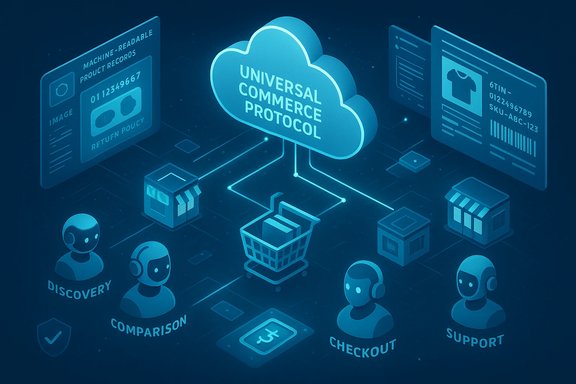
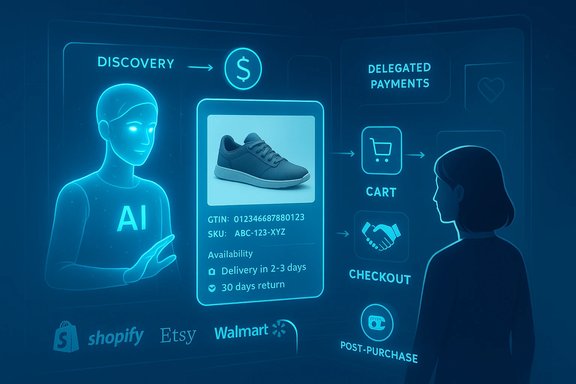
Google has unveiled the Universal Commerce Protocol (UCP), an open standard designed to let AI agents carry a customer from discovery through checkout and post‑purchase support without stitching together bespoke integrations for every assistant and merchant.
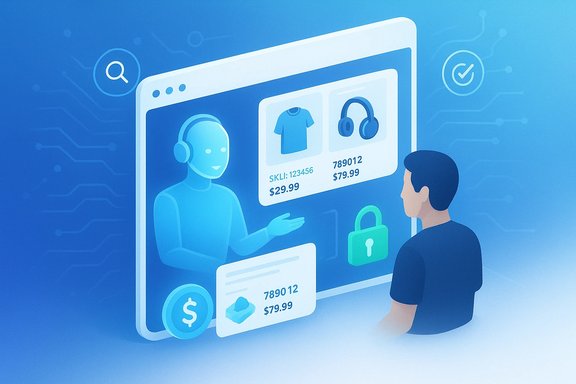
The last 18 months have seen commerce shift from page‑centric funnels to conversation‑first experiences where AI agents—embedded in chatbots, search assistants, and platform surfaces—do more than recommend: they can confirm inventory, initiate tokenized payments, and even act when a price or availability condition is met. That architecture depends on three technical primitives: high‑fidelity, machine‑readable product feeds; delegated, short‑lived payment tokens; and orchestration protocols that tie conversational intent to auditable commerce events. Industry experiments — from instant checkouts inside ChatGPT to in‑app buy flows from several platform players — showed the promise and the painful edge cases that occur when those primitives are unevenly implemented.
Google framed UCP as a solution to that integration problem. Built in collaboration with major merchants and platform partners, UCP defines a common language and optional extensions so agents, merchants and payment providers can interoperate across discovery, checkout, and after‑sale workflows. The company says UCP is compatible with related agentic standards such as the Agent Payments Protocol (AP2), Agent2Agent (A2A), and the Model Context Protocol (MCP).
What to monitor next:
That path will not be frictionless. Data quality, fraud control, legal clarity and fee economics will determine whether UCP becomes the plumbing of a healthy, interoperable agent economy or another layer that entangles merchants in new operational costs. For merchants and platforms, the prudent course is to pilot, instrument, and negotiate terms now—because the places where agents can act will rapidly become places where sales happen.
Source: TechCrunch Google announces a new protocol to facilitate commerce using AI agents | TechCrunch
 Background
The last 18 months have seen commerce shift from page‑centric funnels to conversation‑first experiences where AI agents—embedded in chatbots, search assistants, and platform surfaces—do more than recommend: they can confirm inventory, initiate tokenized payments, and even act when a price or availability condition is met. That architecture depends on three technical primitives: high‑fidelity, machine‑readable product feeds; delegated, short‑lived payment tokens; and orchestration protocols that tie conversational intent to auditable commerce events. Industry experiments — from instant checkouts inside ChatGPT to in‑app buy flows from several platform players — showed the promise and the painful edge cases that occur when those primitives are unevenly implemented.Google framed UCP as a solution to that integration problem. Built in collaboration with major merchants and platform partners, UCP defines a common language and optional extensions so agents, merchants and payment providers can interoperate across discovery, checkout, and after‑sale workflows. The company says UCP is compatible with related agentic standards such as the Agent Payments Protocol (AP2), Agent2Agent (A2A), and the Model Context Protocol (MCP).
What Google announced at NRF
The headline: Universal Commerce Protocol (UCP)
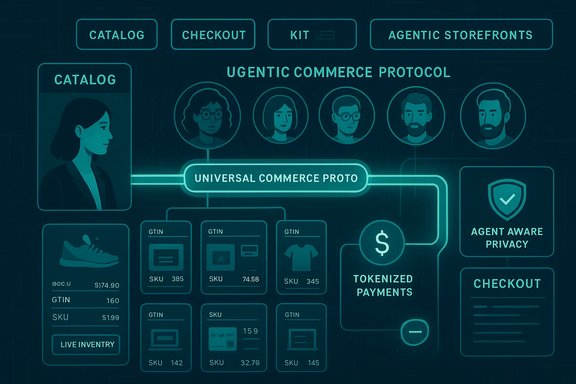
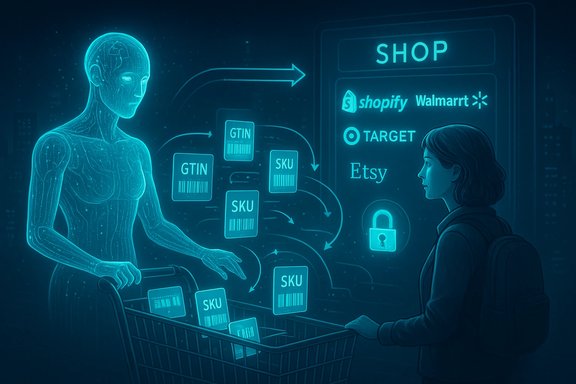
UCP is an open‑source standard intended to let AI agents and merchant systems exchange the key artifacts that make shopping reliable: canonicalized product records, live inventory and shipping metadata, promotion and loyalty data, and a checkout handshake that preserves merchant‑of‑record duties. Google presented UCP as modular—agents and businesses can implement the core messages and select extensions relevant to subscriptions, promotions, or post‑purchase support. Major retail names participated in the development, including Shopify, Etsy, Wayfair, Target, and Walmart, and Google listed endorsements from payment and commerce industry partners.Product‑level effects: UCP in Search and Gemini
Google said it will use UCP to enable “AI mode” product listings in Search and within the Gemini apps. Eligible U.S. retailers will be able to let shoppers complete purchases inside Google’s AI surfaces, using Google Pay for checkout and shipping information pulled from Google Wallet; PayPal support is slated to follow as an additional payment option. Brands will also be able to run agent‑aware discount campaigns so a shopper receiving a recommendation in AI mode can see a contextual offer at the moment of decision.Ecosystem partners and endorsements
Google did not stand alone. PayPal issued a statement endorsing UCP and pledged to be an available payment option for the new checkout feature. Retailers and commerce platforms — including Shopify and major bricks‑and‑mortar chains — said they had helped shape the protocol and would participate in early rollouts and pilots. Observers noted that competitors (Microsoft, OpenAI and others) are pursuing compatible but distinct approaches to agentic commerce, so the market will remain pluralistic for the near term.Why UCP matters: technical anatomy and practical implications
UCP’s core technical goals
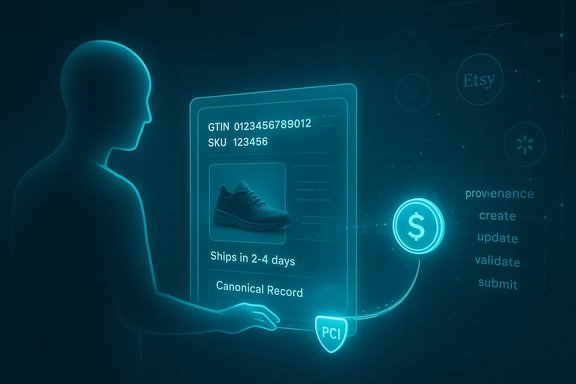
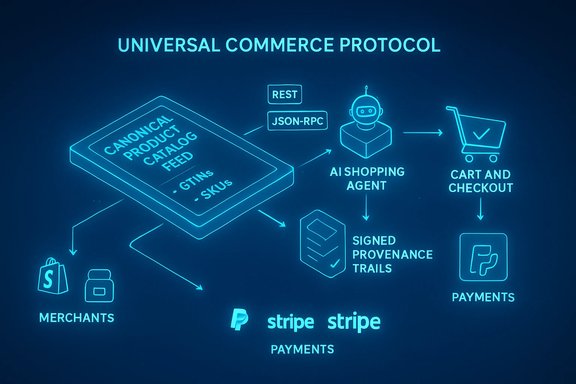
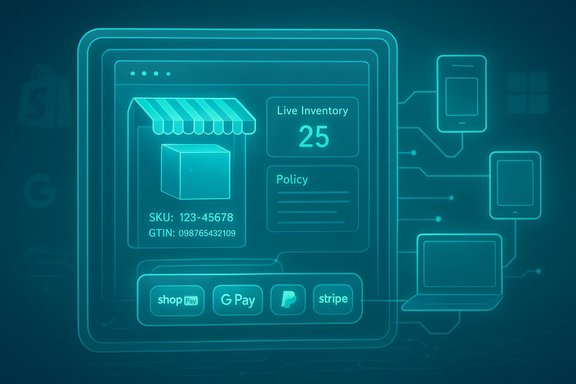
- Canonical product representation: UCP expects merchants to publish high‑quality, machine‑readable product records (GTINs, SKUs, images, shipping windows, return policies). This reduces hallucinations and mismatches between an agent’s recommendation and the merchant’s inventory.
- Delegated, tokenized payments: Rather than giving agents raw card data, UCP prescribes short‑lived tokens or delegated checkout sessions that payment processors exchange and validate. That minimizes PCI exposure and creates an auditable trail.
- Orchestration and provenance: The protocol defines message flows that link a conversational prompt to a canonical product record, the checkout session, and subsequent fulfillment events—critical for dispute resolution and merchant telemetry.
What merchants gain
- Reduced integration overhead: implement UCP once and expose products to multiple agents and assistant surfaces.
- Better conversion capture: by enabling in‑conversation checkout, merchants can shorten the path from intent to purchase, which early vendor data and pilots indicate can boost conversion. Vendors have reported large increases in AI‑originated traffic and orders, though those numbers are vendor‑supplied and should be validated in independent A/B tests.
What platforms and payments providers gain
- Platform owners strengthen their position as the discovery surface and can monetize new ad and placement models that rely on agentic moments of intent. Google, for example, intends to let brands present targeted discounts in AI mode, a natural evolution of search ad tech to conversational surfaces.
- Payments firms gain a standardized path to support delegated agentic payments; AP2 (Agent Payments Protocol) and interoperable token semantics reduce the friction of adapting PSPs to agent workflows. Google previously announced AP2 and positions it as complementary to UCP.
A closer look at technical challenges and friction points
Data hygiene is the single biggest gating factor
Agent‑first checkout only works if product data is accurate and fresh. Stale inventory, mismatched SKUs, or ambiguous variant mapping result in failed checkouts and dissatisfied customers. Empirical pilots and operational guidance stress canonicalization—GTINs, shipping windows, and explicit return policies—before participation. Merchants lacking that discipline will see the downside quickly.Multi‑item carts, bundles, subscriptions: the hard problems
Early agentic checkout pilots intentionally limited scope (single‑item purchases or controlled cart constructs) to reduce complexity around tax, promotions, and returns. UCP’s extensible design explicitly recognizes these edge cases, but real‑world implementations will need careful orchestration for multi‑item carts, tax calculations across jurisdictions, cross‑merchant bundles, gift and loyalty redemptions, and subscription billing. Those are nontrivial and will push complexity into payment and fulfillment stacks.Fraud, chargebacks and agent identity
Tokenization reduces attack surface, but it does not eliminate fraud or disputes. Platforms and payment providers must jointly define agent identity, attestations of user intent, and rate‑limiting to prevent automated buying abuse. Card networks and fraud teams are already experimenting with agent verification primitives; widespread adoption requires standard audit trails and liability rules.Governance and merchant control
Automatic enrollment or default opt‑in mechanics can scale participation but create merchant backlash if defaults impose extra operational burden or unclear fees. Merchants need transparent opt‑in windows, placement controls, and contractual clarity about data sharing and fee economics. History shows that merchant trust is fragile when platforms change defaults without consultation.Business strategy: winners, losers, and the new economics of discovery
Potential winners
- Platform surfaces with large conversational footprints (Google Search + Gemini, Microsoft Copilot, OpenAI/ChatGPT) because they can capture discovery and present shoppable results at high intent moments.
- Payment and tokenization providers (PayPal, Stripe, Adyen, card networks) because agentic payments create demand for secure delegated‑payment rails. PayPal’s immediate endorsement of UCP illustrates that position.
- Merchants with mature data practices who can be reliably shoppable without operational friction; these merchants will get early conversion benefits while maintaining merchant‑of‑record duties.
Risks for merchants and smaller sellers
- Merchants with poor catalog hygiene risk operational headaches, chargebacks, and reputational damage when agents surface incorrect or unavailable items.
- Platforms may introduce new ad and placement models inside agent responses; merchants could face new discovery fees or competition for promoted slots inside chat results. This could reshape marketing budgets from click‑based to placement and catalog‑level sponsorship.
Operational playbook: preparing for UCP and agentic commerce
Merchants and technical teams should treat UCP participation as a channel launch requiring discipline across catalog, payments, and operations:- Audit and canonicalize product feeds: GTINs, clear SKUs, dimensions, accurate images, and shipping windows. Machines need precise data.
- Harden payments and fraud integration: adopt tokenized checkout rails, verify seller protection coverage with PSPs, and tune fraud models for agentic patterns.
- Test limited pilots: select a constrained SKU set and region, instrument conversion and support metrics, and measure dispute and return rates versus baseline channels.
- Update customer service flows: prepare scripts and SLAs for agent‑origin orders, and ensure returns and refunds handling map cleanly to agentic order flows.
- Negotiate data and fee terms: clarify telemetry sharing, attribution rules, and any placement or transaction fees before broad enrollment.
Policy, privacy and regulatory considerations
Agentic commerce raises questions regulators will want answered:- Disclosure and consent: Users must clearly know when an AI agent initiates a checkout or is acting on automated triggers. Platforms will need explicit UI affordances for consent, especially for purchases above de minimis thresholds.
- Liability allocation: Who is responsible when an agent misrepresents price or availability—the platform, the agent developer, or the merchant? UCP and related protocols can provide provenance records, but legal frameworks must adapt to specify liability and dispute resolution.
- Privacy and profiling: Conversational signals tied to commerce create rich profiling vectors. Regulators will examine data minimization, consent flows, retention policies, and cross‑border data transfers.
- Competition: Platforms that bundle discovery and checkout may face scrutiny if they favor in‑house partners or require default enrollment mechanics that disadvantage independent merchants. Antitrust authorities will be watching as agentic commerce scales.
How UCP fits into the evolving standards landscape
UCP does not operate in isolation. It explicitly references and interoperates with AP2 (Agent Payments Protocol), A2A (Agent2Agent), and MCP (Model Context Protocol). AP2, announced by Google in 2025, focuses on the payment‑level semantics of agentic transactions; UCP builds on those payment rails and concentrates on the end‑to‑end shopping journey. Multiple standards and vendor initiatives are converging, which is a positive sign: interoperability reduces vendor lock‑in and allows merchants to reach multiple conversational surfaces from a single integration point. However, standards work is iterative. Expect multiple revisions to handle complex real‑world cases—cross‑merchant bundles, tax rules, split settlements, and subscription semantics will take time to standardize. Institutions such as payment networks, standards bodies and major platform coalitions will be central to the next phase of protocol stabilization.What’s credible now — and what needs verification
Several claims made during recent product announcements and vendor briefings are credible and technically consistent with known agentic commerce patterns: tokenized delegated payments, the need for canonical product feeds, and the basic checkout handshake. Google’s developer post and multiple vendor statements confirm the formal launch of UCP and initial industry endorsements. That said, many performance metrics coming from platform partners—conversion multipliers, AI‑attributed order growth, and projection of rollout timelines—are vendor‑sourced and should be treated as directional. Independent, longitudinal third‑party audits and merchant‑level A/B testing will be necessary to validate the scale and economics of agentic channels. Vendor uplift statistics are useful for trend signals, but they are not substitutes for rigorous measurement under controlled conditions.Strategic verdict and what to watch
UCP is a meaningful step toward a common agentic commerce fabric. It addresses a real pain point—fragmented integrations across agent platforms, merchant storefronts and payment processors—and offers a modular, extensible architecture that maps to the technical primitives the industry already uses. If widely adopted and implemented with transparent opt‑in mechanics, clear merchant controls, and strong fraud and privacy guardrails, UCP could reduce friction for merchants while enabling a new generation of conversational buying experiences. But execution risks are material. Adoption depends on merchant readiness (data hygiene), payments provider interoperability (token semantics, chargeback rules), platform policies (opt‑in defaults, placement economics), and emerging regulatory guardrails. Merchants should pilot conservatively, demand provenance logging, and negotiate clear terms around fees and data. Platforms should publish governance frameworks and provide robust auditor‑friendly telemetry so disputes and fraud can be resolved without eroding merchant trust.What to monitor next:
- Merchant participation rates and the balance between opt‑in versus automatic enrollment mechanics.
- Independent performance studies that measure conversion, return/dispute rates, and customer satisfaction across agentic surfaces.
- Standards evolution for multi‑item carts, tax handling and subscription semantics within UCP and AP2.
- Regulatory guidance or enforcement actions concerning disclosure, liability and platform neutrality in agentic commerce.
Conclusion
UCP marks a significant milestone in the maturation of agentic commerce: an industry player with Google’s reach has proposed a concrete, extensible protocol aimed at connecting conversational discovery to merchant checkout and post‑purchase flows. The technical blueprint aligns with best practices—canonical product feeds, delegated payments, and auditable orchestration—while the ecosystem endorsements (payments firms, marketplaces and major retailers) accelerate the path to practical pilots.That path will not be frictionless. Data quality, fraud control, legal clarity and fee economics will determine whether UCP becomes the plumbing of a healthy, interoperable agent economy or another layer that entangles merchants in new operational costs. For merchants and platforms, the prudent course is to pilot, instrument, and negotiate terms now—because the places where agents can act will rapidly become places where sales happen.
Source: TechCrunch Google announces a new protocol to facilitate commerce using AI agents | TechCrunch