

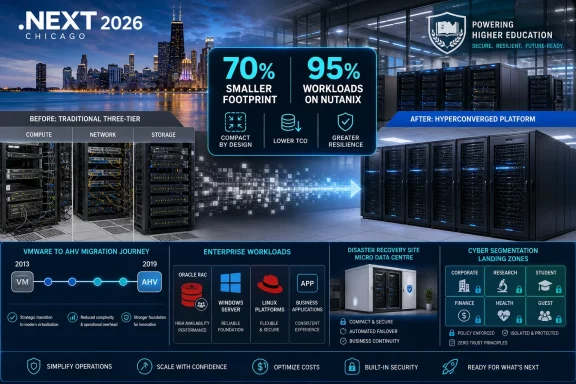
At Nutanix .NEXT 2026 in Chicago, the University of Canberra said its long-running shift from traditional three-tier infrastructure to Nutanix has cut its data centre footprint by about 70% and moved roughly 95% of on-premises workloads onto the platform. That is not merely a customer-success anecdote; it is a case study in how infrastructure strategy has changed for universities that must behave like enterprises without always having enterprise budgets. The important part is not that the university bought hyperconverged infrastructure early. It is that the bet compounded over more than a decade, eventually shaping decisions about virtualisation, disaster recovery, research computing, VDI, AI, and cyber segmentation.
The University of Canberra began looking at Nutanix in 2013, originally through the familiar doorway of virtual desktops. That was the era when hyperconverged infrastructure was still treated by many infrastructure teams as promising but slightly exotic: good for VDI, maybe useful for branch offices, and not yet the obvious place to put crown-jewel application workloads.
What changed, according to Justin Mason, Associate Director of Technology Services at the university, was the realisation that the platform was not just a VDI appliance in different clothing. The university was running a traditional three-tier model with compute, storage, and networking maintained as separate architectural layers. In practice, that meant fragmented hardware, isolated physical servers, and an operational model that multiplied as the application estate grew.
The old design had a logic. A building management system could live on one server, a student information system on another, and a database workload on carefully specified infrastructure. But the logic of isolation eventually ran into the physics of a data centre: racks fill, cooling becomes a constraint, and every new workload starts to carry the shadow cost of more space, more cabling, more maintenance, and more time.
That is the point often missed in cloud-versus-on-prem debates. The enemy is not necessarily the data centre. The enemy is unabsorbed complexity — the kind that forces administrators to treat every refresh, patch window, and capacity request as a bespoke exercise.
That chronology matters. The migration to AHV happened well before Broadcom’s acquisition of VMware turned virtualisation licensing into a board-level conversation for many organisations. Canberra was not reacting to a sudden procurement shock; it was pursuing simplification when VMware was still widely viewed as the safest default in enterprise virtualisation.
Mason’s account is telling because it avoids the triumphalist tone that vendors often prefer. VMware on Nutanix, he said, was stable and solid. The move to AHV was not framed as an escape from a broken platform, but as a step toward fewer moving parts and a tighter operational model.
That is the more durable argument for AHV. It is not that every VMware customer can or should leave tomorrow. It is that organisations already invested in Nutanix may find the case for keeping a separate hypervisor layer harder to defend when the native option is sufficiently mature, operationally integrated, and already covered by the platform’s management tooling.
It did work. Mason said the Oracle RAC environment performed well on AHV and satisfied the DBAs, who had been accustomed to running databases on physical infrastructure. That single success appears to have become an internal proof point: if a complex clustered database could make the move, the rest of the estate no longer looked so intimidating.
The full migration from VMware to AHV took six to 12 months. Much of it was manual, because tooling such as Nutanix Move was not yet available in the way it is today. The process involved converting virtual machines into the Nutanix format and installing the necessary guest tools and drivers.
There is a useful corrective here for organisations now imagining any hypervisor migration as either effortless or impossible. Canberra’s move was neither. It required work, but it was manageable because the university had already consolidated the substrate beneath the workloads. The hard part had been turning an estate of silos into a platform.
For a university, that kind of reduction is not just an infrastructure metric. It affects capital planning, facilities strategy, energy consumption, disaster recovery options, and the amount of technical labour consumed by physical operations. It also changes the tone of internal IT discussions: capacity stops being a permanent crisis and becomes something closer to an engineering variable.
Mason’s description of the old world will sound familiar to many WindowsForum readers. Maintenance meant carefully taking systems offline, applying patches, updating firmware, and often accepting workload downtime because the server and the application were too tightly coupled. When every important workload has its own physical dependencies, the maintenance calendar becomes a map of organisational pain.
In the Nutanix model, workloads can move between nodes during maintenance. Nodes can be patched, rebooted, removed, or replaced while the cluster continues to serve applications. That does not eliminate risk, but it changes the default posture from “schedule downtime and hope” to “maintain the platform while preserving service.”
Still, the more interesting savings may be the ones not captured neatly in a three-year infrastructure comparison. Fewer maintenance windows mean fewer late nights. Easier hardware refreshes mean less project overhead. Less physical sprawl means fewer failure domains that require specialised knowledge of one-off designs.
The university’s hardware refresh model illustrates the point. In the old environment, replacing a server meant planning a workload migration. In the Nutanix environment, a node reaching the end of its lifecycle after five to seven years can be removed from the cluster and replaced, after which the platform rebalances and redistributes metadata.
That matters because lifecycle management is where many infrastructure strategies quietly fail. A design can look elegant on day one and become punishing by year five. Canberra’s claim is that Nutanix made the refresh cycle more routine, and routine is one of the highest compliments an operations team can give a platform.
For many mid-sized organisations, disaster recovery has historically been an exercise in compromise. A full duplicate environment is expensive. A minimal recovery environment can be operationally fragile. Cloud recovery can be attractive, but cost, latency, governance, and workload suitability complicate the picture.
Canberra’s approach appears to sit in the middle. By reducing the physical scale of its primary environment, the university could build a smaller DR footprint without treating resilience as an afterthought. That is the quiet advantage of consolidation: it does not merely make the primary site tidier; it makes the secondary site more achievable.
The workload mix is broad rather than specialised. The university runs Oracle, Microsoft SQL Server, HR systems, the student information system, and a large data warehouse on Nutanix. Its main server operating systems are Windows Server and Red Hat Enterprise Linux, which is exactly the kind of mixed estate that tends to accumulate in higher education.
The remaining exceptions are instructive. The university’s CCTV system and backup platform do not currently run on Nutanix. That is not a failure of consolidation; it is evidence that a mature infrastructure team still recognises when specialised systems deserve separate treatment.
The CCTV environment is storage-intensive and already sits on dedicated storage. Mason noted that Nutanix’s expanded external storage support could make it a candidate for future consolidation, because connecting dedicated storage into the broader Nutanix management model could reduce the number of separate systems the team maintains.
The backup environment is different. Backup architectures often require separation by design, both for resilience and for security. In an age of ransomware, keeping backup infrastructure distinct can be less about legacy preference and more about blast-radius management.
That evolution is necessary. Classic HCI won by collapsing compute and storage into a simpler operational unit. But enterprises do not live entirely inside one architectural pattern. They have external arrays, cloud services, VDI platforms, AI experiments, regulatory constraints, and teams that increasingly expect self-service consumption.
External storage support is therefore more than a feature checkbox. It is an admission that the original HCI bargain — scale compute and storage together inside the same appliance-like cluster — is not always the right fit. Storage-heavy workloads such as video, analytics, or large archives may benefit from independent scaling, and customers do not want to abandon existing storage investments just to modernise virtualisation.
That is why Canberra’s interest in external storage is so revealing. The university is not looking for novelty. It is looking for fewer operational islands. If Nutanix can bring more of those islands under common management without forcing everything into one hardware pattern, the platform becomes more useful to conservative IT teams.
Nutanix and its ecosystem partners have been positioning hybrid Azure Virtual Desktop as a way to combine Microsoft’s control plane with on-premises execution. In practical terms, that appeals to organisations that want the manageability and identity integration of Microsoft’s cloud desktop stack without moving every desktop workload fully into Azure.
The Nerdio alliance adds another layer. Nerdio has built a strong position around AVD automation and management, and its support for Nutanix environments could reduce friction for customers with existing on-prem VDI estates. For Canberra, that means a potential path from current VDI arrangements toward a more Microsoft-aligned model without treating the data centre as dead weight.
This is also where Windows administrators should pay attention. The future of desktop virtualisation is not simply “cloud VDI wins.” It is more likely to be a split model in which identity, policy, orchestration, and user experience are cloud-shaped, while some execution remains local for performance, data residency, cost, or operational reasons.
That is the part of the cloud story that on-prem teams have often struggled to reproduce. Public cloud did not win developers over merely because it had elastic infrastructure. It won because it gave them immediacy. A portal, a template, a quota, and a few clicks can change the relationship between central IT and the rest of the organisation.
For a university, that shift is especially important. Researchers often operate on grant timelines, project deadlines, and experimental workflows that do not map neatly to traditional infrastructure ticket queues. If every server request becomes a negotiation with central IT, shadow IT becomes rational.
Self-service also creates governance challenges. Someone must decide what images are available, how costs or capacity are allocated, how long workloads can live, and what security baselines are enforced. But that is still a better problem than uncontrolled sprawl, because the platform can make the approved path easier than the unofficial one.
Universities are under pressure to support AI experimentation while also protecting data, budgets, and governance boundaries. Researchers want access to modern tooling. Security teams want control over sensitive datasets. Finance teams want to avoid uncontrolled cloud spend. Infrastructure teams want to avoid building bespoke platforms for every lab.
A catalogue-driven model could help by turning AI environments into governed services rather than artisanal deployments. If a faculty member can request a known configuration with approved images, defined resource limits, and appropriate data controls, the university gets closer to cloud-like consumption without surrendering everything to a public cloud provider.
But AI also complicates the Nutanix story. GPU capacity, model governance, data locality, power draw, and software supply chains all introduce constraints that ordinary virtual machine estates did not have at the same intensity. Nutanix can make the platform pitch, but customers will judge it by how well it handles the messy operational details after the keynote demos end.
In the old data centre, segmentation often emerged from networks, VLANs, firewall rules, and administrative convention. In cloud environments, segmentation is increasingly expressed through templates, policies, accounts, subscriptions, projects, and automated guardrails. The modern enterprise now expects both worlds to behave more like the latter.
For a university, this is particularly attractive because the workload estate is not homogeneous. Administrative systems, research projects, student-facing applications, databases, and experimental environments have different risk profiles. Treating them as separate landing zones could make cyber segmentation more repeatable and less dependent on tribal knowledge.
The deeper issue is that hybrid infrastructure is no longer just a placement problem. It is a governance problem. The question is not only where a workload runs, but which identity rules, network policies, security controls, deployment templates, and lifecycle processes follow it.
That distinction matters because rushed platform migrations are dangerous. Virtualisation touches everything. Storage assumptions, backup integration, monitoring, disaster recovery, licensing, automation, and admin skills all sit close to the hypervisor layer. When organisations migrate under duress, they often rediscover dependencies they forgot they had.
Canberra avoided that scramble because it had already made AHV normal. The platform choice became a settled operating fact rather than an emergency programme. That is the kind of advantage that does not show up in a procurement spreadsheet until the market shifts and everyone else is suddenly trying to move at once.
This does not mean AHV is automatically the right answer for every VMware shop. It does mean the old assumption that VMware is the neutral default has weakened. The hypervisor has become strategic again precisely because its cost, control plane, ecosystem, and licensing terms now carry more visible risk.
The answer, in Canberra’s case, appears to be “most of it.” Windows Server workloads, SQL Server environments, VDI discussions, and Azure Virtual Desktop possibilities all sit inside or adjacent to the Nutanix strategy. That does not make Nutanix a Microsoft platform, but it does show how Microsoft-heavy institutions can modernise without defaulting every workload into Azure.
That hybrid posture is likely to become more common. Microsoft’s management plane, identity stack, security tooling, and desktop services are increasingly cloud-oriented. But many organisations still have reasons to keep workloads close: latency, data sovereignty, sunk hardware investments, predictable performance, or simple institutional preference.
The real battleground is therefore not cloud versus on-prem. It is whether on-prem platforms can offer enough cloud-like management to remain credible. Canberra’s self-service portal, AHV consolidation, AVD interest, and landing-zone thinking all point in that direction.
There is also a useful humility in the remaining 5%. The university has not forced every workload onto Nutanix for the sake of a cleaner slide. CCTV and backup remain separate for now, and both exceptions are rational. Mature consolidation is not monoculture; it is knowing which platforms deserve to be common and which should remain distinct.
The risk, as always, is that platform consolidation can become platform dependence. Nutanix may reduce the number of infrastructure components, but it also becomes more central to operations. That raises the stakes for licensing, support, roadmap trust, skills, and exit planning.
Still, every infrastructure strategy has a dependency model. The question is whether the dependency reduces more complexity than it creates. Canberra’s decade-long experience suggests that, for this university, it did.
 Canberra’s Lesson Is That Infrastructure Debt Is Paid in Floor Space
The University of Canberra began looking at Nutanix in 2013, originally through the familiar doorway of virtual desktops. That was the era when hyperconverged infrastructure was still treated by many infrastructure teams as promising but slightly exotic: good for VDI, maybe useful for branch offices, and not yet the obvious place to put crown-jewel application workloads.What changed, according to Justin Mason, Associate Director of Technology Services at the university, was the realisation that the platform was not just a VDI appliance in different clothing. The university was running a traditional three-tier model with compute, storage, and networking maintained as separate architectural layers. In practice, that meant fragmented hardware, isolated physical servers, and an operational model that multiplied as the application estate grew.
The old design had a logic. A building management system could live on one server, a student information system on another, and a database workload on carefully specified infrastructure. But the logic of isolation eventually ran into the physics of a data centre: racks fill, cooling becomes a constraint, and every new workload starts to carry the shadow cost of more space, more cabling, more maintenance, and more time.
That is the point often missed in cloud-versus-on-prem debates. The enemy is not necessarily the data centre. The enemy is unabsorbed complexity — the kind that forces administrators to treat every refresh, patch window, and capacity request as a bespoke exercise.
Hyperconvergence Worked Because the University Let It Become Boring
The university’s first Nutanix pilot went well enough that production workloads moved onto the platform in 2014. From there, the story becomes less about a dramatic migration and more about institutional confidence accumulating over time. The university began with Hyper-V on Nutanix, later ran VMware, and then moved to Nutanix AHV around 2018 or 2019.That chronology matters. The migration to AHV happened well before Broadcom’s acquisition of VMware turned virtualisation licensing into a board-level conversation for many organisations. Canberra was not reacting to a sudden procurement shock; it was pursuing simplification when VMware was still widely viewed as the safest default in enterprise virtualisation.
Mason’s account is telling because it avoids the triumphalist tone that vendors often prefer. VMware on Nutanix, he said, was stable and solid. The move to AHV was not framed as an escape from a broken platform, but as a step toward fewer moving parts and a tighter operational model.
That is the more durable argument for AHV. It is not that every VMware customer can or should leave tomorrow. It is that organisations already invested in Nutanix may find the case for keeping a separate hypervisor layer harder to defend when the native option is sufficiently mature, operationally integrated, and already covered by the platform’s management tooling.
The Oracle RAC Test Was the Moment the Risk Model Changed
The university’s early AHV test was not a disposable workload or a forgotten departmental app. It was an Oracle RAC database cluster, the kind of environment that tends to attract caution from database administrators for good reason. If that worked, the psychological barrier to migrating less demanding workloads would be much lower.It did work. Mason said the Oracle RAC environment performed well on AHV and satisfied the DBAs, who had been accustomed to running databases on physical infrastructure. That single success appears to have become an internal proof point: if a complex clustered database could make the move, the rest of the estate no longer looked so intimidating.
The full migration from VMware to AHV took six to 12 months. Much of it was manual, because tooling such as Nutanix Move was not yet available in the way it is today. The process involved converting virtual machines into the Nutanix format and installing the necessary guest tools and drivers.
There is a useful corrective here for organisations now imagining any hypervisor migration as either effortless or impossible. Canberra’s move was neither. It required work, but it was manageable because the university had already consolidated the substrate beneath the workloads. The hard part had been turning an estate of silos into a platform.
The 70% Footprint Reduction Is the Number That Explains the Strategy
The headline number is difficult to ignore: after moving 90% of workloads onto Nutanix, the university calculated that its data centre footprint had fallen by 70%. At one stage, it had been planning a larger data centre. Consolidation changed the capacity forecast enough that the larger facility was no longer needed.For a university, that kind of reduction is not just an infrastructure metric. It affects capital planning, facilities strategy, energy consumption, disaster recovery options, and the amount of technical labour consumed by physical operations. It also changes the tone of internal IT discussions: capacity stops being a permanent crisis and becomes something closer to an engineering variable.
Mason’s description of the old world will sound familiar to many WindowsForum readers. Maintenance meant carefully taking systems offline, applying patches, updating firmware, and often accepting workload downtime because the server and the application were too tightly coupled. When every important workload has its own physical dependencies, the maintenance calendar becomes a map of organisational pain.
In the Nutanix model, workloads can move between nodes during maintenance. Nodes can be patched, rebooted, removed, or replaced while the cluster continues to serve applications. That does not eliminate risk, but it changes the default posture from “schedule downtime and hope” to “maintain the platform while preserving service.”
The Savings Were Real, but the Labour Savings May Be the Larger Story
The university estimates that it saved around AU$1.2 million in infrastructure costs over three years compared with its projected spend under the old three-tier model. For an institution with annual infrastructure capital expenditure of roughly AU$2 million to AU$2.5 million, that is meaningful. It is not a hyperscale number, but it is exactly the kind of number that matters in public-sector-adjacent IT, where every avoided expansion can fund something more visible than racks and rails.Still, the more interesting savings may be the ones not captured neatly in a three-year infrastructure comparison. Fewer maintenance windows mean fewer late nights. Easier hardware refreshes mean less project overhead. Less physical sprawl means fewer failure domains that require specialised knowledge of one-off designs.
The university’s hardware refresh model illustrates the point. In the old environment, replacing a server meant planning a workload migration. In the Nutanix environment, a node reaching the end of its lifecycle after five to seven years can be removed from the cluster and replaced, after which the platform rebalances and redistributes metadata.
That matters because lifecycle management is where many infrastructure strategies quietly fail. A design can look elegant on day one and become punishing by year five. Canberra’s claim is that Nutanix made the refresh cycle more routine, and routine is one of the highest compliments an operations team can give a platform.
Two Data Centres Became Enough Because the Second One Got Smaller
The university now runs Nutanix on Supermicro servers across a main data centre and a micro data centre. That second phrase — micro data centre — says a lot about how consolidation changes disaster recovery. If the production footprint shrinks far enough, the recovery footprint can shrink too.For many mid-sized organisations, disaster recovery has historically been an exercise in compromise. A full duplicate environment is expensive. A minimal recovery environment can be operationally fragile. Cloud recovery can be attractive, but cost, latency, governance, and workload suitability complicate the picture.
Canberra’s approach appears to sit in the middle. By reducing the physical scale of its primary environment, the university could build a smaller DR footprint without treating resilience as an afterthought. That is the quiet advantage of consolidation: it does not merely make the primary site tidier; it makes the secondary site more achievable.
The workload mix is broad rather than specialised. The university runs Oracle, Microsoft SQL Server, HR systems, the student information system, and a large data warehouse on Nutanix. Its main server operating systems are Windows Server and Red Hat Enterprise Linux, which is exactly the kind of mixed estate that tends to accumulate in higher education.
Ninety-Five Percent Is Not Perfection, and That Is the Point
Today, roughly 95% of the university’s on-premises workloads run on Nutanix. That includes around 500 virtual machines across production, test, and development environments. Production accounts for about 100 to 150 applications, while the total application count across environments is closer to 300 to 350.The remaining exceptions are instructive. The university’s CCTV system and backup platform do not currently run on Nutanix. That is not a failure of consolidation; it is evidence that a mature infrastructure team still recognises when specialised systems deserve separate treatment.
The CCTV environment is storage-intensive and already sits on dedicated storage. Mason noted that Nutanix’s expanded external storage support could make it a candidate for future consolidation, because connecting dedicated storage into the broader Nutanix management model could reduce the number of separate systems the team maintains.
The backup environment is different. Backup architectures often require separation by design, both for resilience and for security. In an age of ransomware, keeping backup infrastructure distinct can be less about legacy preference and more about blast-radius management.
Nutanix Is Trying to Outgrow the HCI Box It Built
The University of Canberra’s story lands at an interesting moment for Nutanix. At .NEXT 2026, the company pushed announcements around AI, external storage, virtual desktops, Kubernetes, and hybrid cloud operations. The through-line is clear: Nutanix no longer wants to be understood simply as a hyperconverged infrastructure vendor.That evolution is necessary. Classic HCI won by collapsing compute and storage into a simpler operational unit. But enterprises do not live entirely inside one architectural pattern. They have external arrays, cloud services, VDI platforms, AI experiments, regulatory constraints, and teams that increasingly expect self-service consumption.
External storage support is therefore more than a feature checkbox. It is an admission that the original HCI bargain — scale compute and storage together inside the same appliance-like cluster — is not always the right fit. Storage-heavy workloads such as video, analytics, or large archives may benefit from independent scaling, and customers do not want to abandon existing storage investments just to modernise virtualisation.
That is why Canberra’s interest in external storage is so revealing. The university is not looking for novelty. It is looking for fewer operational islands. If Nutanix can bring more of those islands under common management without forcing everything into one hardware pattern, the platform becomes more useful to conservative IT teams.
VDI Is Back, but This Time It Is Wearing an Azure Badge
The university still has VDI considerations in play. It runs some workloads on Dizzion, formerly Nutanix Frame, and it has been discussing Azure Virtual Desktop internally because Microsoft is already deeply embedded across the institution. That makes Nutanix’s work around Azure Virtual Desktop on AHV strategically relevant.Nutanix and its ecosystem partners have been positioning hybrid Azure Virtual Desktop as a way to combine Microsoft’s control plane with on-premises execution. In practical terms, that appeals to organisations that want the manageability and identity integration of Microsoft’s cloud desktop stack without moving every desktop workload fully into Azure.
The Nerdio alliance adds another layer. Nerdio has built a strong position around AVD automation and management, and its support for Nutanix environments could reduce friction for customers with existing on-prem VDI estates. For Canberra, that means a potential path from current VDI arrangements toward a more Microsoft-aligned model without treating the data centre as dead weight.
This is also where Windows administrators should pay attention. The future of desktop virtualisation is not simply “cloud VDI wins.” It is more likely to be a split model in which identity, policy, orchestration, and user experience are cloud-shaped, while some execution remains local for performance, data residency, cost, or operational reasons.
Self-Service Research Computing Is the Real Cloud Analogue
One of Canberra’s more interesting projects is not about AHV itself but about self-service. Using Nutanix Cloud Manager Self-Service, the university gives researchers and some students access to a web portal where they can deploy workloads such as Windows servers and Red Hat servers themselves.That is the part of the cloud story that on-prem teams have often struggled to reproduce. Public cloud did not win developers over merely because it had elastic infrastructure. It won because it gave them immediacy. A portal, a template, a quota, and a few clicks can change the relationship between central IT and the rest of the organisation.
For a university, that shift is especially important. Researchers often operate on grant timelines, project deadlines, and experimental workflows that do not map neatly to traditional infrastructure ticket queues. If every server request becomes a negotiation with central IT, shadow IT becomes rational.
Self-service also creates governance challenges. Someone must decide what images are available, how costs or capacity are allocated, how long workloads can live, and what security baselines are enforced. But that is still a better problem than uncontrolled sprawl, because the platform can make the approved path easier than the unofficial one.
AI Makes the Platform Argument Harder and More Urgent
Nutanix AI caught Mason’s attention during the .NEXT keynote, particularly the idea of deploying applications from a central catalogue in ways that could appeal to science and technology researchers. That reaction is exactly what Nutanix wants from higher education and research-heavy customers. AI is not just a workload category; it is a forcing function for infrastructure modernisation.Universities are under pressure to support AI experimentation while also protecting data, budgets, and governance boundaries. Researchers want access to modern tooling. Security teams want control over sensitive datasets. Finance teams want to avoid uncontrolled cloud spend. Infrastructure teams want to avoid building bespoke platforms for every lab.
A catalogue-driven model could help by turning AI environments into governed services rather than artisanal deployments. If a faculty member can request a known configuration with approved images, defined resource limits, and appropriate data controls, the university gets closer to cloud-like consumption without surrendering everything to a public cloud provider.
But AI also complicates the Nutanix story. GPU capacity, model governance, data locality, power draw, and software supply chains all introduce constraints that ordinary virtual machine estates did not have at the same intensity. Nutanix can make the platform pitch, but customers will judge it by how well it handles the messy operational details after the keynote demos end.
Landing Zones Move Cloud Governance Back On Prem
Mason also pointed to Nutanix’s landing zones announcement as relevant for cybersecurity segmentation. The phrase landing zone comes from public cloud architecture, where it usually means a governed environment with predefined controls, identity, networking, policy, and resource boundaries. Bringing that concept on premises is a sign of how far enterprise IT language has shifted.In the old data centre, segmentation often emerged from networks, VLANs, firewall rules, and administrative convention. In cloud environments, segmentation is increasingly expressed through templates, policies, accounts, subscriptions, projects, and automated guardrails. The modern enterprise now expects both worlds to behave more like the latter.
For a university, this is particularly attractive because the workload estate is not homogeneous. Administrative systems, research projects, student-facing applications, databases, and experimental environments have different risk profiles. Treating them as separate landing zones could make cyber segmentation more repeatable and less dependent on tribal knowledge.
The deeper issue is that hybrid infrastructure is no longer just a placement problem. It is a governance problem. The question is not only where a workload runs, but which identity rules, network policies, security controls, deployment templates, and lifecycle processes follow it.
Broadcom’s VMware Shock Still Haunts the Conversation
The University of Canberra’s AHV migration predates Broadcom’s VMware acquisition, but the timing gives the case study extra weight. Many organisations spent 2024 and 2025 reassessing VMware estates after licensing and packaging changes altered the economics of staying put. Nutanix has benefited from that market anxiety, but Canberra’s story shows a different path: move before panic sets the agenda.That distinction matters because rushed platform migrations are dangerous. Virtualisation touches everything. Storage assumptions, backup integration, monitoring, disaster recovery, licensing, automation, and admin skills all sit close to the hypervisor layer. When organisations migrate under duress, they often rediscover dependencies they forgot they had.
Canberra avoided that scramble because it had already made AHV normal. The platform choice became a settled operating fact rather than an emergency programme. That is the kind of advantage that does not show up in a procurement spreadsheet until the market shifts and everyone else is suddenly trying to move at once.
This does not mean AHV is automatically the right answer for every VMware shop. It does mean the old assumption that VMware is the neutral default has weakened. The hypervisor has become strategic again precisely because its cost, control plane, ecosystem, and licensing terms now carry more visible risk.
The Windows Angle Is Not Just Servers, but Control
For WindowsForum readers, the University of Canberra case is relevant beyond the fact that Windows Server workloads run on the platform. The larger Windows angle is about control: how much of the Microsoft-centred enterprise estate can remain manageable, patchable, recoverable, and policy-driven when the underlying infrastructure is no longer a classic VMware or Hyper-V design?The answer, in Canberra’s case, appears to be “most of it.” Windows Server workloads, SQL Server environments, VDI discussions, and Azure Virtual Desktop possibilities all sit inside or adjacent to the Nutanix strategy. That does not make Nutanix a Microsoft platform, but it does show how Microsoft-heavy institutions can modernise without defaulting every workload into Azure.
That hybrid posture is likely to become more common. Microsoft’s management plane, identity stack, security tooling, and desktop services are increasingly cloud-oriented. But many organisations still have reasons to keep workloads close: latency, data sovereignty, sunk hardware investments, predictable performance, or simple institutional preference.
The real battleground is therefore not cloud versus on-prem. It is whether on-prem platforms can offer enough cloud-like management to remain credible. Canberra’s self-service portal, AHV consolidation, AVD interest, and landing-zone thinking all point in that direction.
The Numbers That Survive the Vendor Booth
The University of Canberra’s Nutanix story is persuasive because it is not built on one metric. It combines space reduction, workload consolidation, capex avoidance, operational simplification, DR practicality, and future optionality. None of those is sufficient alone. Together, they form a stronger case.There is also a useful humility in the remaining 5%. The university has not forced every workload onto Nutanix for the sake of a cleaner slide. CCTV and backup remain separate for now, and both exceptions are rational. Mature consolidation is not monoculture; it is knowing which platforms deserve to be common and which should remain distinct.
The risk, as always, is that platform consolidation can become platform dependence. Nutanix may reduce the number of infrastructure components, but it also becomes more central to operations. That raises the stakes for licensing, support, roadmap trust, skills, and exit planning.
Still, every infrastructure strategy has a dependency model. The question is whether the dependency reduces more complexity than it creates. Canberra’s decade-long experience suggests that, for this university, it did.
The Canberra Playbook Is Smaller Than a Cloud Revolution and More Useful
The practical lessons from the University of Canberra are not revolutionary, which is precisely why they matter. This is not a story about abandoning the data centre or betting everything on one hyperscaler. It is a story about making the on-premises estate smaller, more automated, and less punishing to operate.- The university began with Nutanix in 2013, moved production workloads in 2014, and migrated from VMware to AHV around 2018 or 2019.
- Consolidation helped reduce the data centre footprint by about 70% once roughly 90% of workloads had moved to Nutanix.
- Around 95% of on-premises workloads now run on Nutanix, spanning Windows Server, Red Hat Enterprise Linux, Oracle, Microsoft SQL Server, HR, student information, and data warehouse systems.
- The university estimates it avoided about AU$1.2 million in infrastructure costs over three years compared with its projected three-tier architecture spend.
- The remaining exceptions, including CCTV and backup, show that consolidation works best when it is selective rather than ideological.
- The next phase is less about HCI itself and more about external storage, Azure Virtual Desktop, AI catalogues, self-service research computing, and landing-zone-style governance.
References
- Primary source: Frontier Enterprise
Published: 2026-06-17T05:00:10.175106
Inside the University of Canberra's IT overhaul with Nutanix | Frontier Enterprise
University of Canberra’s Justin Mason discusses its Nutanix AHV migration, infrastructure consolidation, and future plans. www.frontier-enterprise.com
- Related coverage: ir.nutanix.com
Nutanix Announces 2026 .NEXT Event Lineup: Fueling the Future of Enterprise AI, Virtualized and Cloud Native Apps, and Hybrid Multicloud Innovation | Nutanix, Inc
Takes place April 7-9, 2026 in Chicago Features executive keynotes, innovation news, customer insights, hands-on labs and demos, and insightful sessions to meet today’s demands and scale for tomorrow SAN JOSE, Calif., March 10, 2026 (GLOBE NEWSWIRE) -- Nutanix (NASDAQ: NTNX), a leader in hybridir.nutanix.com
- Related coverage: nutanix.com
Nutanix Unveils Agentic AI Platform Enhancements and Broader Ecosystem Support
Nutanix introduced new capabilities within the Nutanix Cloud Platform (NCP) solution that help organizations run expanding AI workloads with greater reliability and operational consistency.www.nutanix.com - Related coverage: getnerdio.com
Nerdio Announces a Strategic Technology Alliance with Nutanix for End-User Computing Modernization - Nerdio
Nerdio Announces a Strategic Technology Alliance with Nutanix for End-User Computing Modernization — Official Nerdio press release. CHICAGO – April 7, 2026 – Nerdio, the leading automated end-user computing (EUC) platform for Microsoft Cloud technologies today announced a strategic getnerdio.com
- Related coverage: virtualizationreview.com
Nutanix Spotlights Cloud Platform Update, New Agentic AI Services -- Virtualization Review
Nutanix used its .NEXT 2026 event in Chicago to roll out a broader Nutanix Cloud Platform update and a related expansion of its agentic AI offerings aimed at neocloud providers, adding new infrastructure, multitenancy and management capabilities tied to AI workloads.<virtualizationreview.com - Related coverage: jeroentielen.nl
Nutanix .Next 2026 Chicago - Jeroen Tielen
Beginning April this year, I attended the Nutanix .Next event in Chicago (sorry for the late posting of this blogpost, as a one-men-company, I’m terrible busy at the moment). This is the annual global event where Nutanix is announcing all the cool new stuff which is coming. This is also...www.jeroentielen.nl
- Related coverage: crn.com
Nutanix Goes Big On Agentic AI, Adds Multi-Tenant Cloud Capabilities
Nutanix is touting its new multi-tenancy capabilities as the last key to attracting customers of arch-rival VMware to migrate to Nutanix’s cloud technology.www.crn.com - Related coverage: next.nutanix.com
Nutanix Supports Microsoft Azure Virtual Desktop Hybrid as it Enters Public Preview | Nutanix Community
Today, Nutanix announced support for Microsoft Azure Virtual Desktop Hybrid in public preview, giving customers a new way to use the Azure cloud servi... next.nutanix.com
- Related coverage: itseller.us
During .NEXT 2026, Nutanix marked a milestone with its unified platform for AI and multicloud | ITseller US
Nutanix's annual .NEXT 2026 meeting, held in the city of Chicago, has marked a foundational milestone in the company's history. For the first time, the firm has officially positioned its data and services platform (Nutanix Cloud Platform) as capable of managing virtual machines... itseller.us
- Related coverage: techtarget.com
What IT leaders should know from Nutanix .NEXT | TechTarget
Learn about the announcements made at Nutanix's 2026 .NEXT conference. Key points expanded hypervisor, VM, container and AI support.www.techtarget.com - Related coverage: itpro.com
Nutanix wants to help customers shore up cloud sovereignty | IT Pro
New automation tools and infrastructure management capabilities look to tackle single-vendor dependency and shore up sovereignty requirementswww.itpro.com
