

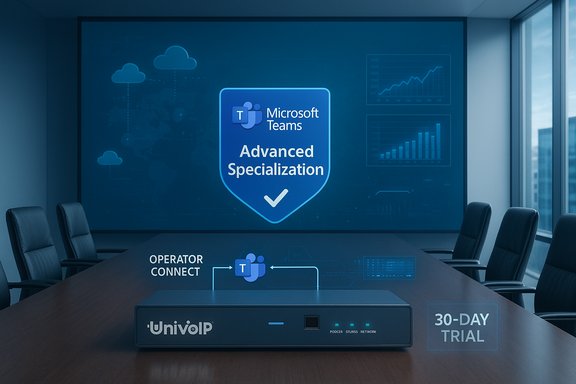
UniVoIP’s announcement that it has earned Microsoft’s Calling for Microsoft Teams Advanced Specialization marks a clear signal: the company is positioning itself as a verified partner capable of turning Microsoft Teams into a full, enterprise-grade phone system — and it arrives at a moment when many organizations are still wrestling with fragmented voice estates.
Background
Microsoft’s Calling for Microsoft Teams Advanced Specialization is a formal partner credential that validates three core pillars: measurable performance (customer consumption), skilling (certified personnel), and real-world customer references. The program is explicitly tied to the Solutions Partner for Modern Work designation, and Microsoft publishes clear thresholds — notably a requirement to demonstrate at least 1,000 Teams Phone–enabled users in a trailing 12‑month window and named engineers who have passed the Teams Administrator Associate certification plus the Teams Calling technical assessment. UniVoIP’s marketing and product pages have long promoted a “Cloud Voice for Microsoft Teams” offer that delivers calling natively inside the Teams client through both Operator Connect and Direct Routing paths, and the vendor lists features such as automated onboarding, real‑time dashboards, and a 30‑day trial. Those claims are reinforced by recent UniVoIP blog posts and PR that describe Operator Connect availability and automated provisioning practices. This article summarizes what UniVoIP’s specialization means in practice, verifies the key technical and programmatic claims, and provides a critical analysis of strengths, operational caveats, and the precise procurement checks CIOs and tech buyers should insist on before consolidating voice onto Teams.The telephony gap: why Teams adoption hasn’t automatically meant Teams calling
Despite broad Teams adoption for chat and meetings, a surprisingly large share of organisations still rely on mixed telephony estates: legacy PBXs, SIP trunks, third‑party conferencing services, and siloed contact‑centre platforms. The result is operational friction (multiple consoles and support chains), security and compliance complexity, and avoidable cost overhead from duplicated contracts and hardware maintenance.- IT teams must operate different support models and SLAs for vendors.
- Users often context‑switch between multiple apps for chat, meetings and voice.
- Additional systems expand the organization’s attack surface and complicate data governance.
What UniVoIP’s Advanced Specialization actually certifies
Earning Microsoft’s Calling for Microsoft Teams specialization is not marketing fluff — Microsoft requires auditable evidence. The most relevant program checks include:- Solutions Partner alignment: the partner must hold the Solutions Partner for Modern Work designation.
- Performance (ACR / enabled users): partners must show a growth threshold in Teams Phone enabled users; Microsoft cites a 1,000-user minimum over a trailing 12 months as the standard program gate.
- Skilling: named individuals must have passed the Microsoft 365 Certified: Teams Administrator Associate exam and the Teams Calling technical assessment. The program requires multiple certified staff to demonstrate bench strength.
- Customer references: providers must submit three references that demonstrate real deployments covering Phone System, Calling Plan or Direct Routing, network planning and remediation, and operational outcomes.
What UniVoIP brings to a Teams calling deployment
UniVoIP’s public materials and recent announcements position the company as a turnkey Teams voice provider with several notable capabilities:- Native Teams calling: voice handled directly in the Teams client; no separate softphone or plugin required. This reduces user friction and supports single‑client workflows.
- Dual delivery paths: support for both Operator Connect (carrier‑managed PSTN breakout) and Direct Routing (SBC-based control) to match customer regulatory or control requirements.
- Automated onboarding: UniVoIP claims automated provisioning and “activate in minutes” onboarding flows that integrate with Microsoft 365 tenant provisioning and phone‑number porting. These are positioned as major levers for fast growth and rapid hiring scenarios.
- Operational tooling: real‑time dashboards, call reporting and a single management plane (Service Control) that integrates with Teams Admin Center for visibility.
- Commercial simplicity: transparent pricing, a 30‑day trial, free number porting claims and US‑based 24/7 support — all elements designed to lower procurement friction.
Verifying the vendor claims — what is provable and what needs scrutiny
Several key UniVoIP claims are verifiable against public material; others are vendor marketing that buyers should validate.Provable items:
- Microsoft’s specialization requirements (1,000 Teams Phone enabled users, skilling, and customer references) are published by Microsoft. That confirms the program’s intended rigor and the kinds of artifacts UniVoIP would have had to provide.
- UniVoIP’s Operator Connect availability and Cloud Voice product descriptions are documented in vendor blogs and PR channels, establishing that delivery models are in place.
- “Onboard in 15 minutes” / “activate in minutes” — this is a practical, outcome‑oriented marketing claim tied to automation in provisioning. In many real‑world deployments the time‑to‑first‑call depends on number porting, regulatory checks, and tenant readiness; therefore the claim should be validated with documented onboarding logs or a pilot. Treat it as a vendor‑reported business outcome until you see time‑stamped provisioning records.
- Uptime and resilience SLAs — UniVoIP cites geo‑redundant infrastructure, but enterprise buyers must request SLA language, regional SBC placement diagrams and failover testing evidence (especially for Direct Routing designs). These are operational controls typically reviewed during procurement due diligence.
- E911 and emergency calling compliance — any Teams Phone migration must validate local emergency calling paths and failover plans. Don’t accept a general “we support E911” statement — request a runbook for each country you operate in.
Strengths: why a verified Teams calling partner matters
- Procurement signal: achieving Microsoft’s Advanced Specialization reduces shortlisting friction. For procurement teams, the badge means a partner has been audited against specific skilling and delivery thresholds, which simplifies initial vendor screening.
- Single‑pane experience: native Teams calling eliminates multiple user clients and reduces training friction — a clear user‑experience win that often improves adoption metrics.
- Operational automation: automated provisioning and tenant integration materially lower the operational burden of large-scale onboarding, especially for companies with high employee churn or frequent international hires. UniVoIP positions automation as a core differentiator.
- Multiple PSTN paths: offering both Operator Connect and Direct Routing lets UniVoIP align its architecture to customer needs — Operator Connect for simplicity and carrier-managed breakout, Direct Routing where granular control, SBC survivability or complex regulatory routing is required. That flexibility is valuable in multinational deployments.
Risks, tradeoffs and what Microsoft’s badge does not guarantee
The specialization is meaningful but it is not a substitute for rigorous procurement or pilot validation. Key risks include:- Badge ≠ guaranteed project outcome: the specialization documents capability at audit time; it does not bind personnel, guarantee current staffing levels, nor substitute for case‑specific references. Verify the audit date, request Partner Center evidence, and ask for named customer references in the same vertical and regional footprint.
- Data governance and AI telemetry: Teams voice feeds can surface into Copilot and downstream analytics; buyers must insist on explicit contractual terms covering transcript retention, non‑training guarantees, redaction workflows and exportable audit logs before enabling voice‑AI features. These are common pitfalls when voice becomes an AI data layer.
- Emergency calling / regulatory nuance: Direct Routing architecture and SBC placement affect E911 and local regulatory compliance. Enterprises must validate regional failover, SBC survivability, and any local operator dependencies.
- Feature parity for PBX‑heavy users: some user groups still require specific PBX parity (complex hunt groups, operator consoles, analog devices). A Teams migration should be staged and map which users truly need full PBX feature parity versus those who can operate on Teams Phone. Don’t assume every PBX feature maps 1:1 to Teams Phone.
- Vendor lock‑in: deep Teams embedding (identity, recordings, analytics in Azure) improves productivity but increases exit cost. Demand exportable artifacts, documented APIs and a handover runbook in the contract.
A practical procurement and pilot checklist
To convert a specialization badge into a low‑risk deployment, procurement and technical leads should ask for the following artifacts and follow a short pilot plan:Required artifacts
- Microsoft Partner Center verification of the Calling for Microsoft Teams specialization and audit completion date.
- A dated skills matrix with the names and certification IDs of the engineers assigned to your engagement (Teams Admin Associate and Teams Calling technical assessment pass evidence).
- At least three customer references with contactable references in the same regulatory environment and similar scale; one reference should include measurable before/after KPIs.
- Architecture diagrams: PSTN routing (Operator Connect vs Direct Routing), SBC placement, regional failover and E911 flows.
- Data flow and governance diagrams: where audio, transcripts and derived artifacts are stored, access controls, retention policies, and whether data can be used for vendor/model training.
- A documented onboarding runbook with time‑stamped provisioning logs from a recent customer migration (to validate “minutes” claims).
- SLA and support playbook (mean time to provision, major incident response, 24/7 support escalation procedures and credits).
- Discovery (0–14 days): inventory telephony estate, identify 50–200 pilot seats, map E911 and regulatory needs.
- Foundation (15–30 days): configure tenant, enable retention and DLP, provision test numbers, and validate SBC / Operator Connect routing.
- Pilot (30–75 days): onboard the pilot cohort, instrument call quality metrics (MOS, jitter, packet loss), CQD and CDR exports, and test provision timelines and porting flows. Implement human‑in‑the‑loop gates if any AI automations are used.
- Validate (75–90 days): evaluate KPIs (AHT, adoption, provisioning time), review compliance artifacts, and decide on scale or rollback. Secure exit/porting procedures and export raw audio/transcripts as a test of portability.
Real‑world scenarios: what changes for buyers and IT teams
Consider two common corporate scenarios:- A mid‑sized professional services firm (≈500 seats) currently running Teams for collaboration but several regional PBXs for voice will benefit from decommissioning on‑prem hardware, consolidating carrier contracts, and shortening the vendor stack. The result is a predictable, cloud‑based OPEX model and less operational churn for IT teams. That change requires validated E911 plans and targeted PBX parity mapping for specialized receptionists and analog devices.
- A high‑growth tech firm that hires dozens of employees monthly gains outsized value from automated onboarding: new hires receive numbers and voice capabilities as part of M365 provisioning, reducing a common bottleneck. Validate onboarding logs and test porting timelines for outside numbers; also plan FinOps controls for license sprawl if Teams Premium or Copilot seats are planned.
Where UniVoIP’s specialization sits in the wider market
The Teams voice market is fragmenting across three broad vendor strategies: Connect (bridge Teams to legacy systems), Extend (embed agent consoles into Teams while keeping legacy CCaaS features), and Unify (fully Teams‑native contact center and agent experiences built on ACS/Teams Phone extensibility). UniVoIP’s dual delivery posture (Operator Connect + Direct Routing) positions it to serve both simplicity‑first and control‑first customers, and the Microsoft specialization makes it more visible to enterprises using Microsoft’s partner discovery channels.That said, competition remains brisk from established UCaaS vendors and telcos that emphasize PBX pedigree or global carrier scale. For buyers, specialization narrows down the field but does not replace the need for pilots and reference validations.
Final assessment — strengths, steps to validate, and the bottom line
UniVoIP’s attainment of Microsoft’s Calling for Microsoft Teams Advanced Specialization is a meaningful commercial milestone; it validates that the company has demonstrated repeatable deployments, named certified staff and customer references that meet Microsoft’s program gates. For organisations looking to consolidate voice into Teams, a specialized partner reduces shortlisting risk and brings access to operational playbooks and co‑sell pathways. However, the specialization is a starting signal — not a substitute for procurement diligence. Buyers should insist on demonstrable onboarding logs, named engineer availability, exportable governance artifacts, testable E911 runbooks and contractual guarantees for data handling, retention and human‑in‑the‑loop controls. These programmatic checks convert a badge into predictable outcomes.In plain terms: UniVoIP’s badge tells you the partner knows how to deliver Teams Phone at scale. Your job as a buyer is to verify that the partner knows how to deliver it for your scale, your regulatory environment, and your edge cases — and that the migration playbook is spelled out in measurable, testable artifacts before you flip the migration switch.
Quick checklist for procurement to take away
- Request Partner Center proof of UniVoIP’s Calling for Microsoft Teams Advanced Specialization and the audit date.
- Ask for the certified headcount and certification IDs that were used to qualify the specialization.
- Secure at least two reference customers in your vertical and region, and ask for anonymised onboarding logs that show provisioning timelines.
- Validate E911, SBC design and failover plans for each country you operate in.
- Run a 60–90 day pilot with clearly instrumented KPIs and a go/no‑go decision gate based on adoption, call quality, and compliance outcomes.
Source: UC Today UniVoIP Clinches Microsoft’s Calling for Teams Advanced Specialization, Turning Teams into a True Phone System
