

TROYPOINT’s July 2026 Unlinked list identifies 17 working codes for Fire TV, Android TV, and Google TV users, with “FIRESTICK,” “EMDYOUTUBE,” “EVERYTHING,” “FIRETVGURU,” and “7919e0d4” presented as the most active libraries as of June 30, 2026. The guide is useful as a snapshot of a sideloading ecosystem that still has momentum. But the more interesting story is not which code has the most APKs. It is that Unlinked now sits at the collision point between user freedom, copyright enforcement, platform lockdown, and basic device security.
Unlinked codes look trivial: short strings that unlock app libraries inside a third-party Android installer. Enter the code, browse the store, pick an APK, install it, and the Fire TV or Android TV box becomes something more flexible than the official app store allows.
That simplicity is the entire appeal. A code such as “FIRESTICK” or “EMDYOUTUBE” is easier to share than a direct download URL, easier to update than a forum post, and easier for a non-technical user than learning Android Debug Bridge. For a living-room device controlled by a remote, that convenience matters.
TROYPOINT’s list shows a tiered ecosystem. The top libraries are described as recently updated, broad in scope, and stocked with streaming apps, video players, VPNs, IPTV tools, utilities, and app-store alternatives. The lower-ranked libraries are treated more cautiously: still potentially useful, but stale, unreliable, or full of outdated packages.
That distinction matters because sideloading is not just about access. It is about maintenance. A library with hundreds of APKs can look impressive while quietly serving old builds, broken apps, or software that no longer works on current Fire OS and Android TV releases. In 2026, the freshest code is often more valuable than the largest one.
That created a gray-market culture around the device. Some users sideloaded legitimate apps missing from Amazon’s store, including regional broadcasters, niche players, open-source media tools, and utilities. Others used the same plumbing to install unlicensed streaming apps, IPTV clients of uncertain legality, and modified APKs designed to remove ads or bypass restrictions.
For years, Amazon largely tolerated the technical possibility even when it disliked the uses. The device exposed developer options, Downloader became a household name among cord-cutters, and tutorials proliferated. The bargain was uneasy but stable: Amazon controlled the default experience, while power users could still step outside the walls.
That bargain is now under pressure. Recent reporting indicates Amazon has moved toward stronger blocks on some sideloaded apps and has signaled that some newer Fire TV hardware will no longer support installing apps from unknown sources. Whether every model follows immediately is less important than the strategic direction. The era when sideloading was a quiet, semi-official escape hatch is ending.
That also makes Unlinked’s weakness obvious. The maintainer curates the pile.
When TROYPOINT notes that some apps are “modded” to remove ads or add features, that is a flashing yellow light. A modified APK may be harmless, helpful, or malicious. Unless the user can verify the developer, signature, hash, and provenance of the package, the installation is an act of trust.
This is not a theoretical risk. APK files can request broad permissions, bundle unwanted trackers, imitate legitimate apps, or update themselves outside the usual store controls. A streaming box may not hold a user’s tax records, but it sits on the home network, shares credentials for streaming services, and often runs under accounts tied to payment methods.
The standard advice to “use a VPN” only addresses part of the problem. A VPN may hide traffic from an ISP or change a visible IP address, but it does not make a malicious APK safe. It does not stop an app from harvesting device identifiers, abusing local network access, or phoning home over the encrypted tunnel the user just paid for.
FIRESTICK was listed as updated on June 21, 2026. EMDYOUTUBE followed on June 24, 2026. StreamKings, behind code 7919e0d4, was listed as updated on June 12, 2026. Those dates tell users the maintainers are still present, still swapping builds, and still reacting to a moving app ecosystem.
By contrast, several older libraries in the list have not been updated since 2021, 2022, or 2023. They may still contain useful utilities, but they are also time capsules. A media app from 2021 may rely on dead endpoints, broken certificates, abandoned libraries, or Android APIs that newer devices handle differently.
The temptation is to judge these stores by file count. IPTV Super Store is described as having more than 900 apps, while StreamKings has more than 800 files. But abundance is not quality control. In an environment where unofficial apps appear, vanish, fork, and get repackaged, a small updated library can be safer and more useful than a giant neglected one.
That is the central lesson for WindowsForum readers who manage devices for family, clients, or small offices: treat sideloading libraries like package repositories. A repository is only as trustworthy as its maintainers, update practices, and transparency. A code pasted from a blog post is not a supply-chain strategy.
The TV platform fight is the same argument with a remote control. The official store is safer, more predictable, and easier to support. It is also incomplete, region-limited, policy-driven, and sometimes hostile to niche software. Sideloading fills the gap.
But TV devices raise the stakes because the user base is different. A PC user who downloads an unsigned executable is at least expected to understand some risk. A Fire TV user may be following a YouTube tutorial while trying to watch a football match, a regional channel, or a film not available in their country.
That gap between technical power and user understanding is where code-based installers thrive. It is also where abuse thrives. One code can unlock a library of useful tools; another can unlock a mess of copyright-infringing apps, fake clones, and mystery binaries. The interface makes both feel equally legitimate.
Platform owners are responding in the predictable way. They are not trying to teach every user software provenance. They are narrowing the path. If a device cannot install unknown apps, the support problem shrinks, the piracy problem shrinks, and the malware problem shrinks. So does user freedom.
The trouble begins when libraries mix those tools with apps built around free access to movies, live television, sports, adult content, or paid channels. Some apps may aggregate legal streams. Others may scrape sources, embed pirated feeds, or rely on IPTV services that do not have distribution rights. The user often cannot tell which is which from inside the installer.
That ambiguity is part of the product. A code-based library does not ask the user to evaluate licensing. It presents a menu. “Movies,” “Sports,” “Live TV,” and “Adult” become categories, not legal claims.
For publishers, leagues, studios, and platform operators, that is enough to trigger enforcement. Amazon’s apparent crackdown on piracy-related apps is not merely a moral campaign. It is a business necessity for a company that sells streaming hardware, rents and sells video, runs ads, hosts apps, and maintains relationships with rights holders.
For users, the legal risk may feel abstract, but the practical risk is immediate. Apps disappear. Feeds break. Installers get blocked. Devices receive updates that invalidate old guides. The more a setup depends on unofficial access, the more brittle it becomes.
Sometimes the mechanism is advertising. Sometimes it is affiliate marketing. Sometimes it is data collection. Sometimes it is a paid IPTV subscription dressed in casual language. Sometimes it is simply infringement, with the developer monetizing attention until the app is abandoned, cloned, or blocked.
Modified apps complicate the picture further. Removing ads from an app may improve the experience, but it may also deprive the original developer of revenue, violate terms, or introduce new code from an unknown third party. “Ad-free” sounds like a feature. In supply-chain terms, it means the binary is no longer the binary its original publisher shipped.
That is why Windows veterans should instinctively distrust the phrase modded APK. On the desktop, running a modified installer from an unknown source would be treated as risky. On TV boxes, the same behavior has been normalized by convenience.
The double standard is cultural, not technical. Android TV devices are computers. Fire TV devices are computers. They deserve the same suspicion users bring to random Windows EXE files.
But the VPN has become a talisman. It is often presented as if it converts an unsafe ecosystem into a safe one. It does not.
If an app is malicious, a VPN does not sanitize it. If a service is illegal, a VPN does not make it licensed. If a device is compromised, a VPN may simply provide the compromised app with a protected route to its operator. If a user enters credentials into a cloned app, the VPN is irrelevant.
The better advice is layered. Users should prefer official stores when possible, avoid modified builds when original builds exist, check update dates, remove unused apps, disable install permissions after use, and avoid logging into sensitive accounts inside unknown software. A VPN can be one layer, but it should not be the layer that excuses every other risk.
This distinction matters because affiliate-driven privacy advice can blur incentives. VPN providers pay commissions. Cord-cutting sites often depend on those commissions. That does not make the advice wrong, but it does mean readers should separate the security claim from the commercial funnel.
Google also has incentives to police living-room software. It operates an app store, sells ads, licenses a platform to hardware partners, and faces pressure from rights holders. Its security model has become more restrictive over time across Android generally, and TV is unlikely to be exempt forever.
The practical difference is fragmentation. Fire TV is Amazon’s stack, so a policy shift can hit large numbers of devices through firmware and product design. Android TV and Google TV involve Google, OEMs, regional variants, operator devices, and uncertified boxes. That makes the ecosystem messier but not necessarily safer.
Cheap no-name Android TV boxes deserve special caution. Some are not certified Android TV devices at all. Some ship with outdated Android builds, questionable firmware, or preinstalled apps that users did not choose. Escaping Amazon’s garden by buying mystery hardware can replace one problem with another.
For users who want legitimate flexibility, the best path remains boring: certified hardware, known developers, open-source projects where possible, and a willingness to pay for services that actually license content. The living-room hacker ethos does not require pretending every APK menu is harmless.
Enterprise IT spends enormous effort controlling package sources. Admins care about signed installers, vendor reputation, update channels, vulnerability disclosures, and rollback plans. They do not let random departments install business-critical software from anonymous file lockers because “someone on a forum said it works.”
Home streaming setups rarely get that discipline. A friend recommends a code. A YouTuber demonstrates it. A blog ranks it. The user installs ten apps and forgets which library they came from. Six months later, one breaks, another updates itself, and a third remains on the box forever.
The consequences are smaller than a domain compromise, but the pattern is the same. Unverified software accumulates. Permissions persist. Old code survives beyond its support life. Users normalize prompts they do not understand.
That is why the most security-conscious response to TROYPOINT’s list is not panic. It is inventory. If a Fire TV or Android TV device has been treated as an experimental APK playground, it is worth reviewing what is installed, what still gets used, and what can be removed.
The “worth mentioning” section tells the other half of the story. It is crowded with older libraries whose last updates stretch back years. They are remnants of a faster, looser period in the Fire TV modding scene, when code lists spread widely and platform enforcement felt less immediate.
That split mirrors the broader market. The sideloading world is consolidating around actively maintained hubs, while older collections decay. The platform world is moving toward more enforcement, not less. Users are caught between the convenience of unofficial app discovery and the shrinking tolerance of device makers.
TROYPOINT’s own recommendation of its Toolbox over dead Unlinked libraries is revealing. Even in the enthusiast community, the argument is shifting from “here are all the codes” to “use a curated source that stays updated.” That is a tacit admission that the code-list model has become noisy.
The next phase will likely be less open, more curated, and more adversarial. Platform vendors will block more. Library maintainers will adapt. Users will chase the next installer. The cycle will continue, but each turn will require more trust in fewer intermediaries.
There are legitimate reasons to sideload. A regional streaming provider may not publish in Amazon’s store. A developer may need to test an app. An open-source tool may not fit commercial store policies. A user may prefer a launcher, browser, file manager, or player that the official store buries or excludes.
There are also bad reasons. Installing mystery apps to access paid content for free is not the same as installing a missing public broadcaster app. Installing a modified APK because it removes ads is not the same as installing a developer’s official release. A library that mixes all of those together asks the user to do ethical and technical sorting at remote-control speed.
The middle ground is to preserve sideloading while raising the burden of trust. That means users should know where an APK came from, why it is needed, whether an official version exists, and how it will be updated. It means device makers should not use piracy as a blanket excuse to eliminate every advanced-user feature. It means enthusiast sites should foreground provenance as much as convenience.
That is an uncomfortable compromise, which is usually a sign it is the honest one. Total lockdown punishes legitimate users. Total openness punishes naïve ones.
For anyone still using Unlinked, the safest posture is selective skepticism, not blind avoidance or blind enthusiasm.
The likely future is not the death of sideloading, but its narrowing into a more contested, more technical, and less casual practice. Enthusiasts will still find ways to install what they want, just as Windows users have always found ways around default guardrails. The question is whether ordinary streaming-device owners will be left with safer products, poorer choices, or simply a new set of middlemen asking for trust.
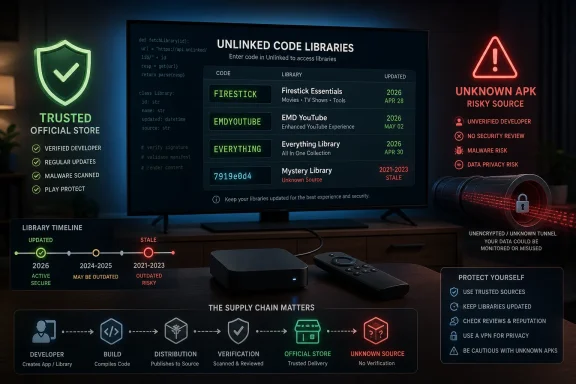 The Code List Is Really a Map of the Sideloading Economy
Unlinked codes look trivial: short strings that unlock app libraries inside a third-party Android installer. Enter the code, browse the store, pick an APK, install it, and the Fire TV or Android TV box becomes something more flexible than the official app store allows.That simplicity is the entire appeal. A code such as “FIRESTICK” or “EMDYOUTUBE” is easier to share than a direct download URL, easier to update than a forum post, and easier for a non-technical user than learning Android Debug Bridge. For a living-room device controlled by a remote, that convenience matters.
TROYPOINT’s list shows a tiered ecosystem. The top libraries are described as recently updated, broad in scope, and stocked with streaming apps, video players, VPNs, IPTV tools, utilities, and app-store alternatives. The lower-ranked libraries are treated more cautiously: still potentially useful, but stale, unreliable, or full of outdated packages.
That distinction matters because sideloading is not just about access. It is about maintenance. A library with hundreds of APKs can look impressive while quietly serving old builds, broken apps, or software that no longer works on current Fire OS and Android TV releases. In 2026, the freshest code is often more valuable than the largest one.
Fire TV Became the Battleground Because It Was Too Useful
The Fire TV Stick became a favorite among tinkerers for the same reason it became a favorite among casual streamers: it was cheap, familiar, and good enough. Amazon sold a low-cost living-room computer with an app store, a remote, HDMI output, Wi-Fi, and enough Android DNA to make sideloading practical.That created a gray-market culture around the device. Some users sideloaded legitimate apps missing from Amazon’s store, including regional broadcasters, niche players, open-source media tools, and utilities. Others used the same plumbing to install unlicensed streaming apps, IPTV clients of uncertain legality, and modified APKs designed to remove ads or bypass restrictions.
For years, Amazon largely tolerated the technical possibility even when it disliked the uses. The device exposed developer options, Downloader became a household name among cord-cutters, and tutorials proliferated. The bargain was uneasy but stable: Amazon controlled the default experience, while power users could still step outside the walls.
That bargain is now under pressure. Recent reporting indicates Amazon has moved toward stronger blocks on some sideloaded apps and has signaled that some newer Fire TV hardware will no longer support installing apps from unknown sources. Whether every model follows immediately is less important than the strategic direction. The era when sideloading was a quiet, semi-official escape hatch is ending.
Unlinked Solves a Usability Problem and Creates a Trust Problem
Unlinked’s genius is that it abstracts away the hardest part of sideloading: finding the file. Users do not need to type long URLs with a remote, search shady download pages, or know which APK variant matches their device. A library maintainer curates the pile.That also makes Unlinked’s weakness obvious. The maintainer curates the pile.
When TROYPOINT notes that some apps are “modded” to remove ads or add features, that is a flashing yellow light. A modified APK may be harmless, helpful, or malicious. Unless the user can verify the developer, signature, hash, and provenance of the package, the installation is an act of trust.
This is not a theoretical risk. APK files can request broad permissions, bundle unwanted trackers, imitate legitimate apps, or update themselves outside the usual store controls. A streaming box may not hold a user’s tax records, but it sits on the home network, shares credentials for streaming services, and often runs under accounts tied to payment methods.
The standard advice to “use a VPN” only addresses part of the problem. A VPN may hide traffic from an ISP or change a visible IP address, but it does not make a malicious APK safe. It does not stop an app from harvesting device identifiers, abusing local network access, or phoning home over the encrypted tunnel the user just paid for.
The Best Libraries Are the Ones That Admit They Age
The most useful detail in the July 2026 list is not the code names. It is the “last updated” line attached to each library.FIRESTICK was listed as updated on June 21, 2026. EMDYOUTUBE followed on June 24, 2026. StreamKings, behind code 7919e0d4, was listed as updated on June 12, 2026. Those dates tell users the maintainers are still present, still swapping builds, and still reacting to a moving app ecosystem.
By contrast, several older libraries in the list have not been updated since 2021, 2022, or 2023. They may still contain useful utilities, but they are also time capsules. A media app from 2021 may rely on dead endpoints, broken certificates, abandoned libraries, or Android APIs that newer devices handle differently.
The temptation is to judge these stores by file count. IPTV Super Store is described as having more than 900 apps, while StreamKings has more than 800 files. But abundance is not quality control. In an environment where unofficial apps appear, vanish, fork, and get repackaged, a small updated library can be safer and more useful than a giant neglected one.
That is the central lesson for WindowsForum readers who manage devices for family, clients, or small offices: treat sideloading libraries like package repositories. A repository is only as trustworthy as its maintainers, update practices, and transparency. A code pasted from a blog post is not a supply-chain strategy.
The App Store War Has Moved Into the Living Room
Windows users know this story. Microsoft spent years trying to reconcile the openness of Win32 with the safety and commercial control of the Microsoft Store. Apple took the opposite approach on iOS. Google has tried to keep Android open while tightening Play Protect, permissions, and policy enforcement.The TV platform fight is the same argument with a remote control. The official store is safer, more predictable, and easier to support. It is also incomplete, region-limited, policy-driven, and sometimes hostile to niche software. Sideloading fills the gap.
But TV devices raise the stakes because the user base is different. A PC user who downloads an unsigned executable is at least expected to understand some risk. A Fire TV user may be following a YouTube tutorial while trying to watch a football match, a regional channel, or a film not available in their country.
That gap between technical power and user understanding is where code-based installers thrive. It is also where abuse thrives. One code can unlock a library of useful tools; another can unlock a mess of copyright-infringing apps, fake clones, and mystery binaries. The interface makes both feel equally legitimate.
Platform owners are responding in the predictable way. They are not trying to teach every user software provenance. They are narrowing the path. If a device cannot install unknown apps, the support problem shrinks, the piracy problem shrinks, and the malware problem shrinks. So does user freedom.
The Copyright Story Is Not a Footnote
Many Unlinked libraries contain legitimate utilities: VPN clients, file managers, launchers, speed-test tools, web browsers, media players, and app-store alternatives. Those categories are not inherently suspicious. A user may have perfectly reasonable reasons to install them.The trouble begins when libraries mix those tools with apps built around free access to movies, live television, sports, adult content, or paid channels. Some apps may aggregate legal streams. Others may scrape sources, embed pirated feeds, or rely on IPTV services that do not have distribution rights. The user often cannot tell which is which from inside the installer.
That ambiguity is part of the product. A code-based library does not ask the user to evaluate licensing. It presents a menu. “Movies,” “Sports,” “Live TV,” and “Adult” become categories, not legal claims.
For publishers, leagues, studios, and platform operators, that is enough to trigger enforcement. Amazon’s apparent crackdown on piracy-related apps is not merely a moral campaign. It is a business necessity for a company that sells streaming hardware, rents and sells video, runs ads, hosts apps, and maintains relationships with rights holders.
For users, the legal risk may feel abstract, but the practical risk is immediate. Apps disappear. Feeds break. Installers get blocked. Devices receive updates that invalidate old guides. The more a setup depends on unofficial access, the more brittle it becomes.
“Free” Is Often a Pricing Model With Missing Labels
The language around these libraries tends to emphasize free media, free apps, and easy installation. That is understandable; cord-cutting started as a rebellion against bloated cable bills. But “free” software in the sideloading world usually has a hidden financing mechanism.Sometimes the mechanism is advertising. Sometimes it is affiliate marketing. Sometimes it is data collection. Sometimes it is a paid IPTV subscription dressed in casual language. Sometimes it is simply infringement, with the developer monetizing attention until the app is abandoned, cloned, or blocked.
Modified apps complicate the picture further. Removing ads from an app may improve the experience, but it may also deprive the original developer of revenue, violate terms, or introduce new code from an unknown third party. “Ad-free” sounds like a feature. In supply-chain terms, it means the binary is no longer the binary its original publisher shipped.
That is why Windows veterans should instinctively distrust the phrase modded APK. On the desktop, running a modified installer from an unknown source would be treated as risky. On TV boxes, the same behavior has been normalized by convenience.
The double standard is cultural, not technical. Android TV devices are computers. Fire TV devices are computers. They deserve the same suspicion users bring to random Windows EXE files.
The VPN Pitch Needs a Reality Check
TROYPOINT’s guide repeatedly urges users to connect to a trusted VPN before using unverified apps. That advice is common in the cord-cutting world, and it has some merit. A VPN can reduce ISP visibility into destination traffic, help avoid crude network throttling, and add privacy when using unknown services.But the VPN has become a talisman. It is often presented as if it converts an unsafe ecosystem into a safe one. It does not.
If an app is malicious, a VPN does not sanitize it. If a service is illegal, a VPN does not make it licensed. If a device is compromised, a VPN may simply provide the compromised app with a protected route to its operator. If a user enters credentials into a cloned app, the VPN is irrelevant.
The better advice is layered. Users should prefer official stores when possible, avoid modified builds when original builds exist, check update dates, remove unused apps, disable install permissions after use, and avoid logging into sensitive accounts inside unknown software. A VPN can be one layer, but it should not be the layer that excuses every other risk.
This distinction matters because affiliate-driven privacy advice can blur incentives. VPN providers pay commissions. Cord-cutting sites often depend on those commissions. That does not make the advice wrong, but it does mean readers should separate the security claim from the commercial funnel.
Android TV and Google TV Are Not a Permanent Safe Harbor
Some users may respond to Fire TV restrictions by moving to Android TV or Google TV boxes. That may preserve more sideloading flexibility in the short term, especially on devices that retain standard Android settings and developer options. It is not a guarantee.Google also has incentives to police living-room software. It operates an app store, sells ads, licenses a platform to hardware partners, and faces pressure from rights holders. Its security model has become more restrictive over time across Android generally, and TV is unlikely to be exempt forever.
The practical difference is fragmentation. Fire TV is Amazon’s stack, so a policy shift can hit large numbers of devices through firmware and product design. Android TV and Google TV involve Google, OEMs, regional variants, operator devices, and uncertified boxes. That makes the ecosystem messier but not necessarily safer.
Cheap no-name Android TV boxes deserve special caution. Some are not certified Android TV devices at all. Some ship with outdated Android builds, questionable firmware, or preinstalled apps that users did not choose. Escaping Amazon’s garden by buying mystery hardware can replace one problem with another.
For users who want legitimate flexibility, the best path remains boring: certified hardware, known developers, open-source projects where possible, and a willingness to pay for services that actually license content. The living-room hacker ethos does not require pretending every APK menu is harmless.
WindowsForum Readers Should Recognize the Supply-Chain Pattern
The Unlinked ecosystem may look far from Windows administration, but the underlying problem is familiar. It is software distribution without a strong root of trust.Enterprise IT spends enormous effort controlling package sources. Admins care about signed installers, vendor reputation, update channels, vulnerability disclosures, and rollback plans. They do not let random departments install business-critical software from anonymous file lockers because “someone on a forum said it works.”
Home streaming setups rarely get that discipline. A friend recommends a code. A YouTuber demonstrates it. A blog ranks it. The user installs ten apps and forgets which library they came from. Six months later, one breaks, another updates itself, and a third remains on the box forever.
The consequences are smaller than a domain compromise, but the pattern is the same. Unverified software accumulates. Permissions persist. Old code survives beyond its support life. Users normalize prompts they do not understand.
That is why the most security-conscious response to TROYPOINT’s list is not panic. It is inventory. If a Fire TV or Android TV device has been treated as an experimental APK playground, it is worth reviewing what is installed, what still gets used, and what can be removed.
The July 2026 List Shows a Scene in Transition
The top codes in the July 2026 list show that Unlinked is not dead. FIRESTICK, EMDYOUTUBE, EVERYTHING, FIRETVGURU, and StreamKings all appear to offer active or semi-active libraries. Some focus on broad app selection; others lean into IPTV, utilities, adult content, or media players.The “worth mentioning” section tells the other half of the story. It is crowded with older libraries whose last updates stretch back years. They are remnants of a faster, looser period in the Fire TV modding scene, when code lists spread widely and platform enforcement felt less immediate.
That split mirrors the broader market. The sideloading world is consolidating around actively maintained hubs, while older collections decay. The platform world is moving toward more enforcement, not less. Users are caught between the convenience of unofficial app discovery and the shrinking tolerance of device makers.
TROYPOINT’s own recommendation of its Toolbox over dead Unlinked libraries is revealing. Even in the enthusiast community, the argument is shifting from “here are all the codes” to “use a curated source that stays updated.” That is a tacit admission that the code-list model has become noisy.
The next phase will likely be less open, more curated, and more adversarial. Platform vendors will block more. Library maintainers will adapt. Users will chase the next installer. The cycle will continue, but each turn will require more trust in fewer intermediaries.
The Practical Middle Ground Is Narrow but Real
It is easy to reduce this debate to two camps: locked-down app stores versus anything-goes sideloading. That misses the users in the middle.There are legitimate reasons to sideload. A regional streaming provider may not publish in Amazon’s store. A developer may need to test an app. An open-source tool may not fit commercial store policies. A user may prefer a launcher, browser, file manager, or player that the official store buries or excludes.
There are also bad reasons. Installing mystery apps to access paid content for free is not the same as installing a missing public broadcaster app. Installing a modified APK because it removes ads is not the same as installing a developer’s official release. A library that mixes all of those together asks the user to do ethical and technical sorting at remote-control speed.
The middle ground is to preserve sideloading while raising the burden of trust. That means users should know where an APK came from, why it is needed, whether an official version exists, and how it will be updated. It means device makers should not use piracy as a blanket excuse to eliminate every advanced-user feature. It means enthusiast sites should foreground provenance as much as convenience.
That is an uncomfortable compromise, which is usually a sign it is the honest one. Total lockdown punishes legitimate users. Total openness punishes naïve ones.
The Codes Are Less Important Than the Habits They Encourage
TROYPOINT’s July 2026 list is valuable if read carefully. It identifies which Unlinked libraries are still alive, which are stale, and which categories dominate the scene. It also exposes how much of the streaming-device underground depends on social trust rather than verifiable software distribution.For anyone still using Unlinked, the safest posture is selective skepticism, not blind avoidance or blind enthusiasm.
- Active libraries with recent update dates are preferable to giant collections that have not changed since 2021 or 2022.
- Official app stores and developer websites should be the first choice when they provide the same app.
- Modified APKs deserve extra suspicion because the user is trusting both the original developer and the unknown modifier.
- A VPN can improve privacy in some scenarios, but it does not prove that an app is safe, legal, or well maintained.
- Fire TV users should expect sideloading to become more restricted on newer hardware and future software updates.
- Android TV and Google TV devices may offer more flexibility, but uncertified boxes and unknown firmware can introduce their own risks.
The likely future is not the death of sideloading, but its narrowing into a more contested, more technical, and less casual practice. Enthusiasts will still find ways to install what they want, just as Windows users have always found ways around default guardrails. The question is whether ordinary streaming-device owners will be left with safer products, poorer choices, or simply a new set of middlemen asking for trust.
References
- Primary source: TROYPOINT
Published: 2026-06-30T21:50:10.539084
17 Best Unlinked Codes for Free Media Apps (July 2026 List)
This guide lists the best Unlinked Codes for installing secret apps on Firestick and Android. Working codes for July 2026.troypoint.com - Related coverage: howtogeek.com
How to Sideload Apps on the Fire TV and Fire TV Stick
Open your Amazon Fire TV to a bigger world of Android apps. www.howtogeek.com
- Related coverage: techradar.com
'This device prevents sideloading': Amazon warns Fire TV Stick HD buyers that it can't be turned into an illegal 'Fire Stick' for free streaming | TechRadar
Stick to the official appswww.techradar.com - Related coverage: androidcentral.com
Fire TV is cracking down on piracy apps, including the ones you sideloaded | Android Central
The crackdown has begun in France and Germany and will soon expand globally.www.androidcentral.com - Related coverage: factually.co
TROYPOINT APK: What It Is, How Safe It Is, And Who Sho... | Factually
Executive summary TROYPOINT is a cord‑cutting resource that builds and curates Android/APK tools—most notably the Downloader installer app and the TROYPOI...factually.co
- Related coverage: techbloat.com
Amazon Fire TV now blocks install of some sideloaded apps
Amazon Fire TV now blocks some sideloaded apps. Learn why installs fail, how to diagnose errors, and fix it with Downloader or ADB www.techbloat.com
- Related coverage: t3.com
Amazon chooses nuclear option for Fire TV Sticks – no Android, no sideloading, no installing apps | T3
Future Fire TV Sticks to continue the cloud only trendwww.t3.com - Related coverage: hardware.com.br
Fim da farra do APK? Amazon começa a bloquear instalação de apps piratas no Fire TV - Hardware.com.br
Amazon endurece regras e Fire TV passa a bloquear a instalação manual (sideload) de apps considerados piratas. Sistema impede até o carregamento do APK.www.hardware.com.br - Related coverage: unboxd.tech
Sideload Apps Fire TV & Google TV Safely | unboxd.tech
Sideload apps on Fire TV and Google TV safely in 2026. Step-by-step guide to install apps outside the store while avoiding risks.unboxd.tech - Related coverage: pcgameshardware.de
- Related coverage: firestick.io
How to Sideload Apps on Firestick (Complete 2026 Guide)
Learn how to sideload APKs on Amazon Firestick and Fire TV with 5 proven methods. Updated for 2026 with VegaOS warnings, Amazon's new blocking system, and safety tips. firestick.io
- Related coverage: cincodias.elpais.com
Amazon ya bloquea el uso de apps para reproducir contenido ilegal en su ecosistema Fire TV | Gadgets | Smartlife | Cinco Días
Nuevo golpe a la pirateríacincodias.elpais.com
