Unstructured announced on June 3, 2026, from San Francisco that it is expanding its collaboration with Microsoft to integrate its cloud-native data-preparation platform with Azure services, Microsoft Foundry, Azure AI Search, Azure Blob Storage, and Microsoft Marketplace for enterprise AI workflows. The pitch is simple: enterprises do not lack AI ambition, models, or cloud capacity; they lack clean, governed, searchable data that large language models can actually use. That makes this less a routine partner announcement than another sign that the AI stack is hardening around a very old problem. Before agents can act, copilots can answer, or RAG systems can retrieve, somebody has to turn the corporate attic into a usable library.
For the past two years, enterprise AI has been sold largely through the language of interfaces: chat windows, copilots, agents, and dashboards that promise to make work feel conversational. That layer is still where executives see the demo and where vendors find the budget. But the harder engineering battle has moved downward, into ingestion, parsing, indexing, enrichment, permissioning, and retrieval.
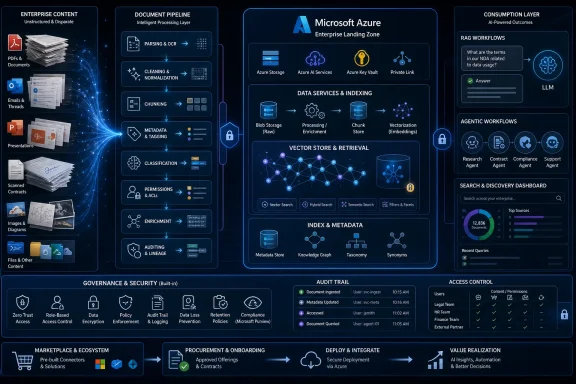
Unstructured’s Azure announcement lands squarely in that lower layer. The company’s platform is designed to take PDFs, Office documents, emails, images, presentations, and other messy enterprise files and convert them into structured output that can feed search indexes, RAG pipelines, copilots, and agentic systems. In the company’s telling, it supports more than 64 file types and more than 30 connectors, including Microsoft OneDrive, SharePoint, and Azure Blob Storage.
That matters because Microsoft’s enterprise AI pitch now depends on a chain of services working together. Microsoft Foundry is the application and agent-building environment. Azure AI Search is the retrieval and indexing substrate. Azure Blob Storage and related storage services hold much of the raw material. Microsoft Marketplace is the procurement channel that turns a vendor integration into something a cloud buyer can actually purchase without a six-month detour through sourcing.
The deal therefore reflects a broader shift in enterprise AI from Can we build a chatbot? to Can we operationalize a governed data supply chain for AI? The former is a prototype exercise. The latter is infrastructure.
That material is often where the most valuable institutional knowledge lives. It is also where AI projects go to get slow, expensive, and brittle. A model can generate fluent text from a prompt, but it cannot reliably answer questions about a company’s internal policies, claims history, technical manuals, or regulated procedures unless that content is extracted, segmented, enriched, indexed, and secured.
Unstructured’s framing is that data preparation has become one of the biggest barriers to moving generative AI from experimentation into production. That is not vendor hyperbole so much as the daily reality of enterprise AI teams. Retrieval-augmented generation is only as useful as the documents it retrieves, and document retrieval is only as useful as the chunks, metadata, permissions, and update schedules behind it.
This is where “AI-ready data” becomes more than marketing language. A 300-page PDF is not AI-ready simply because it sits in cloud storage. A SharePoint library is not AI-ready simply because a connector can see it. The value comes from transforming raw content into units that preserve meaning, map to business context, and remain auditable when a system produces an answer.
But the distance between “we have files in Microsoft systems” and “we have trustworthy AI workflows grounded in those files” is substantial. That is the space Unstructured is trying to occupy. Its value proposition is not that Azure lacks AI services; it is that the last mile of document transformation is too specialized, too variable, and too operationally important to be treated as a checkbox.
The announcement says Unstructured can ingest from Azure services such as Azure Blob Storage, prepare data for Azure AI Search, and support use with Microsoft Foundry. It also emphasizes Azure-native deployment, meaning customers can run the platform inside their Azure environments rather than shipping sensitive content into an uncontrolled black box. For regulated industries, that deployment model may be more important than any individual parser.
This is the pragmatic shape of enterprise AI adoption. Companies want model choice and flashy agents, but they also want data residency, private networking, access controls, logging, procurement alignment, and audit trails. The more AI becomes part of production business processes, the more boring requirements become decisive.
Unstructured says the collaboration supports Marketplace availability and private offers. That means the integration is not just a technical story; it is also a purchasing story. For Microsoft, this helps keep AI infrastructure spend inside the Azure commercial orbit. For Unstructured, it lowers friction with the exact buyers that tend to have the most painful unstructured-data estates: financial services, healthcare, insurance, pharmaceuticals, and government.
This is one of the quieter ways hyperscalers reinforce their AI ecosystems. They do not need to build every specialized tool themselves if the surrounding marketplace makes Azure the default place to buy, deploy, govern, and meter those tools. The platform wins when partners solve hard edge cases without pulling customers away from the cloud center of gravity.
For IT departments, the Marketplace path is useful but not magic. Procurement convenience does not answer questions about data lineage, transformation quality, permission inheritance, lifecycle management, or cost predictability. It merely makes the conversation easier to start.
Bad chunking can split meaning across boundaries. Weak metadata can bury the most relevant result. Stale indexes can surface obsolete policy. Poor permission handling can leak information across departments. Scanned documents can lose tables, signatures, or context during extraction. A system can appear to “know” an organization while quietly relying on an incomplete and distorted map of its records.
Unstructured’s platform is aimed at that map-making process. The announcement specifically calls out parsing, chunking, enriching, and preparing data for RAG pipelines, AI agents, copilots, and enterprise search. Those verbs are not glamorous, but they are where quality is won or lost.
This is also why the collaboration matters for WindowsForum’s more technical audience. The real enterprise AI job is not merely choosing a model or deploying a chatbot front end. It is designing the ingestion and retrieval system that determines what the model sees, what it ignores, and what evidence it can cite back to a user or workflow.
That distinction is why data preparation has become a security and operations issue, not just a data-engineering issue. If an AI agent is summarizing documents, drafting responses, routing tickets, initiating workflows, or supporting compliance decisions, the quality of the underlying content pipeline becomes part of the control plane. Garbage in, garbage out is no longer a joke; it is a risk register entry.
Microsoft’s Foundry strategy depends on organizations trusting agents with increasingly complex tasks. Unstructured’s pitch complements that by saying the agent layer needs a cleaner substrate. If enterprises are going to connect agents to internal knowledge, the knowledge has to be normalized, permission-aware, and maintained as source systems change.
That does not eliminate the need for human review, policy controls, or model evaluation. It simply moves the conversation closer to reality. The agent economy, if it exists at all, will be built as much on document hygiene as on model capability.
In a bank, an AI assistant may need to understand policy manuals, customer communications, risk documentation, loan files, and regulatory updates. In healthcare, the relevant corpus may include clinical documents, claims records, payer rules, and operational procedures. In pharmaceuticals, research and compliance documentation can span years of controlled processes and specialized terminology.
These sectors do not merely need AI systems that can read documents. They need systems that can read the right documents, preserve context, honor permissions, and support review. They also need deployment patterns that do not casually move sensitive data outside approved environments.
That is why Azure-native deployment is central to the announcement. Enterprises already invested in Microsoft’s cloud security, identity, and compliance architecture are more likely to consider AI data-preparation tooling that fits inside that operating model. The closer Unstructured can stay to Azure’s governance boundaries, the stronger its case becomes.
The “ugly” part is important. Real documents are not clean benchmark examples. They contain nested tables, footnotes, headers, watermarks, mixed languages, scanned pages, rotated images, embedded charts, corrupted formatting, and organizational shorthand. They live in systems with inconsistent permissions and unclear ownership. They change without telling the AI team.
A specialized vendor can build its reputation around solving those edge cases. Microsoft, meanwhile, can focus on making Azure the place where those specialized tools plug into model development, search, agents, identity, and procurement. That is a platform strategy rather than a single-product strategy.
There is a risk for Microsoft, too. The more the Azure AI story depends on partners to make enterprise data usable, the more customers may notice gaps in the native experience. But in the near term, an ecosystem that admits complexity is probably stronger than one that pretends a single wizard can solve every ingestion problem.
Open-source adoption often functions as an informal proving ground. Engineers can test concepts, inspect behavior, and understand the transformation steps before a procurement team standardizes on an enterprise edition. In the AI infrastructure market, that can be a meaningful advantage because trust is not only about vendor assurances; it is also about observability and operational familiarity.
Still, open-source familiarity does not automatically translate into enterprise readiness. Large organizations will care about support, scalability, security controls, deployment architecture, and integration with their existing platforms. The Azure collaboration is a way of answering those questions in the language enterprise buyers understand.
This is also part of the broader commercialization pattern around generative AI. Open-source projects establish developer credibility, then enterprise platforms package that capability with governance, connectors, support, and marketplace procurement. The winner is rarely the clever parser alone; it is the parser that fits into the buyer’s operating model.
The Unstructured-Microsoft collaboration is partly a market response to those failures. Enterprises are realizing that the most expensive AI mistakes often happen before the model is invoked. If source content is poorly parsed, badly segmented, or incorrectly enriched, no amount of prompt engineering will fully rescue the output.
This should temper some of the enthusiasm around “agentic AI” as a near-term business transformation. Agents are only as reliable as the tools and context they are given. If an organization cannot maintain a clean AI data pipeline, it should be cautious about handing automated workflows more responsibility.
That does not mean enterprises should wait for perfect data. Perfect data never arrives. It means the pipeline must be treated as a product with owners, metrics, release discipline, and monitoring, not as a one-time migration task.
SharePoint in particular can be both a gold mine and a swamp. It contains policies, project records, legal files, templates, reports, and institutional memory. It also contains duplicates, abandoned libraries, broken inheritance, conflicting document versions, and permissions that reflect organizational history more than current governance.
Unstructured’s support for Microsoft OneDrive, SharePoint, and Azure Blob Storage is therefore more than a connector checklist. It is a recognition that Microsoft estates are where much of the enterprise AI corpus already lives. The hard part is not finding the files; it is transforming them without flattening their meaning or ignoring their security context.
For WindowsForum readers, this is where the announcement connects to day-to-day operations. AI projects that begin in innovation teams eventually come knocking on identity, storage, compliance, endpoint, and collaboration administrators. The people who kept file shares and SharePoint farms alive may now find themselves central to whether AI systems can be trusted.
To be AI-ready, data must be more than machine-readable. It must be meaningful in context, available to the right systems, protected from the wrong users, fresh enough for the use case, and structured in ways that support retrieval and reasoning. It also must preserve enough source traceability that users can understand why a system produced a result.
Unstructured’s platform addresses a significant slice of that problem, especially around transformation and preparation. But AI readiness also depends on governance decisions outside any single product. Which repositories should be included? Who approves source hierarchy? How are obsolete documents retired? How are conflicting policies resolved? How are sensitive fields masked or excluded?
These are organizational questions as much as technical ones. Vendors can provide tooling, but enterprises still have to decide what their AI systems are allowed to know.
That crowded field benefits customers in one sense: more options, more connectors, more deployment models, and more pressure on pricing. It also creates confusion. Buyers must distinguish between vendors that move data, vendors that parse documents, vendors that govern knowledge, vendors that build search indexes, and vendors that orchestrate agents. Many will claim to do all of the above.
The Unstructured announcement is strongest where it stays specific: complex unstructured content, file-type support, connector breadth, Azure-native deployment, Azure AI Search preparation, Microsoft Foundry alignment, and Marketplace procurement. Those are tangible claims a technical team can evaluate. The weaker parts are the generic industry phrases that now appear in almost every AI press release.
That is not a criticism unique to Unstructured. It is the state of the market. Enterprise AI vendors are all trying to stand near the same budget line, and “RAG, copilots, and agents” has become the approved incantation.
Teams should look at how the system handles tables, scanned documents, mixed file types, nested sections, headers, footnotes, images, and domain-specific language. They should examine whether chunking strategies preserve meaning and whether metadata enrichment improves retrieval rather than merely adding decorative fields. They should also test update behavior when source documents change.
The security review is equally important. Azure-native deployment is promising, but customers still need to understand data flows, identity integration, logging, encryption, private networking options, and how permissions are represented downstream in Azure AI Search and agent workflows. A pipeline that ingests restricted content into a broadly accessible index can turn a productivity project into a compliance incident.
Cost deserves attention as well. AI data pipelines can create expenses across storage, compute, indexing, search, model calls, and vendor licensing. Marketplace procurement may simplify buying, but it does not guarantee predictable operating costs. Production AI systems tend to become more expensive as they become more useful.
Unstructured fits into that story as a specialist for the content layer. Its role is not to replace Microsoft Foundry or Azure AI Search, but to make the data feeding those services more usable. If the integration works as advertised, it gives Azure customers a more direct path from raw enterprise files to searchable, model-ready knowledge.
This also illustrates why the AI platform wars will not be decided only by model leaderboards. Enterprises will choose ecosystems that reduce integration friction, satisfy governance requirements, and make procurement defensible. The winning stack may be the one that makes hard infrastructure feel boring enough to trust.
For Microsoft, that means courting partners that solve the unglamorous problems. For Unstructured, it means proving that document transformation can become a durable layer in enterprise AI architecture rather than a replaceable preprocessing step.
 Microsoft’s AI Stack Has Reached the Plumbing Phase
For the past two years, enterprise AI has been sold largely through the language of interfaces: chat windows, copilots, agents, and dashboards that promise to make work feel conversational. That layer is still where executives see the demo and where vendors find the budget. But the harder engineering battle has moved downward, into ingestion, parsing, indexing, enrichment, permissioning, and retrieval.Unstructured’s Azure announcement lands squarely in that lower layer. The company’s platform is designed to take PDFs, Office documents, emails, images, presentations, and other messy enterprise files and convert them into structured output that can feed search indexes, RAG pipelines, copilots, and agentic systems. In the company’s telling, it supports more than 64 file types and more than 30 connectors, including Microsoft OneDrive, SharePoint, and Azure Blob Storage.
That matters because Microsoft’s enterprise AI pitch now depends on a chain of services working together. Microsoft Foundry is the application and agent-building environment. Azure AI Search is the retrieval and indexing substrate. Azure Blob Storage and related storage services hold much of the raw material. Microsoft Marketplace is the procurement channel that turns a vendor integration into something a cloud buyer can actually purchase without a six-month detour through sourcing.
The deal therefore reflects a broader shift in enterprise AI from Can we build a chatbot? to Can we operationalize a governed data supply chain for AI? The former is a prototype exercise. The latter is infrastructure.
The Unstructured Data Problem Was Never a Side Quest
The phrase “unstructured data” has always had a slightly misleading neatness to it. In practice, it means everything that does not fit comfortably into rows and columns: scanned contracts, policy manuals, support tickets, clinical PDFs, slide decks, invoices, compliance memos, research notes, emails, handwritten forms, and old documents with formatting choices nobody wants to defend.That material is often where the most valuable institutional knowledge lives. It is also where AI projects go to get slow, expensive, and brittle. A model can generate fluent text from a prompt, but it cannot reliably answer questions about a company’s internal policies, claims history, technical manuals, or regulated procedures unless that content is extracted, segmented, enriched, indexed, and secured.
Unstructured’s framing is that data preparation has become one of the biggest barriers to moving generative AI from experimentation into production. That is not vendor hyperbole so much as the daily reality of enterprise AI teams. Retrieval-augmented generation is only as useful as the documents it retrieves, and document retrieval is only as useful as the chunks, metadata, permissions, and update schedules behind it.
This is where “AI-ready data” becomes more than marketing language. A 300-page PDF is not AI-ready simply because it sits in cloud storage. A SharePoint library is not AI-ready simply because a connector can see it. The value comes from transforming raw content into units that preserve meaning, map to business context, and remain auditable when a system produces an answer.
Azure Gets a Specialist for the Messiest Mile
Microsoft already has pieces of this puzzle. Azure AI Search can index content and power retrieval. Microsoft Foundry can connect agents to knowledge sources. Azure storage services can host enterprise data at scale. Microsoft 365 contains the daily working corpus of millions of organizations.But the distance between “we have files in Microsoft systems” and “we have trustworthy AI workflows grounded in those files” is substantial. That is the space Unstructured is trying to occupy. Its value proposition is not that Azure lacks AI services; it is that the last mile of document transformation is too specialized, too variable, and too operationally important to be treated as a checkbox.
The announcement says Unstructured can ingest from Azure services such as Azure Blob Storage, prepare data for Azure AI Search, and support use with Microsoft Foundry. It also emphasizes Azure-native deployment, meaning customers can run the platform inside their Azure environments rather than shipping sensitive content into an uncontrolled black box. For regulated industries, that deployment model may be more important than any individual parser.
This is the pragmatic shape of enterprise AI adoption. Companies want model choice and flashy agents, but they also want data residency, private networking, access controls, logging, procurement alignment, and audit trails. The more AI becomes part of production business processes, the more boring requirements become decisive.
Marketplace Availability Turns Integration Into Procurement
The Microsoft Marketplace angle should not be dismissed as administrative filler. In enterprise software, a product that can be bought through an existing cloud marketplace often has a shorter path to deployment than one that requires a fresh vendor relationship. That is especially true when organizations are trying to draw down Azure commitments or consolidate AI spending under established cloud governance.Unstructured says the collaboration supports Marketplace availability and private offers. That means the integration is not just a technical story; it is also a purchasing story. For Microsoft, this helps keep AI infrastructure spend inside the Azure commercial orbit. For Unstructured, it lowers friction with the exact buyers that tend to have the most painful unstructured-data estates: financial services, healthcare, insurance, pharmaceuticals, and government.
This is one of the quieter ways hyperscalers reinforce their AI ecosystems. They do not need to build every specialized tool themselves if the surrounding marketplace makes Azure the default place to buy, deploy, govern, and meter those tools. The platform wins when partners solve hard edge cases without pulling customers away from the cloud center of gravity.
For IT departments, the Marketplace path is useful but not magic. Procurement convenience does not answer questions about data lineage, transformation quality, permission inheritance, lifecycle management, or cost predictability. It merely makes the conversation easier to start.
RAG’s Reputation Now Depends on Better Data Pipelines
Retrieval-augmented generation was supposed to be the enterprise-safe answer to hallucination. Instead of asking a model to rely on its training data, organizations could ground responses in current internal sources. The basic idea remains sound, but many early RAG implementations have revealed how much can go wrong between document upload and answer generation.Bad chunking can split meaning across boundaries. Weak metadata can bury the most relevant result. Stale indexes can surface obsolete policy. Poor permission handling can leak information across departments. Scanned documents can lose tables, signatures, or context during extraction. A system can appear to “know” an organization while quietly relying on an incomplete and distorted map of its records.
Unstructured’s platform is aimed at that map-making process. The announcement specifically calls out parsing, chunking, enriching, and preparing data for RAG pipelines, AI agents, copilots, and enterprise search. Those verbs are not glamorous, but they are where quality is won or lost.
This is also why the collaboration matters for WindowsForum’s more technical audience. The real enterprise AI job is not merely choosing a model or deploying a chatbot front end. It is designing the ingestion and retrieval system that determines what the model sees, what it ignores, and what evidence it can cite back to a user or workflow.
Agents Raise the Cost of Bad Context
The announcement repeatedly uses the language of “agentic workflows,” which is now unavoidable in enterprise AI marketing. But agents change the stakes in a meaningful way. A chatbot with bad context may give a wrong answer. An agent with bad context may take a wrong action.That distinction is why data preparation has become a security and operations issue, not just a data-engineering issue. If an AI agent is summarizing documents, drafting responses, routing tickets, initiating workflows, or supporting compliance decisions, the quality of the underlying content pipeline becomes part of the control plane. Garbage in, garbage out is no longer a joke; it is a risk register entry.
Microsoft’s Foundry strategy depends on organizations trusting agents with increasingly complex tasks. Unstructured’s pitch complements that by saying the agent layer needs a cleaner substrate. If enterprises are going to connect agents to internal knowledge, the knowledge has to be normalized, permission-aware, and maintained as source systems change.
That does not eliminate the need for human review, policy controls, or model evaluation. It simply moves the conversation closer to reality. The agent economy, if it exists at all, will be built as much on document hygiene as on model capability.
Regulated Industries Are the Real Test Case
The press release names financial services, healthcare, insurance, pharmaceuticals, and government as target sectors. That is unsurprising, but it is also revealing. These are industries with mountains of valuable documents, strict retention requirements, complex access controls, and real penalties for mishandling information.In a bank, an AI assistant may need to understand policy manuals, customer communications, risk documentation, loan files, and regulatory updates. In healthcare, the relevant corpus may include clinical documents, claims records, payer rules, and operational procedures. In pharmaceuticals, research and compliance documentation can span years of controlled processes and specialized terminology.
These sectors do not merely need AI systems that can read documents. They need systems that can read the right documents, preserve context, honor permissions, and support review. They also need deployment patterns that do not casually move sensitive data outside approved environments.
That is why Azure-native deployment is central to the announcement. Enterprises already invested in Microsoft’s cloud security, identity, and compliance architecture are more likely to consider AI data-preparation tooling that fits inside that operating model. The closer Unstructured can stay to Azure’s governance boundaries, the stronger its case becomes.
Microsoft Benefits When Partners Handle the Ugly Edges
Microsoft’s AI portfolio is broad enough that almost any partner announcement can sound redundant at first glance. Azure already has storage, search, AI services, document intelligence, security tooling, and development environments. But breadth is not the same as completeness, and enterprise data preparation is a field of ugly edge cases.The “ugly” part is important. Real documents are not clean benchmark examples. They contain nested tables, footnotes, headers, watermarks, mixed languages, scanned pages, rotated images, embedded charts, corrupted formatting, and organizational shorthand. They live in systems with inconsistent permissions and unclear ownership. They change without telling the AI team.
A specialized vendor can build its reputation around solving those edge cases. Microsoft, meanwhile, can focus on making Azure the place where those specialized tools plug into model development, search, agents, identity, and procurement. That is a platform strategy rather than a single-product strategy.
There is a risk for Microsoft, too. The more the Azure AI story depends on partners to make enterprise data usable, the more customers may notice gaps in the native experience. But in the near term, an ecosystem that admits complexity is probably stronger than one that pretends a single wizard can solve every ingestion problem.
The Open-Source Halo Still Matters
Unstructured is not arriving as an unknown name in AI data preparation. The company has built visibility through its platform and open-source community, and the announcement positions it as foundational infrastructure for organizations building AI systems dependent on high-quality enterprise data pipelines. That open-source halo can matter when developers and data teams are skeptical of closed AI tooling.Open-source adoption often functions as an informal proving ground. Engineers can test concepts, inspect behavior, and understand the transformation steps before a procurement team standardizes on an enterprise edition. In the AI infrastructure market, that can be a meaningful advantage because trust is not only about vendor assurances; it is also about observability and operational familiarity.
Still, open-source familiarity does not automatically translate into enterprise readiness. Large organizations will care about support, scalability, security controls, deployment architecture, and integration with their existing platforms. The Azure collaboration is a way of answering those questions in the language enterprise buyers understand.
This is also part of the broader commercialization pattern around generative AI. Open-source projects establish developer credibility, then enterprise platforms package that capability with governance, connectors, support, and marketplace procurement. The winner is rarely the clever parser alone; it is the parser that fits into the buyer’s operating model.
The Announcement Is Also a Warning About AI Shortcuts
There is a seductive shortcut in enterprise AI: point a model at a document repository, add a search index, and call the result a knowledge assistant. That may work for demos, but it tends to break under production expectations. Users ask ambiguous questions. Documents contradict one another. Permissions are messy. Tables matter. Dates matter. Version history matters.The Unstructured-Microsoft collaboration is partly a market response to those failures. Enterprises are realizing that the most expensive AI mistakes often happen before the model is invoked. If source content is poorly parsed, badly segmented, or incorrectly enriched, no amount of prompt engineering will fully rescue the output.
This should temper some of the enthusiasm around “agentic AI” as a near-term business transformation. Agents are only as reliable as the tools and context they are given. If an organization cannot maintain a clean AI data pipeline, it should be cautious about handing automated workflows more responsibility.
That does not mean enterprises should wait for perfect data. Perfect data never arrives. It means the pipeline must be treated as a product with owners, metrics, release discipline, and monitoring, not as a one-time migration task.
Windows Shops Will Recognize the SharePoint Problem
For many Microsoft-heavy organizations, the phrase “enterprise content” really means SharePoint, OneDrive, Teams-adjacent files, Exchange archives, and years of Office documents scattered across departmental boundaries. This is the everyday terrain of Windows administrators and Microsoft 365 teams, and it is rarely as orderly as AI vendors imply.SharePoint in particular can be both a gold mine and a swamp. It contains policies, project records, legal files, templates, reports, and institutional memory. It also contains duplicates, abandoned libraries, broken inheritance, conflicting document versions, and permissions that reflect organizational history more than current governance.
Unstructured’s support for Microsoft OneDrive, SharePoint, and Azure Blob Storage is therefore more than a connector checklist. It is a recognition that Microsoft estates are where much of the enterprise AI corpus already lives. The hard part is not finding the files; it is transforming them without flattening their meaning or ignoring their security context.
For WindowsForum readers, this is where the announcement connects to day-to-day operations. AI projects that begin in innovation teams eventually come knocking on identity, storage, compliance, endpoint, and collaboration administrators. The people who kept file shares and SharePoint farms alive may now find themselves central to whether AI systems can be trusted.
The “AI-Ready” Label Needs Scrutiny
Every infrastructure market develops its own comforting adjective. In cloud, it was “cloud-native.” In analytics, it was “real-time.” In security, it was “zero trust.” In enterprise AI, the adjective is now “AI-ready,” and it deserves careful handling.To be AI-ready, data must be more than machine-readable. It must be meaningful in context, available to the right systems, protected from the wrong users, fresh enough for the use case, and structured in ways that support retrieval and reasoning. It also must preserve enough source traceability that users can understand why a system produced a result.
Unstructured’s platform addresses a significant slice of that problem, especially around transformation and preparation. But AI readiness also depends on governance decisions outside any single product. Which repositories should be included? Who approves source hierarchy? How are obsolete documents retired? How are conflicting policies resolved? How are sensitive fields masked or excluded?
These are organizational questions as much as technical ones. Vendors can provide tooling, but enterprises still have to decide what their AI systems are allowed to know.
The Competitive Field Is Getting Crowded Fast
Unstructured is not alone in seeing the opportunity. The broader enterprise AI market is filling with data integration companies, content management vendors, search providers, observability platforms, and cloud-native tooling vendors all claiming a role in AI data preparation. Recent integrations across Microsoft’s ecosystem show how quickly “AI-ready data” has become a category.That crowded field benefits customers in one sense: more options, more connectors, more deployment models, and more pressure on pricing. It also creates confusion. Buyers must distinguish between vendors that move data, vendors that parse documents, vendors that govern knowledge, vendors that build search indexes, and vendors that orchestrate agents. Many will claim to do all of the above.
The Unstructured announcement is strongest where it stays specific: complex unstructured content, file-type support, connector breadth, Azure-native deployment, Azure AI Search preparation, Microsoft Foundry alignment, and Marketplace procurement. Those are tangible claims a technical team can evaluate. The weaker parts are the generic industry phrases that now appear in almost every AI press release.
That is not a criticism unique to Unstructured. It is the state of the market. Enterprise AI vendors are all trying to stand near the same budget line, and “RAG, copilots, and agents” has become the approved incantation.
The Real Evaluation Starts After the Demo
For enterprises considering Unstructured on Azure, the first evaluation should not be whether a canned demo can answer a question from a PDF. It should be whether the platform improves retrieval quality, governance, and operational maintainability across the organization’s actual content mess. That means testing against difficult documents, not sanitized samples.Teams should look at how the system handles tables, scanned documents, mixed file types, nested sections, headers, footnotes, images, and domain-specific language. They should examine whether chunking strategies preserve meaning and whether metadata enrichment improves retrieval rather than merely adding decorative fields. They should also test update behavior when source documents change.
The security review is equally important. Azure-native deployment is promising, but customers still need to understand data flows, identity integration, logging, encryption, private networking options, and how permissions are represented downstream in Azure AI Search and agent workflows. A pipeline that ingests restricted content into a broadly accessible index can turn a productivity project into a compliance incident.
Cost deserves attention as well. AI data pipelines can create expenses across storage, compute, indexing, search, model calls, and vendor licensing. Marketplace procurement may simplify buying, but it does not guarantee predictable operating costs. Production AI systems tend to become more expensive as they become more useful.
The Azure AI Story Is Becoming an Ecosystem Story
Microsoft’s enterprise AI narrative once revolved heavily around access to powerful models and the rapid rollout of Copilot-branded experiences. That phase is not over, but it is no longer sufficient. The next phase is about whether Azure can serve as the governed platform where companies build, ground, deploy, monitor, and buy the components of AI workflows.Unstructured fits into that story as a specialist for the content layer. Its role is not to replace Microsoft Foundry or Azure AI Search, but to make the data feeding those services more usable. If the integration works as advertised, it gives Azure customers a more direct path from raw enterprise files to searchable, model-ready knowledge.
This also illustrates why the AI platform wars will not be decided only by model leaderboards. Enterprises will choose ecosystems that reduce integration friction, satisfy governance requirements, and make procurement defensible. The winning stack may be the one that makes hard infrastructure feel boring enough to trust.
For Microsoft, that means courting partners that solve the unglamorous problems. For Unstructured, it means proving that document transformation can become a durable layer in enterprise AI architecture rather than a replaceable preprocessing step.
The Azure Announcement Leaves Five Practical Signals
The useful way to read this announcement is not as proof that enterprise AI is solved, but as evidence that the market is converging on the data pipeline as the real bottleneck. The companies that move fastest will not be the ones with the flashiest chatbot demo. They will be the ones that can repeatedly turn governed enterprise content into reliable context.- Enterprises should treat unstructured data preparation as production infrastructure, not as a preliminary cleanup task before the “real” AI work begins.
- Azure customers now have another marketplace-backed option for turning Blob Storage, SharePoint, OneDrive, and other content sources into AI-ready inputs for search and agents.
- RAG quality depends heavily on parsing, chunking, metadata, freshness, and permissions, not merely on the choice of language model.
- Regulated industries will evaluate this kind of integration primarily through security, compliance, auditability, and deployment control.
- Microsoft’s AI platform strategy is increasingly dependent on a partner ecosystem that fills specialized gaps around data, content, and workflow integration.
References
- Primary source: The National Law Review
Published: Wed, 03 Jun 2026 15:23:23 GMT
Unstructured Expands Integration with Microsoft Azure to Power Enterprise AI Workflows
Enterprise organizations can transform unstructured data into AI-ready intelligence using Unstructured’s platform integrated with Microsoft Azure services and Microsnatlawreview.com
- Official source: learn.microsoft.com
Connect an Azure AI Search index to Foundry agents - Microsoft Foundry | Microsoft Learn
Connect Azure AI Search indexes to Foundry agents for grounding responses with citations. Includes Python, C#, TypeScript, and REST samples.learn.microsoft.com - Related coverage: ai.azure.us
- Related coverage: prnewswire.com
Hyland Collaborates with Microsoft to Power the Agentic Enterprise with the Content Innovation Cloud on Microsoft Azure
/PRNewswire/ -- Hyland, a global leader in enterprise content management (ECM) and the pioneer of the content-powered agentic enterprise, today announced a... www.prnewswire.com
- Official source: devblogs.microsoft.com
Ground Your Agents Faster with Native Azure AI Search Indexing in Foundry | Microsoft Foundry Blog
Instantly ground your Azure AI Foundry agents with enterprise data using native Azure AI Search indexing. Ingest content from Azure Blob Storage, ADLS Gen2 or Microsoft OneLake and create a vector search index in one click—no manual setup required. Discover how to accelerate agent deployment...devblogs.microsoft.com - Official source: marketplace.microsoft.com
Microsoft Marketplace | cloud solutions, AI apps, and agents
marketplace.microsoft.com
- Official source: techcommunity.microsoft.com
Azure AI Search integration with Microsoft OneLake, now generally available | Microsoft Community Hub
Discover Azure AI Search's newest connector, the OneLake files indexer. techcommunity.microsoft.com
- Related coverage: businesswire.com
- Related coverage: salesforce.com
Informatica Expands Microsoft Fabric & Azure POD Integration - Salesforce
New innovations strengthen a trusted data foundation for Informatica customers using analytics and AI across Microsoft Fabric and Azure REDWOOD CITY,www.salesforce.com - Official source: appsource.microsoft.com
- Official source: azuremarketplace.microsoft.com
Microsoft Marketplace | cloud solutions, AI apps, and agents
azuremarketplace.microsoft.com
- Official source: cdn-dynmedia-1.microsoft.com
- Related coverage: issuewire.com
- Official source: adoption.microsoft.com