

Unstructured announced on June 3, 2026, that it is expanding its Microsoft Azure integration so enterprises can use its cloud-native ETL platform to prepare documents, emails, images, presentations, and other unstructured content for AI workloads on Azure. The announcement is not simply another marketplace listing or partner badge. It is a useful signpost for where enterprise AI is moving: away from model spectacle and toward the plumbing required to make models useful inside real organizations. For WindowsForum readers, the story is less about one vendor and more about the emerging Microsoft-centered stack for retrieval, agents, copilots, and governed enterprise data.
The first wave of generative AI in the enterprise was obsessed with models. Which model was fastest, cheapest, most capable, safest, most multimodal, or most likely to pass a bar exam became the shorthand for AI strategy. That made sense for the demo era, but it was always an incomplete way to think about production systems.
The harder enterprise problem is not whether a model can summarize a clean block of text. It is whether the model can find the right policy document in SharePoint, parse a half-scanned PDF, extract structure from a slide deck, ignore duplicated boilerplate, preserve permissions, and retrieve the relevant clause when a user or agent needs it. That is not glamorous work. It is, however, the difference between a chatbot that impresses executives in a conference room and an AI workflow that survives contact with compliance, security, and angry users.
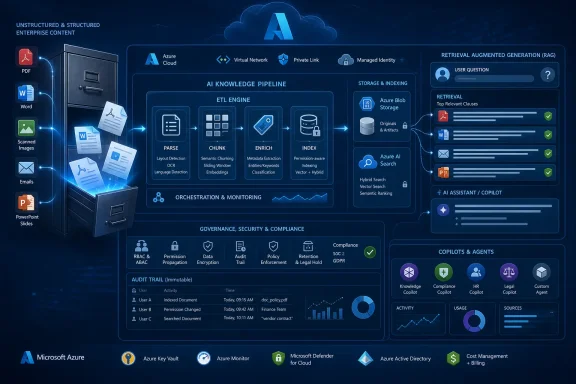
Unstructured’s Azure expansion lands precisely in that gap. The company says its platform can process more than 64 file types, connect to more than 30 enterprise sources, and prepare content for retrieval-augmented generation, copilots, enterprise search, and agentic workflows. The vocabulary is fashionable, but the underlying problem is old: businesses have been drowning in documents for decades, and most of those documents were never designed to be consumed by machines.
This is why the phrase AI-ready data has become more than vendor decoration. It means the messy parts of enterprise knowledge have to be cleaned, chunked, enriched, indexed, and governed before they can become useful context for a large language model. The model may be the visible interface. The data pipeline is the thing that determines whether the interface knows anything worth saying.
That platform story is coherent, but it is not complete by itself. Azure can host models, store data, run search, orchestrate agents, and provide security controls. What it cannot magically do is make every PowerPoint, PDF, Word document, email export, scanned image, and enterprise repository behave like a neatly normalized database.
This is where Unstructured is positioning itself. Its pitch is that enterprises can ingest data from Azure services such as Blob Storage, parse and transform the material, and prepare it for indexing in Azure AI Search and use in Microsoft Foundry workflows. The company also highlights Microsoft 365-adjacent sources such as OneDrive and SharePoint, which matters because those systems are often where the real institutional knowledge lives.
There is a practical symmetry here. Microsoft wants Azure to be the control plane for enterprise AI. Unstructured wants to be the preparation layer that turns enterprise content into something the Azure AI stack can consume. The collaboration gives both companies a cleaner story: Microsoft can point to a partner that handles messy content transformation, while Unstructured can ride the procurement, deployment, and trust machinery of Azure.
The announcement also reflects a broader correction in enterprise AI. The industry is learning that bring your own data is not a single step. It is a pipeline, a governance problem, a retrieval problem, and an operations problem disguised as a demo checkbox.
In 2026, RAG is no longer a clever pattern tacked onto chatbots. It is becoming one of the core architectural assumptions behind enterprise AI systems. Microsoft’s Foundry and Azure AI Search strategy makes that clear, as do the waves of agent frameworks that assume access to tools, memory, knowledge sources, and indexed enterprise content.
But RAG is only as good as the retrieval substrate beneath it. If the source documents are badly parsed, chunked at arbitrary boundaries, stripped of tables, missing metadata, or indexed without permission context, the model receives bad evidence. A confident answer based on malformed retrieval is still a bad answer; it is just a bad answer with better branding.
This is why document transformation has suddenly become strategic. Chunk size, layout preservation, metadata enrichment, image extraction, table handling, and source attribution are not clerical details. They shape what the AI system can know, what it can cite, and how reliably it can answer when the question is specific, regulated, or legally sensitive.
Unstructured’s value proposition sits squarely in that layer. The company is not claiming to replace Azure AI Search or Microsoft Foundry. It is claiming to prepare the material those systems need to work well. In the enterprise, that may be the more defensible part of the stack than yet another chatbot front end.
Microsoft Marketplace helps with that alignment. It allows customers to buy partner software through existing Microsoft commercial channels and, in some cases, apply spending toward broader Azure commitments. For a startup or specialist vendor like Unstructured, that can shorten a sales cycle that might otherwise stall inside legal, procurement, or finance.
The private offer angle is also significant. Regulated enterprises rarely buy production AI infrastructure off the shelf in a one-size-fits-all fashion. They negotiate terms, deployment models, security requirements, and support obligations. Marketplace procurement does not eliminate that complexity, but it can move it into a familiar channel.
This is one reason Microsoft’s cloud ecosystem is so powerful. Azure is not just compute and storage; it is a procurement surface, identity layer, compliance story, and partner distribution network. When an AI data platform becomes purchasable through that ecosystem, it becomes easier for conservative organizations to treat it as part of their approved stack rather than a science project.
There is a downside to this gravitational pull. As more pieces of the AI pipeline become Azure-native or Azure-procured, customers may find themselves increasingly bound to Microsoft’s architecture choices. That may be acceptable for organizations already committed to Azure. It is less comfortable for shops trying to preserve multi-cloud flexibility or avoid building an AI estate around one vendor’s control plane.
They are also industries where AI has obvious appeal. A bank wants faster policy search and compliance review. A hospital system wants to summarize clinical and administrative documents without leaking protected health information. An insurer wants to automate claims review. A pharmaceutical company wants to search research, regulatory, and manufacturing records. A government agency wants to make enormous archives usable without surrendering control.
The common thread is that the content is valuable precisely because it is messy, old, specialized, and difficult to move. Enterprise AI vendors often talk as if every organization has a clean lakehouse waiting to be connected to a model. In reality, much of the knowledge is trapped in semi-structured or unstructured systems, wrapped in permissions, version histories, document formats, and human workflows.
Running Unstructured within customer Azure environments is therefore a meaningful part of the pitch. The company says this deployment model can help organizations maintain security, compliance, and data governance controls. For regulated customers, locality and control are not cosmetic requirements. They determine whether a project can move beyond a pilot.
That does not make the risk disappear. Processing sensitive documents for AI use creates new data movement, new derived artifacts, and new indexes that must be governed. An extracted table, embedding, chunk, or enriched metadata field can become sensitive even if the original document never leaves the tenant. Enterprise IT will need to treat the AI preparation layer as part of the security boundary, not as neutral middleware.
Either way, agents make the data problem more urgent. A chatbot that gives a weak answer is annoying. An agent that takes an action based on a weak answer can create operational damage. If the agent is drafting a customer response, routing a support case, triggering a compliance workflow, or preparing a financial review, retrieval quality and source integrity matter enormously.
This is where Microsoft’s platform ambitions and Unstructured’s pipeline pitch intersect. Foundry gives Microsoft a place to build and manage AI applications and agents. Azure AI Search and Foundry IQ provide grounding and retrieval. Unstructured proposes to make the enterprise content usable before those layers begin reasoning over it.
That division of labor is sensible, but it should not lull buyers into thinking agentic workflows are solved by assembling branded components. The hard parts remain: permissions, evaluation, auditability, fallback behavior, human approval, and error recovery. A prepared document corpus is necessary. It is not sufficient.
Still, the data-preparation layer is where many agent projects will either mature or fail. Agents need reliable context, not just access to a pile of files. If the content pipeline cannot distinguish a superseded policy from the current one, preserve document hierarchy, or attach enough metadata to support traceability, the agent will inherit ambiguity and amplify it.
The enterprise platform is a different motion. Large customers want support, security commitments, managed deployment options, integrations, and contractual accountability. A collaboration with Microsoft and availability through Microsoft Marketplace is designed to bridge the gap between developer familiarity and enterprise procurement.
This is a familiar lifecycle in infrastructure software. The open-source project proves utility, the commercial platform packages it for operations, and the cloud marketplace turns it into an approved line item. The risk is that customers sometimes conflate open-source accessibility with enterprise readiness. The two can reinforce each other, but they are not the same thing.
For Microsoft, the open-source connection also fits a broader pattern. The company has spent years courting developer communities while steering production workloads toward Azure. Partnering with firms that already have developer traction helps Microsoft make Azure feel less like a closed enterprise suite and more like a place where modern AI builders can assemble best-of-breed systems.
That said, the most interesting competitive question is not whether Unstructured can parse documents. It is whether document intelligence becomes a differentiated third-party layer or a feature absorbed into hyperscaler platforms. Microsoft has its own content understanding, document intelligence, search, and AI orchestration services. The partner ecosystem thrives when Microsoft leaves room around the edges. It becomes more complicated when those edges move.
In that environment, an Azure-integrated unstructured-data pipeline is not just technically convenient. It is politically convenient. It lets an AI initiative align with existing identity, storage, procurement, and governance decisions. That kind of alignment can matter as much as benchmark performance.
The potential drawback is architectural narrowing. Once documents flow from Microsoft 365 or Azure Blob Storage into an Azure-centered indexing and agent framework, switching costs accumulate. Index schemas, enrichment logic, workflow definitions, permissions models, and evaluation harnesses can all become sticky. Even if the data nominally belongs to the customer, the operating model may become increasingly Microsoft-shaped.
This does not make the strategy wrong. Standardizing on a coherent stack can reduce friction and improve security. The alternative, a patchwork of disconnected AI tools moving sensitive data between clouds and SaaS platforms, can be worse. But enterprises should be honest about the trade: the more Azure-native the AI pipeline becomes, the more Azure becomes the center of gravity for knowledge work automation.
For sysadmins and architects, the practical question is not whether Microsoft’s stack is good or bad. It is whether the organization understands where the boundaries are. Who owns the transformed data? Where are embeddings stored? How are deleted documents removed from indexes? How do permission changes propagate? What happens when a model cites a stale chunk? Those are the questions that turn an AI platform from a demo into infrastructure.
This matters because traditional access controls were often built around documents and repositories. AI systems work through derived representations. An embedding may not be human-readable in the usual sense, but it can still encode sensitive information. A chunk may contain enough context to expose a confidential matter even if it is detached from the original document. A search index may make discoverable what was previously obscure.
Enterprise customers will need governance practices that follow the data through transformation. It is not enough to say the source documents remain in Azure or that the pipeline runs in the customer environment. The derived objects must be inventoried, protected, expired, and audited. Otherwise, AI readiness becomes a new form of data sprawl.
Microsoft’s advantage is that it can tie many of these concerns into existing cloud governance patterns. Azure policy, identity, logging, network controls, private endpoints, and compliance tooling give customers familiar levers. But partner platforms must fit cleanly into that model, and customers should verify that fit rather than assume it from the presence of a Microsoft logo.
This is especially important for agentic workflows. If an agent can retrieve, reason, and act, then data governance is no longer just about confidentiality. It is about operational authority. The wrong chunk in the wrong context can lead to the wrong action, and the audit trail must explain how the system got there.
Enterprise AI projects often begin with a clean ambition: make our knowledge usable. Then they encounter duplicate repositories, inconsistent naming conventions, poor retention hygiene, scanned documents, old file formats, undocumented permissions, and business owners who cannot agree which source is authoritative. The model is rarely the bottleneck at that point.
This is why the collaboration’s promise should be understood as acceleration, not magic. A platform can parse, chunk, enrich, and prepare content. It cannot decide which policy is current if the organization has no policy lifecycle. It cannot fix a permissions model that was already wrong. It cannot make a regulator comfortable with automation unless the surrounding controls are credible.
The better interpretation is that tools like Unstructured lower the cost of doing the necessary work. They make it more feasible to transform messy content at scale, plug that content into Azure AI services, and iterate toward production. That is valuable, but it still requires information architecture, security design, and operational discipline.
This is also where IT pros regain relevance in a conversation that has too often been dominated by AI evangelists. The future of enterprise AI will be shaped by people who understand storage, identity, permissions, compliance, logging, backup, retention, and change management. In other words, the same unglamorous disciplines that have always determined whether enterprise technology works.
 The AI Gold Rush Has Reached the Filing Cabinet
The first wave of generative AI in the enterprise was obsessed with models. Which model was fastest, cheapest, most capable, safest, most multimodal, or most likely to pass a bar exam became the shorthand for AI strategy. That made sense for the demo era, but it was always an incomplete way to think about production systems.The harder enterprise problem is not whether a model can summarize a clean block of text. It is whether the model can find the right policy document in SharePoint, parse a half-scanned PDF, extract structure from a slide deck, ignore duplicated boilerplate, preserve permissions, and retrieve the relevant clause when a user or agent needs it. That is not glamorous work. It is, however, the difference between a chatbot that impresses executives in a conference room and an AI workflow that survives contact with compliance, security, and angry users.
Unstructured’s Azure expansion lands precisely in that gap. The company says its platform can process more than 64 file types, connect to more than 30 enterprise sources, and prepare content for retrieval-augmented generation, copilots, enterprise search, and agentic workflows. The vocabulary is fashionable, but the underlying problem is old: businesses have been drowning in documents for decades, and most of those documents were never designed to be consumed by machines.
This is why the phrase AI-ready data has become more than vendor decoration. It means the messy parts of enterprise knowledge have to be cleaned, chunked, enriched, indexed, and governed before they can become useful context for a large language model. The model may be the visible interface. The data pipeline is the thing that determines whether the interface knows anything worth saying.
Microsoft’s AI Platform Needs More Than Models
Microsoft has spent the last several years turning Azure into the default corporate landing zone for generative AI. Azure AI Foundry, now increasingly presented simply as Microsoft Foundry, gives developers a place to build, evaluate, monitor, and operate AI applications and agents. Azure AI Search, now tied into the Foundry IQ story, supplies retrieval over textual and vector indexes. Azure Blob Storage remains one of the most common holding pens for raw enterprise data.That platform story is coherent, but it is not complete by itself. Azure can host models, store data, run search, orchestrate agents, and provide security controls. What it cannot magically do is make every PowerPoint, PDF, Word document, email export, scanned image, and enterprise repository behave like a neatly normalized database.
This is where Unstructured is positioning itself. Its pitch is that enterprises can ingest data from Azure services such as Blob Storage, parse and transform the material, and prepare it for indexing in Azure AI Search and use in Microsoft Foundry workflows. The company also highlights Microsoft 365-adjacent sources such as OneDrive and SharePoint, which matters because those systems are often where the real institutional knowledge lives.
There is a practical symmetry here. Microsoft wants Azure to be the control plane for enterprise AI. Unstructured wants to be the preparation layer that turns enterprise content into something the Azure AI stack can consume. The collaboration gives both companies a cleaner story: Microsoft can point to a partner that handles messy content transformation, while Unstructured can ride the procurement, deployment, and trust machinery of Azure.
The announcement also reflects a broader correction in enterprise AI. The industry is learning that bring your own data is not a single step. It is a pipeline, a governance problem, a retrieval problem, and an operations problem disguised as a demo checkbox.
RAG Has Become an Enterprise Architecture Pattern, Not a Hack
Retrieval-augmented generation started as a practical workaround. Instead of asking a model to remember everything, developers could retrieve relevant documents at query time and feed that context into the model. It reduced hallucination risk, made outputs more current, and allowed organizations to use private information without retraining a foundation model.In 2026, RAG is no longer a clever pattern tacked onto chatbots. It is becoming one of the core architectural assumptions behind enterprise AI systems. Microsoft’s Foundry and Azure AI Search strategy makes that clear, as do the waves of agent frameworks that assume access to tools, memory, knowledge sources, and indexed enterprise content.
But RAG is only as good as the retrieval substrate beneath it. If the source documents are badly parsed, chunked at arbitrary boundaries, stripped of tables, missing metadata, or indexed without permission context, the model receives bad evidence. A confident answer based on malformed retrieval is still a bad answer; it is just a bad answer with better branding.
This is why document transformation has suddenly become strategic. Chunk size, layout preservation, metadata enrichment, image extraction, table handling, and source attribution are not clerical details. They shape what the AI system can know, what it can cite, and how reliably it can answer when the question is specific, regulated, or legally sensitive.
Unstructured’s value proposition sits squarely in that layer. The company is not claiming to replace Azure AI Search or Microsoft Foundry. It is claiming to prepare the material those systems need to work well. In the enterprise, that may be the more defensible part of the stack than yet another chatbot front end.
The Marketplace Angle Is Not Administrative Trivia
The Azure Marketplace availability may sound like procurement boilerplate, but it matters. Large organizations often do not adopt AI infrastructure because a developer found a useful tool. They adopt it when security review, budget approval, vendor risk, contract terms, billing alignment, and cloud commitments all line up.Microsoft Marketplace helps with that alignment. It allows customers to buy partner software through existing Microsoft commercial channels and, in some cases, apply spending toward broader Azure commitments. For a startup or specialist vendor like Unstructured, that can shorten a sales cycle that might otherwise stall inside legal, procurement, or finance.
The private offer angle is also significant. Regulated enterprises rarely buy production AI infrastructure off the shelf in a one-size-fits-all fashion. They negotiate terms, deployment models, security requirements, and support obligations. Marketplace procurement does not eliminate that complexity, but it can move it into a familiar channel.
This is one reason Microsoft’s cloud ecosystem is so powerful. Azure is not just compute and storage; it is a procurement surface, identity layer, compliance story, and partner distribution network. When an AI data platform becomes purchasable through that ecosystem, it becomes easier for conservative organizations to treat it as part of their approved stack rather than a science project.
There is a downside to this gravitational pull. As more pieces of the AI pipeline become Azure-native or Azure-procured, customers may find themselves increasingly bound to Microsoft’s architecture choices. That may be acceptable for organizations already committed to Azure. It is less comfortable for shops trying to preserve multi-cloud flexibility or avoid building an AI estate around one vendor’s control plane.
Regulated Industries Want AI, But They Want It on Their Terms
Unstructured’s announcement explicitly calls out financial services, healthcare, insurance, pharmaceuticals, and government. That list is not accidental. These are industries with huge document burdens, strict retention rules, sensitive personal or commercial data, and a low tolerance for unexplained automation.They are also industries where AI has obvious appeal. A bank wants faster policy search and compliance review. A hospital system wants to summarize clinical and administrative documents without leaking protected health information. An insurer wants to automate claims review. A pharmaceutical company wants to search research, regulatory, and manufacturing records. A government agency wants to make enormous archives usable without surrendering control.
The common thread is that the content is valuable precisely because it is messy, old, specialized, and difficult to move. Enterprise AI vendors often talk as if every organization has a clean lakehouse waiting to be connected to a model. In reality, much of the knowledge is trapped in semi-structured or unstructured systems, wrapped in permissions, version histories, document formats, and human workflows.
Running Unstructured within customer Azure environments is therefore a meaningful part of the pitch. The company says this deployment model can help organizations maintain security, compliance, and data governance controls. For regulated customers, locality and control are not cosmetic requirements. They determine whether a project can move beyond a pilot.
That does not make the risk disappear. Processing sensitive documents for AI use creates new data movement, new derived artifacts, and new indexes that must be governed. An extracted table, embedding, chunk, or enriched metadata field can become sensitive even if the original document never leaves the tenant. Enterprise IT will need to treat the AI preparation layer as part of the security boundary, not as neutral middleware.
The Agentic AI Story Depends on Boring Data Discipline
The word agentic has become one of the more overworked terms in AI marketing. In its useful form, it describes systems that can plan, call tools, maintain state, and perform multi-step tasks with some degree of autonomy. In its less useful form, it means a chatbot with a workflow diagram.Either way, agents make the data problem more urgent. A chatbot that gives a weak answer is annoying. An agent that takes an action based on a weak answer can create operational damage. If the agent is drafting a customer response, routing a support case, triggering a compliance workflow, or preparing a financial review, retrieval quality and source integrity matter enormously.
This is where Microsoft’s platform ambitions and Unstructured’s pipeline pitch intersect. Foundry gives Microsoft a place to build and manage AI applications and agents. Azure AI Search and Foundry IQ provide grounding and retrieval. Unstructured proposes to make the enterprise content usable before those layers begin reasoning over it.
That division of labor is sensible, but it should not lull buyers into thinking agentic workflows are solved by assembling branded components. The hard parts remain: permissions, evaluation, auditability, fallback behavior, human approval, and error recovery. A prepared document corpus is necessary. It is not sufficient.
Still, the data-preparation layer is where many agent projects will either mature or fail. Agents need reliable context, not just access to a pile of files. If the content pipeline cannot distinguish a superseded policy from the current one, preserve document hierarchy, or attach enough metadata to support traceability, the agent will inherit ambiguity and amplify it.
Open Source Credibility Meets Enterprise Packaging
Unstructured has built mindshare partly through its open-source presence. That matters in the AI infrastructure market, where developers often discover tools before procurement departments do. Open-source adoption can create bottom-up credibility, especially when teams are experimenting with RAG pipelines and document parsing outside formal vendor evaluations.The enterprise platform is a different motion. Large customers want support, security commitments, managed deployment options, integrations, and contractual accountability. A collaboration with Microsoft and availability through Microsoft Marketplace is designed to bridge the gap between developer familiarity and enterprise procurement.
This is a familiar lifecycle in infrastructure software. The open-source project proves utility, the commercial platform packages it for operations, and the cloud marketplace turns it into an approved line item. The risk is that customers sometimes conflate open-source accessibility with enterprise readiness. The two can reinforce each other, but they are not the same thing.
For Microsoft, the open-source connection also fits a broader pattern. The company has spent years courting developer communities while steering production workloads toward Azure. Partnering with firms that already have developer traction helps Microsoft make Azure feel less like a closed enterprise suite and more like a place where modern AI builders can assemble best-of-breed systems.
That said, the most interesting competitive question is not whether Unstructured can parse documents. It is whether document intelligence becomes a differentiated third-party layer or a feature absorbed into hyperscaler platforms. Microsoft has its own content understanding, document intelligence, search, and AI orchestration services. The partner ecosystem thrives when Microsoft leaves room around the edges. It becomes more complicated when those edges move.
Microsoft’s Stack Is Becoming the Default Path of Least Resistance
For Windows and Microsoft 365-heavy organizations, the gravitational pull is obvious. Their users live in Office documents, Outlook, Teams, SharePoint, OneDrive, and line-of-business applications tied to Entra ID. Their infrastructure teams already manage Azure subscriptions, security policies, and compliance controls. Their executives are already hearing about Copilot and Foundry.In that environment, an Azure-integrated unstructured-data pipeline is not just technically convenient. It is politically convenient. It lets an AI initiative align with existing identity, storage, procurement, and governance decisions. That kind of alignment can matter as much as benchmark performance.
The potential drawback is architectural narrowing. Once documents flow from Microsoft 365 or Azure Blob Storage into an Azure-centered indexing and agent framework, switching costs accumulate. Index schemas, enrichment logic, workflow definitions, permissions models, and evaluation harnesses can all become sticky. Even if the data nominally belongs to the customer, the operating model may become increasingly Microsoft-shaped.
This does not make the strategy wrong. Standardizing on a coherent stack can reduce friction and improve security. The alternative, a patchwork of disconnected AI tools moving sensitive data between clouds and SaaS platforms, can be worse. But enterprises should be honest about the trade: the more Azure-native the AI pipeline becomes, the more Azure becomes the center of gravity for knowledge work automation.
For sysadmins and architects, the practical question is not whether Microsoft’s stack is good or bad. It is whether the organization understands where the boundaries are. Who owns the transformed data? Where are embeddings stored? How are deleted documents removed from indexes? How do permission changes propagate? What happens when a model cites a stale chunk? Those are the questions that turn an AI platform from a demo into infrastructure.
The Quiet Security Problem Is the New Data Exhaust
Preparing unstructured data for AI creates secondary data. A raw PDF becomes extracted text. A slide deck becomes chunks. An email archive becomes metadata and embeddings. A document repository becomes a searchable index designed for semantic retrieval. Each of those artifacts may reveal information differently from the original source.This matters because traditional access controls were often built around documents and repositories. AI systems work through derived representations. An embedding may not be human-readable in the usual sense, but it can still encode sensitive information. A chunk may contain enough context to expose a confidential matter even if it is detached from the original document. A search index may make discoverable what was previously obscure.
Enterprise customers will need governance practices that follow the data through transformation. It is not enough to say the source documents remain in Azure or that the pipeline runs in the customer environment. The derived objects must be inventoried, protected, expired, and audited. Otherwise, AI readiness becomes a new form of data sprawl.
Microsoft’s advantage is that it can tie many of these concerns into existing cloud governance patterns. Azure policy, identity, logging, network controls, private endpoints, and compliance tooling give customers familiar levers. But partner platforms must fit cleanly into that model, and customers should verify that fit rather than assume it from the presence of a Microsoft logo.
This is especially important for agentic workflows. If an agent can retrieve, reason, and act, then data governance is no longer just about confidentiality. It is about operational authority. The wrong chunk in the wrong context can lead to the wrong action, and the audit trail must explain how the system got there.
The Real Competition Is Against Enterprise Inertia
The most immediate competitor to Unstructured’s Azure integration is not necessarily another AI data-preparation vendor. It is the spreadsheet, the shared drive, the abandoned knowledge base, and the institutional habit of leaving documents where they are because moving them is risky and expensive.Enterprise AI projects often begin with a clean ambition: make our knowledge usable. Then they encounter duplicate repositories, inconsistent naming conventions, poor retention hygiene, scanned documents, old file formats, undocumented permissions, and business owners who cannot agree which source is authoritative. The model is rarely the bottleneck at that point.
This is why the collaboration’s promise should be understood as acceleration, not magic. A platform can parse, chunk, enrich, and prepare content. It cannot decide which policy is current if the organization has no policy lifecycle. It cannot fix a permissions model that was already wrong. It cannot make a regulator comfortable with automation unless the surrounding controls are credible.
The better interpretation is that tools like Unstructured lower the cost of doing the necessary work. They make it more feasible to transform messy content at scale, plug that content into Azure AI services, and iterate toward production. That is valuable, but it still requires information architecture, security design, and operational discipline.
This is also where IT pros regain relevance in a conversation that has too often been dominated by AI evangelists. The future of enterprise AI will be shaped by people who understand storage, identity, permissions, compliance, logging, backup, retention, and change management. In other words, the same unglamorous disciplines that have always determined whether enterprise technology works.
The Azure AI Pipeline Is Becoming a Procurement Decision
The concrete lesson from Unstructured’s announcement is that the enterprise AI stack is hardening. What used to be a lab notebook of embeddings, scripts, and model calls is becoming a purchasable architecture with named layers: storage, transformation, indexing, orchestration, governance, and deployment. That should make serious projects easier to fund, but it also makes early architectural choices more consequential.- Unstructured’s expanded Azure integration is aimed at preparing complex enterprise content for RAG, copilots, AI agents, and search rather than replacing Microsoft’s AI services.
- The collaboration connects naturally to Azure Blob Storage, Azure AI Search, Microsoft Foundry, SharePoint, OneDrive, and Microsoft Marketplace procurement.
- The most important technical challenge is not model selection but the reliable parsing, chunking, enrichment, indexing, and governance of unstructured content.
- Regulated industries may benefit from Azure-native deployment options, but they still need to govern derived AI artifacts such as chunks, metadata, embeddings, and indexes.
- Microsoft gains a stronger partner story for enterprise AI data preparation, while customers gain convenience at the cost of deeper Azure architectural gravity.
- IT teams should evaluate these systems as production data infrastructure, not as experimental chatbot accessories.
References
- Primary source: HPCwire
Published: Thu, 04 Jun 2026 00:07:08 GMT
BigDATAwire - Data Science • AI • Advanced Analytics
Enterprise organizations can transform unstructured data into AI-ready intelligence using Unstructured’s platform integrated with Microsoft Azure services and Microsoft Marketplace. SAN FRANCISCO, June 3, 2026 — Unstructured today announced a collaboration […]www.hpcwire.com - Related coverage: techradar.com
From code-first to intent-first: Microsoft Build 2026 could be the end of programming as we know it | TechRadar
Redefining what it means to be a developer with agentic AIwww.techradar.com - Official source: azure.microsoft.com
Microsoft Build 2026: Building agentic apps with Microsoft Fabric and Microsoft Databases | Microsoft Azure Blog
Microsoft Build 2026 highlights advancements in app development with Microsoft Fabric and Microsoft Databases, emphasizing a unified data and AI platform.azure.microsoft.com - Official source: ai.azure.com
- Official source: devblogs.microsoft.com
Build smarter document workflows: What's new in Azure Content Understanding at Build 2026 | Microsoft Foundry Blog
Azure Content Understanding (CU) in Foundry Tools is Microsoft's comprehensive content AI service. It ingests diverse data types — documents, audio,devblogs.microsoft.com - Related coverage: innovationopenlab.com
Unstructured Expands Integration with Microsoft Azure to Power Enterprise AI Workflows
Unstructured, the enterprise platform for transforming unstructured data into AI-ready structured data, today announced a collaboration with Microsoft to help enterprises accelerate adoption of genera...www.innovationopenlab.com
- Official source: opensource.microsoft.com
From open source to agentic systems: Microsoft at Open Source Summit North America 2026 | Microsoft Open Source Blog
Discover how Azure Linux 4.0 and Azure Container Linux deliver a secure, scalable Linux foundation for cloud native apps, containers, and AI workloads.opensource.microsoft.com - Official source: learn.microsoft.com
Add a new connection to your project - Microsoft Foundry | Microsoft Learn
Learn how to add a new connection to your Foundry project.learn.microsoft.com - Related coverage: ebisuda.net
Microsoft Build 2026:Azure AI FoundryがFoundry IQ・HorizonDB・Claude統合でAIエージェント基盤を全面強化 | ebisuda.net
Build 2026でMicrosoftがAzure AI Foundryを刷新。外部データ連携レイヤー「Foundry IQ」、AIネイティブDB「HorizonDB」を投入、AnthropicのClaudeもファーストパーティ統合。www.ebisuda.net
- Official source: azuremarketplace.microsoft.com
Microsoft Marketplace | cloud solutions, AI apps, and agents
Accelerate your AI transformation with Microsoft Marketplace—your trusted source to find, try, and buy cloud solutions, AI apps, and agents to meet your business needs.azuremarketplace.microsoft.com
- Official source: cdn-dynmedia-1.microsoft.com
