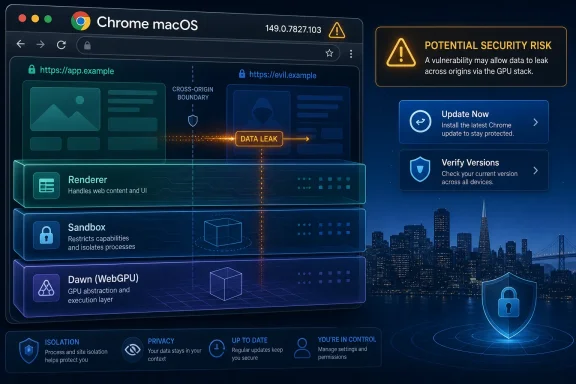
Google Chrome for macOS before version 149.0.7827.103 contains CVE-2026-11686, a high-severity Chromium vulnerability in Dawn that can let an attacker who has already compromised the renderer process leak cross-origin data through a crafted HTML page. That narrow wording is the story: this is not a classic “visit a page and lose the machine” bug, but it is a reminder that modern browser compromise is increasingly built from chained, platform-specific weaknesses. For WindowsForum readers, the immediate fix is simple—update Chrome—but the more interesting lesson is how much security now depends on components most users never see. Dawn, WebGPU, renderer isolation, cross-origin boundaries, and CPE metadata have become part of the everyday patch-management vocabulary whether administrators asked for them or not.
CVE-2026-11686 is listed as an issue in Dawn, the Chromium project’s implementation layer for WebGPU. The affected product line is Google Chrome on macOS prior to 149.0.7827.103, and the described impact is leakage of cross-origin data after a renderer process has already been compromised. Chromium assigned the issue a High security severity, while CISA’s ADP scoring currently gives it a much lower CVSS 3.1 base score of 3.1 because exploitation requires user interaction, high attack complexity, and a preexisting renderer compromise.
That mismatch is not an error so much as a signal. Chromium is judging the bug in the context of browser exploit chains, where a leak across an origin boundary can be valuable even if it is not the first link in the chain. CVSS, by contrast, is trying to score the individual vulnerability as a standalone item, and that makes the prerequisite renderer compromise weigh heavily against the base score.
This is the recurring tension in browser security advisories. A vulnerability can look modest when isolated and still matter inside a real-world exploit sequence. Attackers do not need every bug to deliver code execution; sometimes they need a primitive that turns a partial compromise into access to something the sandbox was supposed to protect.
The macOS restriction also deserves careful reading. NVD’s affected configuration combines Chrome versions before 149.0.7827.103 with Apple macOS, rather than treating Windows and Linux as vulnerable for this particular CVE. That does not mean Windows administrators can ignore the Chrome update that shipped alongside it, because the same desktop release addressed many other security defects, including a separate exploited V8 zero-day reported in the same update cycle.
The security trade-off is obvious. Any interface that brings untrusted web content closer to GPU resources, drivers, memory handling, and platform-specific behavior becomes a richer attack surface. Browser vendors know this, which is why these APIs are fenced by validation layers, sandboxing, process isolation, origin checks, and vendor-specific mitigations.
CVE-2026-11686 is described as “insufficient validation of untrusted input.” That is broad language, but it points to the core job of a component like Dawn: take commands and data that originate from web content, validate them rigorously, and prevent malformed or malicious input from crossing into places it should not. When that validation fails, the resulting bug may not look dramatic in isolation, but it can undermine a boundary the browser relies on.
The affected outcome here is leakage of cross-origin data. The phrase sounds abstract, but it is one of the web’s bedrock protections. A malicious page should not be able to read data from another site simply because both exist inside the same browser. If a bug helps bypass that rule, it threatens the separation between tabs, sessions, accounts, and services.
For defenders, that prerequisite lowers the probability of opportunistic exploitation. It is not the same risk class as a trivially reachable remote code execution bug requiring only a victim to load a page. That is why the ADP CVSS score lands in Low territory even though Chromium severity is High.
But the browser threat model is not built around single, self-contained bugs anymore. Real attacks often chain flaws: one vulnerability gets code running inside a renderer, another escapes or weakens the sandbox, another leaks secrets, and another stabilizes the exploit across versions or platforms. A cross-origin leak after renderer compromise can become the reconnaissance or data-theft stage of that chain.
This is why dismissing the bug because it requires an existing compromise is the wrong administrative instinct. If the renderer is already compromised, defenders are already in trouble, but they are not necessarily equally in trouble in all scenarios. The browser sandbox and same-origin policy exist precisely to limit what happens next. A bug that erodes those limits matters because containment is part of the security model, not an afterthought.
A cross-origin leak changes the calculation. The CVE does not say that arbitrary data can be stolen from any site under all conditions, and defenders should resist inflating the advisory beyond what is known. But it does say enough to make the exposure meaningful: a crafted HTML page could be used to leak data across a boundary that the browser is designed to enforce.
The risk is sharper in enterprise environments where browsers carry authenticated sessions into SaaS tools, identity portals, device-management consoles, support dashboards, and internal web apps. The browser has become the front door to the business, and origin isolation is one of the locks on that door. When that lock has a flaw, the correct response is not panic; it is swift patching and a sober look at exposure.
The modern browser is also a credential container in practice, even when organizations avoid calling it that. Cookies, tokens, SSO state, cached application data, and active sessions all make the browser a high-value target. A leak that appears narrow in a CVE field can have broader consequences depending on what the victim is logged into and what other bugs are present in the chain.
The CISA-ADP vector lists network attack vector, high attack complexity, no privileges required, required user interaction, unchanged scope, low confidentiality impact, and no integrity or availability impact. Taken literally, that produces a Low base score. For a standalone vulnerability queue, that might push the issue far below remote code execution flaws and actively exploited zero-days.
Chromium’s High severity reflects a different lens. Browser vendors understand how seemingly constrained flaws interact with sandboxed renderers, process boundaries, GPU interfaces, and web-origin rules. Their severity labels often encode exploit-chain usefulness and architectural sensitivity, not just the final observable impact of one bug in isolation.
Administrators should not treat either score as gospel. CVSS is useful for consistency, but vendor severity is often closer to the product’s actual threat model. When the product is a browser and the bug touches origin boundaries or post-compromise containment, a low numerical score should not automatically mean low operational priority.
In practical patch management, the distinction may not matter much because Chrome updates are cumulative. You are not choosing whether to install only the Dawn fix. You are deciding whether to move the browser fleet to the current stable build, which also includes other security fixes from the same release train.
For CVE-2026-11686, the configuration recorded by NVD uses an AND relationship: vulnerable Google Chrome versions up to, but excluding, 149.0.7827.103, combined with Apple macOS. That is consistent with the CVE description, which explicitly says “Google Chrome on macOS.” In other words, the macOS platform constraint is not an omission; it is the condition that narrows the vulnerable configuration.
The discomfort comes from Chrome’s cross-platform release pattern. The stable desktop update shipped versions for Windows, macOS, and Linux in the same advisory cycle, and many vulnerability tools ingest Chrome advisories as broad product updates. If a scanner expects a single Chrome CPE across all operating systems, a macOS-only vulnerability can look under-modeled or over-modeled depending on how the tool handles platform CPEs.
There is also a subtle versioning problem. The patched Mac build is 149.0.7827.103, while Windows and Linux builds in the same update cycle are commonly reported as 149.0.7827.102. If a dashboard naively says “Chrome before 149.0.7827.103” across every operating system, it may flag Windows systems incorrectly. If it ignores the CVE because the affected CPE includes macOS, it may still miss the broader urgency of the same Chrome update bundle for non-Mac systems.
So, are we missing a CPE? Based on the public description, the more defensible answer is that the CPE appears intentionally platform-scoped rather than incomplete. The bigger issue is whether downstream scanners represent that AND relationship correctly and whether administrators understand that this CVE’s macOS specificity does not downgrade the importance of the larger Chrome security update.
This is a common trap in patch triage. Teams focus on the CVE that triggered an alert in one scanner or a forum post, then miss the fact that browser releases are bundles. Chrome does not ask administrators to apply the Dawn patch but skip the V8 patch. The relevant unit of action is the stable-channel version deployed across the fleet.
For macOS endpoints, that means Chrome 149.0.7827.103 or later. For Windows and Linux endpoints in the same release cycle, the commonly reported patched build is 149.0.7827.102, though administrators should rely on Chrome’s own update mechanism, enterprise management tooling, or vendor package metadata rather than manually comparing isolated advisory snippets.
This is especially important in mixed fleets. A Windows-first IT shop with a small executive or developer Mac population can easily miss Mac-specific browser vulnerabilities if patch reporting is organized by Windows update rings alone. Conversely, a Mac admin may see “Dawn” and “cross-origin leak” and underestimate the broader update because the CVSS entry is not screaming for attention.
The Chromium dependency chain complicates response. A bug in Dawn may affect Chrome first in public advisories, but the same underlying code can matter for other Chromium-based browsers depending on version, platform, feature flags, and integration timing. Users often assume that a non-Google Chromium browser is automatically patched when Chrome is patched. That is not always true on the same day.
Enterprise admins should therefore track browser brands and versions, not just engines. A device with Chrome patched but an outdated secondary Chromium browser still has exposure. Developers, power users, and security teams are especially likely to have multiple browsers installed, including beta, dev, and canary builds that fall outside standard software inventory rules.
The Windows angle is direct even when the specific CVE is macOS-only. Microsoft Edge shares the Chromium base, and Windows environments often standardize on both Edge and Chrome for compatibility reasons. A Chrome advisory is rarely just a Chrome story anymore; it is an early warning about the health of a shared browser supply chain.
GPU-adjacent browser bugs are not new, but WebGPU gives the issue a sharper edge because it formalizes a powerful interface for web applications. The security model depends heavily on validation. Web content must be allowed to request complex operations without being allowed to smuggle unsafe state into lower layers.
That is why “insufficient validation of untrusted input” is not a throwaway CWE label. It is the exact class of mistake that matters when an API boundary is translating untrusted web requests into structured operations closer to hardware and platform graphics stacks. The failure mode may be memory corruption, information disclosure, sandbox weakening, or logic confusion depending on the component.
For users, none of this means WebGPU is inherently unsafe or should be disabled everywhere. It means new browser capabilities carry security costs, and those costs must be paid through aggressive testing, rapid updates, and conservative enterprise controls where exposure is unnecessary. A locked-down kiosk has different needs than a developer workstation or a gaming laptop.
Admins using Chrome Browser Cloud Management, Microsoft Intune, Jamf, Munki, Kandji, Workspace ONE, or similar tooling should verify actual installed versions rather than assuming auto-update completed. Chrome’s updater is reliable for consumer machines, but enterprise environments often introduce deferrals, packaging delays, user-session constraints, or network policies that slow rollout.
The most useful query is not “Do we have CVE-2026-11686?” but “Which browsers and versions are installed, on which operating systems, and when did they last successfully update?” That turns a CVE-specific panic into an inventory discipline. It also catches the awkward cases: stale portable browsers, abandoned developer builds, and machines where auto-update is broken.
Security teams should also review whether browser update SLAs distinguish between normal feature updates and security-stamped stable-channel updates. A seven-day or fourteen-day grace period may be acceptable for ordinary app updates, but it is harder to defend when the same release cycle includes a known exploited browser-engine vulnerability. The browser is too exposed to treat as another background application.
The real risk is lag. Browser security depends on shrinking the time between vendor release and fleet adoption. Every day a browser remains behind the stable channel is a day in which attackers can study patches, infer bug details, and test exploitability against users who have not caught up.
Google and Chromium often restrict bug details until users have had time to update. That policy is sensible, but it also creates a race. Defenders get a short window where the advisory is public but the technical roadmap is incomplete. Attackers get the same window, plus the ability to diff code changes, watch downstream patches, and focus on high-value environments known to update slowly.
This is why patch verification matters more than advisory reading. An administrator who can prove Chrome updated across the fleet is in better shape than one who can recite the CVSS vector. The details matter for risk analysis, but the update is the control.
Chrome is an application, but its risk depends on operating system, channel, component, build number, feature exposure, and sometimes hardware capability. Dawn is a component inside Chromium, but the public CVE is assigned to Google Chrome on macOS. WebGPU may be available, disabled, partially implemented, policy-controlled, or differently integrated depending on product and platform.
A vulnerability scanner wants a yes-or-no answer. The real world often offers “yes, if this browser build is on this platform and the affected component is reachable under these conditions.” CPE syntax can encode some of that through logical configurations, but many dashboards flatten it away for readability. That flattening is where false positives and false negatives breed.
For WindowsForum’s audience, this is not an academic complaint. Many admins live inside reports that executives read as truth. If a report says 10,000 Windows devices are vulnerable to a macOS-only Chrome CVE, trust erodes. If it suppresses a Chrome update warning because one CVE is macOS-only while the bundle includes Windows-relevant fixes, risk increases.
The answer is not to abandon CVE or CPE data. It is to treat it as a starting point, not a verdict. Good vulnerability management still requires product knowledge, release-note reading, and enough skepticism to ask whether the data model matches the deployment reality.
 A Mac-Only Chrome Bug Still Belongs on Every Admin’s Radar
CVE-2026-11686 is listed as an issue in Dawn, the Chromium project’s implementation layer for WebGPU. The affected product line is Google Chrome on macOS prior to 149.0.7827.103, and the described impact is leakage of cross-origin data after a renderer process has already been compromised. Chromium assigned the issue a High security severity, while CISA’s ADP scoring currently gives it a much lower CVSS 3.1 base score of 3.1 because exploitation requires user interaction, high attack complexity, and a preexisting renderer compromise.That mismatch is not an error so much as a signal. Chromium is judging the bug in the context of browser exploit chains, where a leak across an origin boundary can be valuable even if it is not the first link in the chain. CVSS, by contrast, is trying to score the individual vulnerability as a standalone item, and that makes the prerequisite renderer compromise weigh heavily against the base score.
This is the recurring tension in browser security advisories. A vulnerability can look modest when isolated and still matter inside a real-world exploit sequence. Attackers do not need every bug to deliver code execution; sometimes they need a primitive that turns a partial compromise into access to something the sandbox was supposed to protect.
The macOS restriction also deserves careful reading. NVD’s affected configuration combines Chrome versions before 149.0.7827.103 with Apple macOS, rather than treating Windows and Linux as vulnerable for this particular CVE. That does not mean Windows administrators can ignore the Chrome update that shipped alongside it, because the same desktop release addressed many other security defects, including a separate exploited V8 zero-day reported in the same update cycle.
Dawn Is the Kind of Component Users Never Notice Until It Fails
Dawn sits below the user-facing browser experience, but it matters because it helps expose modern GPU capabilities to web content. WebGPU is designed to give web apps more direct, efficient access to graphics and compute features than older APIs allowed. That is good news for advanced browser applications, gaming, visualization, machine learning demos, and the long-running project of making the web feel less like a document viewer and more like an application runtime.The security trade-off is obvious. Any interface that brings untrusted web content closer to GPU resources, drivers, memory handling, and platform-specific behavior becomes a richer attack surface. Browser vendors know this, which is why these APIs are fenced by validation layers, sandboxing, process isolation, origin checks, and vendor-specific mitigations.
CVE-2026-11686 is described as “insufficient validation of untrusted input.” That is broad language, but it points to the core job of a component like Dawn: take commands and data that originate from web content, validate them rigorously, and prevent malformed or malicious input from crossing into places it should not. When that validation fails, the resulting bug may not look dramatic in isolation, but it can undermine a boundary the browser relies on.
The affected outcome here is leakage of cross-origin data. The phrase sounds abstract, but it is one of the web’s bedrock protections. A malicious page should not be able to read data from another site simply because both exist inside the same browser. If a bug helps bypass that rule, it threatens the separation between tabs, sessions, accounts, and services.
The Renderer Compromise Requirement Is a Caveat, Not a Comfort Blanket
The most important phrase in the CVE description is “who had compromised the renderer process.” That means CVE-2026-11686 is not presented as the initial entry point. An attacker first needs to gain control or meaningful influence inside Chrome’s renderer, the process responsible for handling web page content.For defenders, that prerequisite lowers the probability of opportunistic exploitation. It is not the same risk class as a trivially reachable remote code execution bug requiring only a victim to load a page. That is why the ADP CVSS score lands in Low territory even though Chromium severity is High.
But the browser threat model is not built around single, self-contained bugs anymore. Real attacks often chain flaws: one vulnerability gets code running inside a renderer, another escapes or weakens the sandbox, another leaks secrets, and another stabilizes the exploit across versions or platforms. A cross-origin leak after renderer compromise can become the reconnaissance or data-theft stage of that chain.
This is why dismissing the bug because it requires an existing compromise is the wrong administrative instinct. If the renderer is already compromised, defenders are already in trouble, but they are not necessarily equally in trouble in all scenarios. The browser sandbox and same-origin policy exist precisely to limit what happens next. A bug that erodes those limits matters because containment is part of the security model, not an afterthought.
Cross-Origin Data Is the Browser’s Quiet Crown Jewel
The web’s same-origin policy is one of the least glamorous but most consequential security ideas in everyday computing. It is what keeps a random page from reading your bank tab, your webmail, your intranet portal, or a cloud dashboard just because those things are open in the same browser profile. Users rarely think about it because when it works, nothing appears to happen.A cross-origin leak changes the calculation. The CVE does not say that arbitrary data can be stolen from any site under all conditions, and defenders should resist inflating the advisory beyond what is known. But it does say enough to make the exposure meaningful: a crafted HTML page could be used to leak data across a boundary that the browser is designed to enforce.
The risk is sharper in enterprise environments where browsers carry authenticated sessions into SaaS tools, identity portals, device-management consoles, support dashboards, and internal web apps. The browser has become the front door to the business, and origin isolation is one of the locks on that door. When that lock has a flaw, the correct response is not panic; it is swift patching and a sober look at exposure.
The modern browser is also a credential container in practice, even when organizations avoid calling it that. Cookies, tokens, SSO state, cached application data, and active sessions all make the browser a high-value target. A leak that appears narrow in a CVE field can have broader consequences depending on what the victim is logged into and what other bugs are present in the chain.
The Scorecard Says Low, the Vendor Says High, and Both Can Be True
Security teams often want a single number to drive prioritization. CVSS encourages that habit, vulnerability scanners automate it, and dashboards make it seductively easy to sort by severity. CVE-2026-11686 is a useful example of why that habit can mislead.The CISA-ADP vector lists network attack vector, high attack complexity, no privileges required, required user interaction, unchanged scope, low confidentiality impact, and no integrity or availability impact. Taken literally, that produces a Low base score. For a standalone vulnerability queue, that might push the issue far below remote code execution flaws and actively exploited zero-days.
Chromium’s High severity reflects a different lens. Browser vendors understand how seemingly constrained flaws interact with sandboxed renderers, process boundaries, GPU interfaces, and web-origin rules. Their severity labels often encode exploit-chain usefulness and architectural sensitivity, not just the final observable impact of one bug in isolation.
Administrators should not treat either score as gospel. CVSS is useful for consistency, but vendor severity is often closer to the product’s actual threat model. When the product is a browser and the bug touches origin boundaries or post-compromise containment, a low numerical score should not automatically mean low operational priority.
In practical patch management, the distinction may not matter much because Chrome updates are cumulative. You are not choosing whether to install only the Dawn fix. You are deciding whether to move the browser fleet to the current stable build, which also includes other security fixes from the same release train.
The CPE Entry Is Awkward, but It Is Not Necessarily Missing the Point
The user-facing NVD page asks, “Are we missing a CPE here?” That line appears frequently on NVD entries while enrichment data settles, but it is worth examining because CPE precision matters for scanners and enterprise vulnerability management.For CVE-2026-11686, the configuration recorded by NVD uses an AND relationship: vulnerable Google Chrome versions up to, but excluding, 149.0.7827.103, combined with Apple macOS. That is consistent with the CVE description, which explicitly says “Google Chrome on macOS.” In other words, the macOS platform constraint is not an omission; it is the condition that narrows the vulnerable configuration.
The discomfort comes from Chrome’s cross-platform release pattern. The stable desktop update shipped versions for Windows, macOS, and Linux in the same advisory cycle, and many vulnerability tools ingest Chrome advisories as broad product updates. If a scanner expects a single Chrome CPE across all operating systems, a macOS-only vulnerability can look under-modeled or over-modeled depending on how the tool handles platform CPEs.
There is also a subtle versioning problem. The patched Mac build is 149.0.7827.103, while Windows and Linux builds in the same update cycle are commonly reported as 149.0.7827.102. If a dashboard naively says “Chrome before 149.0.7827.103” across every operating system, it may flag Windows systems incorrectly. If it ignores the CVE because the affected CPE includes macOS, it may still miss the broader urgency of the same Chrome update bundle for non-Mac systems.
So, are we missing a CPE? Based on the public description, the more defensible answer is that the CPE appears intentionally platform-scoped rather than incomplete. The bigger issue is whether downstream scanners represent that AND relationship correctly and whether administrators understand that this CVE’s macOS specificity does not downgrade the importance of the larger Chrome security update.
The June Chrome Update Was Bigger Than This One CVE
CVE-2026-11686 arrived in a Chrome stable-channel update that drew attention for another reason: Google also patched CVE-2026-11645, a V8 vulnerability reported as exploited in the wild. That V8 bug is a different issue with a different impact profile, but it changes the operational context around the release. When a Chrome update includes an actively exploited browser-engine flaw, delaying the entire update because one Dawn bug looks low-scoring is indefensible.This is a common trap in patch triage. Teams focus on the CVE that triggered an alert in one scanner or a forum post, then miss the fact that browser releases are bundles. Chrome does not ask administrators to apply the Dawn patch but skip the V8 patch. The relevant unit of action is the stable-channel version deployed across the fleet.
For macOS endpoints, that means Chrome 149.0.7827.103 or later. For Windows and Linux endpoints in the same release cycle, the commonly reported patched build is 149.0.7827.102, though administrators should rely on Chrome’s own update mechanism, enterprise management tooling, or vendor package metadata rather than manually comparing isolated advisory snippets.
This is especially important in mixed fleets. A Windows-first IT shop with a small executive or developer Mac population can easily miss Mac-specific browser vulnerabilities if patch reporting is organized by Windows update rings alone. Conversely, a Mac admin may see “Dawn” and “cross-origin leak” and underestimate the broader update because the CVSS entry is not screaming for attention.
Browser Patch Management Has Outgrown the Old Desktop Mindset
There was a time when browser patching could be treated as routine desktop hygiene. Today it belongs closer to endpoint security operations. Chrome, Edge, Brave, Vivaldi, and other Chromium-based browsers ship fast because the web attack surface moves fast, and because the same underlying components are shared across a large ecosystem.The Chromium dependency chain complicates response. A bug in Dawn may affect Chrome first in public advisories, but the same underlying code can matter for other Chromium-based browsers depending on version, platform, feature flags, and integration timing. Users often assume that a non-Google Chromium browser is automatically patched when Chrome is patched. That is not always true on the same day.
Enterprise admins should therefore track browser brands and versions, not just engines. A device with Chrome patched but an outdated secondary Chromium browser still has exposure. Developers, power users, and security teams are especially likely to have multiple browsers installed, including beta, dev, and canary builds that fall outside standard software inventory rules.
The Windows angle is direct even when the specific CVE is macOS-only. Microsoft Edge shares the Chromium base, and Windows environments often standardize on both Edge and Chrome for compatibility reasons. A Chrome advisory is rarely just a Chrome story anymore; it is an early warning about the health of a shared browser supply chain.
GPU-Adjacent Bugs Are Becoming Normal Browser Risk
Dawn and WebGPU are part of a broader trend: the browser is absorbing workloads that used to belong to native applications. That includes accelerated graphics, media processing, AI-adjacent compute, collaboration tools, design software, and increasingly complex enterprise web apps. The more the browser does, the more it touches parts of the system that were historically outside the web threat model.GPU-adjacent browser bugs are not new, but WebGPU gives the issue a sharper edge because it formalizes a powerful interface for web applications. The security model depends heavily on validation. Web content must be allowed to request complex operations without being allowed to smuggle unsafe state into lower layers.
That is why “insufficient validation of untrusted input” is not a throwaway CWE label. It is the exact class of mistake that matters when an API boundary is translating untrusted web requests into structured operations closer to hardware and platform graphics stacks. The failure mode may be memory corruption, information disclosure, sandbox weakening, or logic confusion depending on the component.
For users, none of this means WebGPU is inherently unsafe or should be disabled everywhere. It means new browser capabilities carry security costs, and those costs must be paid through aggressive testing, rapid updates, and conservative enterprise controls where exposure is unnecessary. A locked-down kiosk has different needs than a developer workstation or a gaming laptop.
What Security Teams Should Actually Do This Week
The operational response to CVE-2026-11686 should be boring, which is the point. Confirm that Chrome on macOS is updated to 149.0.7827.103 or later. Confirm that Windows and Linux Chrome installations received the corresponding stable-channel update from the same security release. Then check Chromium-based browsers separately, because the presence of one patched browser does not patch the others.Admins using Chrome Browser Cloud Management, Microsoft Intune, Jamf, Munki, Kandji, Workspace ONE, or similar tooling should verify actual installed versions rather than assuming auto-update completed. Chrome’s updater is reliable for consumer machines, but enterprise environments often introduce deferrals, packaging delays, user-session constraints, or network policies that slow rollout.
The most useful query is not “Do we have CVE-2026-11686?” but “Which browsers and versions are installed, on which operating systems, and when did they last successfully update?” That turns a CVE-specific panic into an inventory discipline. It also catches the awkward cases: stale portable browsers, abandoned developer builds, and machines where auto-update is broken.
Security teams should also review whether browser update SLAs distinguish between normal feature updates and security-stamped stable-channel updates. A seven-day or fourteen-day grace period may be acceptable for ordinary app updates, but it is harder to defend when the same release cycle includes a known exploited browser-engine vulnerability. The browser is too exposed to treat as another background application.
The Enterprise Risk Is Not the Bug; It Is the Lag
CVE-2026-11686 by itself is not the nightmare scenario that keeps CISOs awake. It requires a compromised renderer, user interaction, and a crafted HTML page. It is a confidentiality issue with a limited public description, not a fully disclosed turnkey exploit.The real risk is lag. Browser security depends on shrinking the time between vendor release and fleet adoption. Every day a browser remains behind the stable channel is a day in which attackers can study patches, infer bug details, and test exploitability against users who have not caught up.
Google and Chromium often restrict bug details until users have had time to update. That policy is sensible, but it also creates a race. Defenders get a short window where the advisory is public but the technical roadmap is incomplete. Attackers get the same window, plus the ability to diff code changes, watch downstream patches, and focus on high-value environments known to update slowly.
This is why patch verification matters more than advisory reading. An administrator who can prove Chrome updated across the fleet is in better shape than one who can recite the CVSS vector. The details matter for risk analysis, but the update is the control.
The CPE Footnote Tells a Bigger Story About Vulnerability Data
The “missing CPE” prompt on NVD pages is easy to ignore, but it exposes a structural weakness in vulnerability management. CVEs are human-readable advisories squeezed into machine-readable taxonomies. CPEs try to express affected products and platforms precisely, but modern software does not always fit neatly into that model.Chrome is an application, but its risk depends on operating system, channel, component, build number, feature exposure, and sometimes hardware capability. Dawn is a component inside Chromium, but the public CVE is assigned to Google Chrome on macOS. WebGPU may be available, disabled, partially implemented, policy-controlled, or differently integrated depending on product and platform.
A vulnerability scanner wants a yes-or-no answer. The real world often offers “yes, if this browser build is on this platform and the affected component is reachable under these conditions.” CPE syntax can encode some of that through logical configurations, but many dashboards flatten it away for readability. That flattening is where false positives and false negatives breed.
For WindowsForum’s audience, this is not an academic complaint. Many admins live inside reports that executives read as truth. If a report says 10,000 Windows devices are vulnerable to a macOS-only Chrome CVE, trust erodes. If it suppresses a Chrome update warning because one CVE is macOS-only while the bundle includes Windows-relevant fixes, risk increases.
The answer is not to abandon CVE or CPE data. It is to treat it as a starting point, not a verdict. Good vulnerability management still requires product knowledge, release-note reading, and enough skepticism to ask whether the data model matches the deployment reality.
The Lesson From CVE-2026-11686 Fits in a Patch Window, Not a Panic Room
This Chrome flaw is a useful case study precisely because it is not the loudest bug in the room. It sits at the intersection of a modern web API, a platform-specific build, a renderer-compromise prerequisite, and a cross-origin confidentiality impact. That combination is messy, and modern security work is mostly the art of handling messy accurately.- Chrome on macOS should be updated to 149.0.7827.103 or later to address CVE-2026-11686.
- The vulnerability is scoped to macOS in the public affected configuration, but the surrounding Chrome stable-channel update matters across desktop platforms.
- The low CVSS score should not override Chromium’s High severity label when assessing browser exploit-chain risk.
- The renderer-compromise prerequisite reduces standalone exploitability but does not make the bug irrelevant.
- Vulnerability scanners should be checked for correct handling of the Chrome-plus-macOS CPE relationship.
- Enterprise teams should verify installed browser versions directly rather than assuming auto-update completed.
References
- Primary source: NVD / Chromium
Published: 2026-06-15T19:14:49-07:00
NVD - CVE-2026-11686
 nvd.nist.gov
- Security advisory: MSRC
Published: 2026-06-15T19:14:49-07:00
Original feed URL
Security Update Guide - Microsoft Security Response Center
 msrc.microsoft.com
- Related coverage: stack.watch
- Related coverage: vulnerability.circl.lu
Vulnerability-Lookup
Vulnerability-Lookup - Fast vulnerability lookup correlation from different sources.vulnerability.circl.lu