

UST has expanded its partnership with Anthropic to put Claude models into the engineering, operations, and industry platforms it builds and manages for large enterprises. The move is aimed at Global 1000 customers that want to move beyond limited AI pilots, particularly in semiconductor, manufacturing, automotive, telecom, embedded, and IoT environments.
The announcement was published by UST on July 8, despite the July 20 timestamp attached to the syndicated report. UST said the alliance elevates it to a Global Premier Partner in Anthropic’s Claude Partner Network Services Tier and includes training 20,000 UST employees on Claude.
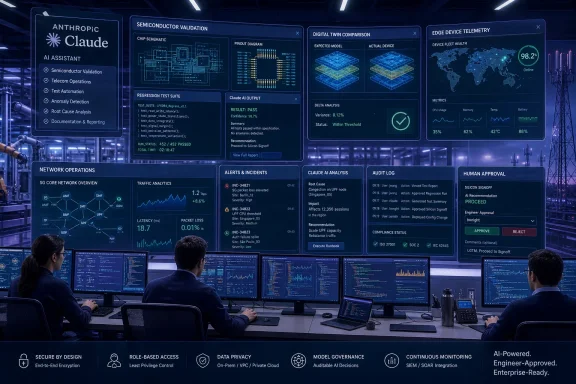
The most concrete technical example is UST-iDEC, the company’s hardware and silicon-validation platform. UST says it is adding Claude as a reasoning component in an existing agentic validation pipeline used to test semiconductor designs and related hardware.
According to UST, Claude Code will be used to interpret chip pinouts and hardware schematics, then generate and run regression-test scripts that engineers would otherwise write manually. UST also plans to use Claude’s models to compare live edge-device data with digital twins, flagging possible firmware regressions and signal-integrity faults.
UST claims iDEC already reduces validation cycle times by 50% to 70% and can turn some four-day processes into 48-hour runs. Those performance figures come from UST’s own announcement and have not been independently verified.
For enterprise engineering teams, the significance is less about a new standalone Claude application than tighter integration with workflows where AI output can trigger tests, inspect telemetry, and feed results back into existing tooling. That also raises the usual governance requirements: model access, data handling, code-review gates, test isolation, and clear human approval before AI-generated actions affect production hardware or software.
The company is positioning the alliance around industry-specific deployments rather than generic chatbot access. It also said Claude will be brought into selected horizontal enterprise platforms and UST’s internal operations, where it expects customers to need controls around accuracy, compliance, reliability, and data protection.
Anthropic’s role is to provide the models; UST will handle implementation, managed engineering, domain-specific integrations, and delivery. That division reflects a broader enterprise pattern: model vendors are increasingly relying on large systems integrators to connect AI services to legacy applications, operational data, and regulated workflows.
Admins and engineering leaders working with UST should expect Claude adoption to arrive as part of a project implementation, not as a consumer-style software rollout. They should require normal enterprise controls around identity, logging, least-privilege service accounts, data residency, and validation of AI-generated scripts before deployment.
UST’s next task is turning the announced integrations into customer deployments with measurable operational results.
The announcement was published by UST on July 8, despite the July 20 timestamp attached to the syndicated report. UST said the alliance elevates it to a Global Premier Partner in Anthropic’s Claude Partner Network Services Tier and includes training 20,000 UST employees on Claude.
 Claude moves into engineering workflows
The most concrete technical example is UST-iDEC, the company’s hardware and silicon-validation platform. UST says it is adding Claude as a reasoning component in an existing agentic validation pipeline used to test semiconductor designs and related hardware.According to UST, Claude Code will be used to interpret chip pinouts and hardware schematics, then generate and run regression-test scripts that engineers would otherwise write manually. UST also plans to use Claude’s models to compare live edge-device data with digital twins, flagging possible firmware regressions and signal-integrity faults.
UST claims iDEC already reduces validation cycle times by 50% to 70% and can turn some four-day processes into 48-hour runs. Those performance figures come from UST’s own announcement and have not been independently verified.
For enterprise engineering teams, the significance is less about a new standalone Claude application than tighter integration with workflows where AI output can trigger tests, inspect telemetry, and feed results back into existing tooling. That also raises the usual governance requirements: model access, data handling, code-review gates, test isolation, and clear human approval before AI-generated actions affect production hardware or software.
Telecom and enterprise operations are also in scope
UST said it will integrate Claude into its IntelliOps telecom platform for network operations, service assurance, and OSS/BSS modernization. The intended uses include identifying service problems, predicting radio access network failures, and supporting approved remediation workflows through existing secure integrations.The company is positioning the alliance around industry-specific deployments rather than generic chatbot access. It also said Claude will be brought into selected horizontal enterprise platforms and UST’s internal operations, where it expects customers to need controls around accuracy, compliance, reliability, and data protection.
Anthropic’s role is to provide the models; UST will handle implementation, managed engineering, domain-specific integrations, and delivery. That division reflects a broader enterprise pattern: model vendors are increasingly relying on large systems integrators to connect AI services to legacy applications, operational data, and regulated workflows.
What Windows and IT teams should take from it
There is no new Windows client, Microsoft 365 integration, endpoint requirement, or broadly available Claude product in this announcement. The near-term impact will be confined to UST customers and projects where the company is already supplying platforms or services.Admins and engineering leaders working with UST should expect Claude adoption to arrive as part of a project implementation, not as a consumer-style software rollout. They should require normal enterprise controls around identity, logging, least-privilege service accounts, data residency, and validation of AI-generated scripts before deployment.
UST’s next task is turning the announced integrations into customer deployments with measurable operational results.
References
- Primary source: The Fast Mode
Published: 2026-07-20T00:19:18+00:00
UST Partners with Anthropic to Deploy Claude AI Across Enterprise Platforms
UST Partners with Anthropic to Deploy Claude AI Across Enterprise Platformswww.thefastmode.com - Related coverage: ust.com
UST Partners with Anthropic to Bring Claude into UST's Platforms, Engineering, and Operations and Train 20,000 UST Employees Globally
Under the strategic alliance, UST will combine Anthropic’s Claude models with UST’s proprietary industry and horizontal platforms, engineering services, domain solutions, and internal operations, helping clients modernize and transform core systems and operationalize trusted AI at scale.www.ust.com
- Related coverage: prnewswire.com
UST Partners with Anthropic to Bring Claude into UST's Platforms, Engineering, and Operations and Train 20,000 UST Employees Globally
/PRNewswire/ -- UST, a leading AI and technology transformation solutions company, today announced a strategic alliance with Anthropic, the AI safety and... www.prnewswire.com
- Related coverage: morningstar.com
- Related coverage: marketscreener.com
- Related coverage: hpcwire.com
AIwire - Covering Scientific & Technical AI
SAN FRANCISCO and ALISO VIEJO, Calif., July 10, 2026 — UST, a leading AI and technology transformation solutions company, has announced a strategic alliance with Anthropic, the AI safety and […]www.hpcwire.com
