

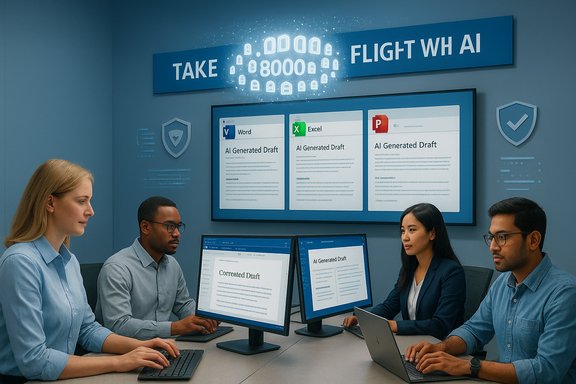
UST’s announced deployment of Microsoft 365 Copilot and GitHub Copilot—a program UST says covers 8,000 Copilot licenses and is embedded in its “Take Flight with AI” initiative—signals another major systems-integration firm moving from experiment to enterprise-scale generative-AI tooling for both knowledge workers and engineers. The move is presented by UST as an acceleration of productivity, collaboration, and secure, governed AI adoption across its global workforce, while also promising faster production-ready deliveries for clients and a sustained investment in AI training for employees.
UST is a global digital transformation and engineering company founded in 1999 that publicly positions itself as powered by technology, driven by AI, inspired by people. The company’s published corporate materials put headcount at roughly 30,000+ employees across 30+ countries, and the organization has been increasingly active in unveiling AI and cloud-related initiatives over the last several years. Microsoft’s Copilot family now occupies two complementary enterprise roles:
Key risk areas to monitor:
However, the precise license numbers and training totals cited in the company release are company-reported metrics; independent corroboration from Microsoft or third-party confirmations was not located in public sources at the time this article was prepared, so those figures should be treated as reported by UST until further verification is available. Meanwhile, the technical underpinnings and operational recommendations UST references mirror established best practices for responsible Copilot adoption: secure data flows, identity and device controls, DLP, developer security pipelines, and staged pilot-to-scale programs. Organizations evaluating similar steps should insist on rigorous measurement, documented governance and testable security controls before scaling Copilot to thousands of seats.
By combining Microsoft’s Copilot platform capabilities with disciplined governance and operator training, UST aims to convert generative AI from a tactical experiment into a predictable, measurable element of enterprise delivery. The outcome will depend on the company’s ability to translate playbooks into repeatable, auditable operations—and on publishing post-deployment KPIs that validate the claimed productivity and client outcomes.
Source: ANI News https://www.aninews.in/news/busines...erate-ai-driven-transformation20251202115741/
 Background / Overview
UST is a global digital transformation and engineering company founded in 1999 that publicly positions itself as powered by technology, driven by AI, inspired by people. The company’s published corporate materials put headcount at roughly 30,000+ employees across 30+ countries, and the organization has been increasingly active in unveiling AI and cloud-related initiatives over the last several years. Microsoft’s Copilot family now occupies two complementary enterprise roles:- Microsoft 365 Copilot — a productivity Copilot that integrates generative assistance into Word, Excel, PowerPoint, Outlook, Teams and other Microsoft 365 apps; and
- GitHub Copilot — the developer Copilot that integrates into IDEs and GitHub workflows to accelerate coding, refactoring, and security remediation.
What UST announced (summary of the company statement)
- UST announced integration of Microsoft 365 Copilot and GitHub Copilot across its operations as part of its Take Flight with AI initiative.
- The company stated it has deployed 8,000 Microsoft 365 Copilot and GitHub Copilot licenses for employees.
- UST said it has trained 25,000 associates in generative AI under the same initiative and emphasized role-based enablement, security and governance templates, and “de-risked” adoption playbooks as part of its rollout.
- UST framed the deployment as enabling automation of routine tasks, faster insight generation, improved collaboration, and measurable productivity gains in engineering velocity, proposals and content development, and data workflows.
- Executives quoted in the announcement described the move as a strategic and cultural investment to build an AI-powered, future-ready workforce.
Why this matters: productivity, developer velocity and market context
Microsoft’s Copilot stack is intentionally positioned to serve multiple organizational roles. Organizations that combine Microsoft 365 Copilot (knowledge work assistance) with GitHub Copilot (developer assistance) aim to drive parallel productivity gains across business and engineering teams—reducing time spent on repetitive drafting, data preparation and routine coding tasks while freeing people to work on higher-value, creative or architectural problems.- For knowledge workers, Microsoft 365 Copilot surfaces summarization, drafting, and data-exploration capabilities directly inside Office apps and Teams. Administrators can deploy the Copilot desktop/app with standard software-management tooling (Intune, Configuration Manager) and manage uptake via Microsoft 365 admin tooling. Microsoft documentation specifically lays out deployment guidance, channel rollout behavior, and update requirements.
- For software engineering teams, GitHub Copilot extends into IDEs and GitHub workflows, and recent GitHub product capabilities (Copilot Chat, Copilot Edits, Autofix and more) seek to shorten remediation cycles and accelerate multi-file edits. Enterprises often pair GitHub Copilot with automated security scanning and remediation pipelines to reduce developer friction and shrink remediation backlogs. Industry examples and adoption case studies show measurable improvements in developer throughput when Copilot is integrated into a disciplined CI/CD and security workflow.
- defined governance and DLP boundaries,
- role-based training, and
- integration with identity and device management,
is the current best practice to unlock Copilot value while controlling risk. Several systems integrators and enterprise customers have publicly described similar adoption patterns and benefits.
Technical verification and what’s provable
When assessing a vendor announcement of this kind, three categories of claims require verification:- The deployment scale and license counts — UST’s announcement cites 8,000 Copilot licenses. That is a direct corporate claim and, as with many company press releases, is authoritative for what the company intends to or has purchased; third‑party confirmation (for example, a Microsoft transaction confirmation or partner press release) is the standard way to independently corroborate license counts. At the time of review, the UST announcement is presented via its media release; independent, corroborating announcements from Microsoft or a widely circulated news outlet were not found in public Microsoft news pages or major technology press outlets during the verification checks performed for this article. That absence does not disprove the claim, but it does mean the license count should be treated as a company-reported figure until corroborated by Microsoft partner disclosures or audited financial/operational statements. (UST’s corporate profile and press archive show rapid hiring and global expansion that make a large Copilot deployment plausible.
- Training and internal enablement numbers — the announcement reports 25,000 associates trained in generative AI under the Take Flight with AI initiative. This is again a company declaration and consistent with large-scale internal skilling programs that other integrators and enterprise customers have reported. Verification typically relies on company internal reporting, public training registries, or partner announcements; absent those, this claim should also be regarded as company-reported. UST’s broader press history shows repeated references to large upskilling efforts, which supports plausibility but is not a formal audit.
- Expected productivity and impact claims — the release forecasts measurable productivity benefits such as improved engineering velocity and faster proposal and content development. There is broad industry evidence that Copilot tools can deliver those kinds of gains when combined with process changes, governance and metrics-driven adoption programs. Independent case studies published by Microsoft and third-party reporting show significant time savings in targeted scenarios, but realized ROI varies by use case, governance posture, and integration maturity. Therefore, the productivity claims are plausible and consistent with other corporate deployments, but they retain a degree of contingency until UST publishes post-rollout KPIs or client case studies demonstrating realized outcomes.
The implementation posture UST describes — strengths and sensible practices
UST’s public narrative highlights several implementation choices that align with enterprise best practices for Copilot-scale rollouts:- Role-based enablement and training: targeted training that ties Copilot use to job-relevant scenarios produces faster adoption and measurable outcomes. Well-built training programs emphasize hands-on labs, guardrails for data, and change management. This is a core theme in enterprise Copilot adoption playbooks.
- Enterprise-grade security and governance templates: Copilot adoption without DLP, conditional access, and data-grounding controls invites data-exposure risks. Microsoft provides admin tooling and guidance to implement policies; enterprises must map Copilot data flows to compliance regimes (GDPR, sectoral rules, export controls) and instrument monitoring and audit trails.
- De-risked adoption playbooks and rapid production patterns: the claim that UST will deliver “de-risked adoption playbooks” is consistent with how systems integrators operate—packaged accelerators, templates, and reference architectures shorten time to production when they are coupled with governance and testing. Published industry case studies show integrators often provide these artifacts as client-facing services.
- Alignment with Microsoft product roadmaps: partnering organizations that align engineering roadmaps with Microsoft’s product cadence can reduce integration friction and shorten pilot-to-production timelines—especially when using Copilot Studio, Azure AI Foundry, and Microsoft Graph integrations. Public Microsoft guidance and partner programs encourage this alignment.
Risks, open questions and governance imperatives
A substantive Copilot rollout must manage several cross-cutting risks. UST’s announcement acknowledges governance and “responsible AI” guidelines; however, the mechanics of those controls determine how effectively risks are controlled.Key risk areas to monitor:
- Data exposure and leakage — Copilot accesses organizational content to ground responses. Without strict data access controls, scope-limited retrieval, and redaction or masking policies, there’s a real risk of exposing IP, third-party data or regulated personal information. Enterprises must implement least-privilege retrieval, Purview/Entra policies, and content-safety checks. Microsoft’s documentation and customer best-practices note these as core steps for enterprise Copilot adoption.
- Model ground-truthing and hallucinations — generative outputs can be plausible but incorrect. For knowledge-worker outputs (e.g., legal summaries, regulatory interpretations, financial models), manual review and explainability processes are non-negotiable. Deployments that treat Copilot output as draft rather than authoritative minimize downstream risk.
- Security of developer workflows — GitHub Copilot helps generate code at speed, but surfaced code must be validated for licensing, security and supply chain risk. Enterprises using Copilot in CI/CD should pair it with code scanning (CodeQL, SCA) and Copilot Autofix workflows that create reviewable PRs rather than pushing blind fixes. Enterprise controls and security automation are essential.
- Regulatory/compliance posture across jurisdictions — authorship, data residency and sovereignty rules can constrain Copilot interaction handling. Microsoft has been expanding in‑country Copilot processing options and localized data controls for regulated markets; enterprises should explicitly map Copilot data flows to regulatory requirements in each market where employees will use the tool. Recent Microsoft announcements about in‑country processing reflect this shift towards localized governance.
- Measurement and license management — Copilot license costs are non-trivial. Organizations need granular usage metrics, adoption tracking and a plan for license reallocation if adoption lags. Microsoft’s admin reports and usage dashboards are designed to help organizations track ROI and optimize license spend.
How enterprises typically operationalize Copilot (practical playbook)
Below is a pragmatic, sequential playbook that large integrators and enterprises follow when moving Copilot into production. This aligns with Microsoft guidance and field-proven methods used by large adopters.- Plan and pilot
- Identify business-critical scenarios and low-risk first pilots (e.g., meeting summaries, template generation).
- Define KPIs (time saved, error reduction, cycle-time improvements).
- Secure and govern
- Implement conditional access, DLP rules, and data-grounding policies.
- Map Copilot interactions to compliance regimes.
- Train and enable
- Run role-based workshops; publish “how to” playbooks and sample prompts.
- Provide hands-on labs and office hours for adoption support.
- Integrate with developer workflows
- Pair GitHub Copilot with CodeQL, SCA, and PR review gating (Copilot Autofix only to create PRs).
- Embed Copilot into developer pipelines for suggested tests and refactor recommendations.
- Measure and iterate
- Use admin dashboards to track usage, reassign licenses and capture ROI evidence.
- Publish anonymized case studies of measured impact.
- Scale
- Convert pilot learnings to enterprise templates and agent catalogs in Copilot Studio.
- Automate lifecycle and model-router decisions for cost/performance tuning with Azure AI Foundry where relevant.
What’s plausible — and what still needs public confirmation
Plausible:- That a systems integrator of UST’s size would purchase thousands of Copilot licenses and push a combined knowledge and developer Copilot program as part of an AI-upskilling initiative.
- That such a deployment could deliver measurable productivity gains when coupled with rigorous governance, role-based training, and targeted use cases.
- That major Copilot features—admin tooling, Copilot Studio publishing to Microsoft 365, and integration routes for GitHub Copilot into developer flows—are available and in commercial use.
- The exact number (8,000) of Copilot seats deployed by UST is reported in the company’s announcement; independent confirmation from Microsoft or an audited third-party account was not located during the verification checks performed for this article and should therefore be treated as a company-reported figure pending corroboration. Similarly, the claim of 25,000 associates trained is plausible and consistent with large upskilling drives, but it is a company-stated metric that would benefit from third-party verification or published training completion data.
Strategic implications for UST clients and the market
- For UST clients, the integration signals that the company is making a strategic bet on embedding generative AI into both delivery and operations. Clients who rely on UST for engineering, product development and transformation engagements should expect faster iteration cycles and potentially Copilot-accelerated deliverables—if the governance and verification layers are robustly applied.
- For the broader market, the move is part of a pattern: integrators and service providers are increasingly shifting from pilot-era experiments to platform-led rollouts that blend Microsoft tooling, bespoke IP (automation platforms), and curated adoption playbooks. That pattern moves the conversation from “Can we use Copilot?” to “How do we integrate Copilot safely into regulated production systems and measure ROI?”
- For Microsoft, large-scale deployments by integrators like UST reinforce Copilot’s role in enterprise modernization. Microsoft has been actively improving localization, governance and admin capabilities to support these kinds of rollouts—an important factor for global customers operating across varied regulatory environments.
Practical notes for IT decision makers and architects
- Treat Copilot outputs as drafts unless explicitly validated. Put review gates into workflows for legal, finance and regulated outputs.
- Instrument and monitor Copilot usage with defined KPIs. Prove value in small, measurable steps before scaling licenses widely.
- Pair GitHub Copilot with automated security scans and require PR-based changes for any Autofix-style automation.
- Maintain a living catalog of permitted training data and knowledge sources for Copilots; document retention and indexing boundaries.
- Consider device standardization and conditional access to lower the blast radius of misconfiguration.
Conclusion
UST’s announcement that it has integrated Microsoft 365 Copilot and GitHub Copilot into its operations—and that it intends to scale that integration with 8,000 licenses as part of a large-scale upskilling program—is consistent with a broader enterprise move to embed generative AI into everyday workflows. The strategy they outline—role-based enablement, governance templates, partner-aligned roadmaps and packaged adoption playbooks—is the right architecture for reducing adoption risk while unlocking productivity.However, the precise license numbers and training totals cited in the company release are company-reported metrics; independent corroboration from Microsoft or third-party confirmations was not located in public sources at the time this article was prepared, so those figures should be treated as reported by UST until further verification is available. Meanwhile, the technical underpinnings and operational recommendations UST references mirror established best practices for responsible Copilot adoption: secure data flows, identity and device controls, DLP, developer security pipelines, and staged pilot-to-scale programs. Organizations evaluating similar steps should insist on rigorous measurement, documented governance and testable security controls before scaling Copilot to thousands of seats.
By combining Microsoft’s Copilot platform capabilities with disciplined governance and operator training, UST aims to convert generative AI from a tactical experiment into a predictable, measurable element of enterprise delivery. The outcome will depend on the company’s ability to translate playbooks into repeatable, auditable operations—and on publishing post-deployment KPIs that validate the claimed productivity and client outcomes.
Source: ANI News https://www.aninews.in/news/busines...erate-ai-driven-transformation20251202115741/
