

Valve’s next-gen gamepad brings the Steam Deck’s sprawling input toolkit to a traditional controller form — and it arrives with a small, magnetic “Puck” that promises low-latency wireless, a new generation of magnetic thumbsticks, capacitive Grip Sense, four-point HD haptics, and full Steam Input parity so “every game on Steam” can be mapped, tuned, and played without compromise.
Valve’s hardware roadmap has come full circle. After the Steam Deck proved that SteamOS and deep input customization could anchor a mainstream product, Valve unveiled a three‑piece 2026 hardware family — the Steam Machine (a living‑room PC), Steam Frame (a VR headset), and a refreshed Steam Controller built deliberately to match the Steam Deck’s input parity. The controller is positioned as the universal Steam gamepad: full-size sticks and ABXY, trackpads for mouse-like control, gyro aiming, and extra grip buttons — all accessible via Steam Input configurations that are pre-populated from Day One. This iteration is not a nostalgic rebake of the original Steam Controller; it is a technical and ergonomic rework aimed squarely at making PC-first controls feel natural on TV, handhelds, and VR. Valve’s stated goals are clear: make the Steam Library playable “wherever Steam is,” with flexible connection options (USB‑C wired, Bluetooth, or Valve’s proprietary Puck radio) and the ability to map complex control schemes without third‑party tools. Early coverage from major outlets confirms the broad specification set Valve released publicly.
Conclusion
The next‑gen Steam Controller is a deliberate, technically ambitious attempt to make the full weight of Steam’s input ecosystem available beyond the Deck. Its Steam Controller Puck, TMR magnetic sticks, Grip Sense, and four‑motor HD haptics are concrete hardware steps toward a universal Steam playstyle. Yet this hardware’s impact depends on the less glamorous work that follows: testing in reviewers’ labs, developer adoption of richer haptics and trackpad features, and Valve’s ability to ship software and firmware updates that translate hardware potential into everyday improvements. For now, it’s a promising synthesis of Valve’s best ideas in input design — but the real story will be written by latency tests, batteries under load, and the Steam community’s willingness to build and share configurations that showcase what the controller can do.
Source: Windows Report Everything to Know About Valve's Next-Gen Steam Controller
 Background / Overview
Valve’s hardware roadmap has come full circle. After the Steam Deck proved that SteamOS and deep input customization could anchor a mainstream product, Valve unveiled a three‑piece 2026 hardware family — the Steam Machine (a living‑room PC), Steam Frame (a VR headset), and a refreshed Steam Controller built deliberately to match the Steam Deck’s input parity. The controller is positioned as the universal Steam gamepad: full-size sticks and ABXY, trackpads for mouse-like control, gyro aiming, and extra grip buttons — all accessible via Steam Input configurations that are pre-populated from Day One. This iteration is not a nostalgic rebake of the original Steam Controller; it is a technical and ergonomic rework aimed squarely at making PC-first controls feel natural on TV, handhelds, and VR. Valve’s stated goals are clear: make the Steam Library playable “wherever Steam is,” with flexible connection options (USB‑C wired, Bluetooth, or Valve’s proprietary Puck radio) and the ability to map complex control schemes without third‑party tools. Early coverage from major outlets confirms the broad specification set Valve released publicly. What’s new: hardware, radio, and inputs
The Steam Controller Puck: dock, dongle, and low‑latency radio
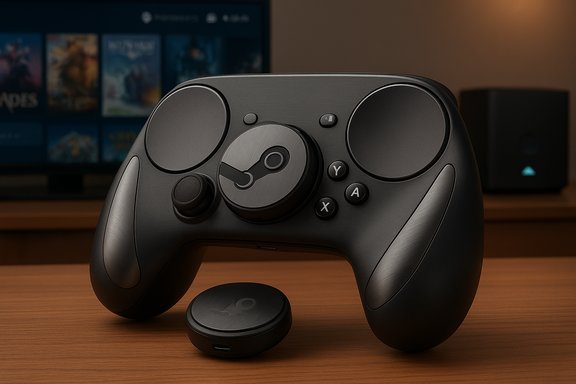
- The Steam Controller Puck is a small magnetic puck that attaches to the controller for charging and acts as a dedicated 2.4 GHz transmitter when plugged into a PC or Steam Machine via USB‑C.
- Valve specifies an end‑to‑end latency of ~8 ms and a measured 4 ms polling rate at 5 m, with support for up to four controllers per puck. That radio is built into the Steam Machine itself, but the included Puck provides plug‑and‑play compatibility for PCs and other devices that lack the radio.
TMR magnetic thumbsticks and capacitive touch
- Valve uses TMR (Tunnel Magneto‑Resistance) magnetic sensors in its thumbsticks to reduce mechanical wear and stick drift — a frequent complaint in analog sticks across the industry.
- The thumbsticks include capacitive touch to detect finger presence and pair with gyro and motion features; they are part of a larger Grip Sense system that uses capacitive strips along the grips to enable one‑handed gyro activation.
Dual trackpads, gyro, and Grip Sense
- The controller carries two 34.5 mm trackpads with pressure‑sensitive clicks and independent LRA haptic motors for high‑definition tactile feedback.
- The Grip Sense capacitive areas let the controller enable gyro aiming only when the player is holding the controller naturally, while releasing grip will return to stick/trackpad-only control — a useful guard against accidental gyro input.
High‑definition haptics and four motors
- There are four haptic motors in total: one LRA under each trackpad for fine tactile texture, and two high‑output motors in the grips for classic rumble and broad game haptics. Valve’s materials call these “HD tactile feedback” motors and claim fine waveform fidelity for nuanced in‑game signals.
Battery, dimensions, and comfort
- Valve lists an 8.39 Wh battery in the controller with a claimed 35+ hours of playtime under normal use, USB‑C charging (and charging via the Puck), and a weight around 292 g for the controller and 16 g for the puck. The controller’s shape and trigger geometry are intended for long sessions; four rear grip buttons are remappable via Steam Input.
Steam Input parity and ecosystem integration
Valve built the Steam Controller to match the Steam Deck’s input set so that community configurations, gyro mappings, and per‑game profiles will be largely transferable. The company’s messaging highlights that the controller will ship pre‑populated with community configs for thousands of titles, and Steam Input will handle remapping, macros, and complex layering. That means mouse and keyboard heavy games should have good day-one mappings for this pad via the existing Steam Deck configuration ecosystem. Cross‑device compatibility: Valve says the controller will work with Windows, macOS, Linux, Steam Deck, Steam Machine, and via Steam Link on iOS/Android — either via Bluetooth, USB‑C, or the puck. The Steam Machine includes the radio natively, so couch play will be particularly seamless with Valve’s own box. Steam Frame’s tracking will also use IR markers so the controller can be tracked in VR scenes as a 6‑DOF input for non‑VR titles viewed on a virtual screen.What journalists and hands‑on reviewers are saying
Early previews emphasize a polished feel and sensible ergonomics: the Steam Controller is described as a controller-first device that still retains the Steam Deck’s advanced inputs. Hands‑on coverage underlines the improved stick feel (magnetic sensors), the tactility of the trackpads, and the practical nature of the puck for couch setups. At the same time, reviewers flag the controller’s new features as only one half of the equation — developer adoption (for haptics and gyro) and Steam Input community support will determine the real success.Strengths: what Valve did right
- Input parity with Steam Deck — that immediately gives the controller access to thousands of community‑made configurations and proven mappings for mouse-centric games.
- Low‑latency dedicated radio via the Puck — delivering ~8 ms end‑to‑end latency is a meaningful improvement over typical Bluetooth and aligns with competitive expectations for responsive input.
- Magnetic TMR sticks — a clear hardware step to reduce drift and prolong accurate stick input without mechanical wear.
- Rich haptics + dual trackpads — layered feedback and pressure‑sensitive trackpads broaden the kinds of games you can play comfortably on a controller.
- Flexible connectivity — USB‑C, Bluetooth, and the Puck cover virtually every use case from wired pro play to couch gaming and mobile streaming.
Risks and unanswered questions
- Battery math and real‑world runtime
The published 8.39 Wh / 35+ hours spec is plausible for light Bluetooth usage, but sustained trackpad haptics, high‑frequency gyro sampling, or VR tracking will shorten that considerably. Valve explicitly notes tracked gameplay reduces runtime; buyers should treat the 35‑hour figure as an average under conservative settings rather than a guarantee. - Proprietary radio adoption and ecosystem fragmentation
The Puck offers clear performance advantages, but it’s an extra accessory and a proprietary radio path. One practical risk: users who prefer a single dongle across multiple platforms (or who lose the puck) may revert to Bluetooth, losing the low‑latency path. Cross‑platform OEMs and third‑party vendors will need to decide whether to include built‑in radios or rely on the puck model. If the puck becomes a required accessory for ideal performance on non‑Valve hardware, adoption could be fragmented. - Developer adoption of richer haptics and trackpad features
Hardware is only useful when developers use it. Valve’s haptics could be transformative if developers and middleware adopt LRA‑style waveforms and expose granular feedback channels; absent that, the extra motors may remain a niche feature leveraged primarily by Valve and a few partners. The trackpads’ pressure sensitivity and fine force feedback are useful, but third‑party dev buy‑in is not automatic. - SteamOS / anti‑cheat and cross‑platform parity
Valve’s messaging of “play every game on Steam” is aspirational. Proton and SteamOS compatibility have improved steadily, but online titles that depend on Windows‑only anti‑cheat or kernel‑level middleware may not behave identically on non‑Windows hosts. For couch players on SteamOS or Steam Machine, this remains a practical compatibility risk for certain competitive titles. Valve has worked with partners to close gaps, but this is an ecosystem problem, not a controller one. - Price and regional availability
Valve has not locked a final MSRP in its initial announcement. Price will be decisive: the controller’s feature set targets premium and prosumer buyers, but a high MSRP could limit mainstream adoption. Valve says hardware ships in early 2026 to existing Steam Deck regions and additional Komodo regions, but the full retail plan and bundles (controller + puck + Steam Machine bundles) will influence value perception.
How this fits into Valve’s broader strategy
This controller completes a strategic loop for Valve: it takes the Steam Deck’s most valuable software and community assets (Steam Input profiles, Proton compatibility, Big Picture/TV mode) and makes that capability available to living rooms and non‑handheld devices. The Steam Machine will house the puck radio natively, but the controller’s design also strengthens Valve’s cross‑device play narrative: one ecosystem, multiple form factors. Valve’s move signals that the company is building a hardware family rather than one hit product, and that the Steam Deck’s control philosophy — customizable, community‑driven, controller‑first input — will be a recurring theme across devices.Practical buying and testing checklist (for early adopters)
- Confirm your play profile: if you mostly play single‑player or story games, Bluetooth will probably meet your needs; competitive FPS players should test the puck to measure real latency improvement.
- Test gyro and Grip Sense in the return window: ensure the capacitive activation feels natural and doesn’t trigger unexpectedly while you reposition hands.
- Verify community configs for your most‑played titles: Steam Input sharing is powerful, but not every top‑down strategy or modded control scheme will be perfect on day one.
- Inspect haptic usage: try games that use subtle effects (racing, flight sims) and compare to traditional rumble for tactile richness.
- If VR is a priority, test with Steam Frame tracking: Valve warns that tracked gameplay will reduce battery life; test to confirm runtime meets your sessions.
Final verdict and what to watch next
Valve’s next‑gen Steam Controller is a sophisticated, feature‑dense gamepad built for a modern Steam ecosystem. It blends industry‑leading hardware choices (magnetic TMR sticks, capacitive Grip Sense), flexible connectivity (USB‑C, Bluetooth, and Valve’s Puck radio), and deep software integration (Steam Input parity with the Deck). These strengths position it to be the best controller for Steam‑centric players who want one device that works across PC, TV, and Valve’s new hardware. Caveats remain: the practical benefits depend on developer adoption of advanced haptics and trackpad features, the puck’s real‑world wireless performance in crowded RF environments, and whether Valve prices the controller competitively enough to reach beyond enthusiasts. The battery spec (8.39 Wh / 35+ hours) is reasonable on paper but will vary widely with usage patterns — expect significantly lower life when using high‑resolution haptics, gyro, or VR tracking. Those variables are the difference between a controller that changes how you play and a feature‑rich peripheral with limited real‑world payoff. Watch for three key moments before deciding to buy: (1) final MSRP and bundle options, (2) independent latency and battery tests using the Puck and Bluetooth, and (3) early community profiles and developer haptic support for the titles you care about. If Valve nails those points, the Steam Controller could become the default controller for people who live inside Steam’s ecosystem — and for anyone who wants precise, drift‑resistant sticks and mouse‑grade trackpad control in a familiar gamepad shell.Conclusion
The next‑gen Steam Controller is a deliberate, technically ambitious attempt to make the full weight of Steam’s input ecosystem available beyond the Deck. Its Steam Controller Puck, TMR magnetic sticks, Grip Sense, and four‑motor HD haptics are concrete hardware steps toward a universal Steam playstyle. Yet this hardware’s impact depends on the less glamorous work that follows: testing in reviewers’ labs, developer adoption of richer haptics and trackpad features, and Valve’s ability to ship software and firmware updates that translate hardware potential into everyday improvements. For now, it’s a promising synthesis of Valve’s best ideas in input design — but the real story will be written by latency tests, batteries under load, and the Steam community’s willingness to build and share configurations that showcase what the controller can do.
Source: Windows Report Everything to Know About Valve's Next-Gen Steam Controller
