

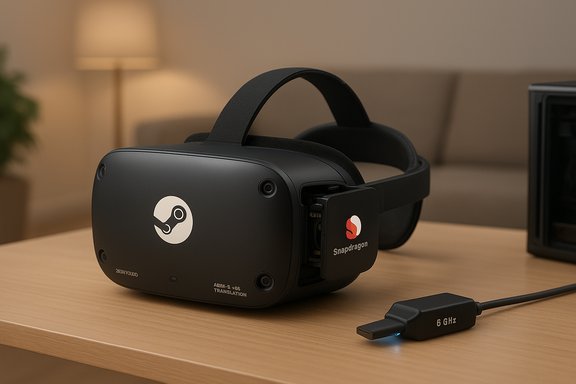
Valve’s surprise hardware salvo landed with a pragmatic twist: the Steam Frame, a Snapdragon-powered, standalone SteamOS VR headset that also runs traditional Steam games and streams PC titles — and in doing so Valve has quietly opened a path for Arm-based SteamOS devices that could reshape the handheld gaming landscape. The Steam Frame’s use of a 4nm Snapdragon SoC, 16 GB of unified RAM, and a SteamOS build that includes an Arm translation/emulation layer marks the first time Valve has shipped SteamOS on Arm silicon, and that technical milestone has consequences well beyond virtual reality.
Valve’s new hardware lineup comprises three pieces meant to work together: a refreshed Steam Controller, a compact living‑room "Steam Machine" PC, and the Steam Frame headset. The Steam Frame is the smallest of the three but the one with the broadest architectural implications: it runs SteamOS on a Snapdragon Arm SoC (widely reported as Snapdragon 8 Gen 3 in hands‑on coverage), pairs that to 16 GB LPDDR5(X) memory, and offers local app execution plus a low‑latency streaming mode to a PC via a dedicated wireless dongle. Multiple hands‑on previews and Valve’s own spec sheets show a per‑eye 2160×2160 LCD panel, pancake optics, six cameras (four outward-facing for tracking and two inward for eye tracking), and a 21.6 Wh internal battery — all packed into a modular core that Valve describes as purposefully lightweight and upgradeable. This is important for two reasons. First, Valve has validated that SteamOS can run on Arm hardware while still offering Proton compatibility and other Steam features; second, a production SteamOS device using Qualcomm silicon removes a major software barrier for OEMs considering Snapdragon-based gaming handhelds or compact PCs running SteamOS in the future. That’s an architectural opening that extends beyond one VR headset — it signals Valve’s willingness to broaden SteamOS to an Arm-centric ecosystem.
That doesn’t mean Arm handheld dominance is imminent. Performance trade‑offs, anti‑cheat compatibility, and battery/thermal realities will keep x86 and Windows relevant for many gamers for the medium term. But Valve’s move does change the calculus: OEMs now have a live reference design and a validated software stack for Arm, and that makes Snapdragon‑based SteamOS handhelds a credible product path — not just a speculative idea. The Steam Frame’s arrival therefore reads as both a practical VR product and a strategic foundation for an Arm-friendly future in portable PC gaming.
Source: Windows Central https://www.windowscentral.com/hard...e-snapdragon-xr-headset-steam-os-arm-support/
 Background / Overview
Valve’s new hardware lineup comprises three pieces meant to work together: a refreshed Steam Controller, a compact living‑room "Steam Machine" PC, and the Steam Frame headset. The Steam Frame is the smallest of the three but the one with the broadest architectural implications: it runs SteamOS on a Snapdragon Arm SoC (widely reported as Snapdragon 8 Gen 3 in hands‑on coverage), pairs that to 16 GB LPDDR5(X) memory, and offers local app execution plus a low‑latency streaming mode to a PC via a dedicated wireless dongle. Multiple hands‑on previews and Valve’s own spec sheets show a per‑eye 2160×2160 LCD panel, pancake optics, six cameras (four outward-facing for tracking and two inward for eye tracking), and a 21.6 Wh internal battery — all packed into a modular core that Valve describes as purposefully lightweight and upgradeable. This is important for two reasons. First, Valve has validated that SteamOS can run on Arm hardware while still offering Proton compatibility and other Steam features; second, a production SteamOS device using Qualcomm silicon removes a major software barrier for OEMs considering Snapdragon-based gaming handhelds or compact PCs running SteamOS in the future. That’s an architectural opening that extends beyond one VR headset — it signals Valve’s willingness to broaden SteamOS to an Arm-centric ecosystem. What the Steam Frame actually is (and isn’t)
A hybrid: standalone headset + streaming client
The Steam Frame is designed to be both an independent device and a low-latency streaming client. Locally, it can run Arm-native and Android VR apps, and — through Valve’s compatibility layers — it can also execute many non‑VR Steam titles. For heavier PC workloads, Valve bundles a dedicated wireless adapter (6 GHz / Wi‑Fi 6E/7 class) that provides a direct link to a host PC, with foveated streaming driven by eye tracking to save bandwidth and reduce encoded pixel load where the user isn’t looking. Hands‑on reviews emphasize the “two‑mode” approach: local Arm execution for mobile AR/VR-style experiences, and PC-streaming for GPU‑heavy games.Hardware highlights
- SoC: 4nm Snapdragon family — hands‑on reports indicate Snapdragon 8 Gen 3 as the likely chip powering the core.
- Memory & storage: 16 GB unified LPDDR5(X); 256 GB / 1 TB UFS options; microSD expansion.
- Displays & optics: Pancake optics with 2160×2160 LCD per eye; refresh rates from 72 Hz to 120 Hz (144 Hz listed as experimental).
- Tracking & cameras: 4 external monochrome cameras for inside‑out tracking, 2 inward cameras for eye tracking, and an IR illuminator for low light.
- Battery & weight: Core module ~185–190 g, 440 g with strap and battery; 21.6 Wh battery.
Why the Arm / Snapdragon choice matters
SteamOS on Arm: the technical first step
Until this announcement, official SteamOS devices were effectively x86-only. Porting the OS and Proton compatibility stack to Arm is a significant engineering lift: Valve needed translation/emulation to run x86 binaries, driver work for Qualcomm XR silicon, and revalidation of Proton/Proton‑FEX behavior under an Arm userland. Tom’s Hardware and other outlets reported that Valve is shipping a translation layer (FEX / “Fex” in coverage) to run x86 desktop games on Arm — a complex software engineering project that now exists in a real retail device. Cross‑platform compatibility on Arm has been the missing piece preventing many OEMs from shipping SteamOS on Snapdragon hardware; Valve’s validation reduces that friction. OEMs now have a working Stack: SteamOS (Arm build) + Proton + FEX for games + Qualcomm XR hardware, plus the commercial precedent of Valve signing off on a Snapdragon device. In short: the “software proof” is done.What this could mean for handhelds
The obvious next inference is a Snapdragon-powered SteamOS handheld. Qualcomm markets XR and gaming-capable SoCs and has publicly signaled ambitions for handheld gaming silicon. With Steam Frame proving Arm compatibility end-to-end, OEMs could theoretically build a Snapdragon handheld that boots SteamOS natively rather than shipping Windows on x86. That’s not a guaranteed product launch today, but the path is open and the operational obstacles far smaller. Windows Central framed this as “laying the foundations for an Arm-based gaming handheld future,” and that assessment fits the engineering realities Valve has now shown.Cross‑checked technical claims (what we can verify now)
To avoid taking marketing claims at face value, multiple independent outlets were checked against Valve’s spec sheets and early hands‑on previews:- The per‑eye 2160×2160 LCD panels and pancake optics appear in Valve’s spec sheet and are corroborated by PC Gamer and Tom’s Hardware reporting.
- The SoC identification as a Snapdragon 8 Gen 3 (4nm) is stated in several hands‑on pieces; Tom’s Hardware and PC Gamer independently name that chip family. Valve’s public text calls it a 4nm Snapdragon SoC without committing to the exact SKU in some messaging, but reporting converges on Snapdragon 8 Gen 3.
- Wireless streaming using a 6 GHz link and foveated streaming driven by eye tracking has been demonstrated and described in Valve’s reveal; Ars Technica and PC Gamer reviewed the streaming concept and noted the bundled adapter for low‑latency PC link.
Strengths: where Valve’s play is strong
- Platform-level validation for Arm SteamOS. This is the single most consequential outcome: Valve shipping SteamOS on Qualcomm silicon removes a big software barrier for Arm handhelds and small form factor machines. That’s a strategic ripple far beyond the headset category.
- Flexible use cases. Steam Frame can be a standalone VR device, a display for native (Arm/Android) titles, and a high‑fidelity streaming client. That versatility is attractive for gamers who want both mobility and access to PC GPU power.
- Smart streaming integration. Foveated streaming tied to eye‑tracking is a technically clever way to reduce bandwidth and CPU/GPU work on the host encoder while keeping perceived quality high where it matters. Valve’s inclusion of a dedicated wireless adapter is a practical answer to Wi‑Fi variability.
- Controller and input parity strategy. The new Steam Controller (and its Puck radio) and the Steam Machine ecosystem show Valve is thinking holistically about input latency, mapping parity, and cross‑device play. Low-latency radios and standardized mappings reduce friction for players moving between Deck, Frame, and living‑room Steam Machines.
Risks, caveats and the hard engineering tradeoffs
1) Performance and translation overhead
Running legacy x86 games on Arm via Proton + a translation/emulation layer (FEX) introduces overhead. While Valve has optimized for this scenario, emulation cannot be free — expect some performance and battery penalties on titles that were tuned for x86. For CPU‑bound workloads, the Snapdragon can’t match higher‑wattage laptop GPUs; for GPU‑bound games the integrated Adreno/Qualcomm GPU (or XR‑class GPU blocks) will be constrained compared with desktop GPUs. Independent benchmarks will be the only way to measure usability for demanding non‑VR titles when run locally.2) Battery life and thermal limitations
A wearable form factor magnifies thermal and power constraints. The listed 21.6 Wh battery is modest, and published hands‑on reports caution that real‑world battery life varies widely by workload. Streaming tends to be power‑cheaper than local GPU rendering but requires a nearby PC and the bundled radio; local gaming will drain the battery much faster. External day‑to‑day convenience will hinge on Valve’s thermal controls, power profiles, and whether users accept external battery packs for extended sessions.3) Streaming latency and VR sickness risk
Wireless latency in VR is unforgiving. Valve’s low‑latency radio and foveated streaming mitigate this, but any non‑trivial increase in end‑to‑end latency can cause discomfort and break immersion. Valve’s promised numbers are encouraging, yet independent latency measurements under realistic home network conditions will be decisive. The absence of a wired PC‑link option (Valve says it’s focused on wireless) is a deliberate design choice that increases streaming’s importance — and therefore its exposure to home Wi‑Fi variability.4) Software compatibility, anti‑cheat, and multiplayer titles
SteamOS’s biggest historical Achilles’ heel has been kernel‑level anti‑cheat and publisher middleware that assume Windows. Running multiplayer, competitive titles that depend on Windows anti‑cheat systems remains a risk on SteamOS, even with Proton progress. Valve’s FEX layer adds complexity rather than native support, and publishers may be slow to certify or test on Arm/translated stacks. For players focused on competitive multiplayer, Windows will likely remain the safer choice for the near term.5) Marketing claims and “6×” language
Valve’s sibling announcement — the Steam Machine — carried a “6× more powerful than the Steam Deck” claim that multiple outlets quickly contextualized as a marketing shorthand tied to synthetic compute metrics and higher thermal budgets rather than a guarantee of native 4K/60 across all modern titles. Marketing multipliers should be treated with caution until independent benchmarks verify real‑world outcomes.What this means for Microsoft, OEMs and Windows on Arm
Microsoft’s recent deprioritization of first‑party XR hardware (HoloLens production was discontinued and support timelines extended, per reporting) leaves a market where Apple, Meta, Samsung and now Valve are the principal consumer XR hardware players. Valve’s arrival with a Snapdragon SteamOS device widens the ecosystem and may create additional pressure for Microsoft to tune Windows on Arm and handheld UX if it wants to compete in this form factor. For OEMs, Valve’s proof of concept reduces the “software risk” in shipping Arm-based SteamOS devices. We can imagine several plausible near‑term outcomes:- OEMs offer Snapdragon SteamOS handhelds that prioritize battery life and Steam‑native play.
- OEMs ship hybrid SKUs (SteamOS or Windows) to capture both ecosystems, as Lenovo has experimented with in prior launches.
- Windows on Arm OEMs accelerate efforts to ship Snapdragon Windows gaming devices, but those will face the additional burden of Windows optimization and anti‑cheat compatibility unless Microsoft makes further platform changes.
The practical buyer’s view: what gamers should expect
- Expect Valve’s Steam Frame to be a premium, niche device focused on flexibility rather than long battery sessions. It targets players who value a wireless, comfortable headset that can both run VR experiences locally and stream PC titles.
- If your priorities are competitive multiplayer titles with Windows‑centric anti‑cheat, keep a PC in the loop: streaming a Windows PC will be required for some titles. Native local play on Arm may be limited for these titles at launch.
- If you’re an enthusiast who enjoys tinkering, Valve’s modular core and the likelihood of a vibrant third‑party accessory scene are attractive. But plan for firmware and software iterations over the first months of retail availability.
Roadmap and what to watch next
- Independent benchmarks and long‑term battery/thermal tests from reputable outlets. Those will prove or disprove claims about local game performance under Proton + FEX and streaming latency in realistic home networks.
- Valve’s documentation and SDK for developers: how easy will it be to package and optimize titles for Arm SteamOS or to ship Android/VR titles through Steam? Early dev tooling and conversion guidance will determine ecosystem momentum.
- OEM announcements of Snapdragon handhelds running SteamOS or Windows on Arm. Valve’s proof reduces friction, but OEMs must commit to driver support and long-term maintenance.
- Publisher/anti‑cheat vendor roadmaps for Linux/Proton and Arm compatibility. Real mass adoption of SteamOS‑first handhelds depends on broad anti‑cheat support.
Conclusion: incremental platform shift with outsized implications
Valve’s Steam Frame is more than a headset; it’s a platform statement. By shipping SteamOS on a Snapdragon Arm SoC with a working translation layer and a practical streaming model, Valve has removed a major software barrier that kept SteamOS and Arm worlds separate. That alone is a strategic win: it signals to OEMs and chipmakers that Valve is ready to support Arm as a first‑class target for gaming devices.That doesn’t mean Arm handheld dominance is imminent. Performance trade‑offs, anti‑cheat compatibility, and battery/thermal realities will keep x86 and Windows relevant for many gamers for the medium term. But Valve’s move does change the calculus: OEMs now have a live reference design and a validated software stack for Arm, and that makes Snapdragon‑based SteamOS handhelds a credible product path — not just a speculative idea. The Steam Frame’s arrival therefore reads as both a practical VR product and a strategic foundation for an Arm-friendly future in portable PC gaming.
Source: Windows Central https://www.windowscentral.com/hard...e-snapdragon-xr-headset-steam-os-arm-support/
