

VAST Data’s AI Operating System is coming to Microsoft Azure, a move that promises to unify data and AI pipelines across on‑premises, hybrid, and multi‑cloud environments while plugging VAST’s data services directly into Azure’s infrastructure and toolchain. Announced at Microsoft Ignite, the collaboration makes VAST’s unified storage, cataloging, compute fabric, and database capabilities available to Azure customers, and positions VAST’s platform as a turnkey option for organizations building large‑scale, agentic AI workflows.
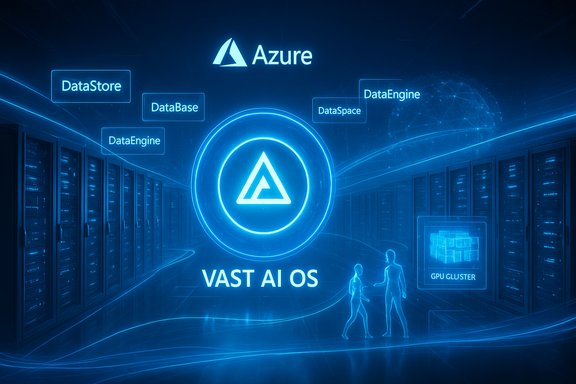
VAST Data has positioned itself in recent years as a vendor building a software‑first “AI Operating System” that collapses storage, database, and real‑time compute into a single platform designed for massive scale and continuous AI workloads. The company’s product messaging emphasizes a global namespace (DataSpace), a unified storage layer (DataStore) that supports file, object, and block protocols, an in‑place compute fabric (DataEngine with InsightEngine and AgentEngine), and a transactional, warehouse‑class DataBase for real‑time queries and vector workloads. VAST’s public materials describe an architecture they call Disaggregated, Shared‑Everything (DASE) and claim features such as built‑in Similarity Reduction to reduce storage footprint for large embedding stores. VAST’s commercial growth and market relevance were already visible in 2025 through major cloud and service deals and venture activity; independent reporting has documented large commercial agreements and rapid ARR growth for the company, underlining why cloud hyperscalers and enterprise customers are watching VAST closely.
For IT leaders and architects, the sensible path is to treat this as an opportunity to pilot and validate: obtain a clear compatibility matrix from VAST and Microsoft, conduct reproducible benchmarks on the exact Azure SKUs you plan to use, and model the long‑term economics including network egress, metadata overhead, and the real impact of Similarity Reduction on your embedding datasets. If those verifications check out, the VAST AI OS on Azure could shorten time‑to‑value for sophisticated agentic AI systems and reduce the operational sprawl that plagues many modern AI stacks.
Source: Techzine Global VAST Data brings AI Operating System to Microsoft Azure
 Background
VAST Data has positioned itself in recent years as a vendor building a software‑first “AI Operating System” that collapses storage, database, and real‑time compute into a single platform designed for massive scale and continuous AI workloads. The company’s product messaging emphasizes a global namespace (DataSpace), a unified storage layer (DataStore) that supports file, object, and block protocols, an in‑place compute fabric (DataEngine with InsightEngine and AgentEngine), and a transactional, warehouse‑class DataBase for real‑time queries and vector workloads. VAST’s public materials describe an architecture they call Disaggregated, Shared‑Everything (DASE) and claim features such as built‑in Similarity Reduction to reduce storage footprint for large embedding stores. VAST’s commercial growth and market relevance were already visible in 2025 through major cloud and service deals and venture activity; independent reporting has documented large commercial agreements and rapid ARR growth for the company, underlining why cloud hyperscalers and enterprise customers are watching VAST closely. What Microsoft and VAST are delivering on Azure
What’s included from the VAST side
- VAST AI Operating System — a unified software platform that bundles DataStore, DataBase, DataSpace and DataEngine (InsightEngine, AgentEngine, SyncEngine).
- DataStore — single namespace supporting file (NFS, SMB), object (S3), and block protocols so legacy apps and modern cloud‑native services can co‑exist without data copies.
- DataBase — a transactional, real‑time query engine that indexes data and vector embeddings to enable ML‑ready search and RAG patterns.
- DataEngine (InsightEngine & AgentEngine) — serverless, stateless compute close to the data for accelerating vector search, RAG pipelines, data preparation, and orchestration of autonomous agents that act on real‑time streams.
- DataSpace (global namespace) — an exabyte‑scale fabric that claims to eliminate traditional data silos and enable seamless mobility between on‑prem and cloud without reconfiguration.
How it runs on Azure
VAST will deliver the AI OS as software that runs on Azure infrastructure and is managed with native Azure controls — customers will be able to deploy and operate VAST using the same tools, governance, security, and billing frameworks they use for other Azure services. The platform is described as able to burst on‑premises workloads into Azure GPU clusters for training and inference without data migration, through high‑throughput services, caching, and metadata‑optimized I/O. Microsoft’s quoted comments emphasize a shared vision to accelerate “agentic AI” — that is, systems composed of many autonomous agents that reason over large data sets — and highlight the intention to align VAST with Azure’s GPU‑accelerated infrastructure. The announcement cites Azure infrastructure features as part of the integration.Technical deep dive: how VAST’s components map to Azure workflows
Data locality and in‑place compute (InsightEngine, AgentEngine)
VAST places compute logically next to the storage layer via its DataEngine and CNode compute model, enabling functions, triggers, and managed services (Trino, Spark) to run without moving data. On Azure this is intended to shorten the RAG and preprocessing path: embeddings and vector search can execute where the data lives, lowering latency and reducing cloud egress and repeated I/O. For real‑time pipelines and millions of concurrent inference or agent operations, that architecture can substantially reduce operational complexity versus multi‑system stacks.Unified access and the DataSpace promise
The DataSpace is marketed as a global namespace spanning edge, on‑premises, and cloud, keeping a single logical view of files, objects and blocks. For enterprises this promises one of the most attractive features: no forced data migration to use cloud GPUs, instead allowing “bursting” of GPU workloads into Azure while leaving primary data stores where they are. This is particularly compelling for regulated environments and data‑gravity‑sensitive workloads.Protocol support and direct GPU access
VAST’s product literature explicitly lists support for NFS, SMB, S3, NVMe‑over‑TCP, and a claim of direct GPU access via concepts like GPUDirect. Those capabilities are central to high‑performance ML pipelines where the I/O path and RDMA/GPUDirect support can be decisive for training and large‑model inference latency. On Azure, the actual availability of those features depends on the selected VM family, networking capabilities (RDMA, Accelerated Networking), and driver stack; architects must validate SKUs and network features for compatibility.DASE (Disaggregated, Shared‑Everything)
DASE separates compute and storage so each can scale independently — a pattern that appeals to AI workloads where GPU fleets and storage pools have different growth curves. In cloud environments, independent scaling aims to reduce stranded resource costs and improve utilization, because customers can right‑size GPU clusters without replicating storage capacity. VAST also highlights Similarity Reduction, a data‑reduction technique intended to shrink the footprint of redundant or highly similar embeddings, which has direct influence on long‑term storage TCO for massive vector indexes.What’s new vs. what’s marketing — verification and caveats
The collaboration is real and announced publicly by VAST at Microsoft Ignite; that is the central, verifiable claim. VAST’s product documentation and press materials corroborate the platform functions described in the announcement: DataStore, DataBase, DataEngine, DataSpace, DASE, and related features are VAST’s core offering. At the same time, several specific infrastructure terms used in the announcement merit caution:- The announcement mentions a “Laos VM Series” and “Azure Boost Accelerated Networking.” Those specific product names are not widely documented in Microsoft public VM or networking documentation and may be internal or marketing‑level phrases rather than exact public SKUs. Microsoft’s public VM families and Accelerated Networking features (ND, NC, HB, etc. are well documented, and architects should insist on SKU‑level compatibility matrices and validated reference architectures before committing to production rollouts. Treat these named infrastructure items as vendor phrasing that requires concrete validation.
- Performance claims such as “keeps Azure GPU clusters saturated” or “instant scale without reconfiguration” are workload‑dependent. Vendor benchmarks are directional and helpful, but independent, reproducible tests on representative datasets — including model sizes, concurrency, and network topologies — are required to validate those claims in a customer environment.
- GPUDirect and RDMA‑style paths depend on the underlying cloud VM and NIC drivers. Azure supports RDMA and NIC acceleration on certain VM families and configurations, but customers must confirm that any required features (e.g., GPUDirect CUDA stack, SR‑IOV, InfiniBand) are available and supported on the selected Azure SKUs and regions.
Practical benefits for enterprise AI teams
- Consolidation of data silos — one global namespace reduces the need to copy, transform, and stage datasets across systems for RAG and retrieval‑augmented workflows.
- Simplified toolchain — native support for NFS/SMB/S3 and managed compute (Trino, Spark) on the same platform reduces ETL overhead and integration complexity.
- Faster RAG and embedding workflows — local vector search and in‑place compute lower latency for retrieval and reduce repeated read costs on large corpora.
- Elastic burst to cloud GPUs — the promise to burst into Azure GPU clusters without wholesale data migration can accelerate experimentation and scale model training when on‑prem capacity is exceeded.
- Cost controls via disaggregation — independent scaling of compute and storage plus deduplication/similarity reduction can materially improve utilization and TCO for long‑running embedding databases.
Risks, unknowns, and operational considerations
- SKU and compatibility risk — customers must obtain a validated compatibility list from Microsoft and VAST that enumerates exact Azure VM SKUs, GPU types, NIC features, and regions where the integration is supported. Marketing names are insufficient for procurement and architecture.
- Network and egress costs — hybrid and multi‑cloud fabrics reduce data movement but do not remove networking costs for cross‑region or cross‑cloud traffic. Architects should model egress and interconnect costs for realistic traffic patterns.
- Vendor performance variability — performance improvements will vary with dataset shape (small files vs. large objects), access patterns, vector dimensionality, and GPU topology. Reproducible benchmarks are mandatory.
- Operational complexity and observability — running an integrated OS that spans on‑prem and Azure requires mature observability for storage metadata, caching behavior, and agent orchestration; operational processes and runbooks must be extended to cover the VAST control plane.
- Lock‑in and migration — while VAST pitches a software‑first, portable model, adopting DASE and DataSpace semantics will inevitably create operational dependencies. Exit and migration plans should be scoped and priced before large‑scale adoption.
What IT architects should ask VAST and Microsoft before pilot
- Provide a validated Azure SKU compatibility matrix listing exact VM sizes, GPU models, NIC capabilities (RDMA, Accelerated Networking), and supported regions.
- Share reference architectures and deployment templates (ARM/Bicep/Terraform) that demonstrate a full hybrid burst scenario, including network topology diagrams and firewall/NAT rules.
- Request raw benchmark data and reproducible test scripts for: embedding ingestion throughput, vector search QPS/latency under concurrency, and training‑time I/O throughput on the proposed Azure SKUs.
- Confirm support matrix for GPUDirect and driver stacks on the specified Azure VM instances (including tested OS images and GPU driver versions).
- Obtain an explicit SLA and escalation path covering cross‑cloud failover, metadata consistency, and disaster recovery for the DataSpace namespace.
A recommended verification and pilot plan (step‑by‑step)
- Define representative workloads: choose a training job, a RAG pipeline, and an embedding store with live read/write patterns.
- Provision exact Azure SKUs from the vendor compatibility list and reproduce the network topology the vendor recommends.
- Run ingestion tests measuring sustained write throughput, metadata operation latency, and embedding creation speeds. Capture NVMe/NIC metrics during runs.
- Run retrieval benchmarks: measure P99 and median latencies for vector search at increasing concurrency, and run model inference pipelines to observe end‑to‑end latency.
- Run a mixed workload: combine background training checkpoints and high‑QPS inference to validate that caching and metadata‑optimized I/O behave under contention.
- Model TCO: include storage footprint pre‑ and post‑Similarity Reduction, egress costs, and GPU utilization rates to compute realistic OPEX for 12–36 months.
- Conduct failure mode tests: simulate an Azure region outage or on‑prem network partition and validate failover semantics for DataSpace.
Market context and implications
VAST’s move onto Azure is consistent with the broader market trend: cloud providers and specialized data‑platform vendors are converging to offer integrated stacks for generative and agentic AI. For enterprises, the combination of an OS‑style platform with cloud elasticity promises faster iteration and simpler operations, particularly for complex RAG and agentic deployments. VAST’s recent commercial traction — including large deals and ARR growth reported by independent outlets — demonstrates the vendor’s momentum and explains why hyperscale clouds are engaging strategically. For Microsoft, enabling more choices for data and model pipelines strengthens Azure’s position against hyperscale rivals by offering differentiated infrastructure options and partner ecosystems that support diverse enterprise needs. For customers, the key practical differentiator will be how well these integrated stacks translate into reproducible performance, predictable costs, and operational simplicity in their specific environments.Final analysis: strengths, opportunities and risks
Strengths
- Unified platform model reduces integration overhead and appeals to teams that struggle with prolonged ETL and duplicated storage across databases, object stores and vector indices.
- Agentic AI focus aligns with many enterprise initiatives to build autonomous workflows that require continuous ingestion and reasoning over live data. VAST’s AgentEngine and InsightEngine are explicit design choices for those use cases.
- Hybrid burst model is attractive for regulated or data‑gravity‑heavy customers who need to keep primary data on‑prem while leveraging cloud GPUs for transient compute.
Opportunities
- Faster time‑to‑production for RAG and retrieval workflows if in‑place compute and unified metadata reduce development friction.
- Cost reduction via disaggregated scaling and similarity reduction for embedding stores — if validated on real‑world datasets.
Risks and unknowns
- SKU ambiguity around Azure infra names used in the announcement; customers must demand SKU‑level clarity and validated configurations. This is the most actionable risk for procurement and architecture.
- Benchmark variability — vendor claims are directional; independent validation remains necessary for production commitments.
- Operational dependency on a single vendor’s semantics for DataSpace and DataBase may complicate future migrations; lock‑in risk should be quantified.
Conclusion
VAST Data’s announcement that its AI Operating System will be available on Microsoft Azure marks a notable step in the evolution of enterprise AI infrastructure: unified storage, a global namespace, and an in‑place compute fabric delivered within a major cloud ecosystem promises to simplify many large‑scale AI workflows. The offering aligns with current market demands for RAG, embedding‑heavy search, and agentic AI. However, the strategic value for any given organization will hinge on two practical verifications: SKU‑level compatibility with Azure’s GPU and networking offerings, and reproducible performance and cost outcomes on representative workloads.For IT leaders and architects, the sensible path is to treat this as an opportunity to pilot and validate: obtain a clear compatibility matrix from VAST and Microsoft, conduct reproducible benchmarks on the exact Azure SKUs you plan to use, and model the long‑term economics including network egress, metadata overhead, and the real impact of Similarity Reduction on your embedding datasets. If those verifications check out, the VAST AI OS on Azure could shorten time‑to‑value for sophisticated agentic AI systems and reduce the operational sprawl that plagues many modern AI stacks.
Source: Techzine Global VAST Data brings AI Operating System to Microsoft Azure
