

Veeam Software is using a recent Microsoft 365 risk-management message to argue that accidental deletion, stale data, fragmented investigations, and AI-driven mistakes are becoming operational resilience problems for organizations that depend on Exchange, SharePoint, OneDrive, Teams, and Entra ID. That is not a new pitch for the backup vendor, but it is a sharper one. The company is no longer selling only the comfort of restore points; it is selling the ability to understand what happened quickly enough for recovery to matter. In a Microsoft 365 world increasingly shaped by Copilot, retention policies, security tooling, and compliance pressure, that distinction matters.
The old version of the Microsoft 365 backup argument was simple: users delete things, ransomware happens, and Microsoft’s built-in retention features are not the same as an independent backup. That argument still holds, but it undersells the problem. Microsoft 365 is no longer merely a cloud mailbox and file-share replacement; it is the collaboration substrate for modern work.
When an employee deletes a mailbox item, changes a SharePoint library, misconfigures a retention rule, or loses a Teams-connected file, the incident is rarely isolated. The data may be connected to a workflow, a legal hold, a security investigation, a customer response, or an AI-generated summary. The operational question is not just “Can we get the item back?” It is “Can we prove what changed, who changed it, whether the change matters, and how far the damage spread?”
That is the space Veeam is trying to occupy. Its post, as summarized by TipRanks, points to accidental deletions, redundant or obsolete data, and AI-related errors as factors that slow down root-cause analysis when teams bounce between multiple tools. The investor-facing reading is obvious: Veeam wants to be seen not only as a backup company, but as a resilience platform sitting inside one of the most durable enterprise software ecosystems on the planet.
For WindowsForum readers, the more interesting story is practical. Microsoft 365 has become so central to identity, productivity, and compliance that backup can no longer be treated as a quiet background job. It has become part of incident response.
That model is often misunderstood because Microsoft 365 is so reliable day to day. When Exchange Online works, SharePoint syncs, and Teams meetings start on time, users assume the data is safe in the same way they assume a local file server snapshot was safe. But availability is not the same as recoverability, and retention is not the same as backup.
Retention policies are designed to preserve or remove content according to governance rules. Backup is designed to restore a known-good state after loss, corruption, misconfiguration, or attack. The distinction sounds academic until a legal team needs a deleted item, a finance team needs a prior version, or a security team needs to unwind a compromised account’s changes.
Veeam’s positioning leans hard into that gap. Its Microsoft 365 products cover Exchange, SharePoint, OneDrive, Teams, and increasingly Entra ID-related data, with messaging around granular recovery, customizable retention, and visibility into protected and unprotected objects. The pitch is that Microsoft 365’s native capabilities are necessary but not always sufficient for organizations that need independent recovery and investigation workflows.
The counterpoint is that not every tenant needs a third-party backup product in the same way. A small organization with simple retention needs and low regulatory exposure may reasonably lean on Microsoft’s built-in capabilities. But as the number of users, workloads, administrators, compliance rules, and automation layers grows, the odds increase that someone will need an independent copy and a faster way to understand the blast radius of a change.
This is where the Microsoft 365 backup conversation changes character. In the past, the worst-case scenario was often framed as data loss: a missing email, a deleted folder, a corrupted file, a ransomware event. In an AI-enabled tenant, bad data can also become bad context. A Copilot-style tool that draws from old documents, poorly permissioned files, or obsolete project material may produce outputs that look authoritative while resting on shaky ground.
That does not mean AI makes Microsoft 365 unsafe by default. It means the tenant’s data hygiene suddenly matters more visibly. Redundant, obsolete, and trivial data used to be a storage and compliance annoyance. Now it can become part of the knowledge layer that employees query and trust.
Veeam’s mention of AI-related errors is therefore strategic. The company is connecting backup and recovery to a broader anxiety among CIOs and CISOs: once AI is allowed to reason over enterprise content, organizations need stronger confidence in the state, lineage, and recoverability of that content. Backup becomes less like insurance and more like an audit trail for operational reality.
A help desk technician may see the user’s complaint. A SharePoint admin may see version history. A security analyst may see sign-in anomalies. A compliance officer may see retention behavior. A backup operator may see restore points. Each view is useful, but the organization still has to stitch them together under time pressure.
That stitching is where incidents become expensive. The longer it takes to determine whether a deletion was accidental, malicious, policy-driven, or caused by automation, the longer the business sits in uncertainty. In regulated environments, uncertainty becomes a reporting and evidence problem. In operational environments, it becomes downtime.
Veeam’s answer is to position visibility and recovery as a joined workflow. The implicit promise is that a data-protection platform should not merely store backup copies; it should help administrators locate affected objects, compare states, recover selectively, and produce confidence that the incident is contained. That is a more ambitious claim than “we can restore your mailbox,” and it reflects how the market is evolving.
The risk for customers is believing that any single product can erase complexity. Microsoft 365 tenants differ wildly. Hybrid identity, conditional access, sensitivity labels, retention policies, Teams sprawl, delegated administration, and third-party apps all complicate the picture. Better tooling helps, but it does not replace architecture, policy discipline, and regular recovery testing.
The company has spent years building credibility in backup and recovery, first through virtualization-heavy environments and later through cloud, Kubernetes, SaaS, and ransomware resilience. Microsoft 365 is a natural target because it combines huge installed base, recurring revenue potential, and real customer anxiety. Almost every organization has email and collaboration data it cannot casually lose.
Veeam’s newer positioning around Veeam Data Cloud for Microsoft 365 also reflects a broader shift in backup consumption. Many customers no longer want to build and maintain the entire backup infrastructure themselves, especially for SaaS workloads. They want a managed or service-like model with predictable pricing, storage included, and fewer moving parts.
That creates a cleaner commercial story. Instead of selling backup software as a tool that administrators must deploy, size, patch, monitor, and scale, vendors can sell resilience outcomes. The buyer is not only the backup admin; it may be the CIO, CISO, compliance lead, or line-of-business owner who cares about how quickly the organization can recover after a mistake or attack.
The challenge is that Microsoft itself is not absent from this market. Microsoft 365 Backup, Microsoft Purview, Defender, Entra, and the broader security and compliance stack all compete for attention and budget. Veeam’s opportunity is to argue that independent, specialized recovery still matters even when the platform owner expands its native capabilities.
When Microsoft enters a feature category, the immediate fear is commoditization. If backup becomes a native checkbox in the admin center, why pay another vendor? That argument will resonate with some customers, especially those that prefer consolidated billing and fewer suppliers.
But Microsoft’s participation can also expand the market. It tells customers that backup for Microsoft 365 is not a paranoid add-on invented by vendors; it is a real requirement even the platform owner acknowledges. Partners can then differentiate around depth, breadth, cross-workload recovery, management experience, independent storage choices, reporting, immutability, and support for complex environments.
Veeam appears to be taking the latter route. Its messaging emphasizes comprehensive protection across Microsoft 365 workloads, including data used by Copilot and AI agents, and it highlights the idea that organizations need control beyond the default service. The company also benefits from being known as a backup vendor rather than a general-purpose cloud suite provider.
That matters psychologically. In a serious recovery event, some administrators prefer a tool whose entire reason for existing is to restore data. Microsoft has the platform advantage, but independent vendors can still win trust by being narrowly obsessed with recoverability.
Backup for identity configuration is a different class of concern. Restoring a deleted file is one thing. Understanding and recovering from a bad identity change is another. Conditional access policies, group memberships, and app permissions can determine whether attackers retain access, whether users can work, and whether security controls function as intended.
Veeam’s Microsoft 365 portfolio increasingly talks about Entra ID protection alongside Exchange, SharePoint, OneDrive, and Teams. That is significant because it moves the discussion from content recovery to tenant resilience. The modern Microsoft 365 environment is a mesh of data, identity, policy, device posture, and collaboration context.
For sysadmins, this is where backup planning becomes less familiar. Traditional backup thinking is workload-centric: servers, databases, shares, mailboxes. Microsoft 365 resilience requires object and relationship thinking. A deleted group may affect Teams access, SharePoint permissions, application authorization, and compliance scope. A restore plan that does not account for those relationships can create false confidence.
The practical lesson is that Microsoft 365 backup scope should be reviewed as architecture, not procurement. If the tenant depends on Entra ID policies, Teams structures, SharePoint permissions, and automated workflows, the recovery strategy needs to match that dependency map.
The harder scenario is ambiguity. Was the missing file deleted by a user, removed by a retention policy, overwritten by sync, moved by automation, hidden by permissions, encrypted by malware, or affected by a service-side issue? Was the old version the correct version? Did the change affect one user, one site, one team, or an entire department?
Veeam’s emphasis on faster investigation workflows speaks to that ambiguity. Recovery without diagnosis can be dangerous. Restore the wrong thing, and you may overwrite legitimate work. Restore too broadly, and you may reintroduce unwanted data. Restore too slowly, and the business impact grows.
This is also where obsolete and redundant data matter. Data clutter is not just untidy; it makes investigation harder. If administrators must sift through years of poorly classified content, duplicate libraries, abandoned Teams, and unclear ownership, the recovery process becomes guesswork.
The industry sometimes talks about resilience as if it were a product SKU. In practice, resilience is a property of clean architecture, tested recovery, well-scoped permissions, understandable retention, and tooling that can produce evidence quickly. Veeam can help with part of that equation, but customers still own the hard governance work.
That changes how backup is justified. In the past, backup budgets often competed with more visible security investments. Firewalls, endpoint detection, identity protection, and phishing defense felt more urgent. Backup was the thing everyone agreed was important until renewal season arrived.
Ransomware changed that calculation by making recovery a board-level issue. SaaS sprawl is changing it again. If Microsoft 365 contains contracts, customer communications, intellectual property, HR records, financial documents, security logs, and AI-accessible knowledge stores, then Microsoft 365 recovery becomes part of enterprise risk management.
Veeam’s investor-facing signal is that this demand should be durable. Enterprises are unlikely to reduce dependence on Microsoft 365. They are unlikely to stop generating data. They are unlikely to face fewer governance demands. And they are unlikely to deploy AI into cleaner, simpler environments than the ones they already have.
That does not guarantee any one vendor a win. But it does explain why Veeam is making Microsoft 365 resilience a visible part of its story. The buyer’s concern has expanded from “Can I restore a file?” to “Can I keep the business accountable when the cloud becomes the system of record?”
The right response is not to dismiss the pitch. It is to translate it into operational questions. Which Microsoft 365 workloads are protected? How often are backups taken? Where are they stored? Who can delete or alter them? Can administrators restore granularly? Can they test restores without disrupting production? Can they recover permissions and metadata, not just content?
Organizations should also examine the gap between retention and recovery. A retention policy may satisfy one legal requirement while making another recovery scenario awkward. A litigation hold may preserve content but not provide the clean restore workflow a business unit expects. A recycle bin may help with simple deletion but not broader corruption or malicious activity.
The same scrutiny should apply to AI readiness. If Copilot or other AI tooling is enabled, administrators should understand what repositories are in scope, how permissions are inherited, which stale data remains discoverable, and how quickly problematic content can be removed or restored. Backup does not solve oversharing, but it can provide a safety net when cleanup or automation goes wrong.
Most importantly, recovery should be tested. Not demonstrated by a vendor in a webinar, not assumed from a dashboard, but tested against realistic scenarios. A restore plan that has never been exercised is a hope with a license key.
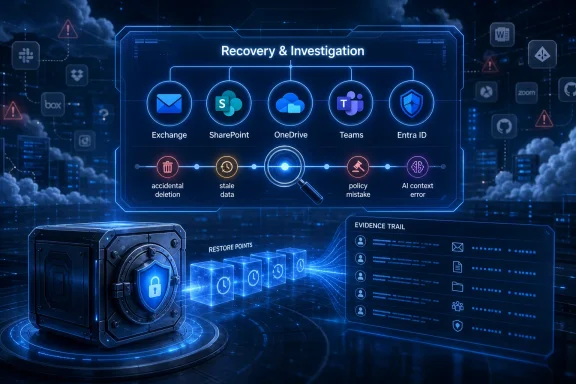 Microsoft 365 Has Become the Place Where Business Risk Hides in Plain Sight
The old version of the Microsoft 365 backup argument was simple: users delete things, ransomware happens, and Microsoft’s built-in retention features are not the same as an independent backup. That argument still holds, but it undersells the problem. Microsoft 365 is no longer merely a cloud mailbox and file-share replacement; it is the collaboration substrate for modern work.When an employee deletes a mailbox item, changes a SharePoint library, misconfigures a retention rule, or loses a Teams-connected file, the incident is rarely isolated. The data may be connected to a workflow, a legal hold, a security investigation, a customer response, or an AI-generated summary. The operational question is not just “Can we get the item back?” It is “Can we prove what changed, who changed it, whether the change matters, and how far the damage spread?”
That is the space Veeam is trying to occupy. Its post, as summarized by TipRanks, points to accidental deletions, redundant or obsolete data, and AI-related errors as factors that slow down root-cause analysis when teams bounce between multiple tools. The investor-facing reading is obvious: Veeam wants to be seen not only as a backup company, but as a resilience platform sitting inside one of the most durable enterprise software ecosystems on the planet.
For WindowsForum readers, the more interesting story is practical. Microsoft 365 has become so central to identity, productivity, and compliance that backup can no longer be treated as a quiet background job. It has become part of incident response.
The Shared Responsibility Model Is Still Doing a Lot of Work
Every vendor in the Microsoft 365 backup market eventually reaches for the same phrase: shared responsibility. Microsoft runs the service, protects the infrastructure, and provides retention, compliance, and recovery capabilities inside the platform. Customers remain responsible for their data strategy, their retention choices, their access controls, and their ability to recover from mistakes or malicious activity in ways that match business requirements.That model is often misunderstood because Microsoft 365 is so reliable day to day. When Exchange Online works, SharePoint syncs, and Teams meetings start on time, users assume the data is safe in the same way they assume a local file server snapshot was safe. But availability is not the same as recoverability, and retention is not the same as backup.
Retention policies are designed to preserve or remove content according to governance rules. Backup is designed to restore a known-good state after loss, corruption, misconfiguration, or attack. The distinction sounds academic until a legal team needs a deleted item, a finance team needs a prior version, or a security team needs to unwind a compromised account’s changes.
Veeam’s positioning leans hard into that gap. Its Microsoft 365 products cover Exchange, SharePoint, OneDrive, Teams, and increasingly Entra ID-related data, with messaging around granular recovery, customizable retention, and visibility into protected and unprotected objects. The pitch is that Microsoft 365’s native capabilities are necessary but not always sufficient for organizations that need independent recovery and investigation workflows.
The counterpoint is that not every tenant needs a third-party backup product in the same way. A small organization with simple retention needs and low regulatory exposure may reasonably lean on Microsoft’s built-in capabilities. But as the number of users, workloads, administrators, compliance rules, and automation layers grows, the odds increase that someone will need an independent copy and a faster way to understand the blast radius of a change.
AI Makes the Backup Story Less Boring and More Urgent
The most notable part of Veeam’s current messaging is the inclusion of AI-related errors. That is not merely marketing garnish. Microsoft 365 data is becoming fuel for AI assistants, copilots, agents, search indexes, summaries, and automated workflows. If the underlying data is stale, duplicated, misclassified, overshared, or accidentally deleted, AI does not magically fix the governance problem. It can amplify it.This is where the Microsoft 365 backup conversation changes character. In the past, the worst-case scenario was often framed as data loss: a missing email, a deleted folder, a corrupted file, a ransomware event. In an AI-enabled tenant, bad data can also become bad context. A Copilot-style tool that draws from old documents, poorly permissioned files, or obsolete project material may produce outputs that look authoritative while resting on shaky ground.
That does not mean AI makes Microsoft 365 unsafe by default. It means the tenant’s data hygiene suddenly matters more visibly. Redundant, obsolete, and trivial data used to be a storage and compliance annoyance. Now it can become part of the knowledge layer that employees query and trust.
Veeam’s mention of AI-related errors is therefore strategic. The company is connecting backup and recovery to a broader anxiety among CIOs and CISOs: once AI is allowed to reason over enterprise content, organizations need stronger confidence in the state, lineage, and recoverability of that content. Backup becomes less like insurance and more like an audit trail for operational reality.
Investigation Delays Are the Hidden Cost of Tool Sprawl
The post’s reference to teams relying on multiple tools gets to a familiar enterprise pain point. Microsoft 365 administration is already split across portals, policy engines, audit logs, security dashboards, compliance centers, PowerShell scripts, third-party tools, and ticketing systems. When something goes wrong, the delay is often not caused by lack of data. It is caused by too many partial views.A help desk technician may see the user’s complaint. A SharePoint admin may see version history. A security analyst may see sign-in anomalies. A compliance officer may see retention behavior. A backup operator may see restore points. Each view is useful, but the organization still has to stitch them together under time pressure.
That stitching is where incidents become expensive. The longer it takes to determine whether a deletion was accidental, malicious, policy-driven, or caused by automation, the longer the business sits in uncertainty. In regulated environments, uncertainty becomes a reporting and evidence problem. In operational environments, it becomes downtime.
Veeam’s answer is to position visibility and recovery as a joined workflow. The implicit promise is that a data-protection platform should not merely store backup copies; it should help administrators locate affected objects, compare states, recover selectively, and produce confidence that the incident is contained. That is a more ambitious claim than “we can restore your mailbox,” and it reflects how the market is evolving.
The risk for customers is believing that any single product can erase complexity. Microsoft 365 tenants differ wildly. Hybrid identity, conditional access, sensitivity labels, retention policies, Teams sprawl, delegated administration, and third-party apps all complicate the picture. Better tooling helps, but it does not replace architecture, policy discipline, and regular recovery testing.
Veeam Is Following the Money Toward SaaS Resilience
For investors, the TipRanks framing is straightforward: Microsoft 365 adoption keeps deepening, governance expectations keep rising, and enterprises increasingly treat SaaS data as business-critical. That creates a market for products that promise backup, recovery, immutability, investigation, and compliance support around cloud productivity platforms. Veeam wants its Microsoft 365 portfolio to sit in that spending lane.The company has spent years building credibility in backup and recovery, first through virtualization-heavy environments and later through cloud, Kubernetes, SaaS, and ransomware resilience. Microsoft 365 is a natural target because it combines huge installed base, recurring revenue potential, and real customer anxiety. Almost every organization has email and collaboration data it cannot casually lose.
Veeam’s newer positioning around Veeam Data Cloud for Microsoft 365 also reflects a broader shift in backup consumption. Many customers no longer want to build and maintain the entire backup infrastructure themselves, especially for SaaS workloads. They want a managed or service-like model with predictable pricing, storage included, and fewer moving parts.
That creates a cleaner commercial story. Instead of selling backup software as a tool that administrators must deploy, size, patch, monitor, and scale, vendors can sell resilience outcomes. The buyer is not only the backup admin; it may be the CIO, CISO, compliance lead, or line-of-business owner who cares about how quickly the organization can recover after a mistake or attack.
The challenge is that Microsoft itself is not absent from this market. Microsoft 365 Backup, Microsoft Purview, Defender, Entra, and the broader security and compliance stack all compete for attention and budget. Veeam’s opportunity is to argue that independent, specialized recovery still matters even when the platform owner expands its native capabilities.
Microsoft’s Own Backup Push Changes the Competitive Math
Microsoft 365 Backup is an important backdrop to Veeam’s messaging. Microsoft has been building first-party backup capabilities for Exchange Online, SharePoint, and OneDrive, with a pay-as-you-go model and partner integrations. That validates the category but also raises the bar for third-party vendors.When Microsoft enters a feature category, the immediate fear is commoditization. If backup becomes a native checkbox in the admin center, why pay another vendor? That argument will resonate with some customers, especially those that prefer consolidated billing and fewer suppliers.
But Microsoft’s participation can also expand the market. It tells customers that backup for Microsoft 365 is not a paranoid add-on invented by vendors; it is a real requirement even the platform owner acknowledges. Partners can then differentiate around depth, breadth, cross-workload recovery, management experience, independent storage choices, reporting, immutability, and support for complex environments.
Veeam appears to be taking the latter route. Its messaging emphasizes comprehensive protection across Microsoft 365 workloads, including data used by Copilot and AI agents, and it highlights the idea that organizations need control beyond the default service. The company also benefits from being known as a backup vendor rather than a general-purpose cloud suite provider.
That matters psychologically. In a serious recovery event, some administrators prefer a tool whose entire reason for existing is to restore data. Microsoft has the platform advantage, but independent vendors can still win trust by being narrowly obsessed with recoverability.
Entra ID Turns Backup Into a Control-Plane Conversation
One of the more consequential shifts in Microsoft 365 resilience is the growing attention to Entra ID. Identity is the control plane for the tenant. If users, groups, policies, application registrations, conditional access, or administrative roles are damaged or compromised, the problem is not limited to lost documents.Backup for identity configuration is a different class of concern. Restoring a deleted file is one thing. Understanding and recovering from a bad identity change is another. Conditional access policies, group memberships, and app permissions can determine whether attackers retain access, whether users can work, and whether security controls function as intended.
Veeam’s Microsoft 365 portfolio increasingly talks about Entra ID protection alongside Exchange, SharePoint, OneDrive, and Teams. That is significant because it moves the discussion from content recovery to tenant resilience. The modern Microsoft 365 environment is a mesh of data, identity, policy, device posture, and collaboration context.
For sysadmins, this is where backup planning becomes less familiar. Traditional backup thinking is workload-centric: servers, databases, shares, mailboxes. Microsoft 365 resilience requires object and relationship thinking. A deleted group may affect Teams access, SharePoint permissions, application authorization, and compliance scope. A restore plan that does not account for those relationships can create false confidence.
The practical lesson is that Microsoft 365 backup scope should be reviewed as architecture, not procurement. If the tenant depends on Entra ID policies, Teams structures, SharePoint permissions, and automated workflows, the recovery strategy needs to match that dependency map.
The Real Enemy Is Not Deletion, It Is Ambiguity
Accidental deletion is the cleanest backup story because everyone understands it. A user deletes a file, a ticket comes in, the admin restores it, and the day is saved. But enterprise incidents are rarely that neat.The harder scenario is ambiguity. Was the missing file deleted by a user, removed by a retention policy, overwritten by sync, moved by automation, hidden by permissions, encrypted by malware, or affected by a service-side issue? Was the old version the correct version? Did the change affect one user, one site, one team, or an entire department?
Veeam’s emphasis on faster investigation workflows speaks to that ambiguity. Recovery without diagnosis can be dangerous. Restore the wrong thing, and you may overwrite legitimate work. Restore too broadly, and you may reintroduce unwanted data. Restore too slowly, and the business impact grows.
This is also where obsolete and redundant data matter. Data clutter is not just untidy; it makes investigation harder. If administrators must sift through years of poorly classified content, duplicate libraries, abandoned Teams, and unclear ownership, the recovery process becomes guesswork.
The industry sometimes talks about resilience as if it were a product SKU. In practice, resilience is a property of clean architecture, tested recovery, well-scoped permissions, understandable retention, and tooling that can produce evidence quickly. Veeam can help with part of that equation, but customers still own the hard governance work.
Governance Pressure Gives Backup a Seat at the Executive Table
The Microsoft 365 data-protection discussion is also being pulled upward by compliance and governance expectations. Regulators, auditors, insurers, and customers increasingly ask not only whether an organization uses cloud services securely, but whether it can recover, investigate, and prove control over critical data.That changes how backup is justified. In the past, backup budgets often competed with more visible security investments. Firewalls, endpoint detection, identity protection, and phishing defense felt more urgent. Backup was the thing everyone agreed was important until renewal season arrived.
Ransomware changed that calculation by making recovery a board-level issue. SaaS sprawl is changing it again. If Microsoft 365 contains contracts, customer communications, intellectual property, HR records, financial documents, security logs, and AI-accessible knowledge stores, then Microsoft 365 recovery becomes part of enterprise risk management.
Veeam’s investor-facing signal is that this demand should be durable. Enterprises are unlikely to reduce dependence on Microsoft 365. They are unlikely to stop generating data. They are unlikely to face fewer governance demands. And they are unlikely to deploy AI into cleaner, simpler environments than the ones they already have.
That does not guarantee any one vendor a win. But it does explain why Veeam is making Microsoft 365 resilience a visible part of its story. The buyer’s concern has expanded from “Can I restore a file?” to “Can I keep the business accountable when the cloud becomes the system of record?”
Administrators Should Treat the Pitch as a Prompt, Not a Panacea
There is a healthy skepticism among IT pros toward vendor resilience messaging, and there should be. Every backup vendor wants to turn fear into budget. Every platform vendor wants to keep customers inside its native tooling. Every security vendor wants to claim adjacency to incident response.The right response is not to dismiss the pitch. It is to translate it into operational questions. Which Microsoft 365 workloads are protected? How often are backups taken? Where are they stored? Who can delete or alter them? Can administrators restore granularly? Can they test restores without disrupting production? Can they recover permissions and metadata, not just content?
Organizations should also examine the gap between retention and recovery. A retention policy may satisfy one legal requirement while making another recovery scenario awkward. A litigation hold may preserve content but not provide the clean restore workflow a business unit expects. A recycle bin may help with simple deletion but not broader corruption or malicious activity.
The same scrutiny should apply to AI readiness. If Copilot or other AI tooling is enabled, administrators should understand what repositories are in scope, how permissions are inherited, which stale data remains discoverable, and how quickly problematic content can be removed or restored. Backup does not solve oversharing, but it can provide a safety net when cleanup or automation goes wrong.
Most importantly, recovery should be tested. Not demonstrated by a vendor in a webinar, not assumed from a dashboard, but tested against realistic scenarios. A restore plan that has never been exercised is a hope with a license key.
The Admin’s Checklist Is Becoming a Boardroom Story
Veeam’s latest Microsoft 365 message is narrow in format but broad in implication. It says the cloud productivity suite has become too important, too messy, and too AI-exposed for organizations to treat data protection as a secondary concern. The details will vary by tenant, but the direction is hard to dispute.- Organizations should distinguish Microsoft 365 retention and compliance features from independent backup and recovery requirements.
- Administrators should map backup coverage across Exchange, SharePoint, OneDrive, Teams, and Entra ID rather than assuming all tenant data is equally protected.
- Investigation speed matters because root-cause delays can turn small deletions or misconfigurations into larger operational incidents.
- AI adoption raises the value of clean, recoverable, well-governed Microsoft 365 data because assistants and agents depend on the quality of their source material.
- Microsoft’s own backup work validates the category, but third-party vendors such as Veeam will compete on independence, breadth, workflow, and recovery depth.
- Recovery plans should be tested against real scenarios, including accidental deletion, compromised accounts, policy mistakes, and stale-data cleanup.
References
- Primary source: TipRanks
Published: 2026-06-07T00:07:07.492389
Veeam Emphasizes Microsoft 365 Data Risk Management and Resilience - TipRanks.com
A LinkedIn post from Veeam Software highlights growing operational risks around data loss and investigation delays in Microsoft 365 environments. The post points to...www.tipranks.com
- Related coverage: veeam.com
Backup for Microsoft 365: Protect & Recover Your Data | Veeam
Backup for Microsoft 365 with Veeam. Protect and recover Exchange, SharePoint, OneDrive and Teams data with secure, reliable backupwww.veeam.com - Official source: enablement.microsoft.com
Veeam – Microsoft Adoption
 enablement.microsoft.com
- Related coverage: helpcenter.veeam.com
Veeam Backup for Microsoft 365 - Veeam Rental Licensing and Usage Reporting Reference Guide
Veeam Backup for Microsoft 365 enables VCSP to offer a data protection service for Microsoft 365 tenant organizations, including protection of Exchange Online, SharePoint Online, OneDrive for Business and Teams.helpcenter.veeam.com - Official source: learn.microsoft.com
Privacy, security, and compliance in Microsoft 365 Backup | Microsoft Learn
Learn about privacy, security, and compliance in Microsoft 365 Backup.learn.microsoft.com - Official source: microsoft.com
Your request has been blocked. This could be due to several reasons.
www.microsoft.com
- Related coverage: avepoint.com
Shared Responsibility Model for Microsoft 365 (2026) | AvePoint
The shared responsibility model is a framework that divides security and data protection duties between a cloud provider and the customer. In Microsoft 365, Microsoft covers physical infrastructure, platform uptime, and service-level security.www.avepoint.com - Related coverage: bp.veeam.com
Security | Veeam Backup for Microsoft 365 Best Practices
Best practice from the field for Veeam Backup for Microsoft 365.bp.veeam.com
- Related coverage: techradar.com
The four shifts reshaping Microsoft 365 security and resilience | TechRadar
Why organizations are rethinking security and resilience in Microsoft 365www.techradar.com - Related coverage: prod-b2b.insight.com
