

Verint announced on May 19, 2026, in Melville, New York, that its Calabrio Workforce Management platform has earned Microsoft’s Solutions Partner with certified software designation for Healthcare AI and Financial Services AI, positioning the contact-center workforce tool more tightly inside Microsoft’s cloud ecosystem. The news is less about another partner badge than about where enterprise AI buying is headed. In regulated industries, the winning pitch is no longer “our model is smart”; it is “our model can be deployed, governed, audited, and sold through the platforms IT already trusts.”
Microsoft’s Solutions Partner with certified software designation is easy to mistake for a logo exercise. The partner world has trained buyers to be skeptical of badges, tiers, and co-sell language because too many of them once meant little more than vendor alignment. But Microsoft’s current certified software program is more pointed than the old “Gold Partner” era: it is designed to identify software that is marketplace-ready, interoperable with Microsoft Cloud services, and aligned to specific solution areas or industry AI scenarios.
That matters because Microsoft has made its cloud stack the control plane for a growing share of enterprise AI. Azure provides the infrastructure, Microsoft 365 provides the productivity surface, Dynamics 365 provides the business-process layer, and Microsoft Marketplace increasingly provides procurement plumbing. A workforce-management vendor that can show up credibly across those layers is not just easier to deploy. It is easier to buy.
For Verint, that is the practical value of the designation. The company is not merely saying Calabrio WFM can connect to Microsoft services. It is saying Microsoft has recognized the software under a program meant to help customers and Microsoft sellers identify industry-aligned AI applications. In healthcare and finance, where procurement teams treat risk as a first-class feature, that difference can decide whether a pilot ever becomes a rollout.
The certification also gives Verint a cleaner answer to a question every AI vendor now faces: who is responsible when the automation touches sensitive workflows? Microsoft’s badge does not transfer accountability away from the customer, nor does it magically certify every configuration as compliant. But it does reduce one kind of uncertainty: whether the product was built to live inside Microsoft’s cloud and partner machinery rather than bolted on after the fact.
That is why Verint’s emphasis on Healthcare AI and Financial Services AI is not accidental. These are industries where workforce decisions can bleed into compliance, customer harm, labor rules, and audit trails. A scheduling assistant that approves time off, suggests overtime, or rebalances shifts is not just optimizing staffing. It is making operational decisions that managers, regulators, and unions may later want to examine.
The phrase agentic AI gives this story its fashionable hook, but the more important word is permission. Enterprises are not short of AI demos. They are short of AI systems that governance teams will allow into production. By presenting Calabrio WFM as certified software inside the Microsoft ecosystem, Verint is trying to move the conversation from possibility to acceptability.
That is a subtle but meaningful shift. The contact-center market has spent years selling dashboards, forecasts, quality monitoring, and automation. The next phase is about whether those systems can take action on behalf of workers and supervisors without creating a compliance incident. Verint’s Microsoft designation is a bid to make that action feel less exotic.
Calabrio’s brand helps Verint here because Calabrio has long been associated with workforce engagement and usability in contact centers. Verint, meanwhile, has leaned heavily into the language of CX automation and business outcomes. The Microsoft-certified Calabrio WFM pitch lets the combined company thread those identities together: a recognizable workforce product, now wrapped in a broader AI automation narrative and distributed through Microsoft’s enterprise channels.
That does not make integration risk disappear. Customers still need to know which roadmap prevails, how overlapping products converge, how licensing changes, and whether “better together” becomes a migration demand. In enterprise software, mergers often promise unified platforms while delivering years of SKU archaeology.
Still, the certification gives Verint something concrete to point to amid that transition. It says at least one important part of the combined portfolio is being pushed through a formal Microsoft channel with industry-specific AI positioning. For CIOs trying to decide whether the Verint-Calabrio combination creates stability or churn, that is a useful signal.
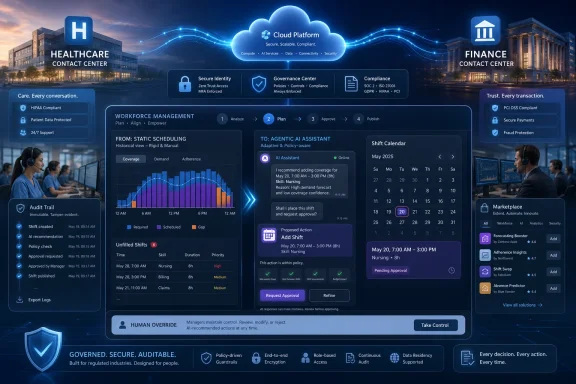
In the simplest version, an agent asks whether they can leave early, take paid time off, swap a shift, volunteer for extra hours, or adjust a break. The system checks staffing requirements, business rules, labor constraints, and approval policies. If the request fits, it can complete the workflow without a supervisor manually touching every step.
That is not science fiction, and it is not a chatbot in the old sense. The value is not that the interface sounds conversational. The value is that the assistant can connect intent to operational systems, reason over constraints, and take bounded action. In contact centers, where scheduling friction is a daily morale tax, that could be genuinely useful.
But this is also where the stakes rise. An AI assistant that merely answers “How much PTO do I have?” is a convenience feature. An AI assistant that approves a schedule change is participating in management. That means the system needs explainability, policy controls, logs, escalation paths, and a way for humans to override bad outcomes.
Microsoft Foundry’s relevance is therefore not just model access. It is the promise of enterprise scaffolding around AI agents: deployment, identity, monitoring, security posture, and governance hooks. Verint’s challenge will be turning that promise into a product experience that customers can trust when the contact center is under pressure.
That is why industry-specific AI certification matters more than a generic cloud compatibility claim. Healthcare buyers want to know how a system handles sensitive data, role-based access, auditability, and operational resilience. Financial services buyers ask similar questions, often with additional scrutiny around recordkeeping, third-party risk management, and supervisory controls.
A workforce-management platform does not become compliant simply because Microsoft recognizes it. The customer’s implementation, data flows, retention policies, integrations, and governance model still matter. But the designation helps Verint enter the conversation at a higher level of trust, especially for organizations already standardized on Azure, Microsoft 365, Teams, Dynamics 365, or Microsoft security tooling.
The strategic appeal is obvious. If a bank or healthcare provider is already using Microsoft as a core enterprise platform, a certified WFM application can look less like another isolated SaaS island and more like an extension of the existing estate. That is exactly the kind of framing that risk committees prefer.
The battleground is shifting to trust architecture. Buyers want to know where the AI runs, what data it touches, how actions are logged, how policies are enforced, whether the vendor can survive a security review, and how easily the product fits into existing procurement channels. In that contest, Microsoft certification is not a knockout blow, but it is useful ammunition.
For Microsoft, the arrangement is equally logical. The company wants Azure and its AI services to be the default home for enterprise agents. It cannot build every industry application itself, so it needs partners whose software makes Microsoft’s platform more valuable. Certified software designations are part of that ecosystem strategy: they help Microsoft sellers route customers toward applications that reinforce the cloud stack.
That creates a mutual dependency. Verint benefits from Microsoft’s credibility and distribution. Microsoft benefits when a specialized vendor turns Azure and Microsoft industry clouds into practical business software. Customers benefit if the result is genuinely easier deployment and governance; they lose if the badge becomes another procurement shortcut that substitutes for due diligence.
The most sober reading is that this certification improves Verint’s sales posture more than it proves customer outcomes. It tells buyers that the platform has cleared Microsoft’s designation process. It does not prove that a given deployment will reduce attrition, improve service levels, or avoid scheduling disputes. Those results still depend on implementation quality, data hygiene, management practices, and how much autonomy customers actually give the AI.
If Calabrio Agent Assist works well, it could give agents more self-service power without forcing supervisors to adjudicate every routine request. That matters because contact-center work is already tightly measured. Agents are tracked for adherence, handle time, quality, occupancy, and customer satisfaction. Giving them a faster way to manage schedule needs can reduce friction in a job that often has too little autonomy.
If it works poorly, the same technology could feel like a new layer of automated denial. A worker asks for a change; the system rejects it; the explanation is vague; the supervisor blames the policy; the policy blames the forecast. That is the darker side of agentic management systems: decisions become faster, but accountability becomes harder to locate.
The difference will come down to design. Good workforce AI should make rules visible, preserve escalation paths, and help managers understand tradeoffs rather than hide behind algorithmic authority. It should not turn employees into variables in a staffing equation while calling the result empowerment.
Verint’s announcement leans toward the optimistic version, where AI removes administrative drag and frees supervisors for coaching. That is plausible. But WindowsForum’s IT-pro audience should watch the implementation details, because enterprise software history is full of tools sold as liberation and experienced as surveillance.
Identity and access management sit at the center of that concern. If an AI assistant can view schedules, PTO balances, staffing rules, and potentially employee attributes, then role design matters. If it can execute actions, then authorization matters even more. The assistant should not become a privileged automation account with a friendly chat interface.
Logging is another non-negotiable. Enterprises will need records of who asked for what, what the AI evaluated, what policy was applied, what action was taken, and who overrode it. In healthcare and finance, those logs may become evidence in audits, disputes, and incident reviews.
Data boundaries will also matter. Contact centers often connect CRM data, telephony data, HR data, performance data, and workforce rules. AI systems thrive on context, but compliance teams thrive on minimization. The operational temptation will be to feed the assistant more information so it can make better decisions. The governance obligation will be to prove that each data flow is justified.
This is where Microsoft alignment may help, especially in organizations already using Entra ID, Purview, Defender, Sentinel, Azure policy controls, or Dynamics. But “runs on Microsoft” should not be read as “governance solved.” It means the governance conversation can start from familiar components rather than a blank slate.
For Verint, marketplace presence turns Microsoft from a platform partner into a sales channel. That matters in a market where customer-experience software overlaps with CRM, telephony, analytics, workforce engagement, and business-process automation. The vendor that appears naturally in a CIO’s existing Microsoft procurement workflow has an advantage over one that requires a separate commercial path.
This is not unique to Verint. Microsoft has been pushing its marketplace as a central venue for enterprise cloud purchasing, and partners have strong incentives to meet the requirements that make their offers easier for Microsoft sellers to recommend. The certified software designation adds another layer to that motion by making the product more legible inside Microsoft’s partner ecosystem.
Customers should welcome the convenience but resist letting procurement smoothness replace architectural review. Marketplace availability can reduce buying friction. It does not answer whether the product’s data model, administrative controls, integration dependencies, or AI behavior fit the organization’s risk tolerance.
That is progress, but it also raises the bar. A workforce-management assistant that can act autonomously needs more scrutiny than a dashboard. It must be evaluated not only for accuracy but for fairness, resilience, failure modes, and human recourse. The more useful the agent becomes, the more it resembles infrastructure.
Verint’s advantage is that workforce management already has measurable outcomes. Contact centers can track service levels, schedule adherence, overtime, shrinkage, occupancy, attrition, and agent satisfaction. If the AI improves operations, the evidence should eventually show up in metrics rather than adjectives.
The danger is that AI branding can blur the distinction between automation that helps workers and automation that simply intensifies work. A system that fills every staffing gap more efficiently may improve customer wait times while making agent schedules less humane. A system that reduces supervisor approvals may also reduce supervisor awareness. These tradeoffs are not reasons to reject the technology, but they are reasons to govern it deliberately.
 Microsoft’s Badge Is Really a Distribution Strategy
Microsoft’s Solutions Partner with certified software designation is easy to mistake for a logo exercise. The partner world has trained buyers to be skeptical of badges, tiers, and co-sell language because too many of them once meant little more than vendor alignment. But Microsoft’s current certified software program is more pointed than the old “Gold Partner” era: it is designed to identify software that is marketplace-ready, interoperable with Microsoft Cloud services, and aligned to specific solution areas or industry AI scenarios.That matters because Microsoft has made its cloud stack the control plane for a growing share of enterprise AI. Azure provides the infrastructure, Microsoft 365 provides the productivity surface, Dynamics 365 provides the business-process layer, and Microsoft Marketplace increasingly provides procurement plumbing. A workforce-management vendor that can show up credibly across those layers is not just easier to deploy. It is easier to buy.
For Verint, that is the practical value of the designation. The company is not merely saying Calabrio WFM can connect to Microsoft services. It is saying Microsoft has recognized the software under a program meant to help customers and Microsoft sellers identify industry-aligned AI applications. In healthcare and finance, where procurement teams treat risk as a first-class feature, that difference can decide whether a pilot ever becomes a rollout.
The certification also gives Verint a cleaner answer to a question every AI vendor now faces: who is responsible when the automation touches sensitive workflows? Microsoft’s badge does not transfer accountability away from the customer, nor does it magically certify every configuration as compliant. But it does reduce one kind of uncertainty: whether the product was built to live inside Microsoft’s cloud and partner machinery rather than bolted on after the fact.
Verint Is Selling Less Software Than Operational Permission
Workforce management has always been a deceptively consequential category. Scheduling a contact center sounds mundane until a hospital call queue spikes, a bank’s fraud line is understaffed, or a regulated service desk misses coverage obligations because a forecast was wrong. The spreadsheet version of this problem is painful; the AI version is powerful but politically sensitive.That is why Verint’s emphasis on Healthcare AI and Financial Services AI is not accidental. These are industries where workforce decisions can bleed into compliance, customer harm, labor rules, and audit trails. A scheduling assistant that approves time off, suggests overtime, or rebalances shifts is not just optimizing staffing. It is making operational decisions that managers, regulators, and unions may later want to examine.
The phrase agentic AI gives this story its fashionable hook, but the more important word is permission. Enterprises are not short of AI demos. They are short of AI systems that governance teams will allow into production. By presenting Calabrio WFM as certified software inside the Microsoft ecosystem, Verint is trying to move the conversation from possibility to acceptability.
That is a subtle but meaningful shift. The contact-center market has spent years selling dashboards, forecasts, quality monitoring, and automation. The next phase is about whether those systems can take action on behalf of workers and supervisors without creating a compliance incident. Verint’s Microsoft designation is a bid to make that action feel less exotic.
The Calabrio Name Gives Verint a Sharper WFM Story
The announcement lands in the shadow of Verint’s combination with Calabrio under Thoma Bravo’s ownership. That deal reshaped the workforce engagement management market by bringing together two names that many contact-center buyers previously evaluated against each other. It also created an integration challenge: how to tell a coherent product story without making customers feel trapped in a portfolio reshuffle.Calabrio’s brand helps Verint here because Calabrio has long been associated with workforce engagement and usability in contact centers. Verint, meanwhile, has leaned heavily into the language of CX automation and business outcomes. The Microsoft-certified Calabrio WFM pitch lets the combined company thread those identities together: a recognizable workforce product, now wrapped in a broader AI automation narrative and distributed through Microsoft’s enterprise channels.
That does not make integration risk disappear. Customers still need to know which roadmap prevails, how overlapping products converge, how licensing changes, and whether “better together” becomes a migration demand. In enterprise software, mergers often promise unified platforms while delivering years of SKU archaeology.
Still, the certification gives Verint something concrete to point to amid that transition. It says at least one important part of the combined portfolio is being pushed through a formal Microsoft channel with industry-specific AI positioning. For CIOs trying to decide whether the Verint-Calabrio combination creates stability or churn, that is a useful signal.
Agentic AI Moves the Scheduling Bot From Advice to Action
Calabrio Agent Assist is the most interesting part of the announcement because it changes the role of automation in workforce management. Traditional WFM tools forecast demand, generate schedules, flag adherence issues, and help supervisors make staffing decisions. Agentic AI aims to collapse part of that loop by letting workers ask for changes in natural language and letting the system evaluate and execute those requests within policy.In the simplest version, an agent asks whether they can leave early, take paid time off, swap a shift, volunteer for extra hours, or adjust a break. The system checks staffing requirements, business rules, labor constraints, and approval policies. If the request fits, it can complete the workflow without a supervisor manually touching every step.
That is not science fiction, and it is not a chatbot in the old sense. The value is not that the interface sounds conversational. The value is that the assistant can connect intent to operational systems, reason over constraints, and take bounded action. In contact centers, where scheduling friction is a daily morale tax, that could be genuinely useful.
But this is also where the stakes rise. An AI assistant that merely answers “How much PTO do I have?” is a convenience feature. An AI assistant that approves a schedule change is participating in management. That means the system needs explainability, policy controls, logs, escalation paths, and a way for humans to override bad outcomes.
Microsoft Foundry’s relevance is therefore not just model access. It is the promise of enterprise scaffolding around AI agents: deployment, identity, monitoring, security posture, and governance hooks. Verint’s challenge will be turning that promise into a product experience that customers can trust when the contact center is under pressure.
Healthcare and Finance Are the Stress Tests for Enterprise AI
Healthcare and financial services are popular targets for AI vendors because the budgets are large and the inefficiencies are obvious. They are also unforgiving markets because the cost of failure is higher than a bad chatbot transcript. If a hospital contact center is understaffed, patients may wait longer for care coordination. If a bank’s service operation mishandles fraud or account access, the consequences can be financial, legal, and reputational.That is why industry-specific AI certification matters more than a generic cloud compatibility claim. Healthcare buyers want to know how a system handles sensitive data, role-based access, auditability, and operational resilience. Financial services buyers ask similar questions, often with additional scrutiny around recordkeeping, third-party risk management, and supervisory controls.
A workforce-management platform does not become compliant simply because Microsoft recognizes it. The customer’s implementation, data flows, retention policies, integrations, and governance model still matter. But the designation helps Verint enter the conversation at a higher level of trust, especially for organizations already standardized on Azure, Microsoft 365, Teams, Dynamics 365, or Microsoft security tooling.
The strategic appeal is obvious. If a bank or healthcare provider is already using Microsoft as a core enterprise platform, a certified WFM application can look less like another isolated SaaS island and more like an extension of the existing estate. That is exactly the kind of framing that risk committees prefer.
The Competitive Fight Is Now About Trust, Not Features
The workforce management and workforce engagement markets are crowded with capable vendors. NICE, Genesys, UKG, Five9, Talkdesk, Assembled, and others all have their own AI narratives, forecasting tools, scheduling features, analytics, and contact-center integrations. Verint cannot win merely by saying it has AI; everyone has AI now.The battleground is shifting to trust architecture. Buyers want to know where the AI runs, what data it touches, how actions are logged, how policies are enforced, whether the vendor can survive a security review, and how easily the product fits into existing procurement channels. In that contest, Microsoft certification is not a knockout blow, but it is useful ammunition.
For Microsoft, the arrangement is equally logical. The company wants Azure and its AI services to be the default home for enterprise agents. It cannot build every industry application itself, so it needs partners whose software makes Microsoft’s platform more valuable. Certified software designations are part of that ecosystem strategy: they help Microsoft sellers route customers toward applications that reinforce the cloud stack.
That creates a mutual dependency. Verint benefits from Microsoft’s credibility and distribution. Microsoft benefits when a specialized vendor turns Azure and Microsoft industry clouds into practical business software. Customers benefit if the result is genuinely easier deployment and governance; they lose if the badge becomes another procurement shortcut that substitutes for due diligence.
The most sober reading is that this certification improves Verint’s sales posture more than it proves customer outcomes. It tells buyers that the platform has cleared Microsoft’s designation process. It does not prove that a given deployment will reduce attrition, improve service levels, or avoid scheduling disputes. Those results still depend on implementation quality, data hygiene, management practices, and how much autonomy customers actually give the AI.
The Agent Experience Is the Quiet Center of the Story
Vendor announcements about workforce AI often speak to executives first: faster deployment, operational efficiency, lower attrition, better forecast accuracy, improved time to value. Those are valid goals, but the people who feel the software most directly are contact-center agents. For them, workforce management is not an abstract optimization engine. It is the system that determines when they work, when they rest, whether they can handle life outside the queue, and how much control they have over their day.If Calabrio Agent Assist works well, it could give agents more self-service power without forcing supervisors to adjudicate every routine request. That matters because contact-center work is already tightly measured. Agents are tracked for adherence, handle time, quality, occupancy, and customer satisfaction. Giving them a faster way to manage schedule needs can reduce friction in a job that often has too little autonomy.
If it works poorly, the same technology could feel like a new layer of automated denial. A worker asks for a change; the system rejects it; the explanation is vague; the supervisor blames the policy; the policy blames the forecast. That is the darker side of agentic management systems: decisions become faster, but accountability becomes harder to locate.
The difference will come down to design. Good workforce AI should make rules visible, preserve escalation paths, and help managers understand tradeoffs rather than hide behind algorithmic authority. It should not turn employees into variables in a staffing equation while calling the result empowerment.
Verint’s announcement leans toward the optimistic version, where AI removes administrative drag and frees supervisors for coaching. That is plausible. But WindowsForum’s IT-pro audience should watch the implementation details, because enterprise software history is full of tools sold as liberation and experienced as surveillance.
IT Departments Will Inherit the Hard Parts
For sysadmins and IT leaders, the important question is not whether AI scheduling sounds useful. It is what the deployment adds to the environment. A workforce-management platform that integrates with Microsoft 365, Dynamics 365, Azure identity, and cloud AI services can simplify architecture, but it also creates new dependencies.Identity and access management sit at the center of that concern. If an AI assistant can view schedules, PTO balances, staffing rules, and potentially employee attributes, then role design matters. If it can execute actions, then authorization matters even more. The assistant should not become a privileged automation account with a friendly chat interface.
Logging is another non-negotiable. Enterprises will need records of who asked for what, what the AI evaluated, what policy was applied, what action was taken, and who overrode it. In healthcare and finance, those logs may become evidence in audits, disputes, and incident reviews.
Data boundaries will also matter. Contact centers often connect CRM data, telephony data, HR data, performance data, and workforce rules. AI systems thrive on context, but compliance teams thrive on minimization. The operational temptation will be to feed the assistant more information so it can make better decisions. The governance obligation will be to prove that each data flow is justified.
This is where Microsoft alignment may help, especially in organizations already using Entra ID, Purview, Defender, Sentinel, Azure policy controls, or Dynamics. But “runs on Microsoft” should not be read as “governance solved.” It means the governance conversation can start from familiar components rather than a blank slate.
Marketplace Availability Changes the Buying Motion
The Microsoft Marketplace angle is easy to overlook, but procurement mechanics increasingly shape enterprise software adoption. A product that is available through Microsoft Marketplace can fit into existing cloud commitments, private offers, co-sell motions, and vendor-management processes. That can shorten the path from interest to contract, especially in large organizations where procurement is often slower than technical evaluation.For Verint, marketplace presence turns Microsoft from a platform partner into a sales channel. That matters in a market where customer-experience software overlaps with CRM, telephony, analytics, workforce engagement, and business-process automation. The vendor that appears naturally in a CIO’s existing Microsoft procurement workflow has an advantage over one that requires a separate commercial path.
This is not unique to Verint. Microsoft has been pushing its marketplace as a central venue for enterprise cloud purchasing, and partners have strong incentives to meet the requirements that make their offers easier for Microsoft sellers to recommend. The certified software designation adds another layer to that motion by making the product more legible inside Microsoft’s partner ecosystem.
Customers should welcome the convenience but resist letting procurement smoothness replace architectural review. Marketplace availability can reduce buying friction. It does not answer whether the product’s data model, administrative controls, integration dependencies, or AI behavior fit the organization’s risk tolerance.
The Real Test Comes After the Badge
The most interesting thing about Verint’s announcement is that it reflects a maturing AI market. Two years ago, many enterprise AI announcements were still about pilots, copilots, and model access. In 2026, the serious announcements are about certification, governance, industry specificity, and operational workflows. The novelty has moved from “AI can answer questions” to “AI can safely do work.”That is progress, but it also raises the bar. A workforce-management assistant that can act autonomously needs more scrutiny than a dashboard. It must be evaluated not only for accuracy but for fairness, resilience, failure modes, and human recourse. The more useful the agent becomes, the more it resembles infrastructure.
Verint’s advantage is that workforce management already has measurable outcomes. Contact centers can track service levels, schedule adherence, overtime, shrinkage, occupancy, attrition, and agent satisfaction. If the AI improves operations, the evidence should eventually show up in metrics rather than adjectives.
The danger is that AI branding can blur the distinction between automation that helps workers and automation that simply intensifies work. A system that fills every staffing gap more efficiently may improve customer wait times while making agent schedules less humane. A system that reduces supervisor approvals may also reduce supervisor awareness. These tradeoffs are not reasons to reject the technology, but they are reasons to govern it deliberately.
The Microsoft Seal Gives Verint a Doorway, Not a Victory Lap
The concrete lesson from this announcement is that AI software is being judged less as a standalone marvel and more as a participant in a larger enterprise trust stack. Verint has gained a useful proof point, but customers still have work to do before treating agentic WFM as production infrastructure.- Verint’s Calabrio WFM certification gives Microsoft-centric enterprises a stronger reason to evaluate the platform for regulated contact-center operations.
- The Healthcare AI and Financial Services AI designations matter because those buyers place unusual weight on governance, auditability, security, and deployment risk.
- Calabrio Agent Assist is important because it moves workforce AI from recommendations toward bounded action on scheduling and staffing workflows.
- Microsoft Marketplace availability can accelerate procurement, but it should not replace security, compliance, and architecture review.
- The Verint-Calabrio combination gives the company more market weight, but customers should still press for roadmap clarity, licensing transparency, and migration assurances.
- The success of agentic workforce management will depend as much on policy design and human override as on model capability.
References
- Primary source: BriefGlance
Published: Tue, 19 May 2026 16:19:18 GMT
Verint Earns Microsoft AI Seal for Workforce Management Platform - BriefGlance.com
Verint's Calabrio WFM gains a key Microsoft certification, promising streamlined AI deployment and new agent autonomy in healthcare and financial services.briefglance.com - Official source: partner.microsoft.com
Differentiate your capabilities with Solutions Partner designations
Attain a Solutions Partner designation and drive success with badging and benefits that help you stand out to customers.partner.microsoft.com
- Official source: learn.microsoft.com
Introduction to Solutions Partner with certified software designations - Partner Center | Microsoft Learn
Learn about Solutions Partner with certified software designations.learn.microsoft.com - Official source: microsoft.com
Your request has been blocked. This could be due to several reasons.
www.microsoft.com
- Official source: blogs.microsoft.com
From vision to reality: Microsoft's partners embrace AI to deliver customer value - The Official Microsoft Blog
Artificial intelligence is a defining technology of our time. Over the past year we’ve begun to see how it can unlock profound possibilities for individuals, organizations and society — and it’s clear that we have only scratched the surface. For Microsoft and our partners across industries, AI...blogs.microsoft.com - Related coverage: calabrio.com
Contact Center AI Platform & Solutions | Verint
Close the AI outcomes gap with the Verint Open Platform. Embed agentic AI directly into your CX workflows to quickly drive measurable results.www.calabrio.com
- Official source: devicepartner.microsoft.com
Solutions Partner designations FAQ
Review frequently asked questions (FAQ) about Solutions Partner designations, how to attain them, and the value they bring to partners.devicepartner.microsoft.com
- Related coverage: itpro.com
Triple Microsoft designation defines serious, competitive, high-performing modern MSPs | ChannelPro
Triple Microsoft designation signals serious MSP capability through rigorous, performance-based accreditation standardswww.itpro.com - Official source: download.microsoft.com
- Official source: cdn-dynmedia-1.microsoft.com
- Official source: techcommunity.microsoft.com
- Related coverage: experteach.eu
- Related coverage: verint.com
One Team, One Platform: The Agentic AI Future of WFM
Verint & Calabrio workforce management solutions come together to offer Agentic AI in WFM, changing the WFM operator’s job from queue manager to AI technician. - Related coverage: newsroom.workday.com
Workday and Microsoft to Deliver Unified AI Agent Experience for the Enterprise - Sep 16, 2025
PDF documentnewsroom.workday.com
- Related coverage: govconwire.com
Thoma Bravo to Acquire Verint for $2B
Upon the deal's closing, Verint will merge with Thoma Bravo portfolio company Calabrio to drive AI-powered CX.www.govconwire.com - Related coverage: lw.com
Latham Advises Financing Thoma Bravo Completed Acquisition Verint Join Forces Calabrio
Banking & Private Credit team represents the financing sources supporting the investment firm’s take-private acquisition of a customer experience automation leader.www.lw.com
- Related coverage: finsmes.com
Thoma Bravo Acquires Verint
Verint (NASDAQ: VRNT), a Melville, NY-based CX automation company, is to be acquired by Thoma Bravo, a software investment firm, in an all-cash transaction reflecting an enterprise value of $2 billion www.finsmes.com
- Related coverage: finance.yahoo.com
Thoma Bravo Completes Acquisition of Verint, a Leader in AI-Driven Customer Experience Automation
Thoma Bravo, a leading software investment firm, today announced that following the completion of its previously announced acquisition of Verint Systems, Inc. ("Verint") on November 26, 2025, it has combined the global customer experience (CX) automation leader with its portfolio...finance.yahoo.com
