

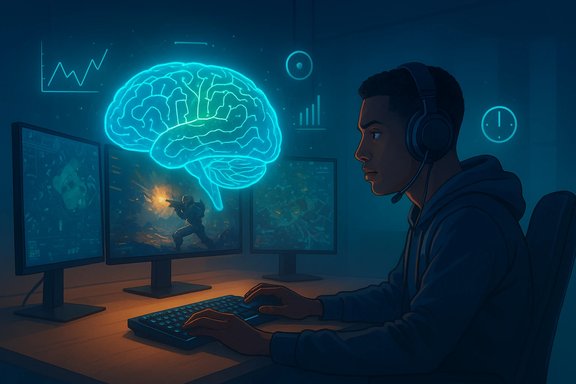
The idea that video games are a brain-rotting pastime is finally giving way to a more nuanced reality: under the right conditions, video games can measurably improve attention, learning speed, and indicators of brain health — but those benefits depend on game type, practice structure, novelty, and moderation.
For two decades neuroscientists and cognitive psychologists have studied whether the fast-paced demands of action and strategy games translate into improved mental abilities outside the screen. Early experimental work from the early 2000s showed that short, targeted exposure to first‑person action games could change how the brain allocates visual attention; later interventions used custom-designed games to train multitasking and cognitive control in older adults. In the last few years, larger-scale surveys and multi-site neuroimaging projects have expanded the evidence base, suggesting both short-term training gains and longer-term correlations between creative engagement — including gaming — and younger-looking brain function. These findings do not imply that all gaming is beneficial; they instead highlight a set of conditions under which gaming acts like a cognitive workout rather than a leisure-only habit.
At the same time, gaming is not a substitute for exercise, sleep, social engagement, or targeted clinical interventions when those are needed. For people interested in leveraging play as part of a brain‑health strategy, the evidence points to an approach of deliberate variety, modest daily sessions, progress tracking, and lifestyle balance — and to seeking professional help if gaming starts to interfere with everyday functioning.
If you want a short checklist to follow right now:
Source: Windows Central https://www.windowscentral.com/gami...-good-heres-what-science-actually-recommends/
 Background / Overview
For two decades neuroscientists and cognitive psychologists have studied whether the fast-paced demands of action and strategy games translate into improved mental abilities outside the screen. Early experimental work from the early 2000s showed that short, targeted exposure to first‑person action games could change how the brain allocates visual attention; later interventions used custom-designed games to train multitasking and cognitive control in older adults. In the last few years, larger-scale surveys and multi-site neuroimaging projects have expanded the evidence base, suggesting both short-term training gains and longer-term correlations between creative engagement — including gaming — and younger-looking brain function. These findings do not imply that all gaming is beneficial; they instead highlight a set of conditions under which gaming acts like a cognitive workout rather than a leisure-only habit. What the strongest studies actually show
Action games and visual attention: rapid, robust effects
Experimental labs led by researchers such as Daphne Bavelier and C. Shawn Green produced some of the earliest controlled evidence that action video games improve certain aspects of visual attention. In randomized training experiments, non-gamers who spent roughly ten hours playing action titles showed measurable increases in the breadth and speed of visual processing compared with control games that lacked the same attentional demands. These were controlled laboratory interventions — not just cross-sectional comparisons — and they demonstrate that short, focused exposure can yield domain‑specific gains.Multitasking, cognitive control and older adults
A landmark randomized trial using a bespoke game called NeuroRacer showed that adaptive, multitasking game training produced durable gains in cognitive control for adults aged 60–85. Participants who trained on the multitasking mode improved beyond untrained 20-year-olds on the same task; crucially, benefits transferred to untrained measures of sustained attention and working memory and persisted for months. That study is a proof of principle that targeted game design — not commercial entertainment titles per se — can remediate age-related declines in specific executive functions.Large-scale, real-world correlations
Beyond small lab trials, larger observational work has linked habitual gaming to better performance on broad cognitive batteries. A 2024 multi-site survey and testing study led by a major cognitive-neuroscience team found that frequent players scored, on average, like people many years younger on pooled cognitive tests; the report emphasized associations rather than causal claims, but the size and global spread of the sample makes the pattern noteworthy. Separate imaging and “brain clock” studies in 2025 found that creative pursuits — including strategy gaming — are associated with differences in functional connectivity that map on to younger‑appearing brain signatures. In smaller controlled training arms, learning a complex strategy title like StarCraft II for around 30 hours produced measurable shifts in those brain‑age estimates.Why games can be cognitively potent: mechanisms and constraints
What games tax the brain to improve it
When the goal is cognitive benefit, not mere entertainment, two features appear repeatedly in the literature:- High perceptual load — fast, unpredictable visual streams that force constant reallocation of attention.
- Complex decision structure — simultaneous information streams, resource management and planning under time pressure.
Transfer is real but limited
A critical distinction: improvements on trained tasks do not automatically generalize to every mental skill. Well‑designed experiments have shown transferable gains — for example, NeuroRacer training improved working memory and sustained attention — but many commercial cognitive‑training programs fail to show broad transfer beyond practiced tasks. The strongest evidence of cross-domain transfer comes from programs or games that intentionally target core, domain-general processes (sustained attention, interference control) and that adapt difficulty to keep players in a learning window. Even then, transfer tends to be modest and task‑specific rather than wholesale increases in “IQ.”Individual differences and selection effects
Not everyone gains equally. Longitudinal and twin‑design research highlights selection effects: people who gravitate to cognitively demanding games may already differ in baseline cognitive profiles, education, or lifestyle. Recent work that controls for earlier-life ability reduces but does not eliminate the relationship between gaming and cognitive performance, indicating both selection and training may be at work. In short, correlation is not causation — but randomized training studies and convergent imaging evidence make a strong case that at least some benefits are causal under prescribed conditions.Dose, novelty, and the "sweet spot" for cognitive gains
Short, structured sessions outperform marathons
Across intervention studies, beneficial training schedules are typically modest in length and regimented:- Laboratory and therapeutic interventions often use daily or near‑daily sessions of 25–60 minutes.
- Several reported improvements after 10–30 total hours of structured practice spread across weeks.
- The NeuroRacer trial used about 12 hours total across four weeks; some action game training experiments reported effects after 10 hours; a StarCraft II training arm produced measurable brain‑age shifts after ~30 hours over several weeks. These doses are a far cry from 24/7 play.
Mixing games matters
Studies indicate learning new games produces more cognitive demand than prolonged play of a single familiar title. Variety prevents plateauing and forces continual relearning, which sustains the plasticity stimulus. For players seeking benefits, alternating between genres and deliberately choosing titles with different cognitive demands (e.g., a strategy title, an action game, and a puzzle with time pressure) is smarter than grinding one game for tens of hours.Benefits versus risks: a balanced appraisal
Notable strengths of the evidence
- Multiple randomized controlled trials show task-specific training gains that sometimes transfer to other measures of attention and working memory.
- Imaging and electrophysiological studies reveal neural correlates (improved connectivity, altered oscillatory power) that parallel behavioral gains, supporting a mechanistic account of change.
- Large observational projects document consistent population-level associations between gaming and cognitive test performance, and new “brain‑clock” analyses link creative engagement (including gaming) to younger functional brain age.
Important caveats and risks
- Selection bias and confounding variables complicate observational claims: people drawn to demanding games may already have higher baseline cognition or other protective lifestyle habits. Researchers who control for earlier cognitive measures find smaller effects, underscoring selection as part of the story.
- Transfer is not universal: many commercial brain‑training programs show practice effects only on the trained tasks; robust transfer depends on careful game design, adaptive difficulty, and targeting of domain‑general processes.
- Problematic gaming exists: the World Health Organization included gaming disorder in ICD‑11 as a clinical condition where gaming causes severe impairment. Such disorders are uncommon but real; excessive play brings risks — sleep disruption, social withdrawal, physical inactivity, and co‑occurring mood or attention problems. Research and clinicians caution against equating routine healthy play with pathological behavior.
- Mental health is distinct from cognition: large surveys show exercise is more strongly tied to improved mental‑health outcomes (lower depression/anxiety symptoms) than gaming per se; video games may boost cognitive test performance without improving emotional well‑being. Balancing gaming with physical activity and social contact is critical.
Practical play: how to “game” your brain the right way
Below are actionable, evidence‑based recommendations to capture cognitive upsides while avoiding harm.Choose the right games
- Prefer titles with high perceptual load and complex decision trees: action shooters, real‑time strategy (e.g., StarCraft II), or games that force rapid situational assessment and multi-object management.
- Consider therapeutic or adaptive games for targeted training needs: prescription or FDA‑cleared digital therapeutics (for example, EndeavorRx) were specifically designed and validated to improve attention in pediatric ADHD. Those products follow clinical protocols rather than open‑ended play.
Structure your sessions
- Keep sessions short and focused: 25–60 minutes per session seems optimal in most trials.
- Aim for total training doses in the ballpark of 10–30 hours spread over several weeks for measurable effects.
- Use adaptive difficulty or settings that scale challenge to maintain novelty and avoid habituation.
Mix and measure
- Rotate genres weekly to keep the brain adapting.
- Track performance on objective tasks (online cognitive batteries, or commercially available assessment tools) rather than relying on subjective impressions alone.
- Combine gaming with exercise, sleep hygiene, and social activity — those lifestyle factors have independent and synergistic benefits for brain health.
Guardrails to avoid harm
- Watch for functional impairment: if gaming crowds out work, school, relationships, or sleep, reassess. ICD‑11 criteria for gaming disorder require persistent impairment over 12 months. Seek professional evaluation when gaming causes clear life disruption.
- Prefer scheduled, intentional play over open‑ended bingeing. Set timers, use break reminders, and maintain daily movement goals.
- Use game settings to reduce harmful triggers (e.g., autoplay, loot‑driven reward loops) if they encourage compulsive behavior.
Where the field still needs better answers
- Long‑term randomized trials comparing different genres, doses, age groups, and outcome batteries are still relatively scarce. While short‑term training studies are encouraging, we need large-scale clinical trials to establish long-term functional benefits (for daily life, work, or independent living).
- Mechanistic work must better reconcile why some games transfer broadly while others do not; individual neurobiology and baseline cognitive profile almost certainly mediate responsiveness.
- Public health guidance must balance the small risk of gaming disorder against the potential cognitive utility of gaming for much of the population; policy should favor education and accessible, evidence-based digital therapeutics rather than blanket moralization.
Bottom line: play intentionally, not endlessly
The smartest takeaways from the research are both encouraging and pragmatic. Video games — especially those that are fast, complex, and adaptive — can act as effective cognitive training tools when played in structured, moderate doses and when novelty is preserved. The gains are real but selective: expect improvements in attention, perceptual processing, task switching and some aspects of learning speed, rather than wholesale increases in intelligence.At the same time, gaming is not a substitute for exercise, sleep, social engagement, or targeted clinical interventions when those are needed. For people interested in leveraging play as part of a brain‑health strategy, the evidence points to an approach of deliberate variety, modest daily sessions, progress tracking, and lifestyle balance — and to seeking professional help if gaming starts to interfere with everyday functioning.
If you want a short checklist to follow right now:
- Play challenging, fast games (action/strategy) in 25–60 minute blocks.
- Aim for a total of 10–30 hours of structured play over several weeks to test for improvements.
- Rotate games to maintain novelty and adaptive difficulty.
- Keep exercise, sleep, and social activity as non‑negotiable habits.
- Watch for signs of functional impairment and consult a clinician if concerns arise.
Source: Windows Central https://www.windowscentral.com/gami...-good-heres-what-science-actually-recommends/
