
Microsoft disclosed CVE-2026-40376 on June 9, 2026, as an Important-rated Visual Studio Code elevation-of-privilege vulnerability fixed in VS Code 1.119.1, involving improper input validation that could let an unauthorized network attacker gain the permissions of an MCP Server’s managed identity. That sentence is the operational answer, but it is not the whole story. The more interesting part is what this advisory says about the new attack surface forming around agentic development tools. VS Code is no longer merely an editor that opens files; it is increasingly a broker between developers, AI agents, network services, terminals, browser sessions, cloud identities, and automation frameworks.
CVE-2026-40376 lands at exactly that intersection. Microsoft’s own scoring says exploitation is less likely, not publicly disclosed, and not known to be exploited in the wild at publication. But the advisory also says the vulnerability is confirmed, network reachable, requires no prior attacker privileges, and could have high confidentiality, integrity, and availability impact if the right conditions are in place. For defenders, that combination should trigger neither panic nor complacency. It should trigger inventory.
For years, Visual Studio Code’s security story was mostly about local trust: malicious extensions, workspace files, terminal execution, path handling, and the risks of opening code from places you do not control. That model is still relevant, but it is no longer sufficient. Modern VS Code now sits in a much more complicated role, especially when Copilot, agents, remote environments, browser integration, and Model Context Protocol-style tooling enter the workflow.
CVE-2026-40376 is classified as an elevation-of-privilege vulnerability, but the privileges in question are not described as local administrator rights on a Windows workstation. Microsoft’s advisory says a successful attacker could obtain the permissions associated with an MCP Server’s managed identity. That is a cloud-era sentence hiding inside a desktop-editor advisory.
Managed identity is supposed to reduce credential sprawl. Instead of storing secrets in config files or environment variables, a service can receive an identity assigned by the platform and use that identity to access authorized resources. That is good security architecture when the surrounding boundaries hold. It is also a concentrated blast radius when an attacker finds a way to make a trusted component act on their behalf.
That is why this vulnerability matters even though Microsoft rates exploitation as less likely. The highest-value target is not necessarily the developer’s laptop. It is the trust relationship behind the tool, the resources reachable through that identity, and the automation path an attacker might bend toward their own purpose.
The vector string is more revealing than the headline severity. The attack vector is network. Privileges required are none. User interaction is required. Attack complexity is high. Scope is unchanged. Confidentiality, integrity, and availability impacts are all high. In plain English: an attacker does not need an account first, but the attack is not expected to work automatically on demand, and a user or user-initiated action must participate in some way.
That combination is familiar to administrators who have spent years sorting real risk from theoretical severity. Network-accessible and unauthenticated increases concern. High attack complexity and user interaction reduce expected mass exploitation. High impact means the affected environments should still move quickly, because the consequence of a successful exploit could be substantial.
The advisory’s temporal metrics sharpen that view. Exploit code maturity is unproven, remediation level is official fix, and report confidence is confirmed. The “confirmed” piece is particularly important. Microsoft is not merely repeating a rumor or reserving a CVE number for a vague concern. The vendor has acknowledged the presence of the vulnerability and shipped a fix.
That does not mean every detail is public. It means the vulnerability is not speculative in the way some early advisories can be. Microsoft’s language says detailed reports may exist, functional reproduction may be possible, source code may be available for verification, or the affected-code author or vendor has confirmed the issue. For CVE-2026-40376, the practical result is that security teams should treat the bug as real even if exploit code is not circulating publicly.
This distinction matters because vulnerability management often gets trapped between two bad instincts. One camp waits for proof-of-concept code before acting, as if weaponization were the only moment at which risk becomes real. The other treats every high-impact CVE as an emergency, flattening the difference between a widely exploited wormable server flaw and a hard-to-trigger client-side path that requires a specific workflow.
CVE-2026-40376 sits between those extremes. The bug is confirmed, the affected product is widely deployed, and the potential impact is high. At the same time, Microsoft says it was not publicly disclosed at release, not known exploited, and less likely to be exploited. That is the profile of a vulnerability that should be patched through normal accelerated maintenance, not one that justifies ripping developer environments apart overnight.
That power is the point. It is also the risk. Every agent tool that can reach a meaningful system becomes a potential security boundary. Every identity granted to that tool becomes a target. Every prompt, network request, serialized message, and input field becomes part of a trust chain that older editor threat models did not have to consider.
Improper input validation is one of the oldest categories in software security, but its consequences change depending on where the bad input lands. In a toy application, it may be boring. In a developer tool wired to automation and identity, it can become privilege movement. The vulnerability class is not new; the surrounding context is.
That is the broader lesson for WindowsForum readers running VS Code across enterprise fleets. The editor is increasingly an orchestration surface. The more it acts on behalf of developers, agents, and services, the more it inherits the security obligations of an application platform.
This matters because developer work is inherently interaction-heavy. Developers clone unfamiliar repositories, review pull requests, run build scripts, test web apps, inspect logs, open documentation, and experiment with extensions. The entire job involves taking structured and semi-structured input from other people and feeding it into powerful local and cloud-connected tools.
Agentic development amplifies that pattern. A human may not manually type every command, but they may authorize an agent to inspect a workspace, run tests, access a browser tab, or call a tool server. User interaction in this world becomes less like clicking a malicious attachment and more like approving a development loop that contains unsafe assumptions.
That is why the “UI:R” part of the CVSS vector should reduce expectations of drive-by exploitation without erasing the threat. A vulnerability that requires a developer’s normal participation can still be relevant if the affected workflow is common enough and the attacker can stage convincing input. In software supply-chain security, the user is often not careless; the user is doing their job.
But high complexity has a half-life. Security teams should be careful about treating it as a permanent shield. Once researchers, criminals, or nation-state operators understand the right preconditions, a difficult exploit can become a repeatable playbook against selected targets. The path from “hard to exploit” to “reliable enough for targeted use” is one of the recurring stories of modern vulnerability exploitation.
The distinction is especially important in developer environments. Attackers do not always need broad reliability when they can target a smaller number of high-value users. A maintainer of a popular package, an engineer with access to production subscriptions, or a developer whose workstation can trigger deployment workflows may be worth the preparation effort.
That does not make CVE-2026-40376 a crisis. It makes it a reminder that attacker economics differ by target. For a random unmanaged workstation, exploitation may be unlikely. For a development organization where VS Code, MCP servers, and managed identities are tied to valuable cloud resources, the risk calculation changes.
Enterprise administrators have a harder problem. They need to know where VS Code is installed, which channels are deployed, whether users have update rights, whether the application is packaged through Intune, Configuration Manager, winget, Chocolatey, a golden image, or a developer self-service portal, and whether portable copies exist outside the official inventory. Developer tools have a way of escaping neat endpoint-management assumptions.
Then there is the identity side. If an organization is using MCP servers with managed identities, updating VS Code is only one part of the response. Teams should also review what permissions those identities have and whether they are scoped tightly enough. A managed identity used by a tool server should not have broad access just because it was convenient during a pilot.
The fix closes the product flaw. It does not automatically fix over-permissioned identities. That is the uncomfortable but useful part of this advisory: it points defenders back toward least privilege in the systems surrounding the editor.
None of that means those features caused CVE-2026-40376. The advisory does not say that, and it would be irresponsible to infer a direct causal chain without evidence. But the release context does show the terrain. VS Code is being redesigned around more capable, more connected, more autonomous development experiences.
That redesign creates real benefits. Agents that can test web apps in a browser, observe their own behavior, use telemetry, and operate with fewer needless prompts can make developers more productive. The security challenge is that every reduction in friction has to be paired with a sharper boundary somewhere else. Otherwise, convenience becomes ambient authority.
Microsoft appears aware of this tension. The release notes repeatedly frame agent features around explicit sharing, organization-managed settings, sandbox behavior, and observability. CVE-2026-40376 is a reminder that the security architecture around these systems is still being stress-tested in public, as all widely deployed software eventually is.
An MCP server with a managed identity belongs on that privilege graph. So does the editor that invokes it. So does the agent that asks for access. So does the workspace content that shapes what the agent sees or does. The old mental model — a user launches an editor and edits files — is too small.
CVE-2026-40376 illustrates this shift neatly. The vulnerability is in Visual Studio Code, but the privilege Microsoft describes is associated with an MCP Server’s managed identity. The editor is the named product, yet the blast radius may be determined by identity and resource permissions elsewhere. That is how modern tooling risk works: product boundaries and security boundaries do not always line up.
For Windows administrators, this argues for closer cooperation with developer platform teams. Endpoint security can verify installed versions. Cloud security can inspect managed identities. DevOps can identify which tool servers exist and what they can reach. No single team sees the whole path unless the organization deliberately connects those views.
Security teams have learned this lesson repeatedly. A vulnerability can sit quietly for weeks before enough technical detail emerges to make it attractive. Conversely, many Important-rated bugs never become operationally significant. The point of vulnerability management is not to predict the future perfectly; it is to reduce exposure before the prediction becomes unnecessary.
For CVE-2026-40376, that means prioritizing the update in environments where VS Code is tied to MCP and managed identities, while still rolling it into broader desktop patching elsewhere. A developer laptop with no relevant MCP usage is not the same risk as a cloud engineering workstation connected to privileged automation. The advisory gives enough information to make that distinction.
It also means watching for revisions. Microsoft’s advisory is version 1.0 as of June 9, 2026. If the company updates the CVE with new affected versions, clarified prerequisites, exploitation status, or mitigation guidance, the risk picture changes. Patch Tuesday is a snapshot; vulnerability management is a film.
This is not a new principle, but developer tooling often gets exceptions in the name of speed. Pilot projects receive broad permissions. Temporary identities become permanent. Lab resources gain access to production-adjacent systems. Automation identities accumulate rights because nobody wants to break the workflow that shipped last quarter.
CVE-2026-40376 is an argument for cleaning that up. Review MCP server identities. Check role assignments. Remove unused permissions. Separate development, staging, and production identities. Make sure logging can show which identity did what, and from where. If an agentic tool is important enough to have a managed identity, it is important enough to have a permission review.
The same logic applies locally. Developers should be encouraged to update VS Code promptly, but organizations should avoid relying entirely on individual behavior. Managed update rings, application control, and software inventory are boring until they are the only reason a developer fleet is not weeks behind.
That shift requires new muscle memory. Security teams need to know not just whether a workstation is patched, but whether the tools on it can act against cloud resources. They need to distinguish between a code editor used as a local text editor and the same editor used as a command center for agentic workflows. They need to treat developer productivity systems as privileged systems, because in many organizations that is what they have become.
CVE-2026-40376 is not the loudest possible version of that warning. It is not known to be exploited. It has an official fix. It has high attack complexity. It requires user interaction. But it is still a clear signal from Microsoft’s own advisory language that the boundary between editor, agent, server, and identity has security consequences.
A healthy response is measured but concrete. Update the editor. Verify the version. Identify MCP usage. Review managed identities. Watch for advisory revisions. That is not glamorous work, but it is exactly the kind of work that prevents an Important-rated bug from becoming an incident report.
CVE-2026-40376 lands at exactly that intersection. Microsoft’s own scoring says exploitation is less likely, not publicly disclosed, and not known to be exploited in the wild at publication. But the advisory also says the vulnerability is confirmed, network reachable, requires no prior attacker privileges, and could have high confidentiality, integrity, and availability impact if the right conditions are in place. For defenders, that combination should trigger neither panic nor complacency. It should trigger inventory.
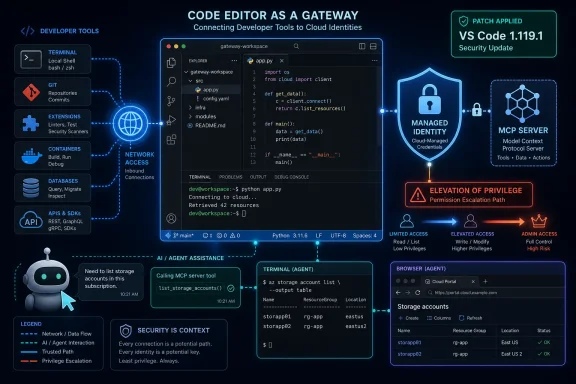 The Editor Has Become an Identity Boundary
For years, Visual Studio Code’s security story was mostly about local trust: malicious extensions, workspace files, terminal execution, path handling, and the risks of opening code from places you do not control. That model is still relevant, but it is no longer sufficient. Modern VS Code now sits in a much more complicated role, especially when Copilot, agents, remote environments, browser integration, and Model Context Protocol-style tooling enter the workflow.CVE-2026-40376 is classified as an elevation-of-privilege vulnerability, but the privileges in question are not described as local administrator rights on a Windows workstation. Microsoft’s advisory says a successful attacker could obtain the permissions associated with an MCP Server’s managed identity. That is a cloud-era sentence hiding inside a desktop-editor advisory.
Managed identity is supposed to reduce credential sprawl. Instead of storing secrets in config files or environment variables, a service can receive an identity assigned by the platform and use that identity to access authorized resources. That is good security architecture when the surrounding boundaries hold. It is also a concentrated blast radius when an attacker finds a way to make a trusted component act on their behalf.
That is why this vulnerability matters even though Microsoft rates exploitation as less likely. The highest-value target is not necessarily the developer’s laptop. It is the trust relationship behind the tool, the resources reachable through that identity, and the automation path an attacker might bend toward their own purpose.
Microsoft’s Score Says “Important,” but the Vector Says “Pay Attention”
The CVSS 3.1 base score for CVE-2026-40376 is 7.5, with a temporal score of 6.5. Microsoft rates it Important rather than Critical, and its exploitability assessment says exploitation is less likely. Those are meaningful signals, especially for patch teams trying to triage a long monthly list. They are not permission to ignore it.The vector string is more revealing than the headline severity. The attack vector is network. Privileges required are none. User interaction is required. Attack complexity is high. Scope is unchanged. Confidentiality, integrity, and availability impacts are all high. In plain English: an attacker does not need an account first, but the attack is not expected to work automatically on demand, and a user or user-initiated action must participate in some way.
That combination is familiar to administrators who have spent years sorting real risk from theoretical severity. Network-accessible and unauthenticated increases concern. High attack complexity and user interaction reduce expected mass exploitation. High impact means the affected environments should still move quickly, because the consequence of a successful exploit could be substantial.
The advisory’s temporal metrics sharpen that view. Exploit code maturity is unproven, remediation level is official fix, and report confidence is confirmed. The “confirmed” piece is particularly important. Microsoft is not merely repeating a rumor or reserving a CVE number for a vague concern. The vendor has acknowledged the presence of the vulnerability and shipped a fix.
The Report Confidence Line Is Doing More Work Than It Seems
The text the user highlighted — Microsoft’s explanation of the Report Confidence metric — is not a throwaway glossary item. It tells defenders how much faith they should place in the existence of the vulnerability and the credibility of the technical details. In this case, Microsoft marks report confidence as confirmed.That does not mean every detail is public. It means the vulnerability is not speculative in the way some early advisories can be. Microsoft’s language says detailed reports may exist, functional reproduction may be possible, source code may be available for verification, or the affected-code author or vendor has confirmed the issue. For CVE-2026-40376, the practical result is that security teams should treat the bug as real even if exploit code is not circulating publicly.
This distinction matters because vulnerability management often gets trapped between two bad instincts. One camp waits for proof-of-concept code before acting, as if weaponization were the only moment at which risk becomes real. The other treats every high-impact CVE as an emergency, flattening the difference between a widely exploited wormable server flaw and a hard-to-trigger client-side path that requires a specific workflow.
CVE-2026-40376 sits between those extremes. The bug is confirmed, the affected product is widely deployed, and the potential impact is high. At the same time, Microsoft says it was not publicly disclosed at release, not known exploited, and less likely to be exploited. That is the profile of a vulnerability that should be patched through normal accelerated maintenance, not one that justifies ripping developer environments apart overnight.
MCP Turns Tooling Into a Security Perimeter
The most interesting clue in Microsoft’s advisory is the reference to the MCP Server’s managed identity. MCP, or Model Context Protocol, is part of the broader shift toward connecting AI assistants and developer tools to external systems through structured servers and tools. In practical terms, these integrations can let agents query repositories, inspect environments, call APIs, manipulate files, and coordinate development work.That power is the point. It is also the risk. Every agent tool that can reach a meaningful system becomes a potential security boundary. Every identity granted to that tool becomes a target. Every prompt, network request, serialized message, and input field becomes part of a trust chain that older editor threat models did not have to consider.
Improper input validation is one of the oldest categories in software security, but its consequences change depending on where the bad input lands. In a toy application, it may be boring. In a developer tool wired to automation and identity, it can become privilege movement. The vulnerability class is not new; the surrounding context is.
That is the broader lesson for WindowsForum readers running VS Code across enterprise fleets. The editor is increasingly an orchestration surface. The more it acts on behalf of developers, agents, and services, the more it inherits the security obligations of an application platform.
User Interaction Does Not Mean User Blame
Microsoft’s vector says user interaction is required. In vulnerability advisories, that phrase is often misunderstood as “someone must do something foolish.” That is not necessarily the case. It can mean the exploit path depends on normal user behavior: opening a project, approving a workflow, sharing context, interacting with an agent, or causing a tool to process attacker-influenced input.This matters because developer work is inherently interaction-heavy. Developers clone unfamiliar repositories, review pull requests, run build scripts, test web apps, inspect logs, open documentation, and experiment with extensions. The entire job involves taking structured and semi-structured input from other people and feeding it into powerful local and cloud-connected tools.
Agentic development amplifies that pattern. A human may not manually type every command, but they may authorize an agent to inspect a workspace, run tests, access a browser tab, or call a tool server. User interaction in this world becomes less like clicking a malicious attachment and more like approving a development loop that contains unsafe assumptions.
That is why the “UI:R” part of the CVSS vector should reduce expectations of drive-by exploitation without erasing the threat. A vulnerability that requires a developer’s normal participation can still be relevant if the affected workflow is common enough and the attacker can stage convincing input. In software supply-chain security, the user is often not careless; the user is doing their job.
High Attack Complexity Buys Time, Not Immunity
The attack complexity for CVE-2026-40376 is high. Microsoft’s FAQ says successful exploitation requires an attacker to take additional actions before exploitation to prepare the target environment. That is a meaningful brake on immediate risk. It suggests this is not a simple packet-to-compromise bug.But high complexity has a half-life. Security teams should be careful about treating it as a permanent shield. Once researchers, criminals, or nation-state operators understand the right preconditions, a difficult exploit can become a repeatable playbook against selected targets. The path from “hard to exploit” to “reliable enough for targeted use” is one of the recurring stories of modern vulnerability exploitation.
The distinction is especially important in developer environments. Attackers do not always need broad reliability when they can target a smaller number of high-value users. A maintainer of a popular package, an engineer with access to production subscriptions, or a developer whose workstation can trigger deployment workflows may be worth the preparation effort.
That does not make CVE-2026-40376 a crisis. It makes it a reminder that attacker economics differ by target. For a random unmanaged workstation, exploitation may be unlikely. For a development organization where VS Code, MCP servers, and managed identities are tied to valuable cloud resources, the risk calculation changes.
The Fix Is Simple; Knowing Where It Matters Is Not
Microsoft lists VS Code 1.119.1 as the fixed build. The security update is tied to the VS Code 1.119 release line, whose release notes say update 1.119.1 addresses security issues. For individual users, the path is straightforward: update Visual Studio Code. VS Code’s auto-update behavior will handle many installations, but that assumption is dangerous in managed environments, offline systems, pinned images, developer containers, and remote desktop pools.Enterprise administrators have a harder problem. They need to know where VS Code is installed, which channels are deployed, whether users have update rights, whether the application is packaged through Intune, Configuration Manager, winget, Chocolatey, a golden image, or a developer self-service portal, and whether portable copies exist outside the official inventory. Developer tools have a way of escaping neat endpoint-management assumptions.
Then there is the identity side. If an organization is using MCP servers with managed identities, updating VS Code is only one part of the response. Teams should also review what permissions those identities have and whether they are scoped tightly enough. A managed identity used by a tool server should not have broad access just because it was convenient during a pilot.
The fix closes the product flaw. It does not automatically fix over-permissioned identities. That is the uncomfortable but useful part of this advisory: it points defenders back toward least privilege in the systems surrounding the editor.
The 1.119 Release Context Makes the Advisory Less Surprising
VS Code 1.119 was not a quiet maintenance release. Its release notes describe a product moving deeper into agent workflows, browser interaction, OpenTelemetry tracing for agent sessions, usage-related Copilot plumbing, and trust and security changes around agent sandboxes. The release explicitly discusses letting agents interact with integrated browser pages when a user shares them, allowing network access in agent sandboxes under a managed setting, and reducing interruptions for certain temporary-folder writes.None of that means those features caused CVE-2026-40376. The advisory does not say that, and it would be irresponsible to infer a direct causal chain without evidence. But the release context does show the terrain. VS Code is being redesigned around more capable, more connected, more autonomous development experiences.
That redesign creates real benefits. Agents that can test web apps in a browser, observe their own behavior, use telemetry, and operate with fewer needless prompts can make developers more productive. The security challenge is that every reduction in friction has to be paired with a sharper boundary somewhere else. Otherwise, convenience becomes ambient authority.
Microsoft appears aware of this tension. The release notes repeatedly frame agent features around explicit sharing, organization-managed settings, sandbox behavior, and observability. CVE-2026-40376 is a reminder that the security architecture around these systems is still being stress-tested in public, as all widely deployed software eventually is.
Developers Are Now Part of the Privilege Graph
Traditional enterprise security diagrams often put developers in a familiar box: privileged users with code access, build access, and maybe production access through controlled pipelines. That model is already complicated. Agentic tooling makes it messier by adding non-human actors that can act through developer-approved sessions and tool identities.An MCP server with a managed identity belongs on that privilege graph. So does the editor that invokes it. So does the agent that asks for access. So does the workspace content that shapes what the agent sees or does. The old mental model — a user launches an editor and edits files — is too small.
CVE-2026-40376 illustrates this shift neatly. The vulnerability is in Visual Studio Code, but the privilege Microsoft describes is associated with an MCP Server’s managed identity. The editor is the named product, yet the blast radius may be determined by identity and resource permissions elsewhere. That is how modern tooling risk works: product boundaries and security boundaries do not always line up.
For Windows administrators, this argues for closer cooperation with developer platform teams. Endpoint security can verify installed versions. Cloud security can inspect managed identities. DevOps can identify which tool servers exist and what they can reach. No single team sees the whole path unless the organization deliberately connects those views.
“Exploitation Less Likely” Is a Triage Signal, Not a Strategy
Microsoft’s exploitability assessment is helpful, but it should be read as a publication-time assessment, not a long-term guarantee. “Less likely” reflects what Microsoft knew when the advisory was released: no public disclosure, no known exploitation, unproven exploit maturity, and likely difficulty in exploitation. Those are good signs. They are also perishable.Security teams have learned this lesson repeatedly. A vulnerability can sit quietly for weeks before enough technical detail emerges to make it attractive. Conversely, many Important-rated bugs never become operationally significant. The point of vulnerability management is not to predict the future perfectly; it is to reduce exposure before the prediction becomes unnecessary.
For CVE-2026-40376, that means prioritizing the update in environments where VS Code is tied to MCP and managed identities, while still rolling it into broader desktop patching elsewhere. A developer laptop with no relevant MCP usage is not the same risk as a cloud engineering workstation connected to privileged automation. The advisory gives enough information to make that distinction.
It also means watching for revisions. Microsoft’s advisory is version 1.0 as of June 9, 2026. If the company updates the CVE with new affected versions, clarified prerequisites, exploitation status, or mitigation guidance, the risk picture changes. Patch Tuesday is a snapshot; vulnerability management is a film.
Least Privilege Is the Real Mitigation Behind the Patch
The official fix is VS Code 1.119.1, but the advisory’s managed-identity language points to a second mitigation layer: permissions discipline. If a compromised tool identity can only reach a narrow set of resources, the worst-case outcome shrinks. If that identity can read secrets, alter deployment infrastructure, or touch production data, the vulnerability becomes more consequential.This is not a new principle, but developer tooling often gets exceptions in the name of speed. Pilot projects receive broad permissions. Temporary identities become permanent. Lab resources gain access to production-adjacent systems. Automation identities accumulate rights because nobody wants to break the workflow that shipped last quarter.
CVE-2026-40376 is an argument for cleaning that up. Review MCP server identities. Check role assignments. Remove unused permissions. Separate development, staging, and production identities. Make sure logging can show which identity did what, and from where. If an agentic tool is important enough to have a managed identity, it is important enough to have a permission review.
The same logic applies locally. Developers should be encouraged to update VS Code promptly, but organizations should avoid relying entirely on individual behavior. Managed update rings, application control, and software inventory are boring until they are the only reason a developer fleet is not weeks behind.
The New Patch Tuesday Muscle Memory for Agentic Tools
Patch Tuesday used to be mostly about Windows, Office, Exchange, browsers, and server roles. Developer tooling was present, but it often felt adjacent. That division is fading. VS Code, GitHub Copilot, Visual Studio, package managers, build tools, and AI agent integrations are now part of the operational security surface of a Windows environment.That shift requires new muscle memory. Security teams need to know not just whether a workstation is patched, but whether the tools on it can act against cloud resources. They need to distinguish between a code editor used as a local text editor and the same editor used as a command center for agentic workflows. They need to treat developer productivity systems as privileged systems, because in many organizations that is what they have become.
CVE-2026-40376 is not the loudest possible version of that warning. It is not known to be exploited. It has an official fix. It has high attack complexity. It requires user interaction. But it is still a clear signal from Microsoft’s own advisory language that the boundary between editor, agent, server, and identity has security consequences.
A healthy response is measured but concrete. Update the editor. Verify the version. Identify MCP usage. Review managed identities. Watch for advisory revisions. That is not glamorous work, but it is exactly the kind of work that prevents an Important-rated bug from becoming an incident report.
The Patch Is Small; the Inventory Lesson Is Large
The practical readout for WindowsForum readers is direct, especially for admins supporting developers and AI-assisted coding environments.- Visual Studio Code 1.119.1 is the fixed build Microsoft lists for CVE-2026-40376.
- Microsoft says the vulnerability involves improper input validation and could allow an unauthorized network attacker to elevate privileges.
- The advisory says successful exploitation could obtain permissions associated with an MCP Server’s managed identity, not broad tenant-level or administrator permissions by default.
- Microsoft assessed the issue as not publicly disclosed, not exploited in the wild at publication, and less likely to be exploited.
- The CVSS vector still deserves attention because it combines network reachability, no required attacker privileges, required user interaction, high attack complexity, and high potential impact.
- Organizations using MCP servers or agentic VS Code workflows should pair the VS Code update with a review of managed identity permissions.
References
- Primary source: MSRC
Published: 2026-06-09T07:00:00-07:00

Security Update Guide - Microsoft Security Response Center
msrc.microsoft.com
