

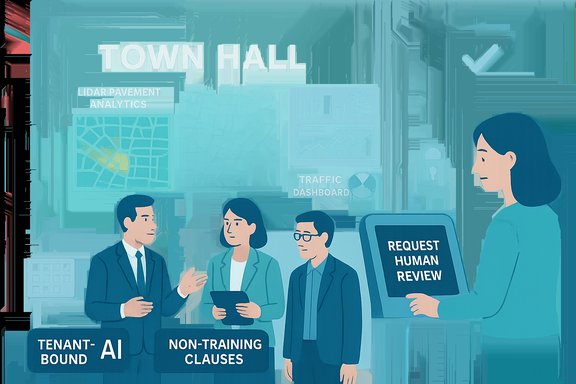
Wellesley’s town government is quietly accelerating its use of artificial intelligence to speed routine work, improve data-driven infrastructure decisions, and make resident services more accessible — while explicitly attempting to balance those gains against privacy, procurement, and records-retention risks.
Background
Town leaders told the Select Board in August that the fiscal-year plan will expand AI use in permitting, infrastructure planning, budget analysis and public engagement. Executive Director Meghan Jop and Information Technology Director Brian DuPont framed the effort as an incremental, governance-first expansion that builds on tools already used by staff rather than a sudden, organization-wide upheaval. Town staff today use both narrow AI (task-specific analytics) and generative AI (content-producing assistants) for administrative work such as summarizing emails, translating documents, drafting job descriptions, and creating social media posts — and the town proposes to scale some of those functions into production workflows. The town’s approach mirrors municipal best practices that prioritize tenant-bound enterprise assistants, human review, and procurement safeguards over unrestricted use of public models.Overview: What Wellesley plans to do
Wellesley’s immediate expansion plans fall into three visible buckets:- Administrative productivity (email summaries, meeting minutes, content drafts) using generative assistants.
- Departmental analytics using narrow AI — for example, LiDAR analysis for pavement condition assessment and traffic-volume analytics for pedestrian and bicycle safety.
- Citizen-facing conveniences like chatbots for routing and FAQs, used cautiously behind governance controls.
Why the distinction between narrow AI and generative AI matters
Narrow AI systems are optimized to perform a limited technical task — for instance, computer-vision models that analyze LiDAR for pavement cracking, or traffic-count analytics that produce volume and speed metrics. These tools are deterministic within their domain and typically do not expose the same privacy or hallucination risks as large generative models.Generative AI (ChatGPT, Microsoft Copilot, Google Gemini and similar assistants) produces new text or content from patterns learned during training and is probabilistic by design. When used for drafting or summarization, generative models accelerate work, but they also introduce risks of factual errors (“hallucinations”), inadvertent disclosure of sensitive inputs, and discoverability under public‑records laws if outputs enter the official record. Municipal guidance therefore treats generative assistants as drafting aids that must be subject to named human verification before publication.
What Wellesley is already using — and what it wants to scale
Departmental tools already in use
Town officials identified several concrete tools that are either in use or being piloted:- Meeting transcription and minutes-generation via Otter and ClerkMinutes, enabling staff to produce faster, searchable public minutes and summaries.
- A LiDAR-analysis tool (reported as Citilogix) used by Public Works to evaluate road and sidewalk surface conditions.
- Traffic analysis with a planned pilot of UrbanSDK to analyze pedestrian, bicycle and construction-related congestion.
- Generative assistants used by staff for administrative drafting and translation tasks.
IT and cybersecurity: AI as an operational tool
DuPont also noted that AI already serves a substantial role in the town’s cybersecurity posture: threat detection, anomaly identification, and incident triage are increasingly augmented by AI-driven analytics. That mirrors what many local governments and enterprise IT teams are doing — applying machine learning to log analysis, intrusion detection, and automated response orchestration to reduce dwell time and speed containment. A security-first posture is a central tenet of responsible municipal AI adoption.The governance framework Wellesley says it will use
Town leadership has stated three core governance commitments:- Compliance with state and federal privacy laws; limiting the type of data that may be uploaded to AI tools outside of closed systems.
- Mandatory cybersecurity training for municipal employees that includes appropriate AI use and data-handling guidance.
- A careful procurement review that weighs the security value, risk, and lifetime cost of any new AI tool before approval.
Strengths of Wellesley’s current approach
1. Pragmatic, incremental adoption
By building on tools staff already use rather than launching a sweeping program, the town reduces change risk and keeps the rollout manageable. Starting with narrowly bounded, staff-facing productivity and analytics projects lets Wellesley capture value quickly while containing exposure. Municipal case studies show measurable time savings from meeting-transcription assistants and summary copilots when governed properly.2. Emphasis on enterprise, tenant-bound controls
Wellesley’s approach favors tenant‑scoped enterprise assistants over open public models — a strategy that reduces immediate surface area for data leakage when tenant configuration and DLP are correctly enforced. This is one of the most repeatedly-cited best practices for local governments adopting generative assistants.3. Integration with operational analytics
Applying narrow AI to infrastructure problems (pavement condition from LiDAR, traffic analytics for safety planning) is a high-value, low‑ambiguity use of AI for a town government. These systems can produce prioritised maintenance lists and evidence-based planning inputs that save money and improve public safety when input data quality and model validation are assured.4. Awareness of cybersecurity and training needs
Acknowledging AI’s role in both productivity and defense shows IT leadership is treating the technology as part of the security surface rather than only a productivity tool. The inclusion of AI topics in mandatory cybersecurity training is a meaningful operational control.Key risks and blind spots — what to watch closely
Municipal AI adoption produces clear operational benefits, but it also introduces multiple, interlocking risks. Wellesley’s plans call these out; the practical test will be the technical and contractual follow-through.Data leakage and vendor promises
Saying a model runs “inside a government tenant” is helpful but not a guarantee against all risk — telemetry, logging, or vendor-side processes can still create exposure unless contracts and tenant settings explicitly prevent training on municipal inputs and require deletion/egress rights. Municipalities must insist on enforceable Data Processing Addenda and non‑training clauses, not just vendor marketing claims.Hallucination and accuracy risk for generative outputs
Generative assistants are probabilistic. If an AI-generated summary or recommendation is published or relied on without proper review, the town risks reputational and legal exposure. Human verification and explicit labeling of AI-assisted content are non-negotiable mitigations.Records-management and public‑records discoverability
Prompts, outputs, and the human edits that follow can become discoverable public records. Towns must define retention policies and redaction rules for AI logs, and ensure the records team is part of procurement and governance decisions. Failure to do so will create legal headaches during FOIA requests or audits.Shadow AI
Restricting only official devices does not eliminate the use of consumer AI on personal devices by staff. This “shadow AI” behavior requires endpoint/network DLP, explicit acceptable‑use policies, and the provision of convenient, sanctioned alternatives so staff don’t sidestep controls. Municipal pilots commonly fail when sanctioned tools are hard to access and employees revert to consumer services for convenience.Procurement and vendor lock-in
Deep integration with a single vendor can produce switching costs over time. Contracts should require data portability, exportable formats, and exit provisions. Procurement officers need to treat AI procurement like a long-term data and governance decision rather than a short-term productivity purchase.Practical implementation checklist for Wellesley (recommended)
The following list synthesizes town statements with municipal best practices into an operational checklist Wellesley should adopt while scaling AI use.- Conduct a tenant configuration audit within 30 days: verify Purview, DLP rules, telemetry and connector settings.
- Publish a plain-English resident notice describing where and how AI is used, and how residents can request human review.
- Make access conditional: require mandatory, role-based AI training before issuing licenses; create AI stewards per department.
- Insert enforceable contract clauses: non‑training guarantees, deletion/exit rights, audit access, and breach-notification timelines.
- Log prompts and outputs with retention and redaction rules; treat logs as sensitive records subject to the town’s records-retention schedule.
- Require human-in-the-loop verification and named reviewer metadata for outputs that affect public communication, permitting, or enforcement.
- Pilot with measurable KPIs (time saved, accuracy/error rate, incident counts) and schedule policy reviews at least every six months.
How residents will likely experience AI in Wellesley
Most AI activity will be “behind the scenes” — infrastructure analytics, budget modeling, and internal summaries — but the town may introduce limited citizen-facing features such as a chatbot for routing residents to forms, FAQs, or to the right department. When deployed publicly, chat assistants should:- Clearly label AI assistance and provide easy human handoffs.
- Limit the data they accept from residents and avoid collecting PII unless there is an explicit, secure escalation path.
- Provide an accessible notice about the assistant’s limitations and the option to request human review.
Vendor- and tool-specific notes — caution where verification is needed
Town officials named product names during the Select Board discussion — for instance, Citilogix for LiDAR analysis and UrbanSDK for traffic analytics. Those vendor-level claims should be treated as town-reported procurement choices; independent verification of the exact product features, training data use, or contractual protections requires reviewing vendor documentation and procurement agreements. Until those contracts and technical integration plans are publicly posted or made available for review, any specific claim about model behavior, retention, or non‑training guarantees should be considered provisional and verified during the procurement phase. Flagging vendor-level claims for independent validation is standard municipal practice.Measuring success: metrics Wellesley should publish
Transparent KPIs help build resident trust and justify budget decisions. Recommended metrics include:- Staff time reclaimed (validated by before/after time‑and‑motion studies).
- Error and rework rates on AI-assisted outputs (documents needing edits after AI assistance).
- Incident counts involving data exposure or unauthorized model use.
- Number of residents routed or served by AI chattools and human escalation rates.
- Cost savings or efficiency gains in infrastructure prioritization (e.g., number of road segments identified and validated per inspection cycle).
A balanced verdict: measured adoption is the defensible path
Wellesley’s plan to expand AI use cautiously — privileging tenant-bound assistants, narrow analytics for infrastructure, mandatory training, and procurement scrutiny — aligns with tested municipal playbooks. This tiered, risk-aware strategy is preferable to both extremes of blanket bans (which forgo operational benefits) and unregulated adoption (which invites privacy, procurement, and records risks). That said, the success of the program will hinge on execution: prompt tenant audits, enforceable procurement clauses, prompt logging and retention schemes, named human verification processes, and visible public reporting. Municipal successes are rarely the product of policy statements alone; they rest on the mundane labor of audits, contract language, and training.Final recommendations for Wellesley town leaders
- Treat governance as ongoing operational work, not a one‑time policy document; schedule policy reviews and public reporting at regular intervals.
- Audit tenant settings immediately and remediate any configuration gaps in Purview/DLP, connector controls, and telemetry logging.
- Make procurement the primary risk-lever: require non‑training commitments, deletion rights, audit access, and exportable formats in vendor agreements.
- Provide convenient, sanctioned AI tools that meet staff needs to reduce shadow-AI behavior, and tie access to mandatory role-based training.
- Publish clear resident-facing notices whenever AI materially supports decisions that affect residents, including how to request human review.
Conclusion
Wellesley’s expansion of AI use is not a leap into uncharted territory; it is a local government following a growing pattern — pilot narrow analytics for infrastructure, adopt transcription and drafting assistants for productivity gains, test citizen-facing chatbots for routing, and anchor everything with tenant-based governance, procurement safeguards, and human oversight. The promise is tangible: faster administrative work, better data for infrastructure decisions, and improved access to information for residents. The peril is also real: data leakage, vendor lock‑in, hallucination-driven errors, and public-records complexity if the technical and contractual details are not rigorously managed.If Wellesley executes the technical controls, procurement clauses, and training programs it has signaled, and if it pairs those with transparent reporting to residents, the town stands to gain the productivity and service benefits of AI while keeping privacy and trust intact. If it treats policy as a checkbox and neglects the tenant audits, logging, and enforceable contract language municipal advisors repeatedly recommend, the short-term gains could be offset by long-term legal and reputational costs. The next six to twelve months will be decisive: a careful, measurable rollout now can lock in operational gains and public trust for years to come.
Source: The Swellesley Report Town of Wellesley expanding its use of AI - The Swellesley Report
