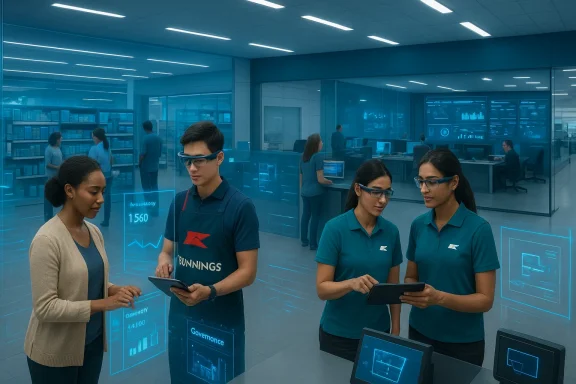
Wesfarmers’ decision to formalise a multi‑year strategic partnership with Microsoft signals a clear shift from experimentation to production-ready AI across one of Australia’s largest retail groups — and it comes with ambitious targets, clear technical choices, and a set of governance and commercial questions that will define whether this becomes a durable competitive advantage or an expensive experiment.
Wesfarmers operates a broad portfolio that includes Bunnings, Kmart Group, Blackwoods and Priceline — businesses that together rely on millions of customer interactions and a complex supply chain stretching across Australia and New Zealand. The new agreement with Microsoft expands the retailer’s use of the Microsoft Cloud, Azure OpenAI, Microsoft 365 Copilot, and Microsoft Copilot Studio, and explicitly targets both internal productivity and customer‑facing innovation. Microsoft will provide embedded engineering expertise, deployment frameworks and governance models to accelerate movement from pilots into production.
This is not Wesfarmers’ first foray into Microsoft‑powered AI. The group has already trialled and deployed early Copilot licences, integrated GitHub Copilot for developers, and piloted a Bunnings in‑store assistant that gives team members rapid access to operational and product information. Microsoft’s own coverage of Wesfarmers’ earlier efforts reported over 1,000 Copilot users inside the group and referenced a series of trials in 2024 and 2025 that produced measurable time savings — the practical base the company is now scaling from.
Why this matters operationally: frontline retail labour is high‑volume and low‑margin. Savings of minutes per interaction compound across thousands of daily transactions, and freeing time for staff to advise customers can directly affect conversion, average transaction value and customer satisfaction. These are the practical levers Wesfarmers is explicitly targeting.
Potential retail benefits:
Key mechanics Wesfarmers is likely to pursue:
Core operational elements the partnership emphasises:
Measuring ROI requires disciplined baseline metrics:
What to watch in vendor dynamics:
Yet the path from pilot to durable advantage is rarely a straight line. The programme’s success will depend on three hard, non‑glamorous things: disciplined data engineering, enterprise‑grade governance and continuous measurement tied to real business KPIs. If Wesfarmers executes on those fundamentals while keeping a cautious stance on agent autonomy in customer flows, this partnership could become a practical blueprint for how large retailers turn generative AI from hype into repeatable value. If it skips those steps, the result will likely be higher costs, governance incidents and lost trust — lessons the entire region will watch closely.
In short: the technology choices make sense; the ambitions are appropriate for the scale; the decisive factor will be executional discipline rather than model choice.
Source: ChannelLife New Zealand https://channellife.co.nz/story/wesfarmers-deepens-microsoft-ai-partnership-for-retail/
 Background / Overview
Wesfarmers operates a broad portfolio that includes Bunnings, Kmart Group, Blackwoods and Priceline — businesses that together rely on millions of customer interactions and a complex supply chain stretching across Australia and New Zealand. The new agreement with Microsoft expands the retailer’s use of the Microsoft Cloud, Azure OpenAI, Microsoft 365 Copilot, and Microsoft Copilot Studio, and explicitly targets both internal productivity and customer‑facing innovation. Microsoft will provide embedded engineering expertise, deployment frameworks and governance models to accelerate movement from pilots into production.This is not Wesfarmers’ first foray into Microsoft‑powered AI. The group has already trialled and deployed early Copilot licences, integrated GitHub Copilot for developers, and piloted a Bunnings in‑store assistant that gives team members rapid access to operational and product information. Microsoft’s own coverage of Wesfarmers’ earlier efforts reported over 1,000 Copilot users inside the group and referenced a series of trials in 2024 and 2025 that produced measurable time savings — the practical base the company is now scaling from.
What the partnership covers: the technical pillars
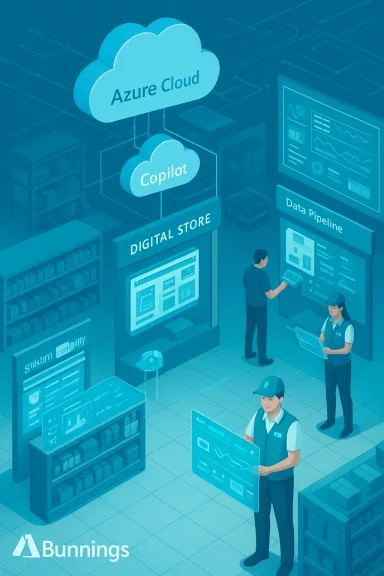
The public brief names a compact stack of Microsoft technologies and target capabilities that will form the backbone of the rollout:- Microsoft Cloud / Azure — cloud hosting, data platform and inference compute for model workloads.
- Azure OpenAI — generative AI models and APIs used to power conversational agents, summarisation, classification and other LLM‑driven features.
- Microsoft 365 Copilot — generative productivity assistant embedded in the Microsoft 365 suite, intended to reduce repetitive work in functions like finance, HR and marketing.
- Microsoft Copilot Studio — the low‑code / maker platform used to craft domain‑specific agents and publish them to internal and customer channels.
Where work has already delivered results: Bunnings as a use‑case
Bunnings is the most concrete case in public reporting so far. The in‑store assistant trial — frequently described internally as an “Ask” service — gives store teams quick access to product details, warranty terms, operational updates and safety information, reducing the time staff spend searching for answers and increasing customer‑facing time. Wesfarmers and Microsoft say the feature has delivered measurable time savings for team members during 2025, and that those gains underpin the decision to more than double the Microsoft 365 Copilot footprint across the group.Why this matters operationally: frontline retail labour is high‑volume and low‑margin. Savings of minutes per interaction compound across thousands of daily transactions, and freeing time for staff to advise customers can directly affect conversion, average transaction value and customer satisfaction. These are the practical levers Wesfarmers is explicitly targeting.
Agentic commerce: what Wesfarmers plans to test
The term agentic commerce denotes shopping and service experiences where AI agents can act on behalf of users inside defined guardrails — guiding product discovery, checking availability, completing orders, and even recommending bundles. Microsoft is positioning Copilot Studio and Azure OpenAI as tools to build “Copilot digital storefronts” and catalog enrichment agents that extract product attributes from images and automate catalog management. Those agent templates accelerate time‑to‑market for conversational shopping features and merchant storefronts.Potential retail benefits:
- Faster discovery and personalised recommendations at scale.
- Richer telemetry for merchandising, enabling smarter promotions and replenishment decisions.
- Reduced service costs through automated handling of routine inquiries and order tracking.
Supply‑chain optimisation: AI where it often pays the most
Wesfarmers highlights demand forecasting, inventory management and product availability as core areas for AI application. These are classic value areas: even modest improvements in forecast accuracy can significantly reduce stockouts or excess inventory, directly improving top line and working capital. Microsoft’s enterprise tools — coupling Azure data services with Azure OpenAI agents — are being positioned as the technical enablers for modelled forecasting and automated replenishment decisions.Key mechanics Wesfarmers is likely to pursue:
- Centralise enterprise data in Azure‑backed data platforms to create a single source of truth.
- Run probabilistic demand models and run scenario planning via LLM‑augmented analytics.
- Embed autonomous or semi‑autonomous agents to recommend or execute replenishment tasks subject to human approval and guardrails.
Skills, governance and moving pilots to production
Microsoft will supply embedded engineering resources and deployment frameworks, and Wesfarmers has committed to skilling programmes designed around Microsoft AI tools. The company’s earlier internal work established an AI operating model and governance principles aligned with Microsoft’s Responsible AI Standards — a sensible starting point for responsible adoption across a group as large and diverse as Wesfarmers.Core operational elements the partnership emphasises:
- Formal governance and Responsible AI frameworks for model validation, monitoring and incident response.
- Large‑scale training to lift frontline makers, store teams and corporate functions from pilot usage to confident day‑to‑day operators.
- Embedded engineering teams to accelerate integration work and reduce time‑to‑production.
Security, privacy, and regulatory considerations
Large Copilot and agent deployments expand the enterprise attack surface. The tech stack listed in the public brief includes native Microsoft governance tooling, but several real‑world risk vectors remain:- Data exposure and leakage through prompts and agent logs. Organisations must ensure prompt governance and mask or filter sensitive fields.
- Access control and least privilege for agents that query or act on enterprise systems. Role‑based access and conditional policies must be rigorous.
- Model hallucinations and incorrect assertions that could mislead staff or customers — especially risky if agents make commitments about availability, pricing or refunds.
- Data residency and sovereignty for customer or supplier data shared with cloud AI services, particularly given cross‑jurisdictional operations in Australia and New Zealand.
Commercial considerations: costs and measurement
Large‑scale AI rollouts have two parallel cost drivers: (a) cloud and inference spend for production models and (b) the internal costs of integration, skilling and change management. Microsoft will provide embedded engineering and deployment frameworks, which reduces some execution risk, but the economics of inference at retail scale can be material if agents are highly interactive and high‑latency SLAs prompt more expensive hosting. The public brief does not disclose commercial terms, so the economics remain proprietary to the parties. Observers should watch for disclosures of incremental operating costs, especially if Wesfarmers moves from hundreds to tens of thousands of Copilot seats.Measuring ROI requires disciplined baseline metrics:
- Hours saved per role, converted to cost or redeployment outcomes.
- On‑shelf availability and stockout rates for supply‑chain pilots.
- Conversion lift, average order value and customer NPS for any agentic commerce pilots.
Competitive context and vendor dynamics: one cloud, many partners?
Large multinationals — including major Australian retailers — increasingly adopt multi‑cloud strategies and maintain partnerships with several hyperscalers for different workloads. While the Wesfarmers–Microsoft announcement is explicit, other recent public claims suggest Wesfarmers is also engaging with alternative cloud vendors on agentic AI experiments. For example, contemporaneous reporting indicates a Google Cloud collaboration pitched at agentic retail experiences. These apparent overlaps are not necessarily contradictory: large retailers commonly compartmentalise by business unit, use‑case or region, and may run parallel vendors for redundancy, best‑of‑breed capability or commercial leverage. Any such multi‑vendor reality increases integration complexity and the governance burden for data flows across clouds.What to watch in vendor dynamics:
- Will Wesfarmers standardise core data platforms in a single cloud, or maintain cross‑cloud data fabrics and federated governance?
- How will the company avoid duplicated infra costs and inconsistent model governance if agents are run on multiple clouds?
- Which vendor(s) will host mission‑critical, low‑latency inference (for example, checkout‑adjacent agents) versus experimentation workloads?
Practical implementation roadmap (a suggested blueprint)
If Wesfarmers follows best‑practice patterns for scaling enterprise AI, the rollout would follow a disciplined, staged roadmap. Below is a practical, numbered sequencing that mirrors what the public brief promises but turns it into an action plan:- Baseline and instrumentation — capture pre‑AI KPIs across target teams and supply‑chain processes.
- Data centralisation and master‑data clean‑up — build the Azure data foundation and canonical product/sales datasets.
- Pilot production models for high‑value, low‑risk tasks — e.g., in‑store knowledge assistant for staff (Bunnings).
- Deploy governance and monitoring — establish model cards, prompt controls, and runtime telemetry dashboards.
- Expand Copilot seats with role‑based training and A/B testing to quantify impact.
- Gradually expose agentic commerce features in closed pilots (controlled customer cohorts, limited payment capabilities).
- Iterate on supply‑chain agents with human‑in‑the‑loop approvals until trust thresholds and SLA met.
Risks and red flags to monitor
The public brief is optimistic but omits several operational details that matter in practice. Watch for these warning signs:- Rapid seat expansion without commensurate governance, training or monitoring — risk of data leakage, incorrect outputs and legal exposure.
- Unclear commercial model for inference-heavy, customer‑facing agents — could lead to unexpectedly high Azure costs.
- Fragmented vendor estate and duplicate data silos if Wesfarmers pursues multiple hyperscaler partners without a unified data governance framework.
- Over‑automating frontline tasks that have qualitative value (judgement, upsell or local knowledge) — AI should augment, not replace, valuable human interactions.
Why this matters for Australian and New Zealand retail
Wesfarmers’ scale makes this a meaningful industry signal. If the group succeeds, it will produce a working playbook for multi‑brand retail adoption of agentic AI within the Microsoft ecosystem and will likely accelerate similar partnerships among major retailers and suppliers. Conversely, executional missteps would be instructive for practitioners about the limits of vendor bundling and the importance of governance and data engineering. Microsoft frames the deal as a “new chapter” for retail AI in Australia and New Zealand; the real test will be whether that chapter contains verifiable, repeatable outcomes beyond pilot anecdotes.Bottom line: realistic optimism with operational discipline
Wesfarmers’ expanded partnership with Microsoft is a pragmatic and necessary move for a group wrestling with complex retail operations, large frontline workforces and multi‑brand customer channels. The combination of Microsoft Cloud, Azure OpenAI, Microsoft 365 Copilot, and Copilot Studio provides a coherent technology stack that can, if governed well, deliver measurable productivity and customer experience improvements. Early signals — Bunnings’ in‑store assistant and 2025 Copilot time savings — justify the scaling ambition.Yet the path from pilot to durable advantage is rarely a straight line. The programme’s success will depend on three hard, non‑glamorous things: disciplined data engineering, enterprise‑grade governance and continuous measurement tied to real business KPIs. If Wesfarmers executes on those fundamentals while keeping a cautious stance on agent autonomy in customer flows, this partnership could become a practical blueprint for how large retailers turn generative AI from hype into repeatable value. If it skips those steps, the result will likely be higher costs, governance incidents and lost trust — lessons the entire region will watch closely.
In short: the technology choices make sense; the ambitions are appropriate for the scale; the decisive factor will be executional discipline rather than model choice.
Source: ChannelLife New Zealand https://channellife.co.nz/story/wesfarmers-deepens-microsoft-ai-partnership-for-retail/