

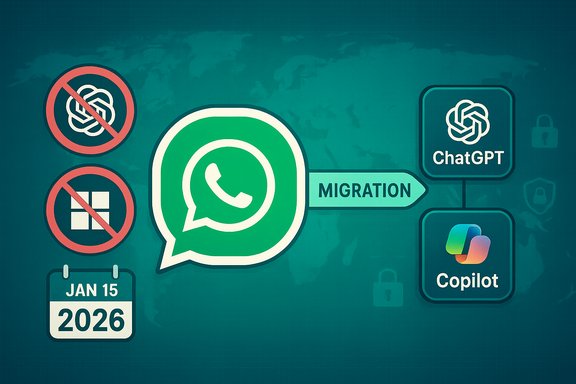
OpenAI’s ChatGPT and Microsoft’s Copilot will stop responding on WhatsApp on January 15, 2026, after Meta revised the WhatsApp Business Solution terms to explicitly ban third‑party, general‑purpose AI assistants from using the platform’s Business API — a policy change that reshapes how conversational AI will be distributed, regulated, and monetized on one of the world’s largest messaging networks.
Background
WhatsApp’s Business Solution (the Business API) was introduced to let companies use WhatsApp for customer support, notifications, and transactional messages. Over the past year, a wave of AI providers repurposed that same channel to deliver consumer-facing assistants directly inside users’ existing chats. Those assistants — notably ChatGPT and Copilot — offered lightweight, zero‑install access to large language model (LLM) capabilities by letting people message an official contact on WhatsApp.In October 2025, Meta updated the Business Solution terms to add a new «AI providers» clause. The clause states that providers of large language models, generative AI platforms, and general‑purpose AI assistants are prohibited from accessing or using the WhatsApp Business Solution when those AI capabilities are the primary functionality offered. The new restrictions take effect on January 15, 2026.
In direct response to the updated terms, OpenAI and Microsoft have confirmed they will withdraw their WhatsApp chatbots by the enforcement date. OpenAI has provided a migration path that lets WhatsApp users link their phone numbers to a ChatGPT account to preserve history; Microsoft advises Copilot users to export their WhatsApp conversations manually because the Copilot WhatsApp integration was unauthenticated and cannot be migrated automatically.
What changed in WhatsApp’s Business API terms
The new “AI providers” prohibition
- The updated terms add a broad definition of “AI Providers,” explicitly covering LLMs, generative AI platforms, and general‑purpose assistants.
- The policy bars those providers from using the Business Solution when the AI assistant is the primary product being delivered through WhatsApp.
- The rule contains discretionary language that gives WhatsApp (Meta) latitude to determine what counts as “primary” or “ancillary” functionality.
The carve‑outs and exceptions
- Important carve‑outs remain: enterprise bots that use AI to support customer service — such as order confirmations, booking flows, ticket triage, or account verification — are still allowed.
- The policy is narrowly targeted at consumer-facing, open‑ended chat assistants that effectively use WhatsApp as a distribution channel for the assistant itself.
Immediate effects: ChatGPT, Copilot, and the user experience
The timeline and user impact
- Cutoff date: January 15, 2026 — after this date, ChatGPT and Copilot will cease functioning inside WhatsApp.
- ChatGPT users were told they can link their WhatsApp number to a ChatGPT account so past WhatsApp conversations will appear in ChatGPT history on the official app and web surfaces. OpenAI reported that more than 50 million people used ChatGPT on WhatsApp prior to the policy shift.
- Copilot users are not offered the same account‑linking migration: because the Copilot integration used an unauthenticated channel, Microsoft warns that conversations cannot be ported automatically. Users who want a copy must export WhatsApp chat threads manually before the deadline.
What remains available inside WhatsApp
- Business support bots and enterprise automation using AI for incidental tasks remain permitted.
- Meta’s own assistant (Meta AI) and any Meta‑built conversational features are unaffected by the Business API ban and will continue to operate inside WhatsApp.
Practical user steps before the shutdown
- Identify any AI assistant chats you want to keep.
- For ChatGPT users: link your WhatsApp number to a ChatGPT account via the official 1‑800‑ChatGPT contact so history migrates into your ChatGPT account history.
- For Copilot or other unauthenticated integrations: export the relevant WhatsApp conversations using WhatsApp’s chat export tools; note exported files may not retain end‑to‑end encryption once saved outside the app.
- Install native apps or use web versions of AI assistants for continuity after January 15, 2026.
Why Meta says it did this — and why analysts are skeptical
Meta’s publicly stated rationale is operational and categorical: the Business API exists to serve businesses interacting with customers, not as a launchpad for third‑party consumer assistants. Meta says widespread, general‑purpose chatbots placed an unexpected burden on infrastructure and required a different kind of support and moderation than traditional business messaging.Strengths of Meta’s stated case:
- The Business API is indeed optimized for predictable business workflows and transactional messaging. General‑purpose LLMs generate far higher and more varied message volumes, plus multimodal exchanges that can strain moderation and support systems.
- Allowing unlimited chat assistants could alter the intended rate‑limits, monitoring needs, and content review responsibilities placed on Meta’s backend.
- The language of the clause gives Meta broad discretion to define confined terms (like “primary functionality”), and critics argue that the policy functions as a competitive gatekeeper.
- With Meta’s own assistant embedded across its apps, the change consolidates Meta AI’s position and narrows consumer choice inside WhatsApp — a platform used by billions.
Industry and regulatory fallout
Competitive impact
- WhatsApp is a massive distribution channel — measured in the billions of active users — and the Business API ban converts that channel into exclusive real estate for Meta’s assistant.
- Smaller AI startups that used WhatsApp to reach users with minimal friction will have to rebuild distribution through native apps, web portals, or other messaging apps. The absence of WhatsApp as a neutral playground reduces low‑cost routes to scale.
Likely cascade of exits
- OpenAI and Microsoft have already confirmed their departures. Other third‑party providers that used the Business API — including several startups and consumer LLM services — will likely announce similar exits or pivots to alternate channels.
- The practical result: by the enforcement date, Meta AI may be the only general‑purpose assistant officially available inside WhatsApp.
Regulatory scrutiny
- Competition and consumer protection authorities are already watching. At least one national competition regulator expanded an investigation into Meta’s WhatsApp AI strategy, citing risks that the policy and Meta’s integration of AI could limit market access and technical development in the chatbot market.
- Antitrust concerns will focus on whether the policy is a legitimate platform management decision or an exclusionary act that leverages a dominant messaging network to stifle rivals.
- Whether the Business API change was necessary and proportionate to the operational problems cited.
- If Meta’s own embedding of AI into WhatsApp constitutes self‑preferencing or unfair tying.
- Whether effective remedies (e.g., data portability, third‑party access conditions) are required.
Technical and privacy implications
Data flows and data portability
- The ChatGPT account‑link approach lets OpenAI associate WhatsApp conversations with a ChatGPT account and give users continuity. That relies on user‑initiated linkage and a move out of WhatsApp’s encrypted message stream into provider‑controlled storage.
- Exported WhatsApp chats become portable artifacts, but exported files may not retain the privacy guarantees of end‑to‑end encryption once stored externally.
- The policy raises hard questions about who controls conversational data and how seamlessly user histories should move between platforms and services.
Authentication and user experience tradeoffs
- The unauthenticated model used by some integrations (e.g., Copilot on WhatsApp) prioritizes instant access and simplicity but sacrifices account continuity and personalization.
- Native apps and web surfaces typically require authentication, unlocking persistent memory, sync, and more advanced features (voice, image uploads, multimodal capabilities) — but at the cost of higher friction for onboarding.
Content safety and moderation
- General‑purpose AI assistants produce variable outputs that may require different moderation tooling than enterprise‑centered bots. Meta’s rationale about additional moderation burden has practical validity.
- When assistants operate inside WhatsApp under the Business Solution umbrella, the platform owner bears moderation oversight obligations; the new policy limits the exposure and operational cost that third‑party LLM activity places on WhatsApp infrastructure.
What OpenAI, Microsoft and other AI vendors will do next
- Consolidate on first‑party surfaces: both OpenAI and Microsoft are pointing users to their native apps, browsers, and web portals as the primary ways to reach ChatGPT and Copilot.
- Build better onboarding hooks: expect improved, lower‑friction account linking and migration flows to capture WhatsApp users before the cutoff date.
- Diversify platform integration: teams will accelerate integrations with alternate messaging channels, email, voice platforms, and proprietary apps to recover lost distribution.
- Reassess partner agreements: some providers may negotiate new enterprise relationships (e.g., telco carriers, OEM preloads) to reestablish reach outside of the WhatsApp channel.
How builders and businesses should respond
- Audit dependency: any company that relies on the WhatsApp Business API for consumer‑facing AI should immediately audit dependencies and rewiring plans.
- Prioritize authenticated experiences: if long‑term engagement and user data continuity matter, design authenticated integrations that can survive changes to third‑party platforms.
- Offer migration tooling: provide clear, simple instructions and in‑app prompts for users to move to native apps or to export important data before January 15, 2026.
- Consider multichannel strategies: distribute assistants across multiple surfaces (native apps, web widgets, other messaging apps) to avoid single‑point platform risk.
Legal and policy risks to watch
- Antitrust investigations: regulators may scrutinize whether the policy amounts to exclusionary conduct, especially where it benefits Meta’s native assistant.
- Consumer data safeguards: linking WhatsApp histories to provider accounts changes data governance; companies must ensure clarity in privacy notices, retention policies, and deletion rights.
- Platform governance precedent: the decision sets a precedent for how platform owners can restrict third‑party services — a theme regulators and courts are already evaluating globally.
What users should know and do now
- If you rely on ChatGPT on WhatsApp, link your phone number to a ChatGPT account now to retain chat history and seamless access in the ChatGPT app or web.
- If you use Copilot on WhatsApp, export conversations you want to keep; Microsoft has stated those chats cannot be imported automatically to other Copilot surfaces due to the integration’s unauthenticated design.
- Expect reminders inside WhatsApp and from vendors as the January 15, 2026 deadline approaches. Act early — exported chats and manual migrations can be time‑consuming.
- Recognize the tradeoffs: moving to a native app can deliver richer features (voice, multimodal inputs, account history) but requires signing up and consenting to the provider’s storage and privacy terms.
Longer‑term outlook: distribution, trust, and the future of conversational AI
WhatsApp’s policy change is a watershed in how conversational AI gets distributed. Messaging apps have become the most convenient interface for billions, and restricting third‑party assistants inside such a dominant channel significantly raises the bar for new entrants.Key structural outcomes likely to play out over the next 12–24 months:
- A re‑concentration of conversational interactions into first‑party and authenticated experiences (apps, web).
- A heavier emphasis on onboarding flows that convert frictionless access into account‑backed relationships.
- Regulatory engagement aimed at balancing platform rights to manage systems versus the need for fair access to essential distribution channels.
- A multifaceted competition where distribution advantages, data access, product features, and platform policies interact in new ways.
Conclusion
Meta’s update to the WhatsApp Business Solution terms forces a formal separation between business messaging and consumer‑facing AI assistants on WhatsApp. The immediate consequence is clear and specific: ChatGPT and Copilot will stop working inside WhatsApp on January 15, 2026, unless individual users migrate or providers change their approach.Operational reasons and product fit are legitimate explanations for the policy change; yet the strategic effects — concentrating general‑purpose conversational AI inside Meta’s ecosystem and narrowing third‑party routes to billions of users — will provoke ongoing industry debate and regulatory attention.
For users, the window to migrate or export is finite and concrete; for developers and competitors, the era of relying on WhatsApp as a neutral distribution platform for general‑purpose assistants is ending. The knock‑on effects — from how conversational history is preserved to how regulators evaluate platform power — will shape the next chapter of consumer AI accessibility and competition.
Source: Tekedia ChatGPT and Microsoft Copilot Set to Leave WhatsApp as Meta Enforces New Ban on Third-Party AI Assistants - Tekedia
