

A Brazilian film site page submitted as “Sandy Koufax Photo Print – Los Angeles Dodgers” appears to be an ecommerce-style product page or search-index artifact, not a film article, mixing sports memorabilia copy with Cineset’s Portuguese entertainment-news feed. That mismatch is the story. It is a small, almost absurd example of how the modern web’s plumbing turns content management systems, affiliate listings, search snippets, and stale pages into something users cannot easily classify. For Windows users and administrators, the lesson is not about baseball prints; it is about trust at the browser edge.
The page’s visible ingredients do not belong together. A Sandy Koufax Dodgers photo print listing is paired with a run of recent entertainment headlines about films, actors, and reviews, all under a Brazilian site that otherwise appears to be in the cinema and pop-culture lane.
That collision is common enough that many users no longer stop to think about it. Search engines surface pages by title, browsers render whatever the server sends, and the user is left to decide whether the page is a store, a hacked page, an ad doorway, an abandoned listing, or some combination of all four.
The safe reading is simple: when a site’s brand, language, subject matter, and commercial offer do not line up, the page deserves suspicion. It may be harmless junk. It may be a misconfigured feed. It may also be a symptom of SEO spam, compromised publishing software, or an affiliate-content injection designed to harvest clicks.
Microsoft Edge, Chrome, Firefox, and modern endpoint security tools all try to catch known bad destinations. But reputation systems work best against known patterns. A compromised niche site, a throwaway product page, or a lightly obfuscated spam landing page can sit in the gray zone long enough to reach ordinary users.
That is why user judgment still matters. A page does not need to ask for a password to be risky; it only needs to push a user toward a download, a fake checkout, a notification permission prompt, or a third-party redirect. The web’s attack surface has become less about one dramatic exploit and more about a chain of small permissions granted too casually.
This is the economics of modern SEO pollution. Attackers and gray-market operators do not need a beautiful storefront. They need indexable text, plausible product names, and a domain with enough trust to slip past the first layer of skepticism.
A film site is useful in that model because it already has content velocity, internal links, and a reason to be crawled frequently. If a malicious or careless actor can attach unrelated product pages to that domain, the spam inherits a little of the host’s credibility.
For administrators, the problem is less sentimental and more operational. Users browse the web from managed devices, sign in with corporate identities, and reuse habits across personal and work contexts. A low-grade spam page can become the first step in credential theft or malware delivery if it redirects at the wrong moment.
Enterprise controls help, but they do not remove the need for policy. DNS filtering, SmartScreen-style reputation checks, browser isolation, and endpoint detection are layers, not guarantees. The messy middle of the web remains a place where human curiosity and automated abuse meet.
That mismatch should trigger a pause. Does the page match the domain? Does the language match the audience? Does the navigation behave consistently? Does the purchase path go somewhere expected? If not, closing the tab is not paranoia; it is basic hygiene.
The web has trained users to tolerate clutter. Pop-ups, recommendation widgets, affiliate boxes, and syndicated feeds have made incoherence feel normal. Attackers benefit from that lowered standard.
Search providers have improved spam detection, but the contest is asymmetrical. A search engine must evaluate the whole web. A spammer only needs a few pages to survive long enough to earn traffic.
That does not mean users should distrust all search results. It means the result page is not a verdict. It is an invitation to inspect.
On Windows, those basics now matter as much as traditional antivirus advice. The operating system is more resistant to old-school drive-by chaos than it used to be, but the browser remains a permission machine. Every prompt is a small negotiation between convenience and risk.
Admins should treat oddball web traffic as signal, not noise. A single visit to a strange product page may mean nothing. Repeated visits to unrelated ecommerce paths on editorial domains may suggest search poisoning, adware, or a compromised browser profile.
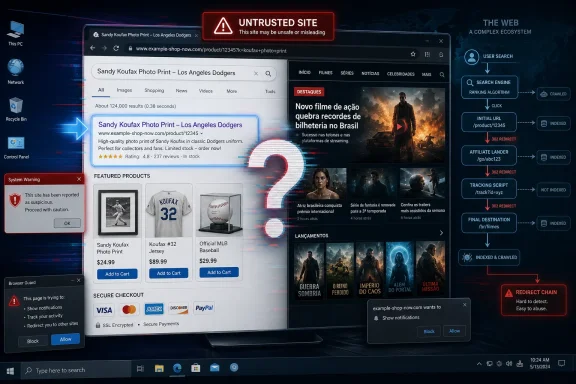 The Web Page That Looks Like a Product and Reads Like a Warning
The page’s visible ingredients do not belong together. A Sandy Koufax Dodgers photo print listing is paired with a run of recent entertainment headlines about films, actors, and reviews, all under a Brazilian site that otherwise appears to be in the cinema and pop-culture lane.That collision is common enough that many users no longer stop to think about it. Search engines surface pages by title, browsers render whatever the server sends, and the user is left to decide whether the page is a store, a hacked page, an ad doorway, an abandoned listing, or some combination of all four.
The safe reading is simple: when a site’s brand, language, subject matter, and commercial offer do not line up, the page deserves suspicion. It may be harmless junk. It may be a misconfigured feed. It may also be a symptom of SEO spam, compromised publishing software, or an affiliate-content injection designed to harvest clicks.
The Browser Is Now the First Security Tool
For years, Windows security advice focused on executables, email attachments, and obvious phishing pages. That advice still matters, but today’s risk often begins earlier, with a search result that looks legitimate enough to click and strange enough to confuse.Microsoft Edge, Chrome, Firefox, and modern endpoint security tools all try to catch known bad destinations. But reputation systems work best against known patterns. A compromised niche site, a throwaway product page, or a lightly obfuscated spam landing page can sit in the gray zone long enough to reach ordinary users.
That is why user judgment still matters. A page does not need to ask for a password to be risky; it only needs to push a user toward a download, a fake checkout, a notification permission prompt, or a third-party redirect. The web’s attack surface has become less about one dramatic exploit and more about a chain of small permissions granted too casually.
SEO Spam Has Become the Background Radiation of the Open Web
The Koufax listing is notable precisely because it is so mundane. Sports memorabilia keywords, selectable print sizes, and marketplace-style phrasing are the sort of low-cost content that can be cloned across thousands of pages. The goal is not always to fool every visitor; it is to catch enough search traffic to make automation profitable.This is the economics of modern SEO pollution. Attackers and gray-market operators do not need a beautiful storefront. They need indexable text, plausible product names, and a domain with enough trust to slip past the first layer of skepticism.
A film site is useful in that model because it already has content velocity, internal links, and a reason to be crawled frequently. If a malicious or careless actor can attach unrelated product pages to that domain, the spam inherits a little of the host’s credibility.
Windows Users See the Mess, Admins Inherit the Risk
For home users, the immediate danger is confusion. A user searching for a collectible print may land on a page that looks vaguely commercial but does not behave like a normal shop. If the next step is a strange payment flow, a browser notification request, or a file download, the damage can escalate quickly.For administrators, the problem is less sentimental and more operational. Users browse the web from managed devices, sign in with corporate identities, and reuse habits across personal and work contexts. A low-grade spam page can become the first step in credential theft or malware delivery if it redirects at the wrong moment.
Enterprise controls help, but they do not remove the need for policy. DNS filtering, SmartScreen-style reputation checks, browser isolation, and endpoint detection are layers, not guarantees. The messy middle of the web remains a place where human curiosity and automated abuse meet.
The Clue Is the Mismatch, Not the Celebrity
Sandy Koufax is incidental here. The same pattern could attach itself to movie posters, printer drivers, sneaker listings, game mods, or Windows utility downloads. What matters is the mismatch between the site’s apparent editorial identity and the page’s commercial payload.That mismatch should trigger a pause. Does the page match the domain? Does the language match the audience? Does the navigation behave consistently? Does the purchase path go somewhere expected? If not, closing the tab is not paranoia; it is basic hygiene.
The web has trained users to tolerate clutter. Pop-ups, recommendation widgets, affiliate boxes, and syndicated feeds have made incoherence feel normal. Attackers benefit from that lowered standard.
Search Engines Cannot Fully Solve a Trust Problem They Helped Create
Search engines are both the discovery layer and part of the incentive structure. Pages like this exist because being indexed has value, even when the content itself is low quality. If a page can rank for a product phrase, it can monetize attention, redirect traffic, or lend credibility to another destination.Search providers have improved spam detection, but the contest is asymmetrical. A search engine must evaluate the whole web. A spammer only needs a few pages to survive long enough to earn traffic.
That does not mean users should distrust all search results. It means the result page is not a verdict. It is an invitation to inspect.
The Security Advice Is Boring Because It Works
The practical advice here is not glamorous. Keep the browser updated. Do not allow notifications from sites you do not recognize. Avoid downloading files from pages whose purpose is unclear. Use a password manager so fake login pages stand out. Let reputation warnings do their job instead of clicking through them on autopilot.On Windows, those basics now matter as much as traditional antivirus advice. The operating system is more resistant to old-school drive-by chaos than it used to be, but the browser remains a permission machine. Every prompt is a small negotiation between convenience and risk.
Admins should treat oddball web traffic as signal, not noise. A single visit to a strange product page may mean nothing. Repeated visits to unrelated ecommerce paths on editorial domains may suggest search poisoning, adware, or a compromised browser profile.
The Koufax Page Leaves a Short Checklist Behind
This particular page is useful because it compresses the modern web’s trust problem into one odd snapshot: a Dodgers print, a Portuguese film-news feed, and a domain that does not obviously explain the relationship. The right response is not panic. It is disciplined skepticism.- A page whose product, language, and site identity do not match should be treated as untrusted until proven otherwise.
- Users should avoid entering payment details, credentials, or personal information on pages reached through suspicious search results.
- Browser notification prompts from unfamiliar sites should be denied, because they are frequently abused for spam and scareware.
- Administrators should consider DNS filtering, browser reputation controls, and endpoint telemetry part of normal web-risk management.
- Search results should be treated as leads, not endorsements, especially for obscure product listings and utility downloads.
References
- Primary source: cineset.com.br
Published: 2026-06-15T14:37:10.101806
- Related coverage: etsy.com
- Related coverage: ebay.com
Sandy Koufax Photo | eBay
Explore a wide range of our Sandy Koufax Photo selection. Find top brands, exclusive offers, and unbeatable prices on eBay. Shop now for fast shipping and easy returns!www.ebay.com - Related coverage: sportsmemorabilia.com
- Related coverage: nzmessengers.co.nz
- Related coverage: apro.bid
