

Data teams are emerging as early leaders in AI agent adoption because, as Microsoft argued on June 29, 2026, structured data work gives agents bounded tasks, measurable outputs, and enough observability for organizations to trust delegation before handing over messier business processes. That is the practical heart of the new agent boom. The glamorous story is autonomous software coworkers; the less glamorous, more important story is that agents are first being trusted where the data is legible, the work is repetitive, and mistakes can be caught. In other words, the agent era is not beginning with magic—it is beginning with monitoring jobs, semantic models, dashboards, and the long-unloved plumbing of enterprise analytics.
The language around AI agents has been inflated almost beyond usefulness. Vendors describe systems that plan, reason, act, observe, and improve; executives hear the promise of digital labor; employees hear the possibility of either relief or displacement. But the adoption curve is being shaped by something more prosaic: where organizations can actually verify whether the thing worked.
That is why data teams matter. They sit at the junction between ambition and evidence. If an agent checks a pipeline, flags an anomaly, profiles a dataset, or drafts a business metric explanation, the result can often be compared against logs, schemas, histories, thresholds, and human review. This makes the data function a safer proving ground than domains where the output is mostly judgment, persuasion, or negotiation.
Microsoft’s Fabric blog post frames this around the “Agent Confidence Index,” a research effort with MIT Technology Review Insights that surveyed 300 global technology experts and ranked 101 tasks across data, AI, and cloud workflows. The headline finding, as Microsoft presents it, is that confidence rises when tasks are well-defined, measurable, and grounded in structured data. That should not surprise anyone who has ever tried to automate a business process: ambiguity is where software promises go to die.
The more interesting point is that data teams are not merely using agents as fancier assistants. They are beginning to redesign workflows around them. That distinction matters. An assistant helps a person do the same work faster; an agent changes the shape of the work by monitoring, initiating, escalating, and acting inside a controlled system.
The general trend is straightforward: organizations trust agents first in environments where context is structured and outcomes are auditable. The product funnel is Microsoft’s answer to how that trust should be built: put enterprise context into Microsoft IQ, business semantics into Fabric IQ, operational signals into Real-Time Intelligence, and governance into Agent 365. In Microsoft’s telling, these layers become the foundation for agents that do not merely answer questions but participate in workflows.
That is consistent with the broader Build 2026 message Microsoft has been pushing. The company has moved beyond treating Copilot as a chat surface and is now describing an agent platform that spans Microsoft 365, Azure, Fabric, Foundry, Windows, and security tooling. The organizing idea is that agents need context as much as they need models. Without context, they are impressive guessers; with context, they might become useful operators.
There is a strategic reason Microsoft is emphasizing data teams. Data estates are where many enterprises have already made long-term Microsoft investments: Power BI, Azure SQL, Synapse legacies, Data Factory, Purview, and now Fabric. If agents become the next interface to business data, Microsoft wants Fabric to be the place where that interface is grounded, governed, and monetized.
That makes data quality monitoring, visualization anomaly detection, real-time stream monitoring, and data profiling unusually good candidates for early agent delegation. They are high-volume enough to justify automation, repetitive enough for pattern recognition, and measurable enough for humans to review without starting from scratch. Most importantly, many errors are reversible or at least containable.
This is not the same as saying these tasks are trivial. Anyone who has maintained production analytics knows that data pipelines fail in weird ways, business definitions drift, and upstream teams make “minor” changes that break downstream reporting. But these failures tend to leave traces. They produce logs, deltas, missing values, latency spikes, duplicate keys, and angry dashboards.
Agents are well matched to that messy-but-instrumented world. They can watch more continuously than a human team, summarize the probable cause, suggest remediation, and route the issue to the right owner. The agent does not need to be omniscient to be useful; it needs to reduce the interval between breakage and awareness.
Agents promise to compress that tax. Microsoft’s example of a “chief of staff” agent that combines calendar, metrics, customer context, and communications into a morning briefing is a revealing one. It is not a moonshot use case. It is a workflow that knowledge workers already perform manually, assembled from applications that were never designed to cooperate cleanly.
The point is not that every executive will now have a perfect briefing bot. The point is that the act of preparation can become a standing workflow rather than a daily scavenger hunt. For data teams, the same pattern applies to pipeline health, customer segmentation, anomaly triage, dashboard explanations, and operational reviews.
That shift changes what humans are asked to do. If an agent can gather the evidence, flag the deviation, and draft the first interpretation, the human role moves toward judgment: deciding whether the anomaly matters, whether the recommendation is safe, and whether the business context changes the answer. This is where the productivity story becomes more credible, because it is not pretending to eliminate expertise. It is trying to reserve expertise for the moments when it matters.
The lower-confidence tasks listed in the blog—cross-cloud data synchronization, database migration planning, feature engineering automation, and legacy system modernization—share a common problem. They are not just technical tasks. They require trade-offs across systems, teams, budgets, histories, compliance constraints, and future roadmaps.
A human expert approaching a migration plan knows that the technically clean answer may be politically impossible, financially absurd, or operationally reckless. They know which system owner is unavailable, which undocumented dependency always breaks during quarter-end close, and which “temporary” integration has been carrying revenue reporting for seven years. That context rarely lives in one table.
This is where agentic AI runs into the hard wall of institutional knowledge. Models can generalize from patterns, but enterprises operate through exceptions. The more an agent is asked to plan rather than observe, the more it needs access to the messy social and procedural reality of the organization.
This is the daily nightmare of enterprise data work. Two teams can both be “right” because they are using different definitions for different purposes. Sales, finance, customer success, and product may each have a defensible view of the same entity, and the mismatch only becomes visible when someone puts the numbers on a slide.
Agents amplify this problem because they make it easier to ask for answers without forcing the requester to specify assumptions. A chatbot-style interface can hide ambiguity behind a confident paragraph. In a conventional analytics workflow, a semantic model, report definition, or SQL query at least gives reviewers something to inspect. With agents, the reasoning path can become harder to see unless observability is built in deliberately.
That is why Microsoft’s emphasis on shared business context is more than marketing language. If agents are to operate reliably, they need access not just to data but to the meanings organizations attach to data. Otherwise, every agent becomes a new intern with root access to confusion.
The semantic layer has long been one of the most contested pieces of the analytics stack. Business intelligence tools, data warehouses, catalogs, governance platforms, and application vendors have all tried to become the place where definitions live. The prize is obvious: whoever controls the semantic layer controls the trusted version of the business.
Agents raise the stakes. If humans mostly interacted with dashboards, semantic drift was painful but manageable. If agents begin taking actions based on those definitions, semantic drift becomes operational risk. A wrong metric can become a wrong recommendation; a wrong recommendation can become a wrong action.
Microsoft’s advantage is distribution. Fabric, Power BI, Microsoft 365 Copilot, Azure, and Foundry give the company many surfaces where a shared context layer can be useful. Its challenge is credibility. Enterprises already have fragmented data estates, competing definitions, legacy warehouses, non-Microsoft platforms, and political fights over ownership. A semantic foundation is not adopted just because a vendor names it.
That shift is powerful and dangerous. In a low-risk scenario, an agent might flag unusual event volume, summarize likely causes, and notify the on-call engineer. In a higher-risk scenario, it might throttle a process, open a ticket, reroute a workload, or trigger a customer communication. The closer the agent gets to action, the more governance matters.
Real-time context also changes user expectations. If a business leader asks why conversion dipped this morning, a weekly batch model is not enough. If a manufacturing system, fraud pipeline, or support queue is moving minute by minute, the value lies in catching the signal while intervention is still possible.
Microsoft’s closed-loop framing—shared definitions from Fabric IQ, live signals from Real-Time Intelligence, and agents that reason over both—captures the direction of travel. But the hard part is not drawing the loop. The hard part is deciding which actions agents are allowed to take, under what policy, with which rollback path, and with what human escalation.
This is the right instinct. Autonomy without visibility is not innovation; it is unmanaged change. Every organization that has lived through shadow IT, spreadsheet sprawl, or SaaS permission creep should recognize the pattern. A tool that starts as a productivity shortcut can become infrastructure before anyone has mapped the risk.
Agent 365, Microsoft’s control-plane concept for securing and governing agents, fits into this anxiety. If enterprises are going to have agents built by Microsoft, partners, developers, departments, and perhaps individual workers, they need inventory, identity, permissions, logs, evaluation, and lifecycle management. Otherwise, the agent estate will become another unmanaged layer of automation.
The question for IT pros is not whether governance will be necessary. It is whether governance will arrive early enough. The history of enterprise technology suggests users adopt convenience first, and control catches up later. Microsoft is trying to sell both at once, because the company knows agent adoption will stall if security teams treat it as an uncontrolled experiment.
In data workflows, human review can be concrete. A data engineer can approve a remediation plan. An analyst can validate an anomaly explanation. A steward can accept or reject a proposed definition change. The agent accelerates the process, but the accountable human still has meaningful control.
In more complex business workflows, the loop can become ceremonial. If an agent produces a migration strategy, risk assessment, and implementation plan in a polished format, reviewers may rubber-stamp it because challenging the output takes more time than accepting it. This is one of the quiet risks of agentic systems: they can make uncertain work look finished.
The answer is not to ban autonomy. It is to design review points where human judgment is actually useful. That means surfacing assumptions, showing evidence, exposing uncertainty, and making it easy to compare the agent’s recommendation against policy and precedent.
If agents become normal participants in enterprise workflows, Windows administrators will inherit new questions. Which agents can access local resources? How are agent actions logged? What happens when a desktop agent interacts with a browser, file system, or line-of-business app? How do endpoint policies distinguish between a user action, a script, a Copilot action, and an autonomous agent action?
Microsoft has already been moving toward a world where Windows can host or broker more agentic experiences under tighter security boundaries. That makes the governance model more important, not less. An agent acting in a data platform is one thing; an agent acting across the productivity desktop is another.
The likely future is not a single omnipotent agent. It is many specialized agents stitched across work surfaces. That makes identity, permissions, audit trails, and data boundaries the real infrastructure of the agent era. Sysadmins have seen this movie before: the exciting demo becomes tomorrow’s access-control problem.
When a human analyst reads a messy metric, they can ask around, infer intent, and apply skepticism. When an agent reads the same metric, it may operationalize the ambiguity at machine speed. That turns data quality from an analytics problem into an automation safety problem.
This gives data professionals a new kind of leverage. Their work is no longer just about producing dashboards or enabling self-service BI. It is about creating the trusted substrate on which agents can reason and act. The semantic model becomes less like documentation and more like control infrastructure.
That also means the old compromises become more expensive. Duplicate customer definitions, inconsistent revenue logic, unlabeled data products, and undocumented transformations are no longer tolerable annoyances. They are failure modes for agentic systems.
This is where buyers should be skeptical of any vendor story that suggests the platform itself creates trust. Trust is not a feature toggle. It is the result of repeated performance under constraints, with enough transparency for people to understand failures and enough governance to prevent small mistakes from becoming systemic ones.
The most successful agent deployments will probably look boring at first. They will involve narrow workflows, clear metrics, limited permissions, and careful escalation paths. They will expand only after teams build evidence that the agent improves outcomes without creating unacceptable risk.
That is not a limitation of the technology. It is how enterprise technology becomes durable. The path from pilot to production has always run through boring disciplines: access control, documentation, monitoring, testing, rollback, and ownership.
Data teams are well positioned because they already think in terms of instrumentation. They know how to compare actuals to expectations, how to define thresholds, how to trace lineage, and how to investigate anomalies. These habits map directly onto agent operations.
The organizations that struggle will be the ones that treat agents as a layer of intelligence sprinkled over broken processes. If no one agrees on the metric, an agent will not magically create agreement. If no one owns the data product, an agent will not create accountability. If a workflow is politically tangled, automation may simply make the tangle move faster.
The better approach is to treat agent adoption as a mirror. Where agents perform well, the organization probably has clear context and measurable workflows. Where they fail, the failure may reveal missing definitions, weak governance, or undocumented dependencies that were already hurting the business.
The immediate implications are concrete.
The next phase of AI agent adoption will be decided less by which model writes the most fluent plan and more by which organizations can supply the context, controls, and current data that make action safe. Data teams are leading because their world already contains the raw materials of trust: structure, lineage, measurement, and operational feedback. If Microsoft is right, the agent frontier will expand from there into broader business workflows—but only as fast as enterprises can turn their own messy knowledge into systems agents can understand.
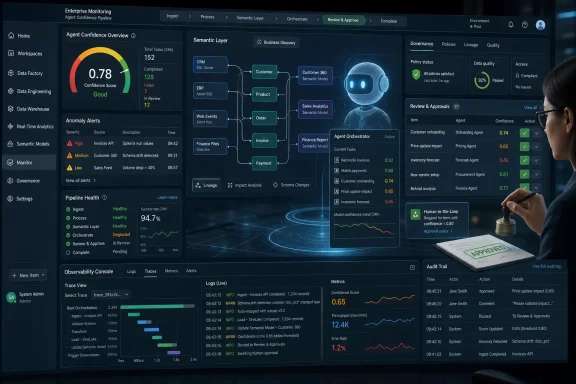 The Agent Revolution Is Starting in the Back Office, Not the Boardroom
The language around AI agents has been inflated almost beyond usefulness. Vendors describe systems that plan, reason, act, observe, and improve; executives hear the promise of digital labor; employees hear the possibility of either relief or displacement. But the adoption curve is being shaped by something more prosaic: where organizations can actually verify whether the thing worked.That is why data teams matter. They sit at the junction between ambition and evidence. If an agent checks a pipeline, flags an anomaly, profiles a dataset, or drafts a business metric explanation, the result can often be compared against logs, schemas, histories, thresholds, and human review. This makes the data function a safer proving ground than domains where the output is mostly judgment, persuasion, or negotiation.
Microsoft’s Fabric blog post frames this around the “Agent Confidence Index,” a research effort with MIT Technology Review Insights that surveyed 300 global technology experts and ranked 101 tasks across data, AI, and cloud workflows. The headline finding, as Microsoft presents it, is that confidence rises when tasks are well-defined, measurable, and grounded in structured data. That should not surprise anyone who has ever tried to automate a business process: ambiguity is where software promises go to die.
The more interesting point is that data teams are not merely using agents as fancier assistants. They are beginning to redesign workflows around them. That distinction matters. An assistant helps a person do the same work faster; an agent changes the shape of the work by monitoring, initiating, escalating, and acting inside a controlled system.
Microsoft’s Argument Is Also a Product Strategy
Microsoft is not a neutral observer here. The blog post is written from inside Microsoft’s Fabric orbit, and its argument naturally points toward Microsoft IQ, Fabric IQ, Real-Time Intelligence, and Agent 365. That does not invalidate the thesis, but it does mean readers should separate the general trend from the product funnel.The general trend is straightforward: organizations trust agents first in environments where context is structured and outcomes are auditable. The product funnel is Microsoft’s answer to how that trust should be built: put enterprise context into Microsoft IQ, business semantics into Fabric IQ, operational signals into Real-Time Intelligence, and governance into Agent 365. In Microsoft’s telling, these layers become the foundation for agents that do not merely answer questions but participate in workflows.
That is consistent with the broader Build 2026 message Microsoft has been pushing. The company has moved beyond treating Copilot as a chat surface and is now describing an agent platform that spans Microsoft 365, Azure, Fabric, Foundry, Windows, and security tooling. The organizing idea is that agents need context as much as they need models. Without context, they are impressive guessers; with context, they might become useful operators.
There is a strategic reason Microsoft is emphasizing data teams. Data estates are where many enterprises have already made long-term Microsoft investments: Power BI, Azure SQL, Synapse legacies, Data Factory, Purview, and now Fabric. If agents become the next interface to business data, Microsoft wants Fabric to be the place where that interface is grounded, governed, and monetized.
Structured Data Gives Agents Something Rare: A Scoreboard
The strongest part of Microsoft’s case is not the branding. It is the observation that data work comes with a scoreboard. A pipeline either ran or failed. A schema changed or it did not. A metric diverged from baseline. A report reconciles with the source system, or someone in finance starts sending emails.That makes data quality monitoring, visualization anomaly detection, real-time stream monitoring, and data profiling unusually good candidates for early agent delegation. They are high-volume enough to justify automation, repetitive enough for pattern recognition, and measurable enough for humans to review without starting from scratch. Most importantly, many errors are reversible or at least containable.
This is not the same as saying these tasks are trivial. Anyone who has maintained production analytics knows that data pipelines fail in weird ways, business definitions drift, and upstream teams make “minor” changes that break downstream reporting. But these failures tend to leave traces. They produce logs, deltas, missing values, latency spikes, duplicate keys, and angry dashboards.
Agents are well matched to that messy-but-instrumented world. They can watch more continuously than a human team, summarize the probable cause, suggest remediation, and route the issue to the right owner. The agent does not need to be omniscient to be useful; it needs to reduce the interval between breakage and awareness.
The Real Breakthrough Is Not Automation, But Attention
Data teams have always carried a heavy tax of operational toil. Analysts and engineers spend too much time validating extracts, reconciling definitions, checking whether the dashboard is wrong or the business is weird, and preparing context for meetings. This is not glamorous work, but it is the substrate of every “data-driven” organization.Agents promise to compress that tax. Microsoft’s example of a “chief of staff” agent that combines calendar, metrics, customer context, and communications into a morning briefing is a revealing one. It is not a moonshot use case. It is a workflow that knowledge workers already perform manually, assembled from applications that were never designed to cooperate cleanly.
The point is not that every executive will now have a perfect briefing bot. The point is that the act of preparation can become a standing workflow rather than a daily scavenger hunt. For data teams, the same pattern applies to pipeline health, customer segmentation, anomaly triage, dashboard explanations, and operational reviews.
That shift changes what humans are asked to do. If an agent can gather the evidence, flag the deviation, and draft the first interpretation, the human role moves toward judgment: deciding whether the anomaly matters, whether the recommendation is safe, and whether the business context changes the answer. This is where the productivity story becomes more credible, because it is not pretending to eliminate expertise. It is trying to reserve expertise for the moments when it matters.
Confidence Falls Exactly Where the Work Gets Interesting
The Microsoft post is careful to note that confidence drops as tasks become more complex, interconnected, and dependent on business judgment. That is the boundary line between impressive demos and production systems. Agents look much stronger when the task is “monitor this stream for unusual behavior” than when the task is “plan a database migration across business-critical systems while minimizing operational and regulatory risk.”The lower-confidence tasks listed in the blog—cross-cloud data synchronization, database migration planning, feature engineering automation, and legacy system modernization—share a common problem. They are not just technical tasks. They require trade-offs across systems, teams, budgets, histories, compliance constraints, and future roadmaps.
A human expert approaching a migration plan knows that the technically clean answer may be politically impossible, financially absurd, or operationally reckless. They know which system owner is unavailable, which undocumented dependency always breaks during quarter-end close, and which “temporary” integration has been carrying revenue reporting for seven years. That context rarely lives in one table.
This is where agentic AI runs into the hard wall of institutional knowledge. Models can generalize from patterns, but enterprises operate through exceptions. The more an agent is asked to plan rather than observe, the more it needs access to the messy social and procedural reality of the organization.
The Problem Is Often Context, Not Intelligence
The blog gives a simple example: ask for the top customers by revenue, and the answer depends on definitions. What counts as a customer? Gross revenue or net revenue? Bookings, billings, recognized revenue, or cash collected? Which time period, currency treatment, region mapping, and account hierarchy?This is the daily nightmare of enterprise data work. Two teams can both be “right” because they are using different definitions for different purposes. Sales, finance, customer success, and product may each have a defensible view of the same entity, and the mismatch only becomes visible when someone puts the numbers on a slide.
Agents amplify this problem because they make it easier to ask for answers without forcing the requester to specify assumptions. A chatbot-style interface can hide ambiguity behind a confident paragraph. In a conventional analytics workflow, a semantic model, report definition, or SQL query at least gives reviewers something to inspect. With agents, the reasoning path can become harder to see unless observability is built in deliberately.
That is why Microsoft’s emphasis on shared business context is more than marketing language. If agents are to operate reliably, they need access not just to data but to the meanings organizations attach to data. Otherwise, every agent becomes a new intern with root access to confusion.
Fabric IQ Is Microsoft’s Bid to Own the Semantic Layer
Fabric IQ is presented as the shared semantic foundation for business and operational data. In plain English, Microsoft wants agents to reason over business entities, relationships, rules, and metrics rather than disconnected tables and schemas. This is a familiar enterprise data dream with a new AI urgency.The semantic layer has long been one of the most contested pieces of the analytics stack. Business intelligence tools, data warehouses, catalogs, governance platforms, and application vendors have all tried to become the place where definitions live. The prize is obvious: whoever controls the semantic layer controls the trusted version of the business.
Agents raise the stakes. If humans mostly interacted with dashboards, semantic drift was painful but manageable. If agents begin taking actions based on those definitions, semantic drift becomes operational risk. A wrong metric can become a wrong recommendation; a wrong recommendation can become a wrong action.
Microsoft’s advantage is distribution. Fabric, Power BI, Microsoft 365 Copilot, Azure, and Foundry give the company many surfaces where a shared context layer can be useful. Its challenge is credibility. Enterprises already have fragmented data estates, competing definitions, legacy warehouses, non-Microsoft platforms, and political fights over ownership. A semantic foundation is not adopted just because a vendor names it.
Real-Time Intelligence Moves Agents From Reports to Operations
The blog’s discussion of Real-Time Intelligence is important because it points to a second transition: from retrospective analysis to live operational response. A dashboard tells you what happened. A real-time agent watches what is happening and may recommend or initiate what happens next.That shift is powerful and dangerous. In a low-risk scenario, an agent might flag unusual event volume, summarize likely causes, and notify the on-call engineer. In a higher-risk scenario, it might throttle a process, open a ticket, reroute a workload, or trigger a customer communication. The closer the agent gets to action, the more governance matters.
Real-time context also changes user expectations. If a business leader asks why conversion dipped this morning, a weekly batch model is not enough. If a manufacturing system, fraud pipeline, or support queue is moving minute by minute, the value lies in catching the signal while intervention is still possible.
Microsoft’s closed-loop framing—shared definitions from Fabric IQ, live signals from Real-Time Intelligence, and agents that reason over both—captures the direction of travel. But the hard part is not drawing the loop. The hard part is deciding which actions agents are allowed to take, under what policy, with which rollback path, and with what human escalation.
Governance Is Becoming the New Agent Runtime
The Microsoft post says 59 percent of surveyed organizations plan to keep humans actively involved in decision-making, especially for higher-stakes scenarios, while 53 percent are increasing observability by monitoring agent activity and tracing decisions. Those numbers are less a sign of hesitation than maturity. Enterprises are not rejecting agents; they are trying to keep them inside an accountable operating model.This is the right instinct. Autonomy without visibility is not innovation; it is unmanaged change. Every organization that has lived through shadow IT, spreadsheet sprawl, or SaaS permission creep should recognize the pattern. A tool that starts as a productivity shortcut can become infrastructure before anyone has mapped the risk.
Agent 365, Microsoft’s control-plane concept for securing and governing agents, fits into this anxiety. If enterprises are going to have agents built by Microsoft, partners, developers, departments, and perhaps individual workers, they need inventory, identity, permissions, logs, evaluation, and lifecycle management. Otherwise, the agent estate will become another unmanaged layer of automation.
The question for IT pros is not whether governance will be necessary. It is whether governance will arrive early enough. The history of enterprise technology suggests users adopt convenience first, and control catches up later. Microsoft is trying to sell both at once, because the company knows agent adoption will stall if security teams treat it as an uncontrolled experiment.
Humans Stay in the Loop Because Accountability Cannot Be Automated Away
The phrase human in the loop is often used as a comfort blanket. It can mean genuine review, or it can mean a person is technically present while the system does the real deciding. The difference matters enormously.In data workflows, human review can be concrete. A data engineer can approve a remediation plan. An analyst can validate an anomaly explanation. A steward can accept or reject a proposed definition change. The agent accelerates the process, but the accountable human still has meaningful control.
In more complex business workflows, the loop can become ceremonial. If an agent produces a migration strategy, risk assessment, and implementation plan in a polished format, reviewers may rubber-stamp it because challenging the output takes more time than accepting it. This is one of the quiet risks of agentic systems: they can make uncertain work look finished.
The answer is not to ban autonomy. It is to design review points where human judgment is actually useful. That means surfacing assumptions, showing evidence, exposing uncertainty, and making it easy to compare the agent’s recommendation against policy and precedent.
Windows Pros Should Care Because Agents Will Not Stay in the Data Platform
For WindowsForum readers, the Fabric angle may sound like a cloud data story. It is broader than that. Microsoft’s agent strategy increasingly touches Microsoft 365, Windows, endpoint security, developer tooling, and identity. The data team may be the first group to operationalize agents, but the patterns they establish will spread.If agents become normal participants in enterprise workflows, Windows administrators will inherit new questions. Which agents can access local resources? How are agent actions logged? What happens when a desktop agent interacts with a browser, file system, or line-of-business app? How do endpoint policies distinguish between a user action, a script, a Copilot action, and an autonomous agent action?
Microsoft has already been moving toward a world where Windows can host or broker more agentic experiences under tighter security boundaries. That makes the governance model more important, not less. An agent acting in a data platform is one thing; an agent acting across the productivity desktop is another.
The likely future is not a single omnipotent agent. It is many specialized agents stitched across work surfaces. That makes identity, permissions, audit trails, and data boundaries the real infrastructure of the agent era. Sysadmins have seen this movie before: the exciting demo becomes tomorrow’s access-control problem.
Data Teams Are Becoming the Trust Engineers of AI
The most consequential change may be cultural. Data teams have spent years trying to convince organizations that definitions, lineage, quality, and governance are not bureaucratic overhead. The rise of agents may finally make that argument impossible to ignore.When a human analyst reads a messy metric, they can ask around, infer intent, and apply skepticism. When an agent reads the same metric, it may operationalize the ambiguity at machine speed. That turns data quality from an analytics problem into an automation safety problem.
This gives data professionals a new kind of leverage. Their work is no longer just about producing dashboards or enabling self-service BI. It is about creating the trusted substrate on which agents can reason and act. The semantic model becomes less like documentation and more like control infrastructure.
That also means the old compromises become more expensive. Duplicate customer definitions, inconsistent revenue logic, unlabeled data products, and undocumented transformations are no longer tolerable annoyances. They are failure modes for agentic systems.
The Vendor Stack Cannot Substitute for Organizational Discipline
Microsoft’s stack can help, but it cannot resolve every organizational ambiguity. A semantic layer can encode definitions; it cannot decide which executive sponsor wins a metric dispute. Observability can show what an agent did; it cannot guarantee that the policy was wise. Real-time intelligence can surface a signal; it cannot determine whether the organization is prepared to act on it.This is where buyers should be skeptical of any vendor story that suggests the platform itself creates trust. Trust is not a feature toggle. It is the result of repeated performance under constraints, with enough transparency for people to understand failures and enough governance to prevent small mistakes from becoming systemic ones.
The most successful agent deployments will probably look boring at first. They will involve narrow workflows, clear metrics, limited permissions, and careful escalation paths. They will expand only after teams build evidence that the agent improves outcomes without creating unacceptable risk.
That is not a limitation of the technology. It is how enterprise technology becomes durable. The path from pilot to production has always run through boring disciplines: access control, documentation, monitoring, testing, rollback, and ownership.
The Early Winners Will Be the Teams That Instrument the Work
The agent confidence gap described by Microsoft points to a practical playbook. Start with tasks where the input is known, the output can be checked, and the cost of error is manageable. Then use those deployments to learn how agents behave in the organization’s real environment.Data teams are well positioned because they already think in terms of instrumentation. They know how to compare actuals to expectations, how to define thresholds, how to trace lineage, and how to investigate anomalies. These habits map directly onto agent operations.
The organizations that struggle will be the ones that treat agents as a layer of intelligence sprinkled over broken processes. If no one agrees on the metric, an agent will not magically create agreement. If no one owns the data product, an agent will not create accountability. If a workflow is politically tangled, automation may simply make the tangle move faster.
The better approach is to treat agent adoption as a mirror. Where agents perform well, the organization probably has clear context and measurable workflows. Where they fail, the failure may reveal missing definitions, weak governance, or undocumented dependencies that were already hurting the business.
The Fabric Story Leaves Enterprises With a Clearer, Harder Checklist
Microsoft’s blog makes the agent future sound approachable because it begins with familiar data work. But the real message is more demanding: organizations that want useful agents need to make their business understandable to machines. That requires more than buying a model or enabling a Copilot button.The immediate implications are concrete.
- Data teams should begin with bounded workflows such as data quality monitoring, anomaly detection, data profiling, and operational alerting because those tasks produce outputs that can be measured and reviewed.
- Organizations should treat shared business definitions as agent infrastructure, not merely analytics documentation.
- Human review should be designed around meaningful decision points, with assumptions, evidence, and uncertainty visible before approval.
- Real-time agent scenarios should be introduced only with clear policies for escalation, rollback, and auditability.
- IT and security teams should inventory agents, permissions, data access, and logs before departmental experiments become unofficial production systems.
- Vendors can provide context layers and governance tools, but enterprises still have to resolve ownership, definitions, and accountability themselves.
The next phase of AI agent adoption will be decided less by which model writes the most fluent plan and more by which organizations can supply the context, controls, and current data that make action safe. Data teams are leading because their world already contains the raw materials of trust: structure, lineage, measurement, and operational feedback. If Microsoft is right, the agent frontier will expand from there into broader business workflows—but only as fast as enterprises can turn their own messy knowledge into systems agents can understand.
References
- Primary source: Microsoft
Published: 2026-06-29T15:42:10.395810
Why data teams are emerging as leaders in AI agent adoption | Microsoft Fabric Blog
New research from Microsoft and MIT Technology Review Insights reveals how organizations are building trust in AI agents—starting with structured data workflows and scaling through shared context and real-time intelligence.www.microsoft.com - Official source: blogs.microsoft.com
Microsoft Build 2026: Be yourself at work - The Official Microsoft Blog
Platforms shift when developers build. We explore, choose tools, dream, create. This platform shift comes with more information than ever, ready at your fingertips. This shift, it’s about building fast AND THEN: it’s about building, operating, optimizing and observing. Securing your...blogs.microsoft.com - Official source: azure.microsoft.com
Microsoft Build 2026: Building agentic apps with Microsoft Fabric and Microsoft Databases | Microsoft Azure Blog
Microsoft Build 2026 highlights advancements in app development with Microsoft Fabric and Microsoft Databases, emphasizing a unified data and AI platform.azure.microsoft.com - Official source: community.fabric.microsoft.com
Fabric IQ: The shared context layer for AI agents ... - Microsoft Fabric Community
If you haven’t already, check out Arun Ulag’s hero blog “ Microsoft Build 2026: Building Agentic Apps with Microsoft Fabric and Microsoft Databases ”community.fabric.microsoft.com - Related coverage: techtarget.com
Microsoft boosts Fabric to make it a foundation for AI | TechTarget
With new features that fuel agents with contextually relevant data, Microsoft is making its Fabric platform a foundation layer for AI.www.techtarget.com - Official source: news.microsoft.com
Microsoft Build 2026 reforça nova era da IA com agentes inteligentes, plataformas abertas e avanços em computação quântica - Source EMEA
Descubra as inovações apresentadas no Microsoft Build 2026, que marcam uma nova era de desenvolvimento com agentes inteligentes, IA avançada, computação quântica e plataformas abertas para developers.news.microsoft.com
- Related coverage: tomsguide.com
Biggest Microsoft Build 2026 announcements — agentic AI, RTX Spark Dev Box, GitHub Copilot app, new MAI models, and more | Tom's Guide
All the big news from Microsoft's AI-focused eventwww.tomsguide.com - Related coverage: tomshardware.com
Microsoft unveils Project Solara AI, a chip-to-cloud platform built to power a new generation of 'agent-first' enterprise devices — hardware designed to run AI agents instead of traditional apps | Tom's Hardware
Microsoft ditches Windows to build OS on Androidwww.tomshardware.com - Related coverage: windowscentral.com
Build 2026 only makes sense if you remember Build 2025: a look back at the groundwork of the "age of AI agents" | Windows Central
Microsoft’s latest announcements build directly on the architecture it introduced a year ago.www.windowscentral.com - Related coverage: itpro.com
Microsoft's new Agent 365 platform is a one-stop shop for deploying, securing, and keeping tabs on AI agents | IT Pro
The new platform looks to shore up visibility and security for enterprises using AI agentswww.itpro.com - Official source: adoption.microsoft.com
- Related coverage: isg.sitefinity.cloud
MSFT Blueprint 2026
Business people join puzzle pieces in office. Concept of teamwork and partnership. double exposure with light effectsisg.sitefinity.cloud
- Related coverage: ltm.com
- Related coverage: arturmarkus.com
Microsoft 365 Copilot Rolls Out 27 New Features in January 2026, Adds GPT-5.2 Model Selector with 3 Reasoning Modes
PDF documentwww.arturmarkus.com
