

fopen is the C runtime call that opens a stream by name, but its lasting importance is that the stream may represent a disk file, terminal, pipe, device, kernel-generated pseudo-file, or other byte source through one small interface. That modest abstraction is why old Unix tools still compose so well and why C’s standard I/O model remains worth understanding even on modern Windows systems. The magic is not that fopen hides complexity; it is that it hides just enough complexity to let programs stay useful outside the scenario their authors first imagined.
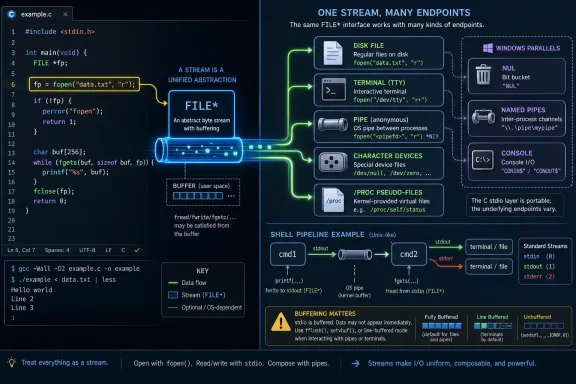 The Boring Function Is Sitting on a Radical Idea
Most programmers meet fopen at the least glamorous moment in their C education. Arrays have stopped being interesting, pointers are about to become dangerous, and somewhere in the middle comes the obligatory program that opens a text file, counts words, and closes it again. The lesson often lands as file handling, which makes fopen sound like plumbing.That framing sells the function short.
fopen is not merely a way to read data.txt; it is the public face of a design bargain between the C library, the operating system, and the programmer. The programmer asks for a stream. The runtime and OS decide what kind of thing is behind it.On Unix-like systems, that “thing” may not be a file in the desktop-user sense at all. It may be a terminal, a pipe, a character device,
/dev/null, /dev/zero, /dev/urandom, or a live kernel interface exposed through /proc. The program sees bytes. The system supplies meaning.That is the part worth preserving in our collective memory. A tiny interface became powerful not because it knew everything, but because it forced many different things to become readable and writable in the same way.
Unix Won by Making the World Look Like a Stream
The old Unix idea is often summarized as “everything is a file,” which is memorable and also a little too neat. Not everything is literally a regular file, and not every system object behaves like one. But the practical insight was stronger than the slogan: many useful things can be made to look enough like byte streams that ordinary programs can operate on them.That is why a program that reads from standard input and writes to standard output becomes more useful than one that insists on opening fixed filenames. The former can read from a keyboard today, a file tomorrow, and the output of another process five seconds after that. It can be tested, chained, redirected, logged, and automated without the author building a custom integration layer for every case.
This is the Unix magic trick in its cleanest form. The shell wires up the plumbing, the program does its small job, and the interface between them remains almost insultingly simple. Bytes go in; bytes come out.
The beauty is that the abstraction is not tied to nostalgia. Modern CI pipelines, log processors, container entrypoints, shell scripts, forensic utilities, and admin one-liners still rely on this same model. A tool that respects streams becomes a citizen of an ecosystem instead of a sealed appliance.
The Three Integers That Made Pipelines Possible
A process on Unix-like systems begins life with three standard channels already open: standard input, standard output, and standard error. Under the C library namesstdin, stdout, and stderr sit lower-level file descriptors, conventionally numbered 0, 1, and 2. Those integers are not magical by themselves. The magic is that the parent process, often the shell, decides what they point to.Run a command normally and standard input likely comes from the terminal while standard output and standard error go back to it. Redirect output to a file and descriptor 1 no longer points at the terminal. Pipe one command into another and the first program’s standard output becomes the second program’s standard input.
The program does not need to know. A well-behaved utility can simply write useful data to
stdout and diagnostics to stderr, trusting the environment to decide where those streams go. That separation is one of the quiet reasons command-line tools are so durable.It also explains why standard error exists as more than a historical curiosity. Data and complaints are different kinds of output. If a program is generating filenames, JSON, CSV, or source code on standard output, an error message injected into that stream can corrupt the next program in the pipeline.
Standard error is the side channel for trouble. It lets a tool say “here is the data you requested” and “something went wrong” without mixing cargo and radio chatter. That division is easy to overlook until the day a pipeline fails because a warning landed where a parser expected structure.
FILE * Is Not the File, and That Distinction Matters
When C code calls fopen, the returned FILE * is not the file itself. It is a pointer to a C library stream object, a higher-level wrapper around whatever underlying handle the platform uses. On POSIX systems, that lower layer is commonly a file descriptor; on Windows, the runtime sits atop a different native handle model and its own compatibility machinery.That stream object does work. It tracks buffering, read/write state, end-of-file state, and errors. It gives functions like
getc, fgets, fprintf, and fread a consistent target. It lets C code speak in the vocabulary of streams rather than syscalls.The buffering is not an implementation footnote. Without it, naïvely reading one character at a time could require one transition into the kernel for each byte. That would turn straightforward code into a performance disaster, because a system call is far more expensive than an ordinary function call.
The C library avoids that trap by reading and writing in larger chunks behind the scenes. Your program asks for one character; the runtime may fetch a block into memory and hand out bytes from that buffer until it needs to refill. To the caller, the stream still feels simple. Underneath, the library is batching work.
This is also why
printf sometimes appears haunted to beginners. Output to a terminal is often line-buffered, meaning a newline flushes it. Output redirected to a file or pipe is often fully buffered, meaning it may sit in memory until the buffer fills or the stream is flushed. Error output is usually treated more urgently, because diagnostics are most useful when they appear before the program explodes.Buffering Is the Helpful Lie That Occasionally Bites
The buffering layer is a helpful lie: it lets programmers pretend that small reads and writes are cheap. Most of the time, that is exactly the right lie. But when code mixes abstraction levels, the lie starts to leak.If a program uses
fprintf on a FILE * and also calls a lower-level write on the same descriptor, the order of visible output may surprise the author. The C library may still be holding bytes in its buffer while the lower-level call writes immediately. The kernel and the runtime are both doing what they were asked; the programmer is the one who created two views of the same stream.The same problem appears after
fork on Unix-like systems. If a process has buffered output pending when it forks, both parent and child may inherit that pending buffer. If both later flush it, output that looked as if it had been printed once can appear twice.Even the humble command-line prompt can be a buffering lesson. Print
Enter your name: without a newline and then wait for input, and the prompt may not appear in some redirected or noninteractive contexts unless the program flushes stdout. The fix is not superstition; it is fflush(stdout).For Windows developers, the lesson carries over even when the implementation details differ. The C runtime’s stream buffering, text-mode translation, and relationship to OS handles are still layers. Layers make programs portable and pleasant, but they reward developers who know where the boundaries are.
Mode Strings Are Small Incantations With Real Consequences
Thefopen mode string looks almost comically small next to the behavior it controls. "r" opens an existing file for reading. "w" opens for writing, creating a file if needed and truncating it if it already exists. "a" opens for appending, creating the file if necessary.Those letters are not cosmetic.
"w" can destroy previous contents before the first byte is written. "a" can change not only the initial file position but the rules that govern later writes. Add +, and the stream supports both reading and writing, subject to sequencing rules that surprise people who assume the runtime will infer their intent.Then there is binary mode. On Unix-like systems, text and binary mode are largely the same for ordinary byte I/O. On Windows, the distinction matters because text mode can translate line endings and treat certain byte patterns historically associated with end-of-file in special ways. That is why portable C code handling non-text data uses
"rb" and "wb" rather than pretending the platform will guess correctly.The mode string is the contract. It tells the runtime not just what the program wants to do, but what transformations and positioning rules the stream must obey. A one-character difference can be the gap between reading bytes faithfully and quietly rewriting them.
The trap is that the API looks too friendly. A beginner sees
"r" and "w" as obvious. A systems programmer eventually learns that the modes encode policy, race-avoidance, compatibility, and decades of accumulated expectations.Append Mode Is a Concurrency Feature in Disguise
Append mode deserves special treatment because it is often misunderstood as “start writing at the end.” That description is incomplete in the way a seatbelt is “a strap.” The important part, at least in the POSIX model, is that append semantics can be enforced at the kernel write path.If two processes try to log to the same file by seeking to the end and then writing, they can race. Both can observe the same end position before either write occurs. One line can overwrite or interleave with another, and the log becomes evidence that optimism is not a synchronization primitive.
Append mode changes the arrangement. With the appropriate underlying append flag, each write is forced to the current end of the file at the moment of the write. The program does not have to perform a separate “go to end” operation and hope the world has not changed before the write lands.
That does not make every logging design magically safe. Standard I/O buffering can split a logical record into multiple lower-level writes. Network filesystems and distributed storage can complicate old assumptions. Application-level record framing still matters.
But the principle is powerful: if the invariant belongs to shared state, ask the kernel to enforce it. Append mode is not just convenience. It is the OS taking responsibility for a race that user-mode code is poorly positioned to win.
This also explains why append mode can feel strange. Seek to the beginning of a stream opened for append, read some data, and then write, and the write still goes to the end. That is not perversity. It is the point.
Device Files Turn fopen Into a Portal
The real fun starts when a pathname does not refer to a normal disk file. Open /dev/null for writing, and the bytes disappear. Open /dev/zero for reading, and the system produces a stream of zero bytes on demand. Open a random device, and the kernel supplies random data through the same broad stream-shaped interface.This is where
fopen stops looking like a file API and starts looking like a portal. The code may still call fread or fprintf, but the object on the other side of the stream is not storage in the usual sense. It is a device or pseudo-device exposed through the filesystem namespace.The implications are practical, not merely philosophical.
/dev/null is how scripts and programs intentionally discard output. /dev/zero can feed tests, allocation patterns, or imaging workflows. Terminal devices let programs address the human console even when standard input and output have been redirected.That last point is especially elegant. A program may be reading data from a pipe and writing transformed data to another pipe, yet still need to ask the user for confirmation. Opening the controlling terminal lets it avoid contaminating the data stream. The stream abstraction does not eliminate distinctions; it gives programs a common way to reach the right endpoint.
Windows has its own equivalents and divergences.
NUL plays a role similar to /dev/null, named pipes are part of the platform, and the Win32 device namespace has its own personality. But the broad lesson is portable: when operating systems expose special resources through file-like interfaces, ordinary tools become unexpectedly powerful./proc Makes the Kernel Readable
The /proc filesystem is one of the most vivid examples of file-shaped thinking. On Linux and many Unix-like systems, entries under /proc are not ordinary files stored on disk. They are live views into kernel and process state, materialized when read.That makes the filesystem feel almost theatrical. A program opens what appears to be a text file, reads it, and receives information about processes, memory, mounts, CPUs, or kernel parameters. The bytes are generated because the read happened.
This approach has trade-offs. Text interfaces can be convenient for humans and scripts but awkward for strict parsing. Kernel data changes while readers observe it. Some interfaces are stable, some are historical accidents, and some should be treated with more caution than their plain-text friendliness suggests.
Still, the design is extraordinarily enabling. A shell script can inspect system state without linking to a special library. A monitoring tool can begin life as a few file reads. Administrators can use
cat, grep, awk, and sed against parts of the running system because the kernel chose to speak bytes.Windows typically exposes comparable system information through APIs, performance counters, ETW, WMI, PowerShell providers, registry views, and native calls. Those can be richer, more structured, and more explicit. They can also require more ceremony. The Unix-style pseudo-file approach wins when observability needs to be quick, composable, and inspectable by tools that already exist.
The Best C APIs Accept Streams, Not Just Names
One of the most useful design lessons hiding insidefopen is that libraries should avoid owning the plumbing unless they must. A function that accepts a filename can only open something it can name. A function that accepts a FILE * can read from a disk file, standard input, a pipe, a device, or a stream another part of the program already prepared.This is not academic purity. It changes how reusable code becomes. A CSV parser that insists on a path is less flexible than one that accepts a stream. A serializer that writes only to a named file is less useful than one that writes to an already-open output stream. A copier that moves bytes from
FILE *in to FILE *out can become a file copier, filter, test harness, compressor stage, or discard tool depending on how it is wired.The principle generalizes beyond C. APIs that accept streams, iterators, readers, writers, buffers, or file-like objects tend to outlive APIs that demand one concrete storage location. They let callers decide where data comes from and where it goes.
This is a lesson modern software keeps relearning under new names. Dependency injection, inversion of control, and interface-based design often restate the old stream lesson in enterprise clothing. Do not make your component responsible for the world. Give it a narrow contract and let the caller supply the environment.
The C version is brutally direct. Read bytes from here. Write bytes there. Do not ask too many questions.
The Relatives of fopen Reveal the Real Abstraction
The surrounding family of functions makes the point even clearer. fdopen takes an existing file descriptor and wraps it in a C stream. That matters because not everything begins as a pathname: pipes, sockets, inherited descriptors, and duplicated handles may already exist before the C library gets involved.fileno goes the other direction, exposing the underlying descriptor for code that needs lower-level operations. That can be necessary for polling, syncing, descriptor flags, or integration with APIs that do not speak standard I/O. It is also a warning sign: once you cross abstraction layers, you must respect both.freopen can reassign an existing stream such as stdout or stderr, which is useful in test harnesses, daemon setup, and old-school logging. popen connects a stream to another process, letting one program read command output or feed command input as though it were doing ordinary file I/O. Memory-backed and custom streams extend the idea still further.The common theme is not “files.” It is streams. The API surface keeps finding ways to attach the same familiar operations to different sources and sinks.
That is why
fopen remains such a good teaching object. Pull on it and you do not merely learn how to open a file. You discover the seam between language runtime, OS object model, buffering policy, process inheritance, device namespaces, and shell composition.Windows Developers Should Care Because Compatibility Is a Design Pressure
For a Windows-focused audience, it is tempting to dismiss all this as Unix lore. That would be a mistake. Windows developers live with these abstractions every day, even when they arrive through the Microsoft C runtime, PowerShell pipelines, WSL, MSYS2, Git Bash, cross-platform build tools, or language runtimes that emulate POSIX-ish expectations.The differences matter. Windows text mode is not Unix text mode. Native handles are not POSIX file descriptors. Console behavior has its own long history. Named devices, pipes, overlapped I/O, code pages, pseudo consoles, and Unicode paths complicate any simplistic “everything is a file” story.
But cross-platform software succeeds precisely by understanding where the abstraction holds and where it breaks. A tool that reads from standard input, writes clean data to standard output, sends diagnostics to standard error, and treats binary data as binary will behave better everywhere. That includes Windows.
The rise of WSL reinforced the point rather than replacing it. Many Windows developers now move between Win32, Linux userlands, PowerShell, CMake, Python, Node.js, Rust, and containerized build environments in the same workday. Stream discipline is the common grammar.
Even PowerShell, for all its object-pipeline sophistication, ultimately coexists with byte-stream tools because the world is full of them. The Windows admin who knows when data is structured objects, when it is text, and when it is raw bytes has a real advantage.
fopen sits at the primitive end of that continuum, but the habits it teaches travel upward.Small Interfaces Age Better Than Grand Frameworks
The broader software lesson is uncomfortable because it cuts against much of modern engineering fashion. We often solve problems by introducing a new service boundary, schema, SDK, protocol, daemon, client library, or orchestration layer. Sometimes that is necessary. Often it is architecture as sediment.The stream model is the opposite instinct. It says: make the interface small, make the contract stable, and let composition do the expansion. A program that transforms bytes can be combined with other programs the author never anticipated. The shell becomes the integration environment.
This does not mean byte streams are always enough. Structured data exists for good reasons. Security boundaries need more than convention. Binary protocols, databases, message queues, RPC systems, and typed APIs all solve problems that plain streams cannot solve cleanly.
But the industry has a habit of abandoning simple interfaces before they are actually exhausted. We build systems that are highly expressive inside their own boundaries and strangely useless outside them. The old C and Unix stream model is a rebuke to that tendency.
A boring function like
fopen reminds us that power can come from refusing to specialize too early. A stream is humble. That is why it can connect so many things.The Five-Letter Doorway Still Teaches the Right Lessons
The practical lessons fromfopen are not limited to C programmers maintaining old utilities. They are design instincts for anyone building tools that should survive contact with real users, automation, and operating systems that do not look exactly like the developer’s laptop.- Programs become more useful when they read from standard input and write primary results to standard output.
- Diagnostics belong on standard error because data streams should remain clean for the next tool in the chain.
FILE *streams add buffering and state, so mixing standard I/O with lower-level operations requires discipline.- Append mode is about kernel-enforced write placement, not merely starting at the end of a file.
- Binary mode matters on Windows when bytes must remain bytes.
- APIs that accept streams are usually more reusable than APIs that accept only filenames.
fopen works because it does not try to expose the entire personality of every object behind it. It offers a small vocabulary and lets the operating system do the translation.That restraint is why the model keeps reappearing. Files, pipes, devices, terminals, process output, in-memory buffers, and kernel pseudo-files can all be made to participate in the same conversation. Not perfectly. Not without caveats. But well enough to change what small programs can do.
fopen will never look glamorous. It will not get a keynote, a certification track, or a cloud pricing calculator. But behind those five letters is a design philosophy that still matters: if you can make different things look like streams, you can compose them, redirect them, test them, automate them, and keep them useful long after their original context has faded. The future of software will not be built entirely out of byte streams, but the systems that age best will keep rediscovering the same old lesson: simple interfaces, carefully honored, are where the real magic hides.References
- Primary source: Dave's Garage (YouTube)
Published: 2026-06-04T13:17:04+00:00
- Related coverage: unix.com
fopen(3p) posix man page | unix.com
Man page for fopen(3p) on posix, from the unix.com online archive.www.unix.com - Related coverage: man.he.net
- Related coverage: manpages.ubuntu.com
Ubuntu Manpage: fopen, fdopen, freopen - stream open functions
stream open functions manpages.ubuntu.com
