
In a digital landscape dominated by subscription streams and algorithmic playlists, a software project born in 1997 has staged a surprising return: Winamp — the once-ubiquitous MP3 player — has been reborn for mobile and cloud-era listening while keeping the core feeling that made it a cult classic. The reboot blends the original’s minimalist, customizable ethos with modern features — local and cloud playback, FLAC lossless support, a 10‑band equalizer, and a built‑in creator monetization tool called Fanzone — and promises to reconnect fans and independent musicians outside the streaming‑royalty squeeze. This is not mere nostalgia repackaged; it’s a deliberate attempt to reimagine how fans pay creators and how listeners manage music files in 2025, and it raises as many questions as it answers about economics, privacy, and longevity.
Winamp began as a student project in 1997 when Justin Frankel and Dmitry Boldyrev combined a Windows UI with an MP3 decoding engine to produce an extremely lightweight player. Its 0.20a release in April 1997 introduced a tiny, focused interface that did one thing well: play digital audio files quickly and with minimal overhead. The design — a compact player window, skinnable UI, plugin architecture, and vivid visualizations — captured the early MP3 era and built a passionate community that persisted even as streaming changed listening habits. The project grew fast: early versions reached millions of downloads and, by the early 2000s, tens of millions of users. The product changed hands several times: Nullsoft — Winamp’s creator — was acquired by AOL in the late 1990s, and AOL later attempted to close Winamp in 2013. The player was rescued by Radionomy (later part of what’s now the Llama Group) in 2014, which kept development alive and began to explore how Winamp might fit into a streaming- and creator-driven market again. That long arc — from scrappy freeware to corporate acquisition to near‑death and eventual revival — is vital to understanding Winamp’s renaissance: the brand persisted because of an invested community and a distinct user experience that wasn’t easily replicated by the big streaming services. Community evidence of persistent usage is everywhere: long‑running forums and user threads show people still deploying Winamp in daily setups and praising its visualizers, skins, and local playback workflows. That continuity of fandom — people keeping Winamp alive on old machines and in enthusiast circles — created the cultural capital the brand needed to relaunch.
Key signals to watch over the next 12–18 months:
Winamp’s comeback is a useful reminder that product DNA matters: a well‑designed, efficient player that honors user control and file ownership can still find an audience in 2025. The brand’s pivot toward creator monetization through Fanzone is ambitious and aligns with broader shifts in how fans prefer to support artists directly. But the relaunch is not without caveats: user‑reported stability issues, opaque reported fee numbers, and the ongoing challenge of platform‑level adoption mean that the story is still being written.
For listeners who keep their own libraries and for musicians who value direct fan relationships, Winamp is worth testing — but with the same skepticism you’d apply to any new marketplace: read the merchant terms, test payments at small scale, and be cautious about exclusive dependencies until business terms are clearly published. For the rest of the listening world, Winamp will likely remain a complementary option: a place to play your treasured local files, rediscover lost albums, and — potentially — back your favorite artists more directly than streaming royalties allow.
Source: MakeUseOf The legendary MP3 player that rocked 28 years ago still rocks today
 Background: how a lightweight MP3 player became a cultural touchstone
Winamp began as a student project in 1997 when Justin Frankel and Dmitry Boldyrev combined a Windows UI with an MP3 decoding engine to produce an extremely lightweight player. Its 0.20a release in April 1997 introduced a tiny, focused interface that did one thing well: play digital audio files quickly and with minimal overhead. The design — a compact player window, skinnable UI, plugin architecture, and vivid visualizations — captured the early MP3 era and built a passionate community that persisted even as streaming changed listening habits. The project grew fast: early versions reached millions of downloads and, by the early 2000s, tens of millions of users. The product changed hands several times: Nullsoft — Winamp’s creator — was acquired by AOL in the late 1990s, and AOL later attempted to close Winamp in 2013. The player was rescued by Radionomy (later part of what’s now the Llama Group) in 2014, which kept development alive and began to explore how Winamp might fit into a streaming- and creator-driven market again. That long arc — from scrappy freeware to corporate acquisition to near‑death and eventual revival — is vital to understanding Winamp’s renaissance: the brand persisted because of an invested community and a distinct user experience that wasn’t easily replicated by the big streaming services. Community evidence of persistent usage is everywhere: long‑running forums and user threads show people still deploying Winamp in daily setups and praising its visualizers, skins, and local playback workflows. That continuity of fandom — people keeping Winamp alive on old machines and in enthusiast circles — created the cultural capital the brand needed to relaunch.The 2024–2025 relaunch: what’s new and why it matters
A modern feature set wrapped in familiar DNA
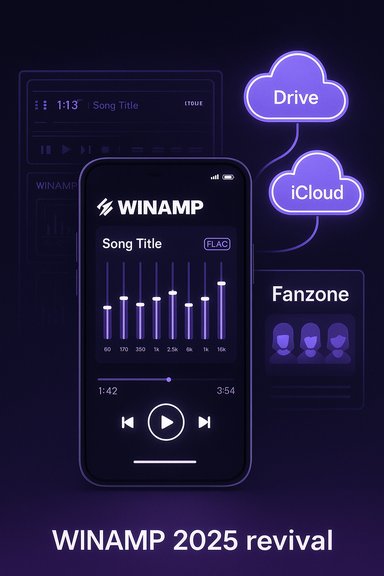
When Winamp re-entered the mainstream in the mid‑2020s, the team pitched it as a hybrid product: an old‑school player for local music files equipped with modern conveniences for cloud‑stored libraries and direct fan‑to‑artist monetization. The public launch included iOS and Android apps that let users:- Play locally stored music files (MP3, FLAC, AAC, WAV, and more).
- Connect cloud storage for library sync (Google Drive on Android, iCloud on iOS).
- Use a 10‑band graphic equalizer, crossfade, and presets.
- Enable ReplayGain support for normalized listening (in some Pro configurations).
- Access Internet radio, podcasts, and a curated Fanzone marketplace for creators.
Fanzone: a built‑in alternative to platform streaming royalties
The most consequential addition to the modern Winamp stack is Fanzone, a creator monetization system embedded in the mobile apps. Fanzone is designed to let artists offer subscription tiers, early releases, exclusive tracks or collectibles, and tipping directly inside the player. It’s positioned as an answer to two persistent problems:- Streaming economics that concentrate revenue among top-tier artists and leave the long tail with marginal payouts.
- Fragmented creator monetization workflows that force artists to stitch together Patreon, Bandcamp, distribution platforms, licensing services, and content‑ID protection tools.
Verifying the claims: what is solid and what is still unclear
Confirmed facts
- Winamp’s origin and founding figures, and its first release date in April 1997, are well documented in historical sources and contemporary coverage.
- The Radionomy acquisition of Winamp and SHOUTcast in early 2014 is corroborated by multiple technology press outlets and press releases at the time. The acquisition was widely reported and later confirmed in company statements.
- The 2023–2024 relaunch timeline, including a web deployment in 2023 and mobile apps arriving in the months after, is reflected on Winamp’s official press material and in app store listings. The apps advertise local and cloud playback, FLAC support (in folder view), 10‑band equalizer, and ReplayGain as features.
Claims that required deeper verification — and where I found gaps
- The statement that Winamp “still had 80 million users” appears in official investor and press communications around the relaunch and is repeated in broader press coverage. Two independent public filings/press outlets (a business wire/equities notice and mainstream technology news articles) repeat the 80‑million figure, linking it to Winamp’s historic user base and brand recognition. That said, terminology matters: the 80‑million figure appears framed as “users” or “registered users” in corporate materials rather than a verifiable count of active, unique, monthly users in the streaming‑service sense. Without an independent audit or a current, transparent metrics disclosure from Winamp’s operator, the precise meaning of “80 million” remains company‑reported. Treat the figure as a company claim that’s been echoed in the press, not as an independently audited active‑user metric.
- Specific Fanzone economics reported in some third‑party coverage — for example, claims that Winamp takes a 15% cut after the first year and charges an annual $55 fee for artists — are harder to verify. Official Winamp press pages describe Fanzone’s role and features but do not publish a clear, itemized fee schedule on their public marketing pages. I could not find a definitive, official Winamp (or Llama Group) document that confirms the exact percentages and the $55 charge in a way that’s independently verifiable. That doesn’t mean the numbers are false — only that they require caution: they appear in some secondary coverage and analysis pieces but are not plainly presented on Winamp’s main product pages or app listing. Treat these financial terms as reported but unconfirmed until Winamp publishes a clear, official fee schedule.
- App stability and UX problems have been reported anecdotally by users in community forums and subreddits. Multiple reports describe crashes, UI quirks, and library sync issues on certain devices or OS versions. Those community reports should be treated as representative user experiences and do not necessarily reflect every user’s experience; however they point to real teething problems typical of major relaunches.
Technical deep dive: formats, audio quality, and playback features
File formats and true local playback
Winamp’s modern apps focus on local file ownership. Confirmed technical capabilities include playback support for common formats — MP3, AAC, WAV — and FLAC support for lossless files (notably available in the app’s Folders view), which makes Winamp relevant for listeners who care about high‑fidelity mobile playback. That’s a strong differentiator: when you store FLAC files locally, you keep the full waveform fidelity, and Winamp’s audio engine on modern phones can hand that through to capable DACs and headphones without server‑side recompression.Equalization and ReplayGain
Winamp ships with a 10‑band equalizer, a set of presets, and the ability to save custom presets — a useful tool for audiophiles who want precise tonal shaping. ReplayGain support (automatic loudness normalization) is supported in the app when you enable certain Pro features; that helps provide consistent perceived loudness across tracks and is important for playlists assembled from heterogeneous sources. Crossfade and gapless playback are supported features as well, though some elements are gated behind Pro or platform parity rollouts (some features were noted as “coming soon” on iOS at certain points).Libraries, cloud sync, and privacy implications
The app integrates with platform cloud storage (Google Drive on Android, iCloud on iOS) so users can access files stored in their personal clouds without uploading to a Winamp server. That design choice helps preserve user ownership while offering remote access from mobile devices. However, cloud integration raises privacy and security considerations (authentication tokens, permission scopes, data retention policies) and puts the burden on Winamp to handle OAuth flows securely and to limit the scope of data access and storage. The app store listing discloses data categories the app may collect (identifiers, usage data, diagnostics), which is standard but worth noting for privacy‑conscious listeners. Users should inspect app permissions and Winamp privacy documentation before connecting cloud storage.Fanzone economy: potential upside and real risks for artists and fans
The promise
- Direct monetization: Fanzone can convert casual listeners into paying patrons inside the same app they use to play music, eliminating friction from switching apps or purchasing on separate platforms.
- Tools for creators: Winamp markets Fanzone as more than a subscription box — it aims to bundle distribution, rights management, and content ID tools so creators can manage multiple income streams (streaming distribution, licensing, fan subscriptions, collectibles) from a single dashboard. That could meaningfully reduce administrative friction for independent musicians if it works as promised.
Key concerns and unknowns
- Fee transparency: The lack of a clear, officially published fee schedule for Fanzone (that is publicly discoverable in consumer‑facing pages) makes it hard to evaluate the economics for smaller artists. Reports of a 15% platform cut and a $55 annual charge require independent confirmation; without it, artists should be cautious and read terms carefully before committing to platform‑exclusive offers. Reported numbers should be treated as provisional until Winamp publishes explicit pricing terms.
- Marketplace liquidity: A subscription platform needs both artists and fans in sufficient numbers to work. Winamp’s brand recognition is strong among legacy users, but converting casual streaming listeners (who expect discovery playlists and algorithmic recommendations) into paying Fanzone subscribers is a major product and marketing challenge.
- Rights and payments: Offering distribution, Content ID, and licensing tools creates complexity and regulatory exposure. Artists must ensure Winamp’s contract terms protect their intellectual property and that payout timetables, chargebacks, and tax treatments are transparent.
UX, reliability, and real‑world testing notes
User feedback since the mobile launch paints a realistic picture: for many, the app reliably plays local files and is a welcome return to a player that respects file ownership. For others, glitches — from lists that stutter when scrolling to occasional crashes and duplicate album entries — have been reported in community channels. These issues are not unexpected for a large‑scale relaunch that must support a wide range of Android OEM skins and iOS versions; however they bear watching if you plan to rely on Winamp for critical listening. Community reports are useful diagnostic signals, and Winamp’s public issue tracker and app store release notes show the team iterating.Who should use Winamp in 2025 — and who should not
Winamp is a strong fit if you:
- Own a curated library of local music files and want true local playback without subscription lock‑in.
- Value lossless audio playback (FLAC) on mobile devices.
- Want an app that prioritizes manual discovery (folder/album browsing) over algorithmic recommendations.
- Are an independent musician looking for one integrated environment to manage distribution and fan subscriptions — provided you verify the fee structure and contractual terms first.
Winamp might not be right if you:
- Rely primarily on algorithmic discovery and social‑driven playlists (Spotify/YouTube have advantages here).
- Prefer a completely hands‑off streaming experience with no local file management.
- Need guaranteed, enterprise‑grade stability on every device immediately after launch; some early adopters have reported rough edges.
Practical tips: getting the most from Winamp on mobile
- Back up your library before you migrate any files: local ownership is great, but you should still keep redundancies.
- Use the Folders view for FLAC playback — the app’s FLAC support is strongest in folder‑based navigation.
- Enable ReplayGain if you assemble playlists from diverse sources; it reduces perceived volume jumps.
- Check the app’s privacy permissions before connecting Google Drive or iCloud; limit access to only what’s necessary.
- If you’re an artist considering Fanzone, request the full published merchant terms and payout schedule in writing and compare them to Patreon, Bandcamp, and other creator platforms. Confirm fees, holdbacks, and dispute mechanisms before committing.
Risks that matter: privacy, monetization traps, and product viability
- Privacy surface area: Any app that connects to Google Drive or iCloud must handle OAuth tokens correctly and minimize persistent server‑side storage. Official app pages disclose typical analytics and identifiers collection; users should be mindful of what data they authorize and read the privacy policy. Missteps here can erode trust fast.
- Economic opacity: If fee structures for creator monetization are unclear or asymmetric, artists may find themselves locked into unfavorable terms once they build an audience on the platform. Transparent, published merchant terms are non‑negotiable for platforms that claim to promote “fair monetization.” If Winamp wants to credibly claim a role in creator economics, it must publish and defend transparent fee schedules and payout timetables.
- Product sustainability: Winamp’s brand value is large, but a successful consumer product requires continuous product investment, distribution partnerships, and community support. The relaunch’s success hinges on whether the Llama Group (and investor ecosystem) keeps shipping features, addresses stability issues, and builds network effects for Fanzone. Historical revivals show that brand nostalgia can kickstart attention but not guarantee long‑term adoption.
Verdict: why Winamp’s return matters — and what to watch next
Winamp’s relaunch is more than a retro tech story; it’s a practical experiment in restoring local ownership, delivering high‑quality playback on mobile, and trying a different creator‑first monetization strategy. For listeners who prize ownership, fidelity, and manual discovery, Winamp offers a compelling alternative to the app‑as‑service model. For independent artists, Fanzone could be a welcome tool — if its economics and contracts are transparent, fair, and competitive with existing creator marketplaces.Key signals to watch over the next 12–18 months:
- Whether Winamp publishes firm, public merchant/creator terms that clarify revenue share, fees, and payout cadence.
- App stability and feature parity across Android and iOS releases (equalizer parity, ReplayGain across both platforms, etc..
- Actual artist adoption and whether Fanzone drives meaningful direct revenue for creators beyond promotional headlines.
- How Winamp manages data access for cloud integrations and whether privacy protections are conservative and transparent.
Winamp’s comeback is a useful reminder that product DNA matters: a well‑designed, efficient player that honors user control and file ownership can still find an audience in 2025. The brand’s pivot toward creator monetization through Fanzone is ambitious and aligns with broader shifts in how fans prefer to support artists directly. But the relaunch is not without caveats: user‑reported stability issues, opaque reported fee numbers, and the ongoing challenge of platform‑level adoption mean that the story is still being written.
For listeners who keep their own libraries and for musicians who value direct fan relationships, Winamp is worth testing — but with the same skepticism you’d apply to any new marketplace: read the merchant terms, test payments at small scale, and be cautious about exclusive dependencies until business terms are clearly published. For the rest of the listening world, Winamp will likely remain a complementary option: a place to play your treasured local files, rediscover lost albums, and — potentially — back your favorite artists more directly than streaming royalties allow.
Source: MakeUseOf The legendary MP3 player that rocked 28 years ago still rocks today
