
The four drivers to watch at the Windows 10 400 were Dale Earnhardt Jr., Jeff Gordon, Denny Hamlin, and Joey Logano, as NASCAR’s Sprint Cup Series returned to Pocono Raceway in Long Pond, Pennsylvania, on August 2, 2015. The race was nominally a stock-car event, but its branding made it something stranger: a Microsoft launch campaign running at 200 mph. Looking back from 2026, after Windows 10 has already crossed its mainstream end-of-support line, the event reads less like a sponsorship curiosity and more like a snapshot of two industries selling momentum. NASCAR had its Chase bubble, Microsoft had its upgrade funnel, and Pocono gave both a triangle-shaped stage.
The timing was almost too tidy to be accidental. Windows 10 launched publicly on July 29, 2015, and four days later its name was wrapped around a 400-mile Sprint Cup race at one of NASCAR’s most idiosyncratic tracks. Microsoft was not merely buying signage; it was placing the Windows 10 brand in the middle of a mass-market weekend built on loyalty, habit, telemetry, and performance claims.
That mattered because Windows 10 was itself being sold as a repair job. Windows 8 had left Microsoft with a credibility problem among desktop users, IT departments, and anyone who wanted the Start menu to behave like the Start menu. Windows 10 promised continuity without surrendering the idea that Windows had to become a service rather than a boxed product.
NASCAR was a convenient metaphor machine. Teams already talked in the language of data, efficiency, simulation, pit timing, and marginal gains. Microsoft could present Windows 10 and Azure not as consumer software abstractions but as operational tools inside a sport where milliseconds and fuel windows decided careers.
The irony is that the race did not reward the most obvious Windows 10 storylines. Dale Earnhardt Jr. carried the Microsoft paint scheme, Jeff Gordon carried the sentimental Pocono résumé, Denny Hamlin carried the track-master label, and Joey Logano carried the form chart. Matt Kenseth, not one of the marquee four in the preview, won the day through the kind of fuel-mileage chaos that makes pre-race certainty look foolish by lap 160.
That made it a good venue for a Windows 10 launch weekend, even if nobody in the marketing department would have put it that way. Windows 10 was also a compromise product: part apology, part platform reset, part enterprise reassurance, part consumer upgrade campaign. It had to satisfy people who wanted the old desktop, people who wanted modern apps, developers being nudged toward a unified platform, and administrators wary of Microsoft’s new servicing cadence.
The “Tricky Triangle” nickname fit the product better than most race sponsors fit their events. Microsoft was trying to convince Windows 7 loyalists, Windows 8 skeptics, and enterprise buyers that one operating system could serve all of them. Pocono asked teams to solve a similarly awkward equation: make a car fast through three incompatible corners without giving away too much on the straights.
That is why the driver list still has value as a historical artifact. It shows how NASCAR previews were built around track history and recent form, while the actual race was ready to expose every assumption. In 2015, as in enterprise IT, past performance was a useful input, not a deployment plan.
Earnhardt’s Pocono record gave the campaign credibility. Two wins, frequent top-ten runs, and a reputation for understanding the track made him more than a celebrity billboard. He was a plausible winner in a sponsored car at a sponsored race, which is exactly the kind of symmetry marketers crave.
But the actual race gave Microsoft something more subtle than a storybook victory. Earnhardt finished fourth, which was strong enough to keep the paint scheme visible without letting the weekend collapse into pure advertisement. He was there at the end, competitive and relevant, but not dominant.
That distinction matters. The Windows 10 rollout was not a single checkered flag either. It was a long campaign of upgrades, compatibility checks, user nudges, telemetry, enterprise pilots, and later, increasingly controversial update practices. Earnhardt’s weekend was a better metaphor than a win would have been: visible, credible, close to the front, but ultimately subject to forces no sponsor could choreograph.
That is why Gordon’s inclusion was not merely statistical. Pocono was one of the places where his past could still argue with the present. Even at 43, even without a 2015 win to that point, he was not a nostalgia pick; he was a driver whose track record forced everyone to keep him in the frame.
His eventual third-place finish validated the preview’s instinct. Gordon did not win, but he came close enough to make the old Pocono numbers feel alive rather than archival. On a day ruled by fuel calculations and late-race attrition, he kept himself positioned where experience could still matter.
For WindowsForum readers, there is a familiar rhythm here. Legacy platforms do not vanish just because a vendor declares a new era. Windows 7 remained beloved after Windows 10 launched, and Windows 10 itself remains stubbornly present after its 2025 end-of-support date. Gordon at Pocono was the veteran system still performing under load, even while the industry was already narrating its replacement.
Pocono had been one of his signature places since his rookie season. Some drivers are generally fast there; Hamlin had looked native to it. The long straights, heavy braking, and precision corner entries suited a driver who could manage rhythm without overdriving the compromise.
Then the race reminded everyone that track mastery is not immunity. Hamlin finished 22nd, two laps down, while his Joe Gibbs Racing teammate Matt Kenseth won. That is NASCAR’s cruelty in miniature: the same organization can hit the strategy window with one car and miss the outcome entirely with another.
It also complicates the easy enterprise analogy. Being good at the platform is not the same as being safe from the rollout. A company can understand Windows deployment, have the right tools, and still get caught by timing, dependencies, hardware readiness, or user behavior. Pocono punishes partial optimization; so do operating-system transitions.
His numbers at the track were respectable rather than overwhelming. One Pocono win, multiple poles, and a record of speed suggested upside, but not inevitability. He was the kind of driver who could make a preview look smart if the race stayed conventional.
It did not. Logano finished 20th, which made the pre-race logic look less wrong than incomplete. Speed matters at Pocono, but fuel mileage, cautions, pit sequencing, and track position can turn speed into a stranded asset.
That is the lesson Microsoft would relearn repeatedly with Windows 10. A technically stronger platform does not automatically create a clean adoption curve. Users care about timing. Businesses care about risk. Hardware matters. The fastest car in clean air and the best operating system on paper both still need the race to unfold in a way that lets their advantages count.
Those two drivers represented the danger of reducing a race to four names. Truex had the freshest Pocono evidence, and Busch had the hottest national form. If the story was “drivers to watch,” both demanded more than honorable mention status.
Yet neither won. Truex finished 19th, and Busch, after starting from the pole and chasing a fourth consecutive Cup victory, finished 21st after running out of fuel late. Kenseth inherited the opportunity and converted it, winning a race that became less about raw dominance than about survival inside the final fuel window.
That ending is why the Windows 10 400 is more than a branded footnote. The race’s most durable lesson is that forecasts fail at the boundary between performance and constraint. In software terms, that boundary is where benchmarks meet real machines, where upgrade eligibility meets drivers, where policy meets users, and where launch-week optimism meets year-two maintenance.
The Windows 10 400 leaned into that tension. Kyle Busch’s bid for a fourth straight victory evaporated when fuel reality caught up with ambition. Others faltered late, and Kenseth, who had not been the central pre-race storyline, found the path through.
That is not a side note; it is the central metaphor. Windows 10’s launch was full of acceleration language: free upgrades, modern devices, universal apps, cloud-connected services, and a faster cadence. But the real work of a platform transition is often fuel mileage. How long can old hardware run? How much user patience is left? How much testing capacity does IT have? How many compatibility exceptions can an organization carry?
Microsoft’s marketing wanted Windows 10 to feel like green-flag racing. The enterprise reality was closer to Pocono’s closing laps. Everyone had a target, everyone had constraints, and the winner was the one who managed the gap between plan and depletion.
The Hendrick Motorsports connection made particular sense. This was not just a sticker deal; Microsoft talked about Windows 10 and Azure as tools that could improve performance on and off the track. In racing, data credibility is earned quickly or not at all. If a platform cannot help engineers make better decisions, it becomes hospitality-suite wallpaper.
There was also a cultural play. Windows had long been the default operating system for home offices, garages, small businesses, timing systems, simulators, and enthusiast communities. NASCAR fans were not a niche detached from Microsoft’s base. They were exactly the kind of mainstream Windows users who might have skipped Windows 8, waited out the noise, and needed a reason to believe Windows 10 was safe.
That is why the No. 88 paint scheme mattered. It put Windows 10 on a Chevrolet driven by Earnhardt rather than inside a sterile launch demo. Microsoft was borrowing the emotional infrastructure of NASCAR: brand loyalty, driver identity, and the assumption that technology is valuable when it helps real people compete.
A decade later, that promise looks more complicated. Windows 10 did become one of Microsoft’s most important operating systems, and for many users it was the stable landing pad after the Windows 8 backlash. It also normalized forced updates, feature-update anxiety, telemetry debates, and a servicing model that shifted power from local administrators toward Microsoft’s release machinery.
The end of support on October 14, 2025, sharpened the contradiction. Windows 10 had been marketed in its early years with an aura of permanence, but it still reached a lifecycle wall. The “last version of Windows” era gave way to Windows 11, hardware requirements, TPM debates, and another round of migration planning.
That hindsight changes the race’s texture. In August 2015, Windows 10 on a race car looked like a launch celebration. In June 2026, it looks like a reminder that even the operating systems presented as eras eventually become legacy infrastructure. The checkered flag always arrives; the only question is whether users get enough warning before the lights go out.
But the winner came from outside the headline quartet. That is the useful part. Good analysis does not eliminate uncertainty; it names the forces most likely to matter and then admits that events can reorder them. Pocono’s fuel window did not make the preview foolish. It made the preview incomplete in the way all pre-event analysis is incomplete.
That is especially relevant for technology coverage. Product launches invite deterministic narratives: this version fixes the last one, this hardware requirement improves security, this migration path is obvious, this platform is inevitable. Then reality arrives with edge cases, driver conflicts, unsupported machines, regional rollout differences, user resistance, and business constraints.
The better lesson from the Windows 10 400 is not “pick the winner.” It is “watch the variables.” Earnhardt represented brand alignment. Gordon represented institutional memory. Hamlin represented specialized expertise. Logano represented current form. Kenseth represented the unglamorous strategy that wins when the obvious variables run dry.
Those memories do not age the same way. Racing nostalgia tends to soften the edges; old paint schemes become collectibles, controversial finishes become stories, and even fuel-mileage races gain texture with distance. Operating-system nostalgia is harsher because the old platform remains on real machines, carrying real risk after support ends.
That is why WindowsForum readers should resist treating this as merely a quirky sports crossover. The race captures a moment when Microsoft was selling Windows 10 as the future through a sport built on legacy brands, mechanical trust, and visible consequences. If a car fails, it coasts. If an operating system ages out underneath a business, the failure can be quieter and more expensive.
The event also reminds us that consumer trust is built in strange places. Microsoft did not win back Windows skeptics only through keynotes and documentation. It showed up in living rooms, retail counters, enterprise pilots, gaming rigs, and, for one weekend, on the hood of Dale Earnhardt Jr.’s Chevrolet at Pocono.
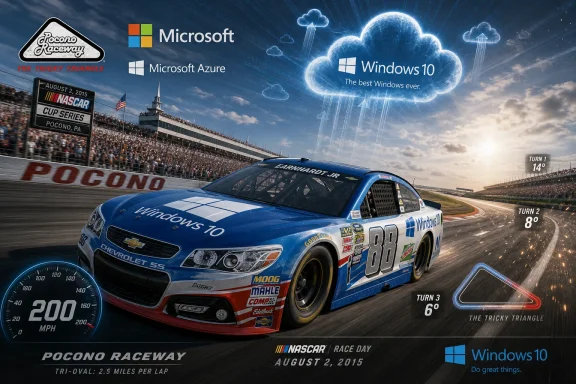 Microsoft Put Its New Operating System on the Hood and the Marquee
The timing was almost too tidy to be accidental. Windows 10 launched publicly on July 29, 2015, and four days later its name was wrapped around a 400-mile Sprint Cup race at one of NASCAR’s most idiosyncratic tracks. Microsoft was not merely buying signage; it was placing the Windows 10 brand in the middle of a mass-market weekend built on loyalty, habit, telemetry, and performance claims.That mattered because Windows 10 was itself being sold as a repair job. Windows 8 had left Microsoft with a credibility problem among desktop users, IT departments, and anyone who wanted the Start menu to behave like the Start menu. Windows 10 promised continuity without surrendering the idea that Windows had to become a service rather than a boxed product.
NASCAR was a convenient metaphor machine. Teams already talked in the language of data, efficiency, simulation, pit timing, and marginal gains. Microsoft could present Windows 10 and Azure not as consumer software abstractions but as operational tools inside a sport where milliseconds and fuel windows decided careers.
The irony is that the race did not reward the most obvious Windows 10 storylines. Dale Earnhardt Jr. carried the Microsoft paint scheme, Jeff Gordon carried the sentimental Pocono résumé, Denny Hamlin carried the track-master label, and Joey Logano carried the form chart. Matt Kenseth, not one of the marquee four in the preview, won the day through the kind of fuel-mileage chaos that makes pre-race certainty look foolish by lap 160.
Pocono Was the Perfect Place for a Software Launch Disguised as a Race
Pocono Raceway has always resisted easy categorization. It is a 2.5-mile tri-oval, but calling it an oval undersells the problem. The three turns are different enough that setup becomes a compromise, braking zones matter, and drivers talk about the place as if it were three tracks stitched together by long straights.That made it a good venue for a Windows 10 launch weekend, even if nobody in the marketing department would have put it that way. Windows 10 was also a compromise product: part apology, part platform reset, part enterprise reassurance, part consumer upgrade campaign. It had to satisfy people who wanted the old desktop, people who wanted modern apps, developers being nudged toward a unified platform, and administrators wary of Microsoft’s new servicing cadence.
The “Tricky Triangle” nickname fit the product better than most race sponsors fit their events. Microsoft was trying to convince Windows 7 loyalists, Windows 8 skeptics, and enterprise buyers that one operating system could serve all of them. Pocono asked teams to solve a similarly awkward equation: make a car fast through three incompatible corners without giving away too much on the straights.
That is why the driver list still has value as a historical artifact. It shows how NASCAR previews were built around track history and recent form, while the actual race was ready to expose every assumption. In 2015, as in enterprise IT, past performance was a useful input, not a deployment plan.
Dale Earnhardt Jr. Was the Human Center of Microsoft’s NASCAR Pitch
Dale Earnhardt Jr. was the obvious headliner because he connected the sponsorship story to the racing story. He had won the 2014 Pocono sweep, he had a July 2015 win at Daytona, and his No. 88 Chevrolet carried Microsoft’s branding at precisely the moment Windows 10 was trying to look both familiar and new. If Microsoft wanted trust, it could hardly have picked a more trusted NASCAR figure.Earnhardt’s Pocono record gave the campaign credibility. Two wins, frequent top-ten runs, and a reputation for understanding the track made him more than a celebrity billboard. He was a plausible winner in a sponsored car at a sponsored race, which is exactly the kind of symmetry marketers crave.
But the actual race gave Microsoft something more subtle than a storybook victory. Earnhardt finished fourth, which was strong enough to keep the paint scheme visible without letting the weekend collapse into pure advertisement. He was there at the end, competitive and relevant, but not dominant.
That distinction matters. The Windows 10 rollout was not a single checkered flag either. It was a long campaign of upgrades, compatibility checks, user nudges, telemetry, enterprise pilots, and later, increasingly controversial update practices. Earnhardt’s weekend was a better metaphor than a win would have been: visible, credible, close to the front, but ultimately subject to forces no sponsor could choreograph.
Jeff Gordon’s Pocono Résumé Made the Preview Feel Like a Farewell Tour
Jeff Gordon entered the 2015 Windows 10 400 with the weight of history and the pressure of scarcity. He had six Pocono wins, an extraordinary stack of top-fives and top-tens, and only a shrinking number of races left before the Chase field hardened. In his final full-time season, every strong track became a possible last chance.That is why Gordon’s inclusion was not merely statistical. Pocono was one of the places where his past could still argue with the present. Even at 43, even without a 2015 win to that point, he was not a nostalgia pick; he was a driver whose track record forced everyone to keep him in the frame.
His eventual third-place finish validated the preview’s instinct. Gordon did not win, but he came close enough to make the old Pocono numbers feel alive rather than archival. On a day ruled by fuel calculations and late-race attrition, he kept himself positioned where experience could still matter.
For WindowsForum readers, there is a familiar rhythm here. Legacy platforms do not vanish just because a vendor declares a new era. Windows 7 remained beloved after Windows 10 launched, and Windows 10 itself remains stubbornly present after its 2025 end-of-support date. Gordon at Pocono was the veteran system still performing under load, even while the industry was already narrating its replacement.
Denny Hamlin Looked Like the Track Specialist Until the Race Became Something Else
Denny Hamlin had every reason to be on the watch list. Four Pocono wins, three poles, elite green-flag speed, and a Joe Gibbs Racing organization in form made him one of the most rational picks on the board. If the preview had been generated by a model weighted toward track-specific history, Hamlin would have scored highly.Pocono had been one of his signature places since his rookie season. Some drivers are generally fast there; Hamlin had looked native to it. The long straights, heavy braking, and precision corner entries suited a driver who could manage rhythm without overdriving the compromise.
Then the race reminded everyone that track mastery is not immunity. Hamlin finished 22nd, two laps down, while his Joe Gibbs Racing teammate Matt Kenseth won. That is NASCAR’s cruelty in miniature: the same organization can hit the strategy window with one car and miss the outcome entirely with another.
It also complicates the easy enterprise analogy. Being good at the platform is not the same as being safe from the rollout. A company can understand Windows deployment, have the right tools, and still get caught by timing, dependencies, hardware readiness, or user behavior. Pocono punishes partial optimization; so do operating-system transitions.
Joey Logano Had the Form, but Pocono Demanded Patience
Joey Logano entered the Windows 10 400 as the hot-hand pick without the same Pocono mythology as Gordon or Hamlin. His recent run of top-fives made him impossible to ignore, and his Daytona 500 win had already secured his 2015 playoff relevance. The question was not whether Logano was fast; it was whether Pocono would turn that speed into control.His numbers at the track were respectable rather than overwhelming. One Pocono win, multiple poles, and a record of speed suggested upside, but not inevitability. He was the kind of driver who could make a preview look smart if the race stayed conventional.
It did not. Logano finished 20th, which made the pre-race logic look less wrong than incomplete. Speed matters at Pocono, but fuel mileage, cautions, pit sequencing, and track position can turn speed into a stranded asset.
That is the lesson Microsoft would relearn repeatedly with Windows 10. A technically stronger platform does not automatically create a clean adoption curve. Users care about timing. Businesses care about risk. Hardware matters. The fastest car in clean air and the best operating system on paper both still need the race to unfold in a way that lets their advantages count.
The Mentioned Outsiders Were the Real Warning Lights
The preview’s notable mentions were Martin Truex Jr. and Kyle Busch, and in some ways they were the more interesting names. Truex had won Pocono earlier in June 2015, giving him a chance to sweep the season’s races at the track. Busch, meanwhile, was on a ferocious comeback run, with four wins in five races and three straight victories entering Pocono.Those two drivers represented the danger of reducing a race to four names. Truex had the freshest Pocono evidence, and Busch had the hottest national form. If the story was “drivers to watch,” both demanded more than honorable mention status.
Yet neither won. Truex finished 19th, and Busch, after starting from the pole and chasing a fourth consecutive Cup victory, finished 21st after running out of fuel late. Kenseth inherited the opportunity and converted it, winning a race that became less about raw dominance than about survival inside the final fuel window.
That ending is why the Windows 10 400 is more than a branded footnote. The race’s most durable lesson is that forecasts fail at the boundary between performance and constraint. In software terms, that boundary is where benchmarks meet real machines, where upgrade eligibility meets drivers, where policy meets users, and where launch-week optimism meets year-two maintenance.
The Race Was a Fuel-Mileage Parable in a Year Obsessed With Upgrades
Fuel-mileage races divide fans because they invert the spectacle. Instead of a flat-out contest, the ending becomes a negotiation with scarcity. Drivers lift earlier, engineers calculate, crew chiefs gamble, and the winner is sometimes the car that appears to be attacking the least.The Windows 10 400 leaned into that tension. Kyle Busch’s bid for a fourth straight victory evaporated when fuel reality caught up with ambition. Others faltered late, and Kenseth, who had not been the central pre-race storyline, found the path through.
That is not a side note; it is the central metaphor. Windows 10’s launch was full of acceleration language: free upgrades, modern devices, universal apps, cloud-connected services, and a faster cadence. But the real work of a platform transition is often fuel mileage. How long can old hardware run? How much user patience is left? How much testing capacity does IT have? How many compatibility exceptions can an organization carry?
Microsoft’s marketing wanted Windows 10 to feel like green-flag racing. The enterprise reality was closer to Pocono’s closing laps. Everyone had a target, everyone had constraints, and the winner was the one who managed the gap between plan and depletion.
The NASCAR Partnership Showed Microsoft Chasing Trust Outside the Usual Channels
Microsoft’s NASCAR push was not random brand tourism. In 2015, the company was repositioning itself under Satya Nadella, emphasizing cloud services, cross-platform pragmatism, and a less combative relationship with users and developers. NASCAR offered an audience that was broad, loyal, technically curious, and comfortable with performance metrics.The Hendrick Motorsports connection made particular sense. This was not just a sticker deal; Microsoft talked about Windows 10 and Azure as tools that could improve performance on and off the track. In racing, data credibility is earned quickly or not at all. If a platform cannot help engineers make better decisions, it becomes hospitality-suite wallpaper.
There was also a cultural play. Windows had long been the default operating system for home offices, garages, small businesses, timing systems, simulators, and enthusiast communities. NASCAR fans were not a niche detached from Microsoft’s base. They were exactly the kind of mainstream Windows users who might have skipped Windows 8, waited out the noise, and needed a reason to believe Windows 10 was safe.
That is why the No. 88 paint scheme mattered. It put Windows 10 on a Chevrolet driven by Earnhardt rather than inside a sterile launch demo. Microsoft was borrowing the emotional infrastructure of NASCAR: brand loyalty, driver identity, and the assumption that technology is valuable when it helps real people compete.
A 2015 Preview Now Reads Like a Time Capsule From the Before-Service Era
The most striking thing about revisiting the Windows 10 400 in 2026 is how young the Windows-as-a-service promise still was. In 2015, the phrase sounded like a way to escape the boom-and-bust cycle of giant Windows releases. Windows 10 would be continuously improved, continuously secured, and continuously present.A decade later, that promise looks more complicated. Windows 10 did become one of Microsoft’s most important operating systems, and for many users it was the stable landing pad after the Windows 8 backlash. It also normalized forced updates, feature-update anxiety, telemetry debates, and a servicing model that shifted power from local administrators toward Microsoft’s release machinery.
The end of support on October 14, 2025, sharpened the contradiction. Windows 10 had been marketed in its early years with an aura of permanence, but it still reached a lifecycle wall. The “last version of Windows” era gave way to Windows 11, hardware requirements, TPM debates, and another round of migration planning.
That hindsight changes the race’s texture. In August 2015, Windows 10 on a race car looked like a launch celebration. In June 2026, it looks like a reminder that even the operating systems presented as eras eventually become legacy infrastructure. The checkered flag always arrives; the only question is whether users get enough warning before the lights go out.
Pocono’s Four Picks Tell Us How Forecasting Fails Gracefully
The original four-driver frame was not bad. Earnhardt finished fourth, Gordon finished third, and both were legitimate threats. Hamlin and Logano were defensible picks based on track record and form. If the goal was to identify plausible contenders, the list did its job.But the winner came from outside the headline quartet. That is the useful part. Good analysis does not eliminate uncertainty; it names the forces most likely to matter and then admits that events can reorder them. Pocono’s fuel window did not make the preview foolish. It made the preview incomplete in the way all pre-event analysis is incomplete.
That is especially relevant for technology coverage. Product launches invite deterministic narratives: this version fixes the last one, this hardware requirement improves security, this migration path is obvious, this platform is inevitable. Then reality arrives with edge cases, driver conflicts, unsupported machines, regional rollout differences, user resistance, and business constraints.
The better lesson from the Windows 10 400 is not “pick the winner.” It is “watch the variables.” Earnhardt represented brand alignment. Gordon represented institutional memory. Hamlin represented specialized expertise. Logano represented current form. Kenseth represented the unglamorous strategy that wins when the obvious variables run dry.
The Windows 10 400 Left More Than a Die-Cast Afterimage
The lasting oddity of the Windows 10 400 is that it now belongs to two nostalgia cycles at once. NASCAR fans can remember the Gen-6 era, Gordon’s final full-time season, Earnhardt’s late-career popularity, and Busch’s furious 2015 comeback. Windows users can remember the brief optimism of a free upgrade that seemed to restore order after Windows 8.Those memories do not age the same way. Racing nostalgia tends to soften the edges; old paint schemes become collectibles, controversial finishes become stories, and even fuel-mileage races gain texture with distance. Operating-system nostalgia is harsher because the old platform remains on real machines, carrying real risk after support ends.
That is why WindowsForum readers should resist treating this as merely a quirky sports crossover. The race captures a moment when Microsoft was selling Windows 10 as the future through a sport built on legacy brands, mechanical trust, and visible consequences. If a car fails, it coasts. If an operating system ages out underneath a business, the failure can be quieter and more expensive.
The event also reminds us that consumer trust is built in strange places. Microsoft did not win back Windows skeptics only through keynotes and documentation. It showed up in living rooms, retail counters, enterprise pilots, gaming rigs, and, for one weekend, on the hood of Dale Earnhardt Jr.’s Chevrolet at Pocono.
The Triangle Still Points to the Practical Lessons
The Windows 10 400 is useful now because it compresses product marketing, motorsport uncertainty, and platform lifecycle reality into one unusually tidy weekend. The race did not deliver the sponsor-perfect ending, but it delivered something better for hindsight: a case study in why momentum is never the same thing as control.- Dale Earnhardt Jr. was the cleanest Windows 10 storyline because he combined Microsoft’s paint scheme with a proven Pocono record and finished a credible fourth.
- Jeff Gordon’s third-place run showed why legacy strength still matters, especially when a veteran platform or driver remains effective after the industry has begun writing its exit narrative.
- Denny Hamlin and Joey Logano proved that track history and recent speed can identify contenders without protecting them from strategy, timing, or execution failures.
- Matt Kenseth’s victory turned the race into a fuel-mileage lesson, rewarding management of constraints over the most obvious pre-race momentum.
- Windows 10’s later end-of-support milestone makes the 2015 sponsorship feel less like a launch party and more like the opening lap of a lifecycle that always had a finish line.
References
- Primary source: theScore
Published: 2026-06-24T12:20:19.370481
4 drivers to watch at the Windows 10 400 | theScore
The NASCAR Sprint Cup Series visits Pocono Raceway this weekend for the Windows 10 400 on Aug. 2. It's the second, and final, time that the series visits …www.thescore.com - Related coverage: nascar.com
Pocono, Microsoft announce Windows 10 400
Official Technology Partner of NASCAR to sponsor Aug. 2 raceBUY: Pocono tickets RELATED: NASCAR, Hendrick team with Microsoft to drive innovation Pocono Raceway and Microsoft, an Official Technology Partner of NASCAR, announced Tuesday that the NASCAR Sprint Cup Series race scheduled for...www.nascar.com - Related coverage: foxsports.com
2015 Windows 10 400 - Final Leaderboard - August 02, 2015 - NASCAR | FOX Sports
View 2015 Windows 10 400 race, qualifier and practice leaderboards, live streams, bonus cameras, videos and odds information. www.foxsports.com
- Related coverage: frcs.pro
2015 Windows 10 400 NASCAR CUP Results | Pocono Raceway
Get the full results for the 2015 Windows 10 400 NASCAR CUP Series race at Pocono Raceway. Find out who dominated the race, key stats, and more. frcs.pro
- Related coverage: geekwire.com
Here's the Microsoft-branded car Dale Earnhardt Jr. will drive at the 'Windows 10 400' NASCAR Pocono race – GeekWire
Microsoft meets NASCAR this weekend at Pocono Raceway. Just a few days after the Redmond giant debuts its newest operating system with Windows 10,www.geekwire.com - Related coverage: nbcsports.com
Results, stats, earnings for Sunday's Sprint Cup race at Pocono
Matt Kenseth claims second victory of season as Joey Logano and Kyle Busch run out of fuel while leading.www.nbcsports.com
- Related coverage: bleacherreport.com
NASCAR at Pocono 2015: Winners, Losers from Windows 10 400
Some races are wilder than others, and Sunday's Windows 10 400 at Pocono is one that will take a day or two to recover from. The race started out with a slew of cautions, which is unusual for Pocono...bleacherreport.com - Related coverage: foxnews.com
Everything you need to know: Windows 10 400 at Pocono | Fox News
Sunday's Windows 10 400 at Pocono Raceway is the 21st race on the NASCAR Sprint Cup Series schedule.www.foxnews.com - Official source: support.microsoft.com
Windows 10 support has ended on October 14, 2025 | Microsoft Support
Windows 10 support ends on October 14, 2025. Upgrade to Windows 11 now to ensure continued security and feature updates. Learn more about the transition.support.microsoft.com - Official source: learn.microsoft.com
Windows 10 Home and Pro - Microsoft Lifecycle | Microsoft Learn
Windows 10 Home and Pro follows the Modern Lifecycle Policy.learn.microsoft.com - Official source: microsoft.com
End of support for Windows 10, Windows 8.1, and Windows 7 | Microsoft Windows
Make a smooth transition to Windows 11 from your unsupported operating system with help from Microsoft. Enjoy the benefits of upgrading to a Windows 11 PC.www.microsoft.com - Official source: news.microsoft.com
Windows 10 available as a free upgrade on July 29 - Source
REDMOND, Wash. — June 1, 2015 — On Monday, Microsoft Corp. announced that Windows 10 will be available July 29 in 190 countries. Windows 10 will help people be more productive and have more fun, with a personal and natural experience that works across all their devices. Familiar, yet better than... news.microsoft.com
- Official source: blogs.microsoft.com
Your free upgrade is here: Windows 10 launches with worldwide fan celebrations, #UpgradeYourWorld and more - The Official Microsoft Blog
On July 29, Microsoft will make Windows 10 available, across 190 countries, as a free upgrade or with new PCs and tablets. “We are excited to bring Windows 10 and its many innovations to the world,” Windows and Devices Group Corporate Vice President Yusuf Mehdi said in a blog post. “Windows 10...blogs.microsoft.com - Official source: blogs.windows.com
Windows 10 Launch: Celebrating with our Fans and Announcing #UpgradeYourWorld
On July 29, we will make Windows 10 available, across 190 countries, as a free upgrade* or with new PCs and tablets. We are excited to bring Windows 10 and its many innovations to the world. Windows 10 is the best Windows ever and was built to empower people to do great things. It hasblogs.windows.com - Related coverage: computing.cs.cmu.edu
End of Life: Windows 10 - SCS Computing Facilities - Carnegie Mellon University
SCS Computing Facilities is beginning a multi-phased project to migrate all SCS managed Windows computers from the SCS Windows domain, to the Andrew Windows domain.computing.cs.cmu.edu
- Related coverage: windowscentral.com
Do you need a new PC after Windows 10 support ends in 2025? | Windows Central
Windows 10 support officially ends on October 14, 2025, and here's the answer to whether you need to buy a new computer or if you can continue using it safely.www.windowscentral.com - Related coverage: tomshardware.com
Windows 10 support ends today — here's who's affected and what you need to do | Tom's Hardware
Update if you can, upgrade if you can't, or at least get the extended support license.www.tomshardware.com - Related coverage: techradar.com
Almost half of global endpoints still run Windows 10, despite reaching end-of-life - and leaving organizations exposed | TechRadar
Windows 10 EoL is herewww.techradar.com - Related coverage: time.com
Microsoft Windows 10: Release Date, Features and More
Windows 10, Microsoft's new operating system, launches July 29.time.com - Related coverage: phys.org
