

Microsoft’s recent reshuffle of the Windows 11 “supported processors” lists detonated into a brief media firestorm — not because the code changed, but because the documentation did, and Microsoft’s OEM-focused wording made the consequences murky for everyday users and IT teams alike.
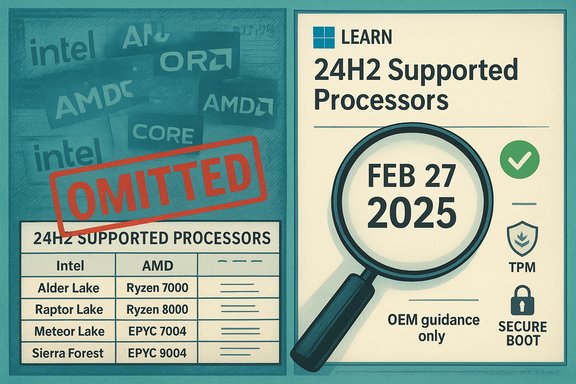
In mid-February 2025 Microsoft published the official CPU support lists for Windows 11, version 24H2 on its Hardware/Design pages. The documentation is explicitly intended for OEMs and ODMs as guidance about which processors may be used in new Windows 11 devices, and it includes an editor’s note acknowledging an update and correction made on February 27, 2025. The Learn pages state these tables reflect the processor models that meet Microsoft’s design principles around security, reliability, and minimum system requirements and that the lists will be updated at each general availability milestone. Yet the first public copies of that list — and a subsequent revision — produced headlines that suggested Microsoft had quietly withdrawn Windows 11 support for broad swathes of Intel hardware (notably many 8th, 9th and 10th Gen parts). That interpretation was inaccurate in important ways, but it also exposed genuine problems: confusing messaging, the fragile boundary between OEM guidance and consumer compatibility, and the operational impact of turning a documentation glitch into a headline-worthy policy change. Multiple news outlets and community threads picked up the story, amplifying the uncertainty.
Source: Neowin Microsoft updates the list of Windows 11 supported processors, makes it very confusing
 Background / Overview
In mid-February 2025 Microsoft published the official CPU support lists for Windows 11, version 24H2 on its Hardware/Design pages. The documentation is explicitly intended for OEMs and ODMs as guidance about which processors may be used in new Windows 11 devices, and it includes an editor’s note acknowledging an update and correction made on February 27, 2025. The Learn pages state these tables reflect the processor models that meet Microsoft’s design principles around security, reliability, and minimum system requirements and that the lists will be updated at each general availability milestone. Yet the first public copies of that list — and a subsequent revision — produced headlines that suggested Microsoft had quietly withdrawn Windows 11 support for broad swathes of Intel hardware (notably many 8th, 9th and 10th Gen parts). That interpretation was inaccurate in important ways, but it also exposed genuine problems: confusing messaging, the fragile boundary between OEM guidance and consumer compatibility, and the operational impact of turning a documentation glitch into a headline-worthy policy change. Multiple news outlets and community threads picked up the story, amplifying the uncertainty. What Microsoft actually published — and what it meant
The Learn pages: OEM guidance, not an OS kill switch
Microsoft’s processor tables live on the Windows Hardware Developer / Learn site. Those pages are explicit: they document which processors OEMs may use when certifying new devices for Windows 11. The page preamble reinforces that the lists represent processors that meet Microsoft’s current “design principles” and that not every new CPU will immediately appear in the tables; subsequent generations that meet the same principles will be considered supported even if not yet listed. The Learn page was edited on February 27, 2025 to correct omissions introduced in a prior version. Key takeaway: the OEM lists are a manufacturing/certification baseline, not a retroactive “we will cut updates to existing PCs” notice.The Feb. 13 drafting error and the correction
When Microsoft first published the 24H2 processor lists, several commonly used Intel SKUs — including many 8th, 9th and 10th Gen models — were missing. That deletion was not accompanied by an explanatory blog post or press release; instead, the authoritative Learn pages simply reflected the omission. After media coverage and community concern, Microsoft updated the page and added an “Editor’s Note” clarifying that a page update on February 13 did not reflect accurate offerings and that a corrected update occurred on February 27, 2025, reintroducing many of the omitted Intel models and reclassifying others. That correction is visible in the page metadata and the editor’s note. This sequence — initial publish → alarming headline → documented correction — is the proximate cause of the confusion.How the headlines got so loud
- Many outlets read the first published tables as the compatibility list for all Windows 11 devices and extrapolated that omission meant Microsoft had changed the consumer upgrade path. That interpretation spread quickly.
- The tables are public and authoritative; when hardware is absent from an official Microsoft table, reasonable people assume it indicates a policy change.
- Microsoft’s initial update lacked an explicit press statement explaining the scope (OEM-only) and the scope of the March correction, so community channels filled the vacuum with speculation. Neowin and other publications documented the apparent removals and compiled lists of affected SKUs before Microsoft added the clarification.
- OEM certification lists have tangible consequences: they determine which new devices can carry the Windows 11 badge and go through the modern driver and certification flows. That downstream effect makes OEM lists feel like policy shifts even when the consumer upgrade policy has not changed.
What this means for consumers, IT admins and OEMs
Consumers and existing PCs
- If your PC is already running Windows 11 (any recent build) and you meet the original Windows 11 system requirements, this documentation glitch does not mean Microsoft will cut updates to your device tomorrow. Microsoft’s clarification and the Learn page update make that explicit. In short: running Windows 11 on an older-but-currently-supported CPU does not automatically make your PC unsupported because of an OEM list revision.
- Practical advice: verify your system’s compatibility using the PC Health Check or your OEM’s support pages before upgrading the OS, and keep drivers/firmware up to date. That is good practice irrespective of documentation changes.
OEMs and new-device certification
- The published lists are aimed squarely at OEMs/ODMs. Any CPU included or excluded on those lists matters mostly when an OEM submits a new device for Windows 11 certification and seeks the Windows compatibility logo.
- For manufacturers, the implication is operational: if you want a new PC to ship with Windows 11 and carry Microsoft’s badge, follow the processor families and DCH driver requirements indicated on the Learn pages. New devices must use modern device drivers that have passed the Windows Hardware Compatibility Program for Windows 11.
- That means OEM purchasing, BOM planning, and QA/testing flows could be influenced by these lists even if consumer upgrade policy hasn’t changed.
Enterprise and lifecycle risk
- For corporate IT teams planning refresh cycles, the OEM lists are a legitimate input into procurement decisions. A processor family omitted from the OEM list might not be certifiable in new branded devices going forward, which affects warranty, imaging, and driver tooling decisions.
- But for existing enterprise fleets, Microsoft’s clarification suggests updates and security fixes continue for devices already running Windows 11 — at least under the current servicing model. It does not preclude future Windows versions from tightening baselines, so lifecycle planners should treat these lists as a signal rather than a promise.
Technical and policy analysis — what the lists reveal
Security and modern-driver requirements are the stated driver
Microsoft tells OEMs that processors on the list meet “design principles around security, reliability, and the minimum system requirements for Windows 11,” and that new devices must ship with modern DCH drivers. That phrasing points to two priorities:- Hardware security primitives (TPM, virtualization extensions, recent microarchitectural mitigations).
- A modern driver model that simplifies quality assurance and long-term servicing for a smaller, more homogeneous device population.
Strange exclusions and the role of classification errors
The initial omission of entire Intel generations (8th–10th Gen in some published snippets) was odd because many of those CPUs already met Windows 11’s original technical requirements. Two plausible explanations emerged:- A drafting/classification error on the Learn pages (Microsoft has acknowledged a page update that did not reflect accurate offerings).
- A conscious OEM policy to encourage newer CPU families for new-device certification even where older SKUs technically meet minimum instructions and security features.
Vendor-specific oddities: AMD vs Intel appearance on the lists
The 24H2 lists simultaneously added many AMD Ryzen 8000-series entries while some Intel SKUs appeared absent in the initial publish. Media outlets noted the asymmetry and speculated on business or technical motives. That kind of interpretation is natural — but the corrected Microsoft pages and follow-up statements show that reading too much strategy into a single documentation snapshot is risky. Documentation cadence, certification timing, and driver availability frequently produce asynchronous list updates across vendors.Why documentation-first changes are hazardous in the modern news cycle
- Official pages are treated as definitive policy by readers, journalists and vendors.
- Automated crawlers and aggregator sites snapshot content quickly, and small errors are amplified.
- Microsoft’s multi-stakeholder audience (consumers, IT admins, OEMs, partners) expects different messages; a single Learn page trying to satisfy all of them will sometimes under-communicate nuance.
Practical guidance (concise, action-oriented)
- Check whether your device is currently running Windows 11 and passes PC Health Check. If yes, you are not forced into immediate change by these list revisions.
- If you plan to buy a new PC and need Microsoft certification (Windows 11 logo), verify with the OEM that the specific CPU SKU and drivers are included in their certification plan; rely on the OEM’s final product spec, not a third-party summary.
- For enterprise procurement: treat Microsoft’s OEM lists as a procurement input — factor them into warranty and imaging plans — but confirm with OEM/vendor certification roadmaps before locking long lead-time buys.
- Keep firmware, drivers and Windows Update current. Many compatibility holds and upgrade blocks have historically been driver/firmware related; the safer route is to ensure Intel/AMD vendor drivers and chipset firmware are factory-updated before attempting an OS upgrade.
- If you depend on a specific SKU being certifiable in a new device, request written confirmation from your OEM partner; public documentation may lag or be edited.
Strengths, risks and final assessment
Notable strengths
- Microsoft’s move to keep an explicit, regularly updated OEM list in public improves transparency for manufacturers and enterprise procurement teams.
- The emphasis on modern DCH drivers and explicit design principles signals a long-term push to improve device reliability and security.
- The Learn pages include an editor’s note and a documented correction history — evidence Microsoft is tracking and revising those pages when needed.
Potential risks and weaknesses
- Public OEM lists can be misread as consumer support policy; that’s a communications failure risk. The February correction showed how quickly a documentation error can translate to market confusion.
- Because certification and listing cadences differ by vendor and SKU, the lists will always be slightly behind the latest silicon launches — and that lag will be misinterpreted as exclusion unless Microsoft provides clearer—immediate—explanatory copy.
- For large enterprises, even perceived ambiguity about support can trigger conservative refresh decisions, increasing costs unnecessarily if the change was only in documentation and not in servicing policy.
Unverifiable or tentative points (flagged)
- Any suggestion that Microsoft is deliberately favoring one CPU vendor over another based solely on the temporary appearance of items in the lists is speculative and not supported by the Learn pages themselves. The corrected documentation and editorial note point to a publishing error as the proximate cause; drawing vendor-bias conclusions from a single snapshot is not verifiable without internal Microsoft testimony. Treat vendor-favor claims as conjecture unless supported by further, direct statements from Microsoft or OEMs.
Where this could go next
- Microsoft will likely refine how it communicates OEM-only guidance versus consumer compatibility to avoid future confusion. A clearer banner on Learn pages indicating “OEM guidance only — this does not change consumer upgrade eligibility” would have helped in this case.
- OEMs may adjust procurement practices to favor CPU families that appear promptly on Microsoft’s published lists to minimize bureaucratic friction and expedite certification badges.
- Windows users and enterprise asset managers should watch future Windows release notes and Microsoft’s Windows Release Health dashboard for any servicing or compatibility holds tied to driver or firmware issues; those are the mechanisms Microsoft has used before to block upgrades for stability or security reasons — and they’re meaningful in practice. News outlets and community commentators will likely scrutinize each subsequent list update more closely.
Conclusion
The February 2025 processor-list episode is useful as a case study in modern product communications: authoritative but context-sensitive documentation, when published without immediate clarifying language, can be mistaken for policy change and cause unnecessary alarm. Microsoft’s corrected Learn pages and explicit editor’s note make the immediate technical reality clear — the OEM lists guide new-device certification and were corrected to reinclude omitted Intel SKUs — but the episode leaves a permanent lesson for vendor communications teams and for IT pros who rely on public documentation for procurement planning. Read the OEM lists, but interpret them in context: certification guidance for new devices is different from ongoing support for machines already running Windows 11.Source: Neowin Microsoft updates the list of Windows 11 supported processors, makes it very confusing
