

Microsoft’s February rollout of Windows 11, version 26H1, is not just another feature update — it’s a targeted, platform-first release built to land on a narrow set of Arm-based PCs and to shepherd a new generation of silicon into the Windows ecosystem. The release starts February 10, 2026, will be factory‑installed only on qualifying devices (initially Qualcomm Snapdragon X2 series systems), and carries a distinct servicing timeline: Home and Pro editions are supported through March 14, 2028, while Enterprise and Education editions are supported through March 13, 2029. ([support.microsoft.microsoft.com/en-us/topic/windows-11-version-26h1-6a0533a9-71a8-43b8-a32c-8fa7db97543d)
Microsoft’s 26H1 departure from the usual second‑half annual feature cadence is deliberate. Rather than rolling new low‑level platform changes to the entire Windows install base, Microsoft created a narrow servicing lane — internally associated with a new core platform — to accommodate architectural differences and firmware expectations of next‑generation Arm SoCs. The company frames 26H1 as a release that “enables the next generation of silicon and hardware innovation,” and says the first wave of devices will ship with Qualcomm’s Snapdragon X2 family.
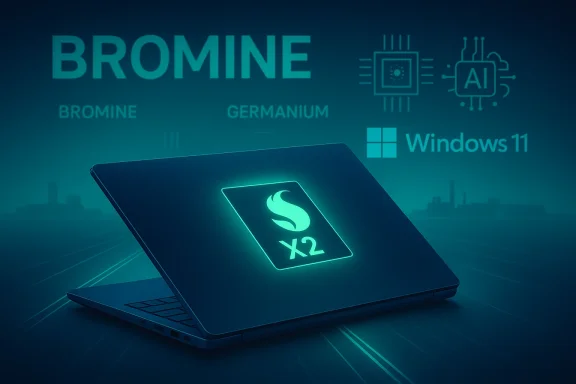
Industry reporting and vendor briefings have adopted shorthand names for the two coexisting development lines: the Bromine platform (26H1) for the Arm‑targeted image and the Germanium lineage that underpins the mainstream H2 releases (24H2, 25H2, and the expected 26H2 later in 2026). This split reduces the risk of wide‑scale regressions attributable to deep kernel, scheduler, power‑management, or NPU/runtime changes, while letting OEMs ship devices that require those changes on their firmware and drivers schedule.
It’s important to separate what Microsoft has explicitly declared (the X2 family) from reporting and OEM claims about specific variants that will ship with 26H1. Microsoft’s support document references the Snapdragon X2 Series in general; the explicit listing of X2‑Plus/Elite/Elite‑Extreme variants comes from vendor and press reporting and appears in early Windows 11 26H1 coverage. Because Microsoft’s published support article does not catalogue SKUs by variant names, those detailed variant claims should be treated as industry reporting corroborated by Qualcomm’s product announcements rather than as a formal Microsoft SKU list.
Why that nuance matters: if an OEM advertises a device with an X2‑branded SKU and a factory 26H1 image, you should confirm the exact model and support details at the point of sale — factory images and vendor support policies determine whether a device qualifies for the 26H1 servicing lane. Some early models (announced at trade shows and in press leaks) explicitly list 26H1 factory images; others simply indicate X2 chips and leave the OS image detail to the OEM.
Those under‑the‑hood changes are not glamorous feature list items for most end users, but they are precisely the sort of engineering changes that, if integrated directly into the mainstream branch without a controlled rollout, can produce subtle regressions across the enormous diversity of PC hardware already in market. The split lane is Microsoft’s method for isolating those risks while still letting OEMs ship on their timetable.
The lifecycle table for Home and Pro editions shows a start date of February 10, 2026 and an end date of March 14, 2028, giving 26H1 a 25‑month support window for consumer SKUs. For Enterprise and Education SKUs, support runs from the same February 10, 2026 start to March 13, 2029, roughly 37 months of support. These dates are concrete and should be treated as fixed planning anchors for procurement and refresh cycles. (learn.microsoft.com)
Two operational takeaways:
In short: not being on 26H1 is not a functional disadvantage for most users today. Microsoft intends for 26H2 (the H2 2026 mainstream release) to be the recommended deployment target for wider rollouts.
But there are costs. Every platform splirface, complicates update rollouts, and raises the possibility of fragmented experiences if ecosystem partners do not coordinate. Microsoft’s choice to keep 26H1 narrow minimizes consumer risk, but it does introduce short‑term complexity for support date IT shops buying mixed fleets.
Source: Windows Latest Microsoft details Windows 11 26H1 support cycle, CPU requirements (just Snapdragon X2 for now), and more
 Background / Overview
Microsoft’s 26H1 departure from the usual second‑half annual feature cadence is deliberate. Rather than rolling new low‑level platform changes to the entire Windows install base, Microsoft created a narrow servicing lane — internally associated with a new core platform — to accommodate architectural differences and firmware expectations of next‑generation Arm SoCs. The company frames 26H1 as a release that “enables the next generation of silicon and hardware innovation,” and says the first wave of devices will ship with Qualcomm’s Snapdragon X2 family.Industry reporting and vendor briefings have adopted shorthand names for the two coexisting development lines: the Bromine platform (26H1) for the Arm‑targeted image and the Germanium lineage that underpins the mainstream H2 releases (24H2, 25H2, and the expected 26H2 later in 2026). This split reduces the risk of wide‑scale regressions attributable to deep kernel, scheduler, power‑management, or NPU/runtime changes, while letting OEMs ship devices that require those changes on their firmware and drivers schedule.
What Microsoft officially announced
- Release date and scope: Microsoft’s support document lists an original publish date of February 10, 2026 for Windows 11, version 26H1 and confirms it is not designed to be offered or installed on existing devices; rather, it will be available on select new devices that will come to market in early 2026.
- Target silicon: Microsoft explicitly names the Qualcomm Snapdragon X2 Series as the first silicon family that will ship with 26H1 out of the box. The support documentation uses the language that the release “enables the next generation of silicon and hardware innovation.”
- Servicing and upgrade path: Devices shipped with 26H1 will continue to receive monthly quality and security updates, but Microsoft confirms those devices will not be able to update to the next annual feature update in the second half of 2026 because 26H1 is based on a different Windows core than versions 24H2, 25H2 and the upcoming 26H2; those devices will have a path to update in a future Windows release.
- Support timelines: Microsoft’s lifecycle pages list clear retirement dates for 26H1: the Home/Pro family (including Pro Education and Pro for Workstations) is supported through March 14, 2028, and the Enterprise/Education family (including Enterprise multi‑session) is supported through March 13, 2029. These are precise cutoffs and are published under Microsoft’s Modern Lifecycle policy.
CPU requirements: Snapdragon X2 today — what Microsoft confirmed, what others report
Microsoft’s support note names the Snapdragon X2 Series as the initial family of supported processors, but it stops short of enumerating every SKU and variant in that family. Independent industry coverage and OEM reporting fill in some of the blanks: multiple outlets and industry briefings point to three initial X2 variants that OEMs plan to ship in early 2026 — commonly referenced as Snapdragon X2 Plus (X2P), Snapdragon X2 Elite (X2E), and Snapdragon X2 Elite Extreme (X2E Extreme). These designations appear in vendor briefings, technical previews of the chips, and early hands‑on coverage from the press.It’s important to separate what Microsoft has explicitly declared (the X2 family) from reporting and OEM claims about specific variants that will ship with 26H1. Microsoft’s support document references the Snapdragon X2 Series in general; the explicit listing of X2‑Plus/Elite/Elite‑Extreme variants comes from vendor and press reporting and appears in early Windows 11 26H1 coverage. Because Microsoft’s published support article does not catalogue SKUs by variant names, those detailed variant claims should be treated as industry reporting corroborated by Qualcomm’s product announcements rather than as a formal Microsoft SKU list.
Why that nuance matters: if an OEM advertises a device with an X2‑branded SKU and a factory 26H1 image, you should confirm the exact model and support details at the point of sale — factory images and vendor support policies determine whether a device qualifies for the 26H1 servicing lane. Some early models (announced at trade shows and in press leaks) explicitly list 26H1 factory images; others simply indicate X2 chips and leave the OS image detail to the OEM.
What’s likely unnical rationale for a split platform
Microsoft and partners are describing 26H1 as a “platform enablement” release — essentially a set of plumbing and low‑level platform changes that enable characteristics expected from the new SoCs. Based on Microsoft’s documentation, early Insider previews, and vendor specs for the Snapdragon X2 family, the critical technical motivations include:- Kernel and scheduler tuning to better match Arm core characteristics and power states.
- Power‑management and thermal frameworks targeted to reach OEM battery‑life claims.
- NPU/runtimes and driver hooks to expose on‑device AI acceleration securely and efficiently.
- Validated DCH driver bundles and firmware attestation flows that OEM factories require.
Those under‑the‑hood changes are not glamorous feature list items for most end users, but they are precisely the sort of engineering changes that, if integrated directly into the mainstream branch without a controlled rollout, can produce subtle regressions across the enormous diversity of PC hardware already in market. The split lane is Microsoft’s method for isolating those risks while still letting OEMs ship on their timetable.
Upgrade paths, servicing differences, and lifecycle implications
Microsoft’s release note is explicit: devices shipped e monthly updates, but will not be upgraded to the next annual feature update in the second half of 2026, because 26H1 is based on a different Windows core. The company says those devices will have a path to update in a future Windows release, but it does not tie that path to a precise version number in its public support text.The lifecycle table for Home and Pro editions shows a start date of February 10, 2026 and an end date of March 14, 2028, giving 26H1 a 25‑month support window for consumer SKUs. For Enterprise and Education SKUs, support runs from the same February 10, 2026 start to March 13, 2029, roughly 37 months of support. These dates are concrete and should be treated as fixed planning anchors for procurement and refresh cycles. (learn.microsoft.com)
Two operational takeaways:
- If you buy a new X2 device in early 2026, verify the vendor’s support commitments — 26H1 devices will remain on their own servicing track and may not receive feature updates on the same cadence as non‑X2 machines.
- Organizations with mixed fleets should treat 26H1 devices as separate endpoints for testing and management, at least until Microsoft aligns the two platform tracks in a future release.
Who needs 26H1 — and who doesn’t
For the vast majority of current Windows PCs (Intel, AMD, earlier Arm), 26H1 is unnecessary. Microsoft and multiple outlets stress that 26H1 does not introduce major consumer‑facing feature improvements beyond the 25H2 baseline; its value is to OEMs and to the new Arm silicon. If you own a first‑generation Snapdragon Copilot+ device or an Intel/AMD laptop, you will not be offered 26H1 via Windows Update and you will continue to receive security, quality, and feature updates through the mainstream 26H2 track.In short: not being on 26H1 is not a functional disadvantage for most users today. Microsoft intends for 26H2 (the H2 2026 mainstream release) to be the recommended deployment target for wider rollouts.
Enterprise, IT, and ISV implications
Enterprises contemplating pilots or purchasesface a few predictable operational tasks:- Pilot tightly and early. Treat 26H1 machines as a distinct ring in your deployment pipeline. Validate management tooling, endpoint detection & response agents (especially kernel‑mode components), and driver stacks before wide rollout.
- Demand OEM SLAs and image documentation. Because 26H1 is a factory image lane, ensure the OEM provides clear upgrade policies, recovery images, and driver update paths. Ask whether the vendor will support reimaging to the mainstream branch in future if consolidation becomes available.
- Confirm application compatibility and fallback paths. ISVs should prioritize Arm64 builds for critical services and provide graceful NPU‑accelerated fallbacks. Some workloads that heavily use native code or kernel extensions may require retesting for Bromine‑platform subtleties.
Ecosystem and OEM perspective
For OEMs and chip vendors, 26H1 is a pragmatic concession: ship validated factory images that aligne and driver assumptions, rather than waiting for the H2 consumer release cadence. Qualcomm and other partners gain the ability to claim validated Windows support and to deliver on power and battert delaying product launches. Qualcomm’s X2 press material and third‑party coverage emphasize strong NPU throughput and improved CPU/GPU efficiency, features that need careful OS co‑design.But there are costs. Every platform splirface, complicates update rollouts, and raises the possibility of fragmented experiences if ecosystem partners do not coordinate. Microsoft’s choice to keep 26H1 narrow minimizes consumer risk, but it does introduce short‑term complexity for support date IT shops buying mixed fleets.
Risks, unknowns, and claims to watch (flagged where appropriate)
- Variant enumeration: Industry coverage lists X2 Plus, X2 Elite, and X2 Elite Extreme as initial SKUs tied to 26H1 devices, but Microsoft’s public support article references only the Snapdragon X2 Series generically; Microsoft has not published a formal SKU‑by‑SKU compatibility document listing X2P/X2E/X2E‑Extreme by name. Treat published variant lists as credible industry reporting rather than official Microsoft SKU lists unless Microsoft amends its documentation. Caveat lector.
- Other silicon requiring 26H1: Some outlets have speculated that additional next‑gen chips (for example, GPU‑centric or custom Arm offerings) could later require the Bromine lane. Microsoft’s public note hints at “capabilities tailored specifically for those platforms,” but it does not enumerate future chips such as the oft‑speculated Nvidia N1X. Any extension beyond Snapdragon X2 is possible but not confirmed. Treat such claims as speculative until vendors or Microsoft make explicit statements.
- Upgrade convergence timeline: Microsoft says 26H1 devices “will have a path to update in a future Windows release,” but the company has not tied that path to a particular H‑series version in consumer‑facing documentation. Industry broader alignment may come with a 2027 H2 release (commonly referenced as 27H2 in press coverage), but that timetable remains subject to change. Organizations should not assume immediate parity between Bromine and Germanium lines.
Recommendations — practical next steps
For consumers- If you own a current Intel/AMD/earlier Arm PC, you do not need 26H1. Continue to use and update 25H2/26H2‑track builds.
- If you plan to buy a Snapdragon X2 machine, confirm the OEM image, warranty, and update policy at purchase. Ask whether the device ships with 26H1 preinstalled and whether vendor drivers will be serviced for the published Microsoft support window.
- Treat 26H1 devices as a separate hardware lane. Run pilots, validate management tooling, and confirm enterprise‑grade driver/agent support before enterprise deployment.
- Use Microsoft’s lifecycle dates when modeling refresh cycles and budgeting for support. The Home/Pro end date is March 14, 2028; Enterprise/Education is March 13, 2029.
- Prioritize Arm64 builds and test NPU‑accelerated code paths on real X2 hardware where possible. Validate graceful fallback behavior for systems without equivalent NPU resources.
- Check compatibility of kernel‑mode components and sign‑off procedures against both the Bromine and Germanium platforms to avoid surprises when customers run mixed fleets.
- Provide clear, public documentation of which factory images ship with 26H1 and commit to driver and firmware servicing windows that match Microsoft’s lifecycle statements. Customers and enterprises will demand clarity.
What to watch next
- Vendor firmware, driver updates, and OEM image notes. Verify at purchase whether a device ships with a Bromine/26H1 image and what the vendor’s in‑warranty update policy looks like.
- Microsoft messaging on upgrade convergence. Microsoft has acknowledged a future update path for 26H1 devices but has not given a target version number. Watch for an explicit timeline for reunification of the platform tracks.
- Other SoCs and platform announcements. If other silicon vendors (for example, Nvidia or smaller Arm fabs) announce chips with similar architectural differences, expect Microsoft to either extend the Bromine lane or to require those devices to ship with 26H1‑equivalent images. But treat such linkage as possible not guaranteed.
Conclusion
Windows 11, version 26H1 is a defensive, engineering‑first play: Microsoft is protecting the broader Windows population from instability while enabling OEMs and silicon partners to ship new Arm hardware that demands deeper OS changes. The practical outcome is a tight, factory‑installed release lane for early 2026 Snapdragon X2 systems, concrete lifecycle windows for planning, and a short‑term management complexity for organizations acquiring these devices. For most users, there is nothing urgent to chase — 26H2 remains the mainstream, broadly recommended release for the general install base — but for buyers, IT teams, and ISVs working with early X2 hardware, careful piloting and vendor due diligence will be essential to avoid surprises as Microsoft and the ecosystem work toward platform alignment.Source: Windows Latest Microsoft details Windows 11 26H1 support cycle, CPU requirements (just Snapdragon X2 for now), and more
