

Microsoft's public clarification about Windows 11, version 26H1 has done more to deepen the industry’s questions than to settle them: the company confirms 26H1 exists, explains it’s targeted at specific new silicon, and that it is not a conventional feature update — but the announcement leaves critical follow‑up questions unanswered for consumers, IT teams, and OEM partners.
Microsoft’s Windows release model has been unusually stable in the past few years: a single, broadly distributed feature update in the second half of the year (H2) while smaller servicing and quality updates arrive throughout. That annual H2 cadence is what Microsoft calls the primary place for new features; it is the baseline most end users and IT teams plan around.
Late in 2025 Microsoft began publishing Canary Channel builds whose version string was updated to Windows 11, version 26H1 (builds in the 28000 series). The Canary announcement explicitly stated that 26H1 “is not a feature update for version 25H2 and only includes platform changes to support specific silicon.” That phrasing — terse but explicit — is the anchor for everything that followed.
Microsoft’s official update‑history documentation later reiterated the device‑targeted distribution model: 26H1 will be available only on new devices that ship with select new silicon starting in early 2026; existing Windows 11 devices will not be offered 26H1 via Windows Update and cannot perform an in‑place upgrade to it. That creates a clear split between factory‑flashed device images and the servicing branch used for the existing installed base. (support.microsoft.com)
This lack of clarity is an operational risk for IT shops that expect predictable, homogeneous servicing across their fleet.
If you are an enterprise buyer, procurement lead, or a channel partner, treat 26H1 as a procurement risk until vendors and Microsoft publish formal servicing and migration documentation. If you are a consumer, the immediate impact is small — but if you’re shopping for the newest Copilot+ or Arm‑based laptop, clarify the support story before you buy.
Microsoft’s platform evolution makes technical sense. The company must now make the operational and lifecycle story equally clear. The sooner Microsoft publishes the missing details, the less messy the 2026 Windows refresh cycle will be.
Source: Thurrott.com Microsoft Explains Windows 11 Version 26H1 and Only Confuses Us More
 Background / Overview
Microsoft’s Windows release model has been unusually stable in the past few years: a single, broadly distributed feature update in the second half of the year (H2) while smaller servicing and quality updates arrive throughout. That annual H2 cadence is what Microsoft calls the primary place for new features; it is the baseline most end users and IT teams plan around. Late in 2025 Microsoft began publishing Canary Channel builds whose version string was updated to Windows 11, version 26H1 (builds in the 28000 series). The Canary announcement explicitly stated that 26H1 “is not a feature update for version 25H2 and only includes platform changes to support specific silicon.” That phrasing — terse but explicit — is the anchor for everything that followed.
Microsoft’s official update‑history documentation later reiterated the device‑targeted distribution model: 26H1 will be available only on new devices that ship with select new silicon starting in early 2026; existing Windows 11 devices will not be offered 26H1 via Windows Update and cannot perform an in‑place upgrade to it. That creates a clear split between factory‑flashed device images and the servicing branch used for the existing installed base. (support.microsoft.com)
What Microsoft actually said (and what it didn’t)
The explicit, documented points
- 26H1 is a platform‑level release in the Canary branch, with visible versioning changes for Insiders and a build series around 28000. Microsoft’s Canary post is unambiguous about the nature of the release.
- It is intended to support specific, next‑generation silicon (industry reporting and Microsoft’s documentation point to Qualcomm’s Snapdragon X2 family and similar next‑gen Arm platforms). Microsoft frames 25H2 as the ongoing primary feature branch while 26H1 supplies plumbing for hardware. (windowscentral.com)
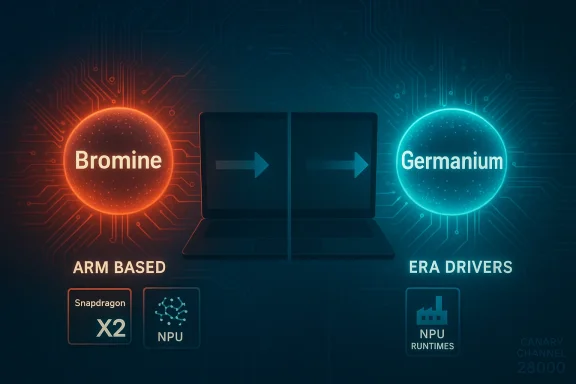
- Distribution will be device‑first: OEMs will ship devices factory‑flashed with a Bromine/26H1 image; existing Intel/AMD/older Arm PCs are expected to remain on the Germanium/25H2 servicing baseline and receive the annual H2 feature update (26H2) in late 2026. (windowscentral.com)
The unstated and ambiguous
- Microsoft’s public notes do not fully explain long‑term servicing, lifecycle, or upgrade mechanics for Bromine‑based devices versus the Germanium baseline. The company’s short Canary message didn’t describe how — or if — a 26H1 device will transition to the broader 26H2 branch later in 2026, nor did it specify whether vendors or customers will be able to convert a 26H1 factory image into the mainstream servicing channel without factory re‑imaging. That omission is material.
The technical center: Bromine vs. Germanium
What “different platform core” means in practice
Reporting by multiple outlets — drawing on Canary metadata, build numbers, and Microsoft Insider notes — has identified two internal platform baselines in play:- Germanium: the platform baseline that underpinned versions 24H2 and 25H2. It’s the servicing base most existing Windows 11 installs use.
- Bromine: the newer internal platform baseline that Microsoft appears to have created to enable deeper OS changes required by next‑gen Arm and specialized silicon (Snapdragon X2, NVIDIA N1X, and similar). Bromine is associated with the 28000 build series and is the foundation of the 26H1 Canary images. (windowscentral.com)
Why OEMs want this
OEMs shipping new Arm‑based Copilot+ and NPU‑centric devices need an OS image that:- is validated with vendor‑supplied DCH drivers and firmware,
- includes tuned power/thermal profiles and scheduler logic for the SoC,
- contains the required NPU runtimes and secure model‑loading mechanisms, and
- avoids day‑one compatibility regressions that damage reviews and returns.
Corroboration: what the public record shows
- Windows Insider Canary post (Build 28000) explicitly states 26H1 is platform changes for specific silicon; it is not a feature update for 25H2. That is Microsoft’s public positioning.
- Microsoft Support’s “Windows 11, version 26H1 update history” page clarifies 26H1 will be available only on new devices with select new silicon; devices running earlier Windows 11 versions will not be offered 26H1 via Windows Update and cannot be installed as an in‑place update. This backing in official documentation is decisive. (support.microsoft.com)
- Independent outlets, led by Windows Central, documented the Bromine/Germanium split and associated hardware targets (Snapdragon X2, NVIDIA N1X). Those reports come from analysis of Canary metadata, OEM timing, and Microsoft artifacts and are consistent with the official Canary post’s language. (windowscentral.com)
Where the messaging broke down (and why people are confused)
Confusing phrasing: “not a feature update” vs. “not upgradeable to 26H2”
Microsoft’s Canary statement was technical and short; it left open how Microsoft plans to handle devices that ship with Bromine/26H1 once 26H2 (the broad H2 feature update) becomes available later in 2026. Some industry coverage and commentary read into that gap and concluded that 26H1 devices might not be directly upgradeable to the 26H2 Germanium‑based servicing path, or that OEM devices would need a separate migration step. At least one widely read analysis suggests that Microsoft told Insiders 26H1 devices will have a “path to update in a future Windows release” rather than a straightforward 26H2 servicing upgrade. Those specific upgrade‑path formulations are not fully documented in the original Canary post and therefore remain partially interpretive. Readers should treat those statements as industry interpretation unless Microsoft publishes explicit upgrade mechanics. (thurrott.com)Two parallel truths — and the UX problem
From Microsoft’s perspective the truth is simple: keep the H2 feature cadence and ship a platform image to enable new hardware. For purchasers and IT teams, the truth becomes messy: buy an X2 device and you may be buying a different OS lineage with unknown servicing and lifecycle pathways. That mismatch — crisp engineering intent, messy customer impact — is where the communication failed.Practical implications for different audiences
For consumers (home buyers)
- If you are running a current Intel/AMD Windows PC, your upgrade path and update expectations do not change: Microsoft’s public guidance indicates your updates continue on 25H2 → 26H2 (H2 2026) in the normal way. You are not being pushed to 26H1. (support.microsoft.com)
- If you buy a new Snapdragon X2 (or similar) device early in 2026: expect it to ship with a factory‑flashed Bromine/26H1 image. Out of the box it should work with the SoC’s driver set and deliver the vendor‑promised on‑device AI experiences. But be prepared to check OEM documentation on update mechanics, warranty/driver support, and whether the OEM images will be serviced differently. (windowscentral.com)
For IT administrators and enterprises
- Treat Bromine‑shipped devices as a distinct device image. Before procurement, insist on written OEM commitments that document: update channels, driver and firmware servicing cadence, rollback procedures, integration with Windows Update for Business, and management tooling support (Intune, Configuration Manager, Windows Autopatch). Those aren’t optional if you plan to run these devices at scale. (support.microsoft.com)
- Validate management agents and security tooling in lab conditions. Early platform baselines frequently expose previously unused code paths in management agents and security agents (antivirus, EDR, management stacks). Do not assume parity with existing Intel/AMD device images until you test.
For OEMs and ISVs
- The Bromine image is your friend for reducing day‑one callbacks — but it also becomes a support contract negotiation point. Clarify how you will deliver drivers and firmware updates post‑sale. If an OEM expects customers to accept a separate Bromine servicing model, that expectation must be explicit at purchase. (windowscentral.com)
Management, servicing, and tooling: what we know — and what’s uncertain
Microsoft’s official documentation on 26H1 focuses on distribution rather than servicing details. Industry reports and some commentary have suggested which management tools will work with Bromine images (Intune, Configuration Manager, Windows Autopatch, etc.), but detailed confirmation of hotpatch, hot‑fix servicing, or special servicing paths for Bromine devices is sparse in the public documentation. Any statement asserting specific servicing and hotpatch behavior for Bromine devices should be treated as provisional until Microsoft issues explicit operational guidance. (support.microsoft.com)This lack of clarity is an operational risk for IT shops that expect predictable, homogeneous servicing across their fleet.
The bigger product implication: is this the start of Windows “12” or a long‑term fork?
A few analysts have jumped from the Bromine/Germanium split to larger product‑line speculation: namely, that Microsoft is preparing for a fundamentally different OS baseline that could justify a major version brand (commonly discussed as “Windows 12” in public speculation). The canonical Microsoft statement does not support that leap; the company framed 26H1 as a targeted, device‑specific platform release. Still, Microsoft’s simultaneous public investment in Windows Baseline Security Mode and User Transparency and Consent — significant platform and security changes announced publicly in early February 2026 — suggests Microsoft is preparing architectural change across Windows that may be easier to pursue on a new platform baseline. Those security and transparency initiatives increase the odds that Microsoft is consolidating major platform work that could eventually be delivered as part of a broader next‑generation release. Mark that conclusion as informed speculation, not a confirmed roadmap.Risk matrix: what can go wrong
- Customer confusion and returns: purchasers who expect the same servicing and update behavior across identically named SKUs (e.g., the same laptop model with Intel vs. Snapdragon) may face surprises if the OEM images and service paths differ. Ask OEMs for explicit lifecycles.
- Enterprise deployment gaps: if management tooling or EDR vendors need months to validate Bromine images, organizations could see delayed deployments or unanticipated regressions. Validate early and insist on vendor certification.
- Fragmentation and support complexity: long‑term divergence between platform baselines without clear migration tooling would create operational sprawl. This is the heart of the messaging problem Microsoft needs to fix. (windowscentral.com)
What Microsoft should clarify (and how vendors and buyers should respond)
- Publicly document the upgrade/migration path for Bromine devices: can factory‑flashed 26H1 devices be moved into the Germanium servicing channel (26H2) without reimaging? If not, explain the long‑term plan.
- Publish a servicing matrix for Bromine images: which update types are supported (hotpatches, security servicing, cumulative updates), how drivers and firmware will be delivered, and whether Windows Update for Business and Autopatch can manage Bromine devices identically to Germanium devices. (support.microsoft.com)
- OEMs should proactively produce procurement‑grade documentation that describes the shipped OS image, update cadence, and end‑of‑support timing — and include that documentation in purchase contracts for enterprise deals.
- ISVs and security vendors must publish clear compatibility statements for Bromine images. Enterprise buyers should demand those certs before large‑scale rollouts.
Quick FAQ: straight answers where possible
- Will my current Windows 11 PC be forced to 26H1?
- No. Microsoft has said 26H1 is not a feature update for 25H2; existing devices will not be pushed to 26H1 via Windows Update.
- Do I need to do anything if I’m not buying new X2 hardware?
- No. Continue to follow your usual update cadence and Microsoft’s H2 releases.
- If I buy a Snapdragon X2 laptop, what should I ask the vendor?
- Ask which Windows image ships, how OEMs will deliver driver/firmware updates, whether the device will receive the same servicing as Intel/AMD SKUs, and what the rollback plan looks like. Demand written answers.
- Is Bromine a stopgap or the start of a permanent fork?
- Microsoft presents Bromine as a targeted platform baseline to enable next‑gen silicon. Whether Bromine becomes the long‑term baseline for Windows depends on Microsoft’s long‑term product choices and whether it standardizes Bromine across architectures. That remains uncertain. (windowscentral.com)
Bottom line
Microsoft’s 26H1 announcement is honest about intent — it exists to support new silicon and it will ship as device images — but the company missed an opportunity to answer the most practical operational questions buyers and IT teams need to plan for. The net effect is clarity about intent and obfuscation about impact. That combination breeds confusion: the engineering justification for Bromine is sound and widely corroborated, but the silence around servicing, upgrade mechanics, and enterprise tooling is dangerous.If you are an enterprise buyer, procurement lead, or a channel partner, treat 26H1 as a procurement risk until vendors and Microsoft publish formal servicing and migration documentation. If you are a consumer, the immediate impact is small — but if you’re shopping for the newest Copilot+ or Arm‑based laptop, clarify the support story before you buy.
Microsoft’s platform evolution makes technical sense. The company must now make the operational and lifecycle story equally clear. The sooner Microsoft publishes the missing details, the less messy the 2026 Windows refresh cycle will be.
Source: Thurrott.com Microsoft Explains Windows 11 Version 26H1 and Only Confuses Us More
