

Microsoft’s update cadence for Windows 11 may be quietly shifting again: a recently surfaced Known Issue Rollback (KIR) connected to the October 2025 Windows 10 cumulative update has sparked the first apparent, semi‑official reference to a device‑targeted Windows 11 release labeled “version 26H1.” If accurate, the move would repeat Microsoft’s recent pattern of shipping platform‑specific images for new Copilot+ hardware (Windows on Arm) while keeping the broad consumer install base on the single annual H2 release cadence. This development is anchored in a mix of telemetry from community reporting, an official Microsoft KB article addressing a Windows 10 UI bug, and corroborating industry coverage — but the claim should be treated cautiously because the naming and delivery mechanics remain unannounced by Microsoft itself.
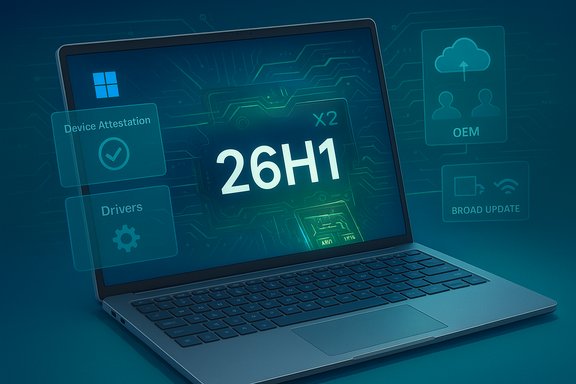
Microsoft shifted Windows 11 from two major annual feature updates to a single, large H2 release with servicing and enablement packages. That changed the way features roll out: binaries can be staged in servicing and then activated selectively with small enablement KBs or targeted servicing branches. This model provides flexibility to deliver hardware‑gated functionality — particularly on‑device AI experiences that depend on a device’s NPU, firmware, and vendor drivers — to qualifying devices first, then expand to the general Windows population later. Community reporting about a potential Windows 11 “26H1” suggests Microsoft may use that mechanism again to coordinate the launch of Qualcomm’s next wave of Snapdragon X2‑based Copilot+ laptops.
Why this is news now: a Known Issue Rollback tied to Windows 10 build KB5066791 — the October 14, 2025 cumulative update — contains metadata that, according to leak reports and community analysis, appears to reference a Windows 11 build identifier with 26H1 in the string. That trace has been interpreted as the first “official” confirmation inside Microsoft’s update tooling that a 26H1 branch exists for Windows 11, even if the public facing naming and scope haven’t been announced. The KB itself and Microsoft’s Release Health postings also document a separate, visible issue — an incorrect “End of support” banner appearing on some Windows 10 systems — which Microsoft acknowledged and remediated via cloud configuration and rollout mechanics.
Caveat: the presence of a version string inside an update artifact does not equate to a product announcement. Microsoft routinely uses internal version flags for servicing, test branches, and device‑targeted rollouts. The string could be an internal tag, a placeholder, or a short‑lived branch label used strictly for update targeting rather than a consumer facing version name. The claim is plausible and technically consistent with how Microsoft manages enablement packages, but it remains unconfirmed until Microsoft publishes formal guidance.
However, the most consequential points remain unconfirmed publicly: Microsoft has not published an official roadmap labeling a consumer product “Windows 11 version 26H1,” and the presence of an internal version string inside a rollback or servicing artifact does not prove that the name or distribution model will be presented to end users exactly as reported. Treat the claim as a plausible, engineer‑driven scenario rather than a final, guaranteed plan. Administrators and users should prepare accordingly — pilot when appropriate, validate driver stacks, and wait for Microsoft and OEM announcements before assuming broad availability.
Windows on Arm is re‑entering the premium conversation with hardware that looks explicitly crafted for on‑device AI. Whether Microsoft will publicize a consumer‑facing “26H1” label or simply use internal servicing branches to coordinate device rollouts, the technical logic for an interim, vendor‑targeted image is sound. The near‑term task for IT and power users is pragmatic: read Microsoft’s Release Health notices, verify OEM image contents before purchase, and treat any early X2 rollout as a pilot rather than an immediate fleet upgrade.
Source: Neowin This could be first official confirmation of Windows 11 version 26H1
 Background / Overview
Microsoft shifted Windows 11 from two major annual feature updates to a single, large H2 release with servicing and enablement packages. That changed the way features roll out: binaries can be staged in servicing and then activated selectively with small enablement KBs or targeted servicing branches. This model provides flexibility to deliver hardware‑gated functionality — particularly on‑device AI experiences that depend on a device’s NPU, firmware, and vendor drivers — to qualifying devices first, then expand to the general Windows population later. Community reporting about a potential Windows 11 “26H1” suggests Microsoft may use that mechanism again to coordinate the launch of Qualcomm’s next wave of Snapdragon X2‑based Copilot+ laptops.Why this is news now: a Known Issue Rollback tied to Windows 10 build KB5066791 — the October 14, 2025 cumulative update — contains metadata that, according to leak reports and community analysis, appears to reference a Windows 11 build identifier with 26H1 in the string. That trace has been interpreted as the first “official” confirmation inside Microsoft’s update tooling that a 26H1 branch exists for Windows 11, even if the public facing naming and scope haven’t been announced. The KB itself and Microsoft’s Release Health postings also document a separate, visible issue — an incorrect “End of support” banner appearing on some Windows 10 systems — which Microsoft acknowledged and remediated via cloud configuration and rollout mechanics.
What the files and signals actually show
The KIR and the 26H1 string: an inside look
The community‑circulated evidence centers on the content of a Known Issue Rollback associated with KB5066791 and Microsoft’s release health entries for October 2025. Some public previews and forum captures show an identifier that reads like SUPPORTED_Windows_11_0_26H1_Only or similar in the internal KIR code. That string is notable because it names a Windows 11 version that Microsoft has not publicly announced. The initial reporting and community discussion are summarized in the uploaded coverage and analysis that circulated after the KIR was published.Caveat: the presence of a version string inside an update artifact does not equate to a product announcement. Microsoft routinely uses internal version flags for servicing, test branches, and device‑targeted rollouts. The string could be an internal tag, a placeholder, or a short‑lived branch label used strictly for update targeting rather than a consumer facing version name. The claim is plausible and technically consistent with how Microsoft manages enablement packages, but it remains unconfirmed until Microsoft publishes formal guidance.
Microsoft’s KB and the Windows 10 UI bug
Microsoft’s official KB for the October 14, 2025 Windows 10 cumulative update (KB5066791) documents the expected lifecycle change — Windows 10 mainstream support ended on October 14, 2025 — and also records an issue where some properly‑entitled systems displayed an incorrect “Your version of Windows has reached the end of support” message in Settings. Microsoft acknowledged the UI error for certain Windows 10 SKUs (including ESU‑enrolled machines and some LTSC/IOT builds) and deployed a correction path. That same KB and supporting Release Health notes are where administrators first saw Microsoft’s remediation steps.The Snapdragon X2 trigger: why Microsoft might ship an interim 26H1
Qualcomm’s Snapdragon X2 family — announced at the Snapdragon Summit — pushes Windows on Arm into a new performance class with larger Hexagon NPUs, third‑generation Oryon CPU cores, and aggressive boost clocks. Independent press coverage documents the headline claims: 3nm process nodes, multi‑GHz bursts (reports of up to 5.0 GHz on top SKUs), and NPU performance marketing at tens of TOPS (headline figures around ~80 TOPS for some configurations). These chips are being positioned for premium Copilot+ PCs that can execute heavier on‑device AI workloads with lower latency and better privacy properties than cloud‑only processing. Early device launches are expected in early 2026. A generation change like X2 brings new driver stacks, media and ISP firmware, attestation flows for secure on‑device model execution, and vendor‑specific power/thermal tuning. Those are the classic engineering reasons for a device‑gated platform release: shipping a vendor image that includes validated drivers and NPUs, testing the entire stack on a certified hardware set, and then enabling user‑facing features more broadly once the ecosystem has stabilized. Microsoft followed a similar pattern with Copilot+ devices in the past: features that required NPU attestation or model runtime support were staged to qualifying hardware first.Technical breakdown: what 26H1 would likely contain
If Microsoft is preparing a device‑targeted Windows 11 26H1 image for Snapdragon X2 devices, engineering expectations point to a narrow, platform‑focused release rather than a broad feature update. Expect the following building blocks:- Device and vendor driver bundles: validated DCH drivers for GPU, NPU runtime, Advanced I/O (Wi‑Fi 7 / FastConnect), camera/ISP stacks, and power management tuned to X2 thermal profiles.
- Hexagon NPU runtimes and secure manifests: on‑device model runtimes, attestation hooks, and secure model manifests that let Windows schedule AI workloads locally.
- Emulation and compatibility patches: Windows on Arm improvements for x64 emulation and AVX translation or other compatibility fixes specific to X2 I/O and performance characteristics.
- Servicing metadata and targeted KIR/eKB packaging: small enablement KBs or catalog entries that allow Microsoft and OEMs to flip features on for devices that meet the required hardware attestations.
- OEM image customizations and validation tooling: vendor images signed and tested with known‑good firmware to reduce early‑ship regressions.
What this means for consumers, enterprises, and developers
Consumers and early adopters
- Buyers of Snapdragon X2 Copilot+ laptops could get the earliest access to advanced on‑device AI features and the performance/latency benefits of local NPUs.
- Those features may be enabled initially only on vendor images; the same capabilities will likely reach broader Windows 11 users later in 26H2 or via enablement flips.
Enterprises and IT administrators
- Treat any 26H1 image like a vendor‑specific OEM image rather than a general servicing update. Pilot X2 devices in controlled rings and validate endpoint agents, VPNs, and management tooling.
- Expect separate packaging and servicing notes; Microsoft may use device‑targeted servicing branches for these machines.
Developers and ISVs
- Prioritize Arm64 native builds and validate kernel‑mode code, DRM, anticheat, and device drivers on Arm hardware early.
- Design fallbacks so functionality gracefully degrades (or shifts to cloud processing) on devices without the X2 NPU capabilities.
Benefits and opportunities
- Faster time‑to‑value for on‑device AI: X2 devices with validated NPUs can deliver local, privacy‑centric AI experiences sooner.
- Cleaner OEM launch quality: coordinated images with Microsoft reduce out‑of‑box driver and firmware mismatch issues.
- Competitive pressure on x86 vendors: a compelling Arm platform with strong AI acceleration forces broader innovation across the PC ecosystem.
Risks, fragmentation, and the messaging challenge
- Fragmentation and confusion: marketing or headlines that reference “Windows 26H1” might mislead users who assume the update will reach all PCs. Clear Microsoft messaging is required to prevent user frustration.
- Early‑ship teething issues: first generation OEM images commonly surface corner‑case bugs (fingerprint sensor problems, docking station behaviors, third‑party agent conflicts).
- Perceived inequality: gating advanced features to a subset of devices may create a perception of unequal access to core Windows features.
- Privacy nuance: on‑device features may fall back to cloud processing on older hardware, changing privacy and latency guarantees — administrators and compliance teams must read feature notes carefully.
Verification checklist — what is confirmed and what is not
- Confirmed: KB5066791 (Oct 14, 2025) exists and Microsoft acknowledged a UI issue where supported Windows 10 SKUs showed an incorrect “end of support” banner. Microsoft documented remediation steps in its KB and Release Health notes.
- Confirmed: Qualcomm announced the Snapdragon X2 family and multiple outlets reported device availability projected in early 2026 — the hardware timeline aligns with the rumor’s reported window.
- Supported by community signals: multiple independent reports and community analysis have observed a KIR or related metadata that appears to reference a Windows 11 26H1 identifier inside Microsoft’s servicing artifacts. Those reports are summarized in community uploads and coverage.
- Not confirmed: Microsoft has not published an official product announcement describing a consumer‑facing “Windows 11 version 26H1” release or committed to delivering that version to all devices. The naming could be internal shorthand, a temporary servicing branch label, or an OEM‑only image. Treat it as plausible rumor until Microsoft confirms.
- Unverified claim: The exact internal string SUPPORTED_Windows_11_0_26H1_Only — as reported in community captures — was not located in Microsoft’s public KB pages or documentation during verification. It may exist in internal metadata or rollback packages not published as‑is on public KB pages; that situation is common with servicing artifacts. Flag such claims as unverified until an authoritative Microsoft artifact is published.
How Microsoft could technically implement device‑targeted delivery
- Ship a vendor image to OEMs that includes the validated X2 runtime, drivers, and model manifests.
- Publish the OS image to OEM channels and offer it via the Windows Update Catalog for new devices.
- Keep user‑facing AI binaries dormant in the shared servicing branch and use a small enablement eKB or catalog switch to turn features on for qualifying devices.
- Use Known Issue Rollbacks (KIRs) and cloud configuration updates to quickly remediate any urgent device‑specific issues discovered in early telemetry.
Practical guidance: what to do now
- Consumers considering an X2 laptop for early on‑device AI: confirm with the OEM which Windows image ships on the device and whether Copilot+ features are pre‑enabled. Budget time for early updates and driver patches.
- Existing Windows 11 users: there is no technical need to rush. The same user‑facing features are likely to be delivered broadly in 26H2 later in the year. Keep Windows Update current and, if comfortable, use the Windows Insider Program to preview changes early.
- Enterprises: pilot X2 devices in a validation ring, confirm that endpoint agents and security tooling function correctly, and coordinate with OEMs on driver signing and update cadence.
- Developers & ISVs: prioritize Arm64 builds where practical, test kernel‑mode and security‑sensitive components on Arm hardware, and provide graceful fallbacks when NPUs are unavailable.
Timeline to watch
- Immediate: Microsoft’s KB and Release Health entries will remain the authoritative place for any servicing or KIR changes related to October 2025 patches. Administrators should monitor there for fixes.
- Late 2025 → early 2026: OEM and Qualcomm announcements will clarify X2 device SKUs, availability dates, and bundled Windows images. Independent reviews and benchmarks will further illuminate which workloads run on NPU vs CPU.
- H1 2026: If the rumor is accurate, early X2 hardware and a device‑targeted image could appear in this window.
- H2 2026: The broader annual Windows 11 feature release (26H2, per the current naming pattern) would likely roll the user‑facing features out to the general install base.
Final analysis and verdict
The convergence of three signals — Qualcomm’s Snapdragon X2 platform, Microsoft’s servicing artifacts (the KIR tied to KB5066791), and independent press coverage — paints a coherent engineering and product logic for a device‑targeted Windows 11 platform image in early 2026. That strategy would enable Microsoft and OEMs to ship validated drivers, NPUs, and firmware with new hardware and protect the broader Windows install base from early‑ship regressions. The evidence is credible and aligns with Microsoft’s recent behavior around Copilot+ and staged feature delivery.However, the most consequential points remain unconfirmed publicly: Microsoft has not published an official roadmap labeling a consumer product “Windows 11 version 26H1,” and the presence of an internal version string inside a rollback or servicing artifact does not prove that the name or distribution model will be presented to end users exactly as reported. Treat the claim as a plausible, engineer‑driven scenario rather than a final, guaranteed plan. Administrators and users should prepare accordingly — pilot when appropriate, validate driver stacks, and wait for Microsoft and OEM announcements before assuming broad availability.
Windows on Arm is re‑entering the premium conversation with hardware that looks explicitly crafted for on‑device AI. Whether Microsoft will publicize a consumer‑facing “26H1” label or simply use internal servicing branches to coordinate device rollouts, the technical logic for an interim, vendor‑targeted image is sound. The near‑term task for IT and power users is pragmatic: read Microsoft’s Release Health notices, verify OEM image contents before purchase, and treat any early X2 rollout as a pilot rather than an immediate fleet upgrade.
Source: Neowin This could be first official confirmation of Windows 11 version 26H1
