

Microsoft’s Windows 11 version 26H1 is real, but it is not the kind of release most Windows users are used to seeing. It is a hardware-optimized build aimed at select new devices shipping in early 2026, not a broad feature update for existing PCs. That makes it less of a consumer-facing headline and more of a platform move, one that signals where Microsoft thinks the next wave of Windows hardware is headed.
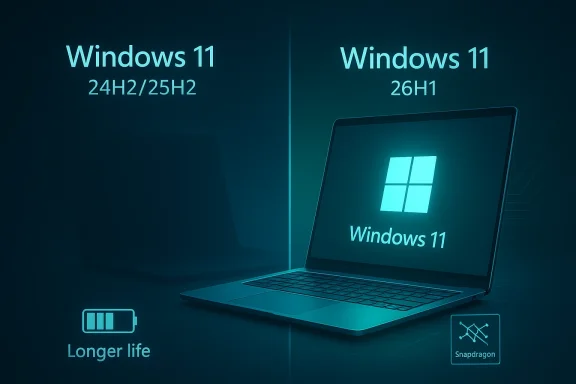
What makes 26H1 notable is not just that it exists, but that Microsoft has explicitly positioned it as the foundation for next-generation silicon and new device experiences. The first systems are tied to Qualcomm Snapdragon X2 Series processors, and Microsoft says these PCs are expected to deliver improved performance and battery life. Existing Windows 11 PCs on 24H2 and 25H2 stay on the normal servicing track, which tells us 26H1 is about enabling a new hardware class, not replacing the mainstream Windows roadmap.
The Windows ecosystem has seen many version numbers, but relatively few that are intentionally scoped around hardware timing rather than general feature distribution. 26H1 is one of those unusual cases. Microsoft’s documentation says it includes the same features introduced with the Windows 11 2025 Update, also known as 25H2, but it is not intended to be installed on existing devices. Instead, it comes preloaded on select new PCs as part of a coordinated launch with silicon partners.
That distinction matters. In the old Windows model, a version number usually implied a wider software milestone that many users would eventually see through Windows Update. Here, Microsoft is effectively separating the OS baseline for new hardware from the feature cadence for the installed base. That means consumers buying new machines may encounter 26H1 without ever consciously choosing it, while everyone else remains on the familiar 24H2/25H2 path.
The release also fits into Microsoft’s broader push toward AI PCs and silicon-specific optimization. Over the last two years, the company has increasingly tied Windows performance narratives to neural processing, battery efficiency, and system-level acceleration. 26H1 is consistent with that direction: it is not sold as a dramatic interface overhaul, but as the software layer that lets new hardware show its best numbers out of the box.
This matters for enterprise buyers as much as for consumers. Microsoft says 24H2 and 25H2 remain the recommended releases for enterprise deployment, while 26H1 can be adopted selectively for organizations evaluating new hardware platforms. In other words, Microsoft is trying to avoid disrupting corporate rollout plans while still giving OEMs a modern baseline to ship against. That is a very Microsoft compromise: stability for IT, novelty for hardware marketing.
The key idea is that 26H1 is not a broad in-place upgrade. Microsoft says it cannot be installed as an in-place update on existing devices and will not be offered through Windows Update to the current Windows 11 install base. That makes it fundamentally different from the annual feature-update model most users know.
That divergence explains why 26H1 devices will not simply roll forward into the next annual feature update in the second half of 2026. Microsoft says those systems will have a path to a future Windows release, but not the same immediate upgrade route as mainstream Windows 11 PCs. This is not how ordinary patching works, and it is one of the clearest signs that Microsoft is creating a parallel hardware lane.
The company also says devices running 26H1 will continue to receive monthly security, quality, and feature updates. So while 26H1 is unusual, it is not a dead-end branch in the sense of being isolated from servicing. It is a supported, updateable release—just one that lives on a different hardware track.
This kind of split is common in mobile ecosystems and far less common on the PC side. But Microsoft has been inching in that direction for years, especially as Windows becomes more sensitive to the capabilities of the underlying processor, NPU, and battery architecture. 26H1 is the clearest expression yet of that shift.
Qualcomm’s role is especially important. Microsoft notes that the first devices will launch with Snapdragon X2 Series processors, which points to ARM-based PCs continuing to occupy the center of Microsoft’s AI and efficiency strategy. That does not mean Intel and AMD are out of the picture, but it does show where Microsoft is placing the first, clearest bet.
That said, the practical user experience is likely to feel familiar. Since 26H1 includes the same features as 25H2, consumers may not perceive a revolution when they boot a new PC. The real difference is underneath, where the OS and silicon are better aligned for the next generation of hardware. That is the point, even if it is not a flashy one.
This is where OEMs matter most. If a new device is marketed as an AI PC, a Copilot+ PC, or simply a premium ultraportable, 26H1 gives the manufacturer a software baseline that can better match the chip configuration. That can help with boot behavior, power management, and out-of-box tuning, even if users never see a dramatic feature banner.
There is also a marketing risk. If buyers see a new version number but notice little obvious difference from 25H2, some will conclude the release is overhyped. Microsoft will need OEMs to translate the technical foundation into real-world value, because the OS version alone will not sell itself. Performance claims must be earned, not merely announced.
That does not mean every feature will be AI-driven, and it would be a mistake to treat 26H1 as an “AI-only” release. But it does mean Microsoft sees the next generation of Windows hardware as something more integrated and more specialized than the universal PC platform of old. The line between operating system and device platform is getting thinner.
For enterprise buyers, the release is best understood as a selective validation lane for new hardware. If a company wants to pilot a new ARM-based fleet or test an OEM platform, 26H1 can be adopted without disturbing the rest of the environment. That gives Microsoft a cleaner story for special-purpose hardware while preserving stability for the default enterprise fleet.
The more interesting issue is future upgrade cadence. Microsoft says 26H1 devices will not be able to move directly to the next annual feature update in the second half of 2026 because of the different core. That creates a planning wrinkle for procurement teams, which will need to think in platform generations, not just Windows versions.
That distinction makes 26H1 closer to a platform release than a normal feature update. Microsoft’s own wording about a different core, selective device availability, and new silicon support all point in that direction. It is a specialized branch meant to help a new generation of machines arrive with less friction and more headroom.
Still, the update model is unusual enough to cause confusion. Consumers may assume a new version number means a broad update they can install immediately, while IT admins may worry it introduces a parallel maintenance burden. Both concerns are reasonable, and both are eased somewhat by Microsoft’s insistence that 26H1 is narrowly scoped.
ARM-based Windows PCs have long carried the promise of better battery life and quieter operation, but their success has depended on software compatibility, OEM tuning, and a strong enough hardware story. 26H1 appears designed to strengthen that trio, making the software layer more aligned with the new chip generation.
It also puts pressure on competitors. Intel and AMD have both invested heavily in AI-capable mobile chips, but Microsoft’s first-wave emphasis on Qualcomm suggests the company wants to highlight a tightly integrated ARM stack. That does not exclude x86 from future 2026 hardware, but it does show where the initial spotlight is going.
The challenge is that platform differentiation can fragment the market if it goes too far. If too many feature promises become hardware-specific, the once-simple Windows story becomes harder to explain and support. That tradeoff is the risk of specialization, and Microsoft will need to manage it carefully.
That has implications for Apple, too. Apple has long controlled the hardware-software stack tightly, which has helped it market performance and battery life as part of a single platform story. Microsoft is not copying Apple exactly, but 26H1 shows it is moving closer to that integrated model.
That means Intel and AMD will need to make a stronger case that their own AI-capable systems can deliver equally compelling experiences. In a market where battery life, thermal efficiency, and local AI performance are all part of the pitch, raw CPU strength is no longer enough. Platform coherence now matters just as much.
Another major opportunity is strategic. Microsoft can use 26H1 to deepen the relationship between Windows and the next generation of AI-capable silicon, which should help the company maintain relevance as PC buying shifts toward efficiency and on-device intelligence. The release also helps OEMs differentiate machines in a crowded market where spec sheets alone are no longer enough.
There is also a fragmentation risk. A special hardware branch can be healthy if it stays narrow, but it can become a support headache if too many devices, features, or update paths diverge. The more Microsoft leans into special platform lanes, the harder it becomes to maintain a simple Windows story across the ecosystem. Simplicity has real value in a platform this large.
The second thing to watch is how Microsoft positions the second-half-2026 annual feature update relative to 26H1 devices. Because Microsoft says 26H1 systems will not upgrade directly to that next release, the company will need a clear story for how those devices move forward. That upgrade path may be the most important practical question raised by the entire release.
Windows 11 26H1 is therefore best understood as a strategic foundation, not a consumer event. It reflects Microsoft’s willingness to split the platform where necessary so that new silicon can shine without dragging the entire Windows base into a disruptive transition. If the company balances that ambition well, 26H1 could mark the start of a more modular, more hardware-aware era for Windows.
Source: thewincentral.com Windows 11 26H1, new hardware release- WinCentral
What makes 26H1 notable is not just that it exists, but that Microsoft has explicitly positioned it as the foundation for next-generation silicon and new device experiences. The first systems are tied to Qualcomm Snapdragon X2 Series processors, and Microsoft says these PCs are expected to deliver improved performance and battery life. Existing Windows 11 PCs on 24H2 and 25H2 stay on the normal servicing track, which tells us 26H1 is about enabling a new hardware class, not replacing the mainstream Windows roadmap.
 Overview
The Windows ecosystem has seen many version numbers, but relatively few that are intentionally scoped around hardware timing rather than general feature distribution. 26H1 is one of those unusual cases. Microsoft’s documentation says it includes the same features introduced with the Windows 11 2025 Update, also known as 25H2, but it is not intended to be installed on existing devices. Instead, it comes preloaded on select new PCs as part of a coordinated launch with silicon partners.That distinction matters. In the old Windows model, a version number usually implied a wider software milestone that many users would eventually see through Windows Update. Here, Microsoft is effectively separating the OS baseline for new hardware from the feature cadence for the installed base. That means consumers buying new machines may encounter 26H1 without ever consciously choosing it, while everyone else remains on the familiar 24H2/25H2 path.
The release also fits into Microsoft’s broader push toward AI PCs and silicon-specific optimization. Over the last two years, the company has increasingly tied Windows performance narratives to neural processing, battery efficiency, and system-level acceleration. 26H1 is consistent with that direction: it is not sold as a dramatic interface overhaul, but as the software layer that lets new hardware show its best numbers out of the box.
This matters for enterprise buyers as much as for consumers. Microsoft says 24H2 and 25H2 remain the recommended releases for enterprise deployment, while 26H1 can be adopted selectively for organizations evaluating new hardware platforms. In other words, Microsoft is trying to avoid disrupting corporate rollout plans while still giving OEMs a modern baseline to ship against. That is a very Microsoft compromise: stability for IT, novelty for hardware marketing.
What Windows 11 26H1 Actually Is
At the simplest level, 26H1 is a special Windows 11 release for new hardware. Microsoft describes it as a hardware-optimized release developed with device manufacturers and silicon partners to support next-generation innovation. It is already documented in Microsoft’s support and Learn pages, where the company says it is available only on select new devices beginning in early 2026.The key idea is that 26H1 is not a broad in-place upgrade. Microsoft says it cannot be installed as an in-place update on existing devices and will not be offered through Windows Update to the current Windows 11 install base. That makes it fundamentally different from the annual feature-update model most users know.
Why the Version Number Matters
Version numbers are often treated as housekeeping, but in this case they signal a meaningful architectural split. Microsoft says 26H1 is based on a different Windows core than 24H2, 25H2, and the upcoming second-half-2026 feature update. That is a rare statement, and it suggests a deeper platform divergence than a typical cumulative release.That divergence explains why 26H1 devices will not simply roll forward into the next annual feature update in the second half of 2026. Microsoft says those systems will have a path to a future Windows release, but not the same immediate upgrade route as mainstream Windows 11 PCs. This is not how ordinary patching works, and it is one of the clearest signs that Microsoft is creating a parallel hardware lane.
- It is preinstalled, not broadly downloadable.
- It is hardware-first, not feature-first.
- It is selective, not universal.
- It is foundational, not flashy.
- It is new-device oriented, not a retrofit for older PCs.
What Microsoft Says It Includes
Microsoft’s own support page says 26H1 includes the same features introduced with the Windows 11 2025 Update, which means the release is not about a new user interface or a headline feature set. The value proposition is subtler: the same software features, but adapted to a newer silicon baseline. That distinction is crucial for understanding why 26H1 exists at all.The company also says devices running 26H1 will continue to receive monthly security, quality, and feature updates. So while 26H1 is unusual, it is not a dead-end branch in the sense of being isolated from servicing. It is a supported, updateable release—just one that lives on a different hardware track.
Why Microsoft Split the Roadmap
The strongest clue to Microsoft’s strategy is the combination of hardware exclusivity and same-feature parity with 25H2. That tells us the company was not trying to deliver a new end-user feature bundle. It was trying to create a platform baseline that could be paired with new chips, new OEM designs, and new performance claims.This kind of split is common in mobile ecosystems and far less common on the PC side. But Microsoft has been inching in that direction for years, especially as Windows becomes more sensitive to the capabilities of the underlying processor, NPU, and battery architecture. 26H1 is the clearest expression yet of that shift.
The Silicon Partnership Model
Microsoft says 26H1 was developed in partnership with device manufacturers and silicon partners. That phrase matters because it implies co-design, not just downstream compatibility testing. The message is that Windows is increasingly shaped alongside the chips it runs on, rather than merely adapted after the fact.Qualcomm’s role is especially important. Microsoft notes that the first devices will launch with Snapdragon X2 Series processors, which points to ARM-based PCs continuing to occupy the center of Microsoft’s AI and efficiency strategy. That does not mean Intel and AMD are out of the picture, but it does show where Microsoft is placing the first, clearest bet.
- Silicon vendors get a cleaner launch story.
- OEMs get a tuned OS baseline.
- Microsoft gets a visible platform milestone.
- Buyers get better battery and performance claims.
- IT gets a narrower testing surface than a broad rollout.
Why Not Just Use 25H2?
The obvious question is why Microsoft did not simply continue with 25H2 and layer hardware optimizations on top. The answer appears to be that some of the underlying work is significant enough to justify a separate branch. Microsoft’s documentation says 26H1 is based on a different Windows core, and that is not language the company uses casually.That said, the practical user experience is likely to feel familiar. Since 26H1 includes the same features as 25H2, consumers may not perceive a revolution when they boot a new PC. The real difference is underneath, where the OS and silicon are better aligned for the next generation of hardware. That is the point, even if it is not a flashy one.
What It Means for New PCs
For buyers of new laptops and desktops in 2026, 26H1 may be invisible until they check the version number. That is typical of platform-level Windows changes: the value is supposed to show up as smoother performance, better efficiency, and fewer rough edges during the first-boot experience. Microsoft’s support wording reinforces that expectation by emphasizing battery life and hardware innovation.This is where OEMs matter most. If a new device is marketed as an AI PC, a Copilot+ PC, or simply a premium ultraportable, 26H1 gives the manufacturer a software baseline that can better match the chip configuration. That can help with boot behavior, power management, and out-of-box tuning, even if users never see a dramatic feature banner.
Consumer Experience
From a consumer standpoint, 26H1 is likely to be judged by feel, not feature lists. Is the machine quiet? Does it last longer on a charge? Does it behave consistently under load? Those are the metrics that will matter, because the release is built to support new silicon rather than to wow with visual changes.There is also a marketing risk. If buyers see a new version number but notice little obvious difference from 25H2, some will conclude the release is overhyped. Microsoft will need OEMs to translate the technical foundation into real-world value, because the OS version alone will not sell itself. Performance claims must be earned, not merely announced.
- Better battery life is the most credible consumer-facing promise.
- Smoother launch-day setup is another likely benefit.
- AI workloads may feel more responsive on supported hardware.
- The version number itself may matter less than the device experience.
- Buyers may not notice 26H1 unless they are looking for it.
The AI PC Angle
26H1 is clearly part of Microsoft’s broader AI PC narrative. The company has been leaning hard into local AI execution, NPU acceleration, and “Copilot+” style device positioning, and 26H1 creates a foundation for that direction. It signals that Windows is being tuned not just for classic x86 compatibility, but for the next wave of on-device inference.That does not mean every feature will be AI-driven, and it would be a mistake to treat 26H1 as an “AI-only” release. But it does mean Microsoft sees the next generation of Windows hardware as something more integrated and more specialized than the universal PC platform of old. The line between operating system and device platform is getting thinner.
Enterprise Implications
Microsoft has gone out of its way to reassure IT departments that 24H2 and 25H2 remain the recommended enterprise releases. That is a significant message because it separates the experimental edge from the mainstream rollout path. Organizations do not need to rewrite deployment plans just because 26H1 exists.For enterprise buyers, the release is best understood as a selective validation lane for new hardware. If a company wants to pilot a new ARM-based fleet or test an OEM platform, 26H1 can be adopted without disturbing the rest of the environment. That gives Microsoft a cleaner story for special-purpose hardware while preserving stability for the default enterprise fleet.
Deployment and Servicing
Microsoft says monthly security and quality updates continue for 26H1, which is essential for enterprise acceptance. No IT department wants a special hardware branch that falls outside normal servicing discipline. The existence of standard update channels suggests Microsoft understands that a niche build still needs operational credibility.The more interesting issue is future upgrade cadence. Microsoft says 26H1 devices will not be able to move directly to the next annual feature update in the second half of 2026 because of the different core. That creates a planning wrinkle for procurement teams, which will need to think in platform generations, not just Windows versions.
What IT Teams Should Notice
- 26H1 is not a broad enterprise deployment target.
- Existing rollout plans for 24H2 and 25H2 do not need immediate changes.
- New silicon pilots can be isolated cleanly.
- Update servicing remains familiar and manageable.
- Future upgrade paths may differ from standard Windows 11 PCs.
How 26H1 Differs from Regular Windows Updates
Most Windows updates are incremental. They bring security fixes, feature toggles, cumulative improvements, or occasional UI adjustments. 26H1 is different because it is not centered on what users see immediately; it is centered on what the hardware can do underneath.That distinction makes 26H1 closer to a platform release than a normal feature update. Microsoft’s own wording about a different core, selective device availability, and new silicon support all point in that direction. It is a specialized branch meant to help a new generation of machines arrive with less friction and more headroom.
The Servicing Model Still Matters
Despite the special positioning, 26H1 is not frozen in amber. Microsoft says devices on the release will continue to receive monthly updates and remain on the supported servicing timeline. That is important, because it means the build is meant to evolve after launch rather than simply sit as an OEM one-off.Still, the update model is unusual enough to cause confusion. Consumers may assume a new version number means a broad update they can install immediately, while IT admins may worry it introduces a parallel maintenance burden. Both concerns are reasonable, and both are eased somewhat by Microsoft’s insistence that 26H1 is narrowly scoped.
Short Comparison
- Regular Windows updates are for the installed base.
- 26H1 is for new device launches.
- Regular updates are broadly available through Windows Update.
- 26H1 is preinstalled on select hardware.
- Regular updates usually preserve the same platform core.
- 26H1 is based on a different Windows core.
The Hardware and Silicon Story
The most concrete hardware detail so far is Microsoft’s reference to Qualcomm Snapdragon X2 Series processors. That is important because it anchors 26H1 in the continuing evolution of Windows-on-ARM, an area Microsoft has been pushing for years as part of its efficiency and AI strategy.ARM-based Windows PCs have long carried the promise of better battery life and quieter operation, but their success has depended on software compatibility, OEM tuning, and a strong enough hardware story. 26H1 appears designed to strengthen that trio, making the software layer more aligned with the new chip generation.
Why Qualcomm Matters
Qualcomm matters because it gives Microsoft a credible route to the kind of always-on, efficient, AI-ready laptop the company wants to showcase. If the first 26H1 devices are powered by Snapdragon X2 silicon, Microsoft gets a clean launch narrative around battery, thermals, and local AI acceleration. That is a very different market story than “another Windows refresh.”It also puts pressure on competitors. Intel and AMD have both invested heavily in AI-capable mobile chips, but Microsoft’s first-wave emphasis on Qualcomm suggests the company wants to highlight a tightly integrated ARM stack. That does not exclude x86 from future 2026 hardware, but it does show where the initial spotlight is going.
- ARM gets the clearest platform alignment.
- Battery claims become more central.
- AI acceleration becomes easier to message.
- OEM differentiation becomes sharper.
- x86 vendors face stronger pressure to keep pace.
Broader OEM Impact
For PC makers, 26H1 offers a fresh marketing hook. New model launches can now be tied to a Windows baseline that sounds purpose-built for the hardware underneath. In a slow PC market, that matters, because OEMs need differentiators that are not just cosmetic.The challenge is that platform differentiation can fragment the market if it goes too far. If too many feature promises become hardware-specific, the once-simple Windows story becomes harder to explain and support. That tradeoff is the risk of specialization, and Microsoft will need to manage it carefully.
Competitive Implications
26H1 is not just a Windows story; it is a competitive signal to the wider PC industry. By aligning Windows more tightly with new silicon, Microsoft is effectively raising the stakes for every chipmaker trying to sell the next generation of premium laptops. The company is saying that software differentiation will increasingly follow hardware differentiation.That has implications for Apple, too. Apple has long controlled the hardware-software stack tightly, which has helped it market performance and battery life as part of a single platform story. Microsoft is not copying Apple exactly, but 26H1 shows it is moving closer to that integrated model.
For Intel and AMD
Intel and AMD will likely view 26H1 as both an opportunity and a warning. The opportunity is that Microsoft clearly wants multiple silicon vendors to support advanced Windows devices over time. The warning is that the first visible momentum may favor ARM-based designs if those are the ones Microsoft wants to spotlight initially.That means Intel and AMD will need to make a stronger case that their own AI-capable systems can deliver equally compelling experiences. In a market where battery life, thermal efficiency, and local AI performance are all part of the pitch, raw CPU strength is no longer enough. Platform coherence now matters just as much.
For the Windows Ecosystem
The broader Windows ecosystem benefits from a clearer hardware roadmap, but it also risks becoming more segmented. A special build for new devices can help OEMs innovate, yet it can also create confusion about which version is “current” in a meaningful sense. That confusion is manageable today, but it could grow if Microsoft repeats this pattern.- Better differentiation for premium PCs.
- Stronger hardware launch narratives.
- More pressure on non-ARM vendors.
- Closer alignment between Windows and silicon roadmaps.
- Potential confusion over version naming.
Strengths and Opportunities
The clearest strength of 26H1 is that it gives Microsoft and its hardware partners a way to launch new PCs with a more tightly tuned software foundation. That should improve device readiness, reinforce battery-life messaging, and create a cleaner launch story for premium hardware. It also gives enterprises a controlled way to evaluate new silicon without destabilizing the mainstream Windows base.Another major opportunity is strategic. Microsoft can use 26H1 to deepen the relationship between Windows and the next generation of AI-capable silicon, which should help the company maintain relevance as PC buying shifts toward efficiency and on-device intelligence. The release also helps OEMs differentiate machines in a crowded market where spec sheets alone are no longer enough.
- Stronger battery-life and efficiency positioning.
- Better alignment with new silicon launches.
- A cleaner story for AI PCs.
- A controlled path for enterprise evaluation.
- Less disruption to existing Windows 11 deployments.
- More room for OEM hardware differentiation.
- A foundation for future platform-specific optimizations.
Risks and Concerns
The main risk is confusion. Microsoft is using a familiar Windows version label for a release that behaves unlike the releases most users know, and that could lead buyers or IT teams to misread its purpose. If the company does not communicate the distinction clearly, 26H1 may be seen as either overcomplicated or underwhelming.There is also a fragmentation risk. A special hardware branch can be healthy if it stays narrow, but it can become a support headache if too many devices, features, or update paths diverge. The more Microsoft leans into special platform lanes, the harder it becomes to maintain a simple Windows story across the ecosystem. Simplicity has real value in a platform this large.
Other Risks to Watch
- Consumer misunderstanding about what 26H1 is.
- Marketing overreach if real-world gains are modest.
- Update-path complexity for future releases.
- Vendor imbalance if one silicon family gets too much emphasis.
- Enterprise caution if the versioning model seems unstable.
- Support burden if version-specific issues multiply.
- Perception that Windows is becoming more fragmented.
Looking Ahead
The next few months will tell us whether 26H1 becomes an important platform marker or merely a quiet transitional build. The biggest indicator will be how many OEMs embrace it as a launch baseline for premium 2026 hardware, especially devices built around Qualcomm’s newest silicon. If the device ecosystem rallies around it, 26H1 could become a template for future special-purpose Windows branches.The second thing to watch is how Microsoft positions the second-half-2026 annual feature update relative to 26H1 devices. Because Microsoft says 26H1 systems will not upgrade directly to that next release, the company will need a clear story for how those devices move forward. That upgrade path may be the most important practical question raised by the entire release.
Key Things to Watch
- Which major OEMs ship 26H1 first.
- Whether Qualcomm remains the flagship silicon partner.
- How Microsoft explains the next upgrade step for 26H1 devices.
- Whether enterprise buyers actually pilot the release.
- How consumers react to a Windows version that is mostly invisible.
- Whether rival chipmakers respond with stronger Windows-ready platforms.
Windows 11 26H1 is therefore best understood as a strategic foundation, not a consumer event. It reflects Microsoft’s willingness to split the platform where necessary so that new silicon can shine without dragging the entire Windows base into a disruptive transition. If the company balances that ambition well, 26H1 could mark the start of a more modular, more hardware-aware era for Windows.
Source: thewincentral.com Windows 11 26H1, new hardware release- WinCentral
