• Thread Author
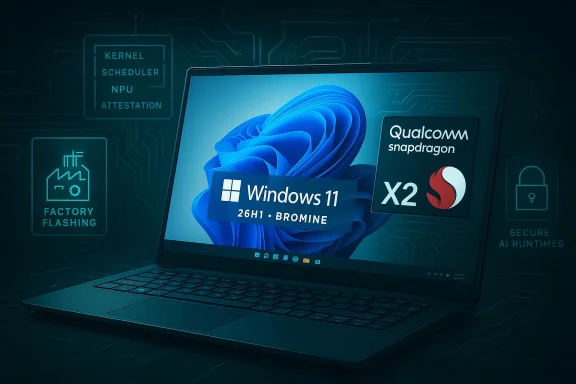
Microsoft’s latest move with Windows 11 has split the roadmap into two clearly different lanes: an early, device‑specific platform release — Windows 11 version 26H1 — that will appear only on new Arm‑based devices (starting with Qualcomm’s Snapdragon X2 series), and a broader, consumer‑facing feature update — Windows 11 version 26H2 — scheduled for the second half of 2026 and destined for the general PC population. This is not a small patch or a cosmetic rebrand; it is a deliberate engineering decision that trades immediate universality for safer, OEM‑friendly platform enablement.

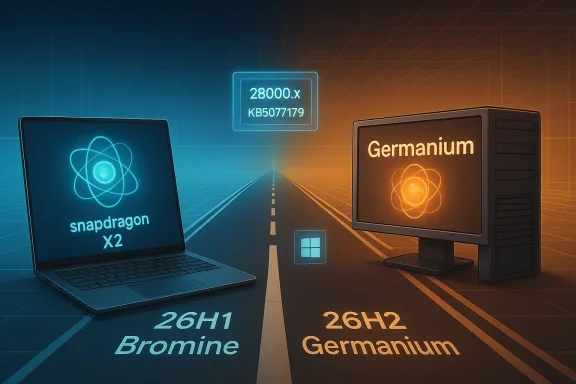
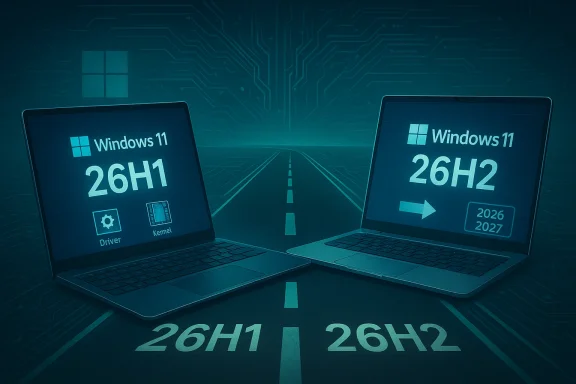
Windows 11 logo above a split road showing 26H1 vs 26H2 update paths for devices.Background / Overview​

Microsoft’s long‑standing cadence for Windows feature updates has been an annual H2 release that delivers visible UI and productivity changes to the entire installed base. In 2026 the company introduced a parallel track: a spring, platform release designed to support new silicon with deep under‑the‑hood changes, and an autumn, feature release that preserves the familiar consumer update experience.
  • The spring release is labeled Windows 11, version 26H1 and is based on a new platform baseline internally recognized by the community as Bromine. It was surfaced in Canary Insider builds with build numbers around the 28xxx family (notably build 28000).
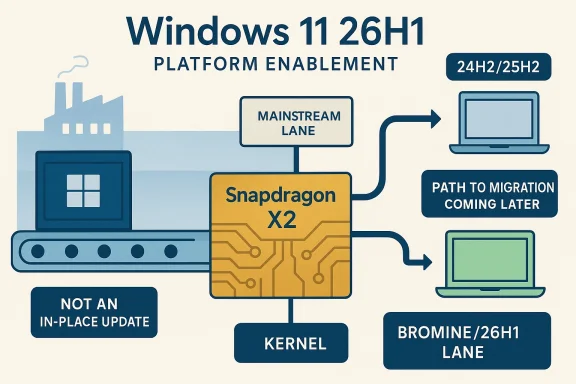
  • Microsoft’s published guidance makes the distinction explicit: 26H1 is intended for select new devices and will not be offered as an in‑place upgrade to existing Windows 11 systems. Devices running earlier Windows 11 releases will not receive 26H1 through Windows Update.
  • The usual mass‑market feature wave continues: Windows 11 26H2 will be the broad update for the wider installed base, scheduled for H2 2026 (with industry reporting pointing to an October window).
The net effect: Microsoft is running two concurrent servicing baselines for parts of 2026 — one narrow and device‑specific, the other broad and feature‑oriented.

What Windows 11 26H1 actually is — and what it is not​

A platform enablement release, not a consumer feature update​

Windows 11 26H1’s publicly stated mission is to enable next‑generation silicon and device innovations — specifically to support processors such as Qualcomm’s Snapdragon X2 series as they arrive in OEM laptops and Copilot+ devices in early 2026. The Microsoft support entry published on February 10, 2026, uses that wording directly and confirms the first devices will ship with Snapdragon X2 Series processors.
This means:
  • 26H1 contains kernel, scheduler, power‑management and runtime changes tuned to the architectural characteristics of new Arm SoCs, including tighter NPU integration and new power domains.
  • Visible, consumer‑facing features are minimal or unchanged versus 25H2; 26H1’s value is primarily stability, performance and battery optimizations on the targeted hardware.
  • Microsoft has stated that devices running 26H1 will continue to receive monthly quality and security updates, but they will follow the 26H1 servicing lane until Microsoft provides a migration path in a future release.

What 26H1 does not do​

  • It does not replace the broader annual feature cadence. Mainstream feature development remains focused on the H2 cycle and will be delivered to the wider installed base via 26H2.
  • It will not be offered through Windows Update as an in‑place upgrade to devices currently running 24H2 or 25H2. In short: if you have an existing Intel or AMD laptop, you will not be auto‑upgraded to 26H1.
These technical and distribution choices are deliberate: platform changes that touch the kernel, firmware interaction, or underlying driver model carry higher regression risk if merged directly into the servicing baseline used by hundreds of millions of PCs. Shipping a validated, OEM‑flashed OS image avoids those risks for early silicon partners.

The hard facts: KB5077179, builds and dates​

On Patch Tuesday, February 10, 2026, Microsoft published cumulative update metadata tied to the new 26H1 baseline — for example, KB5077179 (OS Build 28000.1575) — which appears in Microsoft’s update history and security release notes for the new platform. That KB is the February 2026 cumulative for the 26H1 servicing lane and contains security fixes and quality improvements specific to build 28000.1575.
A few practical points to remember:
  • The build string 28000.x identifies the Bromine platform baseline used for 26H1.
  • KB5077179 is targeted at devices running 26H1; attempting to install it on standard Intel/AMD devices will fail because those devices are not in the supported device catalog for this platform lane. Microsoft’s support documentation and the KB pages are explicit about the device‑bound distribution model.

Which hardware gets 26H1 — Snapdragon X2, and maybe N1X​

Microsoft’s support document explicitly cites Qualcomm’s Snapdragon X2 Series as the first silicon family for which 26H1 will be available out of the box. That alignment was expected: Qualcomm and OEM partners targeted early 2026 shipments for X2‑based Copilot+ laptops, and Microsoft provided the validated Bromine/26H1 images OEMs need to factory‑flash those devices.
There’s also industry speculation — and a track record of reporting — suggesting 26H1 could be prepared to support additional Arm families, most notably NVIDIA’s long‑rumored N1X platform. Several outlets and leaks have suggested that N1X‑based laptops were intended to appear in 2026 and that Microsoft’s 26H1 test builds were written with the general idea of supporting next‑gen Arm silicon. However, N1X readiness and timing have been in flux: supply‑chain reports and leakers such as Moore’s Law Is Dead flagged software and compatibility issues that have delayed N1X availability and made broad OEM timelines uncertain. In short: Nvidia N1X support in 26H1 is plausible, but not confirmed, and subject to change. Treat N1X claims as speculative until Nvidia or Microsoft confirms device‑level support.

Why Microsoft took this route: engineering pragmatism vs. fragmentation risk​

The engineering case​

Modern Arm SoCs are increasingly complex: heterogeneous CPU configurations, large on‑device NPUs, new memory and I/O topologies, and firmware attestation primitives that require coordinated OS support. Waiting to fold those low‑level changes into the single annual feature baseline can delay OEM product launches; shipping unvalidated platforms can create a poor day‑one experience.
By delivering Bromine/26H1 as a factory‑installed image for qualifying devices, Microsoft gives OEMs and silicon partners:
  • A signed, tested OS image they can load at the factory.
  • A stable driver/firmware stack tailored to the target hardware.
  • Time to tune NPU runtimes, power governors and security hooks without risking regressions on the mass market.
From an engineering perspective, that’s a sensible, risk‑averse approach that prioritizes reliability for first‑wave devices.

The messaging and management problem​

But there’s a tradeoff: the move raises the risk of short‑term fragmentation and confusion.
  • Consumers and buyers may not understand the difference between a device that ships with 26H1 and one that will get 26H2 later. Without clear OEM labeling and point‑of‑sale disclosure, buyers could expect features or servicing parity that doesn’t exist yet.
  • IT administrators face procurement and lifecycle complexity: adding 26H1 devices to a fleet introduces a new servicing baseline with its own patch schedule and potential compatibility constraints for management agents, security tooling and line‑of‑business apps.
  • Driver and ISV certification programs must be re‑aligned: vendors may need to produce separate Arm64 builds for 26H1 and ensure graceful fallbacks for the broader Windows 26H2 stream.
If Microsoft, OEMs and ISVs do not communicate clearly, the benefit of safer launches will be offset by support overhead and user confusion. Community threads and early analysis in Windows‑oriented forums raised these exact concerns soon after the Canary builds appeared.

What this means for different audiences​

Consumers (existing PCs)​

  • If you own an Intel or AMD Windows 11 laptop today: nothing immediate to do. Your device will continue on the standard annual cadence and receive the general feature update in the H2 2026 release (26H2).
  • When shopping for a new Copilot+ Arm laptop: verify which Windows version arrives preinstalled and confirm OEM support, warranty terms and update commitments. If you buy an X2 device that ships with 26H1, be aware it may follow a separate servicing lane until Microsoft publishes an explicit migration path.

IT administrators / procurement teams​

  • Treat 26H1 devices as device‑specific images. Pilot them in a controlled ring before wide deployment.
  • Request OEM documentation and SLAs describing how firmware and driver updates will be handled, plus the timeline and mechanism for eventual migration to the broad 26H2 servicing baseline.
  • Validate management tooling and kernel‑mode agents on actual 26H1 hardware before scaling.

Developers and ISVs​

  • Prioritize Arm64 builds and test real hardware early. Emulate system behavior where possible, but verify NPU‑accelerated paths on retail devices.
  • Expect to maintain multiple release targets in the short term, and design graceful fallbacks for features tied to NPU or other silicon accelerators.

Practical checklist: how to approach 26H1 and 26H2​

  • If you’re an existing Windows user, stay on your current servicing lane and wait for 26H2 in H2 2026.
  • If you’re buying a new Snapdragon X2 laptop, confirm the image version at purchase and ask the OEM about update migration guarantees.
  • IT teams: pilot devices in a small ring, demand documentation, and add device filtering in your update policy so 26H1 images don’t accidentally get wide deployment.
  • Developers: test on real X2 hardware, validate NPU runtimes, and plan for server‑side fallbacks when local inference isn’t available.
  • Everyone: watch Microsoft’s official release health and update‑history documentation for official guidance on migration and known issues.

Risks, unknowns and claims you should treat cautiously​

  • Nvidia N1X support: there’s reasonable industry chatter that Microsoft’s plank for 26H1 could be extended to N1X or other Arm families, but N1X readiness has been reported as delayed by software/compatibility issues. That means N1X devices — if they ship with a 26H1 image at all — could arrive later than originally rumored. Treat NVIDIA N1X claims as speculative until either Nvidia or Microsoft issues explicit hardware support statements.
  • Update migration: Microsoft’s support page states that 26H1 devices will not be able to update to the second half feature update in 2026 because 26H1 is based on a different Windows core; Microsoft also promises a “path to update in a future Windows release.” However, the precise timing, mechanism and guarantees for that path remain unspecified and will be crucial for enterprise buyers. Flag this as an open question until Microsoft publishes a servicing matrix.
  • In‑place install behavior: community telemetry and KB metadata (Patch Tuesday entries) show that the 26H1 KB packages exist and that they are not applicable to non‑qualifying hardware. Nevertheless, community forums will likely surface edge cases and compatibility gotchas as devices ship — track those reports.

The strategic angle: Microsoft, OEMs and the ARM ecosystem​

Microsoft’s choice is part technical necessity and part strategic coordination.
  • For Microsoft, delivering Bromine/26H1 lets the company uphold product quality for partners while maintaining the broader annual cadence of visible features.
  • For Qualcomm and OEMs, a validated factory image reduces the risk of day‑one regressions on complicated new silicon and accelerates shipping schedules.
  • For the Windows on Arm ecosystem, the tradeoff is short‑term complexity in exchange for better long‑term hardware integration and the possibility of more compelling Arm‑based PCs in the market.
This is a predictable, engineering‑first response to the realities of modern silicon development: as SoCs gain NPUs and more varied microarchitectures, OS vendors must either delay launches to preserve a single update stream or accept parallel baselines that target early devices. Microsoft opted for the latter — rational and defensible technically, but sensitive from a messaging standpoint.

What to watch next (timeline and signals)​

  • February 2026: Microsoft published 26H1 support docs and KB metadata (KB5077179 / build 28000.1575), confirming the platform lane’s existence and the Snapdragon X2 alignment.
  • Spring 2026: OEMs planned to ship the first Snapdragon X2 laptops with 26H1 factory images; retailers and OEM announcements will be the first visible confirmation. Verify images at point of sale.
  • Mid‑to‑late 2026: Microsoft’s 26H2 feature update — the mainstream release for all existing PCs — is expected in H2 (community reporting points to an October timeframe), and will be the update that restores a single feature parity baseline across the majority of devices.
  • Any announcement from NVIDIA or Qualcomm about N1X/N2x support in 26H1 devices will radically shift expectations; treat such announcements as decisive confirmation or refutation of the speculation. Until then, N1X remains plausible but unproven.

Bottom line​

Windows 11 version 26H1 is real, technical and limited: it’s a factory‑installed, platform‑level release built to enable specific, next‑generation Arm silicon (starting with Snapdragon X2), not a broadly distributed feature update for existing Intel and AMD PCs. Microsoft published support guidance and a February 10, 2026 cumulative (KB5077179, build 28000.1575) that make the distribution model and constraints plain. For most users and organizations, the practical takeaway is simple: continue on the regular update path and expect the mainstream Windows 11 26H2 feature update in the second half of 2026; if you buy a new X2 device, verify vendor commitments and plan a careful pilot before deploying such hardware widely.

Microsoft’s approach is pragmatic engineering cloaked in careful language — it reduces technical risk for OEM launches and gives hardware partners the stable OS baseline they need, but it also raises short‑term operational questions for buyers and IT teams. Clear OEM labeling, documented migration paths, and timely communication from Microsoft will determine whether Bromine/26H1 is remembered as a smart enabler or as the start of a messy fragmentation chapter. Until then, the smart play for most Windows users is patience: 26H2 will bring the features to the broad installed base, and the Bromine lane will remain a targeted, partner‑driven route for those buying the very newest Arm silicon.

Source: Windows Latest Microsoft releases Windows 11 26H1, but it's not for existing PCs. Windows 11 26H2 is coming for all PCs
 

Microsoft has confirmed that Windows 11 version 26H1 — the early, hardware‑focused release shipping with the first Snapdragon X2 PCs this spring — will not be offered an in‑place update to the annual 26H2 feature update this fall, leaving devices that ship on the new 26H1 platform on a separate servicing lane until Microsoft publishes a later convergence release.

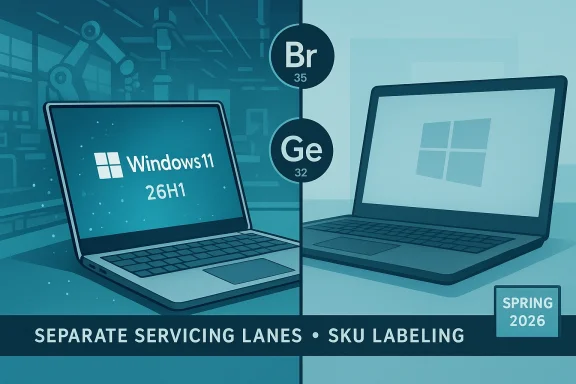
Snapdragon X2 laptop vs Germanium desktop in a futuristic tech showdown.Background​

Microsoft’s Windows release cadence has settled into an annual, H2 feature update rhythm for the broad installed base, with supplemental monthly cumulative updates for security and quality. Historically, every major platform refresh delivered in the second half of the year (the “H2” releases) has been the one that millions of existing Windows PCs receive through Windows Update. That model changed in late 2025 and early 2026 when Microsoft introduced a device‑first, platform‑specific release labelled Windows 11, version 26H1.
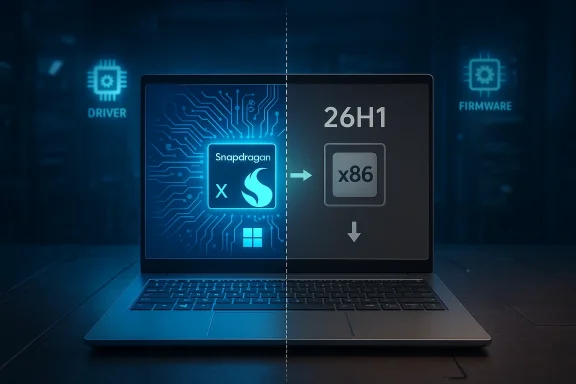
26H1 is not a conventional consumer feature update. It is a platform release — internally codenamed Bromine — produced to support next‑generation Arm silicon such as Qualcomm’s Snapdragon X2 family (and, in industry speculation, potentially other Arm designs). The Bromine core is materially different from the older Germanium core underpinning versions 24H2 and 25H2 (and the forthcoming 26H2). Because Bromine and Germanium are different platform branches, Microsoft’s support documentation makes a blunt statement: devices shipped with 26H1 will receive monthly updates but will not be able to update to the H2 feature update coming later in 2026 (26H2). Instead, those devices will have “a path to update in a future Windows release” — a convergence timeline Microsoft says will arrive at a later date.
This announcement was accompanied by concrete, verifiable signals: Canary Channel builds using the 28000-series build string (the Bromine baseline), and Patch Tuesday metadata that published cumulative packages tied specifically to the 26H1 lane (for example, KB5077179 / OS Build 28000.1575). Microsoft’s release notes for 26H1 explicitly state the device‑first distribution model and the non‑applicability of 26H1 as an in‑place update to existing 24H2/25H2 PCs.

What Microsoft actually said (the verified facts)​

The essentials, stated by Microsoft​

  • 26H1 is a hardware‑optimized release intended to enable specific new silicon families and will be available only on select new devices that ship preinstalled with it.
  • 26H1 is built on a different Windows core (Bromine) than the Germanium platform that underpins recent H2 releases. That difference is the technical reason for the split.
  • Devices running Windows 11, version 26H1 will not be able to update to the next annual feature update in H2 2026. Microsoft promises a future update path, but provides no precise timing or mechanism in the current support note.
  • 26H1 will receive monthly updates for security and quality similar to other Windows servicing lanes; Microsoft has already published cumulative update metadata tied to 26H1 builds.
  • 26H1 will not be delivered via Windows Update to existing devices running 24H2/25H2 and is not intended as an in‑place upgrade path for the installed base.

Concrete technical markers you can verify today​

  • Bromine builds use the 28000.x build series (for example, OS Build 28000.1575).
  • Patch Tuesday entries in February 2026 included KB packages targeted at the 26H1 servicing lane (KB5077179).
  • Microsoft’s “Windows 11, version 26H1” support page states the distribution model and the H2‑2026 upgrade limitation in plain language.
These are not unsubstantiated leaks; they are published Microsoft support and update‑history artifacts. That makes the platform split real, intentional, and documented.

Why Microsoft did this: the technical rationale​

At its core, this is engineering risk management applied to platform evolution.
  • Major platform shifts that change kernel behavior, low‑level driver interfaces, or firmware interaction carry a high potential for regressions. Microsoft’s choice to create a device‑first, OEM‑flashed image for new silicon minimizes the risk of breaking the broader installed base.
  • OEMs and silicon partners need a validated, factory image to tune firmware, drivers, and power management for new SoCs. Shipping a dedicated platform image is the most reliable way to ensure those devices meet battery life, performance, and compatibility targets.
  • By keeping the Bromine lane separate, Microsoft can push platform‑level innovations for Arm designs without forcing those changes onto hundreds of millions of existing Intel/AMD machines that rely on the Germanium servicing baseline.
In short: Bromine lets Microsoft and silicon partners iterate on a new platform without destabilizing the mainstream Windows Update pipeline.

What this means for different audiences​

Consumers (general buyers)​

If you buy a new Arm‑based laptop that ships with Windows 11 version 26H1 this spring, expect:
  • The device will receive monthly security/quality updates.
  • It will not receive the fall 26H2 in‑place feature update alongside mainstream PCs; a future, unspecified update will be used to converge the platform.
  • Functionality and user‑visible features may mirror 25H2 initially (Microsoft states 26H1 includes the same features as the 2025 Update), but underlying platform changes will be present.
If you own an existing Intel or AMD Windows 11 PC:
  • You will continue to receive updates on the Germanium servicing lane (24H2, 25H2 and then 26H2 in H2 2026).
  • You will not be offered 26H1 via Windows Update.

IT administrators and enterprise buyers​

Early‑adopter Arm devices present planning and risk assessment tasks:
  • Device lifecycle and patching policies must account for a separate servicing lane and an uncertain convergence timeline.
  • Imaging, management tools (MDM, SCCM), EDR agents, and vendor drivers will need validation on the Bromine image — do not assume parity with Germanium.
  • Procurement teams should demand OEM and ISV compatibility guarantees and a clear servicing statement for enterprise fleets.

OEMs and silicon partners​

This strategy is beneficial for OEMs and silicon vendors:
  • It allows them to ship certified, tuned images for new chips without waiting for the mainstream servicing baseline to incorporate platform changes.
  • It simplifies QA for device launch; however, vendors must manage support messaging carefully to avoid consumer confusion.

Strengths of Microsoft’s approach​

  • Safer rollouts for new silicon. Creating a platform‑specific lane reduces the chance of widespread regressions that could affect millions of devices.
  • Faster time to market for partners. OEMs and silicon vendors can ship devices with validated images timed to their SoC readiness.
  • Targeted fixes and servicing. Bromine devices get monthly updates tailored to the specific platform and hardware — fixes for Bromine won’t be needlessly gated by the Germanium servicing process.
  • Clear separation of concerns for development teams. Microsoft can evolve core platform capabilities for Arm faster without merging incomplete plumbing into the mainline servicing branch.

Real risks and downsides (what to watch closely)​

  • Fragmentation and update confusion. A split platform baseline with different version numbers (26H1 on Bromine vs 26H2 on Germanium) creates a natural source of confusion for consumers, retailers, and help desks. Expect questions: “Why is my new laptop on 26H1 while my friend’s machine shows 26H2 later in 2026?”
  • Unclear convergence timeline. Microsoft promises a “path to update in a future Windows release,” but offers no firm date or mechanism. For enterprises, the absence of a concrete servicing matrix complicates lifecycle planning.
  • Driver and tooling compatibility issues. Management agents, antivirus/EDR software, device drivers, and specialized peripherals often lag behind platform shifts. Enterprises must test these components on Bromine images before approving devices.
  • Third‑party application risk. Legacy applications that rely on specific on‑demand features (for example, .NET Framework 3.5) may be affected: patch notes tied to the new lane show changes such as .NET Framework 3.5 no longer being a “Windows Feature on Demand” on 26H1, requiring a standalone installer.
  • Support overhead for OEMs and retailers. Store teams and OEM customer support must be prepared to explain the servicing differences and the meaning of version strings to buyers.
  • Potential for consumer frustration. When a device advertises “Windows 11” but cannot receive the same named feature updates as other PCs on a timeline consumers expect, dissatisfaction may follow.

Unverified or speculative claims — exercise caution​

Several publications and community threads have speculated that 26H1 will also target other Arm chips (for example, Nvidia’s N1X family) or that Bromine will quickly replace Germanium for all devices. Those claims are plausible but remain speculative until Microsoft or the silicon vendors publish explicit lists of supported SKUs and a formal roadmap for convergence.
Treat the following as unverified unless and until Microsoft or the relevant silicon OEM confirms them:
  • That Nvidia N1X devices will ship with 26H1 at launch.
  • That Bromine features will be backported wholesale to Germanium in 26H2.
  • The precise timing and mechanism of the “path to update” Microsoft promises for 26H1 devices.

Practical advice: what to do now​

Whether you’re a consumer, IT pro, or OEM, here are concrete steps to take.
  • If you’re buying a new Arm laptop this spring:
  • Ask the retailer or OEM whether the device ships with Windows 11 version 26H1 and what that means for feature updates.
  • Confirm vendor support for enterprise features (BitLocker, TPM attestation, EDR compatibility).
  • If you rely on legacy components like .NET 3.5, verify how to install and support them on 26H1.
  • If you manage enterprise deployments:
  • Hold Bromine/26H1 devices to pilot status until vendors provide validated driver and management support.
  • Update procurement checklists to require a servicing and convergence commitment from OEMs.
  • Ensure imaging and OS deployment workflows account for a separate platform baseline and that rollback paths are tested.
  • If you’re an ISV or device driver author:
  • Acquire Bromine test images early and validate driver behavior, power management, and telemetry.
  • Test management agent installations under Bromine monthly updates to catch compatibility regressions early.
  • If you already own an Intel/AMD device:
  • Continue normal patching; expect to receive 26H2 when Microsoft releases the annual H2 feature update later in 2026.
  • No special action is needed unless you plan to replace the device with a 26H1‑shipped Arm machine.

How Microsoft could have reduced the friction​

There are things Microsoft (and partners) could do to smooth the transition and contain confusion:
  • Publish a precise servicing matrix that lists supported SKUs, the planned update path, and an expected date window for platform convergence.
  • Offer a clear, consumer‑facing explanation at point‑of‑sale and in the OEM support documentation about how 26H1 differs from regular feature updates.
  • Provide a tool or guidance for enterprises to map Bromine devices to existing lifecycle and patching models, including explicit EOL and upgrade windows.
  • Commit to a concrete migration path or compatibility guarantee for enterprises buying Bromine devices in volume, with timelines for when Bromine will be merged into the Germanium servicing baseline (or when Germanium will be replaced entirely).

Deeper technical considerations​

What “different Windows core” can imply​

When Microsoft says Bromine is a different Windows core, that can encompass multiple low‑level changes:
  • Kernel modifications to support new CPU architectures and power features.
  • Revised memory management or scheduler logic to optimize heterogeneous cores in modern SoCs.
  • New hypervisor or virtualization primitives tuned for on‑die AI accelerators or hardware partitioning.
  • Changes in the hardware abstraction layer (HAL) or driver models that require new driver signing or certification paths.
Each of these changes has non‑trivial downstream effects on drivers, firmware interfaces, and security tooling.

Servicing lanes and update logic​

Separating servicing lanes means Microsoft will maintain discrete update metadata, catalog rules, and compatibility filters that control which devices can receive each package. You’ll see this in practice as:
  • KB packages that only apply to the 28000.x family, and that the Microsoft Update Catalog marks as non‑applicable on non‑Bromine hardware.
  • Update cataloging and deployment tools (WSUS, SCCM/MECM) needing to recognize device platform lines to avoid attempting incompatible installs.

Scenarios to monitor​

  • If Microsoft schedules a fast convergence release (e.g., 27H2 or another H2 release where Bromine and Germanium are unified) with a clear migration tool, the disruption will be short‑lived.
  • If convergence slips into 2027 or later, enterprises will face longer complexity in their device fleets and may delay purchases of Bromine devices.
  • If OEMs push heavy marketing of Bromine devices without clear servicing guarantees, consumer confusion and return rates may increase.
  • If driver and ISV ecosystems are slow to support Bromine, early adopters may encounter real productivity or compatibility problems.

Final analysis — balancing risk and reward​

Microsoft’s platform split is a defensible engineering decision: it enables OEMs and silicon partners to ship tuned devices while preventing risky platform plumbing from destabilizing the vast Windows install base. For the ecosystem, the benefits are tangible — better battery life, closer firmware integration, and optimized drivers for Arm SoCs — but Microsoft’s current messaging leaves important operational questions unanswered.
For consumers, this is mostly a curiosity unless you plan to buy an Arm device that explicitly ships with 26H1. For enterprises and IT decision‑makers, the immediate impact is operational: treat Bromine devices as pilots, demand servicing clarity from OEMs, and validate your stack before deployment.
Ultimately, the success of this approach will hinge on three things:
  • How quickly Microsoft and partners converge the two platform lanes,
  • How clearly OEMs communicate the difference at point of sale, and
  • How fast ISVs and driver authors bring Bromine parity to the ecosystem.
If Microsoft executes confidently on those three fronts, Bromine can be a controlled pathway to modern Arm hardware on Windows without long‑term fragmentation. If not, the company risks a period of confusion and increased support overhead for both consumers and enterprises. The coming months — as Snapdragon X2 devices arrive and as Microsoft publishes more servicing details — will tell whether this split becomes a short engineering interlude or the start of a more permanent branching in the Windows platform.

Source: Windows Central Windows 11 version 26H1 won't be getting version 26H2 this fall
 

Microsoft’s decision to ship Windows 11 version 26H1 as a narrowly scoped, factory-installed platform image for new Arm-based laptops — led by Qualcomm’s Snapdragon X2 family — marks a deliberate engineering break from Microsoft’s usual annual feature cadence and raises immediate questions for consumers, enterprises, OEMs and developers about update pathways, device fragmentation, and the practical meaning of “Copilot+” hardware readiness.

Two scientists in lab coats study a Windows 11 laptop with a holographic UI in a high-tech lab.Background / Overview​

Microsoft published an Insider Canary build that surfaces the version string Windows 11, version 26H1 (build numbers in the 28xxx range). The company’s release notes are explicit: “26H1 is not a feature update for version 25H2 and only includes platform changes to support specific silicon.” That wording — short, technical and unusual — reframes 26H1 as a platform enablement release rather than a consumer-facing feature wave.
Industry reporting and OEM briefings tie the initial distribution of 26H1 to Qualcomm’s Snapdragon X2 family (variously marketed in Elite and Elite Extreme tiers). Qualcomm positioned X2-equipped laptops for H1 2026 availability, andlong with internal Microsoft messaging — indicate OEMs will ship specific Snapdragon X2 SKUs with 26H1 preinstalled while Intel/AMD variants of the same model lines will retain the mainstream 25H2 image. That split highlights Microsoft’s device-image approach in practice.
In short: 26H1 exists to give OEMs an RTM-quality OS image they can factory-flash on next-generation Arm silicon so devices deliver validated drivers, firmware and on-device AI experiences from day one — while mainstream Windows 11 feature development remains tied to the normal H2 26H2 release later in the year.

Why Microsoft created a device-specific platform release​

The engineering problem​

Modern SoCs are not incremental CPU bumps. They introduce:
  • heterogeneous CPU topologies (big.LITTLE-like Oryon configurations),
  • vastly larger NPUs (neural processing units) intended for on-device generative and inferencing workloads, and
  • new memory, I/O and firmwareruler and power management in ways that existing servicing channels were not designed to validate at scale.
Microsoft’s engineers concluded that trying to graft these low-level changes into the mainstream 25H2 servicing stream risks regressions and support incidents across billions of devices. A factory image for a targeted hardware set reduces the blast radius — OEMs receive a validated, signed image to flash at the factory, and Microsoft contains risky platform work to a known device set.

Operational benefits for OEMs and hardware launches​

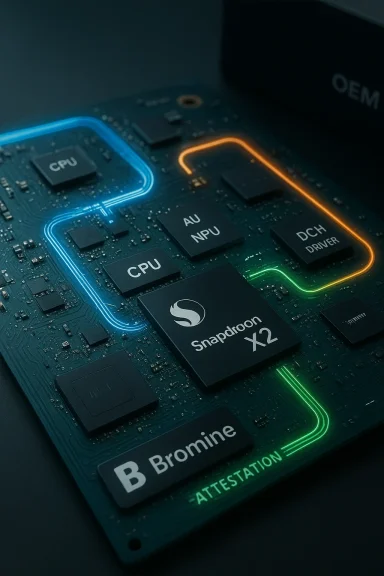
A Bromine/26H1 factory image (Bromine being the internal platform codename associated with the new baseline) givesmage to flash at the point of manufacturing,
  • a driver stack and firmware pairing that minimize day-one issues, and
  • a controlled update path for early hardware that relies on vendor-specific runtime and attestation flows for NPUs.
This approach matters when laptop shipments advertise Copilot+ experiences and local AI acceleration — consumer marketing claims can blow up quickly if drivers or firmware cause crashes, battery drain, or thermal unpredictability at scale.

Snapdragon X2: the silicon pulling 26H1 forward​

What Qualcomm is promising​

Qualcomm’s Snapdragon X2 family is positioned as a pronounced step-up for Windows Arm PCs. Public vendor briefings and press coverage list headline specs for Elite and Elite Extreme SKUs that include:
  • CPU configurations scaling up to 18 cores (12 Prime + 6 Performance in flagship variants),
  • Hexagon NPU performance in the ~80 TOPS range (INT8 basis, used in vendor materials),
  • advanced Adreno X2 GPU parts and wider memory bandwidth (LPDDR5x) for NPU/CPU data movement, and
  • boost CPU frequencies that push the envelope for single- and multi-thread workloads in laptops.
Independent benchmark reporting on pre-production X2 units shows strong multi-thread performance in rendering and encode workloads — enough to draw comparisons to Apple’s M-series and Intel’s latest laptop silicon in some tests — but those results come from early hardware with tuning still in progress. Readers should treat early benchmarks as directional rather than final.

Why X2 matters for Windows’ on-device AI​

Snapdragon X2’s larger NPUs and increased throughput are central to the Copilot+ narrative: Microsoft and OEMs want on-device models, low-latency inference, and local data processing without constant cloud round-trips. Those features require deep integration:
  • secure NPU runtimes and attestation,
  • kernel s heterogeneous compute resources, and
  • power/thermal management tuned to AI-heavy workloads.
Windows must offer hooks to manage these flows; Bromine/26H1 contains those underlying plumbing changes. That is the technical justification for a platform-targeted release rather than a mass update.

Who gets 26H1 — and who does not​

Initial recipients​

  • New Arm-based Copilot+ laptops using Snapdragon X2 SKUs will be the primary devices shipping with Windows 11 26H1 preinstalled at factory. OEM briefings and reporting indicate that models like certain ASUS ZenBook SKUs with X2 options are slated to arrive with the Bromine image.

Not eligible​

  • Existing Intel- and AMD-based Windows 11 PCs will not be offered 26H1 as angh Windows Update. Those systems remain on the mainstream 25H2 servicing baseline and will receive the usual security/quality updates until their H2 feature release (26H2) is available for the broader installed base. Microsoft’s public messaging is blunt on this point: no forced migration.

Possible but unconfirmed extensions​

  • Industry chatter and community captures have suggested other Arm processors (NVIDIA’s rumored N1/N1X family, for example) might be candidates for Bromine/26H1 support, but that remains speculative until Microsoft or the silicon vendor confirms formal support. Treat such claims as rumor uncrosoft publishes specific compatibility statements.

Practical effects: what consumers, IT teams and developers must do​

Consumers and buyers​

  • If you own a current Intel/AMD laptop: no action is required. Your PC remains on 25H2 and will continue to receive security and quality updates in the normal fashion. Do not expect Windows Update to push 26H1 onto your machine. ([pcworld.com](It's official: Windows 11 26H1 isn't for you you plan to buy a new Copilot+ laptop: ask the retailer and OEM explicitly whether a given SKU ships with 26H1 (and what update path and driver servicing channels will be used). Some identically named model lines may have both Intel/AMD and X2 SKUs; the X2 SKU may carry 26H1 while the others do not. Have the vendor document how firmware and driver updates are handled after purchase.

IT teams and procurement​

  • Treat 26H1 devices as hardware-specific images with their own servicing expectations. Pilot thoroughly validate management agents, endpoint protection and MDM behavior on Bromine-based images before wide deployment.
  • Require OEM documentation and SLAs describing firmware and driver update channels. Some Bromine devices may rely more heavily on OEM update tooling than on Windows Update for device-specific drivers and attestations.

Developers and ISVs​

  • Prioritize Arm64 CI builds and test NPU-accelerated code paths where practical. A growing portion of on-device AI workloads will dependnd secure model attestation; apps should degrade gracefully when hardware acceleration is absent.
  • Validate native and emulation paths. While X2-class devices will promote native Arm64 binaries and accelerated runtimes, a large existing installed base still runs x64/x86 workloads under emulation; compatibility testing remains essential.

Risks, trade-offs and unanswered questions​

Fragmentation and servicing complexity​

Shipping a platform image naturally creates a short-term fragmentation risk. Enterprises and ISVs face a bifurcated testing matrix — Bromine/26H1 devices versus the mainstream 25H2/26H2 lineage — which complicates imaging, update planning, and driver certification. Microsoft will need clear guidance on rollout timelines and servicing windows to reduce operational friction.

Updateorting suggests 26H1 devices may follow a different cadence or update mechanism than mainstream devices, potentially affecting how and when those devices receive subsequent feature releases like 26H2. Microsoft’s public messaging has not published a fully unambiguous timeline for how and when Bromine-based devices will converge with the mainstream branch; buyers should demand clarity from OEMs and Microsoft support channels.​

Dependence on OEMs for driver/firmware updates​

A factory image reduces day-one brdependence on OEMs for long-term driver and firmware servicing. If OEM update tooling is inconsistent, enterprises could face a patchwork of support models across device fleets. Require written update policies and test the OEM’s update tooling in pilots.

Security and attestation implications​

On-device AI and secure model execution require attestation, protected runtimes and updated firmware chains. Those flows increase complexity for security teams, who must validate that NPU runtimes, model stores, and attestation endpoints meet corporate policies. Microsoft and OEMs will need to publish best practices for securely provisioning and updating Bromine devices. Until then, treat these devices as higher operational risk from an endpoint security perspective.

How credible are the technical claims about Snapdragon X2?​

Multiple independent outlets and the vendor’s own materials converge on a few consistent claims:
  • flagship X2 SKUs use up to 18 cores in split Prime/Performance arrangements,
  • NPUs in the Snapdragon X2 family are advertised around 80 TOPS (INT8 metric),
  • memory bandwidth and cache configurations scale significantly versus the prior generation.
These claims are present in Qualcomm briefings and reproduced across TechPowerUp, Yahoo/press summaries and multiple hardware outlets that observed pre-production benchmarks. Early benchmarks are promising for multi-threaded workloads, but they come from pre-production hardware (limited thermal tuning and firmware maturity), so vendors’ published figures should be treated as vendor-provided and early tests as provisional. Cross-referencing Qualcomm’s product materials with independent benchmark reports shows tecture and capability intent, while performance deltas in real-world laptop SKUs will depend on OEM thermal and power design.

Recommendation checklist (for immediate action)​

  • If you manage procurement for an organization:
  • Demand OEM documentation that clarifies whether a specific SKU ships with 26H1 and how driver/firmware updates will be delivered post-sale.
  • Require a pilot program with a minimum of 25–50 devices (depending on fleet size) to validate management software, endpoint protection, and update behavior under production policy.
  • Include Bromine/26H1 targets in your asset classification and patching playbook until OEM/Microsoft servicing models are formalized.
  • If you’re a consumer shopping for a Copilot+ laptop:
  • Ask point-of-sale whether the X2 SKU ships with Windows 11 26H1 factory image and confirm the OEM’s update policy.
  • Consider waiting for independent reviews of the final retail hardware that include battery life, thermals, and apty testing before committing if you value long-term predictability.
  • If you’re a developer:
  • Add Arm64 CI runners where possible, test fallbacks for NPU-absent devices, and instrument performance counters to detect behavioral differences between Bromine and mainstream images.
  • If you’re an OEM:
  • Publish an explicit post-sale update roadmap for 26H1 devices and build robust tooling for firmware, driver and attestation updates that integrates with enterprise management tools.

What to watch next (timeline and signals)​

  • OEM announcements at product launch: watch whether OEMs explicitly state “ships with Windows 11 26H1” on product pages and spec sheets; that language matters operationally. Early reporting indicated ASUS ZenBook X2 SKUs as an example of device-specific shipping choices.
  • Microsoft documentation and support articles: Microsoft has published Canary release notes and a blog clarification that 26H1 is platform-only; more detailed servicing guidance is the decisive signal enterprises need.
  • Independent retail reviews and teardown benches: look for final retail units tested for battery life, thermal envelopes and application compatibility to validate vendor claims and early bench results. Early pre-production benchmarks show strong multi-thread results but are not definitive.

Critical assessment — strengths and risks​

Strengths​

  • Engineering safety: Isolating deep platform changes to a factory image is a conservative engineering stance that reduces the likelihood of broad regressions across the billions of Windows devices Microsoft supports.
  • Enables on-device AI: Bromine/26H1 can accelerate the rollout of local AI experiences that depend on secure NPU runtimes and low-latency inference, delivering real user benefits on capable devices.
  • Faster time-to-market: OEMs can ship X2-equipped devices on schedule, with a validated OS image and certified driver stacks.

Risks​

  • Short-term fragmentation: Enterprises and ISVs must contend with multiple test targets (Bromine vs. mainstream) and potentially different servicing models for a subset of devices.
  • OEM servicing dependency: Reliance on vendor-specific update tooling and channels increases operational burden; inconsistent OEM tooling could create long-term support problems.
  • User and buyer confusion: Identically named model lines shipping with different Windows images (depending on silicon) can confuse buyers and complicate support for retailers and service desks.
  • Security complexity: New attestation and NPU runtime flows expand the attack surface and introduce new provisioning challenges for security teams until best practices are published and adopted.

Final verdict​

Windows 11 26H1 is not a typical feature update; it is a targeted, platform-only release created to enable new Arm silicon such as Qualcomm’s Snapdragon X2. That engineering-centered approach makes sense: it reduces day-one risk for OEMs and helps protect mainstream devices from risky low-level changes. However, the model introduces short-term operational friction — fragmentation, servicing complexity and increased reliance on OEMs — that enterprises, service providers and developers must actively manage.
If you’re buying a new Copilot+ laptop, ask for written update and servicing commitments. If you’re managing a fleet, plan a pilot, demand OEM SLAs, and treat Bromine devices as a separate classification until Microsoft and OEMs publish clear, long-term servicing guidance. And if you’re a developer, accelerate Arm64 testing and design for graceful fallback from hardware acceleration.
This is an engineering-first pivot by Microsoft that prioritizes silicon enablement and product reliability for a narrow set of new devices. The broader Windows ecosystem will still receive mainstream features on the H2 cadence (26H2), but expect a short window of complexity as the industry adapts to platform-specific images and on-device AI hardware.

Source: Windows Report https://windowsreport.com/windows-11-26h1-targets-snapdragon-x2-cpus-excludes-existing-pcs/
 

Back
Top