

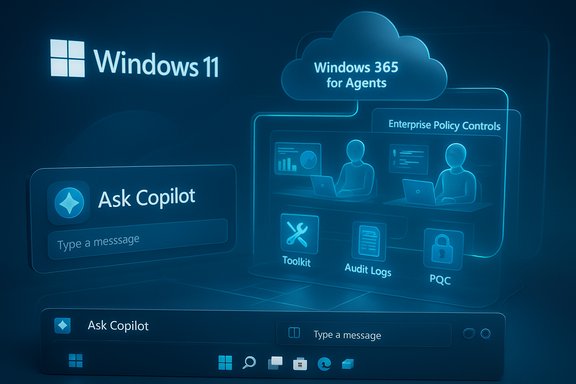
Microsoft’s Ignite demo this week did more than announce new features — it laid out an explicit plan to transform Windows 11 from a platform that runs applications into an operating system that hosts autonomous AI agents, with built-in discovery, permissioning, and containment primitives designed for enterprise scale. The changes — from an Ask Copilot taskbar composer and on-device agent registries to an isolated Agent Workspace and cloud-hosted Windows 365 for Agents — signal a strategic pivot: Windows will not only surface AI help, it will enable agents to act on behalf of users in auditable, policy-controlled environments.
For four decades Windows has been defined by APIs, drivers, and UI affordances that let people and applications interact. The new agent-centric architecture reframes that relationship: rather than merely exposing functionality for human-orchestrated workflows, Windows will provide the runtime, governance, and discovery mechanisms that let software agents discover tools, claim capabilities, and execute multi-step tasks — all while remaining visible and controllable to users and administrators. This is the essence of what Microsoft executives now call an “agentic OS.” That shift matters because enterprises are already experimenting with agentic automation — teams build lightweight scripts, RPA flows, and cloud-run bots — but lack a unified way to manage identity, auditing, and least-privilege access across millions of endpoints. By embedding agent primitives into the OS, Microsoft is attempting to solve three recurring enterprise pain points: discoverability and interoperability of tools, containment and auditability, and centralized policy and lifecycle management. The company’s pitch at Ignite tied those primitives together with both on-device and cloud execution options.
Windows has catalyzed multiple computing eras by standardizing how software runs on personal computers. This latest move — turning the OS into an agent host — could be the next platform inflection, provided the new primitives are delivered with the rigor and transparency enterprise users require. For now, the building blocks are visible in preview and documentation; the decisive tests will be independent security audits, scale pilots, and how quickly Microsoft proves the integrity of agent lifecycle controls in real-world deployments.
Source: gamenexus.com.br Microsoft remakes Windows for an era of autonomous AI agents - GameNexus
 Background: why this is more than another Windows feature wave
For four decades Windows has been defined by APIs, drivers, and UI affordances that let people and applications interact. The new agent-centric architecture reframes that relationship: rather than merely exposing functionality for human-orchestrated workflows, Windows will provide the runtime, governance, and discovery mechanisms that let software agents discover tools, claim capabilities, and execute multi-step tasks — all while remaining visible and controllable to users and administrators. This is the essence of what Microsoft executives now call an “agentic OS.” That shift matters because enterprises are already experimenting with agentic automation — teams build lightweight scripts, RPA flows, and cloud-run bots — but lack a unified way to manage identity, auditing, and least-privilege access across millions of endpoints. By embedding agent primitives into the OS, Microsoft is attempting to solve three recurring enterprise pain points: discoverability and interoperability of tools, containment and auditability, and centralized policy and lifecycle management. The company’s pitch at Ignite tied those primitives together with both on-device and cloud execution options. What Microsoft announced (the technical essentials)
Native platform primitives for agents
Microsoft introduced several foundational platform components in preview or private preview:- Agent Connectors and an on-device registry — Windows will support the Model Context Protocol (MCP) as a standardized connector model so agents can discover and call tools and app capabilities. Developers will register connector manifests in an on-device registry that mediates discovery and permissions. This aligns with industry moves toward MCP as an open protocol.
- MCP proxy and capability mediation — communications between agents and connectors pass through an OS-managed proxy layer that enforces authentication, authorization, and auditing, reducing ad hoc integration risks and centralizing telemetry.
- Agent Workspace (private preview) — a contained, policy‑controlled desktop session for agents to run with distinct agent identities and minimal privileges. The design gives each agent a separable audit trail and runtime identity, and ensures agent actions are distinguishable from user actions.
- Windows 365 for Agents — a cloud execution environment that lets organizations run agents in managed Cloud PCs, enabling large-scale agent workloads to execute off-endpoint under tenant policy and centralized logging. This is intended for high-volume or legacy application automation that enterprises prefer to isolate in the cloud.
- Taskbar and UX changes — the taskbar gets an “Ask Copilot” composer as the visible discovery and invocation point. Agents can appear as taskbar items while they run, with hover cards, progress badges, and notifications to keep users informed without forcing context switches. This is Microsoft’s attempt to normalize agent lifecycle management in a familiar UI surface.
Hardware and developer tiers
Microsoft reaffirmed the Copilot+ PC tier: devices with high-performance NPUs capable of 40+ trillion operations per second (TOPS) will be able to run richer on-device model workloads and enable low-latency experiences like Click-to-Do and advanced image operations. Microsoft’s developer guidance and consumer pages repeat the 40+ TOPS NPU requirement for Copilot+ experiences.Security and resilience updates
Beyond agent plumbing, Microsoft announced several security investments tied to enterprise readiness:- Post-quantum cryptography (PQC) APIs are now generally available on Windows platforms, enabling organizations to adopt NIST-aligned PQC algorithms for key exchange and signatures. This is an explicit move to prepare key Windows components for a future quantum threat model.
- Sysmon integration — the Sysinternals System Monitor (Sysmon) capabilities will be natively available in Windows 11 and Windows Server in 2026, bringing richer telemetry and forensic events into the Event Log out of the box. This is aimed at improving threat hunting and incident response without third‑party installation overhead.
- Hardware-accelerated BitLocker, driver hardening, and expanded recovery tooling — Microsoft plans hardware offload for disk encryption (arriving on new devices in 2026), stricter driver certification requirements, and improved recovery features including Quick Machine Recovery, point-in-time restores, and Cloud Rebuild for remote remediation.
Why Microsoft’s choices matter: the open-protocol gamble
Two interlocking design choices are critical to evaluate:- Adoption of MCP and open connectors: Microsoft’s embrace of Anthropic’s Model Context Protocol (MCP) — an open, client/server protocol for exposing tools and datasets to agents — is a strategic bet on openness and cross‑vendor interoperability. MCP’s explicit goal is to avoid an “N x M” integration problem by standardizing how models and services talk to data sources; Microsoft’s agent connectors and on-device registry are practical ways to operationalize that vision on Windows. This aligns with broader industry adoption and reduces the need for bespoke connectors per model or vendor.
- OS-level mediation and agent identity: By making the OS the arbiter of agent identity, resource grants, and audit logs, Microsoft is attempting to give enterprises a single control plane for agent governance. This is a departure from cloud-only governance (where the provider controls access) and from ad-hoc desktop automations that leave gaps in visibility. If implemented robustly, it could materially reduce risk — but only if policy enforcement, code signing, revocation, and telemetry are transparent and tamper-resistant.
Measurable benefits for organizations and users
When the system works as described, the upside is real and wide-ranging:- Reduced friction for automation: What used to require macros, scripts, or RPA flows could be invoked conversationally and run in parallel without interrupting users — shortening workflows for research, reporting, and remediation.
- Centralized governance: IT can manage agent lifecycles, apply Intune or Group Policy controls, and collect unified audit logs across both endpoint and Cloud PC executions.
- Hybrid compute flexibility: Organizations can run privacy-sensitive or latency-critical tasks locally on Copilot+ hardware, while scaling heavy or legacy automations in Windows 365 for Agents.
- Better developer experience: By exposing consistent connector interfaces and SDKs, ISVs can ship capabilities that any MCP-capable agent can discover and use — lowering integration costs.
- Stronger baseline security: PQC APIs, driver hardening, Sysmon integration, and hardware-protected BitLocker provide tangible security upgrades that complement the agent governance story.
Key risks, unknowns, and operational concerns
The new architecture has several material risk vectors that enterprises must evaluate before broad rollout.1. Trust and supply‑chain dynamics
Allowing third‑party agents to discover and act upon local resources introduces a supply‑chain problem: the security of the agent surface depends on code signing, package integrity, and the timeliness of revocation. Microsoft emphasises signing and packaging requirements, but the devil is in the mechanics: how immediate and reliable is revocation? Does revocation gracefully clean up active agent workspaces? How are compromised agent keys detected and propagated? Until these systems are battle-tested, organizations will be wise to limit agent entitlements and stage pilots with strict approval workflows.2. MCP-specific attack surfaces
MCP is a powerful interoperability standard, but it also creates a predictable attack surface: prompt injection and connector poisoning are plausible risks, and the protocol’s security model depends heavily on correct authentication and runtime mediation. Enterprises should demand hardened MCP proxy implementations, signed tool manifests, and strict least‑privilege defaults for MCP servers exposed on corporate networks. Independent security reviews and formal threat models for MCP usage on endpoints are essential.3. Telemetry, privacy, and data residency
Agents that can access local files, local screens, and cloud connectors change the data flow landscape. Enterprises need clear contracts and technical guarantees about what telemetry Microsoft retains, how logs are protected, and where cloud-connected agent processing occurs. Microsoft’s documentation signals opt‑in defaults and explicit consent flows, but operational visibility — who can see agent transcripts, connector calls, and derived artifacts — must be provable and auditable. Without that, compliance-constrained industries may be forced to block agent features entirely.4. Resource and performance fragmentation
Microsoft’s Copilot+ hardware tier (40+ TOPS NPUs) will deliver the best local experiences, but not every device will meet that bar. The result is a two‑tier experience: Copilot+ users get fast, private on-device inference; everyone else relies on cloud models. That fragmentation complicates user support, testing, and feature parity across large fleets. IT teams will need to inventory hardware capabilities and create differentiated policies for who gets what agent functionality.5. Insider and supply‑chain misconfiguration
Agent Workspaces and agent accounts are only as secure as their configuration. Unknown or overly permissive defaults could lead to agents inheriting wider access than intended. Microsoft says the features are opt‑in and gated, but administrators must validate default policies, revocation behavior, and the integrity of audit logs before enabling agentic features for broader groups. Pilot programs and simulated adversary testing are prerequisites for any production rollout.Practical recommendations for IT leaders and security teams
- Start small and measure
- Run agent experiments in isolated pilot tenants and Cloud PCs. Observe telemetry, resource profiles, and audit trails before expanding.
- Define explicit connector policies
- Map which MCP connectors may access OneDrive, SharePoint, Outlook, or internal file shares; require approval flows for new connectors.
- Treat agents like identities
- Apply lifecycle, signing, and rotation policies similar to service principals; require hardware-backed keys where possible.
- Validate revocation and incident response
- Test agent revocation scenarios: can an admin immediately halt a running agent? Does revocation remove persistent artifacts or cached credentials?
- Inventory Copilot+ eligibility
- Decide which users benefit from on-device inference and plan for Copilot+ procurement or selective feature enablement to avoid fragmentation.
- Audit and retention policies
- Ensure logs from Agent Workspaces and MCP proxies are shipped to SIEMs and protected with tamper-evident controls for compliance audits.
What to test in pilot programs (a short checklist)
- Agent account isolation: verify ACLs and known-folder restrictions.
- Connector signing and discovery: confirm only signed connectors appear in the registry.
- Revocation exercises: simulate a compromised agent and measure cleanup timelines.
- Telemetry completeness: ensure events capture agent identity, timestamps, and resource access.
- Performance impact: measure CPU, GPU, and NPU footprint for common agent tasks.
- Privacy flows: validate consent dialogs, screen capture approvals, and cloud processing destinations.
Long-term implications: platforms, regulation, and developer ecosystems
If Microsoft’s vision succeeds, the next decade could look very different:- Agents as first-class “apps” — Developers will design agents and connectors rather than monolithic apps, shifting user experiences toward outcomes rather than explicit application navigation.
- New enterprise procurement models — Organizations may buy “agent workloads” (bundles of policies, connectors, and compute) rather than just software licenses, changing procurement and compliance workflows.
- Regulatory scrutiny — As autonomous agents make decisions and touch personal data, regulators worldwide will likely demand stricter auditability, demonstrable consent flows, and liability models for agent actions.
- An open agent ecosystem — or fragmentation — MCP adoption across vendors could enable cross-platform agent portability, but divergent implementations or proprietary extensions from major platform owners would undercut the open promise. Microsoft’s choice to support open MCP connectors is therefore strategically important for ecosystem health.
Final analysis: an ambitious, necessary — and risky — platform moment
Microsoft’s agentic Windows is a natural architectural response to a simple market fact: agents need identity, discovery, and governance to be useful at scale. By putting those primitives into the OS and extending them to managed Cloud PCs, Microsoft offers a coherent answer to enterprises that want automation without chaos. The integration of PQC, Sysmon, and hardware hardening shows that the company understands this is as much a security and resilience effort as it is a productivity one. That said, the rollout must be measured. The risk vectors — MCP connector security, signing and revocation mechanics, telemetry transparency, and hardware fragmentation — are real and substantive. Enterprises should pilot deliberately, insist on contractually guaranteed telemetry/processing locations, and require independent security validation before moving agentic workloads into production. The promise is significant: efficiency gains across complex workflows, better accessibility, and a new era of human‑machine collaboration. But to keep that promise from becoming an operational headache, Microsoft, partners, and customers must converge on implementation discipline, transparent telemetry, and robust revocation and incident response mechanics.Windows has catalyzed multiple computing eras by standardizing how software runs on personal computers. This latest move — turning the OS into an agent host — could be the next platform inflection, provided the new primitives are delivered with the rigor and transparency enterprise users require. For now, the building blocks are visible in preview and documentation; the decisive tests will be independent security audits, scale pilots, and how quickly Microsoft proves the integrity of agent lifecycle controls in real-world deployments.
Source: gamenexus.com.br Microsoft remakes Windows for an era of autonomous AI agents - GameNexus
