

Microsoft’s Windows 11 AI retreat became visible on May 7, 2026, after Windows Latest reported that Microsoft is removing or renaming Copilot entry points in consumer-facing apps where the assistant has failed to deliver clear value. The move is not the death of Copilot; it is the demotion of Copilot as a consumer brand. Microsoft is learning, belatedly, that an operating system is not a billboard and that users tolerate intelligence in software only when it behaves like a tool rather than a campaign. The company’s next Windows fight is not about whether AI exists, but whether it can disappear into the work.
For the past two years, Windows has often felt less like a mature desktop operating system than a launch surface for Microsoft’s AI ambitions. Copilot was placed in the taskbar, threaded through Edge, attached to inbox apps, and promoted as the connective tissue of a new computing era. The problem was not that Microsoft believed AI would matter. The problem was that Microsoft confused ubiquity with usefulness.
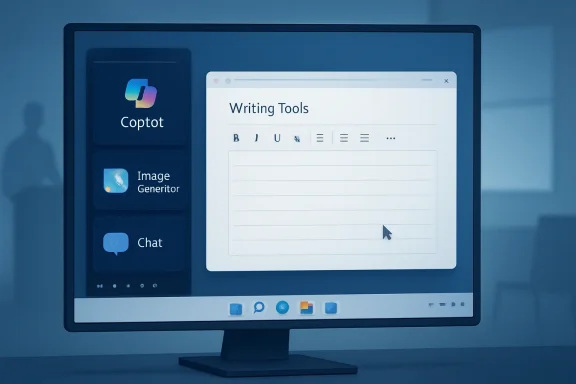
That distinction now appears to be shaping a course correction. Windows Latest reports that Microsoft has removed the “Ask Copilot” button from Snipping Tool and Photos in recent builds, while Notepad’s visible Copilot branding has been replaced by the more modest “Writing Tools.” That is not merely a UI tweak. It is a semantic retreat.
“Writing Tools” says what the feature does. “Copilot” says what Microsoft wants the user to believe. The former belongs in an app; the latter belongs in a keynote.
This is the heart of the shift. Microsoft is not abandoning AI in Windows. It is backing away from the notion that every AI affordance must serve the Copilot master brand. That is a more consequential change than it first appears, because the Copilot brand had become a proxy for everything users disliked about modern Windows: interruptions, promotions, cloud dependence, half-finished ideas, and the creeping sense that the PC was being repurposed around Microsoft’s priorities rather than the owner’s.
According to Windows Latest, Xbox leadership announced that Microsoft would wind down Copilot on mobile and stop development of Copilot on console as part of a broader gaming reset. The more revealing moment came when Jacob Andreou, Microsoft’s recently appointed executive vice president of Copilot, reportedly responded that it was “critical” to remove Copilot from places where it did not live up to its promise. The post was later deleted.
Deleted posts are dangerous evidence. They can be overread, miscontextualized, or turned into corporate tea leaves by people who already know what they want to find. But in this case, the reported message fits too neatly with Microsoft’s public posture to dismiss as noise.
The company has already said it wants to be more intentional about where Copilot appears in Windows. It has already named apps where it would reduce unnecessary Copilot entry points. It is already changing product surfaces in ways that make AI less branded and more contextual. The deleted-post drama matters because it gives the strategy a sharper edge: not just “make Copilot better,” but remove it when it does not earn its place.
That is the standard Microsoft should have applied from the beginning. A console player does not need an AI assistant intruding on the experience unless it solves a real console problem. A screenshot tool does not need a branded chatbot button unless that button is faster and clearer than the workflow it replaces. A desktop operating system does not need another icon begging for attention unless the result is worth the interruption.
At the time, it sounded like a concession to complaints. Now it looks like a strategy: keep AI, but stop making Windows feel like it has been colonized by one brand.
That distinction matters because Microsoft has a long history of trying to turn strategic priorities into surface-level mandates. Internet Explorer, MSN, OneDrive, Teams, Edge, Widgets, and now Copilot have all, at various moments, been treated less as optional utilities than as evidence of where the company wanted users to go. Windows has survived this behavior because it is entrenched. But survival is not the same as trust.
Windows users are unusually good at detecting when a feature exists for them and when it exists for Microsoft. They may tolerate preinstalled apps. They may tolerate defaults. They may tolerate telemetry and cloud prompts and subscription nudges longer than they should. But they eventually notice when the product’s center of gravity shifts away from their work.
The March pledge was therefore not just about bug fixes. It was an attempt to reopen the question of who Windows is for. If Microsoft wants Windows 11 to be seen as a reliable computing platform rather than an AI funnel, reducing Copilot’s most gratuitous appearances is the minimum viable repair.
That is backwards. The best consumer AI features tend to feel boring once they work. They remove friction, reduce steps, and vanish. Nobody needs a personality layer to crop an image, rewrite a sentence, find a setting, or explain a dialog box. They need speed, accuracy, privacy assurances, and a clear exit.
Microsoft’s branding strategy often delivered the opposite. It made Copilot feel like another Microsoft surface competing for user attention. The assistant was presented as a companion, a destination, and an identity layer, when many Windows users simply wanted local, task-specific tools that respected context.
The Notepad change is instructive. A generative writing feature in Notepad is not inherently offensive. A bright Copilot logo in Notepad is. One says, “Here is help if you need it.” The other says, “Microsoft’s AI initiative has arrived inside your text editor.”
That difference may sound cosmetic, but software trust is built out of cosmetics. Icons, names, defaults, animations, pop-ups, and prompts are how users infer intent. Copilot’s consumer rollout repeatedly communicated that Microsoft wanted presence before permission.
That timing was disastrous. Users do not evaluate features in isolation. They build narratives from coincidence. If the operating system is glitchy at the same time the company is loudly celebrating AI-generated code and Copilot integration, many users will draw the simplest possible conclusion: Microsoft is chasing AI while Windows rots.
That conclusion may be technically unfair in individual cases. Windows bugs have many causes, and AI-assisted development is not synonymous with low-quality software. But brand perception does not wait for a root-cause analysis.
Copilot became a symbol of misplaced priorities. Every unwanted icon, every cloud prompt, every half-finished AI feature seemed to confirm that Microsoft’s engineering attention had drifted away from fundamentals. The more Microsoft pushed Copilot as the future of Windows, the more users treated ordinary Windows failures as evidence against Copilot.
This is why removing gratuitous Copilot entry points matters. It does not fix the operating system by itself. But it acknowledges that the operating system cannot be repaired while the most controversial brand in the product keeps appearing in places where users did not ask for it.
This is the split that explains everything. Copilot makes far more sense in Microsoft 365 than it does as a console-side companion or a branded button in Snipping Tool. Corporate workers live inside email, meetings, documents, spreadsheets, chats, and slide decks. Their pain points are textual, repetitive, and deeply tied to Microsoft’s strongest software franchises.
Summarize a meeting. Draft a client response. Extract action items. Build a PowerPoint from a document. Analyze a spreadsheet. These are not abstract AI demos; they are expensive white-collar annoyances with a buyer willing to pay for relief. If Copilot saves even modest time for enough employees, the enterprise math becomes attractive.
Consumer Windows is different. The value proposition is more fragmented, the tolerance for subscription upsells is lower, and the privacy optics are more sensitive. A home user sitting at a desktop does not automatically want a cloud AI assistant hovering near screenshots, photos, games, and system settings. The same brand that looks like productivity leverage to a CIO can look like invasive clutter to a gamer.
Microsoft appears to be accepting that divergence. Copilot can be a high-margin enterprise layer while consumer Windows gets quieter, cleaner, and more utility-driven. That is not a contradiction. It is product-market fit finally catching up with marketing.
The Neo changes that conversation. Even with compromises, a current, low-cost Mac with Apple silicon gives mainstream buyers a new escape hatch. For students, families, and Windows 10 holdouts, the old trade-off becomes less obvious. Why buy a cheap Windows laptop associated with ads, update headaches, and AI nags if a low-cost Mac promises a cleaner baseline experience?
Microsoft cannot control Apple’s hardware strategy. It can control whether Windows feels like a liability on the shelf. That is where Copilot bloat and quality complaints intersect with market pressure. Windows does not need to be perfect to compete, but it cannot afford to look chaotic while Apple is compressing the price gap.
The danger is not that every Windows user will flee to macOS. They will not. Windows remains dominant in gaming, enterprise compatibility, custom hardware, and countless specialized workflows. The danger is that the emotional default changes for ordinary buyers. If Windows becomes the messy option and Apple becomes the affordable clean option, Microsoft has a consumer perception problem that no AI keynote can solve.
The Copilot pullback should be read partly through that lens. Microsoft is not suddenly sentimental about minimalist software. It is responding to the market signal that the desktop experience itself has become a competitive feature again.
Recall’s troubled rollout in 2024 set the tone. Even after Microsoft reworked security and privacy controls, the initial reaction reinforced a broader fear: that AI PCs were being designed to observe first and justify later. For enthusiasts and IT pros, that was not a small messaging problem. It was an architectural concern.
Copilot+ PCs still have a role. Local AI acceleration is real. NPUs will matter more as models become more efficient and as developers find practical uses for low-latency, on-device inference. Accessibility, translation, noise suppression, image processing, search, and workflow automation can all benefit from dedicated AI hardware.
But the brand has to stop sounding like a demand. A user should not feel that buying a modern Windows laptop means buying into Microsoft’s preferred assistant. The hardware should be sold on performance, battery life, responsiveness, privacy-preserving local features, and long-term capability. Copilot can be one service among many, not the personality of the machine.
If Microsoft is wise, it will let the Copilot+ PC label age into a platform capability rather than a consumer ideology. The best version of this future is not a PC that constantly says “Copilot.” It is a PC that quietly performs more tasks locally, more quickly, and with fewer round trips to the cloud.
This is where Microsoft has the most to gain. Windows does not need a revolutionary reinvention every year. It needs fewer paper cuts. It needs faster common paths. It needs settings that stay put, defaults that respect user intent, and inbox apps that feel like finished software instead of promotional vehicles.
There is a lesson here from Microsoft’s own history. The most beloved Windows releases are rarely the most conceptually ambitious. They are the ones that made the previous ambition usable. Windows 7 refined Vista’s architectural changes. Windows 10 softened Windows 8’s tablet-first overreach. A better Windows 11 would not be remembered for a single dramatic feature; it would be remembered for restoring confidence.
That is why the Copilot retreat is not a sideshow. It is part of the quality story. Every unnecessary AI button removed from a core app is one fewer reminder that Microsoft’s agenda might outrank the user’s task. Every renamed feature that describes its function instead of advertising its brand is a small restoration of dignity.
Boring work is not a downgrade. For Windows, boring work is the premium experience.
The future Microsoft wants is not necessarily a chatbot in every corner of Windows. It is an agentic layer across business workflows. In that world, AI does not wait for a user to click a colorful icon. It prepares documents, monitors processes, drafts responses, updates records, coordinates tasks, and acts across applications with permission and auditability.
That future is much easier to monetize in enterprise than in consumer Windows. Companies already pay per seat. They already live inside Microsoft identity, compliance, and administration frameworks. They can measure time saved, or at least persuade themselves that they can. They also have IT departments to manage the risks.
Home users have a different relationship with their PCs. They do not want an administrative thesis. They want the machine to turn on, stay fast, run their apps, play their games, protect their files, and avoid embarrassing interruptions. AI can help with those goals, but only if it becomes subordinate to them.
This is the divide Microsoft must respect. Enterprise Copilot can be ambitious, branded, and deeply integrated because the workplace is already a managed software environment. Consumer Windows should be restrained, local where possible, and ruthlessly task-specific. One size never fit both markets; Copilot merely made the mismatch impossible to ignore.
That sounds simple. It is not. It requires Microsoft to resist the internal pressure to turn every successful technology into a universal brand surface. It requires product teams to measure annoyance as seriously as engagement. It requires executives to accept that the most successful AI features may be the ones users barely identify as AI at all.
Near-term, the Copilot pullback gives Microsoft a chance to reset expectations. The company can present AI as an ingredient rather than an overlord. It can let Notepad have writing tools, Photos have editing tools, and Windows Search have smarter retrieval without forcing every path through the same branded assistant. That would make Windows feel less desperate.
Longer-term, Microsoft has to decide whether Copilot is a consumer companion, an enterprise productivity layer, a developer platform, a hardware certification story, or all of those at once. The answer may be “all,” but the presentation cannot be. Brands stretch until they snap, and Copilot has already been asked to cover too much.
Source: Windows Latest Windows 11 pulls back AI as Microsoft plans to remove Copilot where it doesn't meet its promise
 Microsoft’s AI Billboard Has Become a Liability
For the past two years, Windows has often felt less like a mature desktop operating system than a launch surface for Microsoft’s AI ambitions. Copilot was placed in the taskbar, threaded through Edge, attached to inbox apps, and promoted as the connective tissue of a new computing era. The problem was not that Microsoft believed AI would matter. The problem was that Microsoft confused ubiquity with usefulness.That distinction now appears to be shaping a course correction. Windows Latest reports that Microsoft has removed the “Ask Copilot” button from Snipping Tool and Photos in recent builds, while Notepad’s visible Copilot branding has been replaced by the more modest “Writing Tools.” That is not merely a UI tweak. It is a semantic retreat.
“Writing Tools” says what the feature does. “Copilot” says what Microsoft wants the user to believe. The former belongs in an app; the latter belongs in a keynote.
This is the heart of the shift. Microsoft is not abandoning AI in Windows. It is backing away from the notion that every AI affordance must serve the Copilot master brand. That is a more consequential change than it first appears, because the Copilot brand had become a proxy for everything users disliked about modern Windows: interruptions, promotions, cloud dependence, half-finished ideas, and the creeping sense that the PC was being repurposed around Microsoft’s priorities rather than the owner’s.
A Deleted Post Said the Quiet Part Out Loud
The spark for this week’s argument was not a carefully staged Microsoft announcement. It was, reportedly, a deleted X post.According to Windows Latest, Xbox leadership announced that Microsoft would wind down Copilot on mobile and stop development of Copilot on console as part of a broader gaming reset. The more revealing moment came when Jacob Andreou, Microsoft’s recently appointed executive vice president of Copilot, reportedly responded that it was “critical” to remove Copilot from places where it did not live up to its promise. The post was later deleted.
Deleted posts are dangerous evidence. They can be overread, miscontextualized, or turned into corporate tea leaves by people who already know what they want to find. But in this case, the reported message fits too neatly with Microsoft’s public posture to dismiss as noise.
The company has already said it wants to be more intentional about where Copilot appears in Windows. It has already named apps where it would reduce unnecessary Copilot entry points. It is already changing product surfaces in ways that make AI less branded and more contextual. The deleted-post drama matters because it gives the strategy a sharper edge: not just “make Copilot better,” but remove it when it does not earn its place.
That is the standard Microsoft should have applied from the beginning. A console player does not need an AI assistant intruding on the experience unless it solves a real console problem. A screenshot tool does not need a branded chatbot button unless that button is faster and clearer than the workflow it replaces. A desktop operating system does not need another icon begging for attention unless the result is worth the interruption.
The March Quality Pledge Was Really a Copilot Containment Plan
Microsoft’s March 20, 2026 Windows quality message now looks more important in hindsight. Pavan Davuluri, the Windows and Devices chief, used that post to reassure users that Microsoft understood the frustration around Windows 11 reliability, performance, and clutter. One of the most striking commitments was to reduce unnecessary Copilot entry points in apps such as Snipping Tool, Photos, Widgets, and Notepad.At the time, it sounded like a concession to complaints. Now it looks like a strategy: keep AI, but stop making Windows feel like it has been colonized by one brand.
That distinction matters because Microsoft has a long history of trying to turn strategic priorities into surface-level mandates. Internet Explorer, MSN, OneDrive, Teams, Edge, Widgets, and now Copilot have all, at various moments, been treated less as optional utilities than as evidence of where the company wanted users to go. Windows has survived this behavior because it is entrenched. But survival is not the same as trust.
Windows users are unusually good at detecting when a feature exists for them and when it exists for Microsoft. They may tolerate preinstalled apps. They may tolerate defaults. They may tolerate telemetry and cloud prompts and subscription nudges longer than they should. But they eventually notice when the product’s center of gravity shifts away from their work.
The March pledge was therefore not just about bug fixes. It was an attempt to reopen the question of who Windows is for. If Microsoft wants Windows 11 to be seen as a reliable computing platform rather than an AI funnel, reducing Copilot’s most gratuitous appearances is the minimum viable repair.
Copilot Failed Consumers by Asking for Attention Before Earning Trust
The consumer Copilot problem was never that AI assistance is useless. Plenty of everyday users can benefit from summarization, rewriting, image help, command guidance, and settings discovery. The problem was that Microsoft introduced Copilot into Windows as if the brand itself were the feature.That is backwards. The best consumer AI features tend to feel boring once they work. They remove friction, reduce steps, and vanish. Nobody needs a personality layer to crop an image, rewrite a sentence, find a setting, or explain a dialog box. They need speed, accuracy, privacy assurances, and a clear exit.
Microsoft’s branding strategy often delivered the opposite. It made Copilot feel like another Microsoft surface competing for user attention. The assistant was presented as a companion, a destination, and an identity layer, when many Windows users simply wanted local, task-specific tools that respected context.
The Notepad change is instructive. A generative writing feature in Notepad is not inherently offensive. A bright Copilot logo in Notepad is. One says, “Here is help if you need it.” The other says, “Microsoft’s AI initiative has arrived inside your text editor.”
That difference may sound cosmetic, but software trust is built out of cosmetics. Icons, names, defaults, animations, pop-ups, and prompts are how users infer intent. Copilot’s consumer rollout repeatedly communicated that Microsoft wanted presence before permission.
Windows 11’s Bug Year Turned Copilot Into the Scapegoat
Copilot’s reputation might have survived a heavy-handed rollout if Windows 11 had been otherwise quiet, fast, and dependable. It was not. Through 2025, Windows 11’s public image was battered by complaints about broken updates, performance regressions, File Explorer sluggishness, dark mode inconsistencies, hardware compatibility anxieties, and the general sense that core desktop polish had fallen behind the AI agenda.That timing was disastrous. Users do not evaluate features in isolation. They build narratives from coincidence. If the operating system is glitchy at the same time the company is loudly celebrating AI-generated code and Copilot integration, many users will draw the simplest possible conclusion: Microsoft is chasing AI while Windows rots.
That conclusion may be technically unfair in individual cases. Windows bugs have many causes, and AI-assisted development is not synonymous with low-quality software. But brand perception does not wait for a root-cause analysis.
Copilot became a symbol of misplaced priorities. Every unwanted icon, every cloud prompt, every half-finished AI feature seemed to confirm that Microsoft’s engineering attention had drifted away from fundamentals. The more Microsoft pushed Copilot as the future of Windows, the more users treated ordinary Windows failures as evidence against Copilot.
This is why removing gratuitous Copilot entry points matters. It does not fix the operating system by itself. But it acknowledges that the operating system cannot be repaired while the most controversial brand in the product keeps appearing in places where users did not ask for it.
Enterprise Copilot Is the Product Consumer Copilot Pretended to Be
The irony is that Copilot is not failing everywhere. In the enterprise, Microsoft 365 Copilot has become a serious business. Microsoft has said it has more than 20 million paid enterprise Copilot seats, and the company has described usage momentum in terms that make clear why it will not slow down its AI investment.This is the split that explains everything. Copilot makes far more sense in Microsoft 365 than it does as a console-side companion or a branded button in Snipping Tool. Corporate workers live inside email, meetings, documents, spreadsheets, chats, and slide decks. Their pain points are textual, repetitive, and deeply tied to Microsoft’s strongest software franchises.
Summarize a meeting. Draft a client response. Extract action items. Build a PowerPoint from a document. Analyze a spreadsheet. These are not abstract AI demos; they are expensive white-collar annoyances with a buyer willing to pay for relief. If Copilot saves even modest time for enough employees, the enterprise math becomes attractive.
Consumer Windows is different. The value proposition is more fragmented, the tolerance for subscription upsells is lower, and the privacy optics are more sensitive. A home user sitting at a desktop does not automatically want a cloud AI assistant hovering near screenshots, photos, games, and system settings. The same brand that looks like productivity leverage to a CIO can look like invasive clutter to a gamer.
Microsoft appears to be accepting that divergence. Copilot can be a high-margin enterprise layer while consumer Windows gets quieter, cleaner, and more utility-driven. That is not a contradiction. It is product-market fit finally catching up with marketing.
Apple Gave Windows a Price Problem and a Trust Problem
The MacBook Neo has made this reckoning harder to avoid. Apple’s $599 A18 Pro laptop is not merely another entry-level Mac; it is a shot into the part of the PC market where Windows OEMs have historically relied on price, availability, and inertia. Apple has long beaten most Windows laptops on battery life, integration, and perceived polish. What it lacked was a truly aggressive opening price.The Neo changes that conversation. Even with compromises, a current, low-cost Mac with Apple silicon gives mainstream buyers a new escape hatch. For students, families, and Windows 10 holdouts, the old trade-off becomes less obvious. Why buy a cheap Windows laptop associated with ads, update headaches, and AI nags if a low-cost Mac promises a cleaner baseline experience?
Microsoft cannot control Apple’s hardware strategy. It can control whether Windows feels like a liability on the shelf. That is where Copilot bloat and quality complaints intersect with market pressure. Windows does not need to be perfect to compete, but it cannot afford to look chaotic while Apple is compressing the price gap.
The danger is not that every Windows user will flee to macOS. They will not. Windows remains dominant in gaming, enterprise compatibility, custom hardware, and countless specialized workflows. The danger is that the emotional default changes for ordinary buyers. If Windows becomes the messy option and Apple becomes the affordable clean option, Microsoft has a consumer perception problem that no AI keynote can solve.
The Copilot pullback should be read partly through that lens. Microsoft is not suddenly sentimental about minimalist software. It is responding to the market signal that the desktop experience itself has become a competitive feature again.
The Copilot+ PC Brand Now Carries More Burden Than Glory
Microsoft’s Copilot+ PC push was supposed to give Windows hardware a new identity. Neural processing units, on-device AI, Recall, image generation, live captions, and other features were meant to define a new class of PC. Instead, the branding arrived before the trust did.Recall’s troubled rollout in 2024 set the tone. Even after Microsoft reworked security and privacy controls, the initial reaction reinforced a broader fear: that AI PCs were being designed to observe first and justify later. For enthusiasts and IT pros, that was not a small messaging problem. It was an architectural concern.
Copilot+ PCs still have a role. Local AI acceleration is real. NPUs will matter more as models become more efficient and as developers find practical uses for low-latency, on-device inference. Accessibility, translation, noise suppression, image processing, search, and workflow automation can all benefit from dedicated AI hardware.
But the brand has to stop sounding like a demand. A user should not feel that buying a modern Windows laptop means buying into Microsoft’s preferred assistant. The hardware should be sold on performance, battery life, responsiveness, privacy-preserving local features, and long-term capability. Copilot can be one service among many, not the personality of the machine.
If Microsoft is wise, it will let the Copilot+ PC label age into a platform capability rather than a consumer ideology. The best version of this future is not a PC that constantly says “Copilot.” It is a PC that quietly performs more tasks locally, more quickly, and with fewer round trips to the cloud.
The Windows Team Is Rediscovering the Virtue of Boring Work
The encouraging part of Microsoft’s current posture is that some of the Windows team’s recent work sounds almost unfashionably practical. File Explorer performance, update reliability, taskbar behavior, dark mode consistency, battery life, app responsiveness, and Settings coherence are not glamorous keynote material. They are the things that make an operating system feel owned rather than endured.This is where Microsoft has the most to gain. Windows does not need a revolutionary reinvention every year. It needs fewer paper cuts. It needs faster common paths. It needs settings that stay put, defaults that respect user intent, and inbox apps that feel like finished software instead of promotional vehicles.
There is a lesson here from Microsoft’s own history. The most beloved Windows releases are rarely the most conceptually ambitious. They are the ones that made the previous ambition usable. Windows 7 refined Vista’s architectural changes. Windows 10 softened Windows 8’s tablet-first overreach. A better Windows 11 would not be remembered for a single dramatic feature; it would be remembered for restoring confidence.
That is why the Copilot retreat is not a sideshow. It is part of the quality story. Every unnecessary AI button removed from a core app is one fewer reminder that Microsoft’s agenda might outrank the user’s task. Every renamed feature that describes its function instead of advertising its brand is a small restoration of dignity.
Boring work is not a downgrade. For Windows, boring work is the premium experience.
Microsoft’s Real AI Future Is Agentic, Expensive, and Mostly Not About Your Start Menu
While consumer Copilot gets quieter, Microsoft’s broader AI operation is accelerating. The company is investing in models, agents, Microsoft 365 integration, third-party model support, developer tooling, and Azure infrastructure. None of that suggests retreat. It suggests triage.The future Microsoft wants is not necessarily a chatbot in every corner of Windows. It is an agentic layer across business workflows. In that world, AI does not wait for a user to click a colorful icon. It prepares documents, monitors processes, drafts responses, updates records, coordinates tasks, and acts across applications with permission and auditability.
That future is much easier to monetize in enterprise than in consumer Windows. Companies already pay per seat. They already live inside Microsoft identity, compliance, and administration frameworks. They can measure time saved, or at least persuade themselves that they can. They also have IT departments to manage the risks.
Home users have a different relationship with their PCs. They do not want an administrative thesis. They want the machine to turn on, stay fast, run their apps, play their games, protect their files, and avoid embarrassing interruptions. AI can help with those goals, but only if it becomes subordinate to them.
This is the divide Microsoft must respect. Enterprise Copilot can be ambitious, branded, and deeply integrated because the workplace is already a managed software environment. Consumer Windows should be restrained, local where possible, and ruthlessly task-specific. One size never fit both markets; Copilot merely made the mismatch impossible to ignore.
The Copilot Retrenchment Leaves Microsoft With a Simpler Windows Bargain
The lesson from this week is not that users hate AI. It is that users hate being conscripted into someone else’s platform strategy. Microsoft can still build AI into Windows, but it has to pass a tougher test: does the feature make the current task easier without making the computer feel less like the user’s?That sounds simple. It is not. It requires Microsoft to resist the internal pressure to turn every successful technology into a universal brand surface. It requires product teams to measure annoyance as seriously as engagement. It requires executives to accept that the most successful AI features may be the ones users barely identify as AI at all.
Near-term, the Copilot pullback gives Microsoft a chance to reset expectations. The company can present AI as an ingredient rather than an overlord. It can let Notepad have writing tools, Photos have editing tools, and Windows Search have smarter retrieval without forcing every path through the same branded assistant. That would make Windows feel less desperate.
Longer-term, Microsoft has to decide whether Copilot is a consumer companion, an enterprise productivity layer, a developer platform, a hardware certification story, or all of those at once. The answer may be “all,” but the presentation cannot be. Brands stretch until they snap, and Copilot has already been asked to cover too much.
The Windows User’s New Deal With AI Is Smaller, Quieter, and More Honest
The most concrete message in Microsoft’s apparent course correction is that Copilot must now earn its placement. That is a healthier bargain for users and, in the long run, for Microsoft.- Microsoft is not abandoning AI in Windows, but it is reducing obvious Copilot branding where the feature feels intrusive or poorly matched to the app.
- The reported Xbox pullback shows that Copilot is no longer guaranteed a home simply because Microsoft wants the brand everywhere.
- Enterprise Copilot remains strategically central because Microsoft 365 offers clearer workflows, paying customers, and measurable productivity claims.
- Windows 11 quality work and Copilot containment are linked because users read unwanted AI surfaces as evidence of misplaced priorities.
- Apple’s low-cost MacBook Neo raises the cost of Windows sloppiness by giving mainstream buyers a cleaner and cheaper path into macOS.
- The best consumer AI in Windows will likely look less like a chatbot and more like ordinary tools that quietly reduce friction.
Source: Windows Latest Windows 11 pulls back AI as Microsoft plans to remove Copilot where it doesn't meet its promise
