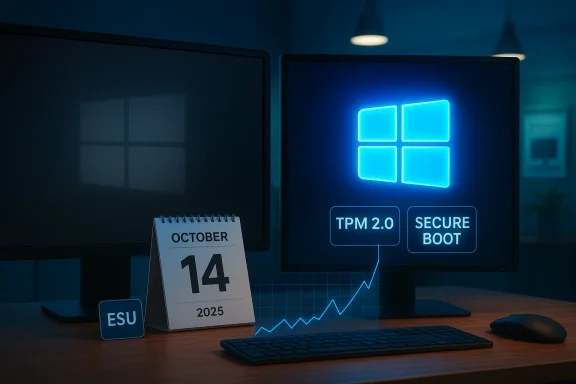
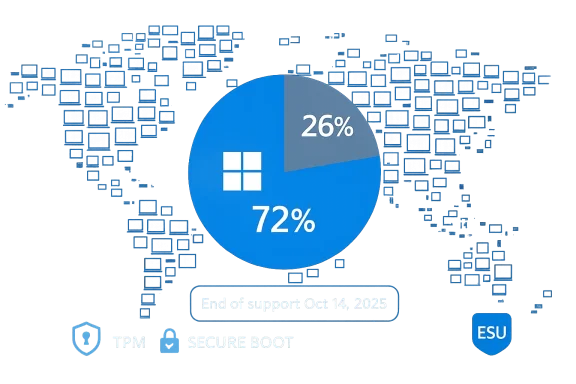
Microsoft’s Windows 11 has reached a turning point: according to public telemetry, it now runs on nearly three out of every four Windows PCs worldwide — a seismic shift that reshapes the desktop landscape for users, IT teams, developers, and the PC hardware market. StatCounter’s February 2026 snapshot shows Windows 11 at roughly 72.7% of desktop Windows pageviews, a dramatic jump from the platform’s low‑to‑mid‑50s just months earlier and a clear signal that the long tail of Windows 10 users is rapidly shrinking.
This metric marks more than a headline — it represents a real inflection in the migration cycle that began with Windows 11’s 2021 launch and accelerated when Microsoft stopped mainstream support for Windows 10 on October 14, 2025. The end‑of‑support deadline, a wave of OEM preloads, and strong PC shipment activity combined to push many organisations and consumers across the upgrade line in late 2025 and early 2026. Microsoft itself has highlighted rapid adoption — Windows 11 passed the one‑billion‑user milestone earlier this year — and public market data now shows how visible that transition has become.
Windows 11 debuted in October 2021 with a new visual direction, stricter hardware security baselines, and an explicit focus on integrating AI and cloud services into the OS experience. The platform’s hardware requirements — notably TPM 2.0 and Secure Boot — created an eligibility floor that left a meaningful portion of older devices unable to upgrade without hardware changes or replacement. That constraint, combined with years of conservative enterprise upgrade cycles, produced a long, uneven migration from Windows 10 to Windows 11.
The migration’s calendar inflection came in 2025. Microsoft’s formal end‑of‑support date for Windows 10 (October 14, 2025) created a hard deadline for security patches and mainstream fixes, prompting organisations to accelerate migrations, buy Extended Security Updates (ESUs) for covered machines, or procure Windows 11‑ready hardware. StatCounter and other public trackers began to show large month‑over‑month swings in Windows version pageview share around that time, culminating in the February 2026 figures widely reported across the tech press.
But data nuance matters. StatCounter’s near‑73% figure is a meaningful directional signal rather than an absolute census, and sensible IT and development strategy requires triangulating public trackers with internal telemetry, vendor reports, and shipment data. For users and organisations, the practical upshot is unchanged: Windows 11 is the primary platform for future features, security investments, and developer targeting. The debate now shifts from if to how to migrate safely and responsibly — and how to balance the security, usability, and sustainability trade‑offs that follow when almost three in four PCs worldwide prefer a single, modern Windows experience.
Source: thewincentral.com Windows 11 Now Runs on Nearly 3 in 4 PCs Worldwide
This metric marks more than a headline — it represents a real inflection in the migration cycle that began with Windows 11’s 2021 launch and accelerated when Microsoft stopped mainstream support for Windows 10 on October 14, 2025. The end‑of‑support deadline, a wave of OEM preloads, and strong PC shipment activity combined to push many organisations and consumers across the upgrade line in late 2025 and early 2026. Microsoft itself has highlighted rapid adoption — Windows 11 passed the one‑billion‑user milestone earlier this year — and public market data now shows how visible that transition has become.
 Background / Overview
Windows 11 debuted in October 2021 with a new visual direction, stricter hardware security baselines, and an explicit focus on integrating AI and cloud services into the OS experience. The platform’s hardware requirements — notably TPM 2.0 and Secure Boot — created an eligibility floor that left a meaningful portion of older devices unable to upgrade without hardware changes or replacement. That constraint, combined with years of conservative enterprise upgrade cycles, produced a long, uneven migration from Windows 10 to Windows 11.The migration’s calendar inflection came in 2025. Microsoft’s formal end‑of‑support date for Windows 10 (October 14, 2025) created a hard deadline for security patches and mainstream fixes, prompting organisations to accelerate migrations, buy Extended Security Updates (ESUs) for covered machines, or procure Windows 11‑ready hardware. StatCounter and other public trackers began to show large month‑over‑month swings in Windows version pageview share around that time, culminating in the February 2026 figures widely reported across the tech press.
What the numbers actually say
The headline figure: nearly 73% for Windows 11
StatCounter’s “Desktop Windows Version Market Share” for February 2026 lists Windows 11 at approximately 72.78%, with Windows 10 accounting for roughly 26–26.5% of desktop Windows pageviews in the same month. Several major outlets picked up the same StatCounter dump and ran similar headlines; the consensus in public reporting is that Windows 11 now represents the majority of active Windows web traffic worldwide.The path to that figure: rapid month‑to‑month gains
What makes the February number striking is the speed of the change. StatCounter shows that Windows 11’s share climbed sharply in the first months of 2026 — a double‑digit percentage‑point increase across January–February in some public reports. That pace is unusual for an OS migration at global scale and reflects a concentrated confluence of drivers (detailed below) rather than steady, linear adoption.Important measurement context
It’s essential to stress that StatCounter’s figures measure pageviews across its panel of tracked websites, not a device census. That means the values reflect active web traffic by OS rather than an absolute installed base of running devices. Pageview weighting makes these numbers useful for detecting usage trends, but also sensitive to changes in browsing patterns, inclusion of new high‑traffic sites in the panel, bot activity, or regional traffic shifts. Multiple outlets and community analysts have flagged this methodological boundary: the StatCounter series is directional and powerful for trend spotting, but it is not a substitute for telemetry‑level counts from vendors or for shipment‑based installed‑base audits.Why adoption accelerated — the key drivers
The February surge wasn’t spontaneous. Four interacting forces composed the momentum that pushed Windows 11 into a dominant position:1) End of Windows 10 support: a policy hammer
Microsoft’s October 14, 2025 end‑of‑support (EoS) for Windows 10 removed the free safety blanket of security and quality updates for mainstream Windows 10 devices. That calendar event is the single most consequential policy trigger for enterprise and consumer behaviour: organisations that must meet compliance and security baselines either migrate, pay for Extended Security Updates (ESUs) where eligible, or accept increased exposure. Microsoft’s lifecycle messaging explicitly recommended upgrading to Windows 11 or enrolling devices in ESU programs, and the market responded.2) OEM preload dynamics: new PCs ship with Windows 11
New PC shipments over the last 18–24 months have overwhelmingly been preloaded with Windows 11. OEMs use the latest supported OS as the default preload to simplify supply chains and present the newest features to buyers; that means each wave of replacement purchases directly increases the Windows 11 installed base. High holiday‑quarter shipments and commercial refresh programs — many timed around the EoS deadline — added millions of preloaded Windows 11 devices to the market. IDC’s trackers recorded a robust PC shipment cycle in 2025 that helped convert upgrade intent into shipped hardware.3) Enterprise migration programs and Microsoft incentives
Large organisations, education programs, and public sector buyers typically run longer, planned refresh projects. The Windows 10 EoS deadline compressed their timelines and pushed some projects forward. Microsoft’s enterprise guidance and integrations with Microsoft 365, Intune, and other management tooling lowered the friction for staged migration. In many cases, IT teams combined hardware refreshes with Windows 11 deployments, which accelerated adoption more than lift‑and‑shift in‑place upgrades would have.4) Product positioning around security and AI features
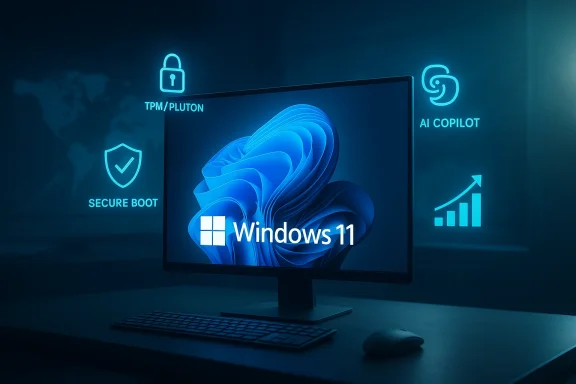
Microsoft has tied several flagship features — stronger hardware‑rooted security (TPM/Pluton), virtualization‑based protections, and an expanding set of AI capabilities built around Copilot and Copilot+ PCs — more tightly to Windows 11. For security‑conscious buyers and those prioritising on‑device AI, Windows 11 was framed as the long‑term supported platform. That repositioning made buying modern hardware a more compelling case during the late‑2025 refresh cycle.How reliable is this “72%” figure? A closer look at measurement and caveats
Public trackers like StatCounter are indispensable for seeing trends in near real‑time, but the nature of the data requires careful interpretation.- StatCounter’s market series are pageview‑weighted, which privileges browsing behaviour rather than unique device counts. A small set of heavily browsing users (or a single high‑traffic site joining the panel) can shift the percentages. That makes short‑term month‑to‑month swings more volatile than shipment or telemetry‑based series.
- Other telemetry sources — such as vendor‑reported active device counts or OEM shipment tallies — often show the same directional shift but with different timing and magnitude. Microsoft’s statement that Windows 11 surpassed one billion users is a telemetry figure from the company and is consistent with the broader narrative of rapid late‑2025–early‑2026 growth, even if public trackers disagree on exact percentage points.
- Analysts and community researchers have repeatedly shown that the same dataset can produce different headlines depending on the segment inspected (desktop vs. all devices vs. regional slices), the window chosen, or how anomalous traffic is treated. In short: the trend toward widespread Windows 11 adoption is real; the precise decimal point for global market share on any single day is less so.
What this shift means for users, IT teams, and developers
For users (home and small business)
- Security and compatibility: Upgrading to Windows 11 gives access to the latest security features (hardware‑backed cryptography, Pluton/TPM protections, virtualization‑based security) and future Windows features. Microsoft’s guidance and OS baselines make Windows 11 the recommended choice for continued support.
- Upgrade eligibility: Not every Windows 10 machine is eligible to upgrade without hardware changes. Users should check device compatibility, backup data before attempting upgrades, and consider device replacement where necessary.
- Extended Security Updates (ESU): Where upgrade is impossible in the near term, ESU offerings or vendor‑managed update programs can provide a temporary bridge — but these are paid, time‑limited, or administratively complex options. Tech press and community reporting have explained ESU costs and constraints; organisations should treat ESUs as a deliberate, short‑term mitigation rather than a long‑term strategy.
For IT teams and sysadmins
- Acceleration of migration planning: If your telemetry still shows a significant Windows 10 footprint, treat the StatCounter headlines as confirmation that the broader market has moved and plan to make Windows 11 the baseline for new deployments, security testing, and user training.
- Security posture adjustment: Windows 11 enables stronger hardware‑based security patterns (Pluton/TPM, Secure Boot, HVCI/VBS), and many organisations should reorganise compliance baselines and imaging workflows to require or at least prioritise those protections. Microsoft’s platform documentation and security blogs are the authoritative place to map those technical controls.
- Testing and compatibility gating: Legacy line‑of‑business apps still running on Windows 10 require careful testing; don’t assume binary compatibility guarantees for all behaviours. Plan pilot waves, use virtualization for isolating problematic workloads, and document rollback paths.
For developers and ISVs
- Primary target shift: With Windows 11 the dominant active platform for many user segments, developers can increasingly assume Windows 11 APIs, modern UX paradigms, and security defaults when designing new applications. That reduces the amount of legacy OS testing required, but it raises expectations around supporting hardware security primitives and modern authentication workflows (e.g., passkeys, Windows Hello).
- Opportunities around AI: Microsoft’s Copilot integrations and Copilot+ PC hardware focus open new opportunities for developers to build AI‑enhanced experiences that run locally or hybrid‑cloud on modern devices. Early adopters who tune experiences for the NPU and Pluton‑enabled security posture will find differentiation in enterprise and consumer markets.
Strengths and strategic benefits of the Windows 11‑first world
- Security baseline standardisation: Modern hardware security requirements raise the floor for what counts as a secure endpoint. When the majority of devices require TPM/Pluton and Secure Boot, organisations can implement stronger defaults without large exceptions.
- Faster feature cadence for modern apps: Developers and platform teams can iterate against a smaller set of OS versions, enabling faster adoption of new APIs, Windowing/UX improvements, and AI features.
- Hardware refresh economics: OEMs benefit from preloaded Windows 11 devices moving through the channel; for enterprises, refresh cycles now deliver both improved performance and stronger built‑in protections.
- A clearer support horizon: Microsoft’s lifecycle rules and ESU options make timelines predictable. That helps CIOs and procurement teams schedule refreshes with fiscal certainty.
Risks, weaknesses and unanswered questions
- Measurement noise and headline risk: As noted earlier, StatCounter and similar trackers are powerful trend signals but can produce large short‑term swings. Relying on a single public tracker for precise installed‑base counts risks over‑reacting to sampling variance, regional anomalies, or filtering changes. Decision‑makers should triangulate with internal telemetry, vendor reports, and shipment data.
- Hardware eligibility and digital divide: The Windows 11 baseline excludes older hardware. Organisations with constrained budgets or long refresh cycles — and individual users with older machines — face either replacement costs or the security risks of running an unsupported OS. That raises equity issues and sustainability costs (e‑waste).
- ESU cost and complexity: Extended Security Updates are useful short‑term mitigations but are not free for many enterprise scenarios. They introduce ongoing management overhead and potential financial pressure on organisations delaying migration.
- User trust and UX friction: Windows 11’s early lifecycle included contentious design and telemetry choices that some users criticized. Rapid forced upgrades, default online‑tied account requirements in certain SKUs, and controversial features can erode trust if not handled transparently. The faster adoption curve increases the risk that systemic UX issues reach more users before fixes are widely available.
- Operational complexity for specialised workloads: Some verticals (medical devices, industrial controllers, legacy instrumentation) run software certified against Windows 10 or earlier. Migrating those environments safely can require long, painstaking vendor coordination and cert re‑validation that short deadlines do not accommodate.
Practical next steps (a checklist for teams and power users)
- Audit device inventory and classify by upgrade eligibility (Windows 11 capable / upgradeable with firmware / requires hardware replacement).
- Prioritise high‑risk endpoints (exposed RDP servers, user groups handling sensitive data) for immediate migration or ESU coverage.
- Run compatibility pilots for business‑critical applications — include performance and security validation under Windows 11 settings (HVCI, VBS, BitLocker).
- Reimagine security baselines to take advantage of Pluton/TPM, Windows Hello, and passkeys; integrate checks into Intune or other MDM tooling.
- For developers: add Windows 11 as the formal minimum target for new features, and maintain a compatibility policy for legacy customers where necessary.
- Communicate transparently with end users about benefits, expected UI changes, and rollback procedures to preserve trust during mass migrations.
Looking forward: what to watch in 2026
- Will StatCounter and other public trackers stabilise around Windows 11 as the majority platform when smoothing for sampling noise? Early 2026 shows broad convergence that Windows 11 is the headline OS in active browsing metrics, but watchers should look for corroborating telemetry from vendors and internal fleets to confirm the magnitude.
- How will Microsoft evolve upgrade flows, telemetry choices, and Copilot integration in response to user feedback? The company has publicly committed to addressing pain points and refining the user experience; the next major servicing releases will be telling.
- Will OEMs sustain strong PC shipment volumes beyond the immediate EoS‑driven refresh window? IDC’s 2025 shipment rebound helped the Windows 11 push; future quarters will reveal whether renewals shift to a new cadence or return to historical norms.
- How will enterprises balance security gains against certification burdens for specialised systems? That trade‑off will dictate migration pacing in regulated industries for years to come.
Conclusion
The headline is simple and consequential: Windows 11 is no longer the “new” version in the way it once was — it is now the default experience for a clear majority of active Windows desktop usage, as measured by public pageview‑based trackers. That reality flows from a mix of Microsoft policy (the Windows 10 end‑of‑support date), OEM preload dynamics, enterprise refresh programs, and strategic product positioning around hardware security and AI.But data nuance matters. StatCounter’s near‑73% figure is a meaningful directional signal rather than an absolute census, and sensible IT and development strategy requires triangulating public trackers with internal telemetry, vendor reports, and shipment data. For users and organisations, the practical upshot is unchanged: Windows 11 is the primary platform for future features, security investments, and developer targeting. The debate now shifts from if to how to migrate safely and responsibly — and how to balance the security, usability, and sustainability trade‑offs that follow when almost three in four PCs worldwide prefer a single, modern Windows experience.
Source: thewincentral.com Windows 11 Now Runs on Nearly 3 in 4 PCs Worldwide