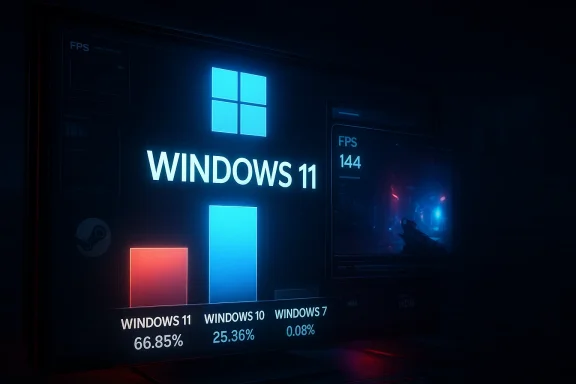
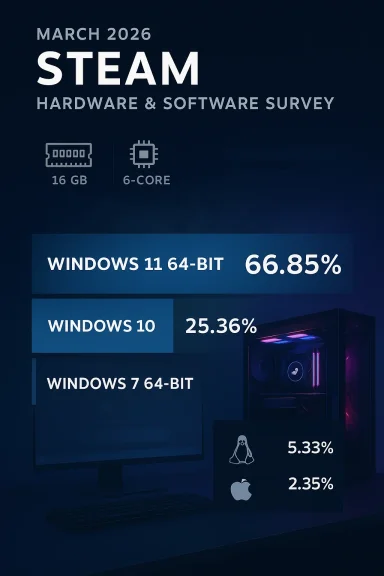
Windows 11 has now firmly established itself as the default operating system for Steam’s gaming audience, and the latest Valve Hardware & Software Survey makes that dominance hard to ignore. In March 2026, Windows 11 64-bit accounted for 66.85% of surveyed Steam systems, while Windows 10 64-bit fell to 25.36% and Windows 7 64-bit lingered at 0.08%. For Microsoft, that is a quiet but meaningful victory: the gaming market has not merely accepted Windows 11, it has normalized it. For everyone else—especially Linux and macOS advocates—the survey still tells a familiar story about a platform ecosystem that remains overwhelmingly Windows-first.
Valve’s monthly Steam Hardware & Software Survey remains one of the most useful public windows into PC gaming behavior because Microsoft does not publish comparable consumer gaming telemetry at the same level of detail. Steam’s survey is optional and anonymous, which means it is not a perfect census, but it is broad enough to expose directional trends that matter to hardware makers, game studios, and operating system vendors. In practice, it has become the closest thing the PC gaming industry has to a shared barometer.
The March 2026 results show a platform market that has continued to consolidate around Windows 11 after a year of volatility. Valve’s own survey page shows that Windows 11 stood at 66.85%, while Windows overall accounted for 92.33% of participating systems. That leaves very little room for alternatives in the mainstream gaming market, even before you account for the fact that Steam’s audience is already more technical and more upgrade-oriented than the broader PC population.
There is an important detail hidden in the month-to-month comparison. February 2026 showed Windows 11 at 56.28% and Windows 10 at 40.25%, while March flipped sharply to 66.85% and 25.36% respectively. That kind of swing suggests a survey-method or sampling effect rather than a literal one-month migration of millions of users. Even so, the underlying conclusion still stands: Windows 11 is the most-used operating system on Steam, and Windows 10 is now the aging runner-up.
The broader market implications are larger than the raw percentages. Game developers optimize for where the players are, hardware vendors prioritize the configurations that dominate sales, and platform holders watch Steam because it reflects behavior rather than aspiration. When Windows 11 rises, it strengthens Microsoft’s ability to position the platform as the baseline for modern PC gaming, even as Windows 10 remains stubbornly present in the installed base.
Microsoft’s gaming strategy has benefited from a combination of hardware refresh cycles, OEM preinstalls, and the slow but steady pressure of Windows 10 lifecycle management. For gamers, the incentive to move has been less about novelty and more about inevitability: new hardware ships with Windows 11, newer drivers target it first, and newer security and platform features are increasingly framed as Windows 11-era defaults. That is a classic platform transition, just stretched over years instead of months.
The Steam audience is especially relevant because it tends to overrepresent users with discrete GPUs, higher refresh-rate displays, and a willingness to tinker. If Windows 11 is winning here, it suggests the operating system has passed the key credibility test with the segment that most cares about performance, compatibility, and latency. In other words, adoption is not being driven only by casual users who accept whatever comes on the machine.
A few points stand out:
That is not a criticism of Windows 10 so much as a recognition of how PC ecosystems work. Players hold onto reliable systems, avoid unnecessary upgrades, and often defer OS changes until a new CPU, motherboard, or laptop purchase forces the issue. The longer a platform has been installed, the more inertia it carries, and Windows 10 had a very long runway.
The more significant concern is support policy rather than market share alone. Once a platform begins its end-of-life descent, developers start thinking in terms of minimum requirements, security assumptions, and testing costs. Windows 10 may remain viable for many users, but its strategic importance will keep shrinking as the share of Windows 11 systems rises across the gaming ecosystem.
That creates a slow but real pressure point:
Why does it persist? In most cases, the answer is not mystery but inertia. Some machines are kept alive for old games, niche peripherals, or offline use. Others are simply never upgraded because they remain outside the normal software churn of modern consumer life. A small number may be virtualized, heavily customized, or used in situations where stability matters more than compatibility.
Windows 7’s survival matters because it reveals how long the tail of PC software can be. Even after official support ends, a nonzero user base remains if the platform still runs a beloved game library. That is one reason publishers continue to weigh backward compatibility so carefully: the long tail may be tiny, but it is rarely zero. Tiny is not the same as nonexistent.
The practical implications are clear:
The most popular graphics card was the NVIDIA GeForce RTX 3060, at 3.92%. That is not a surprise in itself, but it reinforces the long-running reality that Steam’s hardware base tends to favor cards that hit the sweet spot between price, availability, and sufficient performance for the kinds of games most people actually play. The broader GPU market also remains heavily tilted toward NVIDIA, which is consistent with the survey’s manufacturer split.
The CPU picture is similarly balanced but still notable. Intel led with 54.98%, while AMD reached 45.02%, a near parity result that would have looked very different a decade ago. That balance indicates a healthy competitive market, and it also suggests that gamers are increasingly willing to choose based on platform value rather than vendor loyalty alone.
This has several consequences:
The processor market is more balanced, but Intel still has a modest lead over AMD. The fact that the gap is now relatively narrow is itself important because it shows how far AMD has come in gaming relevance. Still, the more dominant vendor inside Steam tends to influence developer assumptions, benchmark comparisons, and buyer confidence in subtle ways that ripple beyond raw share.
It is also worth noting that market dominance in PC gaming often reflects retail channel structure as much as technical merit. Prebuilt machines, laptop lineups, and regional pricing can all skew the survey in ways that do not perfectly mirror enthusiast forum sentiment. In that sense, Steam acts as a corrective to the loudest parts of the PC hardware conversation. Forum discourse and actual purchase patterns are not the same thing.
That said, the gap remains enormous. Even with its relatively healthy showing, Linux is still operating in a space where compatibility work, anti-cheat support, and launcher behavior can all become obstacles. The rise of gaming-focused Linux improvements has helped, but it has not overturned the basic economics of game development, where Windows still commands the largest testing budget and the most reliable support assumptions.
macOS faces a different challenge. It is not competing for dominance in the same way Linux often is; rather, it exists as a platform with a loyal user base but a much narrower gaming identity. Steam’s share for macOS remains low enough that publishers will rarely optimize specifically for it unless a title has broader Apple ecosystem ambitions. The market simply does not reward that extra work very often.
The major takeaways are straightforward:
It also strengthens Microsoft’s long-term platform positioning. The company has spent years trying to make Windows 11 feel like the future rather than a forced update, and the Steam numbers help that narrative. If gamers—who are often skeptical, performance-sensitive, and quick to complain—continue moving to Windows 11, Microsoft gains a powerful counterargument to the idea that the platform is merely a compliance exercise.
There is still a caveat, though. Because Steam’s survey is optional and the March-to-February swing is unusually large, analysts should avoid overreading the month as a literal mass migration event. The direction is clear, but the exact slope is less important than the fact that Windows 11 has become the leading gaming OS by a comfortable margin. That distinction keeps the analysis honest.
The broader implications include:
Windows 11’s lead on Steam is a case study in this kind of stability. It did not need to dominate by force; it simply needed to become the acceptable default across enough OEM, driver, and consumer pathways that switching costs stopped feeling like a barrier. Once that happens, a platform can consolidate surprisingly fast. Adoption curves look sudden only after they have already been climbing for years.
The same logic applies to the hardware market. The continued strength of 16GB RAM, 1080p displays, and mainstream GPUs shows that the market is still governed by practical affordability. That should shape how developers think about minimum specs, how hardware makers think about bundles, and how media outlets frame the “average gamer” conversation.
There is also a broader industry angle to watch. GPU competition, CPU parity, and the staying power of 1080p all point to a market that still prizes pragmatism over prestige. That is good news for consumers buying midrange systems and for developers who want to serve the widest audience, but it also means the PC gaming market may continue to evolve in increments rather than dramatic leaps. That tends to frustrate headline writers, but it usually serves the market well.
What to watch next:
Source: Neowin Windows 11 continues dominating gaming audience
 Overview
Valve’s monthly Steam Hardware & Software Survey remains one of the most useful public windows into PC gaming behavior because Microsoft does not publish comparable consumer gaming telemetry at the same level of detail. Steam’s survey is optional and anonymous, which means it is not a perfect census, but it is broad enough to expose directional trends that matter to hardware makers, game studios, and operating system vendors. In practice, it has become the closest thing the PC gaming industry has to a shared barometer.The March 2026 results show a platform market that has continued to consolidate around Windows 11 after a year of volatility. Valve’s own survey page shows that Windows 11 stood at 66.85%, while Windows overall accounted for 92.33% of participating systems. That leaves very little room for alternatives in the mainstream gaming market, even before you account for the fact that Steam’s audience is already more technical and more upgrade-oriented than the broader PC population.
There is an important detail hidden in the month-to-month comparison. February 2026 showed Windows 11 at 56.28% and Windows 10 at 40.25%, while March flipped sharply to 66.85% and 25.36% respectively. That kind of swing suggests a survey-method or sampling effect rather than a literal one-month migration of millions of users. Even so, the underlying conclusion still stands: Windows 11 is the most-used operating system on Steam, and Windows 10 is now the aging runner-up.
The broader market implications are larger than the raw percentages. Game developers optimize for where the players are, hardware vendors prioritize the configurations that dominate sales, and platform holders watch Steam because it reflects behavior rather than aspiration. When Windows 11 rises, it strengthens Microsoft’s ability to position the platform as the baseline for modern PC gaming, even as Windows 10 remains stubbornly present in the installed base.
Windows 11’s Lead Is No Longer a Surprise
The biggest story is not that Windows 11 leads Steam; it is that the lead has become durable enough to feel routine. A year or two ago, some readers might have treated Windows 11’s growth as an adoption curve still in progress. Now it is closer to a mature market position, where the more interesting question is how long that position can persist and how the transition away from Windows 10 will reshape software support expectations.Microsoft’s gaming strategy has benefited from a combination of hardware refresh cycles, OEM preinstalls, and the slow but steady pressure of Windows 10 lifecycle management. For gamers, the incentive to move has been less about novelty and more about inevitability: new hardware ships with Windows 11, newer drivers target it first, and newer security and platform features are increasingly framed as Windows 11-era defaults. That is a classic platform transition, just stretched over years instead of months.
The Steam audience is especially relevant because it tends to overrepresent users with discrete GPUs, higher refresh-rate displays, and a willingness to tinker. If Windows 11 is winning here, it suggests the operating system has passed the key credibility test with the segment that most cares about performance, compatibility, and latency. In other words, adoption is not being driven only by casual users who accept whatever comes on the machine.
Why Steam Is a Better Signal Than Marketing
The survey is not perfect, but it is revealing because it tracks actual usage rather than vendor messaging. It captures the operating systems people launch games on, the graphics cards they actually own, and the processor classes they live with every day. That makes it more grounded than launch-day hype or install-base claims from any one company.A few points stand out:
- Windows 11 is not merely present; it is the clear first choice on Steam.
- Windows 10 still matters, but its role is now more transitional than dominant.
- Windows 7 persists as a tiny legacy tail, which is remarkable given its age.
- The survey favors users who are active enough to participate, so the results are directional, not absolute.
- Steam’s audience is large enough to expose real hardware ecosystem trends.
Windows 10’s Decline and the End of a Long Transition
Windows 10 is not gone, but it is clearly in the latter phase of its life cycle. In March 2026, it still represented 25.36% of Steam systems, which is a sizable base by any normal standard. Yet relative to Windows 11’s 66.85%, Windows 10 now looks like a legacy platform that remains important mostly because PC hardware replacement is gradual and compatibility habits die slowly.That is not a criticism of Windows 10 so much as a recognition of how PC ecosystems work. Players hold onto reliable systems, avoid unnecessary upgrades, and often defer OS changes until a new CPU, motherboard, or laptop purchase forces the issue. The longer a platform has been installed, the more inertia it carries, and Windows 10 had a very long runway.
The more significant concern is support policy rather than market share alone. Once a platform begins its end-of-life descent, developers start thinking in terms of minimum requirements, security assumptions, and testing costs. Windows 10 may remain viable for many users, but its strategic importance will keep shrinking as the share of Windows 11 systems rises across the gaming ecosystem.
Compatibility Pressure Matters More Than Raw Share
When an operating system is still at 25% of a platform like Steam, it is not abandoned overnight. But once the lead system is over 2.5 times as large, the economics change. More studios will default to Windows 11 validation, more tools will be tuned for its security model, and more edge-case bugs on Windows 10 will be treated as lower-priority.That creates a slow but real pressure point:
- Middleware vendors may optimize first for Windows 11.
- Anti-cheat and driver stacks may assume newer OS behavior.
- Game launchers may prioritize updated security APIs.
- Troubleshooting advice will increasingly start with Windows 11 assumptions.
- Users on Windows 10 may face a death by a thousand paper cuts rather than a single cutover event.
The Strange Survival of Windows 7
The most charmingly anachronistic part of the survey is Windows 7’s continued presence. At 0.08% in March 2026, it is functionally irrelevant to market sizing, but symbolically fascinating. Seventeen years after launch, a tiny cohort of gamers is still using an operating system that most vendors stopped treating as a real target long ago.Why does it persist? In most cases, the answer is not mystery but inertia. Some machines are kept alive for old games, niche peripherals, or offline use. Others are simply never upgraded because they remain outside the normal software churn of modern consumer life. A small number may be virtualized, heavily customized, or used in situations where stability matters more than compatibility.
Windows 7’s survival matters because it reveals how long the tail of PC software can be. Even after official support ends, a nonzero user base remains if the platform still runs a beloved game library. That is one reason publishers continue to weigh backward compatibility so carefully: the long tail may be tiny, but it is rarely zero. Tiny is not the same as nonexistent.
Legacy Systems as a Support Risk
From a publisher’s perspective, the remaining Windows 7 population is too small to justify special engineering effort, but it is large enough to generate occasional compatibility complaints. This is where support teams get trapped between cost and goodwill. Ignoring legacy users can create negative sentiment, but carrying them forward forever is not realistic either.The practical implications are clear:
- Windows 7 support is now a best-effort relic, not a platform strategy.
- Game compatibility issues on Windows 7 will increasingly be seen as expected.
- Driver and anti-cheat vendors will continue to deprioritize it.
- Community troubleshooting will lean on workarounds rather than official fixes.
- Its presence in Steam surveys is mostly a historical footnote with occasional operational significance.
What the Survey Says About PC Gaming Hardware
The operating system numbers grab the headlines, but the hardware data remains equally revealing. March 2026 showed 16GB of RAM at 40.97%, a six-core processor at 27.77%, 8GB of video memory at 27.52%, and a 1080p display as the prevailing screen choice. That combination tells a familiar story: the mainstream PC gamer is still balancing cost, compatibility, and reasonably modern performance rather than chasing exotic enthusiast builds.The most popular graphics card was the NVIDIA GeForce RTX 3060, at 3.92%. That is not a surprise in itself, but it reinforces the long-running reality that Steam’s hardware base tends to favor cards that hit the sweet spot between price, availability, and sufficient performance for the kinds of games most people actually play. The broader GPU market also remains heavily tilted toward NVIDIA, which is consistent with the survey’s manufacturer split.
The CPU picture is similarly balanced but still notable. Intel led with 54.98%, while AMD reached 45.02%, a near parity result that would have looked very different a decade ago. That balance indicates a healthy competitive market, and it also suggests that gamers are increasingly willing to choose based on platform value rather than vendor loyalty alone.
Why 1080p Still Rules
The continued dominance of 1080p is perhaps the least glamorous but most meaningful hardware signal in the survey. It means that despite marketing around higher resolutions and premium display technologies, the biggest audience still plays on a format that prioritizes affordability and broad compatibility. Game developers ignore that reality at their peril.This has several consequences:
- UI scaling and text readability remain critical at 1080p.
- Performance optimization still matters more than pure visual spectacle.
- Midrange GPUs remain the commercial center of gravity.
- Game settings need sensible defaults for mainstream hardware.
- PC gaming is still fundamentally a mass-market rather than a luxury market.
NVIDIA, AMD, Intel, and the Economics of Default Choices
NVIDIA’s continued dominance on Steam is not just a bragging point; it is a statement about ecosystem momentum. With GeForce graphics cards at 72.83% and AMD at 18.55%, the GPU market inside Steam remains lopsided. That does not mean AMD is uncompetitive, but it does mean NVIDIA has retained the kind of broad mindshare that comes from years of driver familiarity, ecosystem support, and perceived game optimization advantages.The processor market is more balanced, but Intel still has a modest lead over AMD. The fact that the gap is now relatively narrow is itself important because it shows how far AMD has come in gaming relevance. Still, the more dominant vendor inside Steam tends to influence developer assumptions, benchmark comparisons, and buyer confidence in subtle ways that ripple beyond raw share.
It is also worth noting that market dominance in PC gaming often reflects retail channel structure as much as technical merit. Prebuilt machines, laptop lineups, and regional pricing can all skew the survey in ways that do not perfectly mirror enthusiast forum sentiment. In that sense, Steam acts as a corrective to the loudest parts of the PC hardware conversation. Forum discourse and actual purchase patterns are not the same thing.
The Vendor Story Behind the Numbers
The hardware split suggests several practical realities:- NVIDIA remains the default safe choice for many gamers.
- AMD’s CPU position is strong enough to be a true peer competitor.
- Integrated platform decisions still matter more than individual component flashiness.
- Driver reputation continues to shape consumer confidence.
- Midrange parts still define the center of PC gaming.
Linux and macOS Remain Minor Players, but the Trend Is Not Static
Linux held 5.33% in March 2026, while macOS stood at 2.35%. Those numbers are small compared with Windows, but they are meaningful because both platforms have managed to remain visible in a market that still heavily favors Microsoft’s desktop ecosystem. Linux in particular has carved out a niche that would have seemed far more ambitious a decade ago.That said, the gap remains enormous. Even with its relatively healthy showing, Linux is still operating in a space where compatibility work, anti-cheat support, and launcher behavior can all become obstacles. The rise of gaming-focused Linux improvements has helped, but it has not overturned the basic economics of game development, where Windows still commands the largest testing budget and the most reliable support assumptions.
macOS faces a different challenge. It is not competing for dominance in the same way Linux often is; rather, it exists as a platform with a loyal user base but a much narrower gaming identity. Steam’s share for macOS remains low enough that publishers will rarely optimize specifically for it unless a title has broader Apple ecosystem ambitions. The market simply does not reward that extra work very often.
Why Small Shares Still Matter
Even a modest percentage on Steam can shape product planning if the trend is stable. That is especially true for Linux because its community is vocal, technically engaged, and increasingly able to produce workarounds or compatibility layers that expand what can run. Over time, that can influence how developers think about portability and platform abstraction.The major takeaways are straightforward:
- Linux is still niche, but it is no longer invisible.
- macOS remains a minority platform for gaming on Steam.
- Windows’ dominance means cross-platform support remains optional, not default.
- Compatibility layers have made alternative platforms more viable, but not dominant.
- The ecosystem still centers on the Windows binary first, and everything else second.
What the March Data Means for Microsoft
For Microsoft, the March 2026 Steam survey is a quiet but welcome proof point. Windows 11 is not only surviving the post-Windows 10 transition; it is becoming the standard gaming OS in a market where credibility matters. That matters because gaming remains one of the most emotionally sticky and technically demanding consumer use cases for Windows.It also strengthens Microsoft’s long-term platform positioning. The company has spent years trying to make Windows 11 feel like the future rather than a forced update, and the Steam numbers help that narrative. If gamers—who are often skeptical, performance-sensitive, and quick to complain—continue moving to Windows 11, Microsoft gains a powerful counterargument to the idea that the platform is merely a compliance exercise.
There is still a caveat, though. Because Steam’s survey is optional and the March-to-February swing is unusually large, analysts should avoid overreading the month as a literal mass migration event. The direction is clear, but the exact slope is less important than the fact that Windows 11 has become the leading gaming OS by a comfortable margin. That distinction keeps the analysis honest.
Consumer Impact vs. Enterprise Narrative
For consumers, the takeaway is mostly about expectation setting. New gaming PCs are overwhelmingly likely to ship with Windows 11, and the software ecosystem is increasingly being tuned around that reality. For Microsoft’s enterprise messaging, Steam offers a useful halo effect: if the newest Windows is trusted in a demanding gaming environment, it becomes easier to argue that it is the modern baseline elsewhere too.The broader implications include:
- Stronger validation of Windows 11 as the default desktop gaming platform.
- Reduced leverage for Windows 10 holdouts over time.
- More justification for Microsoft to keep investing in gaming-related platform improvements.
- A stronger story for OEMs shipping modern gaming laptops and desktops.
- Continued pressure on alternative platforms to improve compatibility and convenience.
The Market’s Hidden Lesson: Stability Beats Hype
One of the most valuable things about the Steam survey is that it exposes how little the market is driven by hype at the base level. New GPUs get attention, new Windows features get coverage, and manufacturers promise leaps in performance, but the dominant platform realities change slowly. The same can be said for operating systems: the winning system is often not the one with the most headlines, but the one that quietly integrates into everyday use.Windows 11’s lead on Steam is a case study in this kind of stability. It did not need to dominate by force; it simply needed to become the acceptable default across enough OEM, driver, and consumer pathways that switching costs stopped feeling like a barrier. Once that happens, a platform can consolidate surprisingly fast. Adoption curves look sudden only after they have already been climbing for years.
The same logic applies to the hardware market. The continued strength of 16GB RAM, 1080p displays, and mainstream GPUs shows that the market is still governed by practical affordability. That should shape how developers think about minimum specs, how hardware makers think about bundles, and how media outlets frame the “average gamer” conversation.
Sequential Takeaways
- Windows 11 is now the clear leading OS on Steam.
- Windows 10 remains important, but it is losing strategic ground.
- Windows 7 persists only as a tiny legacy tail.
- NVIDIA continues to dominate the GPU conversation among gamers.
- Intel and AMD are close enough in CPUs to keep competition meaningful.
- 1080p and 16GB RAM still define the mainstream gaming baseline.
Strengths and Opportunities
The March Steam survey highlights a healthy, if predictable, ecosystem for Windows 11 and the wider PC gaming market. The strongest opportunity for Microsoft is that the operating system now sits at the center of the largest gaming distribution platform’s audience, which gives the company leverage in both consumer perception and partner alignment. That positioning also creates room for better platform messaging around performance, security, and game optimization.- Windows 11 has clear market leadership on Steam.
- The operating system has crossed from transition phase into default phase.
- Hardware makers can align roadmaps with the mainstream 1080p/16GB profile.
- Game developers can increasingly treat Windows 11 as the primary validation target.
- NVIDIA and Intel remain powerful anchors in the gaming supply chain.
- Linux’s steady niche gives the ecosystem some platform diversity.
- Steam’s survey provides a reliable, recurring signal for industry planning.
Risks and Concerns
The biggest risk in reading the survey is assuming that every month-to-month change represents real user migration. The leap from February to March is large enough to suggest sampling effects or reporting variance, so analysts should treat the exact monthly deltas with caution. The broader trend is strong, but the short-term movement could still be noisy.- Survey participation is optional, so results are not a perfect census.
- Month-over-month swings can exaggerate the appearance of rapid change.
- Windows 10 users may face growing compatibility pressure without clear transition guidance.
- Linux and macOS support can remain fragile if publishers ignore smaller shares.
- Legacy Windows 7 users may encounter more unfixable issues over time.
- Hardware vendor concentration can limit competition narratives, especially in GPUs.
- Overfitting game support to the current leader could create future migration costs.
Looking Ahead
The next few survey cycles will matter less for whether Windows 11 remains in first place and more for how the surrounding ecosystem responds. If Windows 10’s share continues to erode, developers will increasingly harden their support around Windows 11-era assumptions, and that will slowly reshape what “compatible” means in PC gaming. The more stable question is not whether Windows 11 leads, but how deeply it becomes embedded as the unspoken baseline.There is also a broader industry angle to watch. GPU competition, CPU parity, and the staying power of 1080p all point to a market that still prizes pragmatism over prestige. That is good news for consumers buying midrange systems and for developers who want to serve the widest audience, but it also means the PC gaming market may continue to evolve in increments rather than dramatic leaps. That tends to frustrate headline writers, but it usually serves the market well.
What to watch next:
- Whether Windows 11 holds or extends its lead in the next survey.
- Whether Windows 10 continues its decline or stabilizes temporarily.
- Whether Linux can sustain or build on its current share.
- Whether 1080p remains the dominant display resolution.
- Whether NVIDIA’s GPU share changes meaningfully as new cards proliferate.
Source: Neowin Windows 11 continues dominating gaming audience