Microsoft’s latest pledge to sharpen Windows 11 for gaming in 2026 marks a deliberate shift from feature marketing to system-level engineering — a promise that could change how handhelds, laptops, and desktops prioritize games over background tasks and make Windows a stronger competitor in the handheld gaming era.
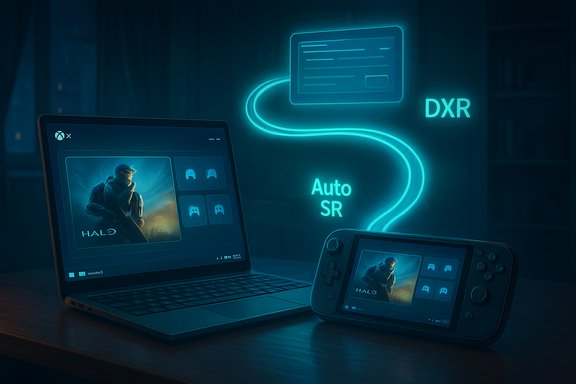
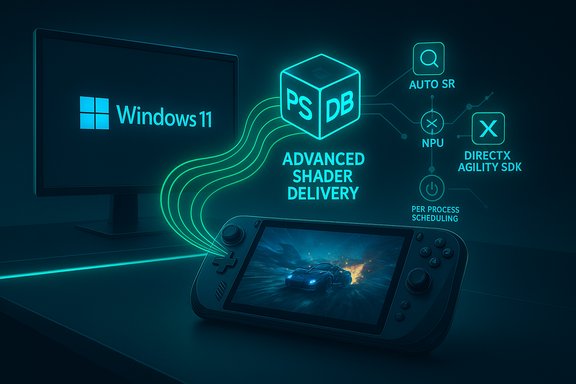
Microsoft has signaled a focused, multi-year push to make Windows 11 “the best place to play,” targeting core system behavior rather than single-game gimmicks. The program centers on four engineering pillars: background workload management, power and scheduling improvements, graphics stack optimizations, and updated drivers. Those pillars are being coupled with two visible consumer-facing technologies: Advanced Shader Delivery (ASD) — an approach that preloads or ships precompiled shaders to eliminate first-run stutter — and Automatic Super Resolution (Auto SR) — an OS-level NPU-accelerated upscaler that increases visual clarity and frame rates without game-level integration.
Those changes are timed to companion hardware launches in the Windows handheld space: compact powered PCs with AI-capable silicon and new handhelds built by OEM partners. Microsoft’s roadmap specifically calls out upcoming previews of Auto SR on AI-NPU-equipped handhelds and broader ASD support for new devices, and it aims to extend those improvements across the Windows 11 ecosystem in 2026.
However, execution risk is real. The benefits will be uneven at first, gated by hardware (NPUs), dependent on vendor driver cadence, and sensitive to the complexities of shader packaging, anti-cheat compatibility, and AI telemetry/privacy. Gamers and developers should be optimistic but pragmatic — expect notable gains on certified hardware and make conservative choices for competitive scenarios until latency and artifact trade-offs are fully characterized.
In short, Windows 11’s next-phase effort could make Windows a much better home for gaming — particularly handheld gaming — if Microsoft, silicon partners, developers, and OEMs coordinate tightly and prioritize reliability and transparency over feature rushes. For enthusiasts, the next 12–18 months will be the most interesting period yet: expect iterative improvements, visible wins on new hardware, and a gradual narrowing of the gap between the convenience of consoles and the breadth of PC gaming.
Source: Windows Central https://www.windowscentral.com/micr...ted-to-making-windows-the-best-place-to-play/
 Background
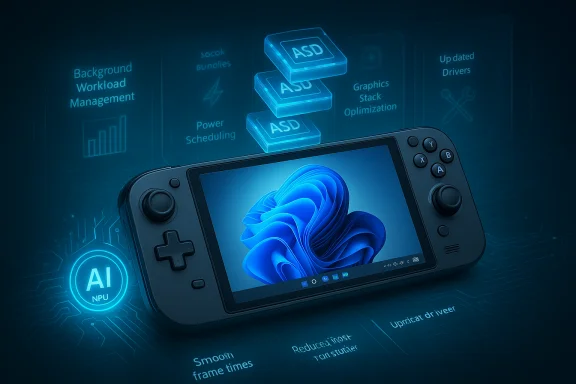
Microsoft has signaled a focused, multi-year push to make Windows 11 “the best place to play,” targeting core system behavior rather than single-game gimmicks. The program centers on four engineering pillars: background workload management, power and scheduling improvements, graphics stack optimizations, and updated drivers. Those pillars are being coupled with two visible consumer-facing technologies: Advanced Shader Delivery (ASD) — an approach that preloads or ships precompiled shaders to eliminate first-run stutter — and Automatic Super Resolution (Auto SR) — an OS-level NPU-accelerated upscaler that increases visual clarity and frame rates without game-level integration.Those changes are timed to companion hardware launches in the Windows handheld space: compact powered PCs with AI-capable silicon and new handhelds built by OEM partners. Microsoft’s roadmap specifically calls out upcoming previews of Auto SR on AI-NPU-equipped handhelds and broader ASD support for new devices, and it aims to extend those improvements across the Windows 11 ecosystem in 2026.
Overview of the announced improvements
The engineering pillars
- Background workload management: Windows will be tuned to reduce non-essential CPU/GPU work while a game is active, shifting cycles to foreground gameplay for more consistent frame pacing.
- Power and scheduling improvements: Per-device and per-process power profiles will aim to keep clocks and thermal behavior closer to optimal for gaming, especially important on battery-powered handhelds.
- Graphics stack optimizations: Reducing driver and runtime overhead in the graphics pipeline to lower CPU bottlenecks and frame-time variance.
- Updated drivers: Coordinated driver updates with silicon and OEM partners to deliver device-specific gains, particularly for unified memory (UMA) and APU platforms.
Advanced Shader Delivery (ASD)
- What it is: ASD precompiles and delivers shader code at install time so the GPU has a ready-to-run shader set when a game launches for the first time.
- Why it matters: It eliminates the classic “stutter” and long stalls during initial shader JIT compilation, which is especially disruptive on handhelds and laptops with limited thermal headroom.
- Practical effect: First-run load times can drop dramatically and initial battery usage is reduced because expensive on-device compilations are minimized.
Automatic Super Resolution (Auto SR)
- What it is: An OS-level upscaler that runs on a device’s NPU (neural processing unit), taking a game rendered at a lower internal resolution and upscaling it to the panel’s output. It’s designed to be transparent to developers.
- Why it matters: By letting games render at lower resolutions and upscaling to look sharper, Auto SR can lift framerates or reduce thermal/power draw while keeping perceived image quality high.
- Hardware dependency: Auto SR requires an on-device NPU (or equivalent AI accelerator) to run efficiently and without consuming main CPU/GPU cycles.
Why this matters now: the handheld turning point
The handheld gaming market — reinvigorated by recent handheld PCs — is driving a new set of expectations. Users want:- console-like responsiveness and launch smoothness,
- long battery life while playing AAA titles,
- a compact device that doesn’t feel like a desktop shoehorned into mobile hardware.
Verified technical specifics readers should know
- New handheld models shipping with Windows 11 hardware optimizations include devices with AI-enabled APUs and NPUs, higher-performance LPDDR memory, and modern NVMe storage. These devices typically offer 7" FHD screens at 120 Hz, variable refresh support, and improved docking capabilities for big-screen play.
- The high-end handheld model variants include multi-core AMD “Ryzen AI” line APUs and larger RAM/SSD configurations to support OS-level AI features and precompiled shader bundles.
- ASD is delivered via tooling that integrates with existing developer workflows, enabling precompiled shader bundles to be packaged during game distribution.
- Auto SR is designed to run on available NPUs and is presented as a system-level feature that requires no developer patching to work with compatible DirectX games.
Strengths — what Microsoft gets right
- System-level optimizations are the right lever
Improving the OS and drivers produces gains across thousands of titles at once. Rather than relying solely on per-game patches, these improvements scale to every game that runs on Windows. - ASD solves a tangible, user-facing problem
Shader compilation stutter ruins first-run experiences and wastes battery on handhelds. Shipping precompiled shader bundles avoids repetitive runtime compilation costs and reduces variance in frame times. - Auto SR leverages specialized silicon
With NPUs becoming more common, moving upscaling off the main GPU/CPU makes sense. It’s an efficient use of dedicated accelerators and can raise effective frame-rates without developer effort. - Hardware and software co-engineering
Microsoft’s plan is explicitly collaborative: OS changes combined with silicon and OEM driver tweaks produce real-world benefits. Coordinated driver updates and tuned power profiles can yield improvements that no single vendor could deliver alone. - A pragmatic approach to the Windows experience on handhelds
Instead of trying to graft a console UI onto Windows, Microsoft is refining the system behaviors that matter for gaming. This pragmatic focus on performance fundamentals is more likely to create lasting improvements.
Risks, unknowns, and where the plan could fail
- Hardware fragmentation and feature gating
Many of the new features depend on AI NPUs, specific APU characteristics, or OEM driver support. That means only a subset of Windows users — primarily those on new handhelds or Copilot+ devices — will see the benefits. Fragmentation risks creating a two-tier Windows experience. - Driver complexity and update coordination
Gains rely heavily on timely, validated driver updates from GPU and APU vendors. If driver rollouts are patchy or if OEMs are slow to push updates, promised improvements may not reach users. Driver regressions remain a common real-world hazard. - Compatibility with anti-cheat and anti-tamper systems
OS-level behavior changes and AI-based upscalers could interact unpredictably with anti-cheat systems. Any OS-level intervention that modifies rendering pipelines or intercepts frames must be validated against anti-cheat frameworks to avoid blocking legitimate features or producing false positives. - Image quality and latency trade-offs for Auto SR
Upscaling can introduce artifacts or perceptual changes, especially in fast competitive games. Even small increases in input latency or motion artifacts can matter for esports titles. Transparency about latency and visual fidelity is essential. - ASD packaging, updates, and modding friction
Precompiled shader bundles must be kept synchronized with driver and game updates. Patches, mods, or dynamically generated shaders could undermine the precompiled set and cause crashes or visual glitches. Developers and storefronts will need robust workflows to refresh shader bundles on updates. - Privacy and telemetry questions around AI features
AI-powered features often rely on models or telemetry. Clear privacy guarantees and local-only model execution are required to maintain user trust. Any hint of external model inference or data collection will attract scrutiny. - Past update reliability concerns
Previous large Windows feature updates have had launch issues that prompted blocks or rollbacks on affected systems. Delivering complex systemic changes across millions of hardware permutations increases the risk of regressions.
The competitive angle: Windows vs. a leaner Steam ecosystem
Valve’s earlier success with the Steam Deck popularized handheld PC gaming and demonstrated that a tailored, lightweight OS can provide a focused experience. Windows’ strength remains its compatibility with the broadest software ecosystem — but that breadth comes with overhead.- Windows’ advantages:
- Massive software compatibility and all major storefronts run on it.
- PC-focused productivity features when users want more than a gaming device.
- Deep partnerships with OEMs and silicon vendors for coordinated tuning.
- SteamOS/Steam ecosystem advantages:
- Lower system overhead by design, favoring simplicity and predictability.
- A curated handheld-first experience that reduces user friction.
- Tighter integration with the Steam storefront and Valve’s own driver/firmware stack.
What this means for gamers (practical takeaways)
- Expect smoother first-run experiences for many games as ASD support widens, particularly on new handhelds and tuned laptops.
- Auto SR will be available only on devices with in-silicon NPUs; it’s not a universal Windows setting for older systems.
- To benefit fully, users will need updated OS builds, vendor drivers, and possibly firmware updates — so patience for the full rollout is necessary.
- Competitive players should be cautious about enabling system-level upscalers until latency and artifact profiles are thoroughly vetted.
- Handheld owners should watch for “handheld optimized” tags and firmware/driver updates from OEMs to unlock the new feature set.
Recommendations for developers and OEMs
- For game developers:
- Integrate ASD workflows now: produce and test precompiled shader bundles during packaging and CI pipelines.
- Validate builds across driver versions and ship robust shader refresh mechanisms to handle patches and mods.
- Test Auto SR and other upscalers for input latency and visual artifacts, and provide explicit guidance for competitive modes.
- For OEMs and silicon partners:
- Prioritize stable driver pipelines and long-term support for shader bundle compatibility.
- Ensure firmware and power profiles are validated alongside OS updates so scheduling improvements translate to real-world gains.
- Provide clear documentation on NPU capabilities, TOPS rating, and expected performance envelopes.
- For Microsoft:
- Publish clear compatibility and privacy documentation for Auto SR and any AI features, emphasizing local-only inference where possible.
- Coordinate anti-cheat testing and provide developer tooling to avoid conflicts.
- Include rollback safeguards and staged rollouts for features that touch the graphics stack.
Questions Microsoft needs to answer publicly
- What exact hardware and driver baselines are required for Auto SR and which devices will be certified?
- How will ASD bundles be distributed and kept in sync when a game or driver is patched?
- Will Auto SR introduce any measurable input latency, and if so, how will Microsoft quantify and expose those numbers to users?
- How will Microsoft guarantee privacy when AI models are used for upscaling or highlight generation?
- What is the deployment timeline and stagger for devices beyond the initial handhelds — will mainstream laptops get partial benefits?
Final assessment — a realistic outlook
Microsoft’s 2026 gaming roadmap is credible and technically sound: targeting OS-level behavior, graphics pipeline efficiency, and AI-accelerated features is the sensible path for broad, durable improvements. The plan’s strengths are its scale and the clear hardware-software co-engineering model that can deliver consistent quality-of-life improvements across many titles.However, execution risk is real. The benefits will be uneven at first, gated by hardware (NPUs), dependent on vendor driver cadence, and sensitive to the complexities of shader packaging, anti-cheat compatibility, and AI telemetry/privacy. Gamers and developers should be optimistic but pragmatic — expect notable gains on certified hardware and make conservative choices for competitive scenarios until latency and artifact trade-offs are fully characterized.
In short, Windows 11’s next-phase effort could make Windows a much better home for gaming — particularly handheld gaming — if Microsoft, silicon partners, developers, and OEMs coordinate tightly and prioritize reliability and transparency over feature rushes. For enthusiasts, the next 12–18 months will be the most interesting period yet: expect iterative improvements, visible wins on new hardware, and a gradual narrowing of the gap between the convenience of consoles and the breadth of PC gaming.
Source: Windows Central https://www.windowscentral.com/micr...ted-to-making-windows-the-best-place-to-play/