

Microsoft’s latest Windows 11 gaming guidance, reported on May 4, 2026, says 16GB of RAM is now the practical baseline and 32GB is the “no worries” configuration for gamers who run browsers, Discord, streaming tools, and modern titles together. That is not a new minimum requirement, and it does not mean every Windows 11 PC suddenly needs a memory upgrade. It does mean Microsoft has finally said the quiet part out loud: the modern Windows desktop is no longer a 16GB comfort zone for people who expect to multitask heavily. The timing, with memory prices rising and AI demand squeezing supply, turns a sensible performance recommendation into a much sharper argument about where PC ownership is heading.
The first thing to separate is the legal minimum from the lived recommendation. Windows 11 still lists 4GB of RAM as the minimum requirement, the sort of number that belongs more to an installer checklist than to a machine anyone would enjoy using in 2026. A PC with 4GB can satisfy the spec sheet, but it cannot satisfy the way people actually use Windows.
That distinction matters because Microsoft’s “32GB” moment is less a formal policy change than a cultural one. For years, enthusiasts treated 32GB as the comfortable build choice: not extravagant, not workstation-class, just the amount that stopped Windows, Chrome, game launchers, overlays, and chat apps from arguing over scraps. Microsoft is now aligning its public advice with what the enthusiast market had already internalized.
The controversy is not that 32GB is absurd. It is that Microsoft’s ecosystem helped make 32GB feel ordinary. The company’s operating system is heavier, its AI ambitions are growing, its own PC branding has normalized 16GB as a floor for Copilot+ hardware, and the wider software industry has become comfortable assuming that memory is cheap enough to waste.
The phrase “no worries” is doing a lot of work here. It is not promising higher average frame rates in every game. It is promising fewer compromises: fewer browser tab purges, fewer hitchy alt-tabs, fewer texture-streaming stalls, fewer moments where a game is technically running fine while the rest of the machine feels like it is breathing through a straw.
But default recommendations have a way of outliving the reality they describe. The modern gaming session is not just a game. It is a Chromium-based browser with a wiki open, a launcher or three, Discord, RGB software, mouse and keyboard utilities, capture software, a VPN, a hardware monitor, cloud sync, anti-cheat, GPU control panels, and perhaps OBS if the player streams or records.
That is before the game itself asks for more. Large open-world titles, high-resolution assets, shader compilation systems, and background asset streaming all increase the penalty for running close to the memory ceiling. Even when a game lists 16GB as recommended, the recommendation often assumes the game is the main event rather than one guest at a crowded party.
This is why the 16GB-to-32GB shift has felt gradual and sudden at the same time. Nothing magical happened overnight. Instead, the margin disappeared one app, one launcher, one Electron wrapper, and one browser tab at a time.
Still, Windows is the platform where most PC gaming happens, and that makes it the platform users blame when the memory budget feels tight. Microsoft does not write every bloated utility, but Windows is the place where all those utilities accumulate. The operating system becomes the landlord of a building filled with tenants who leave the lights on.
Mac and Linux comparisons are emotionally satisfying but technically uneven. Apple controls a much narrower hardware and software environment, and macOS users often compare unified-memory machines under different workload assumptions. Linux can be leaner, but Linux gaming still depends heavily on user tolerance, hardware support, Proton behavior, anti-cheat compatibility, and the specific games involved.
The real comparison is not “Windows versus everything else.” It is Windows versus the promise Windows made: buy ordinary PC hardware, install ordinary PC software, and expect ordinary multitasking to feel ordinary. The 32GB recommendation suggests that promise now costs more memory than many buyers were trained to expect.
The benefit is less glamorous and more important: consistency. When a system runs short on physical memory, Windows leans more heavily on compression and the page file. Modern SSDs are fast, but they are not RAM, and the user notices the difference in hitches, stalls, slow alt-tabs, delayed app switching, and unpredictable background behavior.
That is why 32GB matters most to the people who insist they are not doing anything exotic. A browser, Discord, a game launcher, a game, and a streaming tool do not feel like a professional workload. In 2026, though, that stack can behave like one, especially on machines that also carry OEM background software, security tools, vendor updaters, and AI-adjacent services.
Microsoft’s phrasing is awkward because it sounds like an upsell, but the underlying point is technically defensible. The game may be comfortable at 16GB in isolation. The gaming PC, as actually used, may not be.
But the market is not calm. DRAM and NAND pricing has been under pressure, and the AI infrastructure boom has changed the economics of memory supply in ways consumers can feel. Data centers want high-bandwidth memory, vendors prioritize profitable enterprise demand, and ordinary PC buyers end up shopping in a market where the “sensible” upgrade is no longer casually cheap.
That timing turns Microsoft’s guidance into a public relations problem. Recommending 32GB during a memory squeeze sounds less like practical advice and more like a reminder that the PC industry keeps externalizing its inefficiencies onto the buyer. If apps use more, if Windows adds more, if AI features need more, if games expect more, the user pays.
The result is a strange inversion. Microsoft is not wrong to say 32GB is a safer gaming configuration. Users are not wrong to be annoyed that safety now has a higher cover charge.
This is the quiet tension inside the Windows 11 era. Microsoft’s official minimum remains broad enough to preserve compatibility optics, while its flagship experiences increasingly point toward newer hardware. The supported floor and the promoted future are drifting apart.
That gap creates confusion for ordinary buyers. A user sees that Windows 11 requires 4GB, hears that 8GB laptops are still sold, notices that 16GB is common on mainstream machines, and then reads that 32GB is the “no worries” gaming choice. All of those statements can be true at once, but together they describe a market that has stopped speaking plainly.
The honest version is simple. Four gigabytes is an installation minimum. Eight gigabytes is a compromise machine. Sixteen gigabytes is the realistic general-purpose floor. Thirty-two gigabytes is where a modern Windows gaming PC stops feeling fragile under multitasking pressure.
That is not inherently bad. More memory in mainstream PCs is overdue. The problem is that OEMs often pair memory capacity with unrelated upsells: a better display, a larger SSD, a more expensive GPU, a higher-tier CPU, or a chassis design that makes the memory non-upgradable. Buyers who only want 32GB may be nudged toward a much pricier bundle.
Laptop buyers face the harshest version of this. Soldered memory means the decision is made at purchase, not later when the user’s workload grows. A desktop owner can often postpone the upgrade; a thin-and-light buyer may live with the consequence for the life of the machine.
This is where the “32GB is the new sweet spot” framing becomes dangerous. Sweet for whom? For a desktop builder with DIMM slots, it is a reasonable planning assumption. For a budget laptop buyer, it may be a price wall disguised as future-proofing.
The issue is not that 8GB cannot boot Windows or open a browser. It can. The issue is that the system begins its life with too little headroom for normal software growth. Browser tabs multiply, Teams or Discord sits in the background, antivirus scans run, cloud storage syncs, Windows updates stage themselves, and the user concludes that the whole PC is slow.
That experience damages Windows more than Microsoft seems willing to admit. People do not blame the RAM configuration. They blame the operating system, the laptop brand, or the entire PC category. A machine that looks affordable on a shelf becomes expensive in frustration.
There is a strong case that Microsoft and OEMs should treat 8GB Windows 11 consumer PCs the way the industry eventually treated spinning hard drives in mainstream laptops: technically possible, commercially tempting, and bad for the platform’s reputation.
Even office work has changed. The “basic productivity” machine now often runs Teams, Outlook, a browser loaded with SaaS dashboards, endpoint security, device management agents, password managers, PDF tools, and cloud storage clients. The old mental model of a productivity PC as Word plus email is obsolete.
This is why 32GB has become the new psychological comfort point. It is not only for people chasing ultra settings. It is for users who want the machine to remain boring while modern software behaves badly.
There is an irony here. The PC’s greatest strength is that it lets users run many things at once. The more successful that model becomes, the more memory the platform needs to keep the experience from collapsing under its own openness.
Memory is different because it is easier to understand. Users may not know whether their processor is on a support list, but they know whether they bought 8GB, 16GB, or 32GB. RAM is visible in retail listings, task managers, and upgrade guides. It is the most legible form of performance anxiety.
That makes Microsoft’s dual messaging more precarious. The company wants the inclusiveness of a low minimum and the performance halo of high-end recommendations. But when the gap between those numbers grows too wide, the minimum starts to look ceremonial.
A 4GB minimum tells users what Windows can technically inhabit. A 32GB gaming recommendation tells them what Windows would prefer. The space between those numbers is the actual market, and it is increasingly full of compromise.
The memory curve has always moved this way. Four gigabytes became eight. Eight became sixteen. Sixteen is becoming thirty-two for serious mainstream use. The surprise is not the direction but the social friction around the transition.
Part of that friction comes from the fact that 16GB still works. Many users can keep playing, working, browsing, and chatting without a crisis. The shift to 32GB is therefore not an emergency so much as a change in what counts as a machine with margin.
That nuance matters. Panic buying is not rational. But neither is pretending the old recommendation will remain evergreen because it still works on today’s lighter workloads.
The desktop market remains forgiving. If your motherboard has open slots, a move from 16GB to 32GB can extend the useful life of the system more cleanly than a marginal CPU upgrade. Memory does not solve every performance problem, but it removes one of the most common sources of modern Windows friction.
Laptop buyers should be more cautious. If the memory is soldered, buy for the workload you expect in three or four years, not the workload you can tolerate today. A cheap 16GB laptop may be a good value; a cheap 8GB laptop with no upgrade path is often a trap.
The best advice is also the least satisfying: watch your own workload. Task Manager, Resource Monitor, and in-game behavior tell a more accurate story than any universal rule. If your system is frequently near memory saturation while gaming or working, the argument is no longer theoretical.
But not all growth is progress. Some of it is convenience for developers. Some of it is indifference from vendors. Some of it is the result of frameworks that trade user resources for faster shipping schedules. Some of it is telemetry, background services, launchers, overlays, and bundled utilities that exist because no single vendor feels the full cost of the aggregate.
This is the part Microsoft cannot fully dodge. Windows is the platform steward. If the platform accumulates enough background weight that 32GB becomes the comfort recommendation, Microsoft can be technically correct and still responsible for the environment that made the recommendation necessary.
The company has promised performance work in Windows 11, and that work matters. But optimization and higher hardware expectations are not substitutes for each other. A healthier Windows ecosystem would need both: more efficient software and more realistic memory configurations.
Source: The FPS Review 32GB Is the New Recommended Amount of System Memory for Windows 11
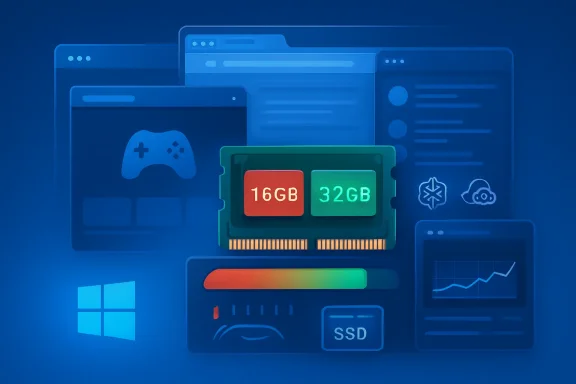 Microsoft Did Not Raise the Floor, It Moved the Goalposts
The first thing to separate is the legal minimum from the lived recommendation. Windows 11 still lists 4GB of RAM as the minimum requirement, the sort of number that belongs more to an installer checklist than to a machine anyone would enjoy using in 2026. A PC with 4GB can satisfy the spec sheet, but it cannot satisfy the way people actually use Windows.That distinction matters because Microsoft’s “32GB” moment is less a formal policy change than a cultural one. For years, enthusiasts treated 32GB as the comfortable build choice: not extravagant, not workstation-class, just the amount that stopped Windows, Chrome, game launchers, overlays, and chat apps from arguing over scraps. Microsoft is now aligning its public advice with what the enthusiast market had already internalized.
The controversy is not that 32GB is absurd. It is that Microsoft’s ecosystem helped make 32GB feel ordinary. The company’s operating system is heavier, its AI ambitions are growing, its own PC branding has normalized 16GB as a floor for Copilot+ hardware, and the wider software industry has become comfortable assuming that memory is cheap enough to waste.
The phrase “no worries” is doing a lot of work here. It is not promising higher average frame rates in every game. It is promising fewer compromises: fewer browser tab purges, fewer hitchy alt-tabs, fewer texture-streaming stalls, fewer moments where a game is technically running fine while the rest of the machine feels like it is breathing through a straw.
The Old 16GB Rule Survived Longer Than It Deserved
For most of the last decade, 16GB was the sane recommendation for a mainstream gaming PC. It was enough for Windows, enough for most games, and enough for a few background apps if the user was not trying to run a miniature broadcast studio beside Cyberpunk or Call of Duty. It became the default because it hit the right balance of price, capacity, and good-enough longevity.But default recommendations have a way of outliving the reality they describe. The modern gaming session is not just a game. It is a Chromium-based browser with a wiki open, a launcher or three, Discord, RGB software, mouse and keyboard utilities, capture software, a VPN, a hardware monitor, cloud sync, anti-cheat, GPU control panels, and perhaps OBS if the player streams or records.
That is before the game itself asks for more. Large open-world titles, high-resolution assets, shader compilation systems, and background asset streaming all increase the penalty for running close to the memory ceiling. Even when a game lists 16GB as recommended, the recommendation often assumes the game is the main event rather than one guest at a crowded party.
This is why the 16GB-to-32GB shift has felt gradual and sudden at the same time. Nothing magical happened overnight. Instead, the margin disappeared one app, one launcher, one Electron wrapper, and one browser tab at a time.
Windows Is Not Alone, But Windows Is the Platform Being Judged
It would be too easy to turn this into a simple indictment of Windows bloat. Modern software is heavy everywhere, and plenty of memory waste comes from cross-platform development choices that have little to do with the kernel or Start menu. Electron apps, browser engines, always-on sync clients, anti-cheat systems, and overlay frameworks are part of the problem on any desktop platform that hosts them.Still, Windows is the platform where most PC gaming happens, and that makes it the platform users blame when the memory budget feels tight. Microsoft does not write every bloated utility, but Windows is the place where all those utilities accumulate. The operating system becomes the landlord of a building filled with tenants who leave the lights on.
Mac and Linux comparisons are emotionally satisfying but technically uneven. Apple controls a much narrower hardware and software environment, and macOS users often compare unified-memory machines under different workload assumptions. Linux can be leaner, but Linux gaming still depends heavily on user tolerance, hardware support, Proton behavior, anti-cheat compatibility, and the specific games involved.
The real comparison is not “Windows versus everything else.” It is Windows versus the promise Windows made: buy ordinary PC hardware, install ordinary PC software, and expect ordinary multitasking to feel ordinary. The 32GB recommendation suggests that promise now costs more memory than many buyers were trained to expect.
The “No Worries” Tier Is Really About Stutter, Not Swagger
The reflexive response to any hardware recommendation is to ask whether it improves frames per second. That is the wrong lens for memory. More RAM rarely turns a midrange GPU into a flagship one, and a game that is primarily GPU-bound will not suddenly become a showcase just because the system has another 16GB available.The benefit is less glamorous and more important: consistency. When a system runs short on physical memory, Windows leans more heavily on compression and the page file. Modern SSDs are fast, but they are not RAM, and the user notices the difference in hitches, stalls, slow alt-tabs, delayed app switching, and unpredictable background behavior.
That is why 32GB matters most to the people who insist they are not doing anything exotic. A browser, Discord, a game launcher, a game, and a streaming tool do not feel like a professional workload. In 2026, though, that stack can behave like one, especially on machines that also carry OEM background software, security tools, vendor updaters, and AI-adjacent services.
Microsoft’s phrasing is awkward because it sounds like an upsell, but the underlying point is technically defensible. The game may be comfortable at 16GB in isolation. The gaming PC, as actually used, may not be.
The Worst Part Is That Microsoft Is Right at the Wrong Moment
If memory prices were low, the reaction would be more muted. Many enthusiasts would shrug, buy a 32GB kit, and move on. The upgrade path on desktops is usually straightforward, and even many laptops now ship with 16GB or 32GB configurations that reflect the new normal.But the market is not calm. DRAM and NAND pricing has been under pressure, and the AI infrastructure boom has changed the economics of memory supply in ways consumers can feel. Data centers want high-bandwidth memory, vendors prioritize profitable enterprise demand, and ordinary PC buyers end up shopping in a market where the “sensible” upgrade is no longer casually cheap.
That timing turns Microsoft’s guidance into a public relations problem. Recommending 32GB during a memory squeeze sounds less like practical advice and more like a reminder that the PC industry keeps externalizing its inefficiencies onto the buyer. If apps use more, if Windows adds more, if AI features need more, if games expect more, the user pays.
The result is a strange inversion. Microsoft is not wrong to say 32GB is a safer gaming configuration. Users are not wrong to be annoyed that safety now has a higher cover charge.
Copilot+ PCs Made 16GB Feel Like the New Entry Ticket
The Windows 11 memory conversation is inseparable from Microsoft’s AI PC push. Copilot+ PCs established 16GB of RAM as part of the modern premium Windows baseline, alongside NPUs and newer processors. That does not mean every AI feature consumes huge amounts of system memory all the time, but it does send a market signal: the platform Microsoft wants to sell is not designed around bare-minimum machines.This is the quiet tension inside the Windows 11 era. Microsoft’s official minimum remains broad enough to preserve compatibility optics, while its flagship experiences increasingly point toward newer hardware. The supported floor and the promoted future are drifting apart.
That gap creates confusion for ordinary buyers. A user sees that Windows 11 requires 4GB, hears that 8GB laptops are still sold, notices that 16GB is common on mainstream machines, and then reads that 32GB is the “no worries” gaming choice. All of those statements can be true at once, but together they describe a market that has stopped speaking plainly.
The honest version is simple. Four gigabytes is an installation minimum. Eight gigabytes is a compromise machine. Sixteen gigabytes is the realistic general-purpose floor. Thirty-two gigabytes is where a modern Windows gaming PC stops feeling fragile under multitasking pressure.
OEMs Will Turn a Recommendation Into a Pricing Ladder
Once Microsoft blesses a number, PC makers know what to do with it. Expect 32GB to appear more often in “creator,” “AI,” and “gaming” configurations, while 16GB remains the base model used to advertise a lower starting price. The recommendation becomes a merchandising tool.That is not inherently bad. More memory in mainstream PCs is overdue. The problem is that OEMs often pair memory capacity with unrelated upsells: a better display, a larger SSD, a more expensive GPU, a higher-tier CPU, or a chassis design that makes the memory non-upgradable. Buyers who only want 32GB may be nudged toward a much pricier bundle.
Laptop buyers face the harshest version of this. Soldered memory means the decision is made at purchase, not later when the user’s workload grows. A desktop owner can often postpone the upgrade; a thin-and-light buyer may live with the consequence for the life of the machine.
This is where the “32GB is the new sweet spot” framing becomes dangerous. Sweet for whom? For a desktop builder with DIMM slots, it is a reasonable planning assumption. For a budget laptop buyer, it may be a price wall disguised as future-proofing.
The 8GB Windows PC Has Become the New Netbook Mistake
If 16GB is under pressure, 8GB is increasingly hard to defend in new Windows machines outside narrow use cases. A lightly used office PC, kiosk, classroom device, or single-purpose terminal can still get by. But a consumer laptop sold in 2026 with 8GB of non-upgradable memory is not a bargain; it is a countdown.The issue is not that 8GB cannot boot Windows or open a browser. It can. The issue is that the system begins its life with too little headroom for normal software growth. Browser tabs multiply, Teams or Discord sits in the background, antivirus scans run, cloud storage syncs, Windows updates stage themselves, and the user concludes that the whole PC is slow.
That experience damages Windows more than Microsoft seems willing to admit. People do not blame the RAM configuration. They blame the operating system, the laptop brand, or the entire PC category. A machine that looks affordable on a shelf becomes expensive in frustration.
There is a strong case that Microsoft and OEMs should treat 8GB Windows 11 consumer PCs the way the industry eventually treated spinning hard drives in mainstream laptops: technically possible, commercially tempting, and bad for the platform’s reputation.
Gamers Are Only the First Audience for a Broader Shift
The current flare-up is framed around gaming, but the memory story is bigger than games. Developers using WSL, Docker, Visual Studio, Android emulators, local databases, and browser-based tools can exhaust 16GB quickly. Content creators working with large images, timelines, plug-ins, and capture tools have known this for years.Even office work has changed. The “basic productivity” machine now often runs Teams, Outlook, a browser loaded with SaaS dashboards, endpoint security, device management agents, password managers, PDF tools, and cloud storage clients. The old mental model of a productivity PC as Word plus email is obsolete.
This is why 32GB has become the new psychological comfort point. It is not only for people chasing ultra settings. It is for users who want the machine to remain boring while modern software behaves badly.
There is an irony here. The PC’s greatest strength is that it lets users run many things at once. The more successful that model becomes, the more memory the platform needs to keep the experience from collapsing under its own openness.
Microsoft’s Minimum Spec Has Become a Political Document
System requirements are never just engineering documents. They are political statements about who gets carried forward, who gets left behind, and how much pain the platform owner is willing to tolerate for compatibility. Windows 11’s CPU, TPM, and Secure Boot requirements already made that clear.Memory is different because it is easier to understand. Users may not know whether their processor is on a support list, but they know whether they bought 8GB, 16GB, or 32GB. RAM is visible in retail listings, task managers, and upgrade guides. It is the most legible form of performance anxiety.
That makes Microsoft’s dual messaging more precarious. The company wants the inclusiveness of a low minimum and the performance halo of high-end recommendations. But when the gap between those numbers grows too wide, the minimum starts to look ceremonial.
A 4GB minimum tells users what Windows can technically inhabit. A 32GB gaming recommendation tells them what Windows would prefer. The space between those numbers is the actual market, and it is increasingly full of compromise.
Enthusiasts Were Early, Not Excessive
The FPS Review notes that many PC enthusiasts have been building with 32GB for years, and that is important context. What once looked like overbuying now looks like accurate forecasting. Enthusiasts did not predict one killer app; they predicted a direction of travel.The memory curve has always moved this way. Four gigabytes became eight. Eight became sixteen. Sixteen is becoming thirty-two for serious mainstream use. The surprise is not the direction but the social friction around the transition.
Part of that friction comes from the fact that 16GB still works. Many users can keep playing, working, browsing, and chatting without a crisis. The shift to 32GB is therefore not an emergency so much as a change in what counts as a machine with margin.
That nuance matters. Panic buying is not rational. But neither is pretending the old recommendation will remain evergreen because it still works on today’s lighter workloads.
The Real Upgrade Advice Is Less Dramatic Than the Debate
The practical guidance is straightforward. If you already have 32GB, you are in the comfortable zone for mainstream Windows gaming and multitasking. If you have 16GB, you do not need to treat your PC as obsolete, but you should be aware that your headroom is shrinking. If you have 8GB or less and use Windows 11 for anything beyond light tasks, memory is probably one of the most meaningful upgrades you can make.The desktop market remains forgiving. If your motherboard has open slots, a move from 16GB to 32GB can extend the useful life of the system more cleanly than a marginal CPU upgrade. Memory does not solve every performance problem, but it removes one of the most common sources of modern Windows friction.
Laptop buyers should be more cautious. If the memory is soldered, buy for the workload you expect in three or four years, not the workload you can tolerate today. A cheap 16GB laptop may be a good value; a cheap 8GB laptop with no upgrade path is often a trap.
The best advice is also the least satisfying: watch your own workload. Task Manager, Resource Monitor, and in-game behavior tell a more accurate story than any universal rule. If your system is frequently near memory saturation while gaming or working, the argument is no longer theoretical.
The PC Industry Has a Waste Problem It Keeps Calling Progress
There is a legitimate reason software uses more memory over time. Applications become more capable, assets grow larger, security layers deepen, and users demand richer interfaces. Nobody should expect a 2026 PC to behave like a 2016 PC while running 2026 software.But not all growth is progress. Some of it is convenience for developers. Some of it is indifference from vendors. Some of it is the result of frameworks that trade user resources for faster shipping schedules. Some of it is telemetry, background services, launchers, overlays, and bundled utilities that exist because no single vendor feels the full cost of the aggregate.
This is the part Microsoft cannot fully dodge. Windows is the platform steward. If the platform accumulates enough background weight that 32GB becomes the comfort recommendation, Microsoft can be technically correct and still responsible for the environment that made the recommendation necessary.
The company has promised performance work in Windows 11, and that work matters. But optimization and higher hardware expectations are not substitutes for each other. A healthier Windows ecosystem would need both: more efficient software and more realistic memory configurations.
The 32GB Line Is a Warning Label for the Next Windows PC
The useful lesson is not that everyone must upgrade this week. It is that buyers should stop treating memory as an afterthought. In 2026, RAM capacity is one of the clearest dividing lines between a Windows PC that merely runs and a Windows PC that remains pleasant under pressure.- A 4GB Windows 11 PC may satisfy the official minimum, but it should not shape anyone’s expectation of a good modern experience.
- An 8GB Windows 11 PC is increasingly appropriate only for narrow, light, or managed workloads, especially if the memory cannot be upgraded.
- A 16GB Windows 11 PC remains usable and often sensible, but it is no longer the effortless comfort tier for gaming plus multitasking.
- A 32GB Windows 11 PC is becoming the mainstream enthusiast recommendation because it protects against background apps, heavier games, and ordinary software sprawl.
- Laptop buyers should treat soldered RAM as a long-term commitment, not a spec-sheet detail they can fix later.
- Microsoft’s recommendation is technically defensible, but it also exposes how much the Windows ecosystem now relies on users buying more hardware to preserve the same feeling of smoothness.
Source: The FPS Review 32GB Is the New Recommended Amount of System Memory for Windows 11
