• Thread Author
Microsoft’s latest Windows 11 servicing wave is now moving from preview to public release, and the result is a broad quality update that touches accessibility, security controls, File Explorer, Settings, display handling, and device management. Reportedly arriving as KB5079391 for Windows 11 24H2 and 25H2, the package continues Microsoft’s pattern of shipping the same monthly improvements across both branches, which share a servicing model introduced with the 25H2 rollout. That shared branch matters because it keeps feature parity tighter than the old “major version” cadence, while also making every monthly patch more consequential for both home users and enterprises.

A digital visualization related to the article topic.Overview​

The most important thing about this update is not any single headline feature, but the way Microsoft is refining Windows 11 as a living platform. The preview version that preceded this release, KB5077241, was framed by Microsoft as a non-security update focused on functionality, performance, and reliability, and this public release appears to carry that same philosophy forward. In other words, the update is part of the broader continuous innovation model Microsoft has been pushing across Windows 11, where smaller changes arrive more frequently rather than being reserved for one giant annual event.
That model gives Microsoft more flexibility, but it also raises the stakes for monthly servicing. Users no longer evaluate Windows updates only by whether they patch vulnerabilities; they now judge them by whether they improve the daily feel of the OS, whether they break workflows, and whether new controls behave predictably. The latest release seems designed to show progress on all three fronts, especially in areas that affect routine use: accessibility, shell behavior, display reliability, and policy management.
There is also a strategic layer here. Windows 11 version 25H2 was announced as an enablement-style release built on the same branch as 24H2, which means Microsoft can deliver many of the same innovations to both versions without forcing users into a dramatic migration cycle. That lowers the friction for IT departments, but it also means the servicing pipeline becomes the real product experience for a large share of the Windows base. For users, the monthly update is no longer background maintenance; it is part of the platform itself.

Why this update matters​

The update lands at a time when Microsoft is trying to balance three separate priorities: polish for consumers, manageability for enterprises, and confidence for accessibility-first workflows. The same patch touches Narrator, Smart App Control, File Explorer, Settings, and Windows Recovery Environment behavior, which is a sign that Microsoft is targeting the full stack rather than isolated bug fixes. That breadth is useful, but it also means organizations will want to test the update carefully before blanket deployment.
  • It reinforces Microsoft’s shift toward monthly platform refinement.
  • It keeps 24H2 and 25H2 aligned on the same servicing train.
  • It brings visible improvements to everyday Windows 11 workflows.
  • It also adds or adjusts features that administrators may need to govern.

From Preview to Public Release​

Microsoft’s release pattern has become increasingly familiar: an optional preview update appears first, feedback arrives from Insiders and early adopters, and then the same code path is folded into the broader public rollout. In this case, the preview cadence for March 2026 builds on earlier Release Preview updates that delivered quality improvements before the security cumulative update cycle. That approach gives Microsoft a chance to surface compatibility problems before the update becomes the default path for the mainstream audience.
The public release also helps explain why the build numbers matter so much. According to Microsoft’s March servicing line, 26100 remains the base for Windows 11 24H2, while 26200 tracks 25H2, and both branches have been advancing in parallel. That parallelism is useful because it reduces drift between the consumer and enterprise fleets, but it also means a single servicing issue can span two widely deployed releases almost immediately.

What changed from the preview build​

The earlier preview emphasized features such as Cross-Device Resume, Smart App Control, and MIDI support, while also refining storage cleanup presentation and fixing usability problems like Start menu glitches and File Explorer freezing. Public release notes typically keep much of that groundwork intact, which is why early testing is so important to Microsoft’s monthly rhythm. Even when the final package is mostly the same, the rollout to general users marks a shift from controlled validation to real-world scale.
  • Preview builds act as dress rehearsals for the public servicing channel.
  • Microsoft uses them to catch compatibility regressions before broad deployment.
  • The public release usually confirms the broader feature direction.
  • Any preview bugs that survive testing become far more important once the patch hits real devices.
The key takeaway is that Microsoft is no longer treating these updates as minor housekeeping. Instead, monthly servicing has become a mechanism for shipping meaningful operating system improvements, and that makes release quality just as important as feature ambition. The company’s challenge is obvious: make Windows feel more modern without making it feel less predictable. That is a harder problem than it looks.

Narrator Gets a Stronger AI-Driven Push​

One of the most visible additions in the update is the expanded Narrator experience. Microsoft is pushing richer image descriptions and tighter integration with Copilot, aiming to improve how blind and low-vision users interpret on-screen visuals. On Copilot+ PCs, the descriptions are generated on-device, which is a meaningful detail because it affects both latency and privacy perception.
This is not just a cosmetic accessibility change. Richer descriptions can make screenshots, diagrams, and interface-heavy applications more usable for people who depend on assistive tech, while Copilot integration offers a second layer of context when the local model is not enough. The bigger strategic point is that Microsoft is trying to make accessibility a showcase for its AI platform rather than a separate silo of features. That is smart product positioning, though it also creates expectations that these AI-assisted tools will be consistently accurate.

Accessibility and AI as a combined story​

The combination of Narrator and Copilot shows where Microsoft wants Windows accessibility to go next. Instead of merely reading interface elements aloud, the OS is trying to interpret what a user is seeing and provide a more human explanation. That can be transformative for image-heavy content, but it must be handled carefully because the wrong description can be more confusing than no description at all.
  • Rich image descriptions improve visual context.
  • Copilot integration adds interactive follow-up.
  • On-device generation lowers latency on Copilot+ PCs.
  • Accuracy and consistency will determine whether the feature feels trustworthy.
It is also notable that Microsoft is extending the feature to all Windows 11 devices, not just its newest hardware. That broad availability suggests the company wants accessibility improvements to be seen as core Windows capabilities, not premium extras. Still, the best experience will likely remain on the newer Copilot+ class of hardware, which keeps the performance advantage as a differentiator.

Smart App Control Becomes Less Inflexible​

The update’s Smart App Control change may matter more to administrators than to average consumers, but it is one of the most important quality-of-life refinements in the release. Microsoft is allowing users to turn Smart App Control on or off without requiring a clean install, removing one of the feature’s biggest practical annoyances. That matters because security tools are only useful when people can actually manage them without rebuilding a machine.
Smart App Control has always represented a tension in Windows design. On one hand, it aims to block untrusted or potentially harmful apps and reduce attack surface; on the other, its earlier deployment model made it feel rigid and hard to revisit once a system state changed. Loosening that requirement makes the feature more usable, but it also suggests Microsoft understands that security controls work best when they are reversible and transparent.

Security posture without the friction​

This change is especially meaningful for power users who test software, developers who spin up tools frequently, and organizations that pilot apps before approving them broadly. A control that can be enabled or disabled from Settings > Windows Security > App & Browser Control is easier to document, support, and explain. That sounds mundane, but in endpoint management, mundane usability often decides whether a security feature is adopted or ignored.
  • Smart App Control is now easier to toggle.
  • The feature remains focused on blocking risky apps.
  • The new model reduces the need for a clean install.
  • Admins get a more practical path for testing and support.
The broader lesson is that Microsoft is trying to make Windows security feel less like a one-way door. That may not sound dramatic, but it is a real product improvement because it gives users a way to experiment without permanent commitment. If Microsoft can keep doing that across more security features, adoption will likely improve.

File Explorer and Shell Reliability Continue to Improve​

For many users, the most welcome changes in this update will be the subtle ones inside File Explorer and the shell. Microsoft says file unblocking is now more reliable for previews, and it has also improved handling around renaming files with Voice Typing using Win + H. Those are not flashy features, but they are exactly the sort of paper cuts that can turn Windows from efficient to irritating.
File Explorer has long been one of the most sensitive parts of Windows because it sits at the intersection of file security, shell extensions, preview panes, and user expectations. Even small regressions can cascade into user-visible freezes or odd permission behavior, which is why Microsoft repeatedly returns to this area in quality updates. The new release also includes more flexible sorting for permissions in Advanced Security Settings, which shows the company is still paying attention to management workflows.

Small fixes with large daily impact​

These changes are easy to overlook in a marketing summary, but they can materially improve confidence in the OS. File unblocking issues in preview workflows are the kind of thing that frustrates users who regularly download tools, installers, or documents from shared environments. Voice Typing in rename flows is another example of a feature that looks minor but can be a genuine productivity boost for users with mobility limitations or just busy hands.
  • More reliable file unblocking reduces workflow friction.
  • Win + H support in renaming improves hands-free use.
  • Security settings sorting makes audits easier.
  • Shell fixes often prevent broader stability complaints.
The interesting part is how often these shell-level refinements become the update’s real value, even if they barely register in a headline. Users do not always notice when File Explorer works correctly; they notice when it does not. That makes these reliability fixes strategically important, even if they are not the sexiest parts of the release.

Settings, Account Management, and the Consumer Experience​

Microsoft is also polishing the Settings app and account-related workflows. The About page now has a clearer layout, the Home page device card is more structured, and opening Settings Home appears more reliable. Microsoft 365 Family users can now upgrade plans directly from Settings > Accounts, which is a strong sign that the company wants the OS to be a place where subscription and device management intersect more naturally.
That last detail is significant because it shows how Windows is increasingly serving as a storefront for Microsoft services as well as a desktop platform. Consumers may appreciate convenience, but they may also see it as another reminder that the operating system is deeply tied to Microsoft’s ecosystem strategy. The redesigned dialog boxes in Other users, including dark mode support, fit the same pattern: the company is trying to make account management feel more modern and less fragmented.

The line between useful and intrusive​

There is a thin line between making Settings more helpful and turning it into a promotional surface. Microsoft seems aware of this tension, which is why the update also includes the ability to disable suggested upgrade prompts. That is a good sign, because the best subscription workflows are the ones that help without feeling coercive.
  • The About page is easier to scan.
  • The Home card is more structured.
  • Microsoft 365 Family upgrades are more direct.
  • Suggested prompts can be disabled.
This area of the update also reflects a broader design shift in Windows 11: the company is trying to consolidate system, device, and account information into a single readable layer. That is useful for casual users, but enterprise admins will still need separate tooling. The consumer-facing polish is real, yet it should not be mistaken for deeper administrative simplification.

Display, Input, and Hardware Behavior​

The update contains a set of display and input refinements that matter more than they might initially appear. Microsoft says it now supports monitors reporting refresh rates above 1000 Hz, improves USB4 monitor sleep behavior, and enhances auto-rotation after sleep. It also claims better HDR reliability and more accurate monitor size reporting through WMI APIs, which should help both end users and device inventory tools.
These kinds of changes often fly under the radar until they fail. High-refresh displays, multi-monitor setups, and USB4 peripherals are precisely where edge-case bugs tend to surface, and Windows has to work across a wild range of hardware quality levels. By investing in these scenarios, Microsoft is signaling that it wants Windows 11 to stay credible on premium hardware as well as mainstream laptops.

Why these changes matter for power users​

For enthusiasts, gamers, and creative professionals, display reliability can be the difference between a smooth desktop and a constant troubleshooting cycle. Better HDR behavior and auto-rotation after sleep are not glamorous changes, but they improve confidence that the OS will behave correctly after suspend, dock, or reconnect events. On the enterprise side, more accurate WMI reporting also helps device management and inventory systems make better decisions.
  • High-refresh support is important for premium panels.
  • USB4 sleep improvements reduce dock-related annoyances.
  • Auto-rotation fixes help convertibles and tablets.
  • Accurate WMI display data benefits asset management.
It is worth noting that Microsoft has spent years trying to reduce the “it worked before sleep” class of bug reports, and this update is clearly part of that effort. The more heterogeneous the Windows hardware ecosystem becomes, the more valuable these reliability fixes are. That diversity is a strength of Windows, but it also makes perfection impossible.

Enterprise, Policy, and Manageability Changes​

A number of the update’s most practical changes are aimed at managed environments. Microsoft added support for DisableSeamlessLanguageBar in Remote Desktop PowerShell, improved start menu layout application via Group Policy, and tightened Application Control for Business ID tagging. It also updated printer support baselines and improved how updates behave when run from certain network locations.
These are the kinds of details that never generate social media excitement, but they matter enormously in enterprise environments where consistency is more important than novelty. Group Policy reliability, printer baselines, and policy tagging directly affect the ability of IT teams to standardize behavior across fleets. If those controls are weak, the cost shows up later in help desk tickets, compliance issues, and deployment delays.

The hidden enterprise value​

There is a reason Microsoft keeps polishing these backstage mechanisms. Enterprises are the customers most likely to delay updates if they suspect instability, and the company knows that predictable policy behavior is part of what keeps Windows viable in managed fleets. In that sense, the enterprise fixes here are not auxiliary; they are central to keeping trust intact.
  • Policy application is more reliable.
  • Remote Desktop administration gets a useful update.
  • Printer support remains a major compatibility focus.
  • Network-path update handling improves deployment resilience.
The same logic applies to the improved Application Control for Business tagging. Better tagging means policies are more likely to map correctly to real applications, which can reduce false positives or enforcement ambiguity. That is a quiet but important step if Microsoft wants Windows security policy to be both strong and administratively sane.

Reliability, Recovery, and Under-the-Hood Stability​

Beyond the visible features, Microsoft is also cleaning up the plumbing. The update improves stability in Windows Recovery Environment when running x64 apps on ARM64 devices, and it fixes an issue where .msu updates could fail with ERROR_BAD_PATHNAME from certain network locations. Those sorts of fixes are the backbone of a healthy update cycle because they affect recovery, installation, and maintenance.
The fact that Microsoft is still adjusting WinRE behavior underscores how complex Windows servicing has become in a mixed architecture world. ARM64 is no longer an experimental niche; it is a real production platform for some users, and recovery workflows must work there as reliably as they do on x86 systems. The network-location update fix is equally important because enterprise deployments often depend on non-local update sources and scripted delivery paths.

Recovery is a feature, not just a fallback​

A lot of users only think about recovery tools after something goes wrong, but Microsoft has to design them as first-class components. If WinRE fails or update install paths behave unpredictably, the entire servicing model becomes less trustworthy. In that sense, these fixes are foundational rather than optional.
  • WinRE stability helps when systems are under stress.
  • ARM64 support remains a strategic priority.
  • Update installation reliability is essential for admins.
  • Recovery issues can erode confidence in the whole release train.
This is also why the update’s handling of sfc /scannow matters, even if the change is just the removal of an unnecessary error message. Small cleanups in diagnostics help reduce noise during troubleshooting, which in turn makes support processes more efficient. Less confusion in repair workflows is a real win.

Strengths and Opportunities​

This update’s biggest strength is its breadth. It makes Windows 11 feel more coherent by touching the places users encounter every day, while also improving the less visible systems that keep enterprise deployments stable. Microsoft is clearly trying to make monthly servicing feel like ongoing product refinement rather than a chore, and that is a promising direction.
  • Narrator becomes more capable and more AI-aware.
  • Smart App Control becomes easier to manage.
  • File Explorer and shell reliability get practical improvements.
  • Settings becomes clearer and more structured.
  • Display support improves for high-end and complex setups.
  • Enterprise policy handling gets more predictable.
  • Recovery and update reliability improve.
  • Microsoft keeps 24H2 and 25H2 aligned on one servicing path.

Risks and Concerns​

The main concern is that the update is so broad that it could expose edge-case regressions across multiple subsystems at once. Microsoft has already seen testing-stage reports tied to camera behavior and lock screen quirks in the preview cycle, and that is a reminder that broad servicing releases can create new instability even when their intent is to improve quality. Users and admins will want to watch the first days of rollout closely.
  • Preview-stage bugs can survive into public rollout.
  • Accessibility AI features may face accuracy questions.
  • Smart App Control changes could confuse less technical users.
  • Display and docking fixes may vary by hardware vendor.
  • Enterprise policy changes can behave differently across managed images.
  • Any broad monthly update carries a risk of unintended regressions.
  • Rollout timing can make troubleshooting harder if issues appear gradually.

Looking Ahead​

What happens next will depend less on the feature list itself and more on how the update behaves in the real world. If the rollout is clean, Microsoft gets a much-needed validation of its continuous innovation strategy, especially for accessibility and manageability features. If problems emerge, the same breadth that makes the update attractive will also make remediation more complicated.
The next milestone is likely the usual split between early adopter feedback and broader enterprise adoption. Home users will notice whether Narrator feels smarter, whether File Explorer stops behaving oddly, and whether display and sleep behavior improve. IT teams, meanwhile, will care more about Group Policy consistency, update installation reliability, and whether Smart App Control is now easier to govern at scale.
  • Watch for any camera or lock screen regressions during rollout.
  • Monitor whether Narrator’s image descriptions are consistently accurate.
  • Check whether Smart App Control’s new toggle model behaves cleanly.
  • Validate display sleep and HDR behavior on multi-monitor systems.
  • Confirm policy and Remote Desktop changes in managed environments.
If Microsoft has gotten this one right, KB5079391 may not be remembered for one marquee feature, but for something more valuable: making Windows 11 feel a little more stable, a little more usable, and a little more deliberate. That is often how a mature operating system earns trust—not through spectacle, but through the accumulation of small, well-judged fixes that quietly improve the everyday experience.

Source: Windows Report https://windowsreport.com/kb5079391...trol-narrator-and-file-explorer-improvements/
 

Microsoft’s latest Windows 11 servicing wave is finally giving the operating system something users have been asking for for years: less friction in the places they touch every day. The update package reportedly arriving as KB5079391 for Windows 11 24H2 and 25H2 brings a mixed bag of refinements, but the real story is not any single feature. It is that Microsoft appears to be shifting from flashy platform messaging toward practical repair, especially around File Explorer, Smart App Control, and a less intrusive overall Windows experience. That is exactly the kind of change that can restore a little faith in the product, even if it does not solve every complaint at once.

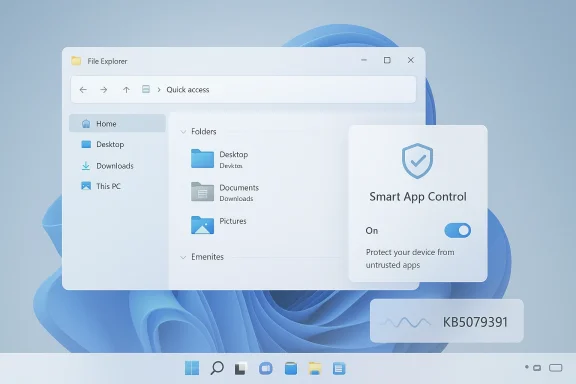
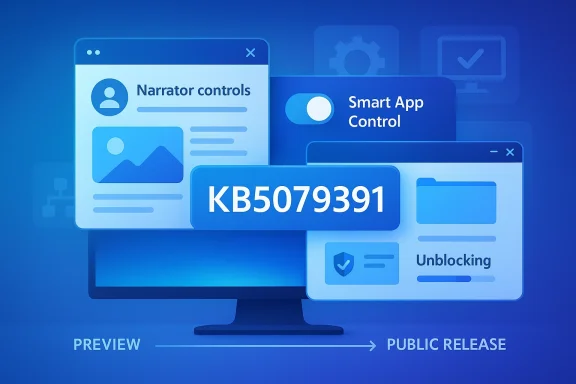
Windows File Explorer window open on blue desktop, with “Smart App Control” enabled and a build ID KB5079391.Background​

Windows 11 has spent much of its life in an awkward position. Microsoft launched it as a polished, modern desktop, but many users experienced it as a tradeoff: cleaner visuals on top, fewer controls underneath. The taskbar became less flexible, File Explorer remained a frequent pain point, and Windows Update continued to feel like an interruption rather than an invisible service. That tension has shaped how the platform is discussed, especially by enthusiasts and IT pros who care less about marketing and more about daily usability.
The current update cycle matters because it suggests Microsoft is finally acknowledging that platform quality matters as much as platform ambition. Insider-era improvements have increasingly focused on responsiveness, control, and consistency rather than just new surfaces for Copilot. In the file search material, the Windows 11 roadmap is described as a kind of public apology tour, with Microsoft trying to address the everyday friction points that make people feel the OS is working against them. That framing may sound dramatic, but it captures the mood well.
One of the more interesting signals is that Microsoft is not only fixing bugs; it is changing the tone of the product. The company has spent years pushing AI features deeper into the shell, yet the newer Insider work appears more selective and restrained. That does not mean Copilot is going away. It means Microsoft seems to be accepting that ubiquity is not the same as usefulness, and that users are more likely to trust AI if it appears intentionally rather than everywhere at once.
The timing also matters because Windows 11 has long been compared with earlier versions of Windows that gave users more freedom. Taskbar positioning, shell behavior, and update timing all became symbols of a broader concern: that the modern Windows experience was becoming more prescriptive. Microsoft appears to be correcting course by restoring some of the lost agency while also working on the basics that never should have regressed in the first place.
In that sense, the latest preview is less about one build and more about a broader philosophy. If the company keeps following through, Windows 11 could become a platform defined by less noise, fewer surprises, and better defaults rather than by a constant stream of features no one asked for. That is still a work in progress, but it is the first time in a while that the direction feels constructive.

What KB5079391 Actually Changes​

The headline changes in the latest preview are not revolutionary, but they are meaningful in context. The build reportedly adds support for 1000Hz refresh rates, improves Smart App Control behavior, and begins rolling out a set of File Explorer fixes that target long-standing usability complaints. Microsoft is also staging many of the changes gradually, which means not everyone will see them immediately after installing the update.

The 1000Hz detail matters less than the precedent​

Support for 1000Hz refresh rates will not affect most people today. Ultra-high-refresh monitors remain niche, and even the first wave of such displays is still just emerging. But the software side matters because Windows has to be ready before the hardware becomes mainstream. That makes the change less about bragging rights and more about ensuring the OS does not become the bottleneck when new display tech arrives.
Smart App Control is a better example of the kind of improvement that can actually change everyday workflow. Microsoft had already said it wanted to improve SAC earlier in the year, and this update finally begins turning that promise into a usability win by letting users toggle it without restarting the computer. That sounds minor, but in Windows terms it is a real quality-of-life improvement because it removes unnecessary friction from a security feature that should feel seamless.
The File Explorer side is where the update starts to feel more important. Microsoft has been criticized for years because Explorer sits at the center of the Windows desktop experience, yet it has often felt sluggish, inconsistent, and awkward in ordinary use. Any update that makes trusted-file handling easier and reduces annoying prompts is immediately more relevant than a spec-sheet display tweak.

Why gradual rollout is both smart and frustrating​

Microsoft’s phased rollout model makes technical sense. It lets the company collect telemetry, catch regressions, and avoid shipping all changes at once if something breaks. But for users, the gradual approach also creates a familiar annoyance: the feeling that Windows improvements are always coming soon rather than simply being available.
That tension has become part of the Windows 11 story. Enthusiasts want visible progress, while Microsoft wants a controlled release process that minimizes risk. The result is a product that often improves in pieces, which can make the overall experience feel slower than the engineering work behind it actually is.
  • 1000Hz support is mostly about future-proofing.
  • Smart App Control gains real usability value.
  • File Explorer remains the most important daily signal.
  • Gradual rollout protects stability but delays gratification.
  • Small fixes can matter more than flashy features.
  • Windows quality is increasingly the real headline.

File Explorer: The Real Test​

If Microsoft wants people to believe Windows 11 is improving, File Explorer is the place to prove it. That app is one of the most frequently used surfaces in the entire OS, which makes its responsiveness a direct measure of whether Windows feels polished or merely decorated. The latest preview’s Explorer-related changes are small on paper, but they matter because they address the exact layer where users feel friction most often.

A daily workflow problem, not a feature problem​

The old criticism of File Explorer is not that it lacks enough features. It is that it often feels slower and less coherent than it should for something so central. That is why many power users have turned to third-party tools or alternatives over the years. Those workarounds are useful, but they are also a sign that Microsoft has left room for others to solve a basic part of the desktop experience.
The recent preview work appears to be aimed at that pain point. Earlier Insider builds already tested things like background preloading to reduce the familiar “cold start” lag, and the newer update continues the theme by making trusted-file handling less cumbersome. Those are not headline features. They are the sort of fixes that users notice only after they stop being annoyed by them.
That distinction matters because Explorer is not just another app. It is the operating system’s file-organizing nerve center, the place where downloads are opened, projects are managed, and routine work gets done. If Microsoft can make Explorer feel snappier and less defensive, the whole OS benefits. If not, Windows 11 will keep carrying the same reputation for polish on the surface and friction underneath.

Trusted-file handling and the “safety versus annoyance” problem​

One of the more practical changes in the update is the improvement to whitelisting trusted files that were downloaded from the internet. In theory, Windows is trying to protect users from risky downloads. In practice, the old behavior often overcorrected and created extra annoyance for people who already knew what they were opening. That is a classic Windows problem: security controls that are technically sensible but operationally irritating.
The value of the new approach is not just convenience. It is trust. When the OS makes a user jump through too many hoops to confirm something they already know is safe, the system starts to feel like an obstacle course. Microsoft seems to be learning that protection works best when it is visible only when needed, not when it gets in the way of routine work.
  • Explorer speed shapes perception of the whole OS.
  • Trusted-file prompts should protect without overblocking.
  • Background preload is a practical, not glamorous, fix.
  • Power users notice Explorer pain first.
  • Third-party utilities exist because Windows left a gap.
  • Usability wins here may matter more than new features elsewhere.

Smart App Control Gets a More Sensible Feel​

Smart App Control has always been one of those features that sounds more compelling in a security briefing than in day-to-day use. Its job is important: help prevent suspicious or untrusted apps from running. But the user experience has historically been clumsy enough that many people only notice the feature when it gets in the way. The latest preview’s ability to toggle SAC without restarting is a small change with outsized practical value.

Security should not feel like a reboot tax​

The core improvement here is obvious once you say it out loud. If a security setting can be turned on or off without restarting, then the feature becomes much easier to test, compare, and live with. That lowers the mental cost of enabling protection, which is exactly what a good Windows security control should do.
It also makes SAC more approachable for both consumers and IT staff. Home users often avoid security features they associate with inconvenience, while administrators tend to care about deployment simplicity and predictable behavior. Removing a restart requirement helps both groups because it reduces the chance that the feature will be treated like a maintenance chore rather than a normal part of the platform.
There is a bigger story here too. Microsoft has been trying to position Windows 11 as more secure without making it feel more restrictive. That balance is hard, and it often breaks down when security features are technically sound but operationally annoying. The SAC update suggests the company is at least trying to solve that tension in a more humane way.

Enterprise and consumer impact are not the same​

For consumers, this is mostly about convenience and confidence. A security feature that can be toggled cleanly is easier to understand and less likely to be disabled forever out of frustration. For enterprises, it is about operational control and reducing the weird edge cases that complicate deployment and support. That is a modest change, but the best enterprise improvements often are.
This is also why the feature matters beyond its immediate scope. Microsoft is learning that the best security posture is not one that demands the most clicks. It is one that users are willing to keep turned on because it respects their time. That may be the most important lesson in the current Windows 11 refresh.
  • No-restart toggles make security easier to adopt.
  • Consumers benefit from less disruption.
  • IT admins benefit from cleaner workflows.
  • Usability is part of security adoption.
  • Respect for time matters in enterprise design.
  • Good controls should feel almost invisible.

Copilot: Less Intrusion, More Intent​

The broader Windows 11 story right now is not just about fixes. It is about restraint. Microsoft appears to be acknowledging that Copilot and related AI features work better when they are intentional rather than omnipresent. That is an important shift because many users have not been opposed to AI in principle; they have been annoyed by the feeling that it was being layered onto everything whether it helped or not.

Why “intentional” is the key word​

The company’s current language is telling. In the file search results, Windows leadership is described as wanting to be more intentional about where Copilot appears. That usually means fewer forced touchpoints, fewer pop-ups, and fewer AI surfaces attached to ordinary tasks that do not need them. In a desktop OS, that restraint can matter as much as the feature itself.
There is a practical reason this matters. When AI is everywhere, it can begin to feel like branding rather than assistance. Users then stop seeing the feature as a tool and start seeing it as a layer they have to work around. Microsoft is better off treating Copilot like a contextual helper than like a banner ad with a chat window.
That does not mean Microsoft is abandoning its AI strategy. It means the company is trying to match the tool to the task. In product terms, that is a healthier place to be, especially for an operating system that still has to serve users who simply want a quiet, reliable desktop.

The competitive angle​

This matters because Windows no longer competes only against old versions of Windows. It competes against macOS, ChromeOS, and even Linux desktops that increasingly appeal to users who want control and predictability. A noisy, overdesigned Windows weakens Microsoft’s argument that the platform is the most flexible productivity environment. A more restrained one strengthens it.
The challenge is obvious: Microsoft needs AI to feel useful without letting it become clutter. That is a delicate balance, and it will require more than one preview build to get right. But the direction is at least promising, because it suggests the company understands that less intrusion can be a feature.
  • Intentional Copilot placement reduces fatigue.
  • Context beats ubiquity in desktop workflows.
  • AI clutter can undermine trust.
  • Restraint may improve adoption more than promotion.
  • Competitors benefit when Windows feels heavy-handed.
  • A calmer shell is a competitive advantage.

1000Hz Support: Important, But Not the Main Event​

The support for 1000Hz refresh rates is the sort of change that generates headlines because the number is easy to understand and easy to overstate. In practical terms, it will matter to a very small slice of users for now. But it is still worth noting because it shows Microsoft making sure the Windows display stack does not become a bottleneck for future hardware.

Why display support matters before adoption​

The point is not that most people need 1000Hz gaming today. The point is that the operating system has to be capable of handling emerging display modes before those modes become more common. That is how platforms stay relevant: by clearing the software path ahead of the hardware curve.
There is also a broader ecosystem effect. Once Windows supports the new modes cleanly, monitor vendors, GPU makers, and display engineers can build around a more predictable baseline. That does not mean every ultra-high-refresh claim will be meaningful in the real world. It does mean the OS will not be the thing holding the industry back.
In that sense, the 1000Hz change is a good example of infrastructure work. It is not sexy, and it will not change how most people use their PCs. But it does show Microsoft paying attention to the next layer of the hardware stack instead of just the current one.

A reminder that specs are not the same as value​

It is easy to get carried away by large numbers in display marketing. A monitor advertising 1000Hz sounds futuristic, but practical user value depends on panel quality, input latency, cable bandwidth, GPU capability, and the actual workload. The operating system supporting the mode is necessary; it is not sufficient.
That is why this update should be read as groundwork, not as proof that the whole ecosystem has leapt forward. Microsoft is removing one barrier. The industry still has to justify the rest.
  • Future-proofing is the real value here.
  • Most users will never notice the change directly.
  • Vendors need OS support before wider adoption.
  • Specs alone do not equal better experiences.
  • Infrastructure work is easy to overlook.
  • The ecosystem moves faster when the OS gets out of the way.

Consumer vs. Enterprise Impact​

Windows changes always land differently depending on who is using the machine. A home user notices whether File Explorer feels snappier and whether a security prompt is less annoying. An enterprise admin cares more about deployment consistency, policy controls, reboot behavior, and how much support overhead a change creates. The latest preview is interesting because it speaks to both groups at once, even if not equally.

Consumers want calm, not just capability​

For consumers, the strongest message is that Windows 11 is becoming less intrusive. Fewer restart headaches, easier file handling, and less friction around security controls are exactly the kinds of improvements that make a PC feel nicer to use. Most users do not want to manage the operating system; they want it to disappear into the background.
That is why the “small” fixes matter so much. A cleaner Explorer interaction or a no-restart security toggle may sound unglamorous, but those details accumulate. Over time, they can change whether a user sees Windows 11 as polished or simply opinionated.

Enterprises care about predictability​

For IT departments, the value lies in reducing unnecessary interruption without weakening control. Better update behavior, clearer security controls, and fewer edge-case annoyances all translate into support savings. Microsoft knows that enterprise trust is earned through consistency, not announcements.
The enterprise challenge is also why Microsoft must be careful. If it gives too much freedom without enough policy structure, it can create security and compliance headaches. If it keeps the experience too rigid, users and administrators alike will keep looking for workarounds. The trick is to build a system that is flexible in the right places and firm in the right ones.
  • Consumers want quiet improvements.
  • Enterprises want controllable change.
  • Support burden falls when friction drops.
  • Policy clarity matters as much as feature richness.
  • Windows trust is built in small interactions.
  • The best update is one people barely notice.

Strengths and Opportunities​

The biggest strength of this update direction is that it targets real pain points instead of pretending Windows 11’s problems are mostly cosmetic. If Microsoft keeps following through, it has a chance to improve the everyday reputation of the platform in ways that matter to both casual users and power users. That would be a meaningful shift from novelty-driven messaging to trust-driven product design.
  • File Explorer improvements address a central workflow.
  • Smart App Control becomes easier to live with.
  • Copilot restraint may reduce user fatigue.
  • 1000Hz support future-proofs the platform.
  • Security and usability are being reconciled better.
  • Gradual repair can rebuild trust over time.
  • Small wins can have an outsized cumulative effect.

Risks and Concerns​

The biggest risk is that Microsoft will continue to make sensible changes that arrive too slowly or too unevenly to change the broader perception of Windows 11. Users have seen enough previews and staged rollouts to know that promising updates do not always translate into meaningful public improvements. If that pattern repeats, this renewed optimism could fade quickly.
  • Partial rollout can blunt the impact.
  • Overpromising can damage credibility.
  • Security controls could become too permissive if mishandled.
  • Copilot placement could still feel inconsistent.
  • Explorer fixes may need deeper work than previews reveal.
  • Gradual delivery can feel like delay, not progress.
  • Enterprise policy conflicts could limit how far changes go.

Looking Ahead​

What happens next will tell us whether Microsoft is truly re-centering Windows 11 around quality or merely smoothing the rough edges while leaving the bigger design philosophy unchanged. The next Insider and preview builds should show whether the Explorer fixes hold up, whether Smart App Control stays easier to manage, and whether the company continues trimming down unnecessary AI clutter. That is where the real proof will be found.
The other thing to watch is whether Microsoft treats these improvements as isolated patches or as the start of a broader pattern. If the company keeps prioritizing usability, predictability, and user control, then Windows 11 may finally begin to feel like a mature operating system rather than a platform still trying to justify itself. That would not solve every complaint overnight, but it would be a real step toward repair.
  • Rollout speed will shape user perception.
  • Explorer performance remains the key benchmark.
  • Copilot restraint must stay consistent.
  • Security UX should keep getting simpler.
  • Update behavior needs to become less disruptive.
  • Enterprise controls will decide how broadly changes can scale.
Windows 11 still has a long way to go before it earns universal confidence, but this update is at least evidence that Microsoft understands the assignment better than it did a year ago. If the company keeps choosing practical improvements over cosmetic noise, the platform could become easier to recommend not because it is trendy, but because it is finally getting out of the way and letting people work.

Source: MakeUseOf The latest Windows 11 update gives me hope Microsoft might actually fix things
 

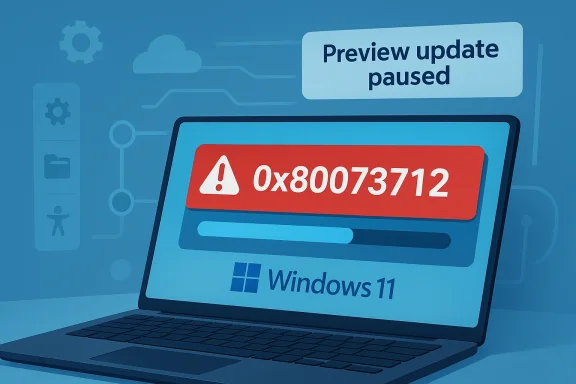
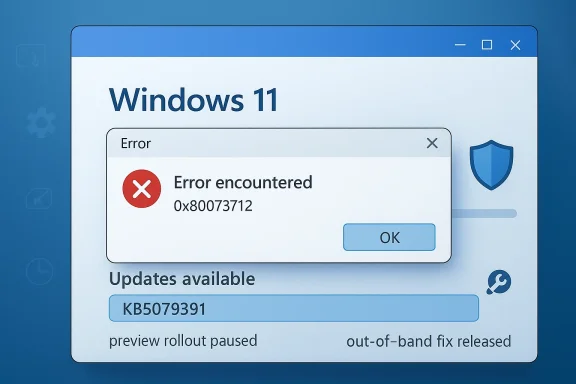
Microsoft’s latest Windows 11 preview update has run into a familiar and frustrating problem: installation failures severe enough to stop the rollout entirely. Microsoft has updated the KB5079391 support entry to say the release was paused because some users hit error 0x80073712, a code Microsoft associates with missing or damaged Windows Update files. That makes this more than a cosmetic hiccup; it is the kind of servicing problem that can undermine confidence in an update before most users have even seen it. pause matters because KB5079391 was not a minor maintenance patch. According to the materials now circulating in Windows-focused coverage and forum discussion, it was the March 2026 non-security update for Windows 11 versions 24H2 and 25H2, shipping with a broad set of usability and platform refinements. Microsoft’s own servicing model for those branches treats monthly preview releases as the proving ground for changes that later flow into the mandatory Patch Tuesday cycle, so a broken preview can ripple into the next required update if the issue is not fixed quickly. ([support.microsoft.microsoft.com/en-gb/topic/march-10-2026-kb5079473-os-builds-26200-8037-and-26100-8037-9c222a8e-cc02-40d4-a1f8-ad86be1bc8b6)
That is why a rollout pause is significant even when the company has not publicly disclosed an exact root cause. In Microsoft’s own support guidance, error 0x80073712 is tied to a missing or damaged file needed by Windows Update, and the company recommends repairing system files with DISM and related tools. When an error code appears in a mainstream update channel, the immediate assumption is not that a single machine is misbehaving; it is that a sizeable portion of the install base may be encountering the same broken state.
The larger context is that Windows 11 servicing has become more complex, not less. Microsoft now maintains separate update histories and release-health pages for 24H2 and 25H2 while also shipping out-of-band fixes when the normal cadence is not fast enough. That layered servicing model helps Microsoft respond faster, but it also raises the stakes when one branch or package misfires, because the company has to decide whether to patch forward, pause the rollout, or both.
This pause also lands in a period when Windows users are unusually sensitive to update quality. March 2026 has already seen the normal Patch Tuesday cycle, follow-up hotpatch activity, and emergency servicing across the Windows 11 family. In other words, Microsoft is not just shipping updates; it is managing a continuous repair pipeline. That makes any installation error feel less like an isolated defect and more like evidence that the pipeline itself is under strain.
--A
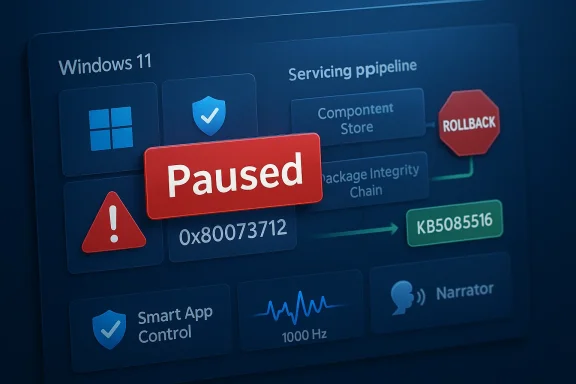
The clearest practical effect of the halt is that users checking Windows Update are no longer being offered KB5079391 in the normal way. Instead, the reporting indicates Windows 11 is now surfacing KB5085516, the out-of-band fix Microsoft released to address Microsoft Account-related issues in Windows apps. That is a strong sign that Microsoft has removed the preview release from broad delivery while it sorts out the servicing problem behind the scenes.
That kind of pause is not unusual in principle, but it does carry a specific implication. Microsoft usually wants preview updates to act as the final validation step before non-security improvements are merged into the more widely deployed monthly release. When a preview is pulled back, it means the company would rather delay feature improvements than risk shipping a package that can fail installation on enough systems to become a support liability. That is the right move operationally, even if it frustrates users who were expecting the new features.

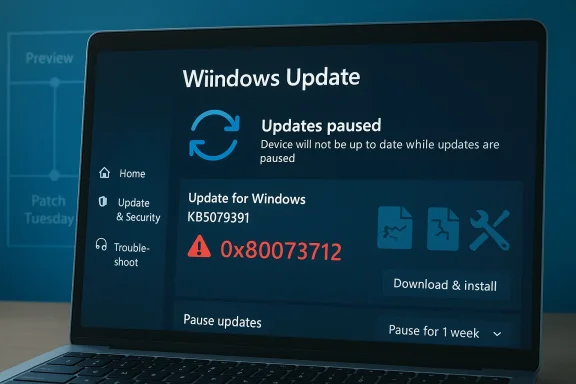
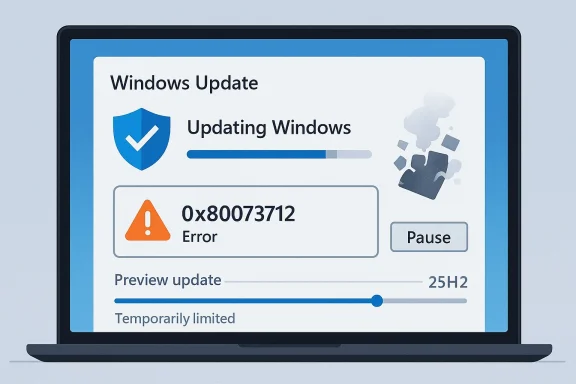
Laptop screen shows Windows Update paused with error 0x80073712 for update KB5079391.Why a pause is more serious than a normal bug​

A bug in a preview build is one thing. A bug that forces Microsoft to stop rollout is another. The distinction is important because it suggests the issue was not limited to an edge case or to a narrow hardware configuration, but was serious enough to trip Microsoft’s internal release threshold. In practical terms, that usually means telemetry, support signals, or install failure rates were pointing in the wrong direction.
For Windows users, that is a mixed blessing. On the one hand, stopping distribution prevents more machines from being affected. On the other hand, it also means the update was bad enough that Microsoft could not simply let the rollout continue and promise to clean up later. That is a reminder that even preview updates are not harmless experiments; on Windows, they are part of the production servicing chain.
  • The update was paused after installation errors surfaced.
  • Microsoft has not yet said which systems are most affected.
  • Error 0x80073712 is associated with missing or damaged update files.
  • The pause appears to affect the broad rollout, not a tiny test group.
  • Microsoft has not publicly given a return date for the update.

The Error Code Matters​

Error 0x80073712 is not random noise. Microsoft’s own troubleshooting material says the code usually means a file needed by Windows Update is damaged or missing, and it suggests running DISM or the Windows Update Troubleshooter as a first-line repair. In other words, the code points to corruption or incomplete servicing state, not just a flaky network connection or a temporary server problem.
That matters because it narrows the likely failure modes. If users are seeing 0x80073712 during an otherwise routine install, the underlying issue could be in the component store, the update cache, or the package itself. Microsoft has not disclosed which of those is responsible for KB5079391, but the fact that the company paused rollout suggests the failure was not limited to a few obviously broken endpoints.

What 0x80073712 usually signals​

Microsoft’s guidance is consistent across languages and support pages: 0x80073712 usually means a required update file is missing or damaged. The recommended response is to repair system files, clear damaged update state, and retry the install. That is a good clue that the bug may involve servicing integrity rather than an issue confined to a single feature in the preview update.
For home users, this often looks like “Windows Update just won’t finish.” For admins, it looks worse, because repeated install failures can break rollout rings, stall image refresh cycles, and create false confidence that a package has deployed successfully when it has not. That is why installation error codes often become enterprise incidents long before they become consumer headlines. (support.microsoft.com)
  • 0x80073712 usually points to missing or damaged servicing files.
  • DISM repair is Microsoft’s default first-step remediation.
  • Rebooting alone is often not enough if the component store is affected.
  • Repeated failures can distort update compliance reports.
  • The code is often a sign of deeper update-state corruption.

What KB5079391 Was Supposed to Bring​

The preview update itself was not trivial. Reporting around the release said KB5079391 included Narrator improvements, a change to Smart App Control so it no longer requires reinstalling Windows to re-enable itself, and display-related enhancements for very high refresh-rate monitors, including support for 1000Hz-plus panels. Those kinds of quality-of-life changes do not usually dominate headlines, but they are exactly the kind of refinements that make a monthly preview worth shipping.
That is why the rollback stings. Users who ibility improvements or smoother multi-display behavior now have to wait while Microsoft resolves a servicing issue. The irony is hard to miss: a release meant to improve reliability is itself being held back because reliability is in question. That is not unusual in Windows land, but it is never a good look.

Why these features matter​

Narrator changes matter because accessibility is not a side feature anymore; it is a core part of Windows usability. Smart App Control matters because many users have long complained about the friction involved in re-enabling it after turning it off. Display support matters because high-refresh monitors are moving from enthusiast gear into mainstream productivity setups. Taken together, these updates point to Microsoft trying to modernize Windows in places that real people actually notice.
That makes the installation failure more frustrating than a simple cosmetic bug would be. If a patch only added an obscure admin setting, it would be easier to ignore. But when the package contains accessibility, security, and display polish, the delay becomes a reminder that servicing quality can block user-facing progress just as much as design decisions can.
  • Accessibility fixes affect a broad range of users.
  • Smart App Control changes reduce friction for security-conscious users.
  • High-refresh display improvements target newer PC hardware.
  • Preview updates often seed the next mandatory monthly build.
  • A failed preview can delay features that were close to mainstream release.

Why Microsoft Pulled the Plug Now​

The timing suggests Microsoft acted quickly once the install issue became visible. That is consistent with how handling Windows 11 servicing this year: if a bug shows signs of broad impact, Microsoft increasingly prefers to pause, patch, and re-release rather than let a flawed package keep spreading. The company’s own recent support documentation for Windows 11 24H2 and 25H2 shows how heavily it relies on release health monitoring to manage such decisions.
There is also a strong practical reason to stop rollout of a preview update rather than wait for Patch Tuesday. Preview builds are not mandatory, but they are supposed to be stable enough to validate the next month’s cumulative changes. If the preview cannot be installed cleanly, then Microsoft loses an important testing signal before the update family becomes compulsory. That makes a pause far more than a public-relations move; it is a servicing-control decision.

The Patch Tuesday pressure​

Microsoft over two weeks before the April 2026 Patch Tuesday window, which means the company has a narrow window to decide whether KB5079391 can be repaired and reintroduced. If it cannot, then the fixes and features it carried may need to wait for the next servicing train. That kind of delay is not catastrophic, but it does complicate Microsoft’s promise that Windows 11 updates will become more predictable and reliable.
There is a broader strategic issue here too. Microsoft has publicly talked about improving Windows Update reliability and even allowing indefinite pauses, which suggests it knows trust in the update process is an unresolved problem. A pullback like this reinforces the sense that Microsoft is still in the middle of that credibility repair. The company can promise better updates to prove it in the field.
  • Microsoft has a short window to fix and reissue the update.
  • Preview updates feed the mandatory monthly cycle.
  • Release health monitoring appears to guide the pause decision.
  • Reliability promises are only as strong as the next rollout.
  • Delays can compound if preview fixes miss the monthly cutoff.

Consumer Impact​

For consumers, the immediate consequence is simple: the new features stay on hold, and the update menu becomes less cluttered. That sounds benign, but it also means ordinary users are now relying on Microsoft to clean up a servicing issue they never asked for in the first place. For most people, update reliability is invisible right up until it breaks, and then it becomes the only thing that matters.
The consumer experience is especially sensitive because Windows 11 has increasingly tied everyday tasks to cloud identity, app syncing, and update-driven feature changes. When a quality update goes wrong, users do not just lose a convenience feature; they can lose confidence that the next automatic install will be safe. That erosion of trust is difficult to measure, but it is very real.

What home users should infer​

Home users should not panic over the pause itself. A removed preview is usually a sign that Microsoft would rather fix the problem than let it spread. Still, users who were eager to get the latest accessibility or display improvements should understand that the delay reflects a real installation issue, not a routine staggered release.
If the update eventually returns, it will likely do so with a revised servicing approach or after Microsoft confirms the failure pattern has been cleared. That means the best consumer posture is patience, not manual force-install attempts. Chasing a preview package that Microsoft has already paused is usually not worth the trouble.
  • Home users lose access to the latest preview improvements for now.
  • The pause reduces the chance of more failed installs.
  • Manual workarounds can be riskier than waiting.
  • Feature previews often return in a corrected package.
  • Trust in Windows Update matters as much as the features themselves.

Enterprise Impact​

Enterprises will care about this differently. A preview pause is not just a missed feature window; it is a warning signal for patch-ring governance, image validation, and compliance reporting. If KB5079391 was failing broadly enough to trigger a rollout stop, IT teams will want to know whether their own update automation already touched affected systems and whether any repair actions are required.
The enterprise angle is also important because Windows 11 now sits inside a much wider operational ecosystem. Update problems can cascade into image rebuild schedules, application compatibility testing, help-desk volume, and device baselines. A pause at the servicing layer can therefore disrupt work that has nothing to do with the visible features in the update notes.

Why admins will notice first​

Admins are the people who see these failures at scale. Even if only a fraction of endpoints are affected, that fraction can become enough to force a policy change. Microsoft’s own guidance around Windows Update errors emphasizes repair tools, troubleshooting steps, and careful checking of update history, which is exactly the sort of discipline enterprise teams need when a release misbehaves. (support.microsoft.com)
A paused preview also complicates ringed deployment. If one pilot group got the update before the rollback and another did not, the organization can wind up with mixed servicing states that make troubleshooting messy. That is why a seemingly modest update failure often becomes a process problem, not just a technical one.
  • Mixed baselines can make troubleshooting harder.
  • Pilot rings may already contain partially updated systems.
  • Compliance dashboards may show inconsistent states.
  • Image refresh cycles can be delayed by a bad preview.
  • Help desks often absorb the first wave of confusion.

Microsoft’s Update Strategy Under Pressure​

This incident also says something about Microsoft’s broader update strategy. The company has spent the past year talking about reliability, staged rollout, and faster remediation, but every pause reminds users that Windows Update is still a high-stakes system with real failure modes. Even a non-security update can become a news event if it causes enough installation trouble.
That pressure is not unique to Microsoft, but it is more visible here because Windows is so widely deployed and so tightly coupled to both consumer and enterprise expectations. Microsoft has to satisfy casual users who want nothing to go wrong, power users who want control, and administrators who want predictable servicing. Those goals do not always align, and rollout pauses are what those tensions look like in practice.

Reliability versus velocity​

Microsoft wants velocity because the platform is now moving too quickly for old servicing assumptions. But it also wants reliability because one bad update can undo months of trust-building. That is the central tension in modern Windows maintenance: the faster Microsoft moves, the more visible its mistakes become. Speed without confidence is just faster disappointment.
The company’s recent willingness to ship out-of-band fixes shows it understands the problem. Yet every emergency patch also underlines how much of Windows now depends on quick reaction rather than perfect first-pass quality. That is efficient in the short term, but it raises expectations that every monthly update will now be judged like a production release in a cloud service. ([support.//support.microsoft.com/en-us/topic/march-16-2026-hotpatch-kb5084897-os-builds-26200-7984-and-26100-7984-out-of-band-74c779d7-e666-49a2-a809-1cbb31a79e7f)
  • Faster servicing raises the stakes for quality control.
  • Rollback capability is now part of Microsoft’s public reputation.
  • Release health transparency matters more than ever.
  • Out-of-band fixes are becoming standard rather than exceptional.
  • Users now expect cloud-like reliability from a local OS.

Strengths and Opportunities​

The silver lining is that Microsoft appears to have caught the problem before it became a wider mess. Pausing a rollout is not glamorous, but it is exactly what a mature servicing organization should do when update failures start to look systemic. It also gives Microsoft a chance to improve the package rather than letting the flaw infect the next mandatory build.
  • Microsoft acted before the bug became entrenched.
  • The pause likely reduced the number of affected devices.
  • The company still has time to fold fixes into April servicing.
  • Update health telemetry can help narrow the root cause.
  • Users may ultimately receive a more stable package.
  • The incident reinforces the value of release-health monitoring.
  • Microsoft can use the pause to improve internal validation.

Risks and Concerns​

The obvious risk is trust erosion. Users remember when an update fails, even if the fix arrives later, and repeated servicing incidents can make people more reluctant to install optional releases at all. That reluctance can backfire, because preview updates are meant to de-risk the next month’s mandatory patch.
  • Trust in Windows Update can suffer after a public rollback.
  • Optional updates may see lower adoption if users become cautious.
  • Enterprise teams may extend pilot cycles, slowing adoption further.
  • Mixed system states can create harder support cases.
  • Microsoft may have to compensate with more emergency servicing.
  • A delayed preview can compress the next release schedule.
  • Repeated issues can make Windows feel less predictable.

Looking Ahead​

The next few weeks will tell us whether KB5079391 returns as a corrected preview or gets folded into a later cumulative update. If Microsoft can fix the install path cleanly and communicate the resolution clearly, the damage may be limited to a brief delay and a few annoyed early adopters. If not, the update will become another data point in the case against Windows Update’s reliability.
What matters most now is whether Microsoft treats this as a one-off servicing defect or a symptom of a broader quality problem in the Windows 11 update pipeline. The company has already said it wants to improve update reliability and make Windows Update less disruptive, which means the credibility test is ongoing. Users and administrators will be watching not just for a fix, but for evidence that the fix was delivered with less friction than the bug.
  • Whether KB5079391 returns before the April 2026 Patch Tuesday cycle.
  • Whether Microsoft identifies a specific cause for 0x80073712 in this case.
  • Whether the fix is reissued as a revised preview or a later cumulative build.
  • Whether Windows Update reliability visibly improves in coming releases.
  • Whether enterprise admins see better consistency across rollout rings.
Microsoft can afford to miss one preview release, but it cannot afford to keep teaching users that every optional update is a gamble. The real story here is not that a Windows 11 feature update stumbled; it is that the update process itself is still the product. When that process fails, even briefly, it exposes the fragile bargain at the center of modern Windows: constant improvement, delivered continuously, with just enough stability to keep people from turning updates off entirely.

Source: Neowin Microsoft stops rollout of the latest Windows 11 feature update due to installation errors
 

Microsoft has quietly hit the brakes on a Windows 11 rollout that was supposed to do the opposite: make the platform feel a little more polished, a little more capable, and a little less clunky. Instead, KB5079391 has become another reminder that Windows servicing is now as much about trust as it is about features, with reports of error 0x80073712 forcing Microsoft to pause distribution and redirect users toward an out-of-band replacement, KB5085516. The immediate problem is technical, but the larger story is familiar: when an update cannot install cleanly, the damage spreads far beyond the bug itself. Windows users remember update failures, and enterprises remember them even longer. 0e it was not just a routine housekeeping patch. Coverage in the WindowsForum files shows it as a March 2026 non-security update for Windows 11 versions 24H2 and 25H2, with changes that included Narrator improvements, Smart App Control refinements, and display support for extremely high refresh-rate monitors, including panels beyond 1000 Hz. Those are the kinds of changes that do not usually grab headlines, but they do show how Microsoft is trying to make Windows 11 feel more modern in the places users actually notice.
That is exactly why the rollback mattersafer, optional place where Microsoft validates what will later flow into the mandatory servicing track. When a preview package develops a broad install problem, the issue is not confined to early adopters; it becomes a warning about the quality of the servicing pipeline itself. In practical terms, Microsoft is not just pulling one update. It is protecting the credibility of the next one.
The error code at the center of the problem, 0x80073712, is not random Windowoas repeatedly associated that code with missing or damaged servicing files, which makes it a strong signal that the fault sits somewhere in the update chain, component store, or package integrity path rather than in a normal user-facing feature toggle. That distinction matters because it changes the diagnosis from “one bad patch” to “a servicing problem that can spread across installations.”
WindowsForum’s recent coverage also shows that Microsoft has been busy with multiple March 2026 update threads across 24H2 eparate fixes for WUSA network-share installation failures and other servicing issues. In other words, KB5079391 arrived during a month when Microsoft was already trying to tidy up a busy update surface. The pause suggests that, at least for this package, the company decided the risk of leaving it live was higher than the inconvenience of temporarily withholding it.

A digital visualization related to the article topic.Overview​

The most important thing to understand is that this incident is not just about one broken download. It is about Microsoft’s willingness to interrupt its oe or install failure rates cross a threshold that looks unacceptable. That may frustrate users waiting for the latest improvements, but it is also a sign that Microsoft is treating release health more seriously than it once did.
For consumer users, the immediate effect is fairly simple: KB5079391 is no longer being broadly offered through Windows Update, and KB5085516 is now being surfaced instead. For Microsoft, that means the companb-related fix path while it works out whatever is behind the installation failure. For everyone else, the update pause is a reminder that optional patches are no longer harmless extras; they are part of the production lifecycle.

Why the pause is significant​

A paused rollout is more serious than a normal bug report because it suggests Microsoft saw a pattern, not an isolated complaint. That usually means the company concluded the problem was large enough to affect more thrll path. It also means the risk was big enough to warrant stopping distribution rather than simply warning users to proceed with caution.
The broader significance is that Microsoft now operates Windows Update like a cloud service with live rollback logic. That can be a good thing, because it limits damage. But it also raises expectations: if Microsoft can pause a release, users will expect it to do so quickly and explain clearlympany leans into staged rollout and release health, the more each visible failure becomes a test of credibility.

What 0x80073712 usually means​

Microsoft’s guidance around 0x80073712 has been consistent across support communities: the code usually points to a corrupt, incomplete, or missing component needed by Windows Update. That is why Microsoft advice in related cases often starts with DISM, system file checksinstalls. The error is less about a flaky network and more about servicing integrity.
That makes the KB5079391 issue particularly awkward. If the update package itself is what trips the failure, the problem is not just inside the operating system image already on the PC. It may be in the way the package is staged, validated, or installed across enough machines that Microsoft had to pull the update entirely. That is a much tougher category of problem than a single misbehaving feature.

What KB5079391 Was Meant to Deliver​

The appeal of KB5079391 was that it targeted practical annoyances rather than theoretical platform polish. WindowsForum’s reporting says the package included fixes for WUSA network-share .msu installations, improvements to Narrator, refinements to Smart App Control, and display enhancements for ultra-high-refresh monitors. Thosas feel more complete, especially for power users and anyone living with the OS every day.
That matters because optional updates are increasingly where Microsoft tries out the changes users actually feel. Accessibility upgrades help more people use the system comfortably. Smart App Control changes reduce friction for security-conscious users. Display and shell refinements help Windows compete with itself, not just with rival desktops.

Accessibility and everyday usability​

Narrator improvements are not a ern in which accessibility is treated as a baseline requirement rather than a niche add-on. When updates in this class work, they expand what Windows can do for more users without forcing a separate feature cycle.
That is why a blocked rollout stings. Accessibility work often lands in the same bucket as “quality-of-life” fixes, but its impact is el suggests. If Microsoft is serious about a more inclusive Windows, then these are not optional luxuries; they are core platform work that should ship reliably.

Smart App Control and system trust​

The Smart App Control change is one of the more interesting pieces because it points to Microsoft trying to reduce friction in at users often disable and then hesitate to re-enable. In that sense, the update was nudging Windows toward a more forgiving security model, where a user does not have to perform a reinstall just to restore a protection setting. That is a meaningful usability improvement.
It also reflects Microsoft’s broader strategyave to be tolerable before they become widely adopted. If the enable-disable-re-enable loop feels punitive, users will avoid the feature altogether. Making the control easier to manage is a small change with outsized strategic value.

Why Microsoft Pulled the Plug​

Microsoft’s decision to stop the rollout appears to have been driven by the scale and consistency of the failure reports rather than by a single dramatic outage. In the world of Windows servicitelemetry from the field showed too many installs failing to justify keeping the package live. It is the kind of decision that is invisible when it works and embarrassing when it does not happen fast enough.
There is also a clear operational logic to the pause. Preview updates are designed to validg wave, not to create new support problems. If Microsoft had let the rollout continue, it could have contaminated the data used to judge the health of the next cumulative update, making the problem more expensive to unwind later.

The servicing-chain problem​

Windows Update is no longer just a download service. It is a chain of decisions, from offer selection to package staging to component-store updates to reboot orchestration. A failure in any parkk broken, even if the visible symptom is just an install code. That is why a code like 0x80073712 can trigger a broad rollback instead of a simple patch note.
This is also why Microsoft’s communications matter so much. A quiet pause can look like an admission that the company does not fully understand the fault. A clear explanation, by contstration into patience. When Microsoft does not explain the root cause, users fill in the blanks themselves, and those blanks usually skew negative.

Timing relative to Patch Tuesday​

The calendar makes the decision even more interesting. KB5079391 was close enough to the next Patch Tuesday cycle that Microsoft had only a narrow window to repair and reissue it. That leaves the company with a straightforward but difficult nch quickly, or fold the changes into a later servicing train and accept the delay.
For users, the consequence is that the preview’s features may be deferred even if they were already close to release. For Microsoft, the pressure is reputational as much as technical. A broken preview on the eve of the next monthly cycle raises the question of whethern process is keeping pace with the platform’s complexity.

KB5085516 as the Replacement Path​

Microsoft’s move to surface KB5085516 in place of KB5079391 signals a familiar pattern: when one package goes bad, the company tries to route affected users into a safer servicing lane. That does not mean the old problems vanish; it means Microsoft is trying to keep the platform movitf-band label is important because it usually implies urgency. Out-of-band updates are the kind Microsoft uses when it needs to fix a particular issue without waiting for the regular monthly rhythm. In this case, the focus appears to be Microsoft account-related problems rather than the broader feature set that made KB5079391 notable in the first placement updates say about Windows servicing
Replacement updates are a confession of sorts. They tell users that Microsoft would rather alter the servicing path than leave a problematic package in circulation. That is good operational behavior, but it also tells us how fragile the monthly update stack can be when a defect leaks from preview to broad distribs that Microsoft can often redirect users without asking them to understand the underlying root cause. The downside is that the update experience starts to feel less like a stable maintenance schedule and more like an emergency response system. That is not inherently bad, but it does make the operating system feel more cloud-like and less predictable.

The acyoft is emphasizing account-related issues in the replacement update is revealing. Windows 11 increasingly depends on Microsoft identity for syncing, activation-adjacent workflows, OneDrive integration, and cross-app continuity. If there is a bug in that layer, it affects more than a single app window; it affects the whole productivity stack.​

That is why Microsoft would want to fix from the rest of the package. It is a tactical way to reduce blast radius while the team investigates whether KB5079391’s install issue and the account bug share any common servicing roots. Even if they do not, grouping them too aggressively would only make the rollout more fragile.

Consumer Impact​

For home users, the pause is mostly a waiting game. The to accessibility, display behavior, and general polish are delayed, while the update menu becomes less confusing because the broken package is no longer being pushed. That is frustrating, but it is also a relief for anyone who has ever watched Windows Update loop through failures and made a simple task feel like a diagnosis session.
The deeper consumer issue is trust. Most users do not care whsed by component-store corruption, a package validation defect, or an installer bug. They care that a routine update no longer behaves routinely. Once that happens, the operating system’s background maintenance starts to feel intrusive rather than helpful.

Why ordinary users notice these failures​

Windows updates are supposed to disappear W becomes visible in the worst possible way: it interrupts the user, consumes time, and often offers a code that means nothing to a normal person. That is where the support experience matters as much as the engineering.
The problem is not just the failure itself, but the effort required to interpret it. If a user sees 0x80073712, they are unlikely to know whether to reboot, repair files, or wait for Microsoft to re-release the upd reliability has become such a sensitive subject among Windows enthusiasts.

Consumer-grade patience is finite​

There is also an emotional cost. Consumers are more forgiving of a one-off delay than of repeated servicing drama, but their tolerance drops quickly when the system starts to feel unstable. A few incidents like this do not br do chip away at the feeling that updates are safe by default.
That erosion matters because many users now see Windows updates as the gatekeeper for everything from app compatibility to security features. If the update process itself looks unreliable, the entire OS starts to feel more fragile, even if the underlying desktop experience is unchanged.

Enterprise Impact​

Enterprise teams will read this incident differently. They are less concerned about missing a display tweak and more concerned that a preview update failed in a way that could distort rollout rings, compliance dashboards, and pilot validation. In a managed environment, a broken optional update can become a planning problem, not just is especially true because enterprises often use preview channels to estimate risk for the next mandatory patch. If the preview is unstable, admins get less trustworthy data about what the next cumulative update will do. That means more caution, more delayed deployment, and more pressure on IT teams to justify why a rollout should proceed at all. managed environments
When update failures occur in business fleets, the visible issue is often not “this one PC didn’t update.” It is a pattern of mixed baselines that makes support more difficult. Some devices may have partially staged changes, some may have failed silently, and some mayxt ring. That kind of inconsistency is poison for endpoint management.
For admins, the pain point is that a failure code can hide a systemic servicing weakness until it is too late. A package that seems fine in test may fall apart in wider deployment, especially if the issue only appears under specific conditions such as network-share installs or particular component-ses the case for disciplined pilot rings even stronger.

Why the 24H2 and 25H2 branches matter​

The fact that this problem spans Windows 11 24H2 and 25H2 is important. It tells us the issue is not confined to an obscure legacy branch or a single insider track. Microsoft is dealing with current servicing lines that matter to both consumer and entow.
That also means IT teams cannot dismiss it as a niche preview hiccup. If a package on active branches can be pulled because of install failures, organizations have to assume that next month’s update path may need more validation than usual. That is exactly the sort of signal that makes admins extend pilot cycles and delay broader deployment.

Strengths and Opportunities​

The good news is t to have moved quickly once the failure pattern became clear, which likely limited the number of affected devices. It also preserved the option to correct the package before the next mandatory servicing wave. In that sense, the pause was a failure of the update, not a failure of response.
  • Microsoft acted before the bug could spread further.
  • *Release-health telemetiThe pause gives the company time to rebuild the package cleanly.**
  • Users avoid a larger wave of failed installations.
  • Enterprises get a clearer signal to slow down rollout.
  • The replacement path via KB5085516 suggests Microsoft is still servicing the issue.
  • **The episode may produce a more robust update
    s
The obvious downside is trust erosion. Every public rollback teaches users that even optional updates can be brittle, and repeated incidents make people more reluctant to install future releases. That reluctance can become self-reinforcing when preview updates are supposed to act as the test bed for the next patch cycle.
  • Trust in Windohit.
  • Optional updates may see lower adoption after visible failures.
  • IT departments may extend pilot testing and slow deployment.
  • Mixed update states can make troubleshooting harder.
  • A delayed preview can compress Microsoft’s next release window.
  • If root cause communication stays vague, speculation fills the gap.
  • Repeated serm predictable.
The more subtle concern is that Microsoft may be normalizing emergency behavior. Out-of-band updates are useful, but if they become too common, they can make the main update cadence feel like a sequence of corrections rather than a dependable service rhythm. That is not where Microsoft wants the Windows brand to land.

What to Watch Next​

The next few weeks will show whether KB5079391 returns as a repaired preview or gets absorbed into a later cumulative update. Much will depend on whether Microsoft can isolate the install failure quickly and whether the company decides the release is still worth preserving as a discrete package. If the problem turns out to be deeper than a simple servicing regression, the features may wait for the next train.
The other thing to watch is communication. Mi to publish every internal detail, but users do need to know whether the failure sits in the component store, the package metadata, or some interaction between the installer and a subset of devices. The more specific the guidance, the faster support teams can stop treating every 0x80073712 case as a mystery.

Key signals to monitor​

  • Whether Microsoft relists KB5079391 after a fix.
  • Whether KB5085516 remains the preferred replacement path.
  • Whether the same install error appears on 24H2 and 25H2 broadly.
  • Whether Microsoft updates the release-health entry with a clearer root cause.
  • Whether enterprises delay adoption of the next optional update.
  • Whether similar servicing issues appear in adjacent March 2026 packages.
What matters most is not whether Microsoft empany can keep proving that Windows servicing is becoming more reliable over time. If KB5079391 is re-released cleanly, the episode will fade into the archive of update hiccups that happen to every major platform. If it is not, then it becomes another exhibit in the case that Windows Update still has a credibility problem.
The broader lesson is that Windows 11 is now judged less like a static operating system and more like a living b, faster feature delivery, and the ability to pull a bad package before it does wider harm. But it also raises the stakes on every release, because each failure is public, measurable, and remembered. Microsoft can afford to pause an update; what it cannot afford is for users to conclude that every new patch is a gamble.

Source: Windows Report https://windowsreport.com/windows-1...80073712-installation-error-disrupts-rollout/
 

Microsoft’s decision to pull the Windows 11 KB5079391 preview update is a reminder that servicing quality still matters more than ambitious roadmaps. The optional March 2026 release reportedly triggered install failures and an error loop on some systems running Windows 11 24H2 and 25H2, with Microsoft temporarily limiting availability while it investigates the root cause. That kind of rollback is unusual, and it lands at exactly the wrong moment for a company trying to convince users that Windows Update is becoming less frustrating, not more. Microsoft’s own support guidance still frames Windows Update as something you can pause, schedule, and manage, but the company’s recent behavior shows how fragile trust can be when a bad package slips through.

A digital visualization related to the article topic.Background​

Windows Update has always lived under a peculiar tension. On one hand, it is the delivery system for security fixes, quality improvements, and the occasional new feature; on the other, it is the place where many users first encounter the cost of imperfect engineering. The KB5079391 incident fits squarely into that long-running story, because preview updates are meant to be low-risk, optional servicing releases that help Microsoft validate fixes before a broader rollout. When even that layer falters, the problem is not just one update but the confidence behind the entire servicing pipeline.
Windows 11’s current servicing model has been especially complex because Microsoft is supporting multiple active branches at once, including 24H2 and 25H2. Those releases often share a common foundation while still moving through different deployment and validation phases, which makes update stability even more important. Microsoft’s own Insider communications repeatedly describe release waves in terms of gradual rollout and normal rollout, underscoring how carefully staged modern Windows servicing is supposed to be. In practice, that also means a defect can spread through a release train quickly if it is not caught early.
The error cited in this case, 0x80073712, is particularly telling because it points to missing or damaged assembly components, not a simple download hiccup. Microsoft’s language around the issue says some update files are missing or problematic, and that the update rollout was paused to prevent additional impact while the issue is investigated. That is the kind of phrasing you expect when the servicing stack itself is intact, but the payload or its dependency chain is not. It also explains why this problem can produce a loop: the system keeps trying, keeps failing, and keeps returning to the same blocked state.
The timing makes the story more interesting. Microsoft has publicly emphasized improvements to Windows in 2026, including usability work, faster core experiences, and more control over update behavior. At the same time, the company is still dealing with the reality that even a preview patch can knock some PCs into an error state. That tension is not new, but it is becoming more visible because Windows 11 is increasingly marketed as a platform that should feel modern, predictable, and responsive. A broken optional update cuts directly against that message.

What Happened With KB5079391​

The core story is straightforward: Microsoft temporarily pulled KB5079391, an optional preview update for Windows 11, after some users encountered install failures and error loops. The update was briefly offered on March 26, 2026, then became unavailable again while Microsoft investigated reports of installation problems. Microsoft has said the update’s rollout is limited for now, and that it may not be offered again until the underlying issue is understood.

The error code matters​

The most visible failure mode appears to be 0x80073712, a code associated with missing assembly files in the WinSxS component store. That detail matters because it suggests the failure is not merely cosmetic; it affects the servicing framework Windows uses to assemble and maintain system components. In plain English, Windows was trying to apply the update, but something essential in the component chain was absent or malformed.
Microsoft’s own wording is unusually blunt for a preview release: “Rollout of this update is temporarily paused due to installation error 0x80073712.” It also warns that some devices may see a message indicating that update files are missing or corrupted, and that Windows will retry later. Those are the kinds of messages users often associate with cumulative updates, but seeing them in an optional preview build is a reminder that preview status does not guarantee preview-grade isolation from real-world frustration.

Why a temporary pull is notable​

Microsoft does not usually yank Windows updates unless the problem is significant enough to justify breaking normal availability. That is why the temporary pause is newsworthy even beyond the specific defect. It suggests the issue was serious enough to outweigh the inconvenience of limiting a release that had already started to reach users.
A pulled preview update also creates a practical split between transparency and trust. On one hand, Microsoft is admitting the problem and stopping the bleed. On the other hand, users who were counting on the update, or who were already stuck in the install loop, are left waiting for a fix with little detail about what went wrong. That is a familiar pattern in Windows servicing, but it never feels good on the receiving end.
  • The update was optional, not mandatory.
  • The rollout appears to have been brief.
  • Microsoft limited availability after the defect surfaced.
  • The company has not yet shared a technical root-cause explanation.
  • Affected devices may repeatedly fail during installation.

Why Preview Updates Still Break Trust​

Preview updates are supposed to absorb risk before a fix reaches everyone, yet they are also the updates enthusiasts often install first because they want new features early. That creates a tricky expectation gap: users understand they are testing the bleeding edge, but they still expect the release to be stable enough to install. When a preview patch fails to install at all, it undercuts the point of preview distribution.

Optional does not mean harmless​

This distinction is important. An optional update may not be required for security compliance, but it can still alter system state, update components, or prepare the device for future servicing. That means a bad preview can have outsized consequences even if it is never marked as critical. In enterprise environments, optional updates are often treated cautiously for exactly this reason.
For consumers, the pain is different. A home user usually wants one thing: click install, walk away, come back to a working PC. When that turns into a loop of failures and retries, the promise of Windows as an automatic platform begins to feel like a burden. The issue is not just the error code, but the loss of control that comes with it.

The servicing stack is part of the product​

A lot of users think of an update as a single file or single patch, but Windows servicing is a layered system involving component manifests, dependency checks, the update engine, and the component store. If one of those layers is inconsistent, the update can fail in ways that are difficult to diagnose without deeper logs. The WinSxS mention is a clue that this was likely a component-assembly problem rather than a simple network issue.
That matters because servicing reliability is not a side feature. It is the mechanism by which every other improvement gets delivered. If Microsoft wants users to accept more frequent refinements, faster feature drops, and more ambitious Windows evolution, it has to make the update plumbing feel invisible. When the plumbing leaks, everything else looks less impressive.
  • Preview status should lower expectations, but not destroy them.
  • Optional updates still influence system reliability.
  • Component-store failures are harder for users to recover from.
  • Repeated failures can erode confidence in future updates.
  • Servicing quality is part of the Windows brand, not just an IT detail.

Microsoft’s 2026 Windows Messaging​

Microsoft has been publicly talking about making Windows faster, cleaner, and more predictable. That includes user-interface changes, performance work, and updates to Windows Update behavior. The company’s message is that it wants Windows to feel less intrusive and more controllable, with improvements that make the operating system easier to live with day to day.

A better update experience is part of the promise​

Microsoft has said users should get more control over the update process, including the ability to skip updates during device setup, restart or shut down without installing updates, and pause updates for longer when needed. That is a meaningful acknowledgment that update friction is one of Windows’ most visible pain points. If the company can deliver those controls without increasing support complexity, the payoff could be real.
But a promise is not a product. If the current update pipeline still produces failures severe enough to force a temporary pull, users will judge Microsoft on the lived experience, not the roadmap language. The irony is hard to miss: the company is talking about reducing annoyance while users are seeing evidence of the exact opposite.

Why the UI story and the servicing story are linked​

It is tempting to treat interface changes and update reliability as separate conversations. They are not. A faster Start menu, a more responsive File Explorer, and a more configurable taskbar are all only valuable if the platform remains trustworthy during upkeep. If Windows Update is flaky, then even the best UI improvements arrive under a cloud.
That is why preview update failures can have strategic weight. They shape how users interpret the entire platform narrative. Microsoft is trying to sell a version of Windows that feels modern and calm, but moments like this remind people of the old Windows stereotype: powerful, yes, but occasionally temperamental.
  • Microsoft is pitching a less frustrating update experience.
  • User control is being positioned as a major theme.
  • Performance and servicing are being marketed as connected goals.
  • Reliability incidents can overshadow feature improvements.
  • Trust in updates is as important as new functionality.

Consumer Impact Versus Enterprise Reality​

For consumers, the KB5079391 issue is mainly an inconvenience unless the install loop blocks a machine from moving forward normally. Most home users simply want the update to disappear, or at least stop retrying endlessly. The average person will not care whether the root cause is in the servicing stack, the component store, or the payload chain; they will care that the PC is acting stuck.

Home users feel the problem first​

Home users often have fewer tools to diagnose an update failure, so the failure reads as a general system problem rather than a specific servicing defect. That distinction matters because a bad update can shake confidence in the whole OS, not just in the updater. Once that happens, users become more hesitant about optional releases, and sometimes even cautious about security updates.
Some will simply wait. Others will retry manually, search for workarounds, or look for advice in forums. The deeper issue is that Windows’ automatic maintenance model depends on user trust, and trust is easiest to lose when the machine appears to be broken by the system that is supposed to maintain it.

Enterprises judge different metrics​

Enterprise admins look at failure rates, rollback behavior, support burden, and whether an issue can be contained through rings or deferrals. A preview update that is quickly limited by Microsoft is less likely to become a broad enterprise outage, but it still creates noise for pilots and test pools. If the defect touches 24H2 and 25H2 broadly enough, it can also complicate validation work for organizations preparing future deployment waves.
This is where the distinction between optional and mandatory updates becomes very practical. Enterprises may never deploy this preview broadly, but they still monitor it because preview behavior often foreshadows quality issues in later cumulative releases. Even when the direct blast radius is small, the reputational cost can be large.
  • Consumers see inconvenience and lost confidence.
  • Enterprises see deployment risk and validation overhead.
  • Optional updates still influence future patch planning.
  • Repeated failures can increase helpdesk pressure.
  • Even isolated defects can shape update policy.

The Error Loop Problem​

An installation error loop is worse than a one-time failure because it creates the impression that the system is trapped. Instead of simply declining to install, Windows retries or reports that it will retry later, making the user feel like progress is always just out of reach. That is why loop behavior tends to generate more frustration than a clean failure screen.

Why loops are so irritating​

A loop implies motion without resolution. The user sees activity, but not closure, and each retry carries the possibility of another failure message. In practical terms, this can waste time, complicate troubleshooting, and make the machine feel unstable even if the rest of the operating system is fine. Perception matters here almost as much as the technical defect.
A broken loop can also discourage users from trying standard repair paths. If Windows Update itself cannot complete an optional package, some users assume deeper repair actions will be equally unreliable. That may not be technically true, but it is psychologically understandable.

0x80073712 is more than a number​

The specific error code is useful because it narrows the class of problem. Microsoft’s description points to missing assembly files, and that hints at inconsistency in system components required for installation. For power users, that is a clue to look at servicing health, but for most people it simply confirms that the update mechanism failed for reasons they cannot see.
The broader lesson is that error codes still matter in Windows because they bridge user experience and engineering reality. A readable explanation can help the right people troubleshoot, but it can also expose the awkward fact that the platform occasionally trips over its own maintenance layers.
  • Error loops amplify frustration.
  • Retry behavior can feel like false progress.
  • Code 0x80073712 points to servicing inconsistency.
  • Missing assemblies are not a casual bug.
  • Simple user-facing messages often mask complex root causes.

Windows Update Control Is Becoming a Bigger Story​

Microsoft has been pushing the idea that Windows Update should be more manageable, less disruptive, and easier to time around real life. Support documentation already explains how to pause updates in Windows 11, and Microsoft’s more recent messaging goes further by suggesting longer pauses and more flexible restart behavior. That is a notable shift in tone from the old “just let Windows do its thing” approach.

More control, but not full control​

Microsoft still does not give users indefinite freedom to ignore updates forever, at least in the current mainstream support model. The support page for Windows 11 describes pausing updates, but also notes that once the pause time limit is reached, the latest updates must be installed. That keeps devices from drifting too far out of date, but it also means users cannot fully escape servicing pressure.
The new message appears to be that Windows should be less disruptive without becoming optional in a broad sense. That is sensible, but it only works if the update mechanism itself becomes more dependable. The moment a bad package gets pulled, the argument for more control becomes stronger, not weaker.

Why pausing matters more now​

When update reliability is inconsistent, pausing becomes a form of risk management rather than procrastination. Many users will now treat optional updates as something to hold back until they see evidence that the release is clean. That does not help Microsoft’s adoption curve, but it is a rational response to repeated servicing surprises.
The irony is that Microsoft’s own platform changes may encourage this behavior. If users are told they can pause longer, skip some update prompts, or avoid awkward restarts, they will naturally become more selective about what they install and when. Good update behavior can build goodwill, while bad update behavior can teach caution very quickly.
  • Windows Update is becoming more configurable.
  • Pausing is increasingly part of normal user strategy.
  • Longer pause windows signal a softer stance on scheduling.
  • Reliability is a prerequisite for earning flexibility.
  • Trust and control are now tightly linked.

Competitive and Market Implications​

The KB5079391 episode does not change the competitive landscape overnight, but it reinforces an old truth: Windows’ strengths and weaknesses are both highly visible because of its scale. Microsoft competes not only with rival desktop ecosystems, but with its own historical reputation for update instability. Every servicing stumble reminds users why “it just works” is such a powerful slogan in operating systems.

Scale magnifies every defect​

A bug that would be a footnote in a niche platform becomes a headline when it affects Windows 11’s mainstream update channel. Microsoft knows this, which is why limiting availability quickly is better than letting a bad update spread. Even so, the optics are hard to avoid: a company promising smoother updates is still having to pull a patch days after release.
That creates an opening, however small, for alternative computing narratives. Platforms that emphasize stability, controlled rollouts, or fewer disruptive updates gain rhetorical advantage whenever Windows has a visible servicing problem. It does not mean users will switch en masse, but it does keep the pressure on Microsoft to improve.

The upside of fast reversals​

To be fair, pulling the update is also evidence of operational maturity. It shows Microsoft is willing to halt distribution rather than insist on a flawed package. In the long run, that kind of response is healthier than pretending a bad release is fine. The real competitive test is whether such reversals become less frequent over time.
Microsoft would likely prefer users focus on feature velocity, AI integration, and productivity improvements. But for many customers, especially IT administrators, the more decisive measure is whether updates can be trusted to land cleanly. If not, every other pitch loses some of its force.
  • Scale makes Windows update failures highly visible.
  • Quick pullbacks can preserve credibility.
  • Stability is a competitive feature, not just a support metric.
  • Rival platforms benefit when Windows looks messy.
  • Microsoft must improve both perception and mechanics.

Strengths and Opportunities​

Even with this setback, Microsoft still has a real opportunity to reshape how Windows servicing works, and there are signs the company understands that. The response to KB5079391 shows the update pipeline is monitored closely, and the broader 2026 messaging suggests Windows is heading toward a more user-conscious maintenance model. If executed well, that could make update management far less adversarial than it has been in the past.
  • Microsoft acted quickly enough to limit further exposure.
  • The company acknowledged the error code and paused rollout.
  • Windows 11 is still receiving ongoing user-experience improvements.
  • More flexible update controls could reduce frustration.
  • Preview channels can still help catch defects earlier.
  • Better servicing could strengthen Windows’ long-term reputation.
  • A more predictable update story would help both consumers and IT teams.

Risks and Concerns​

The downside is that each incident like this chips away at the idea that Windows Update is becoming simpler and safer. If users see a pattern of preview failures, repair loops, or temporarily withdrawn packages, they may become more reluctant to install anything that is not strictly necessary. That hurts adoption of new features and can make Microsoft’s own rollout strategy more conservative over time.
  • Repeated update defects reduce trust in optional releases.
  • Error loops create support burden and user anger.
  • Technical root causes may remain opaque to most customers.
  • Preview issues can affect later cumulative release confidence.
  • More pause flexibility may increase update deferral.
  • Enterprises may tighten validation, slowing feature uptake.
  • Microsoft’s improvement narrative can be weakened by visible servicing misses.

What to Watch Next​

The key question now is not whether KB5079391 was pulled, but how Microsoft handles the investigation and whether the problem resurfaces in a revised package. If the company identifies a packaging defect or servicing-chain issue, it will need to prove the fix is durable and not just a temporary patch to the rollout problem. The answer will also shape how cautious users become around the next optional release.
The broader story is even bigger than one preview update. Microsoft is trying to make Windows feel more polished, faster, and easier to manage, while still relying on a servicing system that occasionally surprises users in exactly the wrong way. That tension will keep defining the Windows 11 experience until the company can make update behavior feel truly routine.
  • Watch for Microsoft to publish a revised technical explanation.
  • Monitor whether KB5079391 returns to availability later.
  • Look for related fixes in the next monthly cumulative update.
  • Pay attention to whether 24H2 and 25H2 are affected in similar ways again.
  • Track whether Microsoft’s longer-update-pause changes arrive on schedule.
  • Observe how quickly the update reliability narrative improves or slips again.
Microsoft’s best path forward is to treat servicing reliability as a first-class product feature, not a background task. If the company can pair its promised Windows 11 refinements with fewer update failures, it will have a stronger story than any single feature launch can provide. If not, each new enhancement will continue to arrive with an asterisk, and Windows users will keep asking the same uncomfortable question: can the operating system modernize without tripping over its own update machinery?

Source: Windows Latest Microsoft pulls Windows 11 KB5079391 preview after it causes install error loop on 25H2 and 24H2
 

Microsoft has quietly hit the brakes on a Windows 11 rollout that was supposed to do the opposite: make the platform feel a little more polished, a little more capable, and a little less clunky. Instead, KB5079391 has become another reminder that Windows servicing is now as much about trust as it is about features, with reports of installation failures forcing Microsoft to pause distribution and redirect users toward a fix path for the underlying update problem. The immediate issue is technical, but the broader story is strategic: when an update cannot install cleanly, the damage spreads far beyond the bug itself. Microsoft’s own March 2026 preview update for Windows 11 versions 24H2 and 25H2 was positioned as a quality release with accessibility, UI, and servicing improvements, yet the pause shows how quickly a preview can turn into a credibility test. dys been more than maintenance chores, but in 2026 they carry a different kind of weight. For consumer users, each monthly patch is a promise that the operating system will stay secure, stable, and responsive. For enterprises, the same patch is a compliance event, a compatibility gamble, and sometimes a help-desk storm rolled into one. That is why even an optional update can matter so much: optional does not mean unimportant, only that Microsoft is asking users to preview what may later become part of the mainline servicing stream.
KB5079391 arrived in that exact role. Wi of the build describes it as the March 26, 2026 preview update for Windows 11 24H2 and 25H2, with changes spanning Narrator refinements, Windows Hello improvements, Application Control for Business, and a fix for WUSA-based deployment failures. That mix matters because it shows how Microsoft now uses preview releases not just for visible polish, but also to validate servicing infrastructure and enterprise workflows. In other words, the update was doing two jobs at once: adding value for users and testing the plumbing underneath Windows Update.
The problem, according to the file search results, is that tyo serve either purpose cleanly. Microsoft reportedly paused the update after some devices hit error 0x80073712, a code Microsoft commonly associates with missing or damaged Windows Update files. That error code is especially awkward because it points to servicing integrity, not a simple feature bug; if the update chain itself is fragile, then the failure is potentially systemic rather than cosmetic.
There is also a larger context that makes the pause more notable. March 2026 has already been a noisy modicing issues, hotpatch repairs, and cumulative update follow-ups showing that Microsoft’s release pipeline is under heavy pressure. In that environment, even a preview update can become a signal about the health of the broader servicing model. Users may see one broken package; Microsoft sees a possible trend that could affect the next mandatory cumulative release if it is not contained quickly.

A digital visualization related to the article topic.Why preview updates matter so much​

Preview updates sit in a strange place in Windows’ lifecycle. They are optional, but they are not trivial,of refinements that later get folded into the mandatory Patch Tuesday package. That means a failure in a preview build is not just an isolated inconvenience; it can be an early warning sign about problems that might reappear in the enforced update track.
That is also why Microsoft’s decision to slow or pause availability is significant. A company can recover from a bug report more easily than from a pattern of installation failures. Once use optional patches are unreliable, they become slower to install future updates, and that reluctance can undermine the very security posture Microsoft wants to improve.

What Microsoft was trying to ship​

The March preview was not designed as a headline-grabbing feature drop, but it still contained meaningful changes. WindowsForum’s thread coverage points to support for dispile Explorer refinements, Smart App Control changes, and accessibility work such as Narrator improvements. Those are not flashy, but they are the kind of incremental upgrades that make an operating system feel current.
That matters because the best OS updates are usually the least visible. Users notice when they fail, not when they work. When Microsoft pauses a package like this, the company is not just backing away from one broken installer; it simprovements can return in a cleaner form.

What Happened​

The key fact is simple: Microsoft appears to have withdrawn KB5079391 from broad availability after installation issues surfaced. The file search results describe the update as “paused” and point to error 0x80073712 as the likely trigger for the rollbant with Microsoft’s usual approach to servicing defects that affect more than a narrow set of devices. That kind of pause is not common for every bug, so it usually means the telemetry was bad enough to justify action.
The timing is important too. The update started rolling out on March 26, 2026, and within a short period Microsoft had scaled it back. That speed suggests the company was reacting to a visible installation pattern rather than waiting for the issue to become more widespread. For users, that is miMicrosoft, it is an admission that the release did not meet the company’s own quality threshold.

Error 0x80073712 is not random noise​

Error 0x80073712 usually means something essential in the servicing stack is missing or corrupted. Microsoft and community reporting often interpret that as a Windows Update file integrity problem rather than a generic connectivity hiccup. That distinction matters because iepdate mechanism itself, not in a user’s Wi-Fi, VPN, or router.
For everyday users, that can be confusing. The device may appear healthy, the download may start, and the process may fail late in installation or after a reboot. That creates the worst kind of update failure: one that looks routine until it suddenly is not.

Why Microsoft chose to pause rather than push through​

A firm pause is often the safer choice s to be repeatable across systems. If an installer defect is tied to the package itself, continuing to distribute the update just increases the number of affected machines and support incidents. Microsoft’s move suggests it believed the cost of silence would bert-term frustration of withholding the patch.
That is a mature response, but it also carries risk. Every pause reinforces the perception that Windows Update is a place where users may get features, fixes, or trouble depending on the day. The challenge for Microsoft is that speed matters, but so does restraint. A broken preview that is stopped quickly is still a broken preview.

The Update’s Feature Set​

The irony is that KB5079391 wasontroversial. It was framed as a Windows 11 quality update with practical improvements, not a risky platform rewrite. The visible changes were mostly the kind Microsoft likes to highlight in preview releases: accessibility, manageability, modern UI consistency, and device support refinements. That makes the pause more frustrating, becaiming for exactly the kind of polish Windows users keep asking for.
One of the more interesting elements was display support above 1000 Hz. That is a niche requirement, but it signals how Windows is chasing the high-end gaming and enthusiast segment as panel refresh rates keep rising. Microsoft is clearly trying to make Windows 11 feel more capable on premium hardware, not just on mainstream office machines.

The practical side of “optional”​

Optional updates often get dismissed as less important becal automatically. That is only half true. They are less urgent from a security standpoint, but they are often where Microsoft validates quality-of-life improvements before folding them into the larger servicing pipeline. In that sense, they are a rehearsal stage for the next mandatory update.
That is why optional does not mean harmless. If thehe issue may influence how Microsoft ships the next cumulative update, and that affects everyone whether they asked for the change or not. Users who keep their systems updated quickly become the canaries in the coal mine.

Enterprise and consumer impact diverge​

For consumers, the issue is mostly about annoyance and trust. Few people manually install preview updates unless they are power users, enthusiastss who like to stay ahead of the curve. For those people, a failed installation is irritating but usually recoverable.
For enterprises, the picture is harsher. IT teams use optional updates selectively, but they still watch them closely because preview packages often expose servicing problems bout. A failure that affects deployment tools or update integrity can become a fleet-management headache long before end users know the patch exists.

Microsoft’s Servicing Strategy​

Microsoft’s modern servicing model depends on controlled risk. It has to deliver monthly security fixes, periodic quality enhancements, and novations without overwhelming users or breaking compatibility. That is a delicate balancing act, and KB5079391 shows how quickly the balance can wobble when an update fails in the field.
What makes this especially tricky is that Windows 11 is now being serviced in layers. There are cumulative updates, preview updates, out-of-band fixes, hotpatupdates for AI, accessibility, or deployment tooling. The more modular the servicing stack becomes, the more places there are for something to go wrong.

The role of update health signals​

Microsoft does not usually reverse course for a single complaint. It watches patterns: install failure rates, telemetry, support volume, and perhaps the volume of related reports from community ch When those signals align badly, a pause is the logical next step.
That is a sign of better operational discipline than Windows had a decade ago. Still, users do not evaluate Microsoft against a theoretical ideal; they judge it by whether the update installed or not. In that sense, the company’s improved responsiveness is helpful, ast of a bad rollup.

Why trust is the real product​

The deeper issue is not the bug itself. It is the implicit contract that updates should make things better, not harder. If enough people are burned by failed installs, the update channel itself becomes a source of hesitation, and hesitation is poisonous in a world wherity value.
That is why a pause like this matters beyond the affected package. Microsoft can reissue a revised build later, but it cannot easily unteach users the idea that preview updates are risky. Restoring confidence takes more than a patch note; it requires a sequence of clean, uneventful releases.

The Competitive indows 11 is not being judged in isolation. Every quality problem in Windows gets compared, fairly or not, with the perceived polish of competing platforms and with Microsoft’s own promises about making Windows calmer, faster, and more predictable. A failed preview update lands especially badly when Microsoft has recently emphasized imp experience.​

That makes KB5079391 more than a patching issue. It becomes part of the broader narrative about whether Microsoft can keep modernizing Windows without making the servicing experience feel brittle. If users see the update cadence as unreliable, they are more likely to delay instalupdates, or distrust future release notes.

What rivals gain when Windows stumbles​

When Windows update stories turn negative, rivals do not need to do much. macOS, ChromeOS, and managed Linux environments all benefit indirectly from the perception that they require less user intervention. That perception is not always fully deserved, but it still influences buying behavior, especially for small businesses and want fewer maintenance surprises.
Microsoft knows this, which is why update reliability has become a strategic issue rather than a purely engineering one. Every visible servicing failure gives opponents an easy talking point: the platform is powerful, but it can be unpredictable. That is not a fatal critique, but it is a costly one.

Whyll matters​

At the same time, Microsoft cannot stop pushing Windows forward just because one update stumbles. Enthusiast hardware, enterprise workflows, accessibility needs, and AI-integrated experiences all depend on incremental OS changes arriving regularly. The solution is not to slow innovation to a crawl, but to make the release pipeline much more boring.
That is a difficult standard, because boring is hard in a software millions of hardware combinations. Yet that is exactly what customers want from Windows Update: boring, invisible, and uneventful. The paradox is that the more visible Microsoft’s update process becomes, the less confident people feel about it.

What this says about Windows 11 in 2026​

Windows 11gly a platform of constant refinement. Microsoft is adding support for new device classes, enhancing built-in tools, and tweaking interface details in ways that only make sense if the underlying servicing channel keeps working. When that channel hiccups, it exposes how fragile the whole model is.
That is why the latest pause matters more than it might seem. It is not only about one March hether Windows 11 can evolve continuously without making every monthly cycle feel like a lottery.

What Users Should Take From This​

The sensible reaction is not panic, but patience. Because KB5079391 was an optional update, most users were never forced to install it in the first place. That naturally limited the impact, and can simply wait for Microsoft to reissue a corrected build or restore the rollout after the issue is resolved.
Still, the incident offers a useful reminder about update hygiene. Optional does not always mean disposable, and preview updates can still affect core servicing paths. Users who do install them early should be prepared for the occasional rollback, repair, or temnot ideal, but it is part of being on the front edge of the Windows release cycle.

What the pause means in practice​

For most people, it means KB5079391 may simply stop appearing in Windows Update for a whilethat your PC is broken; it is more likely a sign that Microsoft is limiting exposure while it investigates the install problem. In practical terms, the best response is often to do nothing until Microsoft publishes a clearer update path.
For IT teams, it means update plans may need to be revised. Preview updates often help validate deployment procedures, and a pause testing timelines or delay internal pilots. In a managed environment, that matters because staging windows are usually tight and tied to downstream release cycles.

A reminder about user behavior​

There is also a human lesson here. Many Windows users have learned to treat updates with suspicion because they remember the one that broke printing, sign-in, sleep, ch new servicing hiccup reinforces that memory. Microsoft has to fight not just current defects, but the accumulated memory of past ones.
That makes the quality bar higher than ever. The company needs not only working updates, but also a perception of predictability. If Windows Update feels safe, users stay current; if it feels risky, they delay, and delay is never a friend of security and Opportunities
Microsoft’s quick action on KB5079391 shows that the company is at least willing to interrupt a rollout when the servicing signals turn bad. That is a strength, because a controlled pause is much better than letting a flawed package spread. It also gives Microsoft room to fix the problem without tke into a broader production incident.
The update itself also reveals genuine product progress. Features like Narrator improvements, Smart App Control refinements, and broader hardware support show that Microsoft is still investing in the day-to-day usability of Windows 11. Those are the kinds of changes users notice over time, even if they do not cre.
  • Fast containment helps limit damage.
  • Optional release status reduced the number of affected devices.
  • Accessibility work remains a positive signal.
  • Enterprise servicing fixes can deliver real operational value.
  • **High-refresh forward-looking platform tuning.
  • Pause-and-repair behavior suggests more mature release governance.
  • Windows 11 preview updates still serve as useful proving grounds.

Risks and Concerns​

The biggest concern is that update reliability remains a recurring theme rather than an isolated event. Even when Microsoft handles a problem responsibly, users still experience the disruption,ng issues can erode trust over time. That is especially risky when the update in question is part of the path toward a mandatory cumulative release.
There is also the technical risk that a failure like 0x80073712 points to deeper servicing fragility. If the update mechanism itself is brittle, then future packages may be more exposed to the sam a Windows ecosystem as large and diverse as this one, that kind of fragility can spread quickly across hardware and deployment scenarios.
  • Trust erosion is the long-term cost.
  • Enterprise rollout delays can follow quickly.
  • Preview bugs can foreshadow Patch Tuesday problems.
  • Servicing-stack issues are harder to diagnose than feature bugs.
  • Consumers may become more hesitant to install updates early.
  • **Support teams mu
  • Microsoft’s broader “reliability” message gets weakened by each pause.

Looking Ahead​

The most important question is not whether Microsoft can fix KB5079391, but whether it can restore confidence in the update cadence quickly enough that users stop thinking about the pause at all. In an ideal world, the issue disappears quietly, the corrected build returns, and the stervicing footnote. In practice, Windows users tend to remember the pattern, not just the patch.
Microsoft now has a narrow but meaningful opportunity to show that its release health process works. If the company identifies the cause, reissues the update cleanly, and avoids a second stumble, the episode will fade. If not, KB5079391 will become another datat that Windows Update still asks users to accept too much uncertainty.

Signals to watch​

  • Whether KB5079391 returns to Windows Update in revised form.
  • Whether Microsoft publishes a clear root-cause explanation for 0x80073712.
  • Whether the issue appears in later cumulative builds.
  • Whether enterprise admins report the same failure across deployment rings.
  • Whether Microsoft’s next preview release ships without similar in.ord to miss one preview release, but it cannot afford to keep teaching users that every optional update is a gamble. The real test is not just whether the next build installs; it is whether it installs so uneventfully that nobody notices the recovery effort at all. That is what Windows needs in 2026: not more drama, but more proof that progress and reliability can finally coexist.

Source: PhoneWorld Microsoft Pulls Windows 11 March Update After Installation Issues - PhoneWorld
 

Microsoft’s decision to pull KB5079391 after installation failures is another unwelcome reminder that Windows 11’s servicing experience remains a work in progress. The update was only a non-security preview release, and that matters because preview builds are supposed to be the low-risk lane where Microsoft can validate improvements before they reach the broad monthly rollout. Instead, the company hit a familiar snag: the update reportedly failed on some systems with error 0x80073712, prompting Microsoft to temporarily remove it from Windows Update.
The good news is that this appears to be a failed-install problem, not a device-breaking outage. That distinction is important, because preview updates can usually be skipped without consequence, and in this case users whose PCs refused to install the patch could still continue using their systems normally. Still, the optics are poor for Microsoft at a moment when Windows 11 quality is under unusually intense scrutiny, especially among enthusiasts and enterprise admins who expect preview updates to be the safest place to test changes.

Windows Update settings showing KB5079391 error code 0x80073712 and date March 26.Overview​

Windows has long used a tiered update model to balance stability and innovation. Security updates arrive on Patch Tuesday, while optional previews typically land later in the month as a way to surface fixes and features before they are folded into the next monthly cumulative release. That system gives Microsoft a chance to catch issues in the wild, but it also creates a narrow margin for error: optional updates are supposed to be boring.
KB5079391 fits squarely into that preview category. The update was offered to production Windows 11 PCs on March 26, 2026, then removed the following evening after reports of installation trouble. According to the reporting, Microsoft did not acknowledge a catastrophic defect, only a servicing issue that caused the patch to fail during installation. The problem was visible enough that the company chose to hide the update entirely rather than leave it available to users who had enabled the “Get the latest updates as soon as they’re available” toggle.
That toggle has become a small but meaningful dividing line in Windows 11’s update strategy. For most users, it never changes anything. For enthusiasts, IT admins, and power users who want to see changes early, it can expose them to the rough edges of Microsoft’s servicing pipeline before those rough edges are sanded down. In other words, KB5079391’s removal is not just about one bad update; it is also about how Windows 11’s preview channel has evolved into a public stress test.
The technical pattern here is familiar to anyone who has followed Windows servicing for more than a few years. The code 0x80073712 often points to missing or corrupted servicing components, incomplete update payloads, or mismatches in the underlying component store. That does not necessarily mean the device itself is damaged, but it does mean the update chain has stumbled somewhere between delivery and installation. Microsoft’s own support guidance around similar update failures has consistently treated that error as a sign of component-store trouble or incomplete update state, which is why the company can sometimes remediate issues by reissuing an update or waiting for the next cumulative package rather than forcing a hotfix in place.

What KB5079391 Was Supposed to Deliver​

KB5079391 was never meant to be a marquee security patch. It was an optional preview update, which means its job was to land quality fixes, feature refinements, and reliability improvements ahead of the next broader release. That makes it more interesting than a routine bug-fix rollup, because preview updates often reveal where Microsoft is steering the platform in the near term.
The reporting around the update suggests that it included several quality-of-life improvements, including better File Explorer behavior when unblocking downloaded files, support for displays up to 1000Hz refresh rates, and reliability improvements for Windows Hello. These are not blockbuster features, but they do hint at the continuing push to make Windows 11 feel more polished on modern hardware. In practice, preview updates are where Microsoft quietly lays the groundwork for those “small” improvements that users only notice when they are missing.

Why preview updates matter​

Preview updates serve three purposes at once. They validate code paths before Patch Tuesday, they help Microsoft measure compatibility at scale, and they give eager users an early look at changes that may matter to them. That makes them both useful and inherently fragile.
  • They are optional by design.
  • They are intended to catch servicing regressions early.
  • They often contain “small” fixes with outsized user impact.
  • They can reveal update pipeline weaknesses before a security release.
  • They are especially important for enterprise validation and image baselines.
For most consumers, preview updates can be ignored with no real downside. For IT departments, however, they are a crucial source of advance notice. A broken preview patch can be a warning sign that the next monthly cumulative update may need extra scrutiny.
The problem with KB5079391 is not simply that it failed. It is that the failure happened on an update that should have been a controlled, low-risk delivery. When that breaks, it undermines confidence in the rest of the servicing pipeline. Users start to ask whether the issue is isolated or systemic, and administrators start to wonder whether they should delay deployment until Microsoft has had time to stabilize the package.

The real-world effect on users​

For the average Windows 11 owner, the practical effect was limited. If the update failed, Windows kept running. If users never opted into the latest-update toggle, they likely never saw it in the first place. That makes the incident less severe from a support standpoint, but it does not make it irrelevant.
The deeper concern is reputational. Windows 11 has already spent a long time under criticism for inconsistent polish, and update reliability is one of the fastest ways to reinforce negative perceptions. A patch that cannot install cleanly does not destroy trust on its own, but it does add one more data point to a story users already think they know.

Why Microsoft Pulled It So Quickly​

Microsoft’s quick removal of KB5079391 is actually a sign that the company is trying to contain problems earlier in the release cycle. In the old days, a broken optional update might have lingered longer in the wild while support teams gathered telemetry. Today, Microsoft has more reason to pull fast if the issue is localized and the patch is nonessential.
That approach also reflects a larger shift in Windows servicing. The company increasingly treats the update pipeline as a live system, not a fixed monthly event. If telemetry shows a specific build or package is misbehaving, the simplest move is often to stop offering it, investigate, and reissue later if needed. That is not elegant, but it is often better than allowing a flawed build to continue hitting users who are trying to stay current.

Temporary removal is not the same as cancellation​

The distinction matters. Microsoft reportedly said the removal was temporary, which suggests the company intends to restore the update after addressing the issue. That could mean repackaging the patch, changing its delivery metadata, or rolling the fixes into the next cumulative release instead.
  • A temporary pull can prevent more failed installs.
  • A revised package may receive a new KB number.
  • Microsoft may choose to fold the changes into Patch Tuesday.
  • The issue may only affect a subset of device configurations.
  • Telemetry can determine whether a broad recall is necessary.
That said, users should not assume the update will return in its original form. Microsoft often revises preview content when servicing problems appear, and sometimes the simplest fix is to wait for the next monthly update rather than reissuing a near-identical package.
The company’s response also helps explain why the issue got more attention than the underlying error would normally deserve. Optional updates are expected to be recoverable. When one fails at scale, Microsoft risks sending the message that even the “safe” path is not entirely safe. That is a bad look in an ecosystem already sensitive to update regressions.

The significance of 0x80073712​

The error code itself is not new, and that’s part of the problem. 0x80073712 has shown up in Windows Update discussions for years, usually tied to missing or corrupted servicing data. Users often encounter it when a package cannot be staged cleanly or when the update store is not in the state Microsoft expects.
In this case, the code does not necessarily imply a widespread platform defect. It could point to a packaging issue with KB5079391, a download integrity problem, or a compatibility edge case affecting certain systems. But even if the root cause is narrow, the user experience is the same: an update that should have quietly installed instead breaks in a visible and frustrating way.

Windows 11’s Update Reputation Problem​

Windows 11’s update reputation is being shaped by a long tail of small incidents rather than one giant disaster. That is arguably worse. A single notorious failure can be fixed in the public mind if Microsoft responds decisively. A pattern of smaller misfires is harder to shake because it keeps confirming the same narrative: Windows updates remain unpredictable.
That reputational drag matters because updates are the lifeblood of the platform. Every security patch, feature rollup, and reliability improvement depends on user trust. When users begin hesitating, they delay updates, stay on older builds, and create a larger support burden for everyone. That is especially damaging in enterprise environments where IT departments need a strong reason to move quickly.

Why trust is so hard to rebuild​

Trust in Windows servicing is cumulative. One clean month does not erase a messy one, and a single pulled preview patch can echo far beyond the devices it affected. People remember the failures because they are disruptive, while successful updates are invisible.
  • Users expect updates to be boring and reliable.
  • Optional updates are supposed to feel safe to try.
  • Enterprises need predictable servicing for compliance.
  • Enthusiasts judge Microsoft by the quality of preview releases.
  • Every failed patch feeds a broader narrative about instability.
This is why even a temporary pull like KB5079391 matters. It is not only about the affected users; it becomes another story in the larger debate about whether Windows 11 has matured enough to be trusted without hesitation.
At the same time, Microsoft is under pressure to move faster than ever. The company wants to deliver features continuously, not just once a year, and that means shipping more often. More frequent shipping naturally increases the odds that a defect will slip through. The challenge is not eliminating mistakes entirely; it is keeping them small enough that users still believe the system is controlled.

Consumer versus enterprise impact​

For consumers, the main issue is annoyance. The patch failed, Windows kept working, and most people never saw it. For enterprise teams, the concern is different: preview failures complicate validation cycles and can hint at problems that will matter later when the same code path lands in a broader release.
  • Consumers mostly lose convenience and confidence.
  • Enterprises lose a potentially useful validation artifact.
  • IT admins may delay broader testing of upcoming fixes.
  • Help desks can see a small spike in update-related questions.
  • Device management teams may need to adjust deployment timing.
That split is important. A consumer-facing servicing issue can be shrugged off as an inconvenience, but an enterprise-facing reliability issue becomes a planning problem. Microsoft knows that distinction, which is why preview update quality can have an outsized impact on how the next month’s rollout is received.

The Broader Servicing Pipeline​

KB5079391 also shines a light on the way Microsoft stages Windows 11 changes across multiple channels. The release pipeline is no longer a simple “test in Insider, then ship to everyone” chain. It includes Dev and Beta Channel validation, Release Preview, optional public preview, Patch Tuesday, and sometimes out-of-band corrections when things go wrong.
That complexity gives Microsoft flexibility, but it also creates more places where things can drift. A package that appears stable in one channel may still fail under real-world conditions when it reaches production PCs with different hardware, drivers, policy settings, or servicing history. That is why Microsoft invests so much in telemetry, because the true test happens after the update leaves the lab.

Why public preview is the last big filter​

By the time an update reaches public preview, it should have already passed multiple internal gates. Yet the public is where hardware diversity explodes. Home PCs, gaming rigs, business laptops, and niche configurations all have different baselines.
  • Different security software can affect update staging.
  • Older component store states can trigger installation failures.
  • Driver packages can change servicing behavior.
  • Language packs and optional features can expose edge cases.
  • Deferred update policies can alter how patches apply.
This is why preview release quality remains so important. If a problem shows up here, Microsoft still has time to revise the package before the broad cumulative release. But if the same issue slips past this stage, the company may end up dealing with support calls on a much larger scale.
The upside is that Microsoft is not powerless. It can pull a package, diagnose the failure mode, and either reissue the update or absorb the changes into the next monthly rollup. The downside is that every such intervention is a public reminder that Windows servicing is an active engineering process, not a seamless utility. Users only notice when it stops being seamless.

Optional updates and the “latest updates” toggle​

The “Get the latest updates as soon as they’re available” toggle has become an important gate for new functionality. It allows Microsoft to stage non-security content to early adopters while keeping mainstream users insulated. In theory, that creates a more controlled rollout. In practice, it also creates a class of users who are effectively participating in live validation.
That is not inherently bad, but it should be understood clearly. If you turn the toggle on, you are opting into earlier exposure to features and earlier exposure to bugs. That tradeoff is acceptable for enthusiasts who value immediacy. It is less appealing for anyone who simply wants a stable machine.

What the Update Contained and Why It Mattered​

The details reported for KB5079391 are interesting because they show where Microsoft is focusing its polish work. File Explorer reliability, Windows Hello consistency, and support for extremely high refresh rate displays are all signals that the company is still refining the edges of the desktop experience. Those aren’t headline features, but they are the kind of things that shape how “finished” Windows feels.
Support for 1000Hz displays also tells a broader story about where Windows is heading. Microsoft is preparing for more extreme gaming and high-performance hardware configurations, even if only a small subset of users can benefit today. That future-proofing matters because platform support often arrives before mainstream adoption. The same is true for reliability work in Windows Hello, which has become a core sign-in path for both consumers and businesses.

Feature polish versus core stability​

The tension in updates like this is straightforward. Microsoft wants to ship both new capabilities and reliability fixes in the same package, but the more code you touch, the more places you can break something.
  • File Explorer fixes affect everyday workflow.
  • Windows Hello fixes affect sign-in trust.
  • High-refresh-rate support speaks to premium hardware.
  • Small UI and behavior tweaks can improve perceived quality.
  • Any one of these can become a regression if not validated properly.
That is why preview updates are so valuable. They show what Microsoft believes matters most in the near term. They also expose the exact kinds of regressions that make users cautious about adopting the latest builds too quickly.

The enterprise angle on feature reliability​

Businesses may care less about 1000Hz display support and more about sign-in and file handling behavior. If Windows Hello becomes more reliable, that can reduce authentication friction and support overhead. If Explorer handles downloaded files more predictably, it can slightly reduce user confusion and IT support questions.
  • Better sign-in reliability helps reduce downtime.
  • More predictable file handling improves compliance workflows.
  • Smoother servicing can lower help desk volume.
  • Small reliability fixes compound across large fleets.
  • Even niche hardware support can matter in engineering or design teams.
In other words, preview updates often carry more value than their modest titles suggest. They are not just feature bundles; they are windows into Microsoft’s strategy for making Windows feel more dependable.

The Market and Competitive Angle​

A pulled update may seem like a purely technical footnote, but it carries market implications too. Microsoft is competing not just with other desktop platforms, but with its own historical reputation. In a world where users can move workflows into the browser, into mobile-first ecosystems, or into managed cloud desktops, reliability becomes a differentiator.
Windows remains dominant on the desktop, yet dominance does not eliminate pressure. If users feel that the platform is harder to trust, slower to stabilize, or more disruptive to maintain, they become more willing to accept alternatives where the update story feels simpler. That does not mean Windows is in danger of losing the PC market, but it does mean every servicing stumble reinforces the appeal of platforms that promise less friction.

Why competitors benefit from Windows friction​

No rival needs to beat Windows feature for feature to gain from servicing frustration. They only need to look more predictable.
  • Simpler update models reduce user anxiety.
  • Fewer visible regressions make a platform feel mature.
  • Enterprise buyers value maintenance predictability.
  • Consumer trust rises when updates feel invisible.
  • A reputation for stability can become a selling point.
That creates a subtle but real competitive pressure. Windows 11 can remain technically superior in many respects and still lose some mindshare if its maintenance story feels noisy. That is especially true in managed business environments, where predictability often beats novelty.
At the same time, Microsoft’s scale makes these incidents more visible than they would be for smaller vendors. A failing patch that affects a niche user base on another platform might never become a story. On Windows, it becomes part of the broader conversation almost immediately, partly because the audience is so large and partly because expectations are so high.

What this means for IT decision-makers​

For IT teams, the lesson is not to panic but to stay disciplined. Optional previews should remain optional. Ring-based deployment, pilot testing, and staged rollout are still the right answers. If anything, KB5079391 is a reminder that cautious deployment policies are justified, not excessive.
  • Test preview updates only on a small pilot group.
  • Watch for install errors before broadening rollout.
  • Verify behavior against your security and imaging baseline.
  • Separate optional previews from mandatory monthly updates.
  • Use telemetry and support history to decide when to move.
That approach may seem conservative, but Windows servicing rewards caution. It is better to let Microsoft find the issue in the preview pool than to discover it across an entire enterprise fleet.

Strengths and Opportunities​

Microsoft’s quick pull of KB5079391 also shows that the company can act decisively when telemetry indicates a problem. That matters, because fast containment is often the difference between a contained embarrassment and a broader service crisis. If handled well, the incident could actually improve confidence in Microsoft’s update governance over time.
The upside is that the underlying improvements are still valuable, and they can likely return in a revised form. The company has multiple ways to salvage the work already done, whether by repackaging the patch or rolling the fixes into the next cumulative update. The larger opportunity is to use this failure as a signal that the preview process is functioning as intended: catching issues before they become mainstream disasters.
  • Fast pullback reduces the number of affected devices.
  • Optional status limits the incident’s user impact.
  • Telemetry-driven remediation can improve future packaging.
  • Quality fixes in the patch remain worth preserving.
  • Preview channels still provide useful early warning.
  • Enterprise admins get another reason to keep staged rollouts.
  • Microsoft can reissue or merge the changes later.

Risks and Concerns​

The biggest risk is not the immediate failure, but the pattern it contributes to. Every pulled update reinforces the idea that Windows 11 servicing is inconsistent, and that perception is hard to reverse. If similar incidents continue, users may become more reluctant to enable early update options or trust preview releases at all.
There is also the possibility that Microsoft ends up delaying useful fixes simply because it needs to revalidate the package. That can push quality improvements farther down the road than planned, which leaves users waiting for changes that were already supposed to be available. More broadly, repeated servicing issues can create a culture of hesitation inside IT departments, where even small patches become candidates for deferral.
  • Reputation damage accumulates over time.
  • Update fatigue can make users defer important patches.
  • Enterprise validation cycles may become longer and more cautious.
  • Feature delivery can slow if packages need repeated revision.
  • Support burden rises when users encounter familiar install errors.
  • Confidence in preview builds may erode among enthusiasts.
  • Complex servicing chains increase the odds of future regressions.

Looking Ahead​

The next question is whether Microsoft will reissue KB5079391 as-is, repackaged with a new build number, or simply roll its contents into the next monthly release. That decision will reveal how localized the problem really was. If the company can restore the update quickly, the incident will likely fade into the background. If it takes longer, it will suggest a more fundamental packaging or servicing issue.
The March 2026 update cycle also matters because it gives Microsoft a natural checkpoint to absorb fixes into the broader cumulative train. That may be the cleanest path if the company determines that a separate re-release would create more confusion than it solves. For users, the practical question is simple: when do the promised improvements actually arrive, and under what package name?
  • Watch for a new KB number or revised build.
  • Check whether Microsoft folds fixes into the next Patch Tuesday release.
  • Monitor whether the same error reappears in similar packages.
  • Pay attention to Release Preview channel builds for clues.
  • Keep an eye on enterprise advisories and community reports.
The broader takeaway is that Windows 11’s servicing story is improving in some areas while still stumbling in others. Microsoft has shown it can move quickly to contain a bad update, but it has not yet eliminated the class of problems that make users skeptical in the first place. Until update reliability feels truly routine, even a pulled preview patch will continue to punch above its technical weight.
KB5079391 will probably not be remembered as a major Windows 11 disaster. But it does fit neatly into a much larger story about trust, polish, and the fragile balance Microsoft must maintain between shipping early and shipping safely. If the company wants Windows 11 to feel mature, the update experience has to be as invisible as possible. Incidents like this are a reminder that, for now, it still isn’t.

Source: Windows Central https://www.windowscentral.com/micr...oft-scrambles-to-address-installation-issues/
 

Microsoft has temporarily pulled KB5079391, the Windows 11 preview update for 24H2 and 25H2, after some devices began failing installation with error 0x80073712. The move turns what should have been a routine optional servicing release into another reminder that Windows update reliability still matters as much as the features inside the package. Microsoft’s own support guidance now says the update’s availability has been temporarily limited while the company investigates the problem, and users who no longer see it in Windows Update are likely seeing the rollout pause rather than a PC-specific fault dce has always depended on a careful balancing act. Microsoft uses monthly security releases to keep systems protected, then layers optional preview updates later in the month to test quality fixes, reliability changes, and small feature adjustments before they are folded into the broader servicing stream. In theory, that model lets Microsoft catch problems early without exposing every user to the rough edges of a new build.
KB5079391 was one of those preview releases. According to the support notes referenced in current reporting, it was offered for Windows 11 24H2 and 25H2, advancing those builds to 26100.8116 and 26200.8116 respectively. The package was not meant to be a headline security patch; it was supposed to be the kind of low-drama release that quietly improves the operating system between major cycles.
Instead, Microsoft has had to acknowledge a known issue tied to installation failures. The company says some devices may see the familiar Windows Update message that files are missing or damaged, followed by 0x80073712. That error has long been associated with missing or corrupted servicing components, which makes it a particularly awkward code to surface during an optional preview release that should be taking a relatively safe path through the servicing pipeline
This is not the first time Windows serv re. Microsoft has spent the past few years trying to move faster with feature delivery while also making update behavior more predictable, but preview releases remain a stress test. When they fail, the consequences are usually limited in the short term, yet the reputational damage can linger much longer than the outage itself.
The current incident also lands in an especially sensitive spot for Windows 11. Enthusiasts and IT administrators increasingly treat optional updates as a preview of Microsoft’s engineering discipline, not just as a source of improvements. When a preview update is pulled, even temporarily, it invites a broader question: if the safer channel is shaky, how much confidence should users place in the mandatory one?

Laptop screen shows “Windows Update” progress with error 0x80073712 and a Pause button.What Microsoft says the error means​

Microsoft’s own public guidance around 0x80073712 generally describes it as a sign that a file needed by Windows Update is damaged or missing. That does not automatically mean the whole PC is broken, but it does mean the update chain is not in a state Microsoft expects. In practical terms, the system may need a repaired component store, a fresh package, or a later servicing pass.

Why the timing matters​

The timing is important because KB5079391 was optional. Optional previews are supposed to absorb the risk of early deployment, while mandatory cumulative updates are expected to be ready for broad rollout. If Microsoft has to halt the preview train, it suggests the company judged the failure rate or telemetry strongly enough to stop distribution rather than let the patch keep spreading.

Overview​

At a surface level, this is a straightforward servicing story: an update failed on some machines, Microsoft paused delivery, and users who do not see it now are waiting for a revised path. But the broader significance is larger than a single KB number. The episode highlights how much Windows 11’s public image is being shaped by update quality, not by the list of features Microsoft wants to ship.
KB5079391 also matters because it was not just another tiny patch. Reporting around the release says it included several quality-of-life improvements, including better File Explorer behavior when unblocking downloaded files, support for monitors reporting refresh rates above 1000 Hz, a fix for an extra error message during sfc /scannow, and reliability improvements for Windows Hello fingerprint sign-in. Microsoft also listed fixes touching Safe Mode, audio, Voice Access, Start menu Group Policy behavior, and Remote Desktop PowerShell handling
That mix tells an important story. Microsoft is still trying to polish the rough edinistrators notice every day, especially in high-end hardware and enterprise workflows. Those are not flashy additions, but they are exactly the kind of changes that can make Windows feel less brittle when they work—and more frustrating when the update delivering them fails.
The company’s response is also revealing. Instead of letting the package remain broadly available while troubleshooting continued, Microsoft reportedly narrowed availability quickly. That suggests a more telemetry-driven servicing model, one that tries to contain localized problems before they become larger incidents.
For users, the practical outcome is simple: if KB5079391 is not appearing in Windows Update, the omission may be deliberate. That distinction matters because it changes the user’s next move. In many cases the right response is not to troubleshoot the PC immediately, but to wait for Microsoft to restore distribution or issue a corrected build.

Optional updates and the trust equation​

Optional previews are supposed to be the least risky part of the update story. They are not required for security, and they can usually be skipped until the next cumulative release. When one of those updates gets pulled, it breaks the implicit promise that preview channels are where Microsoft can safely experiment without disturbing the base installation.

What 0x80073712 usually signals​

The code itself is familiar enough to veteran Windows users. It often shows up when servicing data is incomplete, a payload is not staged properly, or the component store has drifted into an unexpected state. That makes it a broad error class, not a single root cause, and that ambiguity is part of what makes these incidents hard to diagnose from the outside.

What KB5079391 Was Supposed to Fix​

KB5079391 was supposed to be the kind of update that improves trust in Windows 11 by reducing friction in common workflows. The reported fixes touch everyday pain points: File Explorer behavior, fingerprint reliability, shell polish, and device-support gaps that only surface on newer hardware. Those are precisely the areas where small changes can have outsized user impact.
The refresh-rate fix is a good example. Displays capable of going above 1000 Hz are still niche, but Microsoft supporting them is a sign that Windows is trying to keep pace with premium monitors and enthusiast gaming gear. Even if only a small slice of the market uses that capability today, platform support tends to matter before adoption becomes mainstream.
The File Explorer and Windows Hello improvements are arguably more important because they speak to usability. If users routinely encounter odd prompts when unblocking downloaded files, or sporadic fingerprint failures at sign-in, those become friction points they remember. Fixing them should have been the sort of quiet win Microsoft likes to tout.

Quality fixes over marquee features​

Preview updates like KB5079391 are rarely exciting in the way feature launches are exciting. Instead, they exist to smooth out the places where Windows feels old, slow, or inconsistent. That makes them strategically important, because small fixes can make the operating system feel more coherent without changing its identity.

Why the package still mattered​

Even though KB5079391 was optional, it still mattered because it helped define the path into the next monthly rollout. These preview updates often act as a dress rehearsal for the broader cumulative update train, so a failure here can force Microsoft to rework the delivery model before the same code reaches a wider audience.
  • Better File Explorer behavior when unblocking downloaded files
  • Support for monitors above 1000 Hz
  • A fix for an extra sfc /scannow error message
  • Improved Windows Hello fingerprint reliability
  • Fixes related to Safe Mode
  • Audio and Voice Access improvements
  • Start menu and Group Policy behavior refinements
  • Remote Desktop PowerShell handling changes

The Error Code Problem​

The most frustrating part of this episode is that 0x80073712 is not a new or mysterious Windows error. It has appeared in update discussions for years, usually when Windows believes the servicing stack, update payload, or component store is not in the state it needs. That familiarity makes the code feel almost banal, which is exactly why its appearance in a current preview rollout is so awkward.
Microsoft’s support language around similar cases has historically framed the issue as missing or damaged update files. In other words, the user-facing symptom looks like a broken update, but the underlying cause can be anything from a damaged local store to a packaging mismatch in the update itself. That ambiguity makes public troubleshooting difficult because the same code can point to different layers of the update pipeline.
What changes in this case is the context. If a patch is being broadly withheld because install failures are occurring, then the error stops being an isolated nuisance and becomes a release-quality signal. Microsoft is effectively saying that enough installations are going wrong that the safer decision is to pause delivery rather than widen exposure.

Why the code is so damaging​

The reason this matters is not that 0x80073712 is exotic. It is that it is recognizable, reproducible, and tied to a process users expect to be stable. A preview patch should not be generating a familiar update-failure code in enough volume to justify a pause.

The difference between a bad device and a bad package​

Users often assume an install failure means their PC is uniquely unhealthy, but that is not always true. Sometimes the package itself is the problem, or the package interacts poorly with a specific hardware or servicing configuration. That is why Microsoft’s decision to temporarily limit availability is so important: it signals that the problem may not belong to the user at all.
  • The code is familiar, which makes it feel systemic
  • It often points to servicing or component-store problems
  • The same symptom can hide multiple root causes
  • A rollout pause suggests Microsoft saw enough failures to act
  • Optional updates are expected to be resilient enough to skip if needed

Why Microsoft Pulled the Update​

Microsoft’s decision to limit availability so quickly says a lot about how the company now manages Windows Update. The old model of leaving a patch in circulation while support tickets pile up has given way to something more fluid: if telemetry indicates a problem, even an optional one, Microsoft can hide the update and regroup.
That approach is sensible, especially for a non-security preview. Users are not losing critical protection by waiting, and Microsoft avoids multiplying failed installs across a population of systems that were only opting in because they wanted the latest fixes early. In that sense, the pause is an example of the update ecosystem doing what it should.
But there is another reading. If Microsoft can pull a preview update this quickly, it also shows how tightly the company is now managing trust. Windows servicing has become a live service, not a monthly package dump. That gives Microsoft more control, but it also means every interruption is visible in near real time.
The company has not published a workaround in the material currently available, which means users are left with a simple decision: wait, or try traditional repair steps if their system is already failing update installation. For most people, waiting is the smarter option, because a preview release is not usually worth forcing through broken plumbing.

Containment versus confidence​

Rolling back availability is a good containment strategy. It is less good as a confidence-builder if similar events keep happening. Users may accept one temporary pull, but repeated pauses begin to make the entire preview channel feel unreliable.

The downside of moving fast​

Speed is valuable, but so is consistency. When Microsoft moves quickly to retract a problematic update, it avoids broader harm. At the same time, the company risks reinforcing the sense that Windows servicing is reactive, not disciplined.

Consumer Impact​

For most home users, the immediate impact is limited. If KB5079391 failed to install, Windows 11 likely kept running normally, and if the user never enabled the “Get the latest updates as soon as they’re available” option, they may never have seen the preview in the first place. That makes this much less severe than a bad security update or a boot-blocking bug.
Still, annoyance matters. Consumers may not track build numbers, but they notice when Windows Update throws errors, spins unnecessarily, or suggests something is wrong with the machine. A failure like this can erode confidence even if the actual device remains healthy.
There is also a psychological effect. Many users treat optional updates as a sign that Microsoft has finished baking the changes. When one of those updates gets pulled, it creates a subtle sense that Windows is never quite done being repaired. That feeling can be more damaging than a single failure because it accumulates over time.

The practical reality for home PCs​

Most users are not harmed by the pause, because they can simply wait for Microsoft to reissue the package or fold the fixes into the next cumulative update. The cost is mostly inconvenience, not operational disruption.

The trust problem for enthusiasts​

The more important audience may be enthusiasts, early adopters, and power users. They are the group most likely to enable preview delivery, and they are also the group most likely to talk publicly when the update pipeline misbehaves. That makes them a reputation multiplier for Microsoft, for better or worse.
  • Most home users can safely skip the preview
  • The update failure usually does not break the PC
  • Error messages still create anxiety and support friction
  • Enthusiasts are the most visible early-warning audience
  • Confidence in optional updates can erode quickly
  • A clean next release may not fully erase the memory

Enterprise Impact​

Enterprises will look at this very differently. Home users can shrug off a preview pause, but IT departments interpret any servicing issue as a signal about deployment risk. Even if KB5079391 affected only a subset of systems, it becomes part of the evidence base admins use when deciding how quickly to move future patches.
That matters because preview updates are not just for thrill seekers. They are a legitimate input to enterprise validation, image baselines, and pilot-ring testing. A failed optional patch tells administrators to be conservative, especially if they already maintain a staged rollout model.
The upside is that the incident is likely contained. Because KB5079391 is optional, enterprises can choose not to deploy it at all and wait for Microsoft’s next servicing release. That is a big reason preview failures are less damaging than mandatory update failures. The downside is that the event still consumes attention, and attention is one of the scarcest resources in IT.

What admins will do differently​

Most enterprise teams will treat this as a reminder to verify package behavior more carefully before broadening rollout. They will watch for similar codes in pilot rings, compare notes across device classes, and hold back if Microsoft’s revised package does not land cleanly.

Why preview channels still matter​

Even when nothing catastrophic happens, preview channels are valuable because they give administrators an early look at how Microsoft’s servicing stack behaves. If a preview update stumbles, it may not mean the next Patch Tuesday release will fail, but it does mean more scrutiny is warranted.
  • Optional updates can be excluded from enterprise baselines
  • Pilot rings should catch issues before broad deployment
  • Admins may delay adoption of related monthly packages
  • Package validation becomes more important after a pull
  • Telemetry and support history matter more than the feature list
  • The incident reinforces staged rollout discipline

Microsoft’s Servicing Strategy​

The larger story here is that Microsoft is trying to run Windows 11 like a continuously serviced platform, not a once-a-year release. That brings benefits: smaller feature increments, quicker bug fixes, and the ability to respond before problems become systemic. But it also raises expectations, because the update machinery itself becomes part of the product experience.
KB5079391 shows both sides of that strategy. On one hand, Microsoft has a preview channel capable of surfacing real-world issues before they become broadly visible. On the other hand, a failed preview still becomes public evidence that Windows servicing is not as smooth as it should be. That tension is now baked into the platform.
The company also appears increasingly willing to treat pause-and-reissue as a normal operating procedure. That is not necessarily bad. In cloud services, pulling back a bad change is considered responsible engineering. Windows is increasingly being managed with the same logic. The challenge is that desktop users still expect the operating system to feel more immutable than a cloud feature flag.

A live pipeline, not a fixed calendar​

The update model is no longer just about Patch Tuesday. It is about whether Microsoft can safely push, pause, revise, and re-release software while preserving confidence. That is a harder job than old-school monthly servicing, especially when updates reach millions of heterogeneous PCs.

The price of faster delivery​

More frequent delivery means more chances for a defect to escape. Microsoft wants to accelerate quality improvements, but acceleration only works if the release machinery is boring enough that people stop noticing it. KB5079391 is a reminder that Windows is not fully there yet.

Competitive and Market Implications​

Incidents like this matter beyond the Windows ecosystem because they influence how buyers judge platform reliability. Competing operating systems do not need Windows to fail spectacularly; they only need it to keep looking slightly less predictable than the alternatives. That is why small servicing lapses can have outsized competitive value for rivals.
For enterprise decision-makers, the issue is less ideological than operational. If one platform feels easier to keep stable, easier to validate, or easier to defer without consequence, it becomes more attractive for specific workloads. Windows still has massive market strength, but update quality remains one of the few areas where competitors can frame a practical contrast.
There is also a hardware angle. Microsoft has been pushing Windows 11 to shine on advanced displays, biometric hardware, and newer device classes. A successful preview update would have helped reinforce the message that Windows is keeping pace with premium PCs. A pulled update blunts that narrative, even if only temporarily.

The trust premium in platform markets​

Users do not just buy features; they buy confidence. When a platform can demonstrate that it ships improvements without destabilizing systems, it earns a trust premium that compounds over time. When it cannot, every patch becomes a referendum on the brand.

How rivals benefit indirectly​

Competitors benefit when Windows update stories turn negative because it validates their messaging around simplicity, stability, or fewer interruptions. Even if those claims are partly marketing, they become easier to repeat when Microsoft hands them fresh evidence.
  • Reliability becomes a differentiator, not just a technical detail
  • Enterprise buyers care about rollout predictability
  • Consumer annoyance can shape platform perceptions
  • Premium hardware benefits from smooth software support
  • Rival ecosystems gain rhetorical leverage from Windows missteps
  • Microsoft’s brand risk is cumulative, not isolated

Strengths and Opportunities​

Despite the embarrassment, Microsoft’s response also reveals several strengths. The company appears to have good enough telemetry to spot the problem quickly, and it is willing to limit distribution before the issue spreads further. That is the right instinct for a preview release, and it may prevent a small problem from becoming a broad servicing headache.
The update itself also shows that Microsoft is still investing in genuine quality improvements. Even in a failed rollout, the underlying fixes matter, because they reflect the kind of incremental polish Windows 11 needs to stay competitive. If Microsoft reissues the package cleanly, this incident may end up looking more like a successful containment exercise than a major setback.
  • Quick rollback can reduce affected-device count
  • Telemetry-driven decisions improve containment
  • Optional updates give Microsoft a low-risk test lane
  • Quality-of-life fixes remain valuable even after a pull
  • The incident may sharpen future packaging discipline
  • A revised build could land with better validation
  • Enterprises get another reason to stage deployments carefully

Risks and Concerns​

The biggest risk is not the immediate failure; it is the pattern this adds to. Windows 11 already carries a reputation for uneven polish, and every pulled update reinforces that story. If similar incidents keep happening, users may become more skeptical of optional updates and more hesitant to trust Microsoft’s update cadence overall.
There is also a practical downside. When Microsoft has to withdraw a patch, it can delay useful fixes that users and administrators were counting on. That creates a strange situation where good improvements are trapped behind release-quality problems, leaving the platform in a slightly worse place than it should be.
  • Repeated pullbacks weaken update trust
  • Users may defer future previews out of caution
  • IT admins may extend validation cycles
  • Useful fixes can be delayed by repackaging
  • Support burden rises around familiar update errors
  • Windows update fatigue can become a behavior pattern
  • Reputation damage can outlast the technical issue

Looking Ahead​

The next question is whether Microsoft will restore KB5079391 in its original form, issue a revised package, or simply roll the same fixes into a later cumulative update. Each option sends a different signal about the root cause. A quick return would suggest the problem was narrow and contained. A longer delay would hint at a deeper packaging or servicing issue.
Users should also watch the next Patch Tuesday cycle closely. If the same fixes reappear in a later build without fanfare, that would suggest Microsoft chose pragmatism over a public re-release. If a new KB number shows up soon, it will be worth checking whether the install behavior is cleaner the second time around.

Signals to monitor​

  • Whether Microsoft restores KB5079391 or supersedes it
  • Whether a new KB number appears with the same fixes
  • Whether enterprise and consumer systems see different behavior
  • Whether similar 0x80073712 reports surface in later previews
  • Whether Microsoft provides a clearer explanation for the pause
The broader lesson is that Windows servicing is now judged on more than uptime. Users expect a patch to install cleanly, roll back safely if needed, and preserve confidence even when things go wrong. Microsoft did the right thing by pausing KB5079391, but the episode also shows how little room there is left for update mistakes in a platform that still depends on trust more than anything else.
If Microsoft can turn this into a quick correction rather than a prolonged storyline, the incident will fade into the background where preview update glitches belong. If not, KB5079391 may become another small but stubborn data point in the argument that Windows 11 still has work to do before “optional” can truly mean safe, quiet, and forgettable.

Source: Notebookcheck Windows 11 KB5079391 rollout halted after install errors
 

Microsoft has paused rollout of Windows 11 preview update KB5079391 after some devices hit an installation failure, and the move lands at an awkward moment for a company trying to convince users that Windows quality is improving. The issue is tied to error 0x80073712, with Microsoft saying affected users may see a message that some update files are missing or corrupted and that the company has temporarily limited availability while it investigates. The update is not a security patch, but it was being offered as a production-quality preview for Windows 11 version 24H2 and 25H2. (support.microsoft.com)

A digital visualization related to the article topic.Background​

Microsoft’s Windows servicing model has long revolved around a predictable monthly rhythm: a security-heavy Patch Tuesday release, followed by optional preview updates that let interested users and administrators test fixes and features before they become part of the next security cumulative update. KB5079391 fits squarely into that second category. It was released on March 26, 2026 as a non-security preview for Windows 11 versions 24H2 and 25H2, and Microsoft described it as carrying production-quality improvements. (support.microsoft.com)
That wording matters because preview updates occupy a gray zone in user perception. They are optional, but they are not throwaway builds. Microsoft’s own support page frames them as releases that are meant to preview the next month’s security update content, which makes a failed rollout more embarrassing than a simple lab-only bug. In practice, users installing these updates are often the ones trying to stay current, validate hardware, or catch improvements early. (support.microsoft.com)
The current episode also follows a separate out-of-band update, KB5085516, which Microsoft shipped on March 21, 2026 to address Microsoft account sign-in problems introduced by the March 10 update. That sequence reinforces a familiar Windows pattern: a base update, an emergency follow-up, and then a preview release that itself needs to be paused. For enterprise admins, that is not a catastrophic story, but it is absolutely a confidence story. (support.microsoft.com)
Microsoft has publicly been trying to reposition Windows reliability as a priority. In a March 20 blog post, Windows chief Pavan Davuluri told Insiders, “Thank you for holding us to a high standard,” while promising that the company is committed to strengthening the platform’s foundation. That makes this latest pause feel less like a routine servicing hiccup and more like an immediate test of whether that promise is translating into fewer user-visible failures. (blogs.windows.com)
The fact that the problem was caught at install time is important. According to Microsoft’s support page, the affected update did not appear to break devices after installation, because the failure happened before the update could be applied. That distinction won’t comfort users who hit the error, but it does mean this is not a destructive outage in the way some past Windows updates have been. That is a relief, but only a partial one. (support.microsoft.com)

What Microsoft Says Happened​

Microsoft’s support entry for KB5079391 is unusually direct for a paused rollout. Under “Known issues,” the company says the rollout is temporarily paused due to installation error 0x80073712 and adds that some devices may encounter the message: “Some update files are missing or have problems. We’ll try to download the update again later.” Microsoft further states that it has temporarily limited availability while the issue is investigated. (support.microsoft.com)
That message is consistent with a class of Windows servicing problems that usually point toward component store corruption, missing files, or a package composition problem somewhere in the update chain. Microsoft does not disclose the exact root cause on the support page, which is unsurprising, but it also means users and admins are left to infer whether the fault is in the package metadata, the staging mechanism, or a backend distribution issue. The company is acknowledging the symptom, not the mechanism. (support.microsoft.com)

Why 0x80073712 matters​

The 0x80073712 code has a long history in Windows troubleshooting, and Microsoft’s own support materials often associate similar update failures with damaged component store files. In the practical world, that means a failed update might be caused by the device, the package, or both, which makes broad support messaging difficult. For end users, the result is the same: the update does not install, and Windows suggests trying again later.
There is a subtle but important distinction here. A failed installation error is much less severe than a regression that bricks a machine, but it is still a signal that the update pipeline is not resilient enough. When Microsoft pauses a preview update, it is usually trying to avoid compounding the problem by pushing the same package to more machines before understanding whether the issue is localized or systemic. (support.microsoft.com)
  • The update was optional, not mandatory.
  • The rollout was paused, not canceled outright.
  • The error occurred before installation completed, which reduced the risk of damage.
  • Microsoft has not named a root cause, at least not yet.
  • Affected systems are Windows 11 24H2 and 25H2, the current mainstream client branches. (support.microsoft.com)

How Microsoft framed the response​

Microsoft’s wording is telling. The company says it has temporarily limited the availability of this update to prevent additional impact while investigation continues. That is classic servicing language, but it also signals that the company is treating the problem as distribution-wide enough to justify pulling back the release, rather than leaving it on offer and instructing users to manually retry. (support.microsoft.com)
That approach is sensible because preview updates are as much about confidence as functionality. If a non-security optional update cannot reliably install, then it ceases to serve its intended role as a testbed for quality improvements. In that sense, the pause is not just damage control; it is also Microsoft preserving the credibility of its update channel. A preview that can’t preview is worse than no preview at all. (support.microsoft.com)

What KB5079391 Was Supposed to Deliver​

The irony of this incident is that KB5079391 was not a trivial package. Microsoft’s release notes list a wide range of improvements across Settings, File Explorer, Display, Voice Access, Start menu behavior, Remote Desktop, Audio, Windows Hello, and servicing-related reliability. In other words, this was the kind of update Microsoft wants users to notice for the right reasons: not just bug fixes, but platform polish. (support.microsoft.com)
Among the headline items, Microsoft said the update lets monitors report refresh rates higher than 1000 Hz, improves HDR reliability for displays with non-compliant DisplayID 2.0 blocks, and enhances reliability around opening the Settings home page and downloading required updates. It also includes changes for narrator voices, file blocking in File Explorer, and safe mode taskbar loading. That is a lot of surface area for one preview release. (support.microsoft.com)

The feature mix tells a story​

This update’s contents show how broad Windows servicing has become. Microsoft is not just fixing a single bug or one product area; it is tuning the shell, display stack, input accessibility, remote desktop behavior, and installer pipeline all in one monthly cycle. That creates more opportunity for regression, but it also reflects the reality that modern Windows is an ecosystem of interdependent subsystems. (support.microsoft.com)
The display changes are especially interesting because they hint at the pace of hardware evolution. Support for monitors above 1000 Hz is niche today, but it signals that Microsoft wants Windows to be ready for extreme gaming and high-refresh professional displays before the market fully normalizes them. That is forward-looking engineering, even if most users will never see the benefit directly. (support.microsoft.com)
  • Settings received reliability and usability improvements.
  • File Explorer gained better handling for internet-downloaded files.
  • Display got higher refresh-rate reporting and improved HDR behavior.
  • Voice Access and Narrator got accessibility-related refinements.
  • Windows Hello fingerprint reliability was improved on certain devices. (support.microsoft.com)

Why preview releases matter​

Optional preview updates are often dismissed as “just optional,” but they are critical to Microsoft’s servicing strategy. They allow Redmond to test fixes in the wild, surface compatibility issues, and roll known-good improvements into Patch Tuesday. If the preview channel becomes unreliable, the entire monthly cadence loses one of its best pressure valves. (support.microsoft.com)
The pause on KB5079391 is especially awkward because Microsoft explicitly markets these updates as production-quality. That phrase is meant to reassure users that preview does not mean experimental. When the package itself is then blocked due to installation issues, the marketing language starts to sound aspirational rather than operational. (support.microsoft.com)

The Reliability Problem Microsoft Wants to Leave Behind​

This latest hiccup lands in the middle of a larger campaign by Microsoft to present Windows as more dependable. The company has been talking openly about quality, and Davuluri’s recent Insider note was unusually self-aware, thanking users for holding Microsoft to a high standard. The phrase suggests a cultural reset, but the servicing calendar keeps producing reminders that the reset is still in progress. (blogs.windows.com)
That tension is not unique to Microsoft. Operating system updates are inherently risky because they touch everything from drivers to network stacks to security policies. But Windows carries a special burden because it powers both consumer machines and fleet-managed enterprise endpoints, where even a minor update problem can ripple into help desk tickets and delayed deployments. (support.microsoft.com)

A pattern users notice​

What frustrates users is not one isolated failure, but the perception of recurrence. In March alone, Microsoft had to address a Microsoft account sign-in bug with an out-of-band update and then pause a preview release because of installation errors. Even if the issues are unrelated technically, the user experience is cumulative. Each episode reinforces the belief that Windows updates are something to be managed cautiously rather than welcomed eagerly. (support.microsoft.com)
That perception matters because trust is an operational asset. If users delay updates out of fear, Microsoft has to work harder to achieve coverage, which in turn increases exposure windows for security fixes. So a failed optional update can have consequences beyond the direct bug itself. Reliability is not just a quality metric; it is a delivery mechanism for security. (support.microsoft.com)
  • Trust affects how quickly users apply security updates later.
  • Reliability issues create support burden for enterprises.
  • Repeated pauses make preview channels feel less authoritative.
  • Delayed adoption can fragment the installed base.
  • Fragility in the update pipeline affects Microsoft’s broader platform credibility. (support.microsoft.com)

Consumer versus enterprise impact​

For consumers, the immediate impact is mostly annoyance. If the update fails before installation, the device stays functional and users are mostly left with a retry loop and a confusing error message. For enterprises, however, the implications are broader because admins must decide whether to hold back deployment, adjust rings, or wait for Microsoft to restore availability. (support.microsoft.com)
Enterprise teams are also more likely to care about the update’s bundled changes, especially reliability improvements in Settings, Remote Desktop, and the servicing stack itself. When the update is blocked, those improvements remain out of reach, which can prolong known pain points and complicate validation schedules. The biggest cost is often not the failure itself, but the delay it forces downstream. (support.microsoft.com)

The Broader March 2026 Update Chain​

To understand why this pause feels so significant, it helps to look at the update chain around it. On March 10, 2026, Microsoft released KB5079473, the monthly security update for Windows 11 versions 24H2 and 25H2. That release later required an out-of-band fix, KB5085516, after Microsoft account sign-in issues were reported. KB5079391 then arrived as the preview release on March 26, only to be paused days later.
This sequence illustrates the challenge of modern Windows servicing: security deadlines, hotfix urgency, and optional feature staging all happening in parallel. Microsoft is trying to keep the pipeline moving while also preventing one issue from cascading into another. But when multiple update events appear in close succession, each one makes the next one harder to trust.

Why the timing is bad​

The timing is especially sensitive because April Patch Tuesday is approaching. Optional previews are supposed to give Microsoft an opportunity to validate improvements before they become part of the next mandatory update cycle. If the preview itself is unstable, the company risks entering the next month with less confidence in its rollout readiness. (support.microsoft.com)
There is also a communication issue. Microsoft’s support page says additional information will be shared when available, but users are rarely patient with vague servicing language. They want to know whether the issue is widespread, whether reinstalling helps, and whether the update will return in the same form or as a revised package. Silence in a servicing incident tends to be interpreted as uncertainty, even when engineers are simply still investigating. (support.microsoft.com)
  • March 10: security update KB5079473.
  • March 21: out-of-band fix KB5085516 for Microsoft account sign-in.
  • March 26: preview update KB5079391.
  • Late March: rollout paused due to 0x80073712.
  • Early April: Patch Tuesday pressure rises.

Preview updates are supposed to reduce surprises​

The preview channel exists to make Patch Tuesday less surprising, not more. By staging fixes early, Microsoft hopes to catch compatibility issues before they hit the broader population. When a preview release itself must be pulled, the intended safety net has failed in a very visible way. (support.microsoft.com)
That said, pulling the update is also evidence that Microsoft’s internal and external monitoring is working. It is better to pause a flawed package than to keep shipping it in the hope that the problem stays hidden. The hard part is not deciding to pause; it is avoiding the pattern that requires pausing too often. (support.microsoft.com)

What the Error Means for Users​

For most affected users, the practical effect is simple: the update fails, Windows retries, and the package may disappear from offer while Microsoft investigates. Because the failure occurs during installation, systems are not being destabilized by partially applied changes, which is the silver lining in an otherwise frustrating episode. (support.microsoft.com)
Still, the error can be confusing because the phrasing suggests missing or damaged files, which can make users think their machines are broken. That can prompt unnecessary cleanup attempts, system restore experiments, or frantic online searches. The average user does not differentiate between a bad update payload and a local component store problem; they just see Windows failing. (support.microsoft.com)

What users should infer, not assume​

Users should infer that Microsoft is treating the issue as widespread enough to justify pausing the rollout, but they should not assume their own machine is defective. That distinction is important because the same error code can appear in different contexts. Microsoft’s support page is talking about this specific preview update, not issuing a universal verdict on the health of every affected PC. (support.microsoft.com)
Administrators will likely interpret the pause more conservatively. If a deployment is already in progress, they may freeze rings, hold off on manual installation, or wait for a revised release before resuming rollout. That is especially true in managed environments where change control matters more than curiosity about a preview feature. (support.microsoft.com)
  • Home users may simply wait for the update to reappear.
  • Power users may try manual installation, but the rollout pause could still block availability.
  • IT admins will likely suspend deployment rings.
  • Help desks may see questions about 0x80073712 and missing files.
  • Enterprise teams may prioritize the next security update over the preview entirely. (support.microsoft.com)

The human side of update failure​

There is also a psychological effect. Every failed update chips away at the assumption that “checking for updates” is a routine act, not a risk event. Users who hit repeated errors become more likely to delay future maintenance, and that hesitation can linger long after Microsoft resolves the immediate issue. That’s how a temporary bug becomes a durable trust problem. (support.microsoft.com)

Microsoft’s Servicing Stack and Why It Matters​

Buried in the KB5079391 page is one of the more important details: the update includes KB5079387, a servicing stack update. Microsoft describes the servicing stack as the component that installs Windows updates, and it emphasizes that SSUs are meant to keep the update mechanism robust and reliable. That makes the irony of an SSU-bundled package hitting installation trouble even sharper. (support.microsoft.com)
The servicing stack is the plumbing behind Windows Update. Users rarely think about it until something goes wrong, but every cumulative update depends on it. If the pipeline misbehaves, even a well-crafted package can fail to stage correctly. That is why Microsoft keeps adding SSU updates alongside LCUs: the company knows the installer itself is part of the product experience. (support.microsoft.com)

Why this is more than a technical footnote​

When an update includes servicing stack improvements but still fails to install on some systems, it undercuts the idea that each monthly release is tightening the system’s reliability. Microsoft may be improving the internals incrementally, but the end-user experience still depends on flawless coordination between package metadata, component store state, and delivery infrastructure. Windows Update is only as strong as its weakest dependency chain. (support.microsoft.com)
The support page also shows that Microsoft still expects advanced users and admins to use catalog downloads, DISM, and WUSA in some circumstances. That is useful for controlled environments, but it also underscores how complex Windows servicing remains. The more manual escape hatches there are, the more obvious it becomes that the default experience has not fully earned one-click trust. (support.microsoft.com)
  • SSUs are foundational to update reliability.
  • LCUs and SSUs increasingly ship together.
  • Manual install options remain part of the recovery path.
  • Complex servicing flows raise the odds of edge-case failures.
  • A paused rollout can be a sign that Microsoft is protecting the servicing stack’s reputation. (support.microsoft.com)

Competitive and Market Implications​

At first glance, a Windows preview update failure might seem like a niche story. In reality, it sits at the center of Microsoft’s broader platform credibility, which affects not only consumer sentiment but also enterprise procurement, support costs, and the comparative appeal of alternative operating environments. If Windows updates are seen as unpredictable, that becomes a quiet but persistent sales argument for rival platforms and device management models. (support.microsoft.com)
This is especially relevant in hybrid workplaces, where the operating system is just one layer of a larger device strategy. A stable Windows update story helps Microsoft sell the notion that it can manage endpoints, identities, and productivity services as an integrated stack. A troubled update story makes that integration look more fragile than seamless. Confidence in the OS often spills into confidence in the whole ecosystem. (support.microsoft.com)

The enterprise lens​

Enterprise buyers care less about the novelty of monitor refresh rates and more about predictable deployment behavior. A failed preview update means more caution around rings, more validation work, and potentially more reluctance to embrace “get the latest updates as soon as they’re available” settings. That may sound minor, but multiplied across large fleets, it alters how Microsoft’s own release strategy is consumed in the field. (support.microsoft.com)
It also affects Microsoft’s credibility when pitching continuous innovation. The company wants Windows to feel modern, serviceable, and actively improved rather than frozen in a once-a-year cadence. But continuous innovation only works if each step forward is dependable enough that admins are willing to keep walking. One bad step can make the entire path feel slippery. (support.microsoft.com)
  • Better reliability helps Microsoft defend its ecosystem.
  • Update failures increase the appeal of delayed rollout strategies.
  • Enterprise customers may become more conservative with preview channels.
  • Support burden rises when update trust declines.
  • Productivity and identity services are indirectly affected by OS confidence. (support.microsoft.com)

Strengths and Opportunities​

Despite the embarrassment, Microsoft still has a few strengths to lean on here. The company detected a problem quickly enough to pause the release, its support page is explicit about the error, and the update itself contains genuinely useful fixes and improvements rather than cosmetic changes. That gives Microsoft room to recover without rewriting the whole servicing story from scratch. (support.microsoft.com)
The broader opportunity is to turn this incident into a demonstration of better transparency and faster remediation. If Microsoft follows up with a clear root cause, a revised package, and stronger pre-release validation, it can show that the reliability initiative is more than branding. The response matters almost as much as the failure. (blogs.windows.com)
  • Microsoft can use the pause to reinforce a quality-first message.
  • The update contains real value, so users have reason to come back.
  • Clearer incident communication would improve trust.
  • Stronger validation could reduce future preview regressions.
  • The servicing stack work may still pay off in later releases.
  • The company can show it is willing to halt bad rollouts rather than force them through.
  • Enterprise teams may appreciate the caution if follow-up guidance is solid. (support.microsoft.com)

Risks and Concerns​

The main risk is that this becomes another data point in a long memory of Windows update oddities. Even if KB5079391 is ultimately fixed quickly, users remember the failure mode more vividly than the correction. That is especially dangerous when Microsoft is asking people to trust a monthly release cadence that blends security, features, and servicing improvements. (support.microsoft.com)
There is also the risk that the error is symptomatic of a larger update pipeline weakness rather than a one-off defect. If the issue turns out to involve packaging, component-store assumptions, or a distribution quirk, then similar problems could recur in later previews. A single paused rollout is manageable; a pattern of paused rollouts is reputationally corrosive. (support.microsoft.com)
  • Repeated update failures erode user patience.
  • Help desks may face more support calls about installation errors.
  • Enterprises may avoid preview channels altogether.
  • Security update adoption can slow if trust declines.
  • Microsoft’s quality messaging can sound disconnected from lived experience.
  • The issue may hint at broader servicing fragility.
  • Users may conflate this failure with unrelated Windows problems. (support.microsoft.com)

Looking Ahead​

The next step is straightforward in theory and complicated in execution: Microsoft needs to diagnose the cause, restore the rollout, and explain what changed. If the company ships a revised package, the key question will be whether it simply bypasses the error or genuinely resolves the underlying condition that caused 0x80073712 in the first place. (support.microsoft.com)
April’s Patch Tuesday now carries extra weight because it will be judged not only on its own merits, but also against the backdrop of this paused preview. If Microsoft can land the next cumulative update cleanly, the company can argue that the system is improving. If not, the narrative of a reliability push will continue to collide with real-world servicing failures. (support.microsoft.com)

What to watch​

  • Whether Microsoft publishes a clearer root-cause explanation.
  • Whether KB5079391 reappears unchanged or as a revised package.
  • Whether installation error 0x80073712 shows up elsewhere in March or April servicing.
  • How enterprises respond in deployment rings and update policies.
  • Whether the next Patch Tuesday reflects lessons learned from this pause. (support.microsoft.com)
The bigger question is whether Windows quality is improving in ways users can feel, not just in corporate messaging. Microsoft is right that modern Windows is judged harshly, and it is right that the bar is high. But the only durable answer to that pressure is a quieter update stream, fewer emergency fixes, and more releases that simply install the first time. (blogs.windows.com)
For now, KB5079391 is a reminder that Windows reliability is still a work in progress, even when the features are interesting and the intentions are sound. Microsoft may yet resolve the issue and move on, but the story it tells today is familiar: the update system is becoming more ambitious, while the trust required to ship that ambition remains fragile. That is the gap Redmond still has to close.

Source: theregister.com Microsoft pulls Windows update after installation problems
 

Microsoft’s latest Windows 11 preview update has become the kind of small failure that carries outsized symbolic weight. KB5079391, which arrived on March 26, 2026, was meant to improve reliability and polish, yet Microsoft has now paused its rollout after installation attempts ran into error 0x80073712, a classic sign that the servicing chain has lost a component it expected to find. The irony is hard to miss: a quality update failed on quality control, and for a platform already under pressure, that is exactly the sort of bad-news headline Microsoft can least afford. File search results in WindowsForum’s coverage show the same basic arc: the update was offered to Windows 11 users, then limited after installation failures, while the company investigated a fix path .

A digital visualization related to the article topic.Overview​

Windows Update has always been more than a patching system. It is the gatekeeper for security, feature delivery, platform consistency, and, increasingly, Microsoft’s broader vision of Windows as a cloud-connected service rather than a static desktop product. That is why a preview patch like KB5079391 matters even when it is optional. Preview releases are supposed to be the calm before Patch Tuesday, the place where Microsoft validates improvements in the wild without putting the entire installed base at risk. In practice, they are also a public stress test of the update pipeline itself, and KB5079391 appears to have exposed a weak point right in that machinery .
The error Microsoft surfaced, 0x80073712, is not a random code. In Windows servicing terms, it usually means a required file or component is missing, damaged, or otherwise unavailable when the installer tries to assemble the update. That does not automatically imply the PC is broken, but it does mean the update package or the underlying component store is out of sync. In a mature operating system, the difference between a patch that won’t install and a patch that destabilizes a machine is significant, because one hurts trust while the other can destroy productivity outright. The reporting here points to the first category, not the second, which is a relief, but it is still a high-visibility lapse for Microsoft’s release engineering .
The broader context makes the story sharper. Windows 11 has spent much of 2025 and early 2026 under heavier scrutiny than usual, not because every update has been catastrophic, but because there has been a steady drumbeat of problems, edge-case regressions, and out-of-band course corrections. Users do not experience those as isolated incidents; they experience them as a pattern. Every failed install, every rollback, every “temporarily paused” update nudges the market toward the belief that Microsoft is still treating Windows as an evolving beta with a billion endpoints instead of a mature platform with predictable servicing behavior .
The practical impact of this particular issue is narrower than a boot failure or account lockout. Users who never saw KB5079391 install are not missing critical security fixes because this was a non-security preview release. That makes the update easier to ignore than a mandatory Patch Tuesday package, and it also means Microsoft can reissue a corrected build without breaking the world. Still, optional or not, the episode is bad optics. When an update marketed as a step toward stability can’t reliably reach the install phase, it undercuts the message that Windows is becoming more reliable, not less .

What KB5079391 Was Supposed to Do​

KB5079391 was not positioned as a flashy, must-have release, but it was still unusually visible for a preview patch. The reporting around the update indicates it brought quality-of-life improvements such as support for displays beyond 1000 Hz, a refreshed About page in Settings, a Copilot-based Narrator experience, and File Explorer refinements. Those are not the kind of changes that drive keynote cycles, but they are exactly the sort of refinements Microsoft likes to use to argue that Windows 11 is becoming more modern and more polished. That makes the install failure even more awkward, because the update was supposed to embody the idea of quiet improvement .

Why preview updates matter​

Preview updates serve several roles at once. They let Microsoft validate code paths before the broader monthly release, they provide early adopters with new features, and they expose compatibility issues before they reach the mandatory rollout. In theory, that means preview updates should be boring. In practice, they are where servicing flaws often surface first, which is why admins and enthusiasts pay close attention to them even when they can safely skip them.
That is why this failure is more important than it looks. A preview patch failing on installation is not the same as a bad consumer feature. It suggests something is wrong with the plumbing: package integrity, component-store matching, or the sequencing between Windows Update, servicing stack behavior, and the cumulative payload.
The key takeaways are simple:
  • Preview updates are supposed to de-risk the next broader release.
  • A failed preview install can signal a deeper servicing problem.
  • Optional patches still matter because they shape trust in future rollouts.
  • Enterprise teams often use preview behavior as an early warning system.
  • Enthusiasts notice broken previews because they are the first to test the newest code.
A preview release that cannot install cleanly weakens the credibility of the next stable release by association, even if the underlying bug never escapes its lane.

The meaning of 0x80073712​

The 0x80073712 code has long been associated with missing or corrupted update components. In plain English, Windows is telling you it expected something during installation and did not get it. That can happen because the update package itself is incomplete, because the component store on the device is unhealthy, or because some servicing dependency does not line up with the state of the machine.
That matters because the code points to a failure in the ecosystem around the update, not just a single binary. It is one thing for a feature toggle to misbehave. It is another for the update mechanism itself to lose confidence in its own inventory of files. Microsoft’s decision to pause distribution rather than keep pushing the patch suggests the company judged the problem to be broad enough to matter, even if the actual symptom was limited to installation failure rather than post-install damage .

Why Microsoft Pulled the Update​

Microsoft’s response was to temporarily limit availability while it investigated the install problem. That is a standard mitigation, but it still says something important about the severity threshold. Companies do not hide an update unless they think more people will be affected by leaving it live than by pulling it back. In this case, the move implies Microsoft believed the failure rate, or the support burden it would create, justified stopping the rollout rather than letting users keep stumbling into the same dead end .

Rollback logic in modern Windows servicing​

A pause like this is not a rollback of installed systems. It is a distribution-side brake. If a device already had KB5079391 installed, there were no widespread reports in the forum data suggesting the patch itself was breaking machines after installation. That distinction matters because it means Microsoft’s immediate problem was not damage control on already-patched PCs. It was preventing more users from getting stuck in failed installation loops.
That also tells us something about Microsoft’s internal triage. The company appears to have classified the problem as an installer or package-validation defect rather than a core regression in the update’s payload. If true, that is a narrower engineering problem, but it is still embarrassing because it means Windows Update is failing at the very task it exists to perform.

Why the optics are so poor​

The optics are bad for a few reasons. First, the update was part of Microsoft’s reliability story, so the failure lands as an own goal. Second, preview patches are supposed to be lower risk than mandatory security rollups, which makes any visible failure feel like a breach of the unwritten contract with power users. Third, the timing matters: Microsoft has been trying to persuade users that Windows 11 is becoming more predictable, more polished, and more aligned with modern hardware. A failed install is a reminder that the plumbing can still be just as brittle as ever.
The most important point is not that one update failed. It is that the failure happened in a category meant to validate trust. That is why the story resonates far beyond the number of affected devices.

What Users Actually Saw​

The visible symptom was simple but frustrating: Windows Update refused to complete the installation and surfaced error 0x80073712 in a loop. In practical terms, that means the PC keeps trying to do the right thing and keeps getting told something fundamental is missing. For users, this creates the worst kind of update failure: one that consumes time, generates uncertainty, and offers little immediate diagnostic clarity .

Installation failure is not the same as device failure​

This is worth stressing because not every broken update is equally serious. If the update fails to install but the machine remains usable, the user can usually carry on and wait for a corrected package. That is very different from a patch that breaks booting, locks drives, or corrupts account state. The evidence so far suggests KB5079391 belongs in the first category, not the second.
That makes the story more nuanced. It is still a servicing failure, but not a catastrophe. Users are annoyed rather than stranded, which is the best possible outcome once an update has already gone sideways. Even so, repeated failed installs create a support burden because users assume their PCs are at fault and begin troubleshooting the wrong layer of the stack.

The confusion factor​

A code like 0x80073712 can lead users down several rabbit holes. They may suspect Windows corruption, disk damage, a bad SSD, or an aggressive security tool blocking the update. They may run repairs they did not need or spend time chasing a component-store issue that Microsoft ultimately resolves by reissuing the patch. That confusion is part of the harm.
Common user reactions include:
  • Rebooting repeatedly in hopes the update “takes.”
  • Running Windows Update troubleshooter tools.
  • Assuming their antivirus or VPN is to blame.
  • Clearing caches or resetting update components manually.
  • Waiting for Microsoft to quietly replace the package.
In a healthy update ecosystem, a preview patch should not create this much uncertainty. The fact that it did is a reminder that servicing errors are not just technical defects; they are productivity disruptions.

What KB5079391 Says About Windows 11 Right Now​

KB5079391 arrives at a time when Windows 11 is trying to project confidence across several fronts at once. Microsoft wants the platform to feel more modern, more AI-aware, more accessible, and more aligned with contemporary hardware. At the same time, it needs Windows to behave like a dependable utility, the kind of software people stop thinking about after Tuesday’s patches. Those goals are not in conflict in theory, but in practice they are increasingly hard to balance when every release can introduce a new point of failure .

Reliability vs. ambition​

The tension here is obvious. Microsoft has been pushing Copilot-style experiences, richer accessibility tooling, and tighter integration between OS services and cloud identity. Those changes can be useful, but they also widen the surface area for regressions. The more systems are interconnected, the more a seemingly small servicing problem can ripple across File Explorer, sign-in flows, accessibility, and update delivery.
That is the deeper lesson from this kind of failure. Windows is no longer just an operating system in the classic sense. It is an identity hub, a distribution layer, and a service orchestrator. Every added layer increases the number of things that can go wrong when an update is assembled, staged, and deployed.

The consumer experience​

For consumers, the issue mostly creates annoyance and distrust. A preview patch failing to install is the sort of thing enthusiasts notice first and regular users encounter later, often only if the update is offered again after Microsoft fixes it. But consumers also absorb the emotional message: if even a non-security patch can’t go in cleanly, what confidence should they have when Patch Tuesday arrives?
That is the part Microsoft has to manage carefully. A software company can survive one bad release. It cannot easily survive a persistent narrative that its patching model is unpredictable. That is why even a contained failure like this ends up mattering more than its immediate blast radius would suggest.

Enterprise Impact vs Consumer Impact​

The enterprise effect is more strategic than dramatic. Most organizations are not rushing to deploy optional preview patches to production endpoints, so many IT teams will simply avoid KB5079391 until Microsoft resolves the issue. That is a sensible approach, but it also means enterprise admins have one more reminder that preview rings exist for a reason: to identify anomalies before they reach the broader fleet. In that sense, Microsoft’s problem becomes an IT governance story as much as a product story .

What admins care about​

Administrators care less about the feature list and more about predictability. A failed preview update suggests one of two things: either Microsoft’s package quality slipped, or the underlying servicing state in the field is more fragmented than expected. Neither possibility is ideal. Enterprises are built around standardization, and update failures are expensive because they multiply support tickets, imaging questions, and trust gaps.
They also matter because preview behavior can influence whether organizations opt into early release testing at all. If early patches repeatedly create friction, some admins will become more conservative, which reduces Microsoft’s ability to use preview channels as meaningful feedback loops.

Why consumers feel it differently​

Consumers, by contrast, feel the problem as inconvenience and reputation damage. They are less likely to understand what the error code means and more likely to interpret any failed update as evidence that Windows is “broken again.” That perception may be unfair, but it is commercially real. Consumers judge Windows by whether it gets out of the way. When it does not, the annoyance is sticky.
The contrast is stark:
  • Enterprises see a servicing signal and hold back.
  • Consumers see a failed patch and lose trust.
  • IT teams treat it as a validation event.
  • Home users treat it as proof that Windows still has update problems.
Both interpretations are understandable. Together, they create the kind of mixed market feedback Microsoft can ill afford.

Microsoft’s Servicing Model Is Under Pressure​

Windows 11’s current servicing model relies on a delicate rhythm. Microsoft ships a monthly cumulative patch, follows up with a preview package, then folds the preview learnings into the next mandatory release. That structure only works if each stage behaves predictably. Once preview updates start failing in public, the model’s credibility erodes because the promised separation between “safe early testing” and “broad deployment” stops feeling meaningful .

The role of trust in monthly servicing​

Monthly servicing is not just a technical process. It is a trust contract. Users agree to regular change if Microsoft keeps the changes safe, useful, and mostly invisible. The update system breaks down psychologically when the monthly cycle becomes associated with support drama. At that point, each new release invites suspicion rather than anticipation.
That is why Microsoft’s update communications matter so much. A concise explanation, a corrected package, and a visible fix can restore confidence. Silence, ambiguity, or repeated regressions do the opposite.

The product-stack problem​

The company’s challenge is bigger than Windows alone. Microsoft is threading AI, cloud services, identity, productivity software, and device management through the same ecosystem. That can create a powerful user experience when everything works together. It can also magnify the impact of a single bad update because the failure is not perceived as isolated to the OS. It feels like a failure of the whole Microsoft stack.
This is a classic platform risk. The more integrated the experience becomes, the harder it is to isolate blame and the easier it is for one weak link to tarnish the brand. KB5079391 is a small example of a much larger architectural truth.

What the Tom’s Hardware Angle Gets Right​

The Tom’s Hardware framing is effective because it does not overstate the damage. The update is broken, but the evidence suggests the problem is in installation rather than in runtime behavior. That distinction is essential because it separates a servicing embarrassment from a user-land disaster. It also keeps the story grounded in what actually matters to readers: whether their PCs are safe, usable, and likely to be hit by the same bug .

Why this story resonates​

The article resonates because it captures a pattern Windows users already recognize. Microsoft promises a refinement, the update hits the field, and then something in the delivery pipeline malfunctions. Even when no machine is bricked, users still feel as if they are paying a tax in time and confidence. That is especially true for optional updates, which are supposed to be the least stressful path through the servicing system.
The broader lesson is that Microsoft now has to win on boring competence. The flashy AI narrative may dominate product marketing, but the update system still determines whether the platform feels reliable.

The importance of restraint​

There is also value in not exaggerating the impact. Not every bad update is a disaster, and not every pause signals systemic collapse. The strongest reporting acknowledges the limits of what is known while still taking the trust problem seriously. That balanced approach matters because it avoids panic while preserving the seriousness of the servicing failure.
Useful distinctions to keep in mind:
  • Installation failure is not the same as runtime corruption.
  • A preview update is easier to skip than a mandatory security patch.
  • A paused rollout is a corrective action, not a permanent fix.
  • No known device-breaking reports is still not the same as a clean release.
  • A small failure can still have a large reputational effect.
That is exactly the kind of nuance Windows users need when the update pipeline misbehaves.

Strengths and Opportunities​

The good news is that this is a contained incident with a relatively clean technical boundary. Microsoft has the ability to reissue a corrected package, and because KB5079391 was optional, the company has some room to make the fix right without forcing a rushed rollback on the broader installed base. That gives the situation a path to recovery, provided Microsoft is disciplined about how it communicates and how quickly it replaces the bad build .
  • The issue appears to be installation-related, not a device-breaking post-install defect.
  • The patch was a non-security preview, so the blast radius is naturally lower.
  • Microsoft can use the incident to tighten servicing validation before the next cumulative release.
  • A corrected build can restore confidence if it arrives cleanly and quickly.
  • Enterprise teams can treat this as a reminder that preview rings still have real value.
  • Microsoft has an opportunity to improve its update messaging and reduce confusion.
  • The event reinforces why component-store health and servicing integrity matter.

Risks and Concerns​

The downside is that a pattern is forming. Even when each individual problem is different, the accumulation of update mishaps trains users to expect trouble, not progress. That is dangerous because once that expectation takes hold, even good patches are greeted with suspicion, and trust becomes much harder to regain. The servicing stack is one of the least glamorous parts of Windows, but it is also one of the most strategically important.
  • Repeated update failures can erode confidence in Windows 11 servicing.
  • Users may begin to delay updates, increasing exposure to future security risk.
  • The error code can trigger misdiagnosis and unnecessary repair attempts.
  • Microsoft risks reinforcing the idea that Windows updates are unpredictable.
  • Preview-channel failures can make enterprise admins more conservative.
  • The broader Microsoft stack suffers when the OS feels unreliable.
  • AI and feature ambition can be overshadowed by basic patching competence.

Looking Ahead​

The next few days and weeks will reveal whether KB5079391 becomes a footnote or another entry in Windows’ long history of patching headaches. The most likely path is that Microsoft reissues the update or folds the intended improvements into a corrected package, then moves on. If that happens cleanly, the damage should remain mostly reputational. If the fix itself creates new issues, the story changes from an install glitch into another servicing cycle that consumers and admins learn to fear.
What matters now is not just the existence of a fix, but the shape of the follow-through. Microsoft needs to show it can identify the fault, explain the cause in plain language, and avoid making users play guessing games with generic error codes. The company also needs to keep proving that preview patches are truly lower risk than mandatory updates, because that distinction is the foundation of the whole rollout model.
Watch for the following:
  • A corrected replacement for KB5079391.
  • Clearer guidance from Microsoft on the root cause of 0x80073712.
  • Evidence that the repaired package installs cleanly across affected systems.
  • Any sign that similar servicing issues appear in the next cumulative release.
  • Changes to Microsoft’s update validation or rollout gating.
  • Better communication around preview vs. mandatory patch risk.
If Microsoft handles this well, the story can fade quickly. If it stumbles again, the market will read it as more evidence that Windows 11’s update engine still has too many sharp edges for a platform that wants to be seen as mature.
Microsoft still has a chance to turn the episode into a minor servicing note instead of a trust problem, but that requires speed, clarity, and a corrected build that behaves exactly as promised. In the current climate, that is not just a technical requirement; it is a reputational one.

Source: Tom's Hardware Latest Windows 11 update is broken, refuses to install — Microsoft pulls latest update over missing files error
 

Microsoft has quietly hit the brakes on another Windows 11 rollout, and this time the problem is not a dramatic blue screen or an obvious crash but a stubborn installation failure. The preview update KB5079391, released on March 26, 2026, has reportedly been paused after some users ran into error 0x80073712, a servicing code Microsoft commonly associates with missing or damaged update components. The move is especially awkward because the patch was supposed to improve polish and reliability, not become a headline about broken installation behavior. Microsoft’s own release notes now say availability has been temporarily limited while the issue is investigated, confirming that this is more than a minor telemetry blip com](26 de março de 2026 — Pré-visualização do KB5079391 (Compilações do SO 26200.8116 e 26100.8116) - Suporte da Microsoft))

A Windows 11 error screen shows a warning code “0x80073712” with “Temporarily paused.”Overview​

Windows Update has always been more than a patching system. It is the delivery mechanism for security fixes, feature changes, compatibility workarounds, and Microsoft’s broader vision of Windows as an always-evolving service rather than a static product. When that machinery falters, the impact is not limited to one unlucky machine; it ripples across consumer trust, enterprise planning, and the credibility of Microsoft’s release engineering.
That is why a preview update matters even when it is optional. Preview releases are supposed to be the safe lane for validation: optional enough that users can skip them, but real enough that Microsoft can test broad deployment conditions before the mandatory monthly cycle.y that kind of release, aimed at Windows 11 24H2 and 25H2 and billed as a quality update with production relevance rather than a throwaway lab build (support.microsoft.com)
The problem is that the update appears to have hit a familiar Windows servicing wall. Error 0x80073712 is not random; in practical terms, it usually points to missing, corrupted, or out-of-sync components in the update chain. Microsoft’s wording suggests the installation process could not reliably assemble the package on some devices, which is exactly the sort of issue that forces a distribution pause even when the underlying failure does not brick the computer
This also lands in a broader context of a difficult Windows 11 update season. Microsoft has already had to field follow-up fixes and emergency adjustments earlier in 2026, including out-of-band servicing after the March Patch Tuesday cycle. Against that backdrop, another paused rollout reinforces a perception that Windows 11 is still too often repaired in public, one release at a time, rather than shipped with the stability users expect from a mature desktop platform (learn.microsoft.com)

What Microsoft Actually Paused​

Microsoft’s support page for KB5079391 is unusually direct: the release is temporarily paused because some devices encounter installation error 0x80073712. The page also says affected users may see a message that some update files are missing or have problems, and that the company has temporarily limited availability while it investigates (support.microsoft.com)

Why that wording matters​

That phrasing is important because Microsoft is not describing a cosmetic compatibility warning. It is admitting the update could not complete installation cleanly on some machines, which means the patch had to be pulled back before the same failure spread further. In servicing terms, that is a classic stop-the-line event.
The pause also tells us Microsoft likely judged the issue to be broad enough to justify distribution control rather than leaving users to keep retrying. If the failure had been a narrow corner case, Microsoft could have left the update live and worked around it quietly. Instead, the company chose to reduce exposure while the investigation continues

The significance for preview channels​

Preview updates are supposed to be the lower-risk tier. They are optional, and they are generally used by enthusiasts, IT staff, and early adopters who want to test the next month’s changes ahead of broad release. When one of those updates cannot install reliably, it weakens the argument that preview channels are the place where Microsoft proves readiness before wider deployment.
It also creates a nasty irony: the release meant to preview quality improvements became the proof point that quality control still needs work. That is a small technical failure with a large symbolic footprint
  • KB5079391 was released on March 26, 2026
  • The affected branches are Windows 11 24H2 and 25H2
  • Microsoft says the rollout is temporarily limited
  • The triggering error is 0x80073712
  • The update is a non-security preview release

How Error 0x80073712 Fits Windows Servicing​

Error 0x80073712 has long been associated with update component problems. In ordinary Windows troubleshooting language, it often points to a corrupted component store, missing servicing files, or a mismatch between what Windows Update expects and what the machine can actually provide. That does not necessarily mean the PC itself is damaged, but it does mean the update pipeline cannot complete its job cleanly

Device problem, package problem, or both?​

The hard part is that the code does not immediately tell users whether the fault lives on the device, in the update package, or in the servicing stack that mediates between them. Microsoft typically avoids exposing the precise root cause on support pages, which is understandable, but it also leaves administrators with a familiar ambiguity: do you fix the machine, wait for a corrected package, or both?
That ambiguity matters because Windows Update failures can send users into the wrong troubleshooting path. Some will run repair tools, others will clear caches, and some will conclude the computer itself is failing. In reality, the issue may be a combination of package integrity and component-store state rather than a hardware fault at all

Why this code is more than a number​

A failed install is not as destructive as a boot failure, but it is still a trust problem. Windows is telling the user that its own servicing inventory is incomplete or inconsistent, which is a deeply awkward message for a system whose core promise is controlled, dependable patching.
That is why preview failures often matter more than they seem to. They are early indicators of whether Microsoft’s release pipeline is healthy enough to support the next cumulative update cycle. When the preview lane itself starts tripping, the odds of broader confidence problems go up quickly
  • 0x80073712 usually suggests a servicing component mismatch
  • It can reflect a corrupt component store
  • It may also indicate a package composition problem
  • The visible symptom is often a repeat install failure
  • The broader impact is loss of confidence in the update process

Why Microsoft Pulled It​

Microsoft’s response was not to leave the update in place and hope retries would eventually work. Instead, it temporarily limited availability while it investigated the install failure. That is a meaningful signal because companies do not usually reduce rollout scope unless they believe continued exposure would create more harm than delay (support.microsoft.com)

Distribution pause versus rollback​

This is not a rollback of installed systems. It is a distribution-side brake. Devices that already installed KB5079391 were not broadly reported as being broken after the fact, at least in the file results and support notes available so far. That distinction matters because it frames the incident as an installer failure rather than a destructive post-install regression.
In other words, Microsoft appears to have seen a problem with getting the package onto machines, not with what the package did after it landed. That is a narrower engineering issue, but it is still a serious one because Windows Update exists to install updates, and that fundamental task did not work reliably here

What the pause says about Microsoft’s priorities​

The pause also reflects a broader servicing philosophy. Microsoft would rather hold back a preview release than let it generate more support incidents, more user frustration, and more false troubleshooting. That is prudent, but it is also an admission that the company is now managing reputation as much as code.
The support language says the rollout is limited “while the issue is investigated,” which implies Microsoft is still trying to determine whether the root cause sits in packaging, staging, or some other link in the chain. The fact that the company acted before the root cause was publicly clarified shows it considered the symptom severe enough to warrant immediate containment (learn.microsoft.com)

The broader Windows pattern​

Windows users have seen this movie before. One patch ships, a subset of systems misbehave, Microsoft issues an out-of-band correction or temporarily pauses distribution, and the whole cycle reinforces the idea that Windows servicing is still too reactive. That may be inevitable in an ecosystem this large, but it is not cost-free.
Every pause makes the next update feel less routine. For enterprises, routine is the whole point; for consumers, routine is the difference between “install and forget” and “install and worry”

What Users Actually Experienced​

The visible symptom appears to have been straightforward: Windows Update tried to install KB5079391, failed, and surfaced 0x80073712. For the user, that typically means a loop of retries, vague messaging, and little immediate guidance beyond “we’ll try again later.” It is the software equivalent of hitting a locked door with no explanation of what is wrong with the key

Frustration without catastrophe​

This is not the same as losing boot access or corrupting user data. The evidence so far points to a failed install, not a machine-killing regression. That is a relief, because it means most affected users were annoyed rather than stranded.
Still, failed updates are expensive in a quieter way. They waste time, generate support noise, and erode confidence in the next recommended action. Users often assume the machine is at fault and begin troubleshooting hardware, drivers, or antivirus conflicts when the real problem may be the update package itself

Consumer versus enterprise impact​

For consumers, the impact is mostly inconvenience. A preview update is optional, so most home users can ignore it and wait for Microsoft to reissue a corrected build. For enterprises, even an optional failure matters because preview behavior often informs change-management decisions and helps IT teams gauge update health before broader deployment.
The key difference is that enterprises treat update behavior as an operational signal. If preview channels become unreliable, admins get less confidence in the servicing ecosystem as a whole, and that can slow deployment of even unrelated patches
  • Home users can usually wait it out
  • IT teams may need to reassess deployment timing
  • Help desks face extra tickets and diagnostics
  • Failed previews can affect trust in future Patch Tuesday releases
  • A visible error code increases support confusion

Why This Matters Beyond One Update​

The real story here is not one preview patch. It is the accumulation of update incidents that make Windows 11 feel less predictable than Microsoft wants it to feel. A paused preview release might be excusable in isolation, but in sequence with other servicing hiccups, it becomes part of a narrative about fragility.

The confidence problem​

Microsoft has spent years trying to frame Windows as a service with continuous improvement. That framing only works if the update process itself feels dependable. Every time Microsoft has to pull back a release, ship an emergency fix, or acknowledge a new known issue days after Patch Tuesday, the platform loses a little credibility.
That matters because trust is cumulative. Users remember the last failed update more vividly than the release notes. Administrators do too. The result is a subtle but real drag on adoption, especially for organizations that prefer to wait through the first wave of feedback before approving broad rollout (learn.microsoft.com)

The preview channel as a test of seriousness​

Preview updates are supposed to be boring in the best possible way. They should be the place where Microsoft validates feature polish, confirms compatibility, and catches install defects before the next mandatory cycle. When that lane itself starts producing visible failures, it suggests the testing runway still has holes.
That does not mean Microsoft is uniquely bad at patching; every platform vendor battles regressions. But Windows is held to a higher standard because it remains the default desktop operating system for consumers, businesses, schools, and government deployments. A failure in its update channel is therefore not just a bug; it is a platform-level confidence event

Competitive implications​

The competitive consequence is subtle but real. Rival platforms benefit whenever Windows update drama dominates the conversation, because stability is one of the few areas where alternatives can appear quietly superior. That does not mean users will mass-migrate over a single failed preview update, but it does reinforce the perception that Windows remains the most powerful platform and also the most operationally fussy.
That tradeoff has always existed. What changes over time is tolerance. If Microsoft wants users to accept more cloud-connected, account-driven, and continuously updated Windows experiences, it has to prove that the plumbing underneath is becoming more reliable, not less

Strengths and Opportunities​

Despite the embarrassment, Microsoft’s response does show some strengths. The company moved quickly enough to pause distribution, it documented the problem in its own support material, and it is dealing with a non-security preview release rather than a critical Patch Tuesday package. That gives Microsoft room to correct the problem without triggering a broader emergency.
  • Microsoft acted before the issue spread further.
  • The affected update was optional, not mandatory.
  • The failure appears to be installation-stage, not post-install damage.
  • Preview-channel users can serve as early warning sensors.
  • Microsoft can reissue a corrected package without rewriting the whole release strategy.
  • The incident may improve future servicing validation.
  • Enterprise admins still have a clear basis to pause deployment until the issue is resolved.

A chance to improve release engineering​

This is also an opportunity to tighten quality gates. If Microsoft uses the pause to refine package validation, servicing-stack compatibility checks, and preview rollout controls, the company can turn a negative headline into a process improvement.
That outcome would not erase the failure, but it would help justify the existence of preview channels in the first place. The best possible resolution is not just a fixed build, but a slightly more trustworthy update pipeline

A small problem can still teach a big lesson​

The episode may also help Microsoft sharpen how it communicates known issues. Clearer language about what failed, what did not fail, and what users should do next would reduce confusion. In the long run, better transparency can do as much for trust as technical fixes.
That is especially important for optional updates, where users are already deciding how much risk to accept. If Microsoft can make the failure mode easier to understand, it can at least limit the support fallout when things go wrong (learn.microsoft.com)

Risks and Concerns​

The obvious risk is that this becomes another example of Windows update instability in the public mind. Even if KB5079391 is eventually replaced by a corrected build, the headline has already landed, and users often remember the failure longer than the fix. That is especially problematic for Microsoft because update reliability is central to the company’s platform credibility.
  • The issue reinforces a pattern of servicing problems.
  • Users may become more hesitant to install future previews.
  • IT teams may treat Windows updates as less predictable.
  • Support burden rises when error codes remain unclear to non-experts.
  • Microsoft risks weakening confidence in its quality-update narrative.
  • Repeated pauses can make Windows feel reactive, not controlled.
  • Even minor failures can create outsized brand damage.

The hidden cost of “temporary” problems​

Temporary does not mean harmless. A paused rollout creates uncertainty for users who already tried the update and failed, and it leaves everyone else wondering whether the next release will behave the same way. That uncertainty can be just as damaging as the technical issue itself.
For enterprises, the concern is compounded by rollout planning. Many organizations use preview behavior as a signal for whether to accelerate or slow deployment. When that signal becomes noisy, the organization’s own patch strategy becomes more conservative, which can delay adoption of otherwise useful fixes

The risk of normalization​

There is also a larger cultural risk: if users come to see update failures as normal, they stop trusting the update mechanism altogether. That is dangerous because it encourages deferral, and deferred updates can leave systems exposed longer than necessary. Microsoft has to balance the urge to ship continuously with the need to make updates feel dependable enough that users actually install them.
In other words, the company is not just fighting a bug. It is fighting habituation to failure, and that is a much harder problem to solve (learn.microsoft.com)

What to Watch Next​

The next phase will tell us whether this is a narrow servicing defect or a sign of broader fragility in the Windows 11 update pipeline. Microsoft’s response should clarify whether KB5079391 is being replaced, reissued, or simply hidden until a corrected package is ready. The support page will likely remain the main source of truth until the company publishes a revised build or a more specific explanation (learn.microsoft.com)

Watch these items closely​

  • Whether Microsoft publishes a replacement preview build.
  • Whether the company names a more precise root cause.
  • Whether the fix is tied to Windows Update components or the package itself.
  • Whether enterprise admins begin treating preview releases as higher risk again.
  • Whether other March 2026 updates show similar installation anomalies.
Microsoft’s ability to resolve the issue quickly will matter as much as the issue itself. If the company can restore the release without a second wave of failures, the damage may stay contained. If not, KB5079391 may become another entry in a growing list of Windows 11 patches remembered more for the trouble they caused than for the improvements they delivered.
The larger question is whether Microsoft can make Windows feel less like a product that is always being repaired in public. Users do not expect perfection, but they do expect the basic servicing layer to work reliably. When the update system itself becomes the weak link, every new feature arrives under a cloud of skepticism.
Microsoft still has room to rebuild trust, but it will need more than a single corrected package to do it. It will need a cleaner rhythm, clearer communication, and fewer moments where quality updates fail at the quality gate. If that happens, this incident may be remembered as a small but useful course correction. If not, it will read like another reminder that Windows 11’s biggest challenge is not ambition, but execution.

Source: PCWorld Microsoft pulls Windows 11 update after widespread install failures
Source: Technetbook Microsoft Windows 11 Update paused as users report error 0x80073712 and installation failures
 

Microsoft has temporarily pulled back a Windows 11 preview update after installation failures turned what should have been a routine servicing release into another confidence test for Windows Update. The optional patch, KB5079391, was aimed at Windows 11 versions 24H2 and 25H2 and reportedly brought a broad set of quality improvements, but Microsoft paused rollout after users hit error 0x80073712 during installation. The company now says availability has been temporarily limited while it investigates, leaving no firm timeline for a fix and reinforcing the sense that Windows servicing is still balancing ambition against reliability.

A digital visualization related to the article topic.Overview​

Windows Update is no longer just a delivery mechanism for security patches. It is the main way Microsoft pushes feature changes, compatibility adjustments, hardware support, and system-level refinements to a platform that now behaves more like a live service than a traditional desktop operating system. That makes every failed rollout more than a technical nuisance; it becomes a public referendum on Microsoft’s ability to keep Windows stable while continuously changing it. The KB5079391 pause matters because it happened in a channel that is supposed to be lower risk, and because it raised questions about whether the plumbing behind Windows servicing is as dependable as Microsoft wants the market to believe.
KB5079391 was not a security emergency patch. It was a non-security preview release, the kind Microsoft uses to stage the next month’s cumulative improvements before broader release. According to the support notes surfaced in the forum material, the package targeted Windows 11 24H2 and 25H2 and included 29 changes, among them work on Smart App Control, display performance, Windows Hello fingerprint recognition, Windows Recovery Environment behavior on ARM64 devices, and biometric sign-in reliability. In other words, it was meant to be the sort of update that improves polish and confidence, not one that creates a headline about failed installs.
The trouble started when some users received installation error 0x80073712, a code Microsoft’s own guidance associates with missing or corrupted update components. The support text reportedly told affected users that “some update files are missing or have problems,” and Microsoft responded by temporarily limiting the update’s availability. That wording is important: it suggests the company judged the problem serious enough to stop offering the patch broadly rather than let more machines run into the same dead end.
This is also not happening in a vacuum. The Windows 11 servicing story over the last several months has included emergency fixes, sign-in regressions, out-of-band patches, and post-release corrections that have trained users to expect follow-up work. That pattern does not mean every update is broken, but it does mean trust becomes harder to preserve when even optional releases need to be pulled back. The immediate failure here may be narrow, but the reputational impact is broader because it reinforces a familiar narrative: Windows improvements often arrive with a layer of operational uncertainty attached.

What KB5079391 Was Meant to Be​

The irony of KB5079391 is that it appears to have been designed as a quality-forward update. Microsoft was reportedly shipping refinements to user-facing areas like Smart App Control, display handling, and Windows Hello, while also hardening recovery behavior and biometric sign-in reliability. Those are exactly the kinds of changes that should make Windows feel more mature and less brittle. When the package itself fails to install, it reverses the message: instead of proving reliability, the update becomes evidence that the update system still has reliability problems.

Why preview patches matter​

Preview updates are optional, but they are not trivial. Microsoft uses them to validate changes in the real world before the mandatory Patch Tuesday cycle, and power users and IT staff often treat them as an early warning system. If a preview release cannot install cleanly, the update channel loses some of its value as a testbed, because it becomes harder to tell whether the issue is limited, systemic, or a sign of something deeper in the servicing stack.
The business logic here is straightforward. Microsoft wants preview patches to reduce risk, not create it. If they repeatedly fail, enterprises may stop using them as a planning signal, and enthusiasts may stop seeing them as safe early access. That is a subtle shift, but it matters because it weakens one of the main mechanisms Microsoft uses to smooth the path from optional testing to broad deployment.

The shape of the update itself​

Based on the forum material, KB5079391 was a broad package rather than a tiny hotfix. It touched interface behavior, performance, recovery, and authentication-adjacent reliability. That breadth makes the rollback more awkward, because it implies Microsoft had already bundled together a range of user-impacting improvements, then had to stop distribution before most people could benefit from them.
  • It was an optional preview, not a mandatory security patch.
  • It targeted Windows 11 24H2 and 25H2.
  • It included 29 changes, spanning usability and reliability.
  • It improved areas tied to Smart App Control, Windows Hello, and Recovery Environment behavior.
  • It was paused because of installation error 0x80073712.

The Error Code and What It Suggests​

Error 0x80073712 is the kind of Windows problem that immediately raises eyebrows among administrators because it usually points to a component mismatch, missing files, or corruption somewhere in the update chain. That does not necessarily mean the endpoint is badly damaged; it can also indicate a problem in the package itself or in how Windows is staging the payload. But the end result is the same from the user’s perspective: the update refuses to install, and the system tells them to try again later.

Why Microsoft chose to pause the rollout​

Microsoft’s support wording says it “temporarily limited the availability” of the update to prevent additional impact while the issue is investigated. That is classic servicing language, but it also tells us the company saw enough failures to treat this as a distribution problem rather than a one-off edge case. If the issue had been confined to a tiny subset of devices, Microsoft could have left the rollout intact and handled support reactively. Instead, it took the safer route and reduced exposure.
That choice is sensible, but it also has a cost. Every time Microsoft pauses a release, users infer that something about the update pipeline failed before the patch reached scale. In servicing terms, a pause is better than pushing a bad package to more people. In trust terms, however, it is still a visible admission that the update process did not behave as intended.

Symptom versus root cause​

The company has not publicly disclosed the exact root cause. That matters because the visible failure could stem from the package metadata, the device’s component store, or some interaction between Windows Update and servicing dependencies. Without that detail, users are left with a generic code and very little practical guidance beyond retrying later. Microsoft acknowledged the symptom, but not the mechanism.
  • The error is clear to Microsoft but opaque to users.
  • The code can reflect device-side corruption or package-side problems.
  • The pause suggests the failure was broad enough to matter.
  • The lack of root-cause detail leaves admins to infer the likely failure path.
  • The result is a support burden even when the machines are not actually broken.

Why This Matters for Windows 11 Trust​

The single most important issue here is not that one preview update failed. It is that the failure happened in a channel that Microsoft is supposed to use to prove reliability before the broader monthly rollout. That creates a symbolic mismatch: a patch meant to improve confidence instead became a public sign that Windows Update still has sharp edges. For a mature operating system, that is the sort of story Microsoft would rather avoid.

A pattern of disruptions​

The forum material places KB5079391 in a wider sequence of Windows 11 servicing headaches. Microsoft has already had to issue emergency fixes for sign-in issues, Bluetooth problems, and other post-update regressions, with earlier January and March update cycles generating their own waves of disruption. Even when each incident is technically different, the public perception can collapse them into a single narrative: updates are too often something to survive rather than something to welcome.
That is dangerous because trust compounds in both directions. When updates install cleanly, users barely notice. When they fail, the memory lasts. After enough incidents, even a harmless preview release can be greeted with suspicion, and that is a far harder problem to solve than one broken package.

Consumer versus enterprise impact​

For consumers, the inconvenience is immediate but usually limited: the update fails, the PC remains usable, and the user waits for a corrected build. For enterprises, the consequences are more strategic. Admins use preview behavior to judge whether a patch is safe for deployment rings, and repeated failures can push organizations to delay or narrow update adoption. That caution may reduce short-term pain, but it also slows the broader security and reliability benefits Microsoft wants to deliver.
  • Consumers see frustration and retry loops.
  • Enterprises see validation risk and deployment uncertainty.
  • Help desks absorb support calls about installation failures.
  • Update reluctance can increase security exposure over time.
  • Confidence in preview rings can become harder to rebuild.

Microsoft’s Recent Update Record​

This episode lands after several weeks of Microsoft doing damage control on multiple fronts. The company has already issued out-of-band fixes for sign-in disruptions and other patch-related regressions, and the March servicing cycle itself was not free of pain. That matters because users do not evaluate each release in isolation; they build a rolling judgment about whether Windows 11 servicing is getting better or merely becoming more complex.

The March-to-April transition​

The timing is especially awkward because Microsoft still has a regular Patch Tuesday rhythm to maintain, with the next cycle expected on April 14. That makes the KB5079391 pause more than an isolated issue; it becomes part of the runway into the next cumulative update. If Microsoft resolves the problem cleanly before then, it can present the incident as a contained preview-channel hiccup. If not, the trust hit extends into the mandatory monthly cycle.
The company’s broader messaging has also become more explicit about quality. Windows chief Pavan Davuluri recently thanked users for holding Microsoft to a high standard and emphasized the goal of strengthening Windows’ foundation. That sort of statement raises expectations, which is fine when the update experience is smooth. It is less comfortable when a quality-focused preview patch has to be paused for installation failures only days after release.

How the market reads these pauses​

From a market perspective, the story is not simply that Microsoft found and contained a bug. It is that Windows 11 remains under heavier scrutiny than the company would like. Repeated pauses, emergency patches, and out-of-band fixes create a sense that the operating system is still being tuned in public. That may be unavoidable at this scale, but it still weakens the image of a predictable desktop platform.

Enterprise Administration and Deployment Rings​

For IT teams, KB5079391 is a reminder that preview channels are useful precisely because they fail early if something is wrong. That sounds obvious, but it is still operationally valuable. A paused rollout gives administrators a signal to watch for related faults in later cumulative packages and to keep their deployment rings conservative until Microsoft clarifies the issue.

What admins should infer​

A failed optional update does not automatically mean the next security cumulative is unsafe. It does mean the update pipeline needs scrutiny, especially if the root cause involves packaging or component-store assumptions. Enterprises that depend on predictable patching should treat this as a reminder to validate update health, servicing stack behavior, and recovery paths before broad deployment.
That is especially true in environments that already run lean on support staff. If the same generic error starts showing up across multiple endpoints, help desks can waste hours chasing a package problem as if it were a machine-specific corruption issue. The difference matters because one is a rollout management problem and the other is a repair project.

The hidden value of preview failures​

There is a useful, if uncomfortable, upside here. Preview failures can surface problems before they reach a mandatory monthly release. In that sense, the pause may save Microsoft — and its customers — from a wider issue later. A cleanly fixed replacement build would restore some of that confidence, but only if it installs without introducing a new regression.
  • Preview channels can expose servicing defects early.
  • Deployment rings should remain cautious until root cause is known.
  • Admins should monitor for repeated 0x80073712 reports.
  • Recovery and repair readiness remain important safeguards.
  • The next cumulative update will be judged partly against this pause.

What Microsoft Needs to Do Next​

The immediate fix path is straightforward in theory: diagnose the installation failure, release a corrected package, and explain the cause in enough detail to reassure users that the problem was contained. In practice, that is harder than it sounds, because Microsoft must balance transparency with the reality that servicing defects can have multiple contributing factors. Still, the company’s credibility depends on making the next step look deliberate rather than improvised.

The communication challenge​

Microsoft’s current language is cautious and procedural, which is appropriate during an investigation but not sufficient for rebuilding trust. Users and admins want to know whether the fault sits in the update package, the servicing stack, or device state. Without that clarity, they are left to guess, and guesswork is not a good foundation for monthly patch management.
A better response would include a corrected release, a plain-English explanation of the failure mode, and confirmation that the replacement installs cleanly across affected devices. That would not erase the incident, but it would show that Microsoft can move from pause to repair without creating more confusion than the original error.

The bigger reliability story​

This issue also feeds into a larger question about how aggressively Microsoft is changing Windows while trying to improve quality. The company has been promising stronger foundations, but users judge foundations by whether the system updates install cleanly and stay out of the way. That is why this episode matters beyond KB5079391 itself: it is a test of whether Microsoft can make the mundane parts of Windows feel boring again.

Strengths and Opportunities​

The good news is that this looks more like a containment issue than a destructive one. The update was optional, the rollout was paused quickly, and Microsoft appears to have intervened before a wider set of users ran into the same failure. That gives the company a chance to correct course without turning the incident into a full-blown platform outage.
  • The issue was caught in an optional preview channel.
  • Microsoft acted with a distribution pause, not a silent ignore.
  • The failure appears to be pre-installation, not a post-install crash.
  • A corrected build can still restore confidence quickly.
  • Enterprises can treat this as a useful early warning.
  • Microsoft can use the incident to tighten validation.
  • The broader servicing model still has room to become more predictable.

Risks and Concerns​

The downside is that this incident adds to a long and uncomfortable list of Windows update misfires. Even if the technical root cause is narrow, the reputational effect can be broad, because users tend to remember patterns rather than individual incident IDs. In that sense, the real risk is cumulative trust erosion rather than the isolated failure of one preview package.
  • Repeated update problems can train users to delay patching.
  • Generic error codes can drive unnecessary troubleshooting.
  • Preview channels may lose their credibility as testbeds.
  • Enterprises could become more conservative about deployment rings.
  • Microsoft’s quality messaging may sound disconnected from experience.
  • A follow-up fix that misbehaves would worsen the story.
  • The broader Windows 11 brand can absorb reputational drag from servicing failures.

Looking Ahead​

The next few days will show whether KB5079391 becomes a brief servicing footnote or the latest example of Windows Update making Microsoft earn back trust one patch at a time. The most likely path is a corrected release that quietly replaces the paused package, followed by a return to the usual monthly cadence. If that happens cleanly, the damage should remain mostly reputational.
What to watch is not just whether Microsoft republishes the update, but how it explains the root cause and whether the repaired build installs without complaint on affected systems. A clear answer would help preserve the idea that preview updates are still the safer place to find problems before they spread. A vague answer, by contrast, would leave users with the same old feeling that Windows quality is still being repaired in public.
  • A corrected replacement for KB5079391.
  • Clearer guidance on the 0x80073712 failure mode.
  • Evidence that the repaired package installs cleanly across affected systems.
  • Any sign of similar servicing trouble in the next Patch Tuesday cycle.
  • Better communication about preview versus mandatory update risk.
Microsoft still has a chance to turn this into a minor servicing glitch instead of a broader trust problem, but that depends on speed, clarity, and a replacement build that does exactly what the first one could not. Windows users do not need perfection so much as predictability, and that is the standard Microsoft has spent the last year promising to meet. If the company can deliver a corrected patch that installs cleanly and stay ahead of the next round of regressions, this pause will fade into the background. If not, it will read as another sign that Windows 11’s update engine still has too much friction for a platform that wants to be seen as fully mature.

Source: Computing UK Microsoft pulls Windows update after installation failures
 

Microsoft’s latest Windows 11 preview pause is a small event on paper and a big one in context. The company has temporarily pulled KB5079391, a non-security preview for Windows 11 versions 24H2 and 25H2, after installation errors kept some devices from completing the update at all. That matters because the pause lands just days after Microsoft publicly promised to improve Windows reliability, update predictability, and user control. In other words, this is not merely a bad patch; it is an early test of whether Microsoft can turn a long-running quality problem into a credible new operating philosophy.

Windows update paused screen with warning icon, KB5079391 preview, and shield/check illustration.Background​

Windows update problems are hardly new, but the stakes around them have changed. For years, Microsoft has been trying to turn Windows into a service-like platform that evolves monthly rather than in big, disruptive leaps. That model has delivered faster feature delivery, but it has also produced a steady stream of headaches for users and administrators who expect stability from an operating system that sits at the center of work, school, and security.
The current round of attention comes after a particularly rough run of patching incidents and reliability complaints. In March, Microsoft publicly acknowledged that it needed to improve the baseline quality of Windows across multiple layers of the stack, from the Insider Program to drivers, apps, updates, and Windows Hello. The company also said it wanted more predictable updates, clearer restart control, and faster recovery when something goes wrong. Those are not minor promises; they are an admission that patch quality has been undermining trust in Windows itself. (blogs.windows.com)
The update at the center of this latest pause, KB5079391, is a preview release, not a mandatory security patch. That distinction matters. Preview updates are supposed to be the place where Microsoft catches defects before they reach the mainstream monthly quality update, and in that sense the installation failure is exactly the kind of issue previews are meant to expose. But because Microsoft has just made reliability a public priority, even a preview mishap now reads as evidence of the company’s broader challenge. (support.microsoft.com)
Microsoft’s own support material also shows how much engineering complexity sits behind these releases. KB5079391 is described as a non-security update with production-quality improvements, but it also contains multiple MSU files that may need to be installed in a specific order on ARM64 and x64 systems. That is a reminder that modern Windows servicing is not a single, simple transaction. It is a coordinated sequence of packages, prerequisites, update channels, and deployment methods that can fail in subtle ways. (support.microsoft.com)
The pause therefore sits at the intersection of two narratives. One is operational: a bad preview update was halted before it spread too far. The other is strategic: Microsoft is trying to convince customers that Windows Update is becoming more controlled, less disruptive, and more reliable. The problem is that every failed update makes the second story harder to sell.

What Happened with KB5079391​

KB5079391 was released on March 26, 2026, as a preview update for Windows 11 version 25H2 and 24H2. Microsoft’s support page describes it as a non-security update with quality improvements, and the package includes a range of fixes and feature changes, including Windows Hello fingerprint reliability, Narrator improvements, display reliability updates, and adjustments to File Explorer and Account Settings behavior. It is the kind of release that typically gives administrators and enthusiasts a look at what the next cumulative update may include. (support.microsoft.com)
Within roughly a day, Microsoft paused rollout. The support page says rollout was temporarily limited due to an installation error, and that the update might not be offered through Windows Update while the issue is investigated. That is a standard defensive move, but the speed of the pause is notable. It suggests the problem was visible quickly enough, and serious enough, that Microsoft preferred to halt availability rather than let the issue become a wider failure pattern.
The reported symptom was an installation failure message indicating the update files were missing or flawed, after which the system would supposedly try again later. That kind of error can be especially frustrating because it leaves the user with an update loop rather than a clean failure code that points to a fix. For home users, that can feel like a nuisance; for IT teams, it becomes a deployment confidence problem.

Why the Pause Matters​

A preview pause is not the same as a public emergency rollback, but it still carries signal value. Microsoft chose to stop offering the package rather than leave people to troubleshoot failed installations one by one. That is good operational hygiene, yet it also confirms that Windows Update reliability remains sensitive enough to force quick containment.
The practical question is whether the pause is a one-off packaging fault or a symptom of more structural servicing complexity. Microsoft’s own documentation shows that KB5079391 can involve multiple MSU components and manual ordering on certain architectures, which increases the chance of mishandled installation paths or dependency issues. In that sense, the update failure is not surprising, but it is still damaging. (support.microsoft.com)
  • The update was a preview, not a mandatory security patch.
  • Microsoft paused availability after installation errors were reported.
  • The package includes multiple MSU files and ordered install steps.
  • The error appears to have blocked installation rather than merely causing a cosmetic glitch.
  • The event directly undercuts Microsoft’s recent reliability pledge.

Microsoft’s Reliability Pledge​

Just six days before KB5079391 was released, Microsoft published a detailed commitment to improve Windows quality. The company said it would focus on baseline reliability across the Windows Insider Program, drivers and apps, updates, and Windows Hello. It also promised a more predictable update experience with clearer control over restarts and timing, faster progress indicators, and built-in recovery when something goes wrong. (blogs.windows.com)
That statement is important because it reframes reliability as an engineering priority rather than a marketing goal. Microsoft is not only promising fewer bugs; it is promising to redesign the experience so that users are less likely to feel ambushed by Windows Update. In policy terms, that is a major shift. In practical terms, it means customers will likely judge every future update against these words. (blogs.windows.com)
The timing is awkward, because the KB5079391 pause arrived almost immediately after the pledge. Even if the preview issue is isolated, the optics are poor: Microsoft says reliability is the focus, then a preview update fails to install and gets yanked. That sort of sequence gives critics a ready-made counterargument that the company is still solving the same update quality problems it has been talking about for years. (blogs.windows.com)

The Bigger Strategic Shift​

There is, however, a deeper story here. Microsoft’s reliability language suggests it understands that update trust has become a competitive asset. Users may tolerate a feature they did not ask for, but they are far less forgiving when that feature comes bundled with instability, failed restarts, or recovery trouble.
The company’s March message also ties Windows servicing to the Secure Future Initiative, which means quality is being linked not just to convenience but to security and resilience. That is an important reframing. If Microsoft can make updates feel safer and more predictable, it can defend the platform against both user frustration and enterprise skepticism.
  • Microsoft is treating reliability as a platform priority.
  • The company wants less disruptive update behavior.
  • Recovery and progress visibility are now part of the pitch.
  • Security and servicing are being positioned as one combined trust problem.
  • Every misfired update now carries greater reputational cost.

What KB5079391 Actually Brings​

It is easy to focus on the failure and ignore the substance of the preview, but KB5079391 is still revealing. Microsoft says the package includes improvements to Windows Hello fingerprint reliability, Narrator, File Explorer, Voice access, and several display and recovery-related areas. For Copilot+ PCs, the release also carries AI component updates, though those only apply to supported devices. (support.microsoft.com)
The feature set is consistent with Microsoft’s current Windows 11 direction. The company keeps layering AI-enabled assistance into core OS surfaces while also trying to smooth basic usability pain points. That combination can be smart if executed well, because it lets Microsoft sell innovation without ignoring the daily annoyances that actually define user satisfaction. But it also means Windows updates have become more ambitious and therefore more fragile. (support.microsoft.com)
The update also includes a fix for a known issue where Windows Update Standalone Installer packages could fail with ERROR_BAD_PATHNAME in certain scenarios. That irony is hard to miss: a preview intended to improve update reliability was itself paused for installation trouble. In software terms, that is the sort of recursive problem that erodes confidence quickly. (support.microsoft.com)

Feature Highlights​

Microsoft’s own notes show the breadth of the release. The most visible items are not all glamorous, but they are practical, and that may be the point. If Microsoft is serious about rebuilding trust, it has to demonstrate competence in the boring parts of Windows too.
  • Narrator gets expanded AI-powered image description support.
  • Smart App Control can be enabled or disabled without a clean install.
  • File Explorer handling of downloaded files is more reliable.
  • Voice Typing gains file renaming support.
  • Advanced Security Settings gets improved permission sorting.
  • Windows Hello fingerprint reliability is improved on certain devices.
The challenge is that none of those improvements matter if users cannot install the update in the first place. That is the core lesson of the pause. Features may drive the headlines, but servicing quality determines whether those features ever reach the desktop.

Why Preview Updates Keep Causing Headaches​

Preview updates occupy a strange place in Windows servicing. They are optional, but they are also the mechanism Microsoft uses to validate quality improvements before the next security cycle. That means they are supposed to catch edge cases without breaking mainstream users. When they fail, they do not just inconvenience testers; they suggest the servicing pipeline missed something important upstream. (support.microsoft.com)
There is also a structural problem with modern Windows updates: they are no longer just patches. They can include feature rollouts, AI components, servicing stack dependencies, device-specific fixes, and packaging rules that differ by architecture. The more sophisticated the update payload, the more ways there are for installation behavior to go wrong. That complexity is manageable, but only if Microsoft keeps improving validation and package integrity. (support.microsoft.com)
This is why preview failures hit harder than they should. A preview is where users expect rough edges, but it is also where Microsoft can demonstrate that rough edges are being sanded down before they become monthly routine. If previews themselves become unreliable, then the company loses one of the best tools it has for pre-release trust building. That is bad news for everyone from home users to enterprise deployment teams.

Packaging Complexity Is the Hidden Story​

KB5079391 is a useful example because the support documentation shows that the package may need ordered MSU installation steps and can be applied through DISM, Windows Update Standalone Installer, or offline image servicing. That flexibility is great for administrators, but it also increases the surface area for failure.
The practical lesson is simple: Windows servicing has become an ecosystem problem, not just a patching problem. If Microsoft wants fewer broken updates, it has to reduce failure modes across packaging, validation, rollout gating, and recovery. The company’s March reliability pledge acknowledges that reality, but the KB5079391 pause shows the work is still ongoing. (blogs.windows.com)
  • Previews are supposed to catch bugs early.
  • Complex packaging increases the risk of bad installs.
  • Architecture differences can create separate failure paths.
  • Validation gaps become visible fast when a rollout is paused.
  • Update trust depends on more than feature content.

Consumer Impact​

For everyday users, the immediate effect is mostly relief that the faulty update was paused before becoming a wider nuisance. A failed preview is annoying; a failed mandatory update would be much worse. That said, consumers still absorb the broader message that Windows Update remains capable of surprising them at inconvenient moments. (support.microsoft.com)
The good news is that KB5079391 is not required and is not a security fix, so most users are not being asked to do anything urgent. The less comforting news is that it reinforces the sense that Windows updates can still behave unpredictably, which may make users more hesitant to install optional previews in the future. That hesitation is rational, even if it slows feedback loops Microsoft depends on. (support.microsoft.com)
Consumers also need to parse Microsoft’s broader update-control message carefully. Microsoft says users can pause updates in Windows 11, but only for a limited time before the system expects them to install the latest updates. The company is now talking about giving users more direct control, but the current support guidance still makes clear that pauses are temporary by design. (support.microsoft.com)

What Home Users Should Take Away​

The lesson is not “never install updates.” It is to distinguish between security releases, cumulative quality fixes, and optional previews. Most users should leave security updates on, but they may want to be more cautious with preview releases until Microsoft proves its new quality push is producing measurable improvements.
A more skeptical user base may actually help Microsoft if it leads to better rollout discipline. But it can also create a vicious circle where preview participation drops, feedback shrinks, and the company has less real-world data to catch defects early. That is the tension in modern Windows servicing.
  • Optional previews are not urgent for most home users.
  • A pause before broad rollout is often the right move.
  • Users may become more cautious about preview participation.
  • Windows Update still depends on user trust as much as automation.
  • Microsoft’s promise of more control is still work in progress.

Enterprise and IT Admin Impact​

For enterprises, this story is less about one broken preview and more about validation confidence. IT administrators need updates that are predictable, channel-specific, and easy to stage. A paused preview does not disrupt production by itself, but it does remind admins that Microsoft’s servicing quality can still be uneven at the edges. (blogs.windows.com)
The timing is especially awkward because Microsoft has been speaking about clearer update control and more stable monthly reboot patterns. Enterprises want fewer surprises, not more, and they care deeply about whether Windows Update, WSUS, DISM, and standalone installers behave consistently. A failure in a preview package can prompt admins to slow validation across the board, which makes rollouts more conservative and more expensive. (blogs.windows.com)
At the same time, the pause demonstrates that Microsoft is willing to stop distribution when there is a meaningful issue. That is not nothing. Enterprises often prefer a vendor that retracts a flawed update quickly over one that plows ahead and forces remediation later. In that respect, the pause is reassuring, even if it is also embarrassing.

Administrative Implications​

IT teams should read this as a reminder to maintain ring-based deployment discipline. Preview and optional channels are the right places to test compatibility, but they are also where packaging flaws can appear before broader production rollout. If anything, the pause reinforces why staged deployment remains essential.
Microsoft’s support guidance also shows that the update can be installed manually through the Update Catalog and DISM workflows, which gives enterprises fallback options once the issue is fixed. That flexibility matters because it means administrators are not fully dependent on the Windows Update client alone. Still, the bigger enterprise lesson is that stability is becoming a shared responsibility between Microsoft and the customer.
  • Ringed deployment remains the safest approach.
  • Preview failures can affect validation timelines.
  • Manual servicing paths remain important for fallback.
  • Microsoft’s quick pause is a sign of containment discipline.
  • Enterprises will likely demand stronger evidence before broad rollout.

Competitive and Market Implications​

Windows is still the dominant desktop operating system, which means Microsoft can’t afford to treat update reliability as a secondary issue. Every bad patch strengthens the narrative that the platform is powerful but finicky, and that narrative matters when alternatives are marketing themselves as simpler or more self-contained. Reliability may not be glamorous, but it is a competitive feature. (blogs.windows.com)
There is also a strategic comparison to be made with the broader device ecosystem. Apple, ChromeOS, and managed Linux environments all sell some version of “less hassle,” whether or not that promise is fully borne out in practice. Microsoft is trying to counter that by making Windows feel less invasive and more predictable. If it can deliver, it could blunt one of the platform’s most persistent criticisms. If it fails, those criticisms will get louder. (blogs.windows.com)
The pause also matters because Microsoft is increasingly positioning Windows as a foundation for AI-enabled workflows. That only works if the underlying servicing model is trusted. No one wants the message that a desktop OS can describe an image through AI but cannot reliably install its own preview updates. That contradiction is not fatal, but it is a branding problem Microsoft will need to manage carefully. (support.microsoft.com)

The Trust Equation​

Trust in an operating system is cumulative. Users remember whether updates reinstall gracefully, whether their PCs restart when they expect, and whether recovery tools work after something goes wrong. Microsoft is trying to improve that trust equation by promising better reliability and then, in effect, testing that promise in public.
That means the market will judge Windows less on feature lists and more on calm execution. The winners in this space are not always the products with the most features; they are the ones that feel least likely to interrupt your day. Microsoft knows that, which is why its reliability messaging is so pointed.
  • Reliability is now a market differentiator.
  • Update trust shapes the perception of platform quality.
  • AI features cannot compensate for basic servicing failures.
  • Competitors benefit whenever Windows feels fragile.
  • Microsoft’s update policy is now part of its competitive story.

Strengths and Opportunities​

Microsoft still has real strengths here, and the KB5079391 pause should not obscure them. The company identified a defect quickly, stopped rollout, and preserved the ability to reissue a corrected package later. More importantly, it has publicly acknowledged that update quality is a strategic priority, which creates an opportunity to make Windows noticeably better if the follow-through is real.
The company also has a chance to convert this moment into a credibility win. If the reissued update installs cleanly, and if future cumulative releases are less disruptive, Microsoft can point to a measurable improvement in quality. That would not erase the bad patches of the past, but it would show that the company’s servicing process is learning.
  • Quick containment of a bad package is better than broad failure.
  • Microsoft has made a public reliability commitment.
  • Optional previews provide a useful early-warning system.
  • Better recovery and progress reporting can improve user confidence.
  • Stronger Windows Hello and update reliability can support enterprise adoption.
  • The update-control roadmap suggests a more user-friendly future.
  • AI features can be compelling if they ride on a stable base.

Risks and Concerns​

The biggest risk is that this becomes another chapter in a long-running pattern rather than a turning point. If Microsoft keeps announcing reliability initiatives while monthly or preview updates continue to fail, the company will train users to ignore the promises. That would be damaging because trust, once lost in Windows servicing, is hard to rebuild. (blogs.windows.com)
There is also a risk that more flexible update control could reduce the velocity of security adoption if users interpret “more control” as “optional forever.” Microsoft wants users to feel empowered, but it also has to keep systems patched in a timely way. That balance is delicate, especially in consumer environments where discipline varies widely. (support.microsoft.com)
A third concern is operational complexity. The more Microsoft bundles AI components, platform enhancements, and reliability fixes into a single servicing framework, the more there is to test and the more likely edge cases become. That is not a reason to stop innovating, but it is a reason to be conservative about packaging and rollout.
  • Repeated failures could turn reliability messaging into empty branding.
  • More control over updates may lead to slower patch adoption.
  • Complex packages are harder to validate across device diversity.
  • Optional preview trust may decline if problems keep appearing.
  • Enterprises may respond with slower deployment cycles.
  • AI and servicing complexity can create new failure points.
  • Users may grow more skeptical of Windows Update defaults.

Looking Ahead​

What matters next is whether Microsoft can turn the pause into a clean correction. The company has not reissued KB5079391 yet, and until it does, the incident remains an open question. If the corrected package appears quickly and installs reliably, this will be remembered as a responsible rollback rather than a broader indictment.
The larger test is whether Microsoft’s March reliability pledge produces visible results over the coming months. That means fewer update failures, fewer restart surprises, better recovery behavior, and more confidence that previews are catching bugs instead of creating them. It also means Microsoft has to keep its messaging aligned with the experience customers actually see on their desktops. (blogs.windows.com)
The rollout pause also arrives at a time when Microsoft is promising more direct user control over updates and less disruption overall. That promise will only land if the company can prove that Windows Update is becoming not just more flexible, but more dependable. Users do not ask for perfection; they ask for systems that work when needed. Microsoft now has to show that it can deliver exactly that.
  • Watch for a reissued KB5079391.
  • Watch whether the corrected preview installs without widespread errors.
  • Watch if Microsoft’s reliability roadmap produces fewer patch regressions.
  • Watch for changes to restart behavior and update timing.
  • Watch whether enterprise teams become more willing to trust preview channels again.
Microsoft’s pause of KB5079391 is small in isolation, but it lands in a year when Windows reliability has become a visible strategic issue rather than a background annoyance. If the company can fix the patch, improve the pipeline, and keep its promises about update control, this incident will fade into the record as a handled problem. If not, it will be remembered as one more sign that Windows still struggles with the very thing users most want from it: to stay out of the way and simply work.

Source: IT Pro Microsoft pledged to simplify Windows 11 updates – it just paused a preview over installation errors
 

Microsoft has temporarily paused rollout of its Windows 11 preview update KB5079391 after users began reporting installation failures tied to error 0x80073712, a servicing code commonly associated with missing or damaged update components. The move turns what should have been a routine optional release into another reminder that Windows update reliability remains a live issue, especially at a moment when Microsoft has been publicly emphasizing quality and predictability across Windows 11 servicing. File search results show the pause landing amid a broader string of 2026 Windows 11 update problems, including earlier boot, sign-in, and cumulative patch regressions. copends on a simple bargain: ship a predictable mix of security fixes and quality improvements, then use preview updates to validate non-security changes before they become broadly distributed. In theory, the preview channel is the safer lane, because it is optional and intended for early adopters who want to test what is coming next. In practice, that lane only works if the preview itself installs cleanly and behaves well enough to provide useful feedback.
KB5079391 was released on March 26, 2026, as a Windows 11 preview update for versions 24H2 and 25H2. Microsoft described it as a non-security update with a range of quality improvements, including fixes touching Windows Hello fingerprint reliability, Narrator, display behavior, File Explorer, and Account Settings. That makes it a fairly typical monthly preview package on paper, but it also means the release had enough surface area to expose failures in the servicing stack.
The reason this pause matters is not simply that one update frosoft has spent the early part of 2026 dealing with an unusually visible run of Windows 11 servicing issues. File search results reference January boot failures, March Microsoft account sign-in breakage, and additional cumulative patch instability reports. Against that backdrop, even a preview rollback becomes part of a larger reliability narrative rather than an isolated bug report.
This is also a story about trust. Windows Update is no longer just a background i app authentication, and security. When a patch fails to install, users lose confidence in the update itself, but enterprises also lose confidence in the deployment process, the validation pipeline, and the promise that preview releases are safe enough to trial. That is why a technically contained failure can still have strategic consequences.
Microsoft’s own support pages reinforce the complexity of the servicing pipeline. KB5079391 is presented as a preview update for 24H2 and 25H2, bpple package components and ordered installation paths on some systems. That kind of packaging increases the number of places where a dependency mismatch or component-store issue can surface, and it helps explain why an installation error can force a temporary halt even when the payload itself is not a security emergency.

A digital visualization related to the article topic.What the pause actually means​

A paused preview is not the same as a broad emergency rollback, but it still signals that Microsoft saw enough failed installs to stop distribution quickport language indicates the update was temporarily limited while the issue is investigated, which is a standard defensive move when a release begins failing too early in its life cycle. That speed suggests the problem was visible almost immediately to early adopters.
The likely practical effect is that some users will simply stop seeing the update in Windows Update until Microsoft restores availability or replaces it with a corrected build. In other words, the pause is notanges the distribution state of the update itself. For users and admins who track preview releases closely, that matters because it determines whether they can continue testing the next monthly patch train.

What Broke​

The immediate issue reported around KB5079391 is an installation failure associated with error 0x80073712, a code often tied to missing or corrupt Windows Update components. That matters because it suggests thee the patch fully lands, rather than after installation in the form of a visible app crash or system instability. In servicing terms, a patch that cannot complete is a deployment failure, not merely an annoyance.
What makes this especially frustrating is the way Windows update failures often loop. A user may see the install begin, fail validation, and then retry later without ever reaching a successful finish. The result is a machine that seems perfectly usabiich is exactly the kind of problem that wastes time for home users and creates ticket volume for IT teams.
The file search material also suggests that the update did not brick devices or trigger a dramatic hardware failure. That distinction is important, because not every update problem is catastrophic in the same way. Yet from the point of view of endpoint management, a failed preview is still a gineering, and it undercuts the premise that optional updates are the low-risk place to test changes.

Why 0x80073712 matters​

The 0x80073712 error is not just another random Windows code. It typically points to servicing corruption or an update package that cannot reconcile itself with the installed OS state. In plain English, Windows is telling the updater that something expected in the component store or servicing stack is missing or damaged. That is the kind of issue that often takes time to diagnose because it may be rooted in prior update history, system state, or a packaging edge case.
For administrators, the code raises a second worry: if the servicing pipeline has become fragile enough to fail on a preview build, what does that imply for the next mandatory cumulative update? A preview failure does not guarantee a broader release will break, but it does suggest the validation surface is more complex than the happy path Micro. That uncertainty is the real operational cost.

Microsoft’s Reliability Message​

The timing is awkward because Microsoft has publicly been leaning into a stronger reliability message for Windows 11. File search results reference the company’s March 2026 emphasis on baseline quality across the Insider Program, drivers, apps, updates, and Windows Hello, along with promises of more predictable update behavior and clearer recovery when something goes wrong. That is a significant posture shift, because it reframes reliability as an engineering requirement rather than a marketing slogan.
When a preview update is paused almost immediately after release, the company’s reliability messaging takes an immediate credibility hit. Microsoft can argue that halting distribution is the correct thing to do, and in a narrow operational sense that is true. But the optics are hard to ignore: a company promising better update quality is once again forced to stop an update because update qualityhter more than they used to. Optional releases are not supposed to be the glamorous part of Windows; they are supposed to be the controlled environment where Microsoft catches the uglier bugs before Patch Tuesday. If those previews become unreliable, then the entire validation model weakens, because the feedback loop depends on those builds being good enough to test in the first place.

Trust is now pd judged mainly on whether it finished and whether the machine stayed functional. That bar is higher now because Windows sits in the center of identity, cloud storage, productivity apps, and consumer subscriptions. A servicing glitch that breaks sign-in or blocks patch deployment does not just affect the patch itself; it creates friction across the entire Microsoft ecosystem.​

That is why Microsoft’s reliability promiming asked to believe that update quality is improving at the same time as they are seeing examples of why they remain cautious. The promise may be real, but it has to survive repeated field tests before people stop treating every monthly patch as a gamble.

The Broader 2026 Pattern​

The most important context here is that KB5079391 is not arriving in a vacuum. File search results point to earlier Windows 11 problems in 2026, including January boot failures tied to KB5074109 and March sign-in problems tied to KB5079473 that required Microsoft to issue KB5085516 as a corrective out-of-band update. That sequence makes March’s preview pause look less like an oddity and more like another chapter in a rough servicing year.
The March sign-in bug is especially relevant because it showed how a Windows patch can fail in a way that looks like a network problem while actually being an authentication state issue. That kind of failure is sneaky and expensive because it sends users down the wrong troubleshooting path. Once trust is shaken by one update, the next one is judged much more harshly.
Earlier in the year, Microsoft also had to deal with other update-driven regressions, including reports of drive access problems on certain Samsung systems and broader cumulative patch instability complaints. Those exahnot confined to one update type or one device class. Instead, they suggest a release ecosystem under steady pressure from hardware diversity, servicing complexity, and the pace of monthly delivery.

Why the pattern matters more than a single bug​

A single failed preview can be dismissed as an outlier. A sequence of update problems across a few months starts to become a process issue. That shift matters because Microsoft’s monthly cadence is not optional; it is the backbone of Windows security and quality delivery. If customers begin postponing previews, they narrow the feedback pool that Microsoft depends on to catch defects before wider rollout.
The broader risk is that users may begin treating optional previews as unsafe by default. Once that happens, the company loses some of the very audience that is supposed to help validate changes early. That is a subtle but serious failure mode, because it weakens the servicing loop without producing a dramatic headline.

Consumer Impact​

For home users, the immediate pain point is inconvenience. A failed preview update means repeated download attempts, unclear error messages, and a lingering sense that the machine is out of sync with Microsoft’s patch cycle. Most consumers will not dig into servicing stack logs or component-store diagnostics; they will simply experience the update as something broken and annoying.
The broader consumer lesson is that “optional” does not always mean “harmless.” Enthusiasts often enable the latest-update setting to get fixes sooner, but incidents like this teach a different lesson: being first can mean being first to encounter a defect. That creates a tension between curiosity and caution that Microsoft has to manage carefully.

What consumers are likely to see​

In practical terms, affected users may notice the update disappearing from Windows Update, reappearing later, or simply failing repeatedly until Microsoft resolves the issue. Some may never see the package if the pause is long enough. Others may find that a clean install path or a later corrected build is the only straightforward route forward.
That uncertainty is frustrating, but it also reflects the reality of modern Windows servicing. The platform now ships across a huge range of device states, driver stacks, and OEM configurations. A problem that looks small on paper can still take a release offline if it affects the wrong slice of that matrix.

Enterprise Impact​

For IT departments, a paused preview is not just a nuisance; it is a sign that deplobeen shaken. Even though preview updates are optional, many organizations use them to validate next-month changes before they become mandatory. If the preview itself fails to install, admins lose an important testing opportunity.
Enterprises also care about predictability. A preview failure may not require emergency remediation, but it still burns time in pilot rings, patch-validation workflows, and help-desk escalation paths. The cost is multiplied in managed fleets because every failed deployment must be tracked, classified, and either suppressed or remediated.

Why admins should care even if the patch is optional​

Optional does not mean irrelevant. Preview updates often preview the exact cumulative changes that will arrive in the next mandatory release, so a failure in the preview can be a warning sign for the broader servicing chain. If Microsoft cannot push a quality update cleanly through the preview lane, admins will naturally ask how much faith they should place in the next Patch Tuesday package.
There is also a governance angle. Many organizations have built policies around “get the latest updates as soon as they’re available” for specific rings or pilot devices. When those early rings become unreliable, the rollout strategy itself must become more conservative. That slows validation, but it also protects the rest of the fleet from surprises.

How Microsoft Usually Responds​

Microsoft’s standard response to a bad update is to limit availability, invessue a corrected package or an out-of-band fix if necessary. File search results show that same pattern in March, when the company used KB5085516 to address the Microsoft account sign-in issue caused by KB5079473. That is a strong sign that Microsoft is willing to move quickly when a problem is clear and user-facing.
The company’s support materials also show that it expects admins to use standard deployment channels, including Windows Update and managed tooling, depending on the release type. That is important because a pause affects more than casual home users; it also shapes how IT teams schedule validation and whether they can trust the next servicing wave to behave normally.

The likely near-term playbook​

If the failure is isolated to a packaging or dependency issue, Microsoft will likely restore the update after making ase-side correction. If the issue is deeper, the company may instead ship a replacement preview or let the next cumulative release absorb the fixes. Either way, the pause buys time, but it also signals that the patch failed a real-world quality check.
That is the central paradox of modern Windows servicing: stopping a bad update is good engineering, but the need to stop it is itself evidence that the process did not catch the problem early enough. Users happen. What they remember is whether the platform feels controlled or brittle when those bugs appear.

Strengths and Opportunities​

Microsoft’s response shows it is still willing to pull a bad release quickly, which is better than letting a failing update continue spreading. The pause also shows that the company’s servicing telemetry is sensitive enough to detect problems early in the release window. If Microsoft uses this incident to tighten validation, it could improve confidence in future preview cycles.
  • The pause may prevent a wider distribution of the defect.
  • Optional preview channels can still serve as early warning systems.
  • Microsoft can use the incident to refine packaging and dependency checks.
  • Enterprises gain another data point for cautious ring-based rollout.
  • Users may eventually benefit from a corrected release that is more stable.
  • The company has already shown willingness to issue out-of-band fixes when needed.
  • Better update transparency could turn a negative event into a credibility gain.

A chance to improve the servicing story​

If Microsoft can explain the root cause clearly, it could convert a bad episode into evidence that its release process is becoming more accountable. That would not erase the failure, but it would show that the company is treating update reliability as a measurable discipline rather than a vague aspiration. Clarity, in this context, is almost as valuable as the fix itself.

Risks and Concerns​

The biggest concern is that repeated update problems are beginning to look like a pattern rather than a coincidence. When users see preview rollb regressions, and out-of-band corrections in the same quarter, they begin to distrust the entire cadence. That distrust can spread faster than the bug itself.
  • Preview updates may lose their value as a validation channel.
  • Users may delay optional installs more aggressively.
  • Enterprises may widen their hold-back periods.
  • Help desks may face more update-related tickets and confusion.
  • Confidence in Microsoft’s reliability messaging may erode.
  • A packaging issue could mask deeper servicing-stack fragility.
  • More frequent fixes can create update fatigue.

The hidden downside​

The hardest part of a servicing failure is not always the immediate bug. It is the ripple effect on behavior: people start delaying updates, testing them less often, and assuming that the safest choice is to do nothing. That can leave systems exposed longer, which is the opposite of what Microsoft wants from its update process.

Looking Ahead​

The next step will be watching whether Microsoft restores KB5079391, replaces it, or lets the next cumulative release subsume the same fixes. The company has already shown in March that it is willing to issue a targeted out-of-band correction when a patch creates user-facing damage, so the playbook is there if the root cause proves broad enough.
What matters most now is whether Microsoft can explain the failure in a way that makes the pause feel like disciplined engineering rather than recurring instability. If the company identifies a packaging, dependency, or servicing-stack issue, that would at least clarify the failure mode. If not, users will fill the silence with their own conclusions about update quality.

Things to watch​

  • Whether Microsoft restores the preview or issues a replacement build.
  • Whether the company explains the root cause of 0x80073712 in this case.
  • Whether similar issues surface in the next cumulative release.
  • Whether enterprise admins extend holds on preview deployments.
  • Whether Microsoft’s reliability messaging becomes more specific and measurable.
A preview update pause does not mean Windows 11 is broken, but it does mean Microsoft still has work to do on trust, predictability, and deployment quality. The company is clearly trying to make update behavior less disruptive, yet every rollback reminds users that servicing remains one of Windows’ most sensitive fault lines. If Microsoft can turn this pause into a cleaner, better-documented release cycle, it may strengthen the platform in the long run. If not, the market will keep reading each new patch as another test of whether Windows Update can truly be rel most.

Source: Ubergizmo Windows 11: Microsoft Suspends Important Update After Installation Errors
Source: viewsbangladesh.com Microsoft abruptly halts Windows 11 preview update over installati
 

Microsoft’s latest Windows servicing stumble is becoming more than a one-off quality control miss. A preview update for Windows 11 has been paused after installation failures surfaced with error 0x80073712, and Microsoft says it plans an out-of-band fix in the coming days. That matters because this was supposed to be the low-risk validation lane before April’s mandatory security rollout, not another reminder that the Windows update chain can still fracture at the worst possible moment. The optics are especially awkward for Microsoft, which has spent months promising better reliability while simultaneously shipping a string of emergency patches.

A digital visualization related to the article topic.Overview​

The immediate issue is straightforward: the optional Windows 11 preview release KB5079391 was pulled after some devices failed to install it and surfaced the familiar Windows Update message about missing or problematic files. Microsoft’s own support guidance associates 0x80073712 with damaged or missing update components, which makes the failure look like a servicing-chain problem rather than a cosmetic bug. The update itself was only a preview, but the timing is what turns a nuisance into a strategic concern.
That timing is poor because preview builds are supposed to be the proving ground for the next month’s security update. If Microsoft cannot get a nonsecurity preview through its own delivery pipeline cleanly, customers are left wondering how much confidence they should place in the mandatory cumulative update that follows. The company has already been leaning on out-of-band releases more often than many Windows users would like, and the latest pause adds fuel to the argument that emergency servicing is drifting from exception toward routine. Microsoft’s own documentation says out-of-band releases are meant for atypical cases when an issue cannot wait for the next monthly cycle, but 2026 is making that label feel aspirational rather than descriptive.
The broader context is even more uncomfortable. In March 2026 alone, Microsoft has already shipped an out-of-band fix for a Microsoft account sign-in problem caused by the month’s update, and now it is lining up another emergency release for a preview that would not install properly. That is a tough pattern to square with the company’s recent messaging around Windows quality and resilience. Windows is a massive ecosystem, yes, but that scale is precisely why users and administrators expect more disciplined validation before anything lands on production systems.

Background​

Microsoft’s modern Windows servicing model is built around three major rhythms: the monthly security cumulative update, the optional nonsecurity preview release, and the emergency out-of-band release. In theory, the preview update gives Microsoft an extra validation checkpoint before the security update becomes mandatory. In practice, those previews now seem to be where a lot of confidence gets tested, and sometimes lost.
The company has been explicit that out-of-band releases are for urgent cases. Microsoft Learn says they are released outside the normal schedule when an issue is severe enough that it cannot wait for the next month, and that these updates are cumulative, superseding earlier monthly and preview releases. That makes sense for serious regressions, but it also means every emergency release creates a new deployment path, a new support note, and another moment where administrators have to decide whether to trust the latest fix or wait for the dust to settle.
This year’s cadence has been particularly noisy. Microsoft issued an out-of-band update in January to address problems that affected sign-ins and other user-facing behavior, then followed up again in March for Microsoft account sign-in failures, and now appears set to do the same for a preview installation error. In other words, the company is spending a lot of engineering time undoing the consequences of its own servicing pipeline. That does not mean the company is failing wholesale; it does mean that the update system is showing strain at the exact moment Microsoft is trying to persuade customers that Windows can be both fast-moving and dependable.
There is also a messaging problem here. Microsoft has spent months talking up reliability, security hardening, and resilience work, including broader platform initiatives that aim to make Windows easier to recover and less disruptive to manage. Yet users mostly experience those promises through the only metric that matters in practice: whether the update installs cleanly and leaves the machine usable afterward. A repair that arrives quickly is good; a repair that arrives because the first patch broke is still a failure of trust.

Why the 0x80073712 error matters​

The code 0x80073712 is not some obscure internal nuisance. Microsoft’s own support pages tie it to missing or damaged update files, or generally corrupted update content. When users see that message during installation, they are not dealing with a one-off cosmetic glitch in the UI; they are dealing with a failure somewhere in the servicing chain, whether that is the payload, the component store, or the way Windows is reconciling the update package on disk.
That matters because it narrows the likely class of problem. If Microsoft is forced into an out-of-band response, it suggests the issue is not easily solved by a simple retry or by letting Windows Update “self-heal” overnight. The platform may need a corrected package, revised metadata, or a change to the update composition itself. Either way, the root cause is closer to the plumbing than the polish.
  • Error 0x80073712 usually points to missing or damaged update components.
  • The failure is often interpreted as a servicing-chain problem.
  • A retry may not be enough if the package itself is flawed.
  • Microsoft’s response implies a corrected build, not just a workaround.

What Microsoft Says It Will Do​

Microsoft’s current guidance is that the rollout is temporarily paused while the company investigates and prepares a fix. The company says an out-of-band update will arrive “in the coming days,” which is the right sort of language when the root cause has been narrowed but the remediation is not yet ready for broad release. The update in question is KB5079391, a Windows 11 preview release for 24H2 and 25H2 that was supposed to improve quality and stability. Instead, it became another cautionary tale about trust in the update pipeline.
That is a familiar Microsoft pattern in 2026. When a month’s update causes a serious issue, the company now often responds with a cumulative out-of-band package that either replaces or supersedes the original release. Microsoft’s support pages for the January and March emergency fixes make clear that these packages are cumulative and are intended to restore stability quickly, not to introduce a new parallel servicing branch. That is operationally sensible, but it also makes the update calendar feel like a moving target rather than a steady drumbeat.

The likely deployment path​

If Microsoft follows the pattern it has used this year, the fix will probably be offered first to devices already affected by the preview release or bundled into the next monthly security cumulative update. That means some users will see it in Windows Update, while others may need to wait for the next broader rollup. Microsoft’s documentation on out-of-band releases notes that they are cumulative and can supersede preview releases, which reduces the risk of admins having to stack multiple updates manually.
Still, the rollout details matter. A fix that arrives too late is just a postmortem. A fix that arrives cleanly but after the mandatory April security update does little to restore confidence if users have already spent days wondering whether to install or ignore the package. For IT teams, the deciding factor will be whether Microsoft can explain the failure mode clearly enough to make the next deployment safe.

Why This Keeps Happening​

The uncomfortable truth is that Windows servicing has become a layered, interdependent process. A cumulative update is no longer just “the patch.” It is a package that can involve servicing stack components, optional preview payloads, cumulative fixes, dynamic updates, hotpatch channels, and recovery mechanisms. Microsoft has built a system that can move quickly, but quick movement also means more places for a regression to hide.
That complexity is not hypothetical. Microsoft’s own documentation around release health, update cycles, and hotpatch deployment reflects a world in which updates are increasingly modular and targeted. That is good news for precision, especially in enterprises, but it also makes the servicing stack more fragile when one dependency does not line up with another. The more state Windows has to reconcile during install, the more likely a bad package or corrupt component reference can derail the whole process.
There is also the issue of validation breadth. A preview update might look fine in Microsoft’s test rings but still fail on a subset of hardware, configurations, or component-store states that the company cannot fully simulate. That is not a defense; it is a reality of operating system scale. The challenge is that users do not distinguish between “edge-case complexity” and “broken update.” They only see the outcome.

Enterprise and consumer impacts diverge​

For home users, the effect of a failed preview update is mostly annoyance and uncertainty. The patch is optional, so many people will simply ignore it, and the worst outcome is often a failed install loop or a confusing Windows Update message. For administrators, however, even an optional preview failure matters because it erodes trust in the next mandatory cumulative update. A bad preview can slow validation, complicate help desk planning, and force a more cautious rollout posture across pilot rings and production rings alike.
  • Consumers mostly see inconvenience.
  • Administrators see risk, sequencing questions, and support workload.
  • Pilot rings become harder to trust.
  • Mandatory updates inherit the reputation of the broken preview.
  • Confidence, once lost, is slower to rebuild than a package is to download.

The April Deadline Problem​

The most important detail in this story is that the broken update is optional only for now. April’s security release will not be optional, and if the underlying installation issue is not fully understood, the problem could spill into the monthly patch cycle. That is why Microsoft’s move to pause the preview is necessary but not sufficient. The company has to make sure the corrected package will deploy cleanly in the same servicing path that the mandatory patch will later use.
This is where preview quality really matters. Preview releases are supposed to surface trouble before it reaches the broad monthly audience. When they themselves become the trouble, the value of the entire release strategy comes into question. Microsoft does not need to eliminate every bug; no platform operator can. But it does need to reduce the number of times the fix for one problem becomes a demonstration of another.

What April could reveal​

If the out-of-band fix lands quickly and cleanly, Microsoft can frame this as a contained servicing issue that was corrected before the security update cycle. If not, the April mandatory patch could inherit the same baggage. In that case, admins will have to decide whether to deploy on schedule, delay for validation, or rely on compensating controls while waiting for Microsoft to issue yet another corrective release. That is not a fun decision tree.
The concern is less about one failed preview and more about the pattern it reinforces. When users see repeated emergency responses, they start to treat every update as suspect. That is a major problem for a platform that depends on widespread, timely patching for both security and stability.

Microsoft’s Reliability Pledge Under Pressure​

Pavan Davuluri’s reliability and stability comments from late 2025 were meant to signal a shift in tone: fewer surprises, better quality, and a stronger engineering focus on the foundations of Windows. Those promises were sensible and overdue. But promises are judged against the next few release cycles, not against internal roadmaps. So far, the public record in 2026 is mixed at best.
Microsoft has been trying to do two things at once: deliver faster innovation and improve the quality bar. That is a difficult balancing act for any OS vendor, especially one with the installed base and hardware diversity that Windows carries. Yet users do not grade on a curve. They simply notice that the same company promising reliability is also shipping emergency fixes for issues introduced by previous updates. That tension is now the story.
The bigger concern is reputational drift. If emergency servicing becomes normal, then normal servicing starts to feel emergency-adjacent. That is not good for Microsoft, and it is not good for administrators trying to build predictable maintenance windows. A mature servicing model should lower uncertainty, not raise it.

The patch quality debate​

Critics will argue that Microsoft is releasing too quickly, with insufficient validation across real-world hardware and software combinations. Defenders will counter that Windows is too large and too fragmented for perfection, and that the company is at least responding quickly when something goes wrong. Both positions have merit, but the company still has a credibility gap to close.
  • The reliability message is now competing with lived user experience.
  • Fast fixes do not erase the fact that a bad patch shipped.
  • Each emergency patch raises expectations for the next one.
  • The real test is whether Microsoft can reduce the need for emergency patches at all.

The Update Ecosystem Is Changing​

Out-of-band fixes are no longer exceptional in the way they once were. Microsoft’s own release cycle documentation makes clear that these releases are part of a broader toolkit for addressing urgent issues outside the normal monthly schedule. That toolkit now includes cumulative OOB updates, hotpatches for eligible devices, and administrative controls in Intune and Autopatch that let organizations push fixes more quickly when they need to.
That evolution is not accidental. Microsoft has spent the last year pushing a more resilient servicing model, one that can react to field failures with less disruption. In theory, this should be good news for enterprises. They get more precise remediation, more routing options, and fewer blanket reboots. In practice, it also means the update landscape is becoming more complex to interpret, not less.

Why hotpatching and OOB matter together​

Hotpatching solves one class of problem: urgent fixes that can be applied with minimal disruption on eligible managed devices. Out-of-band updates solve another: broad, timely remediation for issues that cannot wait for the next monthly cycle. Together, they give Microsoft more flexibility. They also create more ways for a customer to ask, Which update path applies to me this month?
That is an important operational question because update fatigue is real. The more branching paths Microsoft introduces, the more likely administrators are to delay, double-check, or selectively defer patches. That may be rational, but it is also the opposite of what Microsoft wants when it needs rapid adoption.

The Competitive and Industry Implications​

Windows remains the dominant desktop operating system in enterprise environments, which means its servicing quality has ripple effects well beyond Microsoft’s own ecosystem. A clean patch cycle improves IT confidence across hardware vendors, security partners, and management platforms. A broken one sends the opposite signal: that even the most mature OS vendor still has trouble keeping the update machine predictable.
That matters for competitors too, even if they are not directly in the same market. Apple, Google, and Linux distributions each present different trade-offs in update cadence, control, and ecosystem diversity. Microsoft’s challenge is to prove that Windows can offer both speed and reliability at scale. If it cannot, rivals will continue to market simplicity, predictability, or lower maintenance overhead as differentiators.
For enterprise buyers, the operational message is even sharper. They want an OS that can be patched without drama, because every failed update has a cost in labor, exceptions, and user trust. When Microsoft’s own preview releases start requiring emergency follow-ups, procurement and endpoint-management teams notice. They may not switch platforms, but they do become more conservative about rollout timing and update adoption.

Market expectations are rising​

Customers increasingly expect update transparency, rollback controls, and fast remediation. Microsoft has invested in all three, but the bar keeps moving. A better response is no longer enough if the system keeps producing the same class of problem. Users want fewer incidents, not just faster apologies.
  • Faster remediation is now expected, not praised.
  • Reliability is becoming a core competitive feature.
  • Update predictability affects enterprise buying decisions.
  • Every failed release reinforces the value of cautious deployment policies.
  • Platform trust is now part of the product, not just the service.

Strengths and Opportunities​

Microsoft still has real strengths here, and they matter. The company has the scale, tooling, telemetry, and servicing infrastructure to identify problems quickly, pause risky releases, and ship a corrected package without waiting for the next Patch Tuesday. That is a powerful capability, even if the company has lately needed it more often than it would prefer.
The opportunity is to turn this emergency reflex into a tighter feedback loop that reduces repeat incidents. If Microsoft can make preview validation more representative and its update packaging more resilient, the out-of-band model can remain a safety net rather than a crutch.
  • Rapid rollback when installations fail.
  • Cumulative OOB fixes that simplify the end-user path.
  • Enterprise tooling through Intune and Autopatch.
  • Release health visibility for admins tracking known issues.
  • Telemetry-driven diagnosis that can shorten time to fix.
  • Predictable monthly cadence once the corrective patch lands.
  • Improved trust if Microsoft can stop the same class of issue from recurring.

Risks and Concerns​

The risks are obvious, and they are increasingly cumulative. Every emergency patch Microsoft issues to repair the previous month’s work chips away at confidence in the servicing pipeline. The concern is not that Windows is uniquely broken; it is that the platform’s update process is becoming normalizable in the wrong way, where failure-followed-by-fix feels like a standard operating mode.
That has consequences for both consumers and enterprises. Consumers may grow wary of optional and even mandatory updates. Administrators may slow deployment, increasing the window of exposure to known vulnerabilities. In both cases, the result is the same: a weaker patch culture and a less secure ecosystem.
  • Update fatigue among home users and IT teams.
  • Delayed deployment of mandatory security fixes.
  • Greater support burden for administrators.
  • Reduced confidence in preview validation.
  • More rollback and pause events disrupting release planning.
  • Potential spillover into April’s mandatory update cycle.
  • Perception damage that lingers even after the fix ships.

Looking Ahead​

The next few days will tell us whether this is a contained release failure or another chapter in Microsoft’s 2026 servicing stress test. If the out-of-band fix arrives quickly and the installation path is clean, Microsoft can at least argue that its incident response works. If the fix itself runs into trouble, the problem stops being about one preview release and starts looking structural.
Administrators should watch the release-health pages closely, because Microsoft’s own issue trackers often reveal more than the headline support note. The important question is not just whether the fix appears, but whether it appears as a single clean cumulative replacement or as another layered package that needs extra care to deploy. That distinction matters for patch planning, validation, and rollback strategy.

Signals to watch​

  • Whether Microsoft publishes a corrected cumulative package or a narrowly targeted repair.
  • Whether the fix appears in Windows Update, the Update Catalog, or both.
  • Whether the mandatory April security update inherits any of the same installation risks.
  • Whether Microsoft explicitly identifies the root cause of 0x80073712.
  • Whether enterprise deployment guidance changes for Intune or Autopatch.
  • Whether this becomes another example of a preview update failing where it was meant to validate.
If Microsoft can turn the page quickly, this episode may fade into the long list of annoying but ultimately contained servicing mishaps that every large OS vendor endures. If it cannot, the company will have to confront a harder question: whether Windows update reliability is improving fast enough to justify the pace at which it keeps asking users to trust the next patch. For now, the answer remains mixed, and that is not a comfortable place for the platform’s steward to be.

Source: theregister.com Microsoft plans another out-of-band Windows fix
 

Microsoft has pulled the Windows 11 preview update KB5079391 after some devices began failing during installation with error 0x80073712, turning what should have been a routine quality release into another reminder that update reliability still carries real reputational weight. The affected package was a non-security preview for Windows 11 24H2 and 25H2, and Microsoft says it has temporarily limited availability while it investigates the problem and prepares a fix. That matters because preview updates are supposed to be the safer lane for validation, not the place where the servicing pipeline itself breaks down. The result is familiar frustration for users and IT teams alike: a patch that was meant to improve stability instead becomes the instability.

A digital visualization related to the article topic.Background​

Windows servicing has always been a trust exercise as much as a technical one. Microsoft ships monthly cumulative updates, preview releases, and out-of-band fixes to keep Windows secure and current, but every release also tests the company’s ability to preserve continuity across a huge matrix of hardware, firmware, drivers, and enterprise configurations. When an update fails before it even installs, the problem is especially visible because users never get the benefit of the promised improvements.
The specific error here, 0x80073712, is not obscure to Windows veterans. It generally points to missing or corrupted update components, which means the failure sits in the update chain itself rather than in a visible feature layer. That makes it a particularly awkward kind of regression because it can affect installation before any of the intended enhancements ever reach the desktop. Microsoft’s own support language says it has limited availability of the release while it investigates and is working on an out-of-band update to address the issue.
The broader context is important: this is not a security patch, but a preview release that still arrived with a meaningful list of promised refinements. Community references tied the package to features such as higher-refresh-rate display support, narrator enhancements, Smart App Control changes, and adjustments to File Explorer and Settings. In other words, it was not a throwaway maintenance drop; it was a showcase for the kind of polish Microsoft wants users to notice in Windows 11.
Instead, the update became another illustration of a theme Windows users know too well. Microsoft has spent much of 2025 and early 2026 trying to present Windows 11 servicing as more predictable and more responsive, yet recurring patch regressions keep dragging the conversation back to the same question: how much confidence should users place in a release before the smoke clears? The answer matters for consumers, but it matters even more for enterprises that need reliable change control.
This episode also fits into a larger pattern of increasingly complex Windows maintenance. A single quality update can now touch accessibility features, cloud authentication, display handling, app trust, Settings, and device management all at once. That broad reach makes Windows more capable, but it also increases the blast radius when a release goes wrong. The issue is not just whether a feature works; it is whether the whole servicing stack behaves like a dependable platform.

What Microsoft Paused​

Microsoft’s action was not a full public mea culpa in dramatic terms, but it was operationally clear: the company temporarily limited distribution of KB5079391 while it investigated installation failures. That kind of move usually means telemetry or support feedback has crossed a threshold where continuing rollout would risk more affected systems. In practical terms, it is a controlled retreat rather than a denial.
The support message is also telling because it implies a fix path is already under development. Microsoft said it is working on an out-of-band update that will include the same features, improvements, and fixes from the original package. That matters because it signals the company does not view the update’s contents as the problem; the installation pathway is the problem.

Why the pause matters​

A pause on a preview update does more than reduce short-term damage. It also tells admins that Microsoft considers the failure reproducible or serious enough to justify gating new installations. That is especially relevant in Windows 11 servicing because preview updates are often used as a signal of how the broader monthly process is behaving.
  • It protects users who have not yet installed the release.
  • It reduces the number of new support cases while Microsoft investigates.
  • It preserves the possibility of a cleaner reissue.
  • It also highlights that preview channels are not risk-free.
  • It gives IT teams a reason to reaffirm patch approval discipline.
For consumers, the immediate effect is mostly annoyance. For managed environments, the effect is more consequential because even a limited failure can complicate deployment rings, reporting, and help desk triage. A paused update becomes one more item administrators must explain to users who were told the release was “ready.”
The move also reinforces a subtle but important distinction in modern Windows servicing: optional does not mean irrelevant. Preview releases increasingly contain functionality users actually want, which makes their failure more visible than it would have been a decade ago. When an optional update is attractive enough to install, it stops behaving like optional in the minds of users.

The Error Code Problem​

Error 0x80073712 has long been one of those Windows Update codes that feels almost symbolic. It is not a flashy crash signature or a catastrophic blue screen; it is a quiet failure that says something essential is missing. That phrasing matters because it shifts the user experience from “this computer is broken” to “this update pipeline lost the plot.”
Microsoft’s own description ties the code to missing or corrupted update files, which means the failure can be rooted in staged payload integrity, servicing metadata, or the local state Windows expects when applying the package. In plain English, the update cannot reliably find what it needs to continue. That is why users can see the installation halt midway or fail before completion.

Why installation failures sting more than post-install bugs​

A post-install bug at least gives users the perception that the update made it onto the machine. An install-time failure offers no such consolation. It wastes time, blocks the promise of improvement, and can leave people uncertain about whether their system is in a partially changed state.
  • It creates uncertainty about system integrity.
  • It produces repeated retries and more confusion.
  • It often generates vague troubleshooting paths.
  • It can trigger support calls even on otherwise healthy PCs.
  • It erodes confidence in future patch prompts.
That is why seemingly modest install-time errors can punch above their technical weight. They do not just fail; they fail at the gate. And when Windows Update fails at the gate, the user’s confidence often does not recover quickly.
This is especially awkward for Microsoft because it has been trying to present Windows servicing as more reliable and less disruptive. If the rollout mechanism itself becomes the failure point, every message about quality improvements sounds weaker. The irony is sharp: a quality update became a quality-control story.

Why Preview Updates Still Matter​

Preview updates occupy a strange and increasingly important place in Windows 11. They are not mandatory security packages, but they are also not harmless experiments. They often carry the kind of fixes and feature adjustments that users and enterprises want to evaluate before Patch Tuesday, and that makes them a key part of Microsoft’s release validation strategy. If they fail, the company loses not just one update but a checkpoint in its broader quality pipeline.
KB5079391 was especially notable because it arrived with a broad set of usability refinements. Reports tied it to accessibility work, display support above 1,000 Hz, Smart App Control behavior, and Settings refinements, which means the release was meant to be noticed. That also means the rollback is more than a footnote; it interrupts a package that was supposed to signal progress.

The enterprise angle​

For enterprises, preview updates are useful because they let IT validate behavior in a controlled group before the monthly cumulative reaches the wider fleet. If the preview itself misbehaves, that validation window becomes noisier. Teams now have to ask whether the problem is an isolated rollout glitch or a sign that broader servicing assumptions are at risk.

The consumer angle​

For consumers, the story is simpler but not less frustrating. A preview update is already a voluntary act of trust. If a user opts in and sees installation failure, the lesson they take away is that even the “safe” experimental lane can still bite. That doesn’t just affect one update; it can shape behavior around future offers.
  • Preview updates are supposed to reduce surprises later.
  • Install failures undermine that role.
  • They encourage cautious users to skip optional releases entirely.
  • They increase support noise for users who do try them.
  • They weaken Microsoft’s ability to gather broad validation data.
In that sense, preview failures are costly even when the absolute number of impacted systems is modest. They make the entire preview model feel less useful. And if users stop trusting preview releases, Microsoft loses one of its best early-warning mechanisms.

Windows 11 Servicing in 2026​

This incident lands in a year when Windows 11 servicing has already been under pressure from multiple reported update problems. The forum material provided alongside this story references other March 2026 update regressions, which is enough to show that Microsoft is still wrestling with the same modern challenge: complex cumulative releases interact with an enormous variety of device states, and the resulting bugs are often hard to isolate quickly.
That matters because Windows is no longer just an operating system in the old sense. It is a platform where identity, cloud sync, app trust, browser sessions, display features, and device policies all depend on one another. A servicing failure can therefore look much bigger than the root cause actually is. In practical terms, that means Microsoft has to manage not just code quality, but confidence quality.

Why trust is now part of the product​

Microsoft can ship technically correct code and still lose users if the release process feels unstable. Every canceled rollout, out-of-band fix, and known-issues update tells users that Windows remains more fragile than they hoped. That perception can be unfair in some cases, but it is still commercially important.
The problem is not unique to Microsoft, but Microsoft bears a special burden because Windows is the default desktop environment for so much of business computing. When an update fails, the effect is amplified by scale. Even a small issue can become a widespread support theme because the install base is so large.
That is why quality regressions are so damaging. They do not merely break a feature; they undercut the story that Windows is becoming easier to maintain. The more frequently Microsoft has to pause, patch, and reissue, the more users internalize a different lesson: wait before trusting the first release.

What the Update Was Supposed to Deliver​

The original appeal of KB5079391 was that it promised practical improvements rather than flashy platform theatrics. The preview package was positioned as a set of production-ready refinements, with references in the supplied material to performance and stability work, accessibility enhancements, and Settings changes. That kind of release is exactly the sort of thing users tend to adopt quickly because it sounds low-risk and useful.
It is worth emphasizing that this is not a case of a high-stakes security fix going bad. That distinction matters because it changes the stakes for both consumers and administrators. Security patches are often installed because they must be. Preview updates are installed because users expect them to improve the experience without drama. When they fail, the disappointment feels disproportionate.

Feature value versus installation reliability​

The tension here is classic Microsoft. Users want features, but they want them delivered with less friction. Microsoft wants to keep adding capability without increasing support burden. The problem is that the more feature-rich servicing becomes, the more visible each failure becomes.
  • Better accessibility tools are welcome, but only if they install cleanly.
  • Display and UI improvements help perception, but not if they are unreachable.
  • Stability fixes lose credibility if the update cannot install.
  • Optional releases become de facto trust tests.
  • Feature breadth raises expectations of polish.
This is why the rollback matters beyond the specific package. It does not just delay a release; it disrupts the narrative that Windows 11 improvements are becoming more seamless. For a platform competing against simpler update stories elsewhere, that narrative is not trivial.
The update’s failure also highlights the fragility of cumulative delivery. Microsoft’s modern servicing model packs many changes together, which is efficient but not forgiving. If one component in the chain fails validation or staging, the whole package can collapse before the user sees any of the benefits.

What IT Teams Should Take Away​

IT teams should read this as a reminder that preview channels deserve the same measured discipline they have always required, even when Microsoft labels them as production-ready. The safest posture is still to treat preview releases as controlled test material, not broad deployment candidates. That is especially true when a release is known to be optional and when a rollback has already been initiated.
The practical lesson is less about panic and more about process. If a preview update is being considered for a fleet, it should be tested against representative hardware, hardware vendors, and policy states before wide distribution. That includes laptops, desktops, domain-joined systems, and any device class with unusual driver stacks or security tools.

A disciplined rollout checklist​

  • Validate in a small pilot ring.
  • Confirm the update is actually being offered again after a pause.
  • Watch for installation errors, not just post-install symptoms.
  • Verify recovery paths before approval.
  • Compare behavior across hardware vendors.
  • Delay wider rollout until Microsoft publishes the fix.
That kind of discipline is not overcautious; it is standard operating procedure. The difference in 2026 is simply that Microsoft’s servicing cadence has become fast enough that administrators have less margin for error.
This also reinforces a broader point about Windows governance. The more Microsoft leans on preview and cumulative delivery, the more responsibility shifts to administrators to decide which releases deserve early trust. In that environment, the most expensive mistakes are often not installing a bad patch, but installing it too confidently.

Consumer Impact Versus Enterprise Impact​

For consumers, the main effect of KB5079391’s rollback is inconvenience. The update may never have reached their machine, and if it did fail, the likely outcome is a stalled installation, a confusing error code, and a wait for Microsoft’s next move. Most home users can simply defer and carry on, but that does not make the experience feel reassuring.
For enterprises, the stakes are more procedural. A failed preview update can interfere with change calendars, endpoint management policies, and user expectations. Even when the update is optional, its sudden pause can force admins to re-evaluate whether it should ever have been introduced into evaluation rings at all. That’s a much bigger operational question than “does this fix install?”

Consumer expectations are emotional​

Consumers tend to view Windows updates as a promise that things will quietly get better. When an optional patch fails, the emotional response is often simple frustration. The technical explanation matters less than the feeling that Windows is still asking for patience it has not yet earned.

Enterprise expectations are contractual​

Enterprises, by contrast, think in terms of uptime, deployment sequencing, and supportability. A failed preview update is not just a nuisance; it can become a planning variable. If a preview is unstable, it may delay downstream validation of features that were supposed to be considered for the broader rollout.
  • Consumers want fewer interruptions.
  • Enterprises want fewer surprises.
  • Both want clearer release notes.
  • Both benefit from better communication.
  • Neither enjoys a paused rollout after opt-in installation attempts fail.
That split matters because Microsoft often markets Windows improvements as if they serve both groups equally well. In reality, the same failure can feel trivial to one audience and operationally disruptive to the other. The best update strategy has to acknowledge both realities at once.

The Competitive Lens​

From a competitive standpoint, every Windows Update failure is more than a support problem. It is a reminder that Microsoft has to defend the complexity of Windows against operating systems that market themselves as simpler, more predictable, or more appliance-like. That doesn’t mean competitors are immune from bugs; it means Microsoft’s scale makes every regression more visible.
This matters because update reliability has become part of platform identity. If users associate Windows 11 with frequent patch drama, that perception competes directly with Microsoft’s broader push to make the platform feel modern, polished, and AI-enhanced. A broken preview release is small in engineering terms but large in branding terms.

Why reliability is a product feature​

Users do not separate “the update system” from “the operating system” very cleanly anymore. If a patch fails, they blame Windows, not the specific release mechanism. That means servicing quality has become a visible feature in its own right.
  • Reliability influences trust in new features.
  • Trust affects adoption of optional releases.
  • Adoption affects telemetry and validation.
  • Validation affects release confidence.
  • Release confidence affects the brand.
That’s the competitive problem Microsoft has to solve. It cannot simply ship more; it has to ship better, and it has to persuade users that “better” is not just a marketing line.
The irony is that Microsoft has every incentive to make preview updates compelling. The more useful they are, the more valuable they become to users and admins. But the more useful they are, the more damaging it is when they fail. That is the modern Windows dilemma in one sentence.

Strengths and Opportunities​

Microsoft still has meaningful strengths in this situation, and the company can turn a stumble into a chance to improve both engineering and communications discipline. The fact that the update was paused quickly suggests the servicing safeguards are working at least well enough to limit further exposure, even if the root problem remains unresolved.
The bigger opportunity is to use the incident to reinforce better validation, clearer deployment guidance, and stronger distinctions between optional and mandatory releases. A clean fix will help, but a better process would help more.
  • The rollback likely limited additional failed installs.
  • The company can reissue the release as an out-of-band package.
  • Microsoft can fold the features into a cleaner cumulative build.
  • IT teams get a fresh reminder to keep preview rings small.
  • Users may ultimately receive the same improvements with less friction.
  • Microsoft can improve trust if it communicates the fix path clearly.
  • The incident provides real-world feedback on update health.
There is also a strategic opportunity here for Microsoft to show that it can recover gracefully. A swift, well-documented replacement release would do more for confidence than a long silence followed by a quiet reappearance. In update management, the recovery story is often as important as the failure itself.

Risks and Concerns​

The obvious risk is that one paused preview update becomes part of a wider narrative about Windows 11 instability. Even if the failure rate is limited, repeated incidents can condition users to ignore optional updates or delay mandatory ones. That is not a technical failure so much as a trust failure, and trust is harder to repair than code.
There is also a risk that the eventual fix may not fully resolve the root cause if the issue stems from a broader servicing edge case. If Microsoft ships an out-of-band replacement and users still encounter failures, the company will have turned one patch incident into a lingering credibility problem. That would be especially awkward for an update that was supposed to improve stability.
  • Repeated patch pauses weaken confidence in Windows Update.
  • Users may avoid preview updates altogether.
  • Admins may slow broader rollouts.
  • Help desk load can rise even if the issue is limited.
  • A bad fix can be worse than a paused release.
  • Public perception can outlast the actual technical bug.
  • Hardware diversity makes regression testing harder.
The deeper concern is structural. Windows now depends on so many interlocking services that even small servicing defects can appear bigger than they are. That makes Microsoft’s release process more impressive when it works, and more embarrassing when it doesn’t.

Looking Ahead​

What happens next is likely to be straightforward in technical terms but important in reputational terms. Microsoft has said it is working on an out-of-band update, which suggests a targeted remediation should arrive soon if the company can isolate the cause cleanly. The key question is whether that fix lands as a tidy replacement or as another chapter in the same troubleshooting cycle.
The other thing to watch is how Microsoft explains the failure. Users and administrators can tolerate bugs more easily than they can tolerate ambiguity. If Microsoft clearly identifies the fault domain, the issue may remain a contained servicing incident. If not, speculation will fill the gap.

Signals to watch​

  • Whether Microsoft restores availability with a replacement package.
  • Whether the fix arrives as an out-of-band update or the next cumulative release.
  • Whether the company explains the root cause in more detail.
  • Whether installation failures stop once the remediation is live.
  • Whether related preview content returns unchanged in the reissued build.
For readers, the practical advice is simple: there is no urgency to chase a paused preview update. For Microsoft, the larger task is harder. It must keep proving that Windows 11’s servicing story is not just faster, but safer and more predictable. That is where the next credibility test will be won or lost.
Microsoft’s real challenge is not that KB5079391 failed. It is that every failure like this asks the same uncomfortable question again: if a quality update cannot reliably reach the machine, how much confidence should users place in the rest of the quality story? The answer will depend on the fix, but the expectation will depend on what Microsoft has already taught its customers to believe.

Source: TechRepublic Microsoft Pulls Faulty Windows 11 Update After Installation Failures
 

Microsoft has once again been forced into emergency servicing mode, this time pausing the rollout of a Windows 11 preview update after installation attempts began failing with error 0x80073712. The problematic release, KB5079391, was meant to be a routine non-security preview for Windows 11 24H2 and 25H2, but instead turned into another reminder that even “optional” updates can expose fragility in the servicing stack. Microsoft says it temporarily limited availability while investigating the issue, and an out-of-band fix has now been released to address the installation failures and prevent further disruption.

A digital visualization related to the article topic.Overview​

The immediate story is simple: Microsoft shipped a preview update, some devices could not install it, and the company responded by pulling back distribution and moving to repair mode. But the deeper story is more interesting, because it lands at a moment when Microsoft is trying hard to reshape the way Windows updates are perceived. The company has been pushing harder on reliability, flexibility, and user control, while also expanding the use of out-of-band updates when something breaks badly enough that waiting for the next normal servicing cycle would be unacceptable.
That matters because preview releases are supposed to be the low-risk proving ground for Windows quality work. They are not security emergencies, they are not forced monthly rollups, and they are not meant to be the kind of package that sends administrators hunting through logs for a missing component. When a preview build hits a well-known servicing error like 0x80073712, the optics are bad even before the technical investigation begins. It suggests the update chain itself is still vulnerable to the kind of dependency mismatch or component corruption that Microsoft would prefer to reserve for edge cases, not broad release candidates.
The update also arrives in a broader servicing climate that has become more reactive than traditional Patch Tuesday culture ever was. In recent months, Microsoft has relied on out-of-band releases to address cloud file regressions, Outlook hangs, authentication problems, RRAS vulnerabilities, and even rebootless hotpatches for managed enterprise fleets. In other words, KB5079391 is not happening in isolation; it is part of a much larger shift in how Windows is maintained, repaired, and increasingly dissected into smaller and more frequent corrective moves.

The Failure That Triggered the Pause​

The error reported by affected users, 0x80073712, is the sort of code that immediately catches the attention of anyone who has spent time around Windows servicing. Microsoft’s own wording points to missing or problematic update files, and that usually means the installation process could not find a component it expected to be present in the servicing stack or local payload. In plain English, the system is not just saying “this update failed”; it is saying that the update package itself may not have been assembled or staged in the way the installer expected.
That is why the temporary pause matters. Microsoft did not simply advise users to retry later; it limited availability while it investigated the root cause. That move suggests the company judged the problem serious enough that continued distribution might affect more systems than the normal retry cycle could comfortably absorb. For a preview update, that is exactly the sort of rollback signal that keeps an annoyance from becoming a broader servicing blemish.

Why 0x80073712 stands out​

This particular error has a long history in Windows circles because it often points to servicing inconsistencies rather than a simple network hiccup. It can appear when the component store is damaged, when metadata does not match the expected baseline, or when an update is trying to layer on top of a state that is no longer clean. That makes it a servicing problem as much as an installation problem, which is precisely why these failures tend to draw extra scrutiny.
A few practical implications follow from that:
  • The issue is more likely to be systemic than cosmetic.
  • Retry behavior may not help if the underlying payload is broken.
  • Preview channels are not immune to reliability regressions.
  • Microsoft’s decision to pause implies active risk management, not just housekeeping.
  • Administrators should treat the error as a signal to check baseline health, not just network reachability.

What KB5079391 Was Supposed to Do​

KB5079391 was not a flashy release, and that is part of why the failure stings. According to the information provided in the report, the update included quality improvements and feature-related adjustments such as enabling or disabling Smart App Control without requiring a clean install, plus reliability improvements for Windows Hello Fingerprint on certain devices. That is exactly the kind of package Microsoft wants users to trust: narrow, useful, and aimed at reducing friction rather than adding it.
The trouble is that reliability updates are judged more harshly than new features. If a feature pack breaks installation, it undermines the very premise that the update lane is becoming cleaner and more controlled. The irony is obvious: an update designed to improve update-era ergonomics ended up testing the limits of those same systems. That makes the pause not just a technical correction but a credibility exercise.

Small improvements, large expectations​

Preview updates sit in a strange place in the Windows ecosystem. They are optional, but they still represent the company’s quality promise for the next cumulative cycle. Users who install them are effectively helping Microsoft validate the next phase of the platform, so failures in that lane have an outsized symbolic effect. A broken preview is not just a broken package; it is a warning about the reliability of the pipeline that feeds the stable release.
That is also why this story feels bigger than the update itself. Microsoft has been trying to tell a story about more flexible Windows updates, with greater user control over timing, pausing, and rollout disruption. But flexibility only matters if the underlying updates can actually install cleanly. A more forgiving schedule does not help if the package itself cannot make it to the finish line.

Microsoft’s Response Model Is Changing​

Microsoft’s response to update failures has evolved significantly from the older model of waiting for Patch Tuesday or issuing broad corrective rollups after the fact. The company is now much more comfortable using out-of-band updates, temporary rollout limits, and narrowly targeted repairs to isolate problems quickly. That shift is visible across recent Windows servicing incidents, from January’s file and Outlook regressions to more recent hotpatch activity for managed enterprise devices.
This matters because it changes user expectations. A decade ago, a failed update might have lingered until the next monthly cycle. Today, Microsoft is expected to react fast, communicate clearly, and push a fix or hold a package before the problem spreads. The company’s own behavior shows it understands that window of tolerance is shrinking, especially for Windows 11, where users and IT teams are watching update quality much more closely.

The new rhythm of Windows servicing​

The servicing rhythm in 2026 is no longer a simple monthly drumbeat. Microsoft is operating a layered model that includes cumulative updates, preview releases, hotpatches, Known Issue Rollback, catalog-only fixes, and emergency out-of-band packages. That gives the company more precision, but it also means more paths for things to go wrong.
In practice, that means:
  • Microsoft can respond faster to field issues.
  • Admins have more choices, but also more complexity.
  • Consumers see fewer dramatic disasters, but more stop-start behavior.
  • Rollout pauses are becoming a normal part of quality control.
  • Windows servicing is now as much about orchestration as delivery.
The latest pause fits that pattern perfectly. It is a sign of a company trying to catch problems earlier, but also a sign that even more granular servicing cannot eliminate the basic risk that a Windows update may fail for reasons buried deep in the stack. That is better than shipping a bad package broadly, but it is not the same thing as solving the underlying reliability challenge.

What This Means for Windows 11 Users​

For ordinary Windows 11 users, the most immediate takeaway is not panic but patience. If KB5079391 is no longer offered through Windows Update on some devices, that is by design while Microsoft works through the issue. Users who had not yet installed it should expect delayed availability, and users who already attempted installation may need to wait for the revised delivery path or out-of-band corrective packaging to settle.
The more interesting question is what this means for trust. Windows Update has improved in many ways over the years, but reliability remains the single most important quality metric for most users. A missing feature can be ignored; a failed install cannot. That is why even a non-security preview problem can become a reputation issue when it lands in the public channel.

Consumer impact versus enterprise impact​

Consumers will mostly feel this as inconvenience. They may not see the update at all, or they may encounter the error and be told to try again later. Enterprises, by contrast, have to think about deployment rings, compliance deadlines, image consistency, and whether the failure suggests a broader servicing baseline issue that could affect other packages.
That difference matters because consumer frustration is visible, but enterprise friction is expensive. A preview package that fails on a few home systems is embarrassing. The same problem in a managed fleet can become a workflow interruption, a help desk spike, or a reason to delay adjacent patching decisions. For IT teams, the incident is another reminder that even “low-risk” releases deserve testing in staging before broad deployment.

The Bigger Servicing Pattern Behind the Incident​

This episode fits into a larger pattern that has been building for months. In January, Microsoft had to issue emergency out-of-band updates after a Patch Tuesday release triggered cloud-file and Outlook issues. In March, it also used out-of-band hotpatches to address RRAS management vulnerabilities and later Bluetooth regressions on hotpatch-enabled Windows 11 systems. The pattern is unmistakable: Microsoft is moving faster, more surgically, and more often outside the standard schedule.
That is a pragmatic response to modern Windows complexity. It is also a tacit acknowledgment that the platform is being serviced under tighter operational pressure than before. Windows 11 must support consumer devices, managed enterprise fleets, hotpatch scenarios, and increasingly complex update dependency chains. The result is a servicing environment where one issue can spawn multiple package types and delivery methods, each with its own trade-offs.

Why preview failures matter more now​

Preview failures matter more now because Microsoft is using them as a proving ground for the broader servicing strategy. If a preview update fails, the company loses an opportunity to validate not just features, but the confidence architecture around staged rollout. That includes servicing stack behavior, dependency handling, Windows Update delivery, and the user-facing messaging that tells people what went wrong.
In that sense, KB5079391 is a stress test for the whole model. It is not just about whether one package installs. It is about whether Microsoft can preserve the promise that preview channels are safe enough to trust while still moving quickly enough to keep Windows evolving. That balancing act is becoming one of the defining stories of the Windows 11 era.

Why Microsoft’s Flexibility Push Still Has Work to Do​

Microsoft has been talking more openly about giving users additional control over when and how updates land. The logic is easy to understand: if users can delay, defer, or schedule more intelligently, the update experience becomes less disruptive and more humane. But flexibility is only a win if the patching machinery underneath it is resilient enough to support those choices.
That is where incidents like this become instructive. They reveal that the update problem is not just one of timing; it is also one of reliability, package integrity, and delivery confidence. In other words, you can pause an update, defer an update, and stage an update, but none of that matters if the install engine cannot complete the job. That is the hard truth beneath the marketing language.

The difference between control and confidence​

Control is the ability to choose when something happens. Confidence is the belief that it will work when it does. Microsoft is trying to deliver both, and the company has made real progress in offering more update pathways and more recovery options. But confidence remains fragile, especially when a preview patch has to be pulled before it can even settle into the normal release rhythm.
That is especially important for power users and IT professionals who remember the long list of updates that had to be delayed, withdrawn, or corrected after causing side effects. Windows has become better at self-healing in some respects, but it is still a platform where trust is earned release by release. The latest pause is a reminder that the journey is still unfinished.

Strengths and Opportunities​

Microsoft’s handling of KB5079391 shows that the company is willing to act quickly when update reliability slips, and that is a genuine strength. The temporary limit on availability is a responsible move, especially for a preview update that should never become a broad quality liability. It also creates an opportunity for Microsoft to show that Windows servicing can be both rapid and disciplined.
  • Fast rollback behavior can prevent a limited issue from becoming a platform-wide embarrassment.
  • Out-of-band remediation gives Microsoft a way to repair problems without waiting for the next monthly cycle.
  • Preview-channel feedback can help catch defects before they affect mainstream users.
  • More flexible update controls can reduce disruption for cautious users and enterprises.
  • Better error messaging helps users distinguish between network issues and servicing faults.
  • Incremental servicing allows Microsoft to target the exact problem instead of shipping a large corrective rollup.
  • Enterprise testing discipline can turn a painful event into a stronger deployment process.

Risks and Concerns​

The biggest risk is reputational rather than purely technical. Every visible update failure reinforces the idea that Windows servicing remains less predictable than users would like, especially when the update in question is supposed to improve reliability. If preview packages cannot reliably install, confidence in future monthly rollups will inevitably take a hit.
  • Trust erosion if users begin associating preview updates with avoidable failures.
  • Deployment hesitation in enterprise environments that already treat preview rings cautiously.
  • Servicing-stack uncertainty if the root cause points to deeper package integrity issues.
  • Support burden when help desks have to interpret generic install failures at scale.
  • Update fatigue as users see yet another pause, recall, or emergency correction.
  • Fragmented rollout behavior that makes it harder to know whether a device is truly current.
  • Perception gap between Microsoft’s reliability messaging and lived user experience.

What to Watch Next​

The next few days will tell us whether KB5079391 is a one-off servicing hiccup or a sign of a more stubborn issue in the Windows 11 update pipeline. If Microsoft reissues the package, adjusts its delivery path, or folds the fix into a later cumulative release, that will tell us the company has contained the problem. If the pause lingers, it suggests the underlying cause is more than a simple staging error.
It will also be worth watching whether Microsoft says more about the exact failure mode. So far, the public framing points to missing or problematic update files, but that leaves plenty of room for anything from a malformed payload to a servicing baseline mismatch. Either way, the company will want to avoid the impression that a preview update exposed a broader weakness in Windows Update reliability.

Signals that matter​

  • Whether Microsoft restores the update to Windows Update quickly.
  • Whether the company documents a revised package or fresh build.
  • Whether the fix appears as a simple reissue or a broader servicing correction.
  • Whether enterprise admins report the same error across multiple rings.
  • Whether related preview updates show similar installation fragility.
  • Whether Microsoft references the issue in later release health guidance.
  • Whether the incident affects confidence in the next monthly cumulative update.
In a broader sense, this is another test of Microsoft’s claim that Windows 11 updates are becoming more manageable and less disruptive. The company has real evidence that faster remediation, hotpatching, and out-of-band fixes can help when things go wrong. But the enduring challenge is making sure the base update experience is reliable enough that those rescue tools do not become part of the routine.
Microsoft’s latest pause on KB5079391 is not a catastrophe, but it is revealing. It shows a platform still wrestling with the tension between speed and stability, and a vendor trying to modernize servicing without losing the trust of the people who depend on it. If Microsoft can turn this incident into a cleaner fix and a clearer rollout story, it will reinforce the value of the new model; if not, it will become one more example of why Windows users remain cautious every time “optional update” appears in the queue.

Source: Petri IT Knowledgebase Microsoft Fixes Windows 11 Preview Update Installation Failures
 

Back
Top